


ASTM F1306-21
(Test Method)Standard Test Method for Slow Rate Penetration Resistance of Flexible Barrier Films and Laminates
Standard Test Method for Slow Rate Penetration Resistance of Flexible Barrier Films and Laminates
SIGNIFICANCE AND USE
4.1 Penetration resistance is an important end-use performance of thin flexible materials where a sharp-edged product can destroy the integrity of a barrier wrap. This will permit package entry/exit of gases, odors, and unwanted contaminates, causing potential harm to the product and reducing shelf-life. Material response to penetration will vary with numerous factors, such as film thickness, elastic modulus, rate of penetration, temperature, shape and type of probe. Consequently, material responses from puncture to stretch may be observed and quantified using this method. Although numerous combinations of experimental factors can be devised and used to simulate specific end-use applications, the recommended conditions in this method should be followed for standard comparisons of materials.
SCOPE
1.1 This test method permits flexible barrier films and laminates to be characterized for slow rate penetration resistance to a driven probe. The test is performed at room temperature, by applying a biaxial stress at a single test velocity on the material until perforation occurs. The force, energy, and probe penetration to failure are determined.
1.2 The values stated in SI units are to be regarded as standard. The values given in parentheses after SI units are provided for information only and are not considered standard.
1.3 This standard does not purport to address all of the safety concerns, if any, associated with its use. It is the responsibility of the user of this standard to establish appropriate safety, health, and environmental practices and determine the applicability of regulatory limitations prior to use.
1.4 This international standard was developed in accordance with internationally recognized principles on standardization established in the Decision on Principles for the Development of International Standards, Guides and Recommendations issued by the World Trade Organization Technical Barriers to Trade (TBT) Committee.
General Information
- Status
- Published
- Publication Date
- 14-Jan-2021
- Technical Committee
- F02 - Primary Barrier Packaging
- Drafting Committee
- F02.20 - Physical Properties
Relations
- Effective Date
- 01-Aug-2013
- Effective Date
- 01-May-2013
- Effective Date
- 01-Nov-2011
- Effective Date
- 01-Nov-2008
- Effective Date
- 01-Oct-2008
- Refers
ASTM F2251-03(2008) - Standard Test Method for Thickness Measurement of Flexible Packaging Material - Effective Date
- 01-Apr-2008
- Effective Date
- 01-Nov-2005
- Effective Date
- 01-Nov-2005
- Refers
ASTM F2251-03e1 - Standard Test Method for Thickness Measurement of Flexible Packaging Material - Effective Date
- 10-Jun-2003
- Effective Date
- 10-Jun-2003
- Effective Date
- 10-Nov-2000
- Effective Date
- 10-May-1999
Overview
ASTM F1306-21 is the Standard Test Method for Slow Rate Penetration Resistance of Flexible Barrier Films and Laminates, developed by ASTM International. This standard provides a method to evaluate how well flexible barrier films and laminates resist penetration when subjected to a slow, driven probe-an essential property for packaging materials exposed to sharp or pointed objects. Penetration resistance is a critical performance criterion for packages that must prevent the ingress or egress of gases, odors, and contaminants, thus ensuring product protection and maximizing shelf life.
Testing is performed at room temperature using a universal testing machine, under controlled biaxial stress and at a specific test speed. The procedure quantifies the force, energy, and probe penetration required to cause perforation or failure of the film.
Key Topics
- Penetration Resistance: The ability of flexible films and laminates to withstand penetration by a probe, preventing the compromise of package integrity.
- Test Methodology: Involves applying a slowly driven probe at a uniform rate until perforation occurs, simulating real-world stresses on packaging films.
- Quantitative Measurements: The test determines:
- Peak force required for puncture (N)
- Energy absorbed at break (J)
- Probe penetration distance to failure (mm)
- Factors Influencing Results: Material performance can vary depending on film thickness, elastic modulus, penetration rate, temperature, and probe dimensions.
- Terminology: Key terms include ‘elongation’, ‘puncture’, ‘perforation’, and ‘probe penetration to failure’.
- Repeatability and Reproducibility: The method provides guidance on the number of samples, laboratory standardization, and inter-laboratory comparison.
Applications
ASTM F1306-21 is widely used in the packaging industry, especially for products where barrier integrity and physical protection are essential. Practical applications include:
- Food Packaging: Verification of flexible packaging films’ resistance to puncture helps ensure freshness, prevent contamination, and extend shelf life.
- Medical and Pharmaceutical Packaging: Ensures that sterile barrier systems remain intact during handling, storage, and transport, thus protecting medical devices and pharmaceuticals from external contaminants.
- Industrial Packaging: Used for flexible laminates and films in sectors where packaged products may encounter sharp or irregularly shaped objects.
- Quality Assurance: Provides a standardized approach for manufacturers and suppliers to compare penetration resistance across different film types and batch production, ensuring consistent product quality.
Related Standards
For a comprehensive background on penetration testing and flexible packaging materials, ASTM F1306-21 references and relates to several other international standards:
- ASTM D374: Test Methods for Thickness of Solid Electrical Insulation
- ASTM D618: Practice for Conditioning Plastics for Testing
- ASTM D638: Test Method for Tensile Properties of Plastics
- ASTM F2251: Test Method for Thickness Measurement of Flexible Packaging Material
- ASTM E691: Practice for Conducting an Interlaboratory Study to Determine the Precision of a Test Method
- ASQ/ANSI Z1.9: Sampling Procedures and Tables for Inspection by Variables for Percent Nonconforming
Practical Value
Employing ASTM F1306-21 supports material selection and product development for advanced packaging solutions. It enhances consumer safety, reduces product loss, and helps manufacturers meet regulatory and client requirements for packaging durability.
Keywords: ASTM F1306-21, penetration resistance, flexible barrier films, flexible laminates, packaging materials, puncture test, slow rate penetration, packaging integrity, standard test method, barrier packaging.
Buy Documents
ASTM F1306-21 - Standard Test Method for Slow Rate Penetration Resistance of Flexible Barrier Films and Laminates
REDLINE ASTM F1306-21 - Standard Test Method for Slow Rate Penetration Resistance of Flexible Barrier Films and Laminates
Get Certified
Connect with accredited certification bodies for this standard

Smithers Quality Assessments
US management systems and product certification.

BRCGS (Brand Reputation Compliance Global Standards)
Global food safety and quality standards owner.
DIN CERTCO
DIN Group product certification.
Sponsored listings
Frequently Asked Questions
ASTM F1306-21 is a standard published by ASTM International. Its full title is "Standard Test Method for Slow Rate Penetration Resistance of Flexible Barrier Films and Laminates". This standard covers: SIGNIFICANCE AND USE 4.1 Penetration resistance is an important end-use performance of thin flexible materials where a sharp-edged product can destroy the integrity of a barrier wrap. This will permit package entry/exit of gases, odors, and unwanted contaminates, causing potential harm to the product and reducing shelf-life. Material response to penetration will vary with numerous factors, such as film thickness, elastic modulus, rate of penetration, temperature, shape and type of probe. Consequently, material responses from puncture to stretch may be observed and quantified using this method. Although numerous combinations of experimental factors can be devised and used to simulate specific end-use applications, the recommended conditions in this method should be followed for standard comparisons of materials. SCOPE 1.1 This test method permits flexible barrier films and laminates to be characterized for slow rate penetration resistance to a driven probe. The test is performed at room temperature, by applying a biaxial stress at a single test velocity on the material until perforation occurs. The force, energy, and probe penetration to failure are determined. 1.2 The values stated in SI units are to be regarded as standard. The values given in parentheses after SI units are provided for information only and are not considered standard. 1.3 This standard does not purport to address all of the safety concerns, if any, associated with its use. It is the responsibility of the user of this standard to establish appropriate safety, health, and environmental practices and determine the applicability of regulatory limitations prior to use. 1.4 This international standard was developed in accordance with internationally recognized principles on standardization established in the Decision on Principles for the Development of International Standards, Guides and Recommendations issued by the World Trade Organization Technical Barriers to Trade (TBT) Committee.
SIGNIFICANCE AND USE 4.1 Penetration resistance is an important end-use performance of thin flexible materials where a sharp-edged product can destroy the integrity of a barrier wrap. This will permit package entry/exit of gases, odors, and unwanted contaminates, causing potential harm to the product and reducing shelf-life. Material response to penetration will vary with numerous factors, such as film thickness, elastic modulus, rate of penetration, temperature, shape and type of probe. Consequently, material responses from puncture to stretch may be observed and quantified using this method. Although numerous combinations of experimental factors can be devised and used to simulate specific end-use applications, the recommended conditions in this method should be followed for standard comparisons of materials. SCOPE 1.1 This test method permits flexible barrier films and laminates to be characterized for slow rate penetration resistance to a driven probe. The test is performed at room temperature, by applying a biaxial stress at a single test velocity on the material until perforation occurs. The force, energy, and probe penetration to failure are determined. 1.2 The values stated in SI units are to be regarded as standard. The values given in parentheses after SI units are provided for information only and are not considered standard. 1.3 This standard does not purport to address all of the safety concerns, if any, associated with its use. It is the responsibility of the user of this standard to establish appropriate safety, health, and environmental practices and determine the applicability of regulatory limitations prior to use. 1.4 This international standard was developed in accordance with internationally recognized principles on standardization established in the Decision on Principles for the Development of International Standards, Guides and Recommendations issued by the World Trade Organization Technical Barriers to Trade (TBT) Committee.
ASTM F1306-21 is classified under the following ICS (International Classification for Standards) categories: 55.040 - Packaging materials and accessories; 83.140.10 - Films and sheets. The ICS classification helps identify the subject area and facilitates finding related standards.
ASTM F1306-21 has the following relationships with other standards: It is inter standard links to ASTM F2251-13, ASTM E691-13, ASTM E691-11, ASTM D618-08, ASTM E691-08, ASTM F2251-03(2008), ASTM D618-05, ASTM E691-05, ASTM F2251-03e1, ASTM F2251-03, ASTM D618-00, ASTM E691-99. Understanding these relationships helps ensure you are using the most current and applicable version of the standard.
ASTM F1306-21 is available in PDF format for immediate download after purchase. The document can be added to your cart and obtained through the secure checkout process. Digital delivery ensures instant access to the complete standard document.
Standards Content (Sample)
This international standard was developed in accordance with internationally recognized principles on standardization established in the Decision on Principles for the
Development of International Standards, Guides and Recommendations issued by the World Trade Organization Technical Barriers to Trade (TBT) Committee.
Designation: F1306 − 21
Standard Test Method for
Slow Rate Penetration Resistance of Flexible Barrier Films
and Laminates
This standard is issued under the fixed designation F1306; the number immediately following the designation indicates the year of
original adoption or, in the case of revision, the year of last revision. A number in parentheses indicates the year of last reapproval. A
superscript epsilon (´) indicates an editorial change since the last revision or reapproval.
1. Scope 2.2 ASQ Standards:
ASQ/ANSI Z1.9 Sampling Procedures and Tables for In-
1.1 This test method permits flexible barrier films and
spection by Variables for Percent Nonconforming
laminates to be characterized for slow rate penetration resis-
tance to a driven probe. The test is performed at room
3. Terminology
temperature, by applying a biaxial stress at a single test
3.1 Definitions of Terms Specific to This Standard:
velocity on the material until perforation occurs. The force,
3.1.1 elongation (stretch)—the elastic/plastic deformation
energy, and probe penetration to failure are determined.
of flexible sheet material under penetration by a driven probe.
1.2 The values stated in SI units are to be regarded as
3.1.2 penetration resistance—the ability of a flexible sheet
standard. The values given in parentheses after SI units are
material to withstand elongation and/or puncture by a driven
provided for information only and are not considered standard.
probe.
1.3 This standard does not purport to address all of the
3.1.3 perforation—the development of a measurable flaw
safety concerns, if any, associated with its use. It is the
through a barrier film undergoing penetration.
responsibility of the user of this standard to establish appro-
3.1.4 probe penetration to failure—distance probe travels
priate safety, health, and environmental practices and deter-
from film contact to an instantaneous drop in load as observed
mine the applicability of regulatory limitations prior to use.
on test equipment output.
1.4 This international standard was developed in accor-
dance with internationally recognized principles on standard-
3.1.5 puncture—the brittle elastic fracture of a flexible sheet
ization established in the Decision on Principles for the
material under penetration by a driven probe.
Development of International Standards, Guides and Recom-
3.1.6 universal testing apparatus—machinecapableofmea-
mendations issued by the World Trade Organization Technical
suring tensile stress and compressive strength of materials.
Barriers to Trade (TBT) Committee.
4. Significance and Use
2. Referenced Documents
4.1 Penetration resistance is an important end-use perfor-
2.1 ASTM Standards:
mance of thin flexible materials where a sharp-edged product
D618 Practice for Conditioning Plastics for Testing
can destroy the integrity of a barrier wrap. This will permit
E691 Practice for Conducting an Interlaboratory Study to
package entry/exit of gases, odors, and unwanted
Determine the Precision of a Test Method
contaminates, causing potential harm to the product and
F2251 Test Method for Thickness Measurement of Flexible
reducing shelf-life. Material response to penetration will vary
Packaging Material
with numerous factors, such as film thickness, elastic modulus,
rate of penetration, temperature, shape and type of probe.
Consequently, material responses from puncture to stretch may
be observed and quantified using this method. Although
This test method is under the jurisdiction ofASTM Committee F02 on Primary
Barrier Packaging and is the direct responsibility of Subcommittee F02.20 on
numerous combinations of experimental factors can be devised
Physical Properties.
and used to simulate specific end-use applications, the recom-
Current edition approved Jan. 15, 2021. Published February 2021. Originally
mended conditions in this method should be followed for
approved in 1990. Last previous edition approved in 2016 as F1306 – 16. DOI:
10.1520/F1306-21. standard comparisons of materials.
For referenced ASTM standards, visit the ASTM website, www.astm.org, or
contact ASTM Customer Service at service@astm.org. For Annual Book of ASTM
Standards volume information, refer to the standard’s Document Summary page on Available from American Society for Quality (ASQ), 600 N. Plankinton Ave.,
the ASTM website. Milwaukee, WI 53203, http://www.asq.org.
Copyright © ASTM International, 100 Barr Harbor Drive, PO Box C700, West Conshohocken, PA 19428-2959. United States
F1306 − 21
5. Apparatus 7.2 Install probe apparatus.
5.1 Universal Testing Apparatus, with a recording device. 7.3 Center probe over the fixture.
5.2 Compression Load Cell(s).
8. Number of Test Specimens
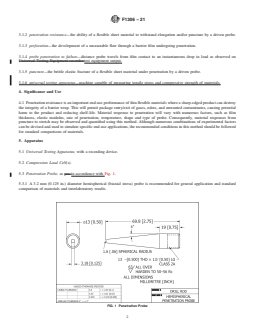
5.3 Penetration Probe, as in accordance with Fig. 1.
8.1 The number of samples tested should be adequate to be
5.3.1 A 3.2 mm (0.125 in.) diameter hemispherical (biaxial
predictive of performance and relative to the purpose of the
stress) probe is recommended for general application and
test. Caution should be taken when eliminating samples with
standard comparison of materials and interlaboratory results.
defects as this can bias results. See ASQ/ANSI Z1.9 for
guidanceonsamplingplansandpracticestoestablishrationale.
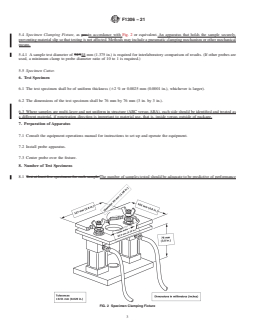
5.4 Specimen Clamping Fixture, as in accordance with Fig.
2 or equivalent. An apparatus that holds the sample securely,
9. Conditioning
preventing material slip so that testing is not affected. Methods
9.1 Condition the test specimens at 23 6 2°C (73.4 6
may include a pneumatic clamping mechanism or other me-
3.6°F) and 50 6 5 % relative humidity for not less than 40 h
chanical means.
prior to test in accordance with Procedure A of Practice D618
5.4.1 A sample test diameter of 35 mm (1.375 in.) is
for those tests where conditioning is required.
required for interlaboratory comparison of results. (If other
probes are used, a minimum clamp to probe diameter ratio of
9.2 Conduct tests in the standard laboratory atmosphere of
10 to 1 is required.)
23 6 2°C (73.4 6 3.6°F) and 50 6 5 % relative humidity
unless otherwise specified in this test method.
5.5 Specimen Cutter.
10. Procedure
6. Test Specimen
10.1 Test equipment should be calibrated and within the
6.1 The test specimen shall be of uniform thickness (62%
calibration interval
or 0.0025 mm (0.0001 in.), whichever is larger).
10.2 Equipment load range should be such that specimen
6.2 The dimensions of the test specimen shall be 76 mm by
puncture occurs within 20 to 80 % of the same.
76 mm (3 in. by 3 in.).
10.3 Using the specimen cutter, cut each sample material
6.3 Where samples are multi-layer and not uniform in
into a 76 mm (3 in.) by 76 mm (3 in.) piece.
structure (ABC versus ABA), each side should be identified
10.4 Measure the caliper (average of 3 readings) in the
and treated as a different material, if penetration direction is
center of a film specimen. Refer to Test Method F2251.
important to material use, that is, inside versus outside of
package.
10.5 Adjust the universal tester cross head speed to 25
mm/min (1.0 in./min). Select a data acquisition rate to give a
7. Preparation of Apparatus
minimum resolution of 0.1 mm/point of penetration. (For chart
7.1 Consult the equipment operations manual for instruc- recorders, set chart recording speed to 500 mm/min (20
tions to set up and operate the equipment. in./min), if applicable.)
FIG. 1 Penetration Probe
F1306 − 21
FIG. 2 Specimen Clamping Fixture
NOTE 1—In case of laminate materials, multiple drops in load may be
10.6 Clamp the film specimen in the holder, place sample
observed as discrete layers fail. Under this condition, the last instanta-
holder directly under crosshead probe, center and lower it as
neous drop to near zero would be considered a failure.
close as possible to the film specimen without making contact.
10.9 Record specimen identification, force (peak) to break,
10.7 Set the appropriate stops and returns on the tester.
energy (work) to break, and probe penetration (at first break)
Reset data collection devices to zero, if applicable.
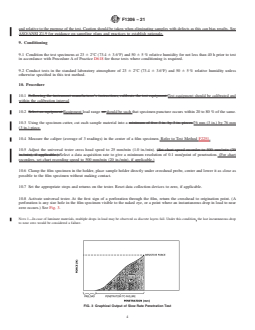
from mechanical testing software output (Fig. 3). (If using
10.8 Activate universal tester. At the first sign of a perfora-
chart recording instruments, record specimen identification on
tion through the film, return the crosshead to origination point.
chart and integrator reading if used.)
(A perforation is any size hole in the film specimen visible to
10.10 Repeat test sequence (10.1 to 10.9) for the remaining
the naked eye, or a point where an instantaneous drop in load
samples.
to near zero occurs.) See Fig. 3.
11. Calculation
11.1 Compute the values of peak force, probe penetration to
break, and energy to break.
11.1.1 Software computed values are acceptable.
11.2 Use the following formulas for calculating the required
values for data acquisition with a time based chart recorder.
11.2.1 Force to Break—Peak force to achieve break (New-
tons). Testers with digital outputs most often hold peak force
measurement data for use in characterizing the material
sample. In the case of devices with paper recorders, the peak
force may need to be calculated based on the full scale of the
loadcellrelativetothemovementofthechartduringtestcycle
as shown below:
D
N 5 R 3L or 3L (1)
FIG. 3 Graphical Output of Slow Rate Penetration Test W
F1306 − 21
TABLE 1 Puncture Force (6 Laboratories)
Values expressed in units of Newtons
Material
Material
Orientation
Average S S rR
r R
BW 010 Inside 6.63 0
...
This document is not an ASTM standard and is intended only to provide the user of an ASTM standard an indication of what changes have been made to the previous version. Because
it may not be technically possible to adequately depict all changes accurately, ASTM recommends that users consult prior editions as appropriate. In all cases only the current version
of the standard as published by ASTM is to be considered the official document.
Designation: F1306 − 16 F1306 − 21
Standard Test Method for
Slow Rate Penetration Resistance of Flexible Barrier Films
and Laminates
This standard is issued under the fixed designation F1306; the number immediately following the designation indicates the year of
original adoption or, in the case of revision, the year of last revision. A number in parentheses indicates the year of last reapproval. A
superscript epsilon (´) indicates an editorial change since the last revision or reapproval.
1. Scope
1.1 This test method permits flexible barrier films and laminates to be characterized for slow rate penetration resistance to a driven
probe. The test is performed at room temperature, by applying a biaxial stress at a single test velocity on the material until
perforation occurs. The force, energy, and elongation probe penetration to perforationfailure are determined.
1.2 The values stated in SI units are to be regarded as standard. The values given in parentheses are mathematical conversions to
inch-pound units that after SI units are provided for information only and are not considered standard.
1.3 This standard does not purport to address all of the safety concerns, if any, associated with its use. It is the responsibility
of the user of this standard to establish appropriate safety safety, health, and healthenvironmental practices and determine the
applicability of regulatory limitations prior to use.
1.4 This international standard was developed in accordance with internationally recognized principles on standardization
established in the Decision on Principles for the Development of International Standards, Guides and Recommendations issued
by the World Trade Organization Technical Barriers to Trade (TBT) Committee.
2. Referenced Documents
2.1 ASTM Standards:
D374 Test Methods for Thickness of Solid Electrical Insulation (Metric) D0374_D0374M
D618 Practice for Conditioning Plastics for Testing
D638 Test Method for Tensile Properties of Plastics
E691 Practice for Conducting an Interlaboratory Study to Determine the Precision of a Test Method
F2251 Test Method for Thickness Measurement of Flexible Packaging Material
2.2 ASQ Standards:
ASQ/ANSI Z1.9 Sampling Procedures and Tables for Inspection by Variables for Percent Nonconforming
3. Terminology
3.1 Definitions of Terms Specific to This Standard:
3.1.1 elongation (stretch)—the elastic/plastic deformation of flexible sheet material under penetration by a driven probe.
This test method is under the jurisdiction of ASTM Committee F02 on Primary Barrier Packaging and is the direct responsibility of Subcommittee F02.20 on Physical
Properties.
Current edition approved March 1, 2016Jan. 15, 2021. Published April 2016February 2021. Originally approved in 1990. Last previous edition approved in 20082016 as
ɛ1
F1306 – 90F1306 – 16.(2008) . DOI: 10.1520/F1306-16.10.1520/F1306-21.
For referenced ASTM standards, visit the ASTM website, www.astm.org, or contact ASTM Customer Service at service@astm.org. For Annual Book of ASTM Standards
volume information, refer to the standard’sstandard’s Document Summary page on the ASTM website.
Available from American Society for Quality (ASQ), 600 N. Plankinton Ave., Milwaukee, WI 53203, http://www.asq.org.
Copyright © ASTM International, 100 Barr Harbor Drive, PO Box C700, West Conshohocken, PA 19428-2959. United States
F1306 − 21
3.1.2 penetration resistance—the ability of a flexible sheet material to withstand elongation and/or puncture by a driven probe.
3.1.3 perforation—the development of a measurable flaw through a barrier film undergoing penetration.
3.1.4 probe penetration to failure—distance probe travels from film contact to an instantaneous drop in load as observed on
Universal Testing Equipment recorder.test equipment output.
3.1.5 puncture—the brittle elastic fracture of a flexible sheet material under penetration by a driven probe.
3.1.6 universal testing apparatus—machine capable of measuring tensile stress and compressive strength of materials.
4. Significance and Use
4.1 Penetration resistance is an important end-use performance of thin flexible materials where a sharp-edged product can destroy
the integrity of a barrier wrap. This will permit package entry/exit of gases, odors, and unwanted contaminates, causing potential
harm to the product and reducing shelf-life. Material response to penetration will vary with numerous factors, such as film
thickness, elastic modulus, rate of penetration, temperature, shape and type of probe. Consequently, material responses from
puncture to stretch may be observed and quantified using this method. Although numerous combinations of experimental factors
can be devised and used to simulate specific end-use applications, the recommended conditions in this method should be followed
for standard comparisons of materials.
5. Apparatus
5.1 Universal Testing Apparatus, with a recording device.
5.2 Compression Load Cell(s).
5.3 Penetration Probe, as per in accordance with Fig. 1.
5.3.1 A 3.2 mm (0.125 in.) diameter hemispherical (biaxial stress) probe is recommended for general application and standard
comparison of materials and interlaboratory results.
FIG. 1 Penetration Probe
F1306 − 21
5.4 Specimen Clamping Fixture, as per in accordance with Fig. 2 or equivalent. An apparatus that holds the sample securely,
preventing material slip so that testing is not affected. Methods may include a pneumatic clamping mechanism or other mechanical
means.
5.4.1 A sample test diameter of 34.935 mm (1.375 in.) is required for interlaboratory comparison of results. (If other probes are
used, a minimum clamp to probe diameter ratio of 10 to 1 is required.)
5.5 Specimen Cutter.
6. Test Specimen
6.1 The test specimen shall be of uniform thickness (62 % or 0.0025 mm (0.0001 in.), whichever is larger).
6.2 The dimensions of the test specimen shall be 76 mm by 76 mm (3 in. by 3 in.).
6.3 Where samples are multi-layer and not uniform in structure (ABC versus ABA), each side should be identified and treated as
a different material, if penetration direction is important to material use, that is, inside versus outside of package.
7. Preparation of Apparatus
7.1 Consult the equipment operations manual for instructions to set up and operate the equipment.
7.2 Install probe apparatus.
7.3 Center probe over the fixture.
8. Number of Test Specimens
8.1 Test at least five specimens for each sample.The number of samples tested should be adequate to be predictive of performance
FIG. 2 Specimen Clamping Fixture
F1306 − 21
and relative to the purpose of the test. Caution should be taken when eliminating samples with defects as this can bias results. See
ASQ/ANSI Z1.9 for guidance on sampling plans and practices to establish rationale.
9. Conditioning
9.1 Condition the test specimens at 23 6 2°C (73.4 6 3.6°F) and 50 6 5 % relative humidity for not less than 40 h prior to test
in accordance with Procedure A of Practice D618 for those tests where conditioning is required.
9.2 Conduct tests in the standard laboratory atmosphere of 23 6 2°C (73.4 6 3.6°F) and 50 6 5 % relative humidity unless
otherwise specified in this test method.
10. Procedure
10.1 Following the instrument manufacturer’s instructions, calibrate the test equipment.Test equipment should be calibrated and
within the calibration interval
10.2 Select an equipment Equipment load range so should be such that specimen puncture occurs within 20 to 80 % of the same.
10.3 Using the specimen cutter, cut each sample material into a minimum of five 3 in. by 3 in. pieces.76 mm (3 in.) by 76 mm
(3 in.) piece.
10.4 Measure the caliper (average of 3 readings) in the center of a film specimen. Refer to Test Method F2251.
10.5 Adjust the universal tester cross head speed to 25 mm/min (1.0 in./min). (Set chart speed recorder to 500 mm/min (20
in./min), if applicable.) Select a data acquisition rate to give a minimum resolution of 0.1 mm/point of penetration. (For chart
recorders, set chart recording speed to 500 mm/min (20 in./min), if applicable.)
10.6 Clamp the film specimen in the holder, place sample holder directly under crosshead probe, center and lower it as close as
possible to the film specimen without making contact.
10.7 Set the appropriate stops and returns on the tester. Reset data collection devices to zero, if applicable.
10.8 Activate universal tester. At the first sign of a perforation through the film, return the crosshead to origination point. (A
perforation is any size hole in the film specimen visible to the naked eye, or a point where an instantaneous drop in load to near
zero occurs.) See Fig. 3.
NOTE 1—In case of laminate materials, multiple drops in load may be observed as discrete layers fail. Under this condition, the last instantaneous drop
to near zero would be considered a failure.
FIG. 3 Graphical Output of Slow Rate Penetration Test
F1306 − 21
10.9 Record specimen identification, force (peak) to break, energy (work) to break, and probe penetration (at first break) from
mechanical testing software output (Fig. 3). (If using chart recording instruments, record specimen identification on chart and
integrator reading if used.)
10.10 Repeat test sequence (10.1 to 10.9) for the remaining samples.
11. Calculation
11.1 Compute the values of peak force, probe penetration to break, and energy to break.
11.1.1 Software computed values are acceptable.
11.2 Use the following formulas for calculating the required values for data acquisition with a time based chart recorder.
11.2.1 Force to Break—Peak force to achieve break (Newtons): (Newtons). Testers with digital outputs most often hold peak force
measurement data for use in characterizing the material sample. In the case of devices with paper recorders, the peak force may
need to be calculated based on the full scale of the load cell relative to the movement of the chart during test c
...
Questions, Comments and Discussion
Ask us and Technical Secretary will try to provide an answer. You can facilitate discussion about the standard in here.
Loading comments...