

ASTM F914/F914M-20
(Test Method)Standard Test Method for Acoustic Emission for Aerial Personnel Devices Without Supplemental Load Handling Attachments
General Information
- Abstract
SIGNIFICANCE AND USE
5.1 This test method provides a means of evaluating acoustic emissions generated by the rapid release of energy from localized sources within an aerial personnel device under controlled loading. The resultant energy releases occur during intentional application of a controlled predetermined load. These energy releases can be monitored and interpreted by qualified individuals.
5.2 This test method permits testing of the major components of an aerial personnel device under controlled loading. This test method utilizes objective criteria for evaluation and may be discontinued at any time to investigate a particular area of concern or prevent a fault from continuing to ultimate failure.
5.3 This test method provides a means of detecting acoustic emission sources that may be defects or irregularities, or both, affecting the structural integrity or intended use of the aerial personnel device.
5.4 Sources of acoustic emission found with this test method shall be evaluated by either more refined acoustic emission test methods or other nondestructive techniques (visual, liquid penetrant, radiography, ultrasonics, magnetic particle, etc.). Other nondestructive tests may be required to locate defects present in aerial personnel devices.
5.5 Defective areas found in aerial personnel devices by this test method should be repaired and retested as appropriate. Repair procedure recommendations are outside the scope of this test method.
SCOPE
1.1 This test method describes a procedure for non-destructive testing using acoustic emission (AE) testing for aerial personnel devices, which do not have a supplemental load handling attachment.
1.1.1 Equipment Covered—This test method covers the following types of vehicle-mounted insulated aerial personnel devices:
1.1.1.1 Extensible boom aerial personnel devices,
1.1.1.2 Articulating boom aerial personnel devices, and
1.1.1.3 Any combination of 1.1.1.1 and 1.1.1.2.
1.1.2 Equipment Not Covered—This test method does not cover any of the following equipment:
1.1.2.1 Material-handling aerial devices,
1.1.2.2 Digger-derricks with platform, and
1.1.2.3 Cranes with platform.
1.2 The AE test method is used to detect and area-locate emission sources. Verification of emission sources may require the use of other nondestructive test (NDT) methods, such as radiography, ultrasonics, magnetic particle, liquid penetrant, and visual inspection. Warning—This test method requires that external loads be applied to the superstructure of the vehicle under test. During the test, caution must be taken to safeguard personnel and equipment against unexpected failure or instability of the vehicle or components.
Note 1: This test method is not intended to be a stand alone NDT method for the verification of the structural integrity of an aerial device. Other NDT methods should be used to supplement the results.
1.3 The values stated in either SI units or inch-pound units are to be regarded separately as standard. The values stated in each system are not necessarily exact equivalents; therefore, to ensure conformance with the standard, each system shall be used independently of the other, and values from the two systems shall not be combined.
1.4 This standard does not purport to address all of the safety concerns, if any, associated with its use. It is the responsibility of the user of this standard to establish appropriate safety, health, and environmental practices and determine the applicability of regulatory limitations prior to use.
1.5 This international standard was developed in accordance with internationally recognized principles on standardization established in the Decision on Principles for the Development of International Standards, Guides and Recommendations issued by the World Trade Organization Technical Barriers to Trade (TBT) Committee.
- Status
- Published
- Publication Date
- 31-Jul-2020
- Technical Committee
- F18 - Electrical Protective Equipment for Workers
- Drafting Committee
- F18.55 - Inspection and Non-Destructive Test Methods for Aerial Devices
Buy Documents
ASTM F914/F914M-20 - Standard Test Method for Acoustic Emission for Aerial Personnel Devices Without Supplemental Load Handling Attachments
REDLINE ASTM F914/F914M-20 - Standard Test Method for Acoustic Emission for Aerial Personnel Devices Without Supplemental Load Handling Attachments
Overview
ASTM F914/F914M-20: Standard Test Method for Acoustic Emission for Aerial Personnel Devices Without Supplemental Load Handling Attachments specifies a non-destructive testing (NDT) procedure using acoustic emission (AE) technology. This method is designed to evaluate the structural integrity of aerial personnel devices-such as extensible boom and articulating boom types-mounted on vehicles, in cases where these devices do not include supplemental load handling attachments.
Acoustic emission testing enables early detection of defects or irregularities by identifying the rapid release of energy from localized sources within the aerial device during controlled loading. By continuously monitoring acoustic emissions, safety-critical defects can be located, investigated, and addressed without causing damage to the equipment.
Key Topics
1. Scope and Applicability
- Applies specifically to insulated, vehicle-mounted aerial personnel devices (extensible boom, articulating boom, or their combination) without supplemental load handling attachments.
- Material-handling aerial devices, digger-derricks with platforms, and cranes with platforms are not covered.
2. Purpose of Acoustic Emission Testing
- Detects potential defects such as cracking, de-lamination, fiber breakage, or other structural issues in both metal and fiberglass reinforced plastic (FRP) components.
- Provides an objective, real-time monitoring technique under controlled payloads.
3. Test Method Significance
- Evaluates the safety and integrity of major aerial device components without destructive procedures.
- Allows for immediate cessation and targeted investigation if concerning acoustic activity is detected.
4. Procedural Highlights
- Involves repeated application of a predetermined load (typically twice the rated platform capacity).
- Qualified personnel must interpret AE data, supplemented as needed with additional NDT methods, such as ultrasonics, radiography, magnetic particle testing, or liquid penetrant inspection.
- Requires appropriate documentation and adherence to safety protocols.
Applications
Practical Value in Industry
- Maintenance and Safety Compliance: Ensures ongoing structural integrity of aerial personnel devices used in applications such as utilities, telecommunications, and construction, helping to prevent unexpected failures.
- Defect Detection: Facilitates early identification of hidden or developing defects, allowing for timely repairs and retesting, thus extending equipment life and reducing downtime.
- Regulatory and Audit Support: Provides standardized test results that can help organizations demonstrate adherence to industry safety regulations and best practices.
- Supplementary Assessment: When AE sources indicate possible issues, results can direct further investigation through more targeted NDT methods.
Related Standards
Organizations employing ASTM F914/F914M-20 often reference these associated standards for a complete NDT strategy:
- ASTM E94 - Guide for Radiographic Examination Using Industrial Radiographic Film
- ASTM E114 / E164 - Practices for Ultrasonic Testing
- ASTM E569 - Practice for Acoustic Emission Monitoring of Structures During Controlled Stimulation
- ASTM E1417/E1417M - Practice for Liquid Penetrant Testing
- ASTM E1444/E1444M - Practice for Magnetic Particle Testing
- F2174 - Practice for Verifying Acoustic Emission Sensor Response
- ANSI A92.2 - Standard for Vehicle-Mounted Elevating and Rotating Aerial Devices
- ASNT SNT-TC-1A - Recommended Practice for Training and Certification of NDT Personnel
By integrating ASTM F914/F914M-20 with these related standards, organizations can build a comprehensive, reliable framework for inspecting and maintaining aerial personnel devices, ensuring workplace safety and equipment reliability.
Keywords: ASTM F914/F914M-20, acoustic emission testing, aerial personnel device inspection, non-destructive testing, structural integrity, extensible boom, articulating boom, NDT standards, safety compliance, equipment maintenance
Relations
- Effective Date
- 01-Aug-2020
- Effective Date
- 01-Jun-2020
- Effective Date
- 01-Jun-2016
- Effective Date
- 01-Dec-2015
- Effective Date
- 01-Apr-2015
- Effective Date
- 01-Jun-2013
- Effective Date
- 15-Oct-2012
- Effective Date
- 15-Aug-2011
- Effective Date
- 15-Aug-2011
- Effective Date
- 01-Aug-2011
- Effective Date
- 15-Jun-2010
- Effective Date
- 01-Jun-2010
- Effective Date
- 01-Jan-2010
- Effective Date
- 01-Oct-2008
- Effective Date
- 01-Jul-2008
Buy Documents
ASTM F914/F914M-20 - Standard Test Method for Acoustic Emission for Aerial Personnel Devices Without Supplemental Load Handling Attachments
REDLINE ASTM F914/F914M-20 - Standard Test Method for Acoustic Emission for Aerial Personnel Devices Without Supplemental Load Handling Attachments
Get Certified
Connect with accredited certification bodies for this standard

BSMI (Bureau of Standards, Metrology and Inspection)
Taiwan's standards and inspection authority.
Sponsored listings
Frequently Asked Questions
ASTM F914/F914M-20 is a standard published by ASTM International. Its full title is "Standard Test Method for Acoustic Emission for Aerial Personnel Devices Without Supplemental Load Handling Attachments". This standard covers: SIGNIFICANCE AND USE 5.1 This test method provides a means of evaluating acoustic emissions generated by the rapid release of energy from localized sources within an aerial personnel device under controlled loading. The resultant energy releases occur during intentional application of a controlled predetermined load. These energy releases can be monitored and interpreted by qualified individuals. 5.2 This test method permits testing of the major components of an aerial personnel device under controlled loading. This test method utilizes objective criteria for evaluation and may be discontinued at any time to investigate a particular area of concern or prevent a fault from continuing to ultimate failure. 5.3 This test method provides a means of detecting acoustic emission sources that may be defects or irregularities, or both, affecting the structural integrity or intended use of the aerial personnel device. 5.4 Sources of acoustic emission found with this test method shall be evaluated by either more refined acoustic emission test methods or other nondestructive techniques (visual, liquid penetrant, radiography, ultrasonics, magnetic particle, etc.). Other nondestructive tests may be required to locate defects present in aerial personnel devices. 5.5 Defective areas found in aerial personnel devices by this test method should be repaired and retested as appropriate. Repair procedure recommendations are outside the scope of this test method. SCOPE 1.1 This test method describes a procedure for non-destructive testing using acoustic emission (AE) testing for aerial personnel devices, which do not have a supplemental load handling attachment. 1.1.1 Equipment Covered—This test method covers the following types of vehicle-mounted insulated aerial personnel devices: 1.1.1.1 Extensible boom aerial personnel devices, 1.1.1.2 Articulating boom aerial personnel devices, and 1.1.1.3 Any combination of 1.1.1.1 and 1.1.1.2. 1.1.2 Equipment Not Covered—This test method does not cover any of the following equipment: 1.1.2.1 Material-handling aerial devices, 1.1.2.2 Digger-derricks with platform, and 1.1.2.3 Cranes with platform. 1.2 The AE test method is used to detect and area-locate emission sources. Verification of emission sources may require the use of other nondestructive test (NDT) methods, such as radiography, ultrasonics, magnetic particle, liquid penetrant, and visual inspection. Warning—This test method requires that external loads be applied to the superstructure of the vehicle under test. During the test, caution must be taken to safeguard personnel and equipment against unexpected failure or instability of the vehicle or components. Note 1: This test method is not intended to be a stand alone NDT method for the verification of the structural integrity of an aerial device. Other NDT methods should be used to supplement the results. 1.3 The values stated in either SI units or inch-pound units are to be regarded separately as standard. The values stated in each system are not necessarily exact equivalents; therefore, to ensure conformance with the standard, each system shall be used independently of the other, and values from the two systems shall not be combined. 1.4 This standard does not purport to address all of the safety concerns, if any, associated with its use. It is the responsibility of the user of this standard to establish appropriate safety, health, and environmental practices and determine the applicability of regulatory limitations prior to use. 1.5 This international standard was developed in accordance with internationally recognized principles on standardization established in the Decision on Principles for the Development of International Standards, Guides and Recommendations issued by the World Trade Organization Technical Barriers to Trade (TBT) Committee.
SIGNIFICANCE AND USE 5.1 This test method provides a means of evaluating acoustic emissions generated by the rapid release of energy from localized sources within an aerial personnel device under controlled loading. The resultant energy releases occur during intentional application of a controlled predetermined load. These energy releases can be monitored and interpreted by qualified individuals. 5.2 This test method permits testing of the major components of an aerial personnel device under controlled loading. This test method utilizes objective criteria for evaluation and may be discontinued at any time to investigate a particular area of concern or prevent a fault from continuing to ultimate failure. 5.3 This test method provides a means of detecting acoustic emission sources that may be defects or irregularities, or both, affecting the structural integrity or intended use of the aerial personnel device. 5.4 Sources of acoustic emission found with this test method shall be evaluated by either more refined acoustic emission test methods or other nondestructive techniques (visual, liquid penetrant, radiography, ultrasonics, magnetic particle, etc.). Other nondestructive tests may be required to locate defects present in aerial personnel devices. 5.5 Defective areas found in aerial personnel devices by this test method should be repaired and retested as appropriate. Repair procedure recommendations are outside the scope of this test method. SCOPE 1.1 This test method describes a procedure for non-destructive testing using acoustic emission (AE) testing for aerial personnel devices, which do not have a supplemental load handling attachment. 1.1.1 Equipment Covered—This test method covers the following types of vehicle-mounted insulated aerial personnel devices: 1.1.1.1 Extensible boom aerial personnel devices, 1.1.1.2 Articulating boom aerial personnel devices, and 1.1.1.3 Any combination of 1.1.1.1 and 1.1.1.2. 1.1.2 Equipment Not Covered—This test method does not cover any of the following equipment: 1.1.2.1 Material-handling aerial devices, 1.1.2.2 Digger-derricks with platform, and 1.1.2.3 Cranes with platform. 1.2 The AE test method is used to detect and area-locate emission sources. Verification of emission sources may require the use of other nondestructive test (NDT) methods, such as radiography, ultrasonics, magnetic particle, liquid penetrant, and visual inspection. Warning—This test method requires that external loads be applied to the superstructure of the vehicle under test. During the test, caution must be taken to safeguard personnel and equipment against unexpected failure or instability of the vehicle or components. Note 1: This test method is not intended to be a stand alone NDT method for the verification of the structural integrity of an aerial device. Other NDT methods should be used to supplement the results. 1.3 The values stated in either SI units or inch-pound units are to be regarded separately as standard. The values stated in each system are not necessarily exact equivalents; therefore, to ensure conformance with the standard, each system shall be used independently of the other, and values from the two systems shall not be combined. 1.4 This standard does not purport to address all of the safety concerns, if any, associated with its use. It is the responsibility of the user of this standard to establish appropriate safety, health, and environmental practices and determine the applicability of regulatory limitations prior to use. 1.5 This international standard was developed in accordance with internationally recognized principles on standardization established in the Decision on Principles for the Development of International Standards, Guides and Recommendations issued by the World Trade Organization Technical Barriers to Trade (TBT) Committee.
ASTM F914/F914M-20 is classified under the following ICS (International Classification for Standards) categories: 17.140.20 - Noise emitted by machines and equipment; 53.020.99 - Other lifting equipment. The ICS classification helps identify the subject area and facilitates finding related standards.
ASTM F914/F914M-20 has the following relationships with other standards: It is inter standard links to ASTM F914/F914M-18, ASTM E750-15(2020), ASTM E1444/E1444M-16, ASTM E750-15, ASTM F2174-02(2015), ASTM E1417/E1417M-13, ASTM E1444/E1444M-12, ASTM E1417/E1417M-11e1, ASTM E1417/E1417M-11, ASTM E1444/E1444M-11, ASTM E114-10, ASTM E976-10, ASTM E750-10, ASTM F2174-02(2008), ASTM E164-08. Understanding these relationships helps ensure you are using the most current and applicable version of the standard.
ASTM F914/F914M-20 is available in PDF format for immediate download after purchase. The document can be added to your cart and obtained through the secure checkout process. Digital delivery ensures instant access to the complete standard document.
Standards Content (Sample)
This international standard was developed in accordance with internationally recognized principles on standardization established in the Decision on Principles for the
Development of International Standards, Guides and Recommendations issued by the World Trade Organization Technical Barriers to Trade (TBT) Committee.
Designation: F914/F914M − 20
Standard Test Method for
Acoustic Emission for Aerial Personnel Devices Without
Supplemental Load Handling Attachments
This standard is issued under the fixed designation F914/F914M; the number immediately following the designation indicates the year
of original adoption or, in the case of revision, the year of last revision.Anumber in parentheses indicates the year of last reapproval.
A superscript epsilon (´) indicates an editorial change since the last revision or reapproval.
1. Scope used independently of the other, and values from the two
systems shall not be combined.
1.1 This test method describes a procedure for non-
1.4 This standard does not purport to address all of the
destructive testing using acoustic emission (AE) testing for
safety concerns, if any, associated with its use. It is the
aerial personnel devices, which do not have a supplemental
responsibility of the user of this standard to establish appro-
load handling attachment.
priate safety, health, and environmental practices and deter-
1.1.1 Equipment Covered—This test method covers the
mine the applicability of regulatory limitations prior to use.
following types of vehicle-mounted insulated aerial personnel
1.5 This international standard was developed in accor-
devices:
dance with internationally recognized principles on standard-
1.1.1.1 Extensible boom aerial personnel devices,
ization established in the Decision on Principles for the
1.1.1.2 Articulating boom aerial personnel devices, and
Development of International Standards, Guides and Recom-
1.1.1.3 Any combination of 1.1.1.1 and 1.1.1.2.
mendations issued by the World Trade Organization Technical
1.1.2 Equipment Not Covered—This test method does not
Barriers to Trade (TBT) Committee.
cover any of the following equipment:
1.1.2.1 Material-handling aerial devices,
2. Referenced Documents
1.1.2.2 Digger-derricks with platform, and
1.1.2.3 Cranes with platform.
2.1 ASTM Standards:
E94Guide for Radiographic Examination Using Industrial
1.2 The AE test method is used to detect and area-locate
Radiographic Film
emissionsources.Verificationofemissionsourcesmayrequire
E114Practice for Ultrasonic Pulse-Echo Straight-Beam
the use of other nondestructive test (NDT) methods, such as
Contact Testing
radiography, ultrasonics, magnetic particle, liquid penetrant,
E164Practice for Contact Ultrasonic Testing of Weldments
and visual inspection. Warning—This test method requires
E569Practice for Acoustic Emission Monitoring of Struc-
that external loads be applied to the superstructure of the
tures During Controlled Stimulation
vehicle under test. During the test, caution must be taken to
E610Terminology Relating to Acoustic Emission (With-
safeguard personnel and equipment against unexpected failure
drawn 1991)
or instability of the vehicle or components.
E650Guide for Mounting Piezoelectric Acoustic Emission
NOTE 1—This test method is not intended to be a stand alone NDT
method for the verification of the structural integrity of an aerial device.
Sensors
Other NDT methods should be used to supplement the results.
E750Practice for Characterizing Acoustic Emission Instru-
1.3 The values stated in either SI units or inch-pound units mentation
are to be regarded separately as standard. The values stated in E976GuideforDeterminingtheReproducibilityofAcoustic
eachsystemarenotnecessarilyexactequivalents;therefore,to Emission Sensor Response
ensure conformance with the standard, each system shall be E1417/E1417MPractice for Liquid Penetrant Testing
E1444/E1444MPractice for Magnetic Particle Testing
This test method is under the jurisdiction of ASTM Committee F18 on
Electrical Protective Equipment for Workers and is the direct responsibility of For referenced ASTM standards, visit the ASTM website, www.astm.org, or
Subcommittee F18.55 on Inspection and Non-Destructive Test Methods for Aerial contact ASTM Customer Service at service@astm.org. For Annual Book of ASTM
Devices. Standards volume information, refer to the standard’s Document Summary page on
Current edition approved Aug. 1, 2020. Published September 2020. Originally the ASTM website.
approved in 1985. Last previous edition approved in 2018 as F914/F914M–18. Withdrawn. The last approved version of this historical standard is referenced
DOI: 10.1520/F0914_F0914M-20. on www.astm.org.
Copyright © ASTM International, 100 Barr Harbor Drive, PO Box C700, West Conshohocken, PA 19428-2959. United States
F914/F914M − 20
F2174Practice for Verifying Acoustic Emission Sensor Re-
Acoustic Emission Reference Scale
Voltage at Voltage at Integral Preamp
sponse
dB Value Sensor Output Sensor Output (40 dB gain)
2.2 ANSI Standard: 0 1 µV 100 µV
20 10 µV 1 mV
ANSI A92.2Standard for Vehicle-Mounted Elevating and
40 100 µV 10 mV
Rotating Aerial Devices
60 1 mV 100 mV
80 10 mV 1 V
2.3 ASNT Standard:
100 100 mV 10 V
ASNTRecommended Practice SNT-TC-1A
3.1.11 event (acoustic emission event).—a local material
change giving rise to acoustic emission.
3. Terminology
3.1.12 event count (Ne)—the number obtained by counting
3.1 Definitions:
each discerned acoustic emission event once.
3.1.1 acoustic emission (AE)—the class of phenomena
3.1.13 extensible-boom aerial device—an aerial device, ex-
whereby elastic waves are generated by the rapid release of
cept the aerial ladder type, with a telescopic or extensible
energy from a localized source or sources within a material, or
boom.
thetransientelasticwave(s)sogenerated.Acousticemissionis
the recommended term for general use. Other terms that have
3.1.14 first-hit—a mode of operation of AE monitoring
been used in AE literature include stress wave emission,
equipment in which an event occurring on one channel will
microseismic activity, and emission or acoustic emission with
prevent all other channels from processing data for a specified
other qualifying modifiers.
period of time. The channel with a sensor closest to the
physical location of the emission source will then be the only
3.1.2 aerial personnel device—any device extensible,
channel processing data from that source.
articulating, or both, that is designed to position personnel.
3.1.15 insulated aerial device—an aerial device designed
3.1.3 amplitude (acoustic emission signal amplitude)—the
peak voltage of the largest excursion attained by the signal with dielectric components to meet a specific electrical insu-
lation rating.
wave form from an emission event.
3.1.16 insulator—any part of an aerial device such as, but
3.1.4 amplitude distribution—a display of the number of
acoustic emission events with signals that exceed an arbitrary not limited to, the upper boom, lower boom or supporting
structure, made of a material having a high dielectric strength,
amplitude as a function of amplitude.
usually FRP or the equivalent.
3.1.5 articulating-boom aerial device—an aerial device
with two or more hinged boom sections. 3.1.17 noise—any undesired signal that tends to interfere
with the normal reception or processing of the desired signal.
3.1.6 attenuation—loss of energy per unit distance.
3.1.18 non-destructive testing—the examination by various
3.1.7 channel—an input to the main AE instrument that
means of devices and their components without alteration of
accepts a preamplifier output.
the original components, so that they may function as before.
3.1.8 commoned—two or more sensors interconnected such
3.1.19 non-overcenter—the feature of an aerial device
that the sensor outputs are electronically processed by a single
where the upper boom cannot travel past vertical orientation
channel without differentiation of sensor origin. (Synonym
with respect to the ground.
“teed”.)
3.1.20 overcenter—the feature of an aerial device where the
3.1.9 count (acoustic emission count), n—the number of
upper boom travels past vertical orientation with respect to the
times the acoustic emission signal amplitude exceeds a preset
ground.
threshold during any selected portion of a test.
3.1.21 qualified personnel—personnel who, by possession
3.1.10 decibel (dB)—logarithmic expression of a ratio of
of a recognized degree, certificate, professional standing, or
two single peak amplitudes. A reference scale expresses the
skill, and who, by knowledge, training, and experience, have
logarithmicratioofasinglepeakamplitudetoafixedreference
demonstrated the ability to deal with problems relating to the
amplitude.
subject matter, the work, or the project.
Signalpeakamplitude ~dB! 520log ~A /A !
10 1 0
3.1.22 signal (emission signal)—a signal obtained by detec-
where:
tion of one or more acoustic emission events.
A = I µV at the sensor output (before amplification), and
3.1.23 For definitions of other terms in this test method,
A = peak voltage of the measured acoustic emission signal.
refer to Terminology E610.
3.2 Definitions of Terms Specific to This Standard(seeFigs.
1 and 2):
3.2.1 elbow—thestructureconnectingtheupperboomtothe
lower boom, about which one articulates relative to the other.
Available fromAmerican National Standards Institute (ANSI), 25 W. 43rd St.,
4th Floor, New York, NY 10036, http://www.ansi.org.
3.2.2 elbow pin—the horizontal pin about which the upper
AvailablefromAmericanSocietyforNondestructiveTesting(ASNT),P.O.Box
28518, 1711 Arlingate Ln., Columbus, OH 43228-0518, http://www.asnt.org. boom rotates relative to the lower boom.
F914/F914M − 20
FIG. 1 Articulating Aerial Device Nomenclature Diagram
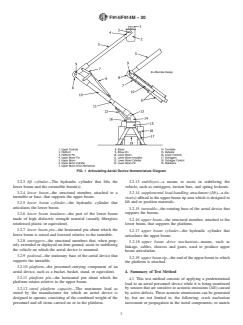
3.2.3 lift cylinder—The hydraulic cylinder that lifts the 3.2.13 stabilizers—a means to assist in stabilizing the
lower boom and the extensible boom(s). vehicle, such as outriggers, torsion bars, and spring lockouts.
3.2.4 lower boom—the structural member, attached to a
3.2.14 supplemental load-handling attachment (Jib)—a de-
turntable or base, that supports the upper boom. vice(s) affixed to the upper-boom tip area which is designed to
lift and or position materials.
3.2.5 lower boom cylinder—the hydraulic cylinder that
articulates the lower boom.
3.2.15 turntable—the rotating base of the aerial device that
supports the booms.
3.2.6 lower boom insulator—the part of the lower boom
made of high dielectric strength material (usually fiberglass
3.2.16 upper boom—the structural member, attached to the
reinforced plastic or equivalent).
lower boom, that supports the platform.
3.2.7 lower boom pin—the horizontal pin about which the
3.2.17 upper boom cylinder—the hydraulic cylinder that
lower boom is raised and lowered relative to the turntable.
articulates the upper boom.
3.2.8 outriggers—the structural members that, when prop-
3.2.18 upper boom drive mechanism—means, such as
erly extended or deployed on firm ground, assist in stabilizing
linkage, cables, sheaves and gears, used to produce upper
the vehicle on which the aerial device is mounted.
boom articulation.
3.2.9 pedestal—the stationary base of the aerial device that
3.2.19 upper boom tip—theendoftheupperboomtowhich
supports the turntable.
the platform is attached.
3.2.10 platform—the personnel-carrying component of an
aerial device, such as a bucket, basket, stand, or equivalent.
4. Summary of Test Method
3.2.11 platform pin—the horizontal pin about which the
4.1 This test method consists of applying a predetermined
platform rotates relative to the upper boom.
load to an aerial personnel device while it is being monitored
3.2.12 rated platform capacity—The maximum load as bysensorsthataresensitivetoacousticemissions(AE)caused
stated by the manufacturer for which an aerial device is by active defects.These acoustic emmissions can be generated
designed to operate, consisting of the combined weight of the by, but are not limited to, the following: crack nucleation
personnel and all items carried on or in the platform. movement or propagation in the metal components; or matrix
F914/F914M − 20
maybediscontinuedatanytimetoinvestigateaparticulararea
of concern or prevent a fault from continuing to ultimate
failure.
5.3 This test method provides a means of detecting acoustic
emission sources that may be defects or irregularities, or both,
affecting the structural integrity or intended use of the aerial
personnel device.
5.4 Sources of acoustic emission found with this test
method shall be evaluated by either more refined acoustic
emission test methods or other nondestructive techniques
(visual, liquid penetrant, radiography, ultrasonics, magnetic
particle, etc.). Other nondestructive tests may be required to
locate defects present in aerial personnel devices.
5.5 Defectiveareasfoundinaerialpersonneldevicesbythis
test method should be repaired and retested as appropriate.
Repair procedure recommendations are outside the scope of
this test method.
6. Personnel Qualifications
6.1 This test method shall be performed by qualified per-
sonnel.Qualificationshallbeinaccordancewithanestablished
written program, consistent with the established format of
ASNT SNT-TC-IAfor training, qualification, and certification
of personnel for conducting AE testing of aerial personnel
devices.
NOTE 2—Personnel performing subsequent nondestructive evaluation
(visual, liquid penetrant, radiography, ultrasonic, magnetic particle, etc.)
on aerial devices shall be certified in accordance withASNT SNT-TC-IA
guidelines.
6.2 Acoustic emission test personnel shall be familiar with
the design, manufacture, and operation of aerial personnel
FIG. 2 Extensible Aerial Device Nomenclature Diagram
devices. Relevant information is contained inANSIA92.2 and
manufacturers’ operating and service manuals.
crazing, de-lamination or fiber breakage of the fiberglass
7. Acoustic Emission Instrumentation
reinforced plastic (FRP) material; or both.
7.1 The AE instrument shall be capable of data acquisition
4.2 The aerial personnel device is loaded at a uniform rate
from discrete channels within a frequency band of 20 to 200
until a predetermined load is reached, which is held for a
kHZ. The number of AE instrument channels shall be deter-
period of time. The load is removed and the cycle is repeated.
mined by the attenuation characteristics of the aerial device in
Acoustic emissions are monitored during both cycles and the
order to provide coverage of those components identified in
data are evaluated.
Table 1. A detailed description of instrumentation characteris-
4.3 Thetestloadusedduringanacousticemissiontestonan
tics is included in Annex A1.
aerial personnel device shall be two times the rated platform
NOTE3—Experiencehasshownthataminimumoftenchannelsofdata
capacity.
acquisition is required.The instrument should be capable of recording the
following: time, events, counts, amplitude and load. Hard copy records
5. Significance and Use
shallbeprovidedbytheinstrumentoravailablethroughadirectinterface.
NOTE 4—A maximum of two sensors may be commoned on any one
5.1 This test method provides a means of evaluating acous-
channel.
tic emissions generated by the rapid release of energy from
localized sources within an aerial personnel device under
8. Test Preparation
controlled loading. The resultant energy releases occur during
8.1 Prior to theAE test, perform a visual observation of the
intentional application of a controlled predetermined load.
aerial lift device to ensure that the components to be tested are
These energy releases can be monitored and interpreted by
free from any condition that may prohibit the test or adversely
qualified individuals.
affect test results.
5.2 This test method permits testing of the major compo-
nents of an aerial personnel device under controlled loading. 8.2 The components to be monitored in an aerial personnel
This test method utilizes objective criteria for evaluation and device shall include but not be limited to those specified in
F914/F914M − 20
TABLE 1 Aerial Device Components That Shall Be Monitored
10. System Calibration
With Acoustic Emission
10.1 Subject the AE system to a thorough calibration and
Articulated Extensible
A functional check to verify accurate performance in accordance
Component Aerial Device Aerial Device
B with the manufacturer’s specification, in conjunction with
Platform X X
Platform attachment X X Practice E750. Perform calibration annually as a minimum in
Upper Boom X X
accordance with a written calibration procedure. Include in the
Lower boom insulator X X
calibration, as a minimum: calibration of threshold levels,
Intermediate boom X X
B
Upper and lower boom XX
amplitude measurement circuits, count measurement circuits,
attachment of elbow
AE sensors, and load measuring devices.
C
Upper and lower section of XNA
lower boom
10.2 SubjecttheAEsystemtoaroutineperformancecheck,
Turntable X X
which shall include as a minimum, verification of threshold
Pedestal X X
levels and amplitude measurements.
A
Refer to Figs. 1 and 2 for illustration of components.
B
The use of the symbol “X” indicates the requirement to monitor this component
with acoustic emission.
11. Procedure
C
The use of the symbol “NA” indicates that acoustic emission does not apply.
11.1 Test articulating aerial personnel devices in positions
such that the components indicated in Table 1 can be moni-
tored. The recommended test positions as illustrated in Fig. 3
or their equivalents may be used.
Table 1. Additional channels and sensors may be used to
11.2 Test extensible aerial personnel devices in positions
supplement the minimum test requirements and improve loca-
such that the components indicated in Table 1 can be moni-
tion resolution.
tored. Recommended test position as illustrated in Fig. 4 or its
8.3 Position the sensors on the FRP and metal portio
...
This document is not an ASTM standard and is intended only to provide the user of an ASTM standard an indication of what changes have been made to the previous version. Because
it may not be technically possible to adequately depict all changes accurately, ASTM recommends that users consult prior editions as appropriate. In all cases only the current version
of the standard as published by ASTM is to be considered the official document.
Designation: F914/F914M − 18 F914/F914M − 20
Standard Test Method for
Acoustic Emission for Aerial Personnel Devices Without
Supplemental Load Handling Attachments
This standard is issued under the fixed designation F914/F914M; the number immediately following the designation indicates the year
of original adoption or, in the case of revision, the year of last revision. A number in parentheses indicates the year of last reapproval.
A superscript epsilon (´) indicates an editorial change since the last revision or reapproval.
1. Scope
1.1 This test method describes a procedure for non-destructive testing using acoustic emission (AE) testing for aerial personnel
devices, which do not have a supplemental load handling attachment.
1.1.1 Equipment Covered—This test method covers the following types of vehicle-mounted insulated aerial personnel devices:
1.1.1.1 Extensible boom aerial personnel devices,
1.1.1.2 Articulating boom aerial personnel devices, and
1.1.1.3 Any combination of 1.1.1.1 and 1.1.1.2.
1.1.2 Equipment Not Covered—This test method does not cover any of the following equipment:
1.1.2.1 Material-handling aerial devices,
1.1.2.2 Digger-derricks with platform, and
1.1.2.3 Cranes with platform.
1.2 The AE test method is used to detect and area-locate emission sources. Verification of emission sources may require the use
of other nondestructive test (NDT) methods, such as radiography, ultrasonics, magnetic particle, liquid penetrant, and visual
inspection. Warning—This test method requires that external loads be applied to the superstructure of the vehicle under test.
During the test, caution must be taken to safeguard personnel and equipment against unexpected failure or instability of the vehicle
or components.
NOTE 1—This test method is not intended to be a stand alone NDT method for the verification of the structural integrity of an aerial device. Other NDT
methods should be used to supplement the results.
1.3 The values stated in either SI units or inch-pound units are to be regarded separately as standard. The values stated in each
system mayare not benecessarily exact equivalents; therefore, to ensure conformance with the standard, each system shall be used
independently of the other. Combiningother, and values from the two systems may result in non-conformance with the
standard.shall not be combined.
This test method is under the jurisdiction of ASTM Committee F18 on Electrical Protective Equipment for Workers and is the direct responsibility of Subcommittee
F18.55 on Inspection and Non-Destructive Test Methods for Aerial Devices.
Current edition approved March 1, 2018Aug. 1, 2020. Published April 2018September 2020. Originally approved in 1985. Last previous edition approved in 20152018
as F914/F914M – 15.F914/F914M – 18. DOI: 10.1520/F0914_F0914M-18.10.1520/F0914_F0914M-20.
Copyright © ASTM International, 100 Barr Harbor Drive, PO Box C700, West Conshohocken, PA 19428-2959. United States
F914/F914M − 20
1.4 This standard does not purport to address all of the safety concerns, if any, associated with its use. It is the responsibility
of the user of this standard to establish appropriate safety, health, and environmental practices and determine the applicability of
regulatory limitations prior to use.
1.5 This international standard was developed in accordance with internationally recognized principles on standardization
established in the Decision on Principles for the Development of International Standards, Guides and Recommendations issued
by the World Trade Organization Technical Barriers to Trade (TBT) Committee.
2. Referenced Documents
2.1 ASTM Standards:
E94 Guide for Radiographic Examination Using Industrial Radiographic Film
E114 Practice for Ultrasonic Pulse-Echo Straight-Beam Contact Testing
E164 Practice for Contact Ultrasonic Testing of Weldments
E569 Practice for Acoustic Emission Monitoring of Structures During Controlled Stimulation
E610 Terminology Relating to Acoustic Emission (Withdrawn 1991)
E650 Guide for Mounting Piezoelectric Acoustic Emission Sensors
E750 Practice for Characterizing Acoustic Emission Instrumentation
E976 Guide for Determining the Reproducibility of Acoustic Emission Sensor Response
E1417/E1417M Practice for Liquid Penetrant Testing
E1444/E1444M Practice for Magnetic Particle Testing
F2174 Practice for Verifying Acoustic Emission Sensor Response
2.2 ANSI Standard:
ANSI A92.2 Standard for Vehicle-Mounted Elevating and Rotating Aerial Devices
2.3 ASNT Standard:
ASNT Recommended Practice SNT-TC-1A
3. Terminology
3.1 Definitions:
3.1.1 acoustic emission (AE)—the class of phenomena whereby elastic waves are generated by the rapid release of energy from
a localized source or sources within a material, or the transient elastic wave(s) so generated. Acoustic emission is the recommended
term for general use. Other terms that have been used in AE literature include stress wave emission, microseismic activity, and
emission or acoustic emission with other qualifying modifiers.
3.1.2 aerial personnel device—any device extensible, articulating, or both, that is designed to position personnel.
3.1.3 amplitude (acoustic emission signal amplitude)—the peak voltage of the largest excursion attained by the signal wave form
from an emission event.
3.1.4 amplitude distribution—a display of the number of acoustic emission events with signals that exceed an arbitrary amplitude
as a function of amplitude.
3.1.5 articulating-boom aerial device—an aerial device with two or more hinged boom sections.
3.1.6 attenuation—loss of energy per unit distance.
3.1.7 channel—an input to the main AE instrument that accepts a preamplifier output.
3.1.8 commoned—two or more sensors interconnected such that the sensor outputs are electronically processed by a single channel
without differentiation of sensor origin. (Synonym “teed”.)
For referenced ASTM standards, visit the ASTM website, www.astm.org, or contact ASTM Customer Service at service@astm.org. For Annual Book of ASTM Standards
volume information, refer to the standard’s Document Summary page on the ASTM website.
Withdrawn. The last approved version of this historical standard is referenced on www.astm.org.
Available from American National Standards Institute (ANSI), 25 W. 43rd St., 4th Floor, New York, NY 10036, http://www.ansi.org.
Available from American Society for Nondestructive Testing (ASNT), P.O. Box 28518, 1711 Arlingate Ln., Columbus, OH 43228-0518, http://www.asnt.org.
F914/F914M − 20
3.1.9 count (acoustic emission count), n—the number of times the acoustic emission signal amplitude exceeds a preset threshold
during any selected portion of a test.
3.1.10 decibel (dB)—logarithmic expression of a ratio of two single peak amplitudes. A reference scale expresses the logarithmic
ratio of a single peak amplitude to a fixed reference amplitude.
Signal peak amplitude dB 5 20 log A /A
~ ! ~ !
10 1 0
where:
A = I μV at the sensor output (before amplification), and
A = peak voltage of the measured acoustic emission signal.
Acoustic Emission Reference Scale
Voltage at Voltage at Integral Preamp
dB Value Sensor Output Sensor Output (40 dB gain)
0 1 μV 100 μV
20 10 μV 1 mV
40 100 μV 10 mV
60 1 mV 100 mV
80 10 mV 1 V
100 100 mV 10 V
3.1.11 event (acoustic emission event).—a local material change giving rise to acoustic emission.
3.1.12 event count (Ne)—the number obtained by counting each discerned acoustic emission event once.
3.1.13 extensible-boom aerial device—an aerial device, except the aerial ladder type, with a telescopic or extensible boom.
3.1.14 first-hit—a mode of operation of AE monitoring equipment in which an event occurring on one channel will prevent all
other channels from processing data for a specified period of time. The channel with a sensor closest to the physical location of
the emission source will then be the only channel processing data from that source.
3.1.15 insulated aerial device—an aerial device designed with dielectric components to meet a specific electrical insulation rating.
3.1.16 insulator—any part of an aerial device such as, but not limited to, the upper boom, lower boom or supporting structure,
made of a material having a high dielectric strength, usually FRP or the equivalent.
3.1.17 noise—any undesired signal that tends to interfere with the normal reception or processing of the desired signal.
3.1.18 non-destructive testing—the examination by various means of devices and their components without alteration of the
original components, so that they may function as before.
3.1.19 non-overcenter—the feature of an aerial device where the upper boom cannot travel past vertical orientation with respect
to the ground.
3.1.20 overcenter—the feature of an aerial device where the upper boom travels past vertical orientation with respect to the
ground.
3.1.21 qualified personnel—personnel who, by possession of a recognized degree, certificate, professional standing, or skill, and
who, by knowledge, training, and experience, have demonstrated the ability to deal with problems relating to the subject matter,
the work, or the project.
3.1.22 signal (emission signal)—a signal obtained by detection of one or more acoustic emission events.
3.1.23 For definitions of other terms in this test method, refer to Terminology E610.
F914/F914M − 20
3.2 Definitions of Terms Specific to This Standard (see Figs. 1 and 2):
3.2.1 elbow—the structure connecting the upper boom to the lower boom, about which one articulates relative to the other.
3.2.2 elbow pin—the horizontal pin about which the upper boom rotates relative to the lower boom.
3.2.3 lift cylinder—The hydraulic cylinder that lifts the lower boom and the extensible boom(s).
3.2.4 lower boom—the structural member, attached to a turntable or base, that supports the upper boom.
3.2.5 lower boom cylinder—the hydraulic cylinder that articulates the lower boom.
3.2.6 lower boom insulator—the part of the lower boom made of high dielectric strength material (usually fiberglass reinforced
plastic or equivalent).
3.2.7 lower boom pin—the horizontal pin about which the lower boom is raised and lowered relative to the turntable.
3.2.8 outriggers—the structural members that, when properly extended or deployed on firm ground, assist in stabilizing the vehicle
on which the aerial device is mounted.
3.2.9 pedestal—the stationary base of the aerial device that supports the turntable.
3.2.10 platform—the personnel-carrying component of an aerial device, such as a bucket, basket, stand, or equivalent.
FIG. 1 Articulating Aerial Device Nomenclature Diagram
F914/F914M − 20
FIG. 2 Extensible Aerial Device Nomenclature Diagram
3.2.11 platform pin—the horizontal pin about which the platform rotates relative to the upper boom.
3.2.12 rated platform capacity—The maximum load as stated by the manufacturer for which an aerial device is designed to
operate, consisting of the combined weight of the personnel and all items carried on or in the platform.
3.2.13 stabilizers—a means to assist in stabilizing the vehicle, such as outriggers, torsion bars, and spring lockouts.
3.2.14 supplemental load-handling attachment (Jib)—a device(s) affixed to the upper-boom tip area which is designed to lift and
or position materials.
3.2.15 turntable—the rotating base of the aerial device that supports the booms.
3.2.16 upper boom—the structural member, attached to the lower boom, that supports the platform.
3.2.17 upper boom cylinder—the hydraulic cylinder that articulates the upper boom.
3.2.18 upper boom drive mechanism—means, such as linkage, cables, sheaves and gears, used to produce upper boom articulation.
3.2.19 upper boom tip—the end of the upper boom to which the platform is attached.
F914/F914M − 20
4. Summary of Test Method
4.1 This test method consists of applying a predetermined load to an aerial personnel device while it is being monitored by sensors
that are sensitive to acoustic emissions (AE) caused by active defects. These acoustic emmissions can be generated by, but are not
limited to, the following: crack nucleation movement or propagation in the metal components; or matrix crazing, de-lamination
or fiber breakage of the fiberglass reinforced plastic (FRP) material; or both.
4.2 The aerial personnel device is loaded at a uniform rate until a predetermined load is reached, which is held for a period of time.
The load is removed and the cycle is repeated. Acoustic emissions are monitored during both cycles and the data are evaluated.
4.3 The test load used during an acoustic emission test on an aerial personnel device shall be two times the rated platform capacity.
5. Significance and Use
5.1 This test method provides a means of evaluating acoustic emissions generated by the rapid release of energy from localized
sources within an aerial personnel device under controlled loading. The resultant energy releases occur during intentional
application of a controlled predetermined load. These energy releases can be monitored and interpreted by qualified individuals.
5.2 This test method permits testing of the major components of an aerial personnel device under controlled loading. This test
method utilizes objective criteria for evaluation and may be discontinued at any time to investigate a particular area of concern
or prevent a fault from continuing to ultimate failure.
5.3 This test method provides a means of detecting acoustic emission sources that may be defects or irregularities, or both,
affecting the structural integrity or intended use of the aerial personnel device.
5.4 Sources of acoustic emission found with this test method shall be evaluated by either more refined acoustic emission test
methods or other nondestructive techniques (visual, liquid penetrant, radiography, ultrasonics, magnetic particle, etc.). Other
nondestructive tests may be required to locate defects present in aerial personnel devices.
5.5 Defective areas found in aerial personnel devices by this test method should be repaired and retested as appropriate. Repair
procedure recommendations are outside the scope of this test method.
6. Personnel Qualifications
6.1 This test method shall be performed by qualified personnel. Qualification shall be in accordance with an established written
program, consistent with the established format of ASNT SNT-TC-IA for training, qualification, and certification of personnel for
conducting AE testing of aerial personnel devices.
NOTE 2—Personnel performing subsequent nondestructive evaluation (visual, liquid penetrant, radiography, ultrasonic, magnetic particle, etc.) on aerial
devices shall be certified in accordance with ASNT SNT-TC-IA guidelines.
6.2 Acoustic emission test personnel shall be familiar with the design, manufacture, and operation of aerial personnel devices.
Relevant information is contained in ANSI A92.2 and manufacturers’ operating and service manuals.
7. Acoustic Emission Instrumentation
7.1 The AE instrument shall be capable of data acquisition infrom discrete channels within a frequency band of 20 to 200 kHZ.
The number of AE instrument channels shall be determined by the attenuation characteristics of the aerial device in order to
provide coverage of those components identified in Table 1. A detailed description of instrumentation characteristics is included
in Annex A1.
NOTE 3—Experience has shown that a minimum of eightten channels of data acquisition is required. The instrument should be capable of recording the
following: time, events, counts, amplitude and load. Hard copy records shall be provided by the instrument or available through a direct interface.
NOTE 4—A maximum of two sensors may be commoned on any one channel.
F914/F914M − 20
TABLE 1 Aerial Device Components That Shall Be Monitored
With Acoustic Emission
Articulated Extensible
A
Component Aerial Device Aerial Device
B
Platform X X
Platform attachment X X
Upper Boom X X
Lower boom insulator X X
Intermediate boom X X
B
Upper and lower boom X X
attachment of elbow
C
Upper and lower section of X NA
lower boom
Turntable X X
Pedestal X X
A
Refer to Figs. 1 and 2 for illustration of components.
B
The use of the symbol “X” indicates the requirement to monitor this component
with acoustic emission.
C
The use of the symbol “NA” indicates that acoustic emission does not apply.
8. Test Preparation
8.1 Prior to the AE test, perform a visual observation of the aerial lift device to ensure that the components to be tested are free
from any condition that may prohibit the test or adversely affect test results.
8.2 The components to be monitored in an aerial personnel device shall include but not be limited to those specified in Table 1.
Additional channels and sensors may be used to supplement the minimum test requirements and improve location resolution.
8.3 Position the sensors on the FRP and metal portions of the components identified in Table 1. The extent of the coverage is
determined by the number of sensors used and the attenuation characteristics of the individual components, and can be verified
by a simulated AE technique as indicated in Guide E976. Record the amplitude of the simulated AE source at a distance of 12 in.
(304 mm) from the sensor as a reference. Continue to move the simulated AE source away from the sensor until the amplitude
is no more than 15 dB less than the reference amplitude. This will establish the maximum area of coverage of the sensor.
8.4 The mounting of sensors shall be in accordance with Practices E569 and E650. The couplant used shall not affect the
performance of the aerial device.
NOTE 5—The couplant should be compatible with the aerial device, not a possible cause of contamination. The couplant should be completely removable
from the surface after testing, leaving the original surface intact.
9. AE Instrumentation System Performance Check
9.1 Make performance verification of the AE system performance with an AE simulator immediately pr
...