

ASTM D3982-21
(Specification)Standard Specification for Contact Molded “Fiberglass” (Glass Fiber Reinforced Thermosetting Resin) Ducts
General Information
- Abstract
ABSTRACT
This specification covers the material and design requirements, and fabrication of ducts and hoods made of "fiberglass" (glass fiber reinforced thermosetting resin) consisting of a polyester, vinyl ester, or other qualified resin-matrix systems with fiber reinforcement manufactured by contact molding, intended for use in handling corrosive fumes and process gases. Special attention is given to equipment that operates at specified temperatures with regard to strength and corrosion resistance. This specification does not address the selection of resins and reinforcements for specific chemical environments.
SCOPE
1.1 This specification covers ducts fabricated by contact molding intended for use in handling corrosive fumes and process gases. Special attention is given to equipment that operates at temperatures over 180°F (82.2°C) with regard to strength and corrosion resistance.
1.2 The material of construction shall be “fiberglass” consisting of a polyester, vinyl ester, or other qualified resin-matrix systems with fiber reinforcement in accordance with Specification C582.
1.3 This specification is not intended to cover selection of resins and reinforcements for specific chemical environments.
1.4 This specification covers ducts up to a design pressure of ±5 psig (34.5 Pa).
1.5 The values stated in inch-pound units are to be regarded as standard. The values given in parentheses are mathematical conversions to SI units that are provided for information only and are not considered standard.
1.6 This standard does not purport to address all of the safety concerns, if any, associated with its use. It is the responsibility of the user of this standard to establish appropriate safety and health practices and determine the applicability of regulatory limitations prior to use.
Note 1: There is no known ISO equivalent to this standard.
1.7 This international standard was developed in accordance with internationally recognized principles on standardization established in the Decision on Principles for the Development of International Standards, Guides and Recommendations issued by the World Trade Organization Technical Barriers to Trade (TBT) Committee.
- Status
- Published
- Publication Date
- 31-Mar-2021
- Technical Committee
- D20 - Plastics
Buy Documents
ASTM D3982-21 - Standard Specification for Contact Molded “Fiberglass” (Glass Fiber Reinforced Thermosetting Resin) Ducts
REDLINE ASTM D3982-21 - Standard Specification for Contact Molded “Fiberglass” (Glass Fiber Reinforced Thermosetting Resin) Ducts
Overview
ASTM D3982-21 is the recognized standard specification for contact molded “fiberglass” (glass fiber reinforced thermosetting resin) ducts and hoods, published by ASTM International. This standard defines material properties, design, fabrication, and inspection requirements for ducts and fittings constructed from glass fiber reinforced resin systems-such as polyester, vinyl ester, or other qualified resins-using contact molding processes. These fiberglass ducts are primarily engineered for handling corrosive fumes and process gases in industrial applications, with special attention to strength and corrosion resistance at elevated temperatures above 180°F (82.2°C). The standard provides necessary requirements to ensure products are fit for use under specified physical and mechanical demands.
Key Topics
Material Requirements:
- Specifies the use of polyester, vinyl ester, or qualified resin-matrix systems with compatible glass fiber reinforcement.
- Follows ASTM C582 for material and laminate requirements.
- Allows optional additives such as thixotropic agents and fire-retardant compounds, with cautions regarding their impact on chemical resistance and laminate quality.
Design and Fabrication:
- Details the construction of duct walls, including corrosion barriers, structural layers, and resin-rich exterior surfaces.
- Defines performance criteria like minimum wall thickness, glass content, and mechanical properties.
- Sets design pressure up to ±5 psig (34.5 Pa) and specifies allowance and safety factors for internal and external pressure calculations.
- Outlines precise tolerances for dimensions, roundness, cut ends, flanges, and overall fabrication.
Installation and Handling:
- Recommends support and hanger spacing to maintain structural integrity.
- Requires full-face gaskets for flanged joints and provides guidelines for bolt tightening and shipment protection.
- Emphasizes careful handling and proper storage to prevent damage during transport and installation.
Inspection and Testing:
- Requires laminate inspection for dimensional tolerances and surface quality.
- Mandates Barcol hardness testing and tackiness assessments to verify proper cure.
- Recommends end-user inspection at the manufacturing facility.
Applications
ASTM D3982-21 is widely applied in industrial environments where corrosive fumes or process gases must be safely conveyed. Key sectors utilizing fiberglass reinforced thermosetting resin ductwork include:
- Chemical Processing Plants: For venting and exhaust systems exposed to aggressive chemicals.
- Wastewater Treatment Facilities: For odor control and venting applications.
- Power Generation: For flue gas desulfurization and emissions control.
- Pharmaceutical and Food Industries: Where durability and corrosion resistance are necessary for clean air handling.
- Laboratory and Research Facilities: For safe fume exhaust and process ventilation.
These ducts are selected for their high strength-to-weight ratio, corrosion resistance, and customizable design for bespoke installations.
Related Standards
When specifying, manufacturing, or installing fiberglass reinforced thermosetting resin ducts, the following standards are frequently referenced or required for compliance:
- ASTM C582: Specification for contact-molded reinforced thermosetting plastic laminates for corrosion-resistant equipment.
- ASTM D2583: Test method for indentation hardness of rigid plastics by means of a Barcol Impressor.
- ASTM D2584: Test method for ignition loss of cured reinforced resins.
- ASTM C581: Practice for determining chemical resistance of thermosetting resins in glass fiber reinforced structures.
- NFPA 91: Standard for installation of blower and exhaust systems for ducts and vapor removal.
While ASTM D3982-21 is a U.S.-based standard with no directly equivalent ISO standard, it follows internationally recognized principles for standardization.
Keywords: fiberglass ducts, ASTM D3982, glass fiber reinforced resin, contact molded ductwork, corrosion resistant duct, industrial ventilation, fume handling, thermosetting resin ducts, duct specification.
Relations
- Effective Date
- 01-Feb-2024
- Effective Date
- 01-Nov-2023
- Effective Date
- 01-Apr-2020
- Effective Date
- 15-Feb-2020
- Effective Date
- 01-Jan-2020
- Effective Date
- 01-Aug-2019
- Effective Date
- 15-Apr-2019
- Effective Date
- 01-Feb-2019
- Effective Date
- 01-Jan-2019
- Effective Date
- 01-Dec-2018
- Effective Date
- 01-Nov-2018
- Effective Date
- 15-Sep-2018
- Effective Date
- 15-Aug-2017
- Effective Date
- 01-Aug-2017
- Effective Date
- 01-Feb-2017
Buy Documents
ASTM D3982-21 - Standard Specification for Contact Molded “Fiberglass” (Glass Fiber Reinforced Thermosetting Resin) Ducts
REDLINE ASTM D3982-21 - Standard Specification for Contact Molded “Fiberglass” (Glass Fiber Reinforced Thermosetting Resin) Ducts
Get Certified
Connect with accredited certification bodies for this standard

DIN CERTCO
DIN Group product certification.

Smithers Quality Assessments
US management systems and product certification.
Sponsored listings
Frequently Asked Questions
ASTM D3982-21 is a technical specification published by ASTM International. Its full title is "Standard Specification for Contact Molded “Fiberglass” (Glass Fiber Reinforced Thermosetting Resin) Ducts". This standard covers: ABSTRACT This specification covers the material and design requirements, and fabrication of ducts and hoods made of "fiberglass" (glass fiber reinforced thermosetting resin) consisting of a polyester, vinyl ester, or other qualified resin-matrix systems with fiber reinforcement manufactured by contact molding, intended for use in handling corrosive fumes and process gases. Special attention is given to equipment that operates at specified temperatures with regard to strength and corrosion resistance. This specification does not address the selection of resins and reinforcements for specific chemical environments. SCOPE 1.1 This specification covers ducts fabricated by contact molding intended for use in handling corrosive fumes and process gases. Special attention is given to equipment that operates at temperatures over 180°F (82.2°C) with regard to strength and corrosion resistance. 1.2 The material of construction shall be “fiberglass” consisting of a polyester, vinyl ester, or other qualified resin-matrix systems with fiber reinforcement in accordance with Specification C582. 1.3 This specification is not intended to cover selection of resins and reinforcements for specific chemical environments. 1.4 This specification covers ducts up to a design pressure of ±5 psig (34.5 Pa). 1.5 The values stated in inch-pound units are to be regarded as standard. The values given in parentheses are mathematical conversions to SI units that are provided for information only and are not considered standard. 1.6 This standard does not purport to address all of the safety concerns, if any, associated with its use. It is the responsibility of the user of this standard to establish appropriate safety and health practices and determine the applicability of regulatory limitations prior to use. Note 1: There is no known ISO equivalent to this standard. 1.7 This international standard was developed in accordance with internationally recognized principles on standardization established in the Decision on Principles for the Development of International Standards, Guides and Recommendations issued by the World Trade Organization Technical Barriers to Trade (TBT) Committee.
ABSTRACT This specification covers the material and design requirements, and fabrication of ducts and hoods made of "fiberglass" (glass fiber reinforced thermosetting resin) consisting of a polyester, vinyl ester, or other qualified resin-matrix systems with fiber reinforcement manufactured by contact molding, intended for use in handling corrosive fumes and process gases. Special attention is given to equipment that operates at specified temperatures with regard to strength and corrosion resistance. This specification does not address the selection of resins and reinforcements for specific chemical environments. SCOPE 1.1 This specification covers ducts fabricated by contact molding intended for use in handling corrosive fumes and process gases. Special attention is given to equipment that operates at temperatures over 180°F (82.2°C) with regard to strength and corrosion resistance. 1.2 The material of construction shall be “fiberglass” consisting of a polyester, vinyl ester, or other qualified resin-matrix systems with fiber reinforcement in accordance with Specification C582. 1.3 This specification is not intended to cover selection of resins and reinforcements for specific chemical environments. 1.4 This specification covers ducts up to a design pressure of ±5 psig (34.5 Pa). 1.5 The values stated in inch-pound units are to be regarded as standard. The values given in parentheses are mathematical conversions to SI units that are provided for information only and are not considered standard. 1.6 This standard does not purport to address all of the safety concerns, if any, associated with its use. It is the responsibility of the user of this standard to establish appropriate safety and health practices and determine the applicability of regulatory limitations prior to use. Note 1: There is no known ISO equivalent to this standard. 1.7 This international standard was developed in accordance with internationally recognized principles on standardization established in the Decision on Principles for the Development of International Standards, Guides and Recommendations issued by the World Trade Organization Technical Barriers to Trade (TBT) Committee.
ASTM D3982-21 is classified under the following ICS (International Classification for Standards) categories: 83.120 - Reinforced plastics. The ICS classification helps identify the subject area and facilitates finding related standards.
ASTM D3982-21 has the following relationships with other standards: It is inter standard links to ASTM D883-24, ASTM D883-23, ASTM F412-20, ASTM C581-20, ASTM D883-20, ASTM D883-19c, ASTM D883-19a, ASTM D883-19, ASTM F412-19, ASTM D883-18a, ASTM D883-18, ASTM D2584-18, ASTM D883-17, ASTM F412-17a, ASTM F412-17. Understanding these relationships helps ensure you are using the most current and applicable version of the standard.
ASTM D3982-21 is available in PDF format for immediate download after purchase. The document can be added to your cart and obtained through the secure checkout process. Digital delivery ensures instant access to the complete standard document.
Standards Content (Sample)
This international standard was developed in accordance with internationally recognized principles on standardization established in the Decision on Principles for the
Development of International Standards, Guides and Recommendations issued by the World Trade Organization Technical Barriers to Trade (TBT) Committee.
Designation: D3982 − 21
Standard Specification for
Contact Molded “Fiberglass” (Glass Fiber Reinforced
Thermosetting Resin) Ducts
This standard is issued under the fixed designation D3982; the number immediately following the designation indicates the year of
original adoption or, in the case of revision, the year of last revision. A number in parentheses indicates the year of last reapproval. A
superscript epsilon (´) indicates an editorial change since the last revision or reapproval.
1. Scope* 2. Referenced Documents
2.1 ASTM Standards:
1.1 This specification covers ducts fabricated by contact
molding intended for use in handling corrosive fumes and C581 Practice for Determining Chemical Resistance of
Thermosetting Resins Used in Glass-Fiber-Reinforced
process gases. Special attention is given to equipment that
operates at temperatures over 180°F (82.2°C) with regard to Structures Intended for Liquid Service
C582 Specification for Contact-Molded Reinforced Thermo-
strength and corrosion resistance.
setting Plastic (RTP) Laminates for Corrosion-Resistant
1.2 The material of construction shall be “fiberglass” con-
Equipment
sisting of a polyester, vinyl ester, or other qualified resin-matrix
D883 Terminology Relating to Plastics
systems with fiber reinforcement in accordance with Specifi-
D2583 Test Method for Indentation Hardness of Rigid Plas-
cation C582.
tics by Means of a Barcol Impressor (Withdrawn 2022)
1.3 This specification is not intended to cover selection of
D2584 Test Method for Ignition Loss of Cured Reinforced
resins and reinforcements for specific chemical environments.
Resins
F412 Terminology Relating to Plastic Piping Systems
1.4 This specification covers ducts up to a design pressure
F436 Specification for Hardened Steel Washers (Metric)
of 65 psig (34.5 Pa).
F0436_F0436M
1.5 The values stated in inch-pound units are to be regarded
2.2 NFPA Standard:
as standard. The values given in parentheses are mathematical
NFPA 91 Installation of Blower and Exhaust Systems for
conversions to SI units that are provided for information only
Duct, Stack and Vapor Removal or Conveying
and are not considered standard.
1.6 This standard does not purport to address all of the
3. Terminology
safety concerns, if any, associated with its use. It is the
3.1 Definitions:
responsibility of the user of this standard to establish appro-
3.1.1 The definitions used in this specification are in accor-
priate safety, health, and environmental practices and deter-
dance with definitions in Terminologies D883 and F412, unless
mine the applicability of regulatory limitations prior to use.
otherwise specified.
3.2 Definitions of Terms Specific to This Standard:
NOTE 1—There is no known ISO equivalent to this standard.
3.2.1 calculated thickness—this description is in accordance
1.7 This international standard was developed in accor-
with the standard laminate composition tables for Types I and
dance with internationally recognized principles on standard-
II in Specification C582.
ization established in the Decision on Principles for the
Development of International Standards, Guides and Recom- 3.2.2 contact molding—includes the “hand layup” and the
“spray up” methods of manufacture.
mendations issued by the World Trade Organization Technical
Barriers to Trade (TBT) Committee.
For referenced ASTM standards, visit the ASTM website, www.astm.org, or
contact ASTM Customer Service at service@astm.org. For Annual Book of ASTM
This specification is under the jurisdiction of ASTM Committee D20 on Standards volume information, refer to the standard’s Document Summary page on
Plastics and is the direct responsibility of Subcommittee D20.23 on Reinforced the ASTM website.
Thermosetting Resin Piping Systems and Chemical Equipment. The last approved version of this historical standard is referenced on
Current edition approved April 1, 2021. Published April 2021. Originally www.astm.org.
approved in 1981. Last previous edition approved in 2014 as D3982 – 08(2014). Available from National Fire Protection Association (NFPA), 1 Batterymarch
DOI: 10.1520/D3982-21. Park, Quincy, MA 02169-7471, http://www.nfpa.org.
*A Summary of Changes section appears at the end of this standard
Copyright © ASTM International, 100 Barr Harbor Drive, PO Box C700, West Conshohocken, PA 19428-2959. United States
D3982 − 21
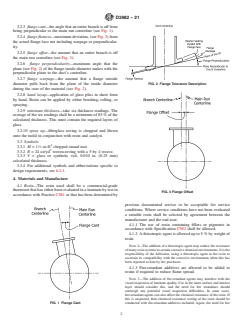
3.2.3 flange cant—the angle that an entire branch is off from
being perpendicular to the main run centerline (see Fig. 1).
3.2.4 flange flatness—maximum deviation, (see Fig. 2) from
the actual flange face not including warpage or perpendicular-
ity.
3.2.5 flange offset—the amount that an entire branch is off
the main run centerline (see Fig. 3).
3.2.6 flange perpendicularity—maximum angle that the
plane (see Fig. 2) of the flange inside diameter makes with the
perpendicular plane to the duct’s centerline.
3.2.7 flange warpage—the amount that a flange outside
FIG. 2 Flange Tolerance Description
diameter pulls back from the plane of the inside diameter
during the cure of the material (see Fig. 2).
3.2.8 hand layup—application of glass plies in sheet form
by hand. Resin can be applied by either brushing, rolling, or
spraying.
3.2.9 minimum thickness—take six thickness readings. The
average of the six readings shall be a minimum of 85 % of the
calculated thickness. This must contain the required layers of
glass.
3.2.10 spray up—fiberglass roving is chopped and blown
onto the mold in conjunction with resin and catalyst.
3.3 Symbols:
3.3.1 M = 1 ⁄2 oz ⁄ft chopped-strand mat.
3.3.2 R = 24 oz/yd woven-roving with a 5 by 4 weave.
3.3.3 V = glass or synthetic veil, 0.010 in. (0.25 mm)
calculated thickness.
3.3.4 For additional symbols and abbreviations specific to
design requirements, see 6.2.1.
4. Materials and Manufacture
4.1 Resin—The resin used shall be a commercial-grade
thermoset that has either been evaluated in a laminate by test in
FIG. 3 Flange Offset
accordance with Practice C581 or that has been determined by
previous documented service to be acceptable for service
conditions. Where service conditions have not been evaluated
a suitable resin shall be selected by agreement between the
manufacturer and the end user.
4.1.1 The use of resin containing fillers or pigments in
accordance with Specification C582 shall be allowed.
4.1.2 A thixotropic agent is allowed up to 5 % by weight of
resin.
NOTE 2—The addition of a thixotropic agent may reduce the resistance
of many resin systems to certain corrosive chemical environments. It is the
responsibility of the fabricator, using a thixotropic agent in the resin to
ascertain its compatibility with the corrosive environment when this has
been reported to him by the purchaser.
4.1.3 Fire-retardant additives are allowed to be added to
resins if required to reduce flame spread.
NOTE 3—The addition of fire-retardant agents may interfere with the
visual inspection of laminate quality. Use in the inner surface and interior
layer should consider this, and the need for fire retardance should
outweigh any potential visual inspection difficulties. In some cases,
fire-retardant agents can also affect the chemical resistance of the resin. If
this is suspected, then chemical resistance testing of the resin should be
FIG. 1 Flange Cant conducted with fire-retardant additives included. Again, the need for fire
D3982 − 21
resistance should be balanced with chemical resistance.
6.1.5 Increase all calculated wall thicknesses to the nearest
standard wall thickness. Treat these standard wall thicknesses
4.2 Reinforcement—Glass reinforcing material with a binder
as minimum dimensions.
and sizing compatible with the resin to be used. Fiber rein-
forcements shall be in accordance with, and meet the require-
6.2 Cylinder Wall Design:
ments of, Specification C582 including composition require-
6.2.1 Symbols and Abbreviations:
ments for Type I and Type II laminates.
6.2.1.1 P—Actual design pressure, psi (MPa).
4.2.1 Corrosion Barrier—Consists of the inner surface fol-
6.2.1.2 PA—Allowable pressure, psi (MPa).
lowed by the interior layer. The corrosion barrier has a
6.2.1.3 D —Outside diameter of cylinder, in. (mm).
o
minimum total calculated thickness of 0.096 in. (2.4 mm).
6.2.1.4 D—Inside diameter of cylinder, in. (mm).
4.2.1.1 Inner Surface—Surfacing veil with approximately
6.2.1.5 S—Ultimate tensile strength, psi (MPa).
90 % resin and 0.010 to 0.020-in. (0.25 to 0.50-mm) calculated
6.2.1.6 F—Safety factor (see 6.1.1).
thickness.
6.2.1.7 T—Cylinder wall thickness, in. (mm).
4.2.1.2 Interior Layer—A minimum of two plies of
1 6.2.1.8 E—Tensile modulus of elasticity, psi (MPa).
1 ⁄2 oz ⁄ft chopped-strand mat or chopped roving equivalent
6.2.1.9 L—Cylinder length between joints or elements that
with a compatible sizing system with approximately 75 % resin
qualify as a stiffener, in. (mm).
and 0.086-in. (2.2-mm) calculated thickness minimum. Fiber
6.2.1.10 I—Required moment of inertia for an element to
length shall be ⁄2 in. (12.7 mm) minimum to 2 in. (50.8 mm)
3 3
qualify as a stiffener, in. (mm ).
maximum.
6.2.2 Internal Pressure:
4.2.2 Structural Layer—Shall consist of chopped-strand mat
1 1
plies of nominally 1 ⁄2 oz ⁄ft and have a ⁄2 in. (12.7 mm)
PDF
T 5
minimum to 2 in. (50.8 mm) maximum fiber length, or shall
2S
consist of a chopped roving equivalent in the spray-up method.
6.2.3 External Pressure (Internal Vacuum):
When necessary, woven-roving plies shall be used and shall
Calculate:
consist of 24 oz/yd with a five by four weave or a suitable
0.5
equivalent agreed on by the end user and the fabricator.
D
o
1.73
S D
Woven-roving shall be applied alternately with a minimum of
T
a 1 ⁄2 oz ⁄yd mat or chopped roving equivalent, finishing with
If result:
a mat layer.
4.2.3 Outer Surface—Shall be coated with a resin-rich layer L
,
and containing 0.2 to 0.6 % paraffin wax with a melting point D
o
of 122 to 126°F (50.0 to 52.2°C), except when other means are
Then use:
used to prevent air inhibition.
2.2E T
P 5
S D
F D
5. Physical Properties o
5.1 Minimum wall of (V, M, M, M) shall be maintained If result:
under any circumstances.
L
$
5.2 Laminates or portions of laminates comprised only of D
o
chopped-strand mat or chopped roving equivalent shall have a
Then use:
20 to 35 % glass content by weight when tested by Test Method
2.5
2.6E T
D2584.
S D
F D
o
5.3 Minimum mechanical properties of standard laminates
P 5
0.5
L T
shall be in accordance with Specification C582. 2 0.45
S D
D D
o o
6. Design Requirements 6.2.4 Stiffeners to Withstand External Pressure:
6.2.4.1 Required Moment of Inertia:
6.1 Design Limitations:
6.1.1 Safety Factor—Use four for external pressure, use six PL D F
~ !
o
I 5
for internal pressure and all other design calculations except 24E
secondary bonding stresses.
6.2.4.2 It is permitted to include material used to attach ring
6.1.2 Maximum Permissible Deflection Under Design
stiffener to cylinder wall when calculating the actual moment
Load—Use L/240 for duct spans. Deflection limit for panel
of inertia of the stiffener as well as the portion of the cylinder
deflection shall be 1.5 %.
wall beneath the stiffener and attachment material up to a width
6.1.3 Secondary Bond Strength—When the load is along the
of 2x (stiffener width).
surface, use 2000 psi (13.79 MPa) ultimate shear stress for the
bonding surface area. Use a safety factor of ten when calcu- 6.3 Rectangular Duct:
lating allowable secondary bonding stresses. 6.3.1 The largest flat panel shall be designed to withstand
6.1.4 When an extra corrosion barrier is specified, do not the loading conditions and not exceed the design limitations
include this thickness in the design calculations. (see 6.1.2). This can be accomplished with a sufficient wall
D3982 − 21
thickness alone or by the incorporation of stiffening ribs to 6.7 Where static electricity has been determined to be a
reduce the required wall thickness. problem by the engineer, the inner surface of the ductwork
6.3.2 Appropriate calculations shall be performed for wall shall be grounded with a maximum resistance to ground of
thickness and stiffening ribs as determined by the manufacturer 10 Ω. The grounding method shall be determined by the
and the purchaser. Minimum wall thickness in all cases for manufacturer and the purchaser.
rectangular duct shall be as in Table 1, substituting the longer
side for the diameter.
7. Dimensions
6.3.3 The radial sides of a rectangular elbow shall be
7.1 Standard duct and fitting dimensions are shown on Fig.
designed as a round cylinder with the same radius.
4 and are based on inside dimensions.
6.4 Follow the requirements of NFPA 91Bulletin, Section
7.2 Standard elbows shall have a centerline radius of
510 when it is required by law or the engineer.
1 ⁄2 times the duct diameter for over 3-in. (76.2-mm) diameter
6.5 Shop Drawings and Design Calculations—The fabri-
and two times the duct diameter for 3-in. diameter and under.
cated structure shall be in accordance with the design and
7.3 Mitered joints on all elbows 24-in. (609.6-mm) diameter
construction details shown on shop drawings and design
and under are not permitted except when more room is required
calculations pr
...
This document is not an ASTM standard and is intended only to provide the user of an ASTM standard an indication of what changes have been made to the previous version. Because
it may not be technically possible to adequately depict all changes accurately, ASTM recommends that users consult prior editions as appropriate. In all cases only the current version
of the standard as published by ASTM is to be considered the official document.
Designation: D3982 − 08 (Reapproved 2014) D3982 − 21
Standard Specification for
Contact Molded “Fiberglass” (Glass Fiber Reinforced
Thermosetting Resin) Ducts
This standard is issued under the fixed designation D3982; the number immediately following the designation indicates the year of
original adoption or, in the case of revision, the year of last revision. A number in parentheses indicates the year of last reapproval. A
superscript epsilon (´) indicates an editorial change since the last revision or reapproval.
1. Scope Scope*
1.1 This specification covers ducts fabricated by contact molding intended for use in handling corrosive fumes and process gases.
Special attention is given to equipment that operates at temperatures over 180°F (82.2°C) with regard to strength and corrosion
resistance.
1.2 The material of construction shall be “fiberglass” consisting of a polyester, vinyl ester, or other qualified resin-matrix systems
with fiber reinforcement in accordance with Specification C582.
1.3 This specification is not intended to cover selection of resins and reinforcements for specific chemical environments.
1.4 This specification covers ducts up to a design pressure of 65 psig (34.5 Pa).
1.5 The values stated in inch-pound units are to be regarded as standard. The values given in parentheses are mathematical
conversions to SI units that are provided for information only and are not considered standard.
1.6 This standard does not purport to address all of the safety concerns, if any, associated with its use. It is the responsibility of
the user of this standard to establish appropriate safety and health practices and determine the applicability of regulatory
limitations prior to use.
NOTE 1—There is no known ISO equivalent to this standard.standard.
1.7 This international standard was developed in accordance with internationally recognized principles on standardization
established in the Decision on Principles for the Development of International Standards, Guides and Recommendations issued
by the World Trade Organization Technical Barriers to Trade (TBT) Committee.
2. Referenced Documents
2.1 ASTM Standards:
C581 Practice for Determining Chemical Resistance of Thermosetting Resins Used in Glass-Fiber-Reinforced Structures
Intended for Liquid Service
This specification is under the jurisdiction of ASTM Committee D20 on Plastics and is the direct responsibility of Subcommittee D20.23 on Reinforced Plastic
Thermosetting Resin Piping Systems and Chemical Equipment.
Current edition approved March 1, 2014April 1, 2021. Published March 2014April 2021. Originally approved in 1981. Last previous edition approved in 20082014 as
D3982 – 08.D3982 – 08(2014). DOI: 10.1520/D3982-08R14.10.1520/D3982-21.
For referenced ASTM standards, visit the ASTM website, www.astm.org, or contact ASTM Customer Service at service@astm.org. For Annual Book of ASTM Standards
volume information, refer to the standard’s Document Summary page on the ASTM website.
*A Summary of Changes section appears at the end of this standard
Copyright © ASTM International, 100 Barr Harbor Drive, PO Box C700, West Conshohocken, PA 19428-2959. United States
D3982 − 21
C582 Specification for Contact-Molded Reinforced Thermosetting Plastic (RTP) Laminates for Corrosion-Resistant Equipment
D883 Terminology Relating to Plastics
D2583 Test Method for Indentation Hardness of Rigid Plastics by Means of a Barcol Impressor
D2584 Test Method for Ignition Loss of Cured Reinforced Resins
F412 Terminology Relating to Plastic Piping Systems
F436 Specification for Hardened Steel Washers (Metric) F0436_F0436M
2.2 NFPA Standard:
NFPA 91 Installation of Blower and Exhaust Systems for Duct, Stack and Vapor Removal or Conveying
3. Terminology
3.1 Definitions:
3.1.1 The definitions used in this specification are in accordance with definitions in Terminologies D883 and F412, unless
otherwise specified.
3.2 Definitions of Terms Specific to This Standard:
3.2.1 calculated thickness—this description is in accordance with the standard laminate composition tables for Types I and II in
Specification C582.
3.2.2 contact molding—includes the “hand layup” and the “spray up” methods of manufacture.
3.2.3 flange cant—the angle that an entire branch is off from being perpendicular to the main run centerline (see Fig. 1).
3.2.4 flange flatness—maximum deviation, (see Fig. 2) from the actual flange face not including warpage or perpendicularity.
3.2.5 flange offset—the amount that an entire branch is off the main run centerline (see Fig. 3).
3.2.6 flange perpendicularity—maximum angle that the plane (see Fig. 2) of the flange inside diameter makes with the
perpendicular plane to the duct’s centerline.
3.2.7 flange warpage—the amount that a flange outside diameter pulls back from the plane of the inside diameter during the cure
of the material (see Fig. 2).
FIG. 1 Flange Cant
Available from National Fire Protection Association (NFPA), 1 Batterymarch Park, Quincy, MA 02169-7471, http://www.nfpa.org.
D3982 − 21
FIG. 2 Flange Tolerance Description
FIG. 3 Flange Offset
3.2.8 hand layup—application of glass plies in sheet form by hand. Resin can be applied by either brushing, rolling, or spraying.
3.2.9 minimum thickness—take six thickness readings. The average of the six readings shall be a minimum of 85 % of the
calculated thickness. This must contain the required layers of glass.
3.2.10 spray up—fiberglass roving is chopped and blown onto the mold in conjunction with resin and catalyst.
3.3 Symbols:
3.3.1 M = 1 ⁄2 oz ⁄ft chopped-strand mat.
3.3.2 R = 24 oz/yd woven-roving with a 5 by 4 weave.
3.3.3 V = glass or synthetic veil, 0.010 in. (0.25 mm) calculated thickness.
3.3.4 For additional symbols and abbreviations specific to design requirements, see 6.2.1.
4. Materials and Manufacture
4.1 Resin—The resin used shall be a commercial-grade thermoset that has either been evaluated in a laminate by test in accordance
D3982 − 21
with Practice C581 or that has been determined by previous documented service to be acceptable for service conditions. Where
service conditions have not been evaluated a suitable resin mayshall be selected by agreement between the manufacturer and the
end user.
4.1.1 The resin may contain use of resin containing fillers or pigments in accordance with Specification C582. shall be allowed.
4.1.2 A thixotropic agent may be added is allowed up to 5 % by weight of resin.
NOTE 2—The addition of a thixotropic agent may reduce the resistance of many resin systems to certain corrosive chemical environments. It is the
responsibility of the fabricator, using a thixotropic agent in the resin to ascertain its compatibility with the corrosive environment when this has been
reported to him by the purchaser.
4.1.3 Fire-retardant additives may are allowed to be added to resins if required to reduce flame spread.
NOTE 3—The addition of fire-retardant agents may interfere with the visual inspection of laminate quality. Use in the inner surface and interior layer
should consider this, and the need for fire retardance should out weigh outweigh any potential visual inspection difficulties. In some cases, fire-retardant
agents can also affect the the chemical resistance of the resin. If this is suspected, then chemical resistance testing of the resin should be conducted with
fire-retardant additives included. Again, the need for fire resistance should be balanced with chemical resistance.
4.2 Reinforcement—Glass reinforcing material with a binder and sizing compatible with the resin to be used. Fiber reinforcements
shall be in accordance with, and meet the requirements of, Specification C582 including composition requirements for Type I and
Type II laminates.
4.2.1 Corrosion Barrier—Consists of the inner surface followed by the interior layer. The corrosion barrier has a minimum total
calculated thickness of 0.096 in. (2.4 mm).
4.2.1.1 Inner Surface—Surfacing veil with approximately 90 % resin and 0.010 to 0.020-in. (0.25 to 0.50-mm) calculated
thickness.
4.2.1.2 Interior Layer—A minimum of two plies of 1 ⁄2 oz ⁄ft chopped-strand mat or chopped roving equivalent with a compatible
sizing system with approximately 75 % resin and 0.086-in. (2.2-mm) calculated thickness minimum. Fiber length shall be ⁄2 in.
(12.7 mm) minimum to 2 in. (50.8 mm) maximum.
1 1
4.2.2 Structural Layer—Shall consist of chopped-strand mat plies of nominally 1 ⁄2 oz ⁄ft and have a ⁄2 in. (12.7 mm) minimum
to 2 in. (50.8 mm) maximum fiber length, or shall consist of a chopped roving equivalent in the spray-up method. When necessary,
woven-roving plies shall be used and shall consist of 24 oz/yd with a five by four weave or a suitable equivalent agreed on by
the end user and the fabricator. Woven-roving shall be applied alternately with a minimum of a 1 ⁄2 oz ⁄yd mat or chopped roving
equivalent, finishing with a mat layer.
4.2.3 Outer Surface—Shall be coated with a resin-rich layer and containing 0.2 to 0.6 % paraffin wax with a melting point of 122
to 126°F (50.0 to 52.2°C), except when other means are used to prevent air inhibition.
5. Physical Properties
5.1 Minimum wall of (V, M, M, M) shall be maintained under any circumstances.
5.2 Laminates or portions of laminates comprised only of chopped-strand mat or chopped roving equivalent shall have a 2520 to
30 %35 % glass content by weight when tested by Test Method D2584.
5.3 Minimum mechanical properties of standard laminates shall be in accordance with Specification C582.
6. Design Requirements
6.1 Design Limitations:
6.1.1 Safety Factor—Use fivefour for external pressure, use tensix for internal pressure and all other design calculations.
calculations except secondary bonding stresses.
D3982 − 21
6.1.2 Maximum Permissible Deflection Under Design Load—Use 1 % of the span for laminates not exposed to a chemical
environment and use L/240 for duct spans. Deflection limit ⁄2 % of the span for allowable deflection when a chemical environment
will be in contact with the laminate.for panel deflection shall be 1.5 %.
6.1.3 Secondary Bond Strength—When the load is along the surface, use 2000 psi (13.79 MPa) ultimate shear stress for the
bonding surface area. Use a safety factor of ten when calculating allowable secondary bonding stresses.
6.1.4 When an extra corrosion barrier is specified, do not include this thickness in the design calculations.
6.1.5 Increase all calculated wall thicknesses to the nearest standard wall thickness. Treat these standard wall thicknesses as
minimum dimensions.
6.2 Cylinder Wall Design:
6.2.1 Symbols and Abbreviations:
6.2.1.1 P—Actual design pressure, psi (MPa).
6.2.1.2 PA—Allowable pressure, psi (MPa).
6.2.1.3 D —Outside diameter of cylinder, in. (mm).
o
6.2.1.4 D—Inside diameter of cylinder, in. (mm).
6.2.1.5 S—Ultimate tensile strength, psi (MPa).
6.2.1.6 F—Safety factor (see 6.1.1).
6.2.1.7 T—Cylinder wall thickness, in. (mm).
6.2.1.8 E—Tensile modulus of elasticity, psi (MPa).
6.2.1.9 L—Cylinder length between joints or elements that qualify as a stiffener, in. (mm).
3 3
6.2.1.10 I—Required moment of inertia for an element to qualify as a stiffener, in. (mm ).
6.2.2 Internal Pressure:
PDF
T 5
2S
6.2.3 External Pressure (Internal Vacuum):
Calculate:
0.5
D
o
1.73
S D
T
If result:
L
,
D
o
Then use:
2.2E T
P 5
S D
F D
o
If result:
L
$
D
o
D3982 − 21
Then use:
2.5
2.6E T
S D
F D
o
P 5
0.5
L T
2 0.45
S D
D D
o o
6.2.4 Stiffeners to Withstand External Pressure:
6.2.4.1 Required Moment of Inertia:
PL D F
~ !
o
I 5
24E
6.2.4.2 Material It is permitted to include material used to attach ring stiffener to cylinder wall may be included when calculating
the actual moment of inertia of the stiffener as well as the portion of the cylinder wall beneath the stiffener and attachment material
up to a width of 2x (stiffener width).
6.3 Rectangular Duct:
6.3.1 The largest flat panel shall be designed to withstand the loading conditions and not exceed the design limitations (see 6.1.2).
This can be accomplished with a sufficient wall thickness alone or by the incorporation of stiffening ribs to reduce the required
wall thickness.
6.3.2 Appropriate calculations shall be performed for wall thickness and stiffening ribs as determined by the manufacturer and the
purchaser. Minimum wall thickness in all cases for rectangular duct shall be as in Table 1, substituting the longer side for the
diameter.
6.3.3 The radial sides of a rectangular elbow shall be designed as a round cylinder with the same radius.
6.4 Follow the requirements of NFPA 91Bulletin, Section 510 when it is required by law or the engineer.
6.5 Shop Drawings and Design Calculations—The fabricated structure shall be in accordance with the design and construction
details shown on shop drawings and design calculations prepared by the manufacturer and approved by the purchaser. Details to
be covered include, but are not limited to, the following:
6.5.1 Materials, including a definition of the fiber-resin system, in accordance with types of resins and reinforcing materials of
Specification C582,
6.5.2 Dimensions,
6.5.3 Size and location of stiffening ribs, (if used),
6.5.4 Location of field joints and flanges, and
6.5.5 Type and location of supports, if supplied by the manufacturer.
6.6 All stiffeners, access openings, lifting devices or other appurtenances shall be included as part of the duct design.
6.7 Where static electricity has been determined to be a problem by the engineer, the inner surface of the ductwork shall be
grounded with a maximum resistance to ground of 10 Ω. The grounding method shall be determined by the manufacturer and the
purchaser.
7. Dimensions
7.1 Standard duct and fitting dimensions are shown on Fig. 4 and are based on inside dimensions.
D3982 − 21
TABLE 1 Typical Flange Dimensions and Hanger Spacing
NOTE 1—1 in. = 25.4 mm
1 lb/ft = 1.488164 kg/m.
A A B
Calculated Cylinder Flange Flange Recom-
Inside Flange Bolt Bolt Hole Number Bolt
Wall Wall Thickness,
Outside mended Bolt
Maximum Bolt
Thickness, Construction min, in.
Diameter, in. Circle, in. Diameter, in. Holes
Diameter, in. Torque, ft/lb
in.
3 3 7
1 0.14 Type I ⁄8 5 ⁄8 4 ⁄16 4 20
1 3 5 1 7
1 ⁄4 0.14 Type I ⁄8 5 ⁄8 4 ⁄4 ⁄16 4 20
1 3 7 1 7
1 ⁄2 0.14 Type I ⁄8 5 ⁄8 4 ⁄2 ⁄16 4 20
1 3 7
2 0.14 Type I ⁄2 6 ⁄8 5 ⁄16 4 25
1 1 7 1 7
...