

ASTM D570-22
(Test Method)Standard Test Method for Water Absorption of Plastics
General Information
- Abstract
SIGNIFICANCE AND USE
4.1 This test method for rate of water absorption has two chief functions: first, as a guide to the proportion of water absorbed by a material and consequently, in those cases where the relationships between moisture and electrical or mechanical properties, dimensions, or appearance have been determined, as a guide to the effects of exposure to water or humid conditions on such properties; and second, as a control test on the uniformity of a product. This second function is particularly applicable to sheet, rod, and tube arms when the test is made on the finished product.
4.2 Comparison of water absorption values of various plastics made on the basis of values obtained in accordance with 8.1 and 8.4 have been found useful.
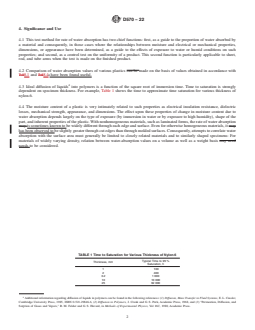
4.3 Ideal diffusion of liquids4 into polymers is a function of the square root of immersion time. Time to saturation is strongly dependent on specimen thickness. For example, Table 1 shows the time to approximate time saturation for various thickness of nylon-6.
4.4 The moisture content of a plastic is very intimately related to such properties as electrical insulation resistance, dielectric losses, mechanical strength, appearance, and dimensions. The effect upon these properties of change in moisture content due to water absorption depends largely on the type of exposure (by immersion in water or by exposure to high humidity), shape of the part, and inherent properties of the plastic. With nonhomogeneous materials, such as laminated forms, the rate of water absorption is sometimes known to be widely different through each edge and surface. Even for otherwise homogeneous materials, it has been observed to be slightly greater through cut edges than through molded surfaces. Consequently, attempts to correlate water absorption with the surface area must generally be limited to closely related materials and to similarly shaped specimens: For materials of widely varying density, relation between water-absorption values on a volume as well as ...
SCOPE
1.1 This test method covers the determination of the relative rate of absorption of water by plastics when immersed. This test method is intended to apply to the testing of all types of plastics, including cast, hot-molded, and cold-molded resinous products, and both homogeneous and laminated plastics in rod and tube form and in sheets 0.13 mm (0.005 in.) or greater in thickness.
1.2 The values given in SI units are to be regarded as standard. The values stated in parentheses are for information only.
Note 1: This test method and ISO 62 are technically equivalent when the test specimen described in 6.2 is used.
1.3 This standard does not purport to address all of the safety concerns, if any, associated with its use. It is the responsibility of the user of this standard to establish appropriate safety, health, and environmental practices and determine the applicability of regulatory limitations prior to use.
1.4 This international standard was developed in accordance with internationally recognized principles on standardization established in the Decision on Principles for the Development of International Standards, Guides and Recommendations issued by the World Trade Organization Technical Barriers to Trade (TBT) Committee.
- Status
- Published
- Publication Date
- 31-Aug-2022
- Technical Committee
- D20 - Plastics
- Drafting Committee
- D20.50 - Durability of Plastics

Overview
ASTM D570-22 is the internationally recognized standard test method for determining the water absorption of plastics. Developed and maintained by ASTM International, this method specifies procedures for measuring the relative rate and amount of water absorbed by various plastic forms when immersed in water. Water absorption can have significant effects on a plastic's mechanical, electrical, and dimensional properties, impacting the material's performance in real-world environments.
This standard applies to a wide variety of plastic materials, including cast, hot-molded, and cold-molded resinous products. Both homogeneous and laminated plastics in the form of rods, tubes, and sheets with thicknesses of 0.13 mm (0.005 in.) or greater are covered. ASTM D570-22 provides guidance not only for material characterization but also for quality control during manufacturing and finished product assessment.
Key Topics
- Test Procedures: Specifies the conditioning, immersion durations, temperature settings, and measurement protocols to accurately determine the water absorption of plastic specimens.
- Material Relevance: Suitable for testing sheet, rod, and tube forms, including both homogeneous and laminated plastics.
- Data Interpretation: Details how to calculate and report the percentage increase in weight due to water absorption, as well as how to evaluate and document changes in physical appearance, mechanical strength, or electrical properties.
- Significance for Properties:
- Water absorption can impact a plastic's electrical insulation, dielectric losses, strength, appearance, and dimensional stability.
- The rate and total absorption are influenced by material type, thickness, surface characteristics, and the presence of cut edges or laminated structures.
- Quality Control: Serves as a uniformity and consistency check for finished plastic products, ensuring compliance with industry or application-specific requirements.
Applications
The practical value of ASTM D570-22 lies in its ability to guide material selection, quality assurance, and performance prediction for plastic products exposed to moisture or humid environments. Key applications include:
- Material Comparison: Enables direct comparison of water absorption rates between different plastics, aiding in the selection of the most suitable material for specific conditions.
- Product Design: Essential for engineers and designers developing components where water exposure could affect performance, such as in electrical insulation, automotive, and construction products.
- Finished Product Testing: Ensures that manufactured batches of plastic sheet, rod, or tube meet specified absorption thresholds, controlling for variability in production.
- Performance Evaluation: Assists in predicting the reliability and durability of plastic components over time, especially where dimensional stability and electrical properties are critical.
- Research and Development: Provides a reproducible framework for studying the effects of formulation or processing changes on water resistance in plastic materials.
Related Standards
- ISO 62: Plastics - Determination of Water Absorption. ASTM D570-22 is technically equivalent to ISO 62 when using the standardized specimen described in the method.
- ASTM D883: Terminology Relating to Plastics. Provides definitions of key terms used throughout ASTM plastics standards.
- ASTM E456: Terminology Relating to Quality and Statistics. Relevant for interpreting statistical terminology within ASTM D570-22 processes.
Summary
ASTM D570-22 remains the primary reference for assessing water absorption in plastics, serving industries where environmental exposure can influence material integrity. Adherence to this standard supports reliable product performance, regulatory compliance, and informed material selection for a broad spectrum of plastic applications. For any project where plastics are exposed to water or humidity, using ASTM D570-22 yields critical data for optimizing performance and durability.
Relations
- Effective Date
- 01-Feb-2024
- Effective Date
- 01-Nov-2023
- Effective Date
- 01-Apr-2022
- Effective Date
- 01-Jan-2020
- Effective Date
- 01-Aug-2019
- Effective Date
- 15-Apr-2019
- Effective Date
- 01-Feb-2019
- Effective Date
- 01-Dec-2018
- Effective Date
- 01-Nov-2018
- Effective Date
- 01-Oct-2017
- Effective Date
- 01-Oct-2017
- Effective Date
- 15-Aug-2017
- Effective Date
- 15-Nov-2013
- Effective Date
- 15-Nov-2013
- Effective Date
- 15-Nov-2013
Get Certified
Connect with accredited certification bodies for this standard

DIN CERTCO
DIN Group product certification.

Smithers Quality Assessments
US management systems and product certification.
Sponsored listings
Frequently Asked Questions
ASTM D570-22 is a standard published by ASTM International. Its full title is "Standard Test Method for Water Absorption of Plastics". This standard covers: SIGNIFICANCE AND USE 4.1 This test method for rate of water absorption has two chief functions: first, as a guide to the proportion of water absorbed by a material and consequently, in those cases where the relationships between moisture and electrical or mechanical properties, dimensions, or appearance have been determined, as a guide to the effects of exposure to water or humid conditions on such properties; and second, as a control test on the uniformity of a product. This second function is particularly applicable to sheet, rod, and tube arms when the test is made on the finished product. 4.2 Comparison of water absorption values of various plastics made on the basis of values obtained in accordance with 8.1 and 8.4 have been found useful. 4.3 Ideal diffusion of liquids4 into polymers is a function of the square root of immersion time. Time to saturation is strongly dependent on specimen thickness. For example, Table 1 shows the time to approximate time saturation for various thickness of nylon-6. 4.4 The moisture content of a plastic is very intimately related to such properties as electrical insulation resistance, dielectric losses, mechanical strength, appearance, and dimensions. The effect upon these properties of change in moisture content due to water absorption depends largely on the type of exposure (by immersion in water or by exposure to high humidity), shape of the part, and inherent properties of the plastic. With nonhomogeneous materials, such as laminated forms, the rate of water absorption is sometimes known to be widely different through each edge and surface. Even for otherwise homogeneous materials, it has been observed to be slightly greater through cut edges than through molded surfaces. Consequently, attempts to correlate water absorption with the surface area must generally be limited to closely related materials and to similarly shaped specimens: For materials of widely varying density, relation between water-absorption values on a volume as well as ... SCOPE 1.1 This test method covers the determination of the relative rate of absorption of water by plastics when immersed. This test method is intended to apply to the testing of all types of plastics, including cast, hot-molded, and cold-molded resinous products, and both homogeneous and laminated plastics in rod and tube form and in sheets 0.13 mm (0.005 in.) or greater in thickness. 1.2 The values given in SI units are to be regarded as standard. The values stated in parentheses are for information only. Note 1: This test method and ISO 62 are technically equivalent when the test specimen described in 6.2 is used. 1.3 This standard does not purport to address all of the safety concerns, if any, associated with its use. It is the responsibility of the user of this standard to establish appropriate safety, health, and environmental practices and determine the applicability of regulatory limitations prior to use. 1.4 This international standard was developed in accordance with internationally recognized principles on standardization established in the Decision on Principles for the Development of International Standards, Guides and Recommendations issued by the World Trade Organization Technical Barriers to Trade (TBT) Committee.
SIGNIFICANCE AND USE 4.1 This test method for rate of water absorption has two chief functions: first, as a guide to the proportion of water absorbed by a material and consequently, in those cases where the relationships between moisture and electrical or mechanical properties, dimensions, or appearance have been determined, as a guide to the effects of exposure to water or humid conditions on such properties; and second, as a control test on the uniformity of a product. This second function is particularly applicable to sheet, rod, and tube arms when the test is made on the finished product. 4.2 Comparison of water absorption values of various plastics made on the basis of values obtained in accordance with 8.1 and 8.4 have been found useful. 4.3 Ideal diffusion of liquids4 into polymers is a function of the square root of immersion time. Time to saturation is strongly dependent on specimen thickness. For example, Table 1 shows the time to approximate time saturation for various thickness of nylon-6. 4.4 The moisture content of a plastic is very intimately related to such properties as electrical insulation resistance, dielectric losses, mechanical strength, appearance, and dimensions. The effect upon these properties of change in moisture content due to water absorption depends largely on the type of exposure (by immersion in water or by exposure to high humidity), shape of the part, and inherent properties of the plastic. With nonhomogeneous materials, such as laminated forms, the rate of water absorption is sometimes known to be widely different through each edge and surface. Even for otherwise homogeneous materials, it has been observed to be slightly greater through cut edges than through molded surfaces. Consequently, attempts to correlate water absorption with the surface area must generally be limited to closely related materials and to similarly shaped specimens: For materials of widely varying density, relation between water-absorption values on a volume as well as ... SCOPE 1.1 This test method covers the determination of the relative rate of absorption of water by plastics when immersed. This test method is intended to apply to the testing of all types of plastics, including cast, hot-molded, and cold-molded resinous products, and both homogeneous and laminated plastics in rod and tube form and in sheets 0.13 mm (0.005 in.) or greater in thickness. 1.2 The values given in SI units are to be regarded as standard. The values stated in parentheses are for information only. Note 1: This test method and ISO 62 are technically equivalent when the test specimen described in 6.2 is used. 1.3 This standard does not purport to address all of the safety concerns, if any, associated with its use. It is the responsibility of the user of this standard to establish appropriate safety, health, and environmental practices and determine the applicability of regulatory limitations prior to use. 1.4 This international standard was developed in accordance with internationally recognized principles on standardization established in the Decision on Principles for the Development of International Standards, Guides and Recommendations issued by the World Trade Organization Technical Barriers to Trade (TBT) Committee.
ASTM D570-22 is classified under the following ICS (International Classification for Standards) categories: 83.120 - Reinforced plastics. The ICS classification helps identify the subject area and facilitates finding related standards.
ASTM D570-22 has the following relationships with other standards: It is inter standard links to ASTM D883-24, ASTM D883-23, ASTM E456-13a(2022)e1, ASTM D883-20, ASTM D883-19c, ASTM D883-19a, ASTM D883-19, ASTM D883-18a, ASTM D883-18, ASTM E456-13A(2017)e1, ASTM E456-13A(2017)e3, ASTM D883-17, ASTM E456-13ae3, ASTM E456-13ae1, ASTM E456-13a. Understanding these relationships helps ensure you are using the most current and applicable version of the standard.
ASTM D570-22 is available in PDF format for immediate download after purchase. The document can be added to your cart and obtained through the secure checkout process. Digital delivery ensures instant access to the complete standard document.
Standards Content (Sample)
This international standard was developed in accordance with internationally recognized principles on standardization established in the Decision on Principles for the
Development of International Standards, Guides and Recommendations issued by the World Trade Organization Technical Barriers to Trade (TBT) Committee.
Designation: D570 − 22
Standard Test Method for
Water Absorption of Plastics
This standard is issued under the fixed designation D570; the number immediately following the designation indicates the year of
original adoption or, in the case of revision, the year of last revision.Anumber in parentheses indicates the year of last reapproval.A
superscript epsilon (´) indicates an editorial change since the last revision or reapproval.
This standard has been approved for use by agencies of the U.S. Department of Defense.
1. Scope* 3. Terminology
1.1 Thistestmethodcoversthedeterminationoftherelative 3.1 For definitions of terms that appear in this practice
rate of absorption of water by plastics when immersed. This relating to plastics, refer to Terminology D883.
test method is intended to apply to the testing of all types of
3.2 For definitions of terms that appear in this practice
plastics, including cast, hot-molded, and cold-molded resinous
relating to quality and statistics (such as precision and bias),
products, and both homogeneous and laminated plastics in rod
refer to Terminology E456.
and tube form and in sheets 0.13 mm (0.005 in.) or greater in
thickness.
4. Significance and Use
1.2 The values given in SI units are to be regarded as
4.1 This test method for rate of water absorption has two
standard. The values stated in parentheses are for information
chief functions: first, as a guide to the proportion of water
only.
absorbed by a material and consequently, in those cases where
NOTE 1—This test method and ISO62 are technically equivalent when
therelationshipsbetweenmoistureandelectricalormechanical
the test specimen described in 6.2 is used.
properties, dimensions, or appearance have been determined,
1.3 This standard does not purport to address all of the
as a guide to the effects of exposure to water or humid
safety concerns, if any, associated with its use. It is the
conditions on such properties; and second, as a control test on
responsibility of the user of this standard to establish appro-
the uniformity of a product. This second function is particu-
priate safety, health, and environmental practices and deter-
larly applicable to sheet, rod, and tube arms when the test is
mine the applicability of regulatory limitations prior to use.
made on the finished product.
1.4 This international standard was developed in accor-
4.2 Comparison of water absorption values of various plas-
dance with internationally recognized principles on standard-
tics made on the basis of values obtained in accordance with
ization established in the Decision on Principles for the
8.1 and 8.4 have been found useful.
Development of International Standards, Guides and Recom-
mendations issued by the World Trade Organization Technical
4.3 Ideal diffusion of liquids into polymers is a function of
Barriers to Trade (TBT) Committee.
the square root of immersion time. Time to saturation is
strongly dependent on specimen thickness. For example,Table
2. Referenced Documents
1 shows the time to approximate time saturation for various
thickness of nylon-6.
2.1 ASTM Standards:
D883Terminology Relating to Plastics
4.4 The moisture content of a plastic is very intimately
E456Terminology Relating to Quality and Statistics
related to such properties as electrical insulation resistance,
dielectric losses, mechanical strength, appearance, and dimen-
2.2 ISO Standard:
sions. The effect upon these properties of change in moisture
ISO62 Plastics—Determination of Water Absorption
content due to water absorption depends largely on the type of
exposure (by immersion in water or by exposure to high
1 humidity), shape of the part, and inherent properties of the
ThistestmethodisunderthejurisdictionofASTMCommitteeD20onPlastics
and is the direct responsibility of Subcommittee D20.50 on Durability of Plastics.
plastic. With nonhomogeneous materials, such as laminated
Current edition approved Sept. 1, 2022. Published September 2022. Originally
approved in 1940. Last previous edition approved in 2018 as D570-98 (2018).
DOI: 10.1520/D0570-22.
2 4
For referenced ASTM standards, visit the ASTM website, www.astm.org, or Additional information regarding diffusion of liquids in polymers can be found
contact ASTM Customer Service at service@astm.org. For Annual Book of ASTM in the following references: (1) Diffusion, Mass Transfer in Fluid Systems,E.L.
Standards volume information, refer to the standard’s Document Summary page on Cussler, Cambridge University Press, 1985, ISBN 0-521-29846-6, (2) Diffusion in
the ASTM website. Polymers, J. Crank and G.S. Park, Academic Press, 1968, and (3) “Permeation,
Available fromAmerican National Standards Institute (ANSI), 25 W. 43rd St., Diffusion, and Sorption of Gases and Vapors,” R.M. Felder and G.S. Huvard, in
4th Floor, New York, NY 10036, http://www.ansi.org. Methods of Experimental Physics, Vol 16C, 1980, Academic Press.
*A Summary of Changes section appears at the end of this standard
Copyright © ASTM International, 100 Barr Harbor Drive, PO Box C700, West Conshohocken, PA 19428-2959. United States
D570 − 22
TABLE 1 Time to Saturation for Various Thickness of Nylon-6
cloth. Sawing, machining, and sandpapering operations shall
Typical Time to 95 % be slow enough so that the material is not heated appreciably.
Thickness, mm
Saturation, h
NOTE 2—If there is any oil on the surface of the specimen when
1 100
received or as a result of machining operations, wash the specimen with
2 400
a cloth wet with gasoline to remove oil, wipe with a dry cloth, and allow
3.2 1 000
to stand in air for2hto permit evaporation of the gasoline. If gasoline
10 10 000
25 62 000 attacks the plastic, use some suitable solvent or detergent that will
evaporate within the 2-h period.
6.7 The dimensions listed in Table 2 for the various speci-
forms, the rate of water absorption is sometimes known to be
mens shall be measured to the nearest 0.025 mm (0.001 in.).
widely different through each edge and surface. Even for
Dimensions not listed shall be measured within 0.8 mm
otherwise homogeneous materials, it has been observed to be
(60.031in.).
slightly greater through cut edges than through molded sur-
faces. Consequently, attempts to correlate water absorption 7. Conditioning
with the surface area must generally be limited to closely
7.1 Three specimens shall be conditioned as follows:
related materials and to similarly shaped specimens: For
7.1.1 Specimens of materials whose water-absorption value
materials of widely varying density, relation between water-
would be appreciably affected by temperatures in the neigh-
absorption values on a volume as well as a weight basis needs
borhood of 110°C (230°F), shall be dried in an oven for 24 h
to be considered.
at 50 63°C (122 65.4°F), cooled in a desiccator, and imme-
diately weighed to the nearest 0.001 g.
5. Apparatus
NOTE 3—If a static charge interferes with the weighing, lightly rub the
5.1 Balance—An analytical balance capable of reading
surface of the specimens with a grounded conductor.
0.0001 g.
7.1.2 Specimens of materials, such as phenolic laminated
5.2 Oven, capable of maintaining uniform temperatures of
plastics and other products whose water-absorption value has
50 63°C (122 65.4°F) and of 105 to 110°C (221 to 230°F).
been shown not to be appreciably affected by temperatures up
to 110°C (230°F), shall be dried in an oven for1hat105to
6. Test Specimen
110°C (221 to 230°F).
6.1 The test specimen for molded plastics shall be in the
7.1.3 When data for comparison with absorption values for
form of a disk 50.8 mm (2 in.) in diameter and 3.2 mm
other plastics are desired, the specimens shall be dried in an
(0.125in.) in thickness. Permissible variations in thickness are
oven for 24 h at 50 63°C (122 65.4°F), cooled in a
60.18 mm (60.007 in.) for hot-molded and 60.30 mm
desiccator, and immediately weighed to the nearest 0.001 g.
(60.012 in.) for cold-molded or cast materials.
6.2 ISO Standard Specimen—The test specimen for homo- 8. Procedure
geneous plastics shall be 60 by 60 by 1 mm. Tolerance for the
8.1 Twenty-Four Hour Immersion—The conditioned speci-
60-mm dimension is 62mmand 60.05 mm for the 1-mm
mens shall be placed in a container of distilled water main-
thickness.
tained at a temperature of 23 61°C (73.4 61.8°F), and shall
6.3 Thetestspecimenforsheetsshallbeintheformofabar rest on edge and be entirely immersed. At the end of 24, + ⁄2,
76.2 mm (3 in.) long by 25.4 mm (1 in.) wide by the thickness
−0 h, the specimens shall be removed from the water one at a
of the material. When comparison of absorption values with time, all surface water wiped off with a dry cloth, and weighed
moldedplasticsisdesired,specimens3.2-mm(0.125-in.)thick
tothenearest0.001gimmediately.Ifthespecimenis ⁄16in.or
shall be used. Permissible variations in thickness shall be 0.20 less in thickness, it shall be put in a weighing bottle immedi-
mm (60.008 in.) except for materials which
...
This document is not an ASTM standard and is intended only to provide the user of an ASTM standard an indication of what changes have been made to the previous version. Because
it may not be technically possible to adequately depict all changes accurately, ASTM recommends that users consult prior editions as appropriate. In all cases only the current version
of the standard as published by ASTM is to be considered the official document.
Designation: D570 − 98 (Reapproved 2018) D570 − 22
Standard Test Method for
Water Absorption of Plastics
This standard is issued under the fixed designation D570; the number immediately following the designation indicates the year of
original adoption or, in the case of revision, the year of last revision. A number in parentheses indicates the year of last reapproval. A
superscript epsilon (´) indicates an editorial change since the last revision or reapproval.
This standard has been approved for use by agencies of the U.S. Department of Defense.
1. Scope Scope*
1.1 This test method covers the determination of the relative rate of absorption of water by plastics when immersed. This test
method is intended to apply to the testing of all types of plastics, including cast, hot-molded, and cold-molded resinous products,
and both homogeneous and laminated plastics in rod and tube form and in sheets 0.13 mm (0.005 in.) or greater in thickness.
1.2 The values given in SI units are to be regarded as standard. The values stated in parentheses are for information only.
NOTE 1—This test method and ISO 62 are technically equivalent when the test specimen described in 6.2 is used.
1.3 This standard does not purport to address all of the safety concerns, if any, associated with its use. It is the responsibility
of the user of this standard to establish appropriate safety, health, and environmental practices and determine the applicability of
regulatory limitations prior to use.
1.4 This international standard was developed in accordance with internationally recognized principles on standardization
established in the Decision on Principles for the Development of International Standards, Guides and Recommendations issued
by the World Trade Organization Technical Barriers to Trade (TBT) Committee.
2. Referenced Documents
2.1 ASTM Standards:
D883 Terminology Relating to Plastics
E456 Terminology Relating to Quality and Statistics
2.2 ISO Standard:
ISO 62 Plastics—Determination of Water Absorption
3. Terminology
3.1 For definitions of terms that appear in this practice relating to plastics, refer to Terminology D883.
3.2 For definitions of terms that appear in this practice relating to quality and statistics (such as precision and bias), refer to
Terminology E456.
This test method is under the jurisdiction of ASTM Committee D20 on Plastics and is the direct responsibility of Subcommittee D20.50 on Durability of Plastics.
Current edition approved Aug. 1, 2018Sept. 1, 2022. Published August 2018September 2022. Originally approved in 1940. Last previous edition approved in 20102018
ɛ1
as D570 - 98 (2010)(2018). . DOI: 10.1520/D0570-98R18.10.1520/D0570-22.
For referenced ASTM standards, visit the ASTM website, www.astm.org, or contact ASTM Customer Service at service@astm.org. For Annual Book of ASTM Standards
volume information, refer to the standard’s Document Summary page on the ASTM website.
Available from American National Standards Institute (ANSI), 25 W. 43rd St., 4th Floor, New York, NY 10036, http://www.ansi.org.
*A Summary of Changes section appears at the end of this standard
Copyright © ASTM International, 100 Barr Harbor Drive, PO Box C700, West Conshohocken, PA 19428-2959. United States
D570 − 22
4. Significance and Use
4.1 This test method for rate of water absorption has two chief functions: first, as a guide to the proportion of water absorbed by
a material and consequently, in those cases where the relationships between moisture and electrical or mechanical properties,
dimensions, or appearance have been determined, as a guide to the effects of exposure to water or humid conditions on such
properties; and second, as a control test on the uniformity of a product. This second function is particularly applicable to sheet,
rod, and tube arms when the test is made on the finished product.
4.2 Comparison of water absorption values of various plastics can be made on the basis of values obtained in accordance with
7.18.1 and 7.48.4. have been found useful.
4.3 Ideal diffusion of liquids into polymers is a function of the square root of immersion time. Time to saturation is strongly
dependent on specimen thickness. For example, Table 1 shows the time to approximate time saturation for various thickness of
nylon-6.
4.4 The moisture content of a plastic is very intimately related to such properties as electrical insulation resistance, dielectric
losses, mechanical strength, appearance, and dimensions. The effect upon these properties of change in moisture content due to
water absorption depends largely on the type of exposure (by immersion in water or by exposure to high humidity), shape of the
part, and inherent properties of the plastic. With nonhomogeneous materials, such as laminated forms, the rate of water absorption
may is sometimes known to be widely different through each edge and surface. Even for otherwise homogeneous materials, it may
has been observed to be slightly greater through cut edges than through molded surfaces. Consequently, attempts to correlate water
absorption with the surface area must generally be limited to closely related materials and to similarly shaped specimens: For
materials of widely varying density, relation between water-absorption values on a volume as well as a weight basis may need
needs to be considered.
TABLE 1 Time to Saturation for Various Thickness of Nylon-6
Typical Time to 95 %
Thickness, mm
Saturation, h
1 100
2 400
3.2 1 000
10 10 000
25 62 000
Additional information regarding diffusion of liquids in polymers can be found in the following references: (1) Diffusion, Mass Transfer in Fluid Systems, E. L. Cussler,
Cambridge University Press, 1985, ISBN 0-521-29846-6, (2) Diffusion in Polymers, J. Crank and G. S. Park, Academic Press, 1968, and (3) “Permeation, Diffusion, and
Sorption of Gases and Vapors,” R. M. Felder and G. S. Huvard, in Methods of Experimental Physics, Vol 16C, 1980, Academic Press.
D570 − 22
5. Apparatus
5.1 Balance—An analytical balance capable of reading 0.0001 g.
5.2 Oven, capable of maintaining uniform temperatures of 50 6 3°C (122 6 5.4°F) and of 105 to 110°C (221 to 230°F).
6. Test Specimen
6.1 The test specimen for molded plastics shall be in the form of a disk 50.8 mm (2 in.) in diameter and 3.2 mm ((0.125 in.) ⁄8
in.) in thickness. Permissible variations in thickness are 60.18 mm (60.007 in.) for hot-molded and 60.30 mm (60.012 in.) for
cold-molded or cast materials.
6.2 ISO Standard Specimen—The test specimen for homogeneous plastics shall be 60 by 60 by 1 mm. Tolerance for the 60-mm
dimension is 62 mm and 60.05 mm for the 1-mm thickness. This test method and ISO 62 are technically equivalent when the
test specimen described in 5.2 is used.
6.3 The test specimen for sheets shall be in the form of a bar 76.2 mm (3 in.) long by 25.4 mm (1 in.) wide by the thickness of
the material. When comparison of absorption values with molded plastics is desired, specimens 3.2-mm ((0.125-in.) ⁄8-in.) thick
shouldshall be used. Permissible variations in thickness shall be 0.20 mm (60.008 in.) except for materials which have greater
standard commercial tolerances.
6.4 The test specimen for rods shall be 25.4-mm (1-in.) long for rods 25.4 mm in diameter or under and 12.7-mm ((0.50-in.) ⁄2-in.)
long for larger-diameter rods. The diameter of the specimen shall be the diameter of the finished rod.
6.5 The test specimen for tubes less than 76 mm (3 in.) in inside diameter shall be the full section of the tube and 25.4-mm (1-in.)
long. For tubes 76 mm (3 in.) or more in inside diameter, a rectangular specimen shall be cut 76 mm in length in the circumferential
direction of the tube and 25.4 mm in width lengthwise of the tube.
6.6 The test specimens for sheets, rods, and tubes shall be machined, sawed, or sheared from the sample so as to have smooth
edges free from cracks. The cut edges shall be made smooth by finishing with No. 0 or finer sandpaper or emery cloth. Sawing,
machining, and sandpapering operations shall be slow enough so that the material is not heated appreciably.
NOTE 2—If there is any oil on the surface of the specimen when received or as a result of machining operations, wash the specimen with a cloth wet with
gasoline to remove oil, wipe with a dry cloth, and allow to stand in air for 2 h to permit evaporation of the gasoline. If gasoline attacks the plastic, use
some suitable solvent or detergent that will evaporate within the 2-h period.
6.7 The dimensions listed in theTable 2 following table for the various specimens shall be measured to the nearest 0.025 mm
(0.001 in.). Dimensions not listed shall be measured within 0.8 mm (6(60.031 in.). ⁄32 in.).
Type of Dimensions to Be Measured to
Specimen the
Nearest 0.025 mm (0.001 in.)
Molded disk thickness
Sheet thickness
Rod length and diameter
Tube inside and outside diameter, and
wall thickness
TABLE 2 Critical Specimen Dimension Measurements
Type of Dimensions
Specimen
Molded disk thickness
Sheet thickness
Rod length and diameter
Tube inside and outside diameter, and
wall thickness
D570 − 22
7. Conditioning
7.1 Three specimens shall be conditioned as follows:
7.1.1 Specimens of materials whose water-absorption value would be appreciably affected by temperatures in the neighborhood
of 110°C (230°F), shall be dried in an oven for 24 h at 50 6 3°C (122 6 5.4°F), cooled in a desiccator, and immediately weighed
to the nearest 0.001 g.
NOTE 3—If a static charge interferes with the weighing, lightly rub the surface of the specimens with a grounded conductor.
7.
...