

ASTM D3916-22
(Test Method)Standard Test Method for Tensile Properties of Pultruded Glass-Fiber-Reinforced Plastic Rod
General Information
- Abstract
SIGNIFICANCE AND USE
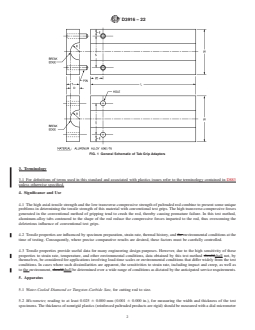
4.1 The high axial-tensile strength and the low transverse-compressive strength of pultruded rod combine to present some unique problems in determining the tensile strength of this material with conventional test grips. The high transverse-compressive forces generated in the conventional method of gripping tend to crush the rod, thereby causing premature failure. In this test method, aluminum-alloy tabs contoured to the shape of the rod reduce the compressive forces imparted to the rod, thus overcoming the deleterious influence of conventional test grips.
4.2 Tensile properties are influenced by specimen preparation, strain rate, thermal history, and environmental conditions at the time of testing. Consequently, where precise comparative results are desired, these factors must be carefully controlled.
4.3 Tensile properties provide useful data for many engineering design purposes. However, due to the high sensitivity of these properties to strain rate, temperature, and other environmental conditions, data obtained by this test method shall not, by themselves, be considered for applications involving load-time scales or environmental conditions that differ widely from the test conditions. In cases where such dissimilarities are apparent, the sensitivities to strain rate, including impact and creep, as well as to the environment, shall be determined over a wide range of conditions as dictated by the anticipated service requirements.
SCOPE
1.1 This test method describes a procedure for determining the tensile properties of a pultruded, glass-fiber-reinforced thermosetting plastic rod of diameters ranging from 2.03 mm (0.08 in.) to 12.7 mm (0.5 in.). Test Method D7205/D7205M is an alternative test method to determine tensile properties of fiber-reinforced composite rods of diameters bigger than 12.7 mm (0.5 in.).
1.2 The values stated in SI units are to be regarded as the standard. The values given in parentheses are for information only.
1.3 This standard does not purport to address all of the safety concerns, if any, associated with its use. It is the responsibility of the user of this standard to establish appropriate safety, health, and environmental practices and determine the applicability of regulatory limitations prior to use. Specific hazards statements are given in 6.1 and 8.4.3.
Note 1: There is no known ISO equivalent to this standard.
1.4 This international standard was developed in accordance with internationally recognized principles on standardization established in the Decision on Principles for the Development of International Standards, Guides and Recommendations issued by the World Trade Organization Technical Barriers to Trade (TBT) Committee.
- Status
- Published
- Publication Date
- 14-Dec-2022
- Technical Committee
- D20 - Plastics
- Drafting Committee
- D20.18 - Reinforced Thermosetting Plastics
Buy Documents
ASTM D3916-22 - Standard Test Method for Tensile Properties of Pultruded Glass-Fiber-Reinforced<brk /> Plastic Rod
REDLINE ASTM D3916-22 - Standard Test Method for Tensile Properties of Pultruded Glass-Fiber-Reinforced<brk /> Plastic Rod
Overview
ASTM D3916-22 is a widely recognized standard test method developed by ASTM International for determining the tensile properties of pultruded glass-fiber-reinforced plastic rod. This method specifically addresses glass-fiber-reinforced thermosetting plastic rods with diameters ranging from 2.03 mm (0.08 in.) to 12.7 mm (0.5 in.), providing essential guidelines for accurate measurement of tensile strength, modulus of elasticity, and elongation.
The standard is significant in the composites industry due to the unique combination of high axial-tensile strength and low transverse-compressive strength found in pultruded rods. It utilizes aluminum-alloy tab grip adapters to minimize rod damage during testing, ensuring more reliable results than conventional gripping techniques.
Key Topics
- Tensile Properties Testing: The standard outlines the test procedure for measuring tensile strength, modulus of elasticity, and percentage elongation at break, including test specimen preparation, conditioning, and detailed steps for executing the test.
- Specialized Gripping Method: By mandating the use of contoured aluminum-alloy tab adapters, ASTM D3916-22 overcomes premature failure commonly caused by high compressive forces in standard grips.
- Influencing Factors: Highlights specimen preparation, strain rate, thermal history, and environmental conditions as critical variables impacting test results and comparability.
- Calculation Guidance: Provides formulas for computing tensile strength, modulus of elasticity, percent elongation, wet-strength retention, and coefficient of variation, supporting clear and consistent reporting.
- Scope Limitations: Explicit about the material diameters covered (2.03 mm to 12.7 mm) and refers users to ASTM D7205/D7205M for larger composite rods.
Applications
The reliable determination of tensile properties for pultruded glass-fiber-reinforced plastic rods holds value across sectors such as:
- Civil Engineering: Used in the structural analysis of fiber-reinforced polymer (FRP) rods in bridges, buildings, and infrastructure.
- Manufacturing: Critical in quality control, specification setting, and validation for FRP rod production.
- Product Development: Enables engineers to select proper materials for components where tensile performance is vital, such as in electrical, marine, or automotive applications.
- Research & Development: Facilitates comparative studies and innovation in composites by standardizing measurement conditions.
This test method is essential when selecting or using pultruded rods in environments where mechanical properties under specific loading and environmental conditions must be well understood. However, data generated is most relevant when specimens and conditions closely match those in the intended application.
Related Standards
For broader or related testing needs, the following ASTM standards and practices are referenced within ASTM D3916-22:
- ASTM D618: Conditioning Plastics for Testing
- ASTM D883: Plastics Terminology
- ASTM D638: Tensile Properties of Plastics (alternative for other plastic forms)
- ASTM D7205/D7205M: Tensile Testing of Larger Fiber-Reinforced Polymer Matrix Composite Bars
- ASTM E4: Force Calibration and Verification of Testing Machines
- ASTM E83: Extensometer Systems Verification
- ASTM E177: Terms Precision and Bias in ASTM Test Methods
- ASTM E691: Conducting Interlaboratory Studies to Determine Precision
There is currently no ISO equivalent for ASTM D3916-22, making it a primary reference for pultruded glass-fiber-reinforced plastic rod tensile testing.
Keywords: ASTM D3916-22, tensile properties, pultruded glass-fiber-reinforced plastic rod, FRP rod testing, mechanical properties, composite materials standard, laboratory test method.
Relations
- Effective Date
- 01-Feb-2024
- Effective Date
- 01-Nov-2023
- Effective Date
- 01-Jan-2020
- Effective Date
- 01-Aug-2019
- Effective Date
- 15-Apr-2019
- Effective Date
- 01-Feb-2019
- Effective Date
- 01-Dec-2018
- Effective Date
- 01-Nov-2018
- Effective Date
- 15-Aug-2017
- Effective Date
- 01-Jun-2014
- Effective Date
- 01-May-2014
- Effective Date
- 01-May-2013
- Effective Date
- 01-May-2013
- Effective Date
- 15-Nov-2012
- Effective Date
- 01-Nov-2011
Buy Documents
ASTM D3916-22 - Standard Test Method for Tensile Properties of Pultruded Glass-Fiber-Reinforced<brk /> Plastic Rod
REDLINE ASTM D3916-22 - Standard Test Method for Tensile Properties of Pultruded Glass-Fiber-Reinforced<brk /> Plastic Rod
Get Certified
Connect with accredited certification bodies for this standard

DIN CERTCO
DIN Group product certification.

Smithers Quality Assessments
US management systems and product certification.
Sponsored listings
Frequently Asked Questions
ASTM D3916-22 is a standard published by ASTM International. Its full title is "Standard Test Method for Tensile Properties of Pultruded Glass-Fiber-Reinforced<brk /> Plastic Rod". This standard covers: SIGNIFICANCE AND USE 4.1 The high axial-tensile strength and the low transverse-compressive strength of pultruded rod combine to present some unique problems in determining the tensile strength of this material with conventional test grips. The high transverse-compressive forces generated in the conventional method of gripping tend to crush the rod, thereby causing premature failure. In this test method, aluminum-alloy tabs contoured to the shape of the rod reduce the compressive forces imparted to the rod, thus overcoming the deleterious influence of conventional test grips. 4.2 Tensile properties are influenced by specimen preparation, strain rate, thermal history, and environmental conditions at the time of testing. Consequently, where precise comparative results are desired, these factors must be carefully controlled. 4.3 Tensile properties provide useful data for many engineering design purposes. However, due to the high sensitivity of these properties to strain rate, temperature, and other environmental conditions, data obtained by this test method shall not, by themselves, be considered for applications involving load-time scales or environmental conditions that differ widely from the test conditions. In cases where such dissimilarities are apparent, the sensitivities to strain rate, including impact and creep, as well as to the environment, shall be determined over a wide range of conditions as dictated by the anticipated service requirements. SCOPE 1.1 This test method describes a procedure for determining the tensile properties of a pultruded, glass-fiber-reinforced thermosetting plastic rod of diameters ranging from 2.03 mm (0.08 in.) to 12.7 mm (0.5 in.). Test Method D7205/D7205M is an alternative test method to determine tensile properties of fiber-reinforced composite rods of diameters bigger than 12.7 mm (0.5 in.). 1.2 The values stated in SI units are to be regarded as the standard. The values given in parentheses are for information only. 1.3 This standard does not purport to address all of the safety concerns, if any, associated with its use. It is the responsibility of the user of this standard to establish appropriate safety, health, and environmental practices and determine the applicability of regulatory limitations prior to use. Specific hazards statements are given in 6.1 and 8.4.3. Note 1: There is no known ISO equivalent to this standard. 1.4 This international standard was developed in accordance with internationally recognized principles on standardization established in the Decision on Principles for the Development of International Standards, Guides and Recommendations issued by the World Trade Organization Technical Barriers to Trade (TBT) Committee.
SIGNIFICANCE AND USE 4.1 The high axial-tensile strength and the low transverse-compressive strength of pultruded rod combine to present some unique problems in determining the tensile strength of this material with conventional test grips. The high transverse-compressive forces generated in the conventional method of gripping tend to crush the rod, thereby causing premature failure. In this test method, aluminum-alloy tabs contoured to the shape of the rod reduce the compressive forces imparted to the rod, thus overcoming the deleterious influence of conventional test grips. 4.2 Tensile properties are influenced by specimen preparation, strain rate, thermal history, and environmental conditions at the time of testing. Consequently, where precise comparative results are desired, these factors must be carefully controlled. 4.3 Tensile properties provide useful data for many engineering design purposes. However, due to the high sensitivity of these properties to strain rate, temperature, and other environmental conditions, data obtained by this test method shall not, by themselves, be considered for applications involving load-time scales or environmental conditions that differ widely from the test conditions. In cases where such dissimilarities are apparent, the sensitivities to strain rate, including impact and creep, as well as to the environment, shall be determined over a wide range of conditions as dictated by the anticipated service requirements. SCOPE 1.1 This test method describes a procedure for determining the tensile properties of a pultruded, glass-fiber-reinforced thermosetting plastic rod of diameters ranging from 2.03 mm (0.08 in.) to 12.7 mm (0.5 in.). Test Method D7205/D7205M is an alternative test method to determine tensile properties of fiber-reinforced composite rods of diameters bigger than 12.7 mm (0.5 in.). 1.2 The values stated in SI units are to be regarded as the standard. The values given in parentheses are for information only. 1.3 This standard does not purport to address all of the safety concerns, if any, associated with its use. It is the responsibility of the user of this standard to establish appropriate safety, health, and environmental practices and determine the applicability of regulatory limitations prior to use. Specific hazards statements are given in 6.1 and 8.4.3. Note 1: There is no known ISO equivalent to this standard. 1.4 This international standard was developed in accordance with internationally recognized principles on standardization established in the Decision on Principles for the Development of International Standards, Guides and Recommendations issued by the World Trade Organization Technical Barriers to Trade (TBT) Committee.
ASTM D3916-22 is classified under the following ICS (International Classification for Standards) categories: 83.120 - Reinforced plastics. The ICS classification helps identify the subject area and facilitates finding related standards.
ASTM D3916-22 has the following relationships with other standards: It is inter standard links to ASTM D883-24, ASTM D883-23, ASTM D883-20, ASTM D883-19c, ASTM D883-19a, ASTM D883-19, ASTM D883-18a, ASTM D883-18, ASTM D883-17, ASTM E4-14, ASTM E177-14, ASTM E177-13, ASTM E691-13, ASTM D883-12e1, ASTM E691-11. Understanding these relationships helps ensure you are using the most current and applicable version of the standard.
ASTM D3916-22 is available in PDF format for immediate download after purchase. The document can be added to your cart and obtained through the secure checkout process. Digital delivery ensures instant access to the complete standard document.
Standards Content (Sample)
This international standard was developed in accordance with internationally recognized principles on standardization established in the Decision on Principles for the
Development of International Standards, Guides and Recommendations issued by the World Trade Organization Technical Barriers to Trade (TBT) Committee.
Designation: D3916 − 22
Standard Test Method for
Tensile Properties of Pultruded Glass-Fiber-Reinforced
Plastic Rod
This standard is issued under the fixed designation D3916; the number immediately following the designation indicates the year of
original adoption or, in the case of revision, the year of last revision. A number in parentheses indicates the year of last reapproval. A
superscript epsilon (´) indicates an editorial change since the last revision or reapproval.
This standard has been approved for use by agencies of the U.S. Department of Defense.
1. Scope* Reinforced Polymer Matrix Composite Bars
E4 Practices for Force Calibration and Verification of Test-
1.1 This test method describes a procedure for determining
ing Machines
the tensile properties of a pultruded, glass-fiber-reinforced
E83 Practice for Verification and Classification of Exten-
thermosetting plastic rod of diameters ranging from 2.03 mm
someter Systems
(0.08 in.) to 12.7 mm (0.5 in.). Test Method D7205/D7205M is
E177 Practice for Use of the Terms Precision and Bias in
an alternative test method to determine tensile properties of
ASTM Test Methods
fiber-reinforced composite rods of diameters bigger than 12.7
E691 Practice for Conducting an Interlaboratory Study to
mm (0.5 in.).
Determine the Precision of a Test Method
1.2 The values stated in SI units are to be regarded as the
standard. The values given in parentheses are for information
3. Terminology
only.
3.1 For definitions of terms used in this standard and
1.3 This standard does not purport to address all of the
associated with plastics issues refer to the terminology con-
safety concerns, if any, associated with its use. It is the
tained in D883 unless otherwise specified.
responsibility of the user of this standard to establish appro-
priate safety, health, and environmental practices and deter-
4. Significance and Use
mine the applicability of regulatory limitations prior to use.
4.1 The high axial-tensile strength and the low transverse-
Specific hazards statements are given in 6.1 and 8.4.3.
compressive strength of pultruded rod combine to present some
NOTE 1—There is no known ISO equivalent to this standard.
unique problems in determining the tensile strength of this
1.4 This international standard was developed in accor-
material with conventional test grips. The high transverse-
dance with internationally recognized principles on standard-
compressive forces generated in the conventional method of
ization established in the Decision on Principles for the
gripping tend to crush the rod, thereby causing premature
Development of International Standards, Guides and Recom-
failure. In this test method, aluminum-alloy tabs contoured to
mendations issued by the World Trade Organization Technical
the shape of the rod reduce the compressive forces imparted to
Barriers to Trade (TBT) Committee.
the rod, thus overcoming the deleterious influence of conven-
tional test grips.
2. Referenced Documents
4.2 Tensile properties are influenced by specimen
2.1 ASTM Standards:
preparation, strain rate, thermal history, and environmental
D618 Practice for Conditioning Plastics for Testing
conditions at the time of testing. Consequently, where precise
D883 Terminology Relating to Plastics
comparative results are desired, these factors must be carefully
D7205/D7205M Test Method for Tensile Properties of Fiber
controlled.
4.3 Tensile properties provide useful data for many engi-
This test method is under the jurisdiction of ASTM Committee D20 on Plastics
neering design purposes. However, due to the high sensitivity
and is the direct responsibility of Subcommittee D20.18 on Reinforced Thermoset-
of these properties to strain rate, temperature, and other
ting Plastics.
environmental conditions, data obtained by this test method
Current edition approved Dec. 15, 2022. Published January 2023. Originally
shall not, by themselves, be considered for applications involv-
approved in 1980. Last previous edition approved in 2016 as D3916 - 08(2016).
DOI: 10.1520/D3916-22.
ing load-time scales or environmental conditions that differ
For referenced ASTM standards, visit the ASTM website, www.astm.org, or
widely from the test conditions. In cases where such dissimi-
contact ASTM Customer Service at service@astm.org. For Annual Book of ASTM
larities are apparent, the sensitivities to strain rate, including
Standards volume information, refer to the standard’s Document Summary page on
the ASTM website. impact and creep, as well as to the environment, shall be
*A Summary of Changes section appears at the end of this standard
Copyright © ASTM International, 100 Barr Harbor Drive, PO Box C700, West Conshohocken, PA 19428-2959. United States
D3916 − 22
NOTE 2—Reference is made to Practice E83.
determined over a wide range of conditions as dictated by the
anticipated service requirements.
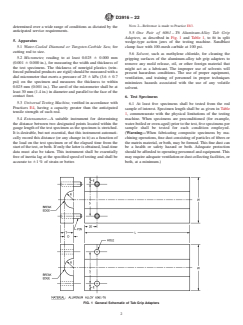
5.5 One Pair of 6061 – T6 Aluminum-Alloy Tab Grip
Adapters, as described in Fig. 1 and Table 1, to fit in split
5. Apparatus
wedge-type action jaws of the testing machine. Sandblast
5.1 Water-Cooled Diamond or Tungsten-Carbide Saw, for
clamp face with 100-mesh carbide at 100 psi.
cutting rod to size.
5.6 Solvent, such as methylene chloride, for cleaning the
5.2 Micrometer, reading to at least 0.025 6 0.000 mm
gripping surfaces of the aluminum-alloy tab grip adapters to
(0.001 6 0.000 in.), for measuring the width and thickness of
remove any mold release, oil, or other foreign material that
the test specimens. The thickness of nonrigid plastics (rein-
might act as a lubricant. The improper use of solvents will
forced pultruded products are rigid) should be measured with a
present hazardous conditions. The use of proper equipment,
dial micrometer that exerts a pressure of 25 6 kPa (3.6 6 0.7
ventilation, and training of personnel in proper techniques
psi) on the specimen and measures the thickness to within
minimizes hazards associated with the use of any volatile
0.025 mm (0.001 in.). The anvil of the micrometer shall be at
solvent.
least 30 mm (1.4 in.) in diameter and parallel to the face of the
contact foot.
6. Test Specimens
5.3 Universal Testing Machine, verified in accordance with
6.1 At least five specimens shall be tested from the rod
Practices E4, having a capacity greater than the anticipated
sample of interest. Specimen length shall be as given in Table
tensile strength of such rod.
1, commensurate with the physical limitations of the testing
5.4 Extensometer—A suitable instrument for determining machine. When specimens are preconditioned (for example,
the distance between two designated points located within the water-boiled or oven-aged) prior to the test, five specimens per
gauge length of the test specimen as the specimen is stretched. sample shall be tested for each condition employed.
It is desirable, but not essential, that this instrument automati- (Warning—When fabricating composite specimens by ma-
cally record this distance (or any change in it) as a function of chining operations, fine dust consisting of particles of fibers or
the load on the test specimen or of the elapsed time from the the matrix material, or both, may be formed. This fine dust can
start of the test, or both. If only the latter is obtained, load-time be a health or safety hazard or both. Adequate protection
data must also be taken. This instrument shall be essentially should be afforded to operating personnel and equipment. This
free of inertia lag at the specified speed of testing and shall be may require adequate ventilation or dust collecting facilities, or
accurate to 61 % of strain or better. both, at a minimum.)
FIG. 1 General Schematic of Tab Grip Adapters
D3916 − 22
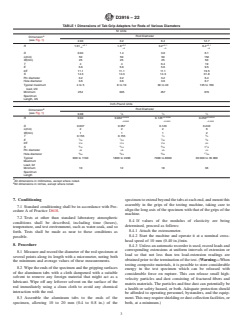
TABLE 1 Dimensions of Tab Grip Adapters for Rods of Various Diameters
SI Units
A Rod Diameter
Dimension
(see Fig. 1)
2.03 3.2 6.4 12.7
+0.1 +0.1 +0.1 +0.1
R 1.01 1.6 3.2 6.4
–0
−0 −0 −0
D 0.94 1.4 3.0 6.1
L(min) 50 50 50 152
W(min) 25 25 25 50
T 4 4 6.4 19
E 5.6 5.6 5.6 9.5
2E 11.1 11.1 11.1 19.5
S 14.3 14.3 14.3 31.8
Pin diameter 3.2 3.2 3.2 6.4
Hole diameter 3.6 3.6 3.6 6.7
Typical maximum 4 to 5 8 to 10 30 to 40 135 to 160
load, kN
Minimum 254 305 457 915
Specimen
Length, kN
Inch-Pound Units
B
Rod Diameter
Dimension
(see Fig. 1)
1 1 1
0.08 ⁄8 ⁄4 ⁄2
+0.004 +0.0004 +0.0004
R 0.04 0.062 0.125 0.250
−0.000 −0.000 −0.000
D 0.037 0.057 0.120 0.240
L(min) 2 2 2 6
W(min) 1 1 1 2
1 3
T 0.155 0.155 ⁄4 ⁄4
7 7 7 3
E ⁄32 ⁄32 ⁄32 ⁄8
7 7 7 3
2E ⁄16 ⁄16 ⁄16 ⁄4
9 9 9 1
S ⁄16 ⁄16 ⁄16 1 ⁄4
1 1 1 1
Pin diameter ⁄8 ⁄8 ⁄8 ⁄4
9 9 9 17
Hole diameter ⁄64 ⁄64 ⁄64 ⁄64
Typical 900 to 1100 1800 to 2200 7000 to 8000 30 000 to 35 000
Maximum
Load, lbf
Minimum 10 12 18 36
Specimen
Length
A
All dimensions in millimetres, except where noted.
B
All dimensions in inches, except where noted.
7. Conditioning specimen to extend beyond the tabs at each end, and mount this
assembly in the grips of the testing machine, taking care to
7.1 Standard conditioning shall be in accordance with Pro-
align the long axis of the specimen with that of the grips of the
cedure A of Practice D618.
machine.
7.2 Tests at other than standard laboratory atmospheric
8.4 If values of the modulus of elasticity are being
conditions shall be described, including time (hours),
determined, proceed as follows:
temperature, and test environment, such as water-soak, and so
8.4.1 Attach the extensometer.
forth. Tests shall be made as near to these conditions as
8.4.2 Start the machine and operate it at a nominal cross-
possible.
head speed of 10 mm (0.40 in.)/min.
8. Procedure 8.4.3 Unless an automatic recorder is used, record loads and
corresponding extensions at uniform intervals of extension or
8.1 Measure and record the diameter of the rod specimen at
load so that not less than ten load-extension readings are
several points along its length with a micrometer, noting both
obtained prior to the termination of the test. (Warning—When
the minimum and average values of these measurements.
testing composite materials, it is possible to store considerable
8.2 Wipe the ends of the specimen and the gripping surfaces
energy in the test specimen which can be released with
of the aluminum tabs with a cloth dampened with a suitable
considerable force on rupture. This can release small high-
solvent to remove any foreign material that might act as a
velocity particles and dust consisting of fractured fibers and
lubricant. Wipe off any leftover solvent on the surface of the
matrix materials. The particles and fine dust can potentially be
rod immediately using a cle
...
This document is not an ASTM standard and is intended only to provide the user of an ASTM standard an indication of what changes have been made to the previous version. Because
it may not be technically possible to adequately depict all changes accurately, ASTM recommends that users consult prior editions as appropriate. In all cases only the current version
of the standard as published by ASTM is to be considered the official document.
Designation: D3916 − 08 (Reapproved 2016) D3916 − 22
Standard Test Method for
Tensile Properties of Pultruded Glass-Fiber-Reinforced
Plastic Rod
This standard is issued under the fixed designation D3916; the number immediately following the designation indicates the year of
original adoption or, in the case of revision, the year of last revision. A number in parentheses indicates the year of last reapproval. A
superscript epsilon (´) indicates an editorial change since the last revision or reapproval.
This standard has been approved for use by agencies of the U.S. Department of Defense.
1. Scope Scope*
1.1 This test method describes a procedure for determining the tensile properties of a pultruded, glass-fiber-reinforced
thermosetting plastic rod of diameters ranging from 3.2 mm (2.03 mm (0.08 ⁄8 in.) to 25.4 mm (1 in.). Little test specimen12.7 mm
(0.5 in.). Test Method D7205/D7205M preparation is required; however, reusable aluminum tab grip adapters (is an alternative test
method to determine tensile propertiesFig. 1) of appropriate size are required to prevent premature failure of the specimens at the
grips. of fiber-reinforced composite rods of diameters bigger than 12.7 mm (0.5 in.).
1.2 The values stated in SI units are to be regarded as the standard. The values given in parentheses are for information only.
1.3 This standard does not purport to address all of the safety concerns, if any, associated with its use. It is the responsibility
of the user of this standard to establish appropriate safety and healthsafety, health, and environmental practices and determine
the applicability of regulatory limitations prior to use. Specific hazards statements are given in Note 36.1 and Note 48.4.3.
NOTE 1—There is no known ISO equivalent to this standard.
1.4 This international standard was developed in accordance with internationally recognized principles on standardization
established in the Decision on Principles for the Development of International Standards, Guides and Recommendations issued
by the World Trade Organization Technical Barriers to Trade (TBT) Committee.
2. Referenced Documents
2.1 ASTM Standards:
D618 Practice for Conditioning Plastics for Testing
D883 Terminology Relating to Plastics
D638D7205/D7205M Test Method for Tensile Properties of PlasticsFiber Reinforced Polymer Matrix Composite Bars
E4 Practices for Force Calibration and Verification of Testing Machines
E83 Practice for Verification and Classification of Extensometer Systems
E177 Practice for Use of the Terms Precision and Bias in ASTM Test Methods
E691 Practice for Conducting an Interlaboratory Study to Determine the Precision of a Test Method
This test method is under the jurisdiction of ASTM Committee D20 on Plastics and is the direct responsibility of Subcommittee D20.18 on Reinforced Thermosetting
Plastics.
Current edition approved April 1, 2016Dec. 15, 2022. Published April 2016January 2023. Originally approved in 1980. Last previous edition approved in 2008 as
D3916 - 08. DOI: 10.1520/D3916-08R16.2016 as D3916 - 08(2016). DOI: 10.1520/D3916-22.
For referenced ASTM standards, visit the ASTM website, www.astm.org, or contact ASTM Customer Service at service@astm.org. For Annual Book of ASTM Standards
volume information, refer to the standard’s Document Summary page on the ASTM website.
*A Summary of Changes section appears at the end of this standard
Copyright © ASTM International, 100 Barr Harbor Drive, PO Box C700, West Conshohocken, PA 19428-2959. United States
D3916 − 22
FIG. 1 General Schematic of Tab Grip Adapters
3. Terminology
3.1 For definitions of terms used in this standard and associated with plastics issues refer to the terminology contained in D883
unless otherwise specified.
4. Significance and Use
4.1 The high axial-tensile strength and the low transverse-compressive strength of pultruded rod combine to present some unique
problems in determining the tensile strength of this material with conventional test grips. The high transverse-compressive forces
generated in the conventional method of gripping tend to crush the rod, thereby causing premature failure. In this test method,
aluminum-alloy tabs contoured to the shape of the rod reduce the compressive forces imparted to the rod, thus overcoming the
deleterious influence of conventional test grips.
4.2 Tensile properties are influenced by specimen preparation, strain rate, thermal history, and the environmental conditions at the
time of testing. Consequently, where precise comparative results are desired, these factors must be carefully controlled.
4.3 Tensile properties provide useful data for many engineering design purposes. However, due to the high sensitivity of these
properties to strain rate, temperature, and other environmental conditions, data obtained by this test method shouldshall not, by
themselves, be considered for applications involving load-time scales or environmental conditions that differ widely from the test
conditions. In cases where such dissimilarities are apparent, the sensitivities to strain rate, including impact and creep, as well as
to the environment, shouldshall be determined over a wide range of conditions as dictated by the anticipated service requirements.
5. Apparatus
5.1 Water-Cooled Diamond or Tungsten-Carbide Saw, for cutting rod to size.
5.2 Micrometer, reading to at least 0.025 6 0.000 mm (0.001 6 0.000 in.), for measuring the width and thickness of the test
specimens. The thickness of nonrigid plastics (reinforced pultruded products are rigid) should be measured with a dial micrometer
D3916 − 22
that exerts a pressure of 25 6 kPa (3.6 6 0.7 psi) on the specimen and measures the thickness to within 0.025 mm (0.001 in.).
The anvil of the micrometer shall be at least 30 mm (1.4 in.) in diameter and parallel to the face of the contact foot.
5.3 Universal Testing Machine, verified in accordance with Practices E4, having a capacity of at least 530 kN (120 000 lbf) to
permit the testing of 25.4 mm (1 in.) diameter rod. Smaller-diameter rod may be tested on lower-capacity equipment,
commensurate with the greater than the anticipated tensile strength of such rod.
5.4 Extensometer—A suitable instrument for determining the distance between two designated points located within the gagegauge
length of the test specimen as the specimen is stretched. It is desirable, but not essential, that this instrument automatically record
this distance (or any change in it) as a function of the load on the test specimen or of the elapsed time from the start of the test,
or both. If only the latter is obtained, load-time data must also be taken. This instrument shall be essentially free of inertia lag at
the specified speed of testing and shall be accurate to 61 % of strain or better.
NOTE 2—Reference is made to Practice E83.
5.5 One Pair of 6061 – T6 Aluminum-Alloy Tab Grip Adapters, as described in Fig. 1 and Table 1, to fit in split wedge-type action
jaws of the testing machine. Sandblast clamp face with 100-mesh carbide at 100 psi.
5.6 Solvent, such as methylene chloride, for cleaning the gripping surfaces of the aluminum-alloy tab grip adapters to remove any
mold release, oil, or other foreign material that might act as a lubricant. The improper use of solvents canwill present hazardous
conditions. Use The use of proper equipment, ventilation, and training of personnel in proper techniques should be practiced to
minimize minimizes hazards associated with the use of any volatile solvent.
6. Test Specimens
6.1 At least five specimens shall be cuttested from the rod sample of interest. Specimen length shall be as great asgiven in Table
1possible,, commensurate with the physical limitations of the testing machine. When specimens are preconditioned (for example,
water-boiled or oven-aged) prior to the test, five specimens per sample shall be tested for each condition employed.
(Warning—When fabricating composite specimens by machining operations, fine dust consisting of particles of fibers or the
matrix material, or both, may be formed. This fine dust can be a health or safety hazard or both. Adequate protection should be
afforded to operating personnel and equipment. This may require adequate ventilation or dust collecting facilities, or both, at a
minimum.)
NOTE 3—Caution: When fabricating composite specimens by machining operations, a fine dust consisting of particles of fibers or the matrix material,
or both, may be formed. These fine dusts can be a health or safety hazard, or both. Adequate protection should be afforded operating personnel and
equipment. This may require adequate ventilation or dust collecting facilities, or both, at a minimum.
7. Conditioning
7.1 Standard conditioning shall be in accordance with Procedure A of Practice D618.
7.2 Tests at other than standard laboratory atmospheric conditions shouldshall be described, including time (hours), temperature,
and test environment, such as watersoak,water-soak, and so forth. Tests shouldshall be made as near to these conditions as possible.
7. Number of Test Specimens
7.1 At least five specimens shall be tested for each sample. When specimens are preconditioned (for example, water-boiled or
oven-aged) prior to test, five specimens per sample shall be tested for each condition employed.
8. Procedure
8.1 Measure and record the diameter of the rod specimen at several points along its length with a micrometer, noting both the
minimum and average values of these measurements.
8.2 Wipe the ends of the specimen and the gripping surfaces of the aluminum tabs with a cloth saturateddampened with a suitable
solvent to remove any foreign material that might act as a lubricant. Wipe off any leftover solvent on the surface of the rod
immediately using a clean cloth to avoid any chemical interaction with the rod.
D3916 − 22
TABLE 1 Dimensions of Tab Grip Adapters for Rods of Various Diameters
SI Units
A Rod Diameter
Dimension
(see Fig. 1)
3.2 6.4 12.7 19 22.2
+0.1 +0.1 +0.1 +0.1 +0.1
R 1.6 3.2 6.4 9.5 11.1
−0 −0 −0 −0 −0
D 1.4 3.0 6.1 9.0 10.1
L(min) 50 50 152 152 178
W(min) 25 25 50 57 64
T 4 6.4 19 19 19
E 5.6 5.6 9.5 9.5 9.5
2E 11.1 11.1 19.5 19.5 19.5
S 14.3 14.3 31.8 38.1 44.4
Pin diameter 3.2 3.2 6.4 6.4 6.4
Hole diameter 3.6 3.6 6.7 6.7 6.7
Typical maximum 8 to 10 30 to 40 135 to 160 300 to 360 400 to
load, kN
Minimum 305 457 914 1070 1170
specimen
length
Inch-Pound Units
B Rod Diameter
Dimension
(see Fig. 1)
1 1 1
⁄8 ⁄4 ⁄2
+0.004 +0.0004 +0.0004 +0.0004 +0.0004
R 0.062 0.125 0.250 0.375 0.438
−0.000 −0.000 −0.000 −0.000 −0.000
D 0.057 0.120 0.240 0.355 0.415
L(min) 2 2 6 6 7
1 1
W(min) 1 1 2 2 ⁄4 2 ⁄2
1 1 3 3
T 0.155 ⁄4 ⁄4 ⁄4 ⁄4
7 7 7 3 3
E ⁄32 ⁄32 ⁄32 ⁄8 ⁄8
7 7 7 3 3
2E ⁄16 ⁄16 ⁄16 ⁄4 ⁄4
9 9 9 1 3
S ⁄16 ⁄16 1 ⁄16 1 ⁄4 1 ⁄4
1 1 1 1 1
Pin diameter ⁄8 ⁄8 ⁄8 ⁄4 ⁄4
9 9 9 17 17
Hole diameter ⁄64 ⁄64 ⁄64 ⁄64 ⁄64
Typical maximum 1800 to 2200 7000 to 8000 30 000 to 65 000 to 80 000 90 000
load, 35 000
lbf
Minimum 12 18 36 42 46
specimen
length
TABLE 1 Dimensions of Tab Grip Adapters for Rods of Various Diameters
SI Units
A Rod Diameter
Dimension
(see Fig. 1)
2.03 3.2 6.4 12.7
+0.1 +0.1 +0.1 +0.1
R 1.01 1.6 3.2 6.4
–0
−0 −0 −0
D 0.94 1.4 3.0 6.1
L(min) 50 50 50 152
W(min) 25 25 25 50
T 4 4 6.4 19
E 5.6 5.6 5.6 9.5
2E 11.1 11.1 11.1 19.5
S 14.3 14.3 14.3 31.8
Pin diameter 3.2 3.2 3.2 6.4
Hole diameter 3.6 3.6 3.6 6.7
Typical maximum 4 to 5 8 to 10 30 to 40 135 to 160
load, kN
Minimum 254 305 457 915
Specimen
Length, kN
Inch-Pound Units
B
Rod Diameter
Dimension
(see Fig. 1)
1 1 1
0.08 ⁄8 ⁄4 ⁄2
+0.004 +0.0004 +0.0004
R 0.04 0.062 0.125 0.250
−0.000 −0.000 −0.000
D 0.037 0.057 0.120 0.240
L(min) 2 2 2 6
W(min) 1 1 1 2
1 3
T 0.155 0.155 ⁄4 ⁄4
7 7 7 3
E ⁄32 ⁄32 ⁄32 ⁄8
7 7 7 3
2E ⁄16 ⁄16 ⁄16 ⁄4
D3916 − 22
Inch-Pound Units
B Rod Diameter
Dimension
(see Fig. 1)
1 1 1
0.08 ⁄8 ⁄4 ⁄2
9 9 9 1
S ⁄16 ⁄16 ⁄16 1 ⁄4
1 1 1 1
Pin diameter ⁄8 ⁄8 ⁄8 ⁄4
9 9 9 17
Hole diameter ⁄64 ⁄64 ⁄64 ⁄64
Typical 900 to 1100 1800 to 2200 7000 to 8000 30 000 to 35 000
Maximum
Load, lbf
Minimum 10 12 18 36
Specimen
Length
A
AllAll dimensions in millimetres, except where noted.
B
AllAll dimensions in inches, except where noted.
8.3 Assemble the aluminum tabs to the ends of the specimen, allowing 10 to 20 mm (0.4 to 0.8 in.) of the specimen to extend
beyond the tabs at each end, and mount this assembly in the grips of the testing machine, taking care to align the long axis of the
specimen with that of the grips of the machine.
8.4 If values of the modulus of elasticity are being determined, proceed as follows:
8.4.1 Attach the extensometer.
8.4.2 Start the machine and operate it at a nominal crosshead speed of 5 mm (0.2010 mm (0.40 in.)/min.
8.4.3 Unless an automatic recorder is used, record loads an
...