

ASTM D4475-21
(Test Method)Standard Test Method for Apparent Horizontal Shear Strength of Pultruded Reinforced Plastic Rods By the Short-Beam Method
General Information
- Abstract
SIGNIFICANCE AND USE
5.1 Apparent shear strength determined by this test method is useful for quality control and specification purposes. It is also applicable to research and development programs concerned with interlaminar-shear strength. The apparent shear strength obtained by this test method is not intended for design purposes, but allowed to be utilized for comparative testing of composite materials, if all failures are in horizontal shear.
5.2 It is recommended that control samples be fabricated with each research test series and that care be used to compare each set of controls with corresponding test series run at different times.
SCOPE
1.1 This test method covers the determination of the apparent horizontal shear strength of fiber reinforced plastic rods. The specimen is a short beam in the form of lengths of pultruded rods. This test method is applicable to all types of parallel-fiber-reinforced plastic rod samples.
1.2 This test method is primarily used for quality control and specification purposes (see 5.1).
1.3 The values stated in SI units are to be regarded as standard.
1.4 This standard does not purport to address all of the safety concerns, if any, associated with its use. It is the responsibility of the user of this standard to establish appropriate safety, health, and environmental practices and determine the applicability of regulatory limitations prior to use.
Note 1: There is no known ISO equivalent to this standard.
1.5 This international standard was developed in accordance with internationally recognized principles on standardization established in the Decision on Principles for the Development of International Standards, Guides and Recommendations issued by the World Trade Organization Technical Barriers to Trade (TBT) Committee.
- Status
- Published
- Publication Date
- 30-Jun-2021
- Technical Committee
- D20 - Plastics
- Drafting Committee
- D20.18 - Reinforced Thermosetting Plastics
Buy Documents

ASTM D4475-21 - Standard Test Method for Apparent Horizontal Shear Strength of Pultruded Reinforced Plastic Rods By the Short-Beam Method
REDLINE ASTM D4475-21 - Standard Test Method for Apparent Horizontal Shear Strength of Pultruded Reinforced Plastic Rods By the Short-Beam Method
Overview
ASTM D4475-21 - Standard Test Method for Apparent Horizontal Shear Strength of Pultruded Reinforced Plastic Rods By the Short-Beam Method - provides a test procedure for determining the apparent horizontal shear strength of fiber reinforced, pultruded plastic rods using a short-beam method. This method is specifically applicable to parallel-fiber-reinforced plastic rod samples. The results are intended primarily for quality control, specification compliance, and research and development purposes, especially for assessing interlaminar-shear strength of composite materials.
This standard is not meant for design applications but serves as an effective means for comparative testing of composite rods, provided all failures are horizontal shear in nature. It establishes a consistent and standardized approach, ensuring reliable and repeatable results across different laboratories and test campaigns.
Key Topics
- Test Methodology: Outlines the procedure for horizontal shear testing of pultruded reinforced plastic rods using a short beam configuration, where the specimen is subjected to center-point loading until failure occurs.
- Applicability: Designed for all types of parallel-fiber-reinforced plastic rod specimens, including various fiber architectures and resin systems.
- Quality Control: Provides a trusted means of verifying product uniformity and batch-to-batch consistency during manufacturing.
- Comparative Testing: Enables research and development teams to compare the interlaminar-shear properties of different composite formulations, preconditioning regimes, or processing methods.
- Specimen Preparation: Specifies requirements for specimen cutting, dimensions, and measurements to ensure consistency and adequate representation of the tested material.
- Precision and Repeatability: Includes detailed notes on repeatability within a laboratory and reproducibility between laboratories, emphasizing the use of control samples and proper test documentation.
- Safety and Compliance: Reminds users to address all relevant safety, health, and environmental concerns in accordance with applicable regulations.
Applications
This standard holds significant value for manufacturers, quality assurance teams, and R&D specialists working with glass or carbon fiber-reinforced pultruded plastic rods. Common application areas include:
- Manufacturing Quality Assurance: Use as a routine quality control check to ensure pultruded rod products meet predefined shear strength specifications.
- Material Qualification: Assessment of new supplier materials, resins, or fiber types by comparing their apparent shear strengths using a standardized methodology.
- Product Development: Supporting performance evaluation of innovative pultrusion formulations and process modifications.
- Research Programs: Comparing the effects of environmental conditioning, aging, or exposure on the horizontal shear strength of pultruded composites.
- Specification Compliance: Facilitates consistent communication and compliance between suppliers and end-users regarding product performance.
Related Standards
For complete and accurate testing in accordance with ASTM D4475-21, the following referenced ASTM standards are relevant:
- ASTM D618: Practice for Conditioning Plastics for Testing - details pre-test conditioning for consistent specimen moisture and temperature state.
- ASTM D883: Terminology Relating to Plastics - defines general terms used in the plastics industry.
- ASTM E4: Practices for Force Verification of Testing Machines - ensures calibration and reliability of the load measurement apparatus.
- ASTM E456: Terminology Relating to Quality and Statistics - provides key terms relating to test precision and bias.
- ASTM E691: Practice for Conducting an Interlaboratory Study to Determine the Precision of a Test Method - guidelines for studies that demonstrate reproducibility and accuracy across multiple labs.
Note: There is currently no ISO equivalent to ASTM D4475-21, making this standard the key reference for horizontal shear testing of pultruded composite rods worldwide.
Optimize your material selection and ensure the mechanical integrity of fiber-reinforced pultruded rods with ASTM D4475-21, the industry standard for evaluating apparent horizontal shear strength using the short-beam method.
Relations
- Effective Date
- 01-Feb-2024
- Effective Date
- 01-Nov-2023
- Effective Date
- 01-Apr-2022
- Effective Date
- 01-Jan-2020
- Effective Date
- 01-Aug-2019
- Effective Date
- 15-Apr-2019
- Effective Date
- 01-Feb-2019
- Effective Date
- 01-Dec-2018
- Effective Date
- 01-Nov-2018
- Effective Date
- 01-Oct-2017
- Effective Date
- 01-Oct-2017
- Effective Date
- 15-Aug-2017
- Effective Date
- 01-Jun-2014
- Effective Date
- 15-Nov-2013
- Effective Date
- 15-Nov-2013
Buy Documents
ASTM D4475-21 - Standard Test Method for Apparent Horizontal Shear Strength of Pultruded Reinforced Plastic Rods By the Short-Beam Method
REDLINE ASTM D4475-21 - Standard Test Method for Apparent Horizontal Shear Strength of Pultruded Reinforced Plastic Rods By the Short-Beam Method
Get Certified
Connect with accredited certification bodies for this standard

DIN CERTCO
DIN Group product certification.

Smithers Quality Assessments
US management systems and product certification.
Sponsored listings
Frequently Asked Questions
ASTM D4475-21 is a standard published by ASTM International. Its full title is "Standard Test Method for Apparent Horizontal Shear Strength of Pultruded Reinforced Plastic Rods By the Short-Beam Method". This standard covers: SIGNIFICANCE AND USE 5.1 Apparent shear strength determined by this test method is useful for quality control and specification purposes. It is also applicable to research and development programs concerned with interlaminar-shear strength. The apparent shear strength obtained by this test method is not intended for design purposes, but allowed to be utilized for comparative testing of composite materials, if all failures are in horizontal shear. 5.2 It is recommended that control samples be fabricated with each research test series and that care be used to compare each set of controls with corresponding test series run at different times. SCOPE 1.1 This test method covers the determination of the apparent horizontal shear strength of fiber reinforced plastic rods. The specimen is a short beam in the form of lengths of pultruded rods. This test method is applicable to all types of parallel-fiber-reinforced plastic rod samples. 1.2 This test method is primarily used for quality control and specification purposes (see 5.1). 1.3 The values stated in SI units are to be regarded as standard. 1.4 This standard does not purport to address all of the safety concerns, if any, associated with its use. It is the responsibility of the user of this standard to establish appropriate safety, health, and environmental practices and determine the applicability of regulatory limitations prior to use. Note 1: There is no known ISO equivalent to this standard. 1.5 This international standard was developed in accordance with internationally recognized principles on standardization established in the Decision on Principles for the Development of International Standards, Guides and Recommendations issued by the World Trade Organization Technical Barriers to Trade (TBT) Committee.
SIGNIFICANCE AND USE 5.1 Apparent shear strength determined by this test method is useful for quality control and specification purposes. It is also applicable to research and development programs concerned with interlaminar-shear strength. The apparent shear strength obtained by this test method is not intended for design purposes, but allowed to be utilized for comparative testing of composite materials, if all failures are in horizontal shear. 5.2 It is recommended that control samples be fabricated with each research test series and that care be used to compare each set of controls with corresponding test series run at different times. SCOPE 1.1 This test method covers the determination of the apparent horizontal shear strength of fiber reinforced plastic rods. The specimen is a short beam in the form of lengths of pultruded rods. This test method is applicable to all types of parallel-fiber-reinforced plastic rod samples. 1.2 This test method is primarily used for quality control and specification purposes (see 5.1). 1.3 The values stated in SI units are to be regarded as standard. 1.4 This standard does not purport to address all of the safety concerns, if any, associated with its use. It is the responsibility of the user of this standard to establish appropriate safety, health, and environmental practices and determine the applicability of regulatory limitations prior to use. Note 1: There is no known ISO equivalent to this standard. 1.5 This international standard was developed in accordance with internationally recognized principles on standardization established in the Decision on Principles for the Development of International Standards, Guides and Recommendations issued by the World Trade Organization Technical Barriers to Trade (TBT) Committee.
ASTM D4475-21 is classified under the following ICS (International Classification for Standards) categories: 83.120 - Reinforced plastics. The ICS classification helps identify the subject area and facilitates finding related standards.
ASTM D4475-21 has the following relationships with other standards: It is inter standard links to ASTM D883-24, ASTM D883-23, ASTM E456-13a(2022)e1, ASTM D883-20, ASTM D883-19c, ASTM D883-19a, ASTM D883-19, ASTM D883-18a, ASTM D883-18, ASTM E456-13A(2017)e3, ASTM E456-13A(2017)e1, ASTM D883-17, ASTM E4-14, ASTM E456-13ae3, ASTM E456-13ae1. Understanding these relationships helps ensure you are using the most current and applicable version of the standard.
ASTM D4475-21 is available in PDF format for immediate download after purchase. The document can be added to your cart and obtained through the secure checkout process. Digital delivery ensures instant access to the complete standard document.
Standards Content (Sample)
This international standard was developed in accordance with internationally recognized principles on standardization established in the Decision on Principles for the
Development of International Standards, Guides and Recommendations issued by the World Trade Organization Technical Barriers to Trade (TBT) Committee.
Designation:D4475 −21
Standard Test Method for
Apparent Horizontal Shear Strength of Pultruded Reinforced
Plastic Rods By the Short-Beam Method
This standard is issued under the fixed designation D4475; the number immediately following the designation indicates the year of
original adoption or, in the case of revision, the year of last revision. A number in parentheses indicates the year of last reapproval. A
superscript epsilon (´) indicates an editorial change since the last revision or reapproval.
1. Scope* 3. Terminology
1.1 This test method covers the determination of the appar- 3.1 Terms used in this standard are defined in accordance
ent horizontal shear strength of fiber reinforced plastic rods. with Terminology D883, unless otherwise specified. For terms
The specimen is a short beam in the form of lengths of relating to precision and bias and associated issues, the terms
pultruded rods. This test method is applicable to all types of used in this standard are defined in accordance with Terminol-
parallel-fiber-reinforced plastic rod samples. ogy E456.
1.2 This test method is primarily used for quality control
4. Summary of Test Method
and specification purposes (see 5.1).
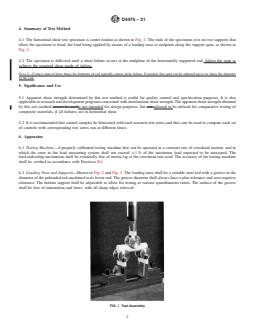
4.1 The horizontal-shear test specimen is center-loaded as
1.3 The values stated in SI units are to be regarded as
shown in Fig. 1. The ends of the specimens rest on two
standard.
supports that allow the specimen to bend, the load being
1.4 This standard does not purport to address all of the
applied by means of a loading nose at midpoint along the
safety concerns, if any, associated with its use. It is the
support span, as shown in Fig. 2.
responsibility of the user of this standard to establish appro-
4.2 The specimen is deflected until a shear failure occurs at
priate safety, health, and environmental practices and deter-
the midplane of the horizontally supported rod.Adjust the span
mine the applicability of regulatory limitations prior to use.
to achieve the required shear mode of failure.
NOTE 1—There is no known ISO equivalent to this standard. NOTE 2—Using a span of three times the diameter of rod typically
causes shear failure. If needed, that span can be adjusted up to six times
1.5 This international standard was developed in accor-
the diameter of the rod.
dance with internationally recognized principles on standard-
ization established in the Decision on Principles for the
5. Significance and Use
Development of International Standards, Guides and Recom-
5.1 Apparent shear strength determined by this test method
mendations issued by the World Trade Organization Technical
is useful for quality control and specification purposes. It is
Barriers to Trade (TBT) Committee.
also applicable to research and development programs con-
cerned with interlaminar-shear strength. The apparent shear
2. Referenced Documents
strength obtained by this test method is not intended for design
2.1 ASTM Standards:
purposes, but allowed to be utilized for comparative testing of
D618 Practice for Conditioning Plastics for Testing
composite materials, if all failures are in horizontal shear.
D883 Terminology Relating to Plastics
5.2 It is recommended that control samples be fabricated
E4 Practices for Force Verification of Testing Machines
with each research test series and that care be used to compare
E456 Terminology Relating to Quality and Statistics
each set of controls with corresponding test series run at
E691 Practice for Conducting an Interlaboratory Study to
different times.
Determine the Precision of a Test Method
6. Apparatus
This test method is under the jurisdiction ofASTM Committee D20 on Plastics
6.1 TestingMachine—Aproperly calibrated testing machine
and is the direct responsibility of Subcommittee D20.18 on Reinforced Thermoset-
that can be operated at a constant rate of crosshead motion, and
ting Plastics.
in which the error in the load measuring system shall not
Current edition approved July 1, 2021. Published July 2021. Originally approved
exceed 61 % of the maximum load expected to be measured.
in 1985. Last previous edition approved in 2016 as D4475 - 02(2016). DOI:
10.1520/D4475-21.
The load-indicating mechanism shall be essentially free of
For referenced ASTM standards, visit the ASTM website, www.astm.org, or
inertia lag at the crosshead rate used. The accuracy of the
contact ASTM Customer Service at service@astm.org. For Annual Book of ASTM
testing machine shall be verified in accordance with Practices
Standards volume information, refer to the standard’s Document Summary page on
the ASTM website. E4.
*A Summary of Changes section appears at the end of this standard
Copyright © ASTM International, 100 Barr Harbor Drive, PO Box C700, West Conshohocken, PA 19428-2959. United States
D4475−21
FIG. 3 Anvil Dimensions
FIG. 1 Test Assembly
7.2 NumberofSpecimens—The number of test specimens is
optional. However, a minimum of five specimens is required to
obtain a satisfactory average and standard deviation.
8. Conditioning
8.1 Conditioning—Condition the test specimens at 23 6
2°C(73.4 63.6°F)and50 65 %relativehumidityfornotless
than 40 h prior to test, in accordance with Procedure A of
PracticeD618forthosetestswhereconditioningisrequired.In
cases of disagreement, the tolerances shall be 61°C (61.8°F)
and 62 % relative humidity. These conditions are recom-
mended for research and development trials, but not necessar-
ily for quality control. However, temperature control to 22.2 6
5.6°C (72 6 10°F) is recommended for quality control.
8.2 Test Conditions—Conduct tests in the standard labora-
tory atmosphere of 23 6 2°C (73.4 6 3.6°F) and 50 6 5%
relative humidity, unless otherwise specified in the test meth-
FIG. 2 Span Configuration for a Span of L Units
ods. In cases of disagreement, the tolerances shall be 61°C
(61.8°F) and 62 % relative humidity.
8.3 Preconditioning in other environments to simulate
6.2 Loading Nose and Supports—Shown in Fig. 2 and Fig.
specified conditions and durations is permissible.
3. The loading nose shall be a suitable steel rod with a groove
in the diameter of the pultruded rod machined in its lower end.
8.4 Testing in other environmental conditions is permis-
The groove diameter shall always have a plus tolerance and
sible.
zero negative tolerance.The bottom support shall be adjustable
to allow for testing at various span/diameter ratios.The surface
9. Speed of Testing
of the groove shall be free of indentation and burrs, with all
9.1 Test the specimen at a rate of crosshead motion of 1.3
sharp edges relieved.
mm (0.05 in.)/min.
6.3 Micrometers—Suitable micrometers for measuring the
NOTE 3—The test time should be recorded, and, if the test takes less
diameter of the test specimen to an incremental discrimination
than 20 s, the rate of crosshead motion should be decreased. If the test
of at least 0.025 mm (0.001 in.) shall be used.
takes over 200 s, the crosshead rate should be increased gradually, or in
steps, until the time to complete the test is less than 200 s.
7. Test Specimen
10. Procedure
7.1 The specimen shall be cut from the pultruded rod to a
length of one diameter greater than the test span and to a 10.1 Beforeconditioningortesting,measurethediameterof
tolerance of plus or minus 0.1 times the diameter. each specimen to the nearest 0.025 mm (0.001 in.) at midpoint.
D4475−21
10.2 Place the rod test specimen in the test fixture, as shown 12. Calculations
in Fig. 1. Align the specimen so that its midpoint
...
This document is not an ASTM standard and is intended only to provide the user of an ASTM standard an indication of what changes have been made to the previous version. Because
it may not be technically possible to adequately depict all changes accurately, ASTM recommends that users consult prior editions as appropriate. In all cases only the current version
of the standard as published by ASTM is to be considered the official document.
Designation: D4475 − 02 (Reapproved 2016) D4475 − 21
Standard Test Method for
Apparent Horizontal Shear Strength of Pultruded Reinforced
Plastic Rods By the Short-Beam Method
This standard is issued under the fixed designation D4475; the number immediately following the designation indicates the year of
original adoption or, in the case of revision, the year of last revision. A number in parentheses indicates the year of last reapproval. A
superscript epsilon (´) indicates an editorial change since the last revision or reapproval.
1. Scope Scope*
1.1 This test method covers the determination of the apparent horizontal shear strength of fiber reinforced plastic rods. The
specimen is a short beam in the form of lengths of pultruded rods. This test method is applicable to all types of
parallel-fiber-reinforced plastic rod samples.
1.2 This test method is primarily used for quality control and specification purposes (see 4.15.1).
1.3 The values stated in SI units are to be regarded as standard.
1.4 This standard does not purport to address all of the safety concerns, if any, associated with its use. It is the responsibility
of the user of this standard to establish appropriate safety safety, health, and healthenvironmental practices and determine the
applicability of regulatory limitations prior to use.
NOTE 1—There is no known ISO equivalent to this standard.
1.5 This international standard was developed in accordance with internationally recognized principles on standardization
established in the Decision on Principles for the Development of International Standards, Guides and Recommendations issued
by the World Trade Organization Technical Barriers to Trade (TBT) Committee.
2. Referenced Documents
2.1 ASTM Standards:
D618 Practice for Conditioning Plastics for Testing
D883 Terminology Relating to Plastics
E4 Practices for Force Verification of Testing Machines
E456 Terminology Relating to Quality and Statistics
E691 Practice for Conducting an Interlaboratory Study to Determine the Precision of a Test Method
3. Terminology
3.1 Terms used in this standard are defined in accordance with Terminology D883, unless otherwise specified. For terms relating
to precision and bias and associated issues, the terms used in this standard are defined in accordance with Terminology E456.
This test method is under the jurisdiction of ASTM Committee D20 on Plastics and is the direct responsibility of Subcommittee D20.18 on Reinforced Thermosetting
Plastics.
Current edition approved April 1, 2016July 1, 2021. Published April 2016July 2021. Originally approved in 1985. Last previous edition approved in 20082016 as
D4475 - 02(2008).D4475 - 02(2016). DOI: 10.1520/D4475-02R16.10.1520/D4475-21.
For referenced ASTM standards, visit the ASTM website, www.astm.org, or contact ASTM Customer Service at service@astm.org. For Annual Book of ASTM Standards
volume information, refer to the standard’s Document Summary page on the ASTM website.
*A Summary of Changes section appears at the end of this standard
Copyright © ASTM International, 100 Barr Harbor Drive, PO Box C700, West Conshohocken, PA 19428-2959. United States
D4475 − 21
4. Summary of Test Method
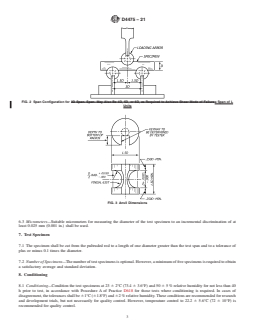
4.1 The horizontal-shear test specimen is center-loaded as shown in Fig. 1. The ends of the specimens rest on two supports that
allow the specimen to bend, the load being applied by means of a loading nose at midpoint along the support span, as shown in
Fig. 2.
4.2 The specimen is deflected until a shear failure occurs at the midplane of the horizontally supported rod. Adjust the span to
achieve the required shear mode of failure.
NOTE 2—Using a span of three times the diameter of rod typically causes shear failure. If needed, that span can be adjusted up to six times the diameter
of the rod.
5. Significance and Use
5.1 Apparent shear strength determined by this test method is useful for quality control and specification purposes. It is also
applicable to research and development programs concerned with interlaminar-shear strength. The apparent shear strength obtained
by this test method cannot be usedis not intended for design purposes, but can allowed to be utilized for comparative testing of
composite materials, if all failures are in horizontal shear.
5.2 It is recommended that control samples be fabricated with each research test series and that care be used to compare each set
of controls with corresponding test series run at different times.
6. Apparatus
6.1 Testing Machine—A properly calibrated testing machine that can be operated at a constant rate of crosshead motion, and in
which the error in the load measuring system shall not exceed 61 % of the maximum load expected to be measured. The
load-indicating mechanism shall be essentially free of inertia lag at the crosshead rate used. The accuracy of the testing machine
shall be verified in accordance with Practices E4.
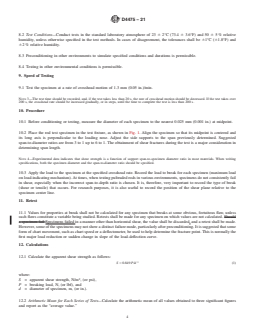
6.2 Loading Nose and Supports—Shown in Fig. 2 and Fig. 3. The loading nose shall be a suitable steel rod with a groove in the
diameter of the pultruded rod machined in its lower end. The groove diameter shall always have a plus tolerance and zero negative
tolerance. The bottom support shall be adjustable to allow for testing at various span/diameter ratios. The surface of the groove
shall be free of indentation and burrs, with all sharp edges relieved.
FIG. 1 Test Assembly
D4475 − 21
FIG. 2 Span Configuration for 3D Span. Span. May Also Be 4D, 5D, or 6D, as Required to Achieve Shear Mode of Failurea Span of L
Units
FIG. 3 Anvil Dimensions
6.3 Micrometers—Suitable micrometers for measuring the diameter of the test specimen to an incremental discrimination of at
least 0.025 mm (0.001 in.) shall be used.
7. Test Specimen
7.1 The specimen shall be cut from the pultruded rod to a length of one diameter greater than the test span and to a tolerance of
plus or minus 0.1 times the diameter.
7.2 Number of Specimens—The number of test specimens is optional. However, a minimum of five specimens is required to obtain
a satisfactory average and standard deviation.
8. Conditioning
8.1 Conditioning—Condition the test specimens at 23 6 2°C (73.4 6 3.6°F) and 50 6 5 % relative humidity for not less than 40
h prior to test, in accordance with Procedure A of Practice D618 for those tests where conditioning is required. In cases of
disagreement, the tolerances shall be 61°C (61.8°F) and 62 % relative humidity. These conditions are recommended for research
and development trials, but not necessarily for quality control. However, temperature control to 22.2 6 5.6°C (72 6 10°F) is
recommended for quality control.
D4475 − 21
8.2 Test Conditions—Conduct tests in the standard laboratory atmosphere of 23 6 2°C (73.4 6 3.6°F) and 50 6 5 % relative
humidity, unless otherwise specified in the test methods. In cases of disagreement, the tolerances shall be 61°C (61.8°F) and
62 % relative humidity.
8.3 Preconditioning in other environments to simulate specified conditions and durations is permissible.
8.4 Testing in other environmental conditions is permissible.
9. Speed of Testing
9.1 Test the specimen at a rate of crosshead motion of 1.3 mm (0.05 in.)/min.
NOTE 3—The test time should be recorded, and, if the test takes less than 20 s, the rate of crosshead motion should be decreased. If the test takes over
200 s, the crosshead rate should be increased gradually, or in steps, until the time to complete the test is less than 200 s.
10. Procedure
10.1 Before conditioning or testing, measure the diameter of each specimen to the nearest 0.025 mm (0.001 in.) at midpoint.
10.2 Place the rod test specimen in the test fixture, as shown in Fig. 1. Align the specimen so that its midpoint is centered and
its long axis is perpendicular to the loading nose. Adjust the side supports to the span previously determined. Suggested
span-to-diameter ratios are from 3 to 1 up to 6 to 1. The obtainment of shear fractures during the test is a major consideration in
determining span length.
NOTE 4—Experimental data indicates that shear strength is a function of support span-to-specimen diameter ratio in most materials. When writing
specifications, both the specimen diameter and the span-to-diameter ratio should be specified.
10.3 Apply the load to the specimen at the specified crosshead rate. Record the load to break for each specimen (maximum load
on load-indicating mechanism). At times, when testing pultruded rods in various environments, specimens do not consistently fail
in shea
...