

ASTM C1841-23
(Specification)Standard Specification for Interior Radiation Control Coating (IRCC) for Building Applications
General Information
- Abstract
SCOPE
1.1 This specification covers the classification, composition, and physical properties of an Interior Radiation Control Coating (IRCC) for use in building applications to reduce radiant heat transfer. The IRCC is sprayed, roller applied, or brushed onto interior building surfaces.
1.2 The values stated in inch-pound units are to be regarded as standard. The values given in parentheses are mathematical conversions to SI units that are provided for information only and are not considered standard.
1.3 This standard does not purport to address all of the safety concerns, if any, associated with its use. It is the responsibility of the user of this standard to establish appropriate safety, health, and environmental practices and determine the applicability of regulatory limitations prior to use.
1.4 This international standard was developed in accordance with internationally recognized principles on standardization established in the Decision on Principles for the Development of International Standards, Guides and Recommendations issued by the World Trade Organization Technical Barriers to Trade (TBT) Committee.
- Status
- Published
- Publication Date
- 30-Apr-2023
- Technical Committee
- C16 - Thermal Insulation
- Drafting Committee
- C16.21 - Reflective Insulation
Buy Documents

ASTM C1841-23 - Standard Specification for Interior Radiation Control Coating (IRCC) for Building Applications
REDLINE ASTM C1841-23 - Standard Specification for Interior Radiation Control Coating (IRCC) for Building Applications
Overview
ASTM C1841-23: Standard Specification for Interior Radiation Control Coating (IRCC) for Building Applications establishes essential requirements for classifying, composing, and testing IRCC products used in buildings. Interior radiation control coatings are specialty, low-emittance liquid coatings applied to interior surfaces in building environments to reduce radiant heat transfer. They play a crucial role in improving energy efficiency, occupant comfort, and, potentially, indoor air quality by controlling thermal radiation inside structures. This standard details application methods, property requirements, and testing protocols to ensure consistent performance and quality for both manufacturers and users.
Key Topics
- Classification and Types
- Two main types based on emittance:
- Type 1: Emittance ≤ 0.15
- Type 2: Emittance > 0.15 and ≤ 0.25
- Two main types based on emittance:
- Physical Properties
- Emittance: Lower emittance values indicate greater resistance to radiant heat transfer.
- Water Vapor Permeance: Minimum value required is >10 perms for breathability and moisture management.
- Surface Burning Characteristics: Must not degrade the substrate’s fire performance class rating.
- Mold Resistance: Performance is evaluated and reported for both coated and uncoated substrates.
- Material Composition
- Products are supplied as either premixed or field-mixed liquids, including binders, pigments, and necessary additives for desired performance.
- Application Methods
- IRCCs may be sprayed, roller-applied, or brushed onto interior building surfaces following manufacturer recommendations.
- Testing and Reporting
- Testing includes measurement of emittance, water vapor permeability, surface burning characteristics, and mold resistance using referenced ASTM test methods.
- Comprehensive reporting requirements include details on composition, application type, substrates tested, coating thickness, test results, and fire class ratings.
Applications
IRCC products specified by ASTM C1841-23 are widely used in:
- Commercial and Residential Buildings:
Application on walls, ceilings, or roofs to enhance energy performance by reducing unwanted radiant heat gain or loss. - Industrial Facilities:
Control of radiant heat in warehouses, factories, and other large-volume spaces to optimize HVAC loads and occupant comfort. - Retrofit and New Construction:
Suitable for both new projects seeking high thermal performance standards and retrofit applications aiming to improve existing structures. - Sustainable Design:
Used as a part of strategies for green building certification, improving envelope performance, and supporting lower operating energy costs.
Value and Benefits:
- Reduces HVAC energy consumption by limiting radiant heat transfer.
- Maintains substrate fire-safety classifications, supporting compliance and safety.
- Enhances indoor environmental quality through resistance to mold growth.
- Flexible application methods suitable for various substrates and project requirements.
- Promotes the longevity of building materials by controlling moisture and minimizing surface contamination.
Related Standards
Several related ASTM standards support the specification, application, and testing of IRCCs, providing an interconnected approach to thermal insulation and building material safety:
- ASTM C168 – Terminology relating to thermal insulation.
- ASTM C1321 – Practice for installation and use of IRCC systems.
- ASTM C1371 – Test method for determination of emittance of materials.
- ASTM D1653, ASTM E96 – Test methods for water vapor transmission.
- ASTM E84 – Test method for surface burning characteristics of building materials.
- ASTM D3273, D3274 – Methods for evaluating resistance to mold and surface disfigurement.
Additional standards from CSA and NIST referenced in ASTM C1841-23 include requirements for plywood and fiber-cement substrates.
Keywords: interior radiation control coating, IRCC, ASTM C1841, low emittance, spray applied coating, radiant heat control, building energy efficiency, mold-resistant coating, water vapor permeance, building standards, fire safety.
Relations
- Effective Date
- 15-Apr-2024
- Effective Date
- 15-Jan-2024
- Effective Date
- 01-Jan-2024
- Effective Date
- 01-Dec-2023
- Effective Date
- 01-Sep-2023
- Effective Date
- 01-Mar-2020
- Effective Date
- 01-Jul-2019
- Effective Date
- 15-Apr-2019
- Effective Date
- 01-Mar-2019
- Effective Date
- 01-Mar-2019
- Effective Date
- 01-Oct-2018
- Effective Date
- 01-Jul-2018
- Effective Date
- 15-Apr-2018
- Effective Date
- 01-Mar-2018
- Effective Date
- 01-Nov-2017
Buy Documents
ASTM C1841-23 - Standard Specification for Interior Radiation Control Coating (IRCC) for Building Applications
REDLINE ASTM C1841-23 - Standard Specification for Interior Radiation Control Coating (IRCC) for Building Applications
Get Certified
Connect with accredited certification bodies for this standard

DIBt (Deutsches Institut für Bautechnik)
German Institute for Building Technology.
DIN CERTCO
DIN Group product certification.

Kiwa BDA Testing
Building and construction product certification.
Sponsored listings
Frequently Asked Questions
ASTM C1841-23 is a technical specification published by ASTM International. Its full title is "Standard Specification for Interior Radiation Control Coating (IRCC) for Building Applications". This standard covers: SCOPE 1.1 This specification covers the classification, composition, and physical properties of an Interior Radiation Control Coating (IRCC) for use in building applications to reduce radiant heat transfer. The IRCC is sprayed, roller applied, or brushed onto interior building surfaces. 1.2 The values stated in inch-pound units are to be regarded as standard. The values given in parentheses are mathematical conversions to SI units that are provided for information only and are not considered standard. 1.3 This standard does not purport to address all of the safety concerns, if any, associated with its use. It is the responsibility of the user of this standard to establish appropriate safety, health, and environmental practices and determine the applicability of regulatory limitations prior to use. 1.4 This international standard was developed in accordance with internationally recognized principles on standardization established in the Decision on Principles for the Development of International Standards, Guides and Recommendations issued by the World Trade Organization Technical Barriers to Trade (TBT) Committee.
SCOPE 1.1 This specification covers the classification, composition, and physical properties of an Interior Radiation Control Coating (IRCC) for use in building applications to reduce radiant heat transfer. The IRCC is sprayed, roller applied, or brushed onto interior building surfaces. 1.2 The values stated in inch-pound units are to be regarded as standard. The values given in parentheses are mathematical conversions to SI units that are provided for information only and are not considered standard. 1.3 This standard does not purport to address all of the safety concerns, if any, associated with its use. It is the responsibility of the user of this standard to establish appropriate safety, health, and environmental practices and determine the applicability of regulatory limitations prior to use. 1.4 This international standard was developed in accordance with internationally recognized principles on standardization established in the Decision on Principles for the Development of International Standards, Guides and Recommendations issued by the World Trade Organization Technical Barriers to Trade (TBT) Committee.
ASTM C1841-23 is classified under the following ICS (International Classification for Standards) categories: 13.280 - Radiation protection; 91.120.99 - Other standards related to protection of and in buildings. The ICS classification helps identify the subject area and facilitates finding related standards.
ASTM C1841-23 has the following relationships with other standards: It is inter standard links to ASTM C168-24, ASTM D4708-24, ASTM D16-24, ASTM E84-23d, ASTM E84-23c, ASTM C1321-15(2020), ASTM E84-19b, ASTM E84-19a, ASTM D4708-19, ASTM E84-19, ASTM E84-18b, ASTM E84-18a, ASTM C168-18, ASTM E84-18, ASTM E84-17a. Understanding these relationships helps ensure you are using the most current and applicable version of the standard.
ASTM C1841-23 is available in PDF format for immediate download after purchase. The document can be added to your cart and obtained through the secure checkout process. Digital delivery ensures instant access to the complete standard document.
Standards Content (Sample)
This international standard was developed in accordance with internationally recognized principles on standardization established in the Decision on Principles for the
Development of International Standards, Guides and Recommendations issued by the World Trade Organization Technical Barriers to Trade (TBT) Committee.
Designation: C1841 − 23
Standard Specification for
Interior Radiation Control Coating (IRCC) for Building
Applications
This standard is issued under the fixed designation C1841; the number immediately following the designation indicates the year of
original adoption or, in the case of revision, the year of last revision. A number in parentheses indicates the year of last reapproval. A
superscript epsilon (´) indicates an editorial change since the last revision or reapproval.
1. Scope C1396 Specification for Gypsum Board
D16 Terminology for Paint, Related Coatings, Materials, and
1.1 This specification covers the classification, composition,
Applications
and physical properties of an Interior Radiation Control Coat-
D1653 Test Methods for Water Vapor Transmission of Or-
ing (IRCC) for use in building applications to reduce radiant
ganic Coating Films
heat transfer. The IRCC is sprayed, roller applied, or brushed
D3273 Test Method for Resistance to Growth of Mold on the
onto interior building surfaces.
Surface of Interior Coatings in an Environmental Cham-
1.2 The values stated in inch-pound units are to be regarded
ber
as standard. The values given in parentheses are mathematical
D3274 Test Method for Evaluating Degree of Surface Dis-
conversions to SI units that are provided for information only
figurement of Paint Films by Fungal or Algal Growth, or
and are not considered standard.
Soil and Dirt Accumulation
1.3 This standard does not purport to address all of the D3925 Practice for Sampling Liquid Paints and Related
safety concerns, if any, associated with its use. It is the
Pigmented Coatings
responsibility of the user of this standard to establish appro- D4708 Practice for Preparation of Uniform Free Films of
priate safety, health, and environmental practices and deter-
Organic Coatings
mine the applicability of regulatory limitations prior to use. E84 Test Method for Surface Burning Characteristics of
1.4 This international standard was developed in accor-
Building Materials
dance with internationally recognized principles on standard- E96 Test Methods for Gravimetric Determination of Water
ization established in the Decision on Principles for the
Vapor Transmission Rate of Materials
Development of International Standards, Guides and Recom- 2.2 CSA Standard:
mendations issued by the World Trade Organization Technical
CSA O121 Douglas Fir Plywood
Barriers to Trade (TBT) Committee.
2.3 NIST Standard:
Voluntary Product Standard PS 1-07 Structural Plywood
2. Referenced Documents
2 3. Terminology
2.1 ASTM Standards:
C168 Terminology Relating to Thermal Insulation
3.1 Refer to the Terminology C168 for definitions of general
C1186 Specification for Flat Fiber-Cement Sheets terms related to thermal insulation used in this specification.
C1321 Practice for Installation and Use of Interior Radiation
3.2 Refer to the Terminology D16 for definitions of general
Control Coating Systems (IRCCS) in Building Construc-
terms for paint, related coatings, materials, and applications
tion
used in this specification.
C1371 Test Method for Determination of Emittance of
3.3 Definitions of Terms Specific to This Standard:
Materials Near Room Temperature Using Portable Emis-
3.3.1 interior radiation control coating (IRCC), n—a low-
someters
emittance liquid applied material, adjacent to an air space
within a structure.
This specification is under the jurisdiction of ASTM Committee C16 on
3.3.2 premixed coating, n—a liquid product that requires all
Thermal Insulation and is the direct responsibility of Subcommittee C16.21 on
ingredients be combined and blended during manufacture and
Reflective Insulation.
require only stirring before application.
Current edition approved May 1, 2023. Published July 2023. Originally approved
in 2022. Last previous edition approved in 2022 as C1841 – 22. DOI: 10.1520/
C1841-23.
2 3
For referenced ASTM standards, visit the ASTM website, www.astm.org, or Available from Canadian Standards Association (CSA), 178 Rexdale Blvd.,
contact ASTM Customer Service at service@astm.org. For Annual Book of ASTM Toronto, ON M9W 1R3, Canada, http://www.csagroup.org.
Standards volume information, refer to the standard’s Document Summary page on Available from National Institute of Standards and Technology (NIST), 100
the ASTM website. Bureau Dr., Stop 1070, Gaithersburg, MD 20899-1070, http://www.nist.gov.
Copyright © ASTM International, 100 Barr Harbor Drive, PO Box C700, West Conshohocken, PA 19428-2959. United States
C1841 − 23
TABLE 2 Surface Burning Characteristic Class Ratings
3.3.3 field mixed coating, n—a liquid product that requires
two or more components be combined in the field before Class Value
A Flame spread index 25 or less
application.
Smoke developed index 450 or less
B Flame spread index 26 to 75
3.3.4 film (as related to IRCC coatings), n—a dried coat of
Smoke developed index 450 or less
an IRCC.
C Flame spread index 76 to 200
Smoke developed index 450 or less
3.3.5 binder, n—the coating ingredient that holds the par-
ticles together.
4. Classification
7.4 Mold Resistance—Shall be determined in accordance
4.1 Type 1—emittance less than or equal to 0.15.
with 11.4. Report the mold resistance for the coated and
4.2 Type 2—emittance greater than 0.15 and less than or
uncoated substrate and meet the relevant performance require-
equal to 0.25.
ments from Table 1.
5. Ordering Information
8. Workmanship, Finish, and Appearance
5.1 Material order shall specify premixed coating or field
8.1 An IRCC shall be manufactured, packaged and shipped
mixed coating.
in such a manner that, when received by the customer, they are
5.2 Material order shall specify Type 1 or Type 2.
suitable for installation or field mixing in accordance with
Practice C1321.
6. Materials and Manufacture
9. Significance and Use – Applications
6.1 Composition—The manufactured product shall be in
liquid form, suitable for application to interior surfaces by
9.1 This specification recognizes that the effectiveness of an
spraying, roller applying, or brushing. The product shall use IRCC is dependent on proper installation. Practice C1321
suitable binders, to which various pigments, dilutants, and
addresses the use and installation of an IRCC.
other additives have been combined to give the desired
9.2 Table 1 in this specification identifies the important film
properties.
properties for IRCC products.
6.2 Product Testing—The IRCC shall be applied and tested
9.3 When specific material properties are required for a
per the manufacturer’s recommended dry film coating thick-
particular application the user shall consult the manufacturer.
ness.
9.4 A key component of the effectiveness of an IRCC is the
maintenance of the surface emittance. Contamination of sur-
7. Physical Properties
faces generally impacts the surface emittance and the effec-
7.1 Emittance—Shall be determined in accordance with
tiveness of the coating. Contamination can be soot, organic
11.1 and meet the relevant performance requirements from
material, dirt, fly ash or similar material in the environment.
Table 1.
7.2 Water Vapor Permeance—Shall be determined in accor- 10. Sampling
dance with 11.2 and meet the relevant performance require-
10.1 Sampling shall be performed in accordance with Prac-
ments from Table 1.
tice D3925.
7.3 Surface Burning Characteristics—The surface burning
11. Test Methods
characteristics of the cured coating shall be determined in
accordance with 11.3 and shall comply with the relevant
11.1 Emittance—The surface emittance of the product shall
performance requirements from T
...
This document is not an ASTM standard and is intended only to provide the user of an ASTM standard an indication of what changes have been made to the previous version. Because
it may not be technically possible to adequately depict all changes accurately, ASTM recommends that users consult prior editions as appropriate. In all cases only the current version
of the standard as published by ASTM is to be considered the official document.
Designation: C1841 − 22 C1841 − 23
Standard Specification for
Interior Radiation Control Coating (IRCC) for Building
Applications
This standard is issued under the fixed designation C1841; the number immediately following the designation indicates the year of
original adoption or, in the case of revision, the year of last revision. A number in parentheses indicates the year of last reapproval. A
superscript epsilon (´) indicates an editorial change since the last revision or reapproval.
1. Scope
1.1 This specification covers the classification, composition, and physical properties of an Interior Radiation Control Coating
(IRCC) for use in building applications to reduce radiant heat transfer. The IRCC is sprayed, roller applied, or brushed onto interior
building surfaces.
1.2 The values stated in inch-pound units are to be regarded as standard. The values given in parentheses are mathematical
conversions to SI units that are provided for information only and are not considered standard.
1.3 This standard does not purport to address all of the safety concerns, if any, associated with its use. It is the responsibility
of the user of this standard to establish appropriate safety, health, and environmental practices and determine the applicability of
regulatory limitations prior to use.
1.4 This international standard was developed in accordance with internationally recognized principles on standardization
established in the Decision on Principles for the Development of International Standards, Guides and Recommendations issued
by the World Trade Organization Technical Barriers to Trade (TBT) Committee.
2. Referenced Documents
2.1 ASTM Standards:
C168 Terminology Relating to Thermal Insulation
C1186 Specification for Flat Fiber-Cement Sheets
C1321 Practice for Installation and Use of Interior Radiation Control Coating Systems (IRCCS) in Building Construction
C1371 Test Method for Determination of Emittance of Materials Near Room Temperature Using Portable Emissometers
C1396 Specification for Gypsum Board
D16 Terminology for Paint, Related Coatings, Materials, and Applications
D1653 Test Methods for Water Vapor Transmission of Organic Coating Films
D3273 Test Method for Resistance to Growth of Mold on the Surface of Interior Coatings in an Environmental Chamber
D3274 Test Method for Evaluating Degree of Surface Disfigurement of Paint Films by Fungal or Algal Growth, or Soil and Dirt
Accumulation
D3925 Practice for Sampling Liquid Paints and Related Pigmented Coatings
D4708 Practice for Preparation of Uniform Free Films of Organic Coatings
E84 Test Method for Surface Burning Characteristics of Building Materials
E96 Test Methods for Gravimetric Determination of Water Vapor Transmission Rate of Materials
This specification is under the jurisdiction of ASTM Committee C16 on Thermal Insulation and is the direct responsibility of Subcommittee C16.21 on Reflective
Insulation.
Current edition approved Nov. 1, 2022May 1, 2023. Published December 2022July 2023. Originally approved in 2022. Last previous edition approved in 2022 as
C1841 – 22. DOI: 10.1520/C1841-22.10.1520/C1841-23.
For referenced ASTM standards, visit the ASTM website, www.astm.org, or contact ASTM Customer Service at service@astm.org. For Annual Book of ASTM Standards
volume information, refer to the standard’s Document Summary page on the ASTM website.
Copyright © ASTM International, 100 Barr Harbor Drive, PO Box C700, West Conshohocken, PA 19428-2959. United States
C1841 − 23
2.2 CSA Standard:
CSA O121 Douglas Fir Plywood
2.3 NIST Standard:
Voluntary Product Standard PS 1-07 Structural Plywood
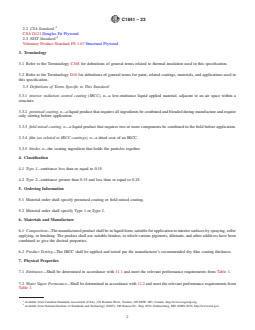
3. Terminology
3.1 Refer to the Terminology C168 for definitions of general terms related to thermal insulation used in this specification.
3.2 Refer to the Terminology D16 for definitions of general terms for paint, related coatings, materials, and applications used in
this specification.
3.3 Definitions of Terms Specific to This Standard:
3.3.1 interior radiation control coating (IRCC), n—a low-emittance liquid applied material, adjacent to an air space within a
structure.
3.3.2 premixed coating, n—a liquid product that requires all ingredients be combined and blended during manufacture and require
only stirring before application.
3.3.3 field mixed coating, n—a liquid product that requires two or more components be combined in the field before application.
3.3.4 film (as related to IRCC coatings), n—a dried coat of an IRCC.
3.3.5 binder, n—the coating ingredient that holds the particles together.
4. Classification
4.1 Type 1—emittance less than or equal to 0.15.
4.2 Type 2—emittance greater than 0.15 and less than or equal to 0.25.
5. Ordering Information
5.1 Material order shall specify premixed coating or field mixed coating.
5.2 Material order shall specify Type 1 or Type 2.
6. Materials and Manufacture
6.1 Composition—The manufactured product shall be in liquid form, suitable for application to interior surfaces by spraying, roller
applying, or brushing. The product shall use suitable binders, to which various pigments, dilutants, and other additives have been
combined to give the desired properties.
6.2 Product Testing—The IRCC shall be applied and tested per the manufacturer’s recommended dry film coating thickness.
7. Physical Properties
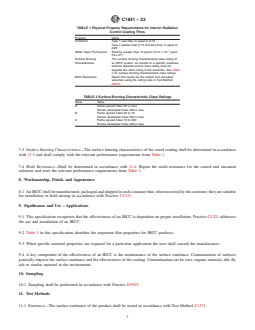
7.1 Emittance—Shall be determined in accordance with 11.1 and meet the relevant performance requirements from Table 1.
7.2 Water Vapor Permeance—Shall be determined in accordance with 11.2 and meet the relevant performance requirements from
Table 1.
Available from Canadian Standards Association (CSA), 178 Rexdale Blvd., Toronto, ON M9W 1R3, Canada, http://www.csagroup.org.
Available from National Institute of Standards and Technology (NIST), 100 Bureau Dr., Stop 1070, Gaithersburg, MD 20899-1070, http://www.nist.gov.
C1841 − 23
TABLE 1 Physical Property Requirements for Interior Radiation
Control Coating Films
Property Value
Emittance Type 1 less than or equal to 0.15.
Type 2 greater than 0.15 and less than or equal to
0.25
–7
Water Vapor Permeance Shall be greater than 10 perms (5.72 × 10 gram/
Pa·s·m )
Surface Burning The surface burning characteristics class rating of
Characteristics an IRCC system, as coated on a specific substrate,
shall be reported and its class rating shall not
degrade the class rating of the substrate. See Table
2 for surface burning characteristics class ratings.
Mold Resistance Report the results for the coated and uncoated
substrate using the rating scale in Test Method
D3274.
TABLE 2 Surface Burning Characteristic Class Ratings
Class Value
A Flame spread index 25 or less
Smoke developed index 450 or less
B Flame spread index 26 to 75
Smoke developed index 450 or less
C Flame spread index 76 to 200
Smoke developed index 450 or less
7.3 Surface Burning Characteristics—The surface burning characteristics of the cured coating shall be determined in accordance
with 11.3 and shall comply with the relevant performance requirements from Table 1.
7.4 Mold Resistance—Shall be determined in accordance with 11.4. Report the mold resistance for the coated and uncoated
substrate and meet the relevant performance requirements from Table 1.
8. Workmanship, Finish, and Appearance
8.1 An IRCC shall be manufactured, packaged and shipped in such a manner that, when received by the customer, they are suitable
for installation or field mixing in accordance with Practice C1321.
9. Significance and Use – Applications
9.1 This specification recognizes that the effectiveness of
...