

ASTM D7945-23
(Test Method)Standard Test Method for Determination of Dynamic Viscosity and Derived Kinematic Viscosity of Liquids by Constant Pressure Viscometer
General Information
- Abstract
SIGNIFICANCE AND USE
5.1 Many petroleum products are used as lubricants and the correct operation of the equipment depends upon the appropriate viscosity of the liquid being used. In addition, the viscosity of many petroleum fuels is important for the estimation of optimum storage, handling, and operational conditions. Thus, the accurate determination of viscosity is essential to many product specifications.
5.2 Density is a fundamental physical property that can be used in conjunction with other properties to characterize both the light and heavy fractions of petroleum and petroleum products and in this test method is used for the calculation from dynamic to kinematic viscosity.
SCOPE
1.1 This test method covers the measurement of dynamic viscosity and density for the purpose of derivation of kinematic viscosity of petroleum liquids, both transparent and opaque. The kinematic viscosity, ν, in this test method is derived by dividing the dynamic viscosity, η, by the density, ρ, obtained at the same test temperature. This test method also calculates the temperature at which petroleum liquids attain a specified kinematic viscosity using Practice D341.
1.2 The result obtained from this test method is dependent upon the behavior of the sample and is intended for application to liquids for which primarily the shear stress and shear rate are proportional (Newtonian flow behavior).
1.3 The range of kinematic viscosity covered by this test method is from 0.5 mm2/s to 1000 mm2/s in the temperature range between –40 °C to 120 °C; however the precision has been determined only for fuels and oils in the range of 2.06 mm2/s to 476 mm2/s at 40 °C and 1.09 mm2/s to 107 mm2/s at 100 °C (as stated in Section 12 on Precision and Bias). For jet fuels, the precision of kinematic viscosity has been determined in the range of 2.957 mm2/s to 5.805 mm2/s at –20 °C and 5.505 mm2/s to 13.03 mm2/s at –40 °C (as stated in Section 12 on Precision and Bias), and the precision of the temperature at 12 mm2/s (cSt) has been determined in the range of –38.3 °C to –58.1 °C (as stated in Section 13 on Precision and Bias). The precision has only been determined for those materials, viscosity ranges, and temperatures as indicated in Section 12 on Precision and Bias. The test method can be applied to a wider range of materials, viscosity, and temperature. For materials not listed in Section 12 on Precision and Bias, the precision and bias may not be applicable.
1.4 The values stated in SI units are to be regarded as standard. No other units of measurement are included in this standard.
1.5 This standard does not purport to address all of the safety concerns, if any, associated with its use. It is the responsibility of the user of this standard to establish appropriate safety, health, and environmental practices and determine the applicability of regulatory limitations prior to use.
1.6 This international standard was developed in accordance with internationally recognized principles on standardization established in the Decision on Principles for the Development of International Standards, Guides and Recommendations issued by the World Trade Organization Technical Barriers to Trade (TBT) Committee.
- Status
- Published
- Publication Date
- 31-Oct-2023
- Technical Committee
- D02 - Petroleum Products, Liquid Fuels, and Lubricants
- Drafting Committee
- D02.07 - Flow Properties
Buy Documents
ASTM D7945-23 - Standard Test Method for Determination of Dynamic Viscosity and Derived Kinematic Viscosity of Liquids by Constant Pressure Viscometer
REDLINE ASTM D7945-23 - Standard Test Method for Determination of Dynamic Viscosity and Derived Kinematic Viscosity of Liquids by Constant Pressure Viscometer
Overview
ASTM D7945-23 specifies the test method for determining the dynamic viscosity and derived kinematic viscosity of liquids using a constant pressure viscometer. This standard is particularly relevant to petroleum products, including transparent and opaque fuels and lubricants. Accurate measurement of viscosity is critical for ensuring the reliable operation of equipment, proper handling, storage, and meeting product specifications in industries reliant on petroleum-derived liquids.
This method is applicable for Newtonian liquids-those with proportional shear stress and shear rate over a temperature range from –40 °C to 120 °C. The kinematic viscosity is calculated by dividing the measured dynamic viscosity by the measured density at the same temperature. For jet fuels, this standard can also be used to calculate the temperature at which a specific kinematic viscosity is reached.
Key Topics
- Dynamic Viscosity Measurement: Determined by measuring the flow time of a liquid through a capillary under constant air pressure in a thermostatically controlled environment.
- Density Measurement: Acquired using a U-tube densitometer under the same conditions as viscosity measurement.
- Derived Kinematic Viscosity: Calculated by dividing dynamic viscosity by density, providing a measure of flow resistance under gravity.
- Temperature Dependence: The method allows for calculation of the temperature at which petroleum liquids reach a specified kinematic viscosity, following ASTM D341.
- Sample Preparation & Handling: Samples must be homogeneous and may need pre-heating, especially for waxy or high-pour-point materials. Filtration and solvent compatibility are also considered.
- Calibration and Precision: Requires traceable calibration using reference standards, with repeatability and reproducibility outlined for various fuels and oils within specified viscosity and temperature ranges.
- Safety and Compliance: Users must ensure compliance with relevant safety, health, and environmental regulations.
Applications
- Petroleum Industry: Used for quality control and specification compliance of fuels, lubricants, and base oils by determining their viscosity and temperature characteristics.
- Aviation: Essential for jet fuel analysis, where precise kinematic viscosity at low temperatures impacts fuel handling and engine performance.
- Industrial Lubricants: Supports the proper selection and performance monitoring of lubricants in machinery and automotive applications.
- Research and Development: Assists in characterizing new formulations of petroleum and synthetic products based on viscosity data.
Credible, repeatable results produced by this method are vital for optimizing equipment operation, improving storage and handling safety, and meeting industry standards. The versatility of ASTM D7945-23 makes it applicable to a wide range of transparent and opaque liquid samples.
Related Standards
- ASTM D341: Practice for Viscosity-Temperature Equations and Charts for Liquid Petroleum or Hydrocarbon Products
- ASTM D445: Test Method for Kinematic Viscosity of Transparent and Opaque Liquids (and Calculation of Dynamic Viscosity)
- ASTM D1655: Specification for Aviation Turbine Fuels
- ASTM D2162: Practice for Basic Calibration of Master Viscometers and Viscosity Oil Standards
- ASTM D4175: Terminology Relating to Petroleum Products, Liquid Fuels, and Lubricants
- ASTM D6300: Practice for Determination of Precision and Bias Data for Use in Test Methods for Petroleum Products, Liquid Fuels, and Lubricants
- ASTM D6708: Practice for Statistical Assessment and Improvement of Expected Agreement Between Two Test Methods
- ASTM D7566: Specification for Aviation Turbine Fuel Containing Synthesized Hydrocarbons
- ISO 5725: Accuracy (Trueness and Precision) of Measurement Methods and Results
- ISO/IEC 17025: General Requirements for the Competence of Testing and Calibration Laboratories
By adhering to ASTM D7945-23, laboratories and industry professionals can ensure reliable and standardized measurement of viscosity properties in petroleum and related products. This not only facilitates regulatory compliance but also supports optimized performance and safety in a range of applications.
Relations
- Effective Date
- 01-Nov-2023
- Effective Date
- 01-Apr-2024
- Effective Date
- 15-Mar-2024
- Effective Date
- 15-Mar-2024
- Effective Date
- 01-Mar-2024
- Effective Date
- 01-Mar-2024
- Refers
ASTM D7566-24 - Standard Specification for Aviation Turbine Fuel Containing Synthesized Hydrocarbons - Effective Date
- 01-Mar-2024
- Refers
ASTM D4175-23a - Standard Terminology Relating to Petroleum Products, Liquid Fuels, and Lubricants - Effective Date
- 15-Dec-2023
- Effective Date
- 01-Dec-2023
- Effective Date
- 01-Nov-2023
- Effective Date
- 01-Oct-2023
- Effective Date
- 01-Oct-2023
- Refers
ASTM D4175-23 - Standard Terminology Relating to Petroleum Products, Liquid Fuels, and Lubricants - Effective Date
- 01-Jul-2023
- Effective Date
- 01-Jul-2023
- Refers
ASTM D4175-23e1 - Standard Terminology Relating to Petroleum Products, Liquid Fuels, and Lubricants - Effective Date
- 01-Jul-2023
Buy Documents
ASTM D7945-23 - Standard Test Method for Determination of Dynamic Viscosity and Derived Kinematic Viscosity of Liquids by Constant Pressure Viscometer
REDLINE ASTM D7945-23 - Standard Test Method for Determination of Dynamic Viscosity and Derived Kinematic Viscosity of Liquids by Constant Pressure Viscometer
Get Certified
Connect with accredited certification bodies for this standard

Element Materials Technology
Materials testing and product certification.

ABS Group Brazil
ABS Group certification services in Brazil.

ABS Quality Evaluations Inc.
American Bureau of Shipping quality certification.
Sponsored listings
Frequently Asked Questions
ASTM D7945-23 is a standard published by ASTM International. Its full title is "Standard Test Method for Determination of Dynamic Viscosity and Derived Kinematic Viscosity of Liquids by Constant Pressure Viscometer". This standard covers: SIGNIFICANCE AND USE 5.1 Many petroleum products are used as lubricants and the correct operation of the equipment depends upon the appropriate viscosity of the liquid being used. In addition, the viscosity of many petroleum fuels is important for the estimation of optimum storage, handling, and operational conditions. Thus, the accurate determination of viscosity is essential to many product specifications. 5.2 Density is a fundamental physical property that can be used in conjunction with other properties to characterize both the light and heavy fractions of petroleum and petroleum products and in this test method is used for the calculation from dynamic to kinematic viscosity. SCOPE 1.1 This test method covers the measurement of dynamic viscosity and density for the purpose of derivation of kinematic viscosity of petroleum liquids, both transparent and opaque. The kinematic viscosity, ν, in this test method is derived by dividing the dynamic viscosity, η, by the density, ρ, obtained at the same test temperature. This test method also calculates the temperature at which petroleum liquids attain a specified kinematic viscosity using Practice D341. 1.2 The result obtained from this test method is dependent upon the behavior of the sample and is intended for application to liquids for which primarily the shear stress and shear rate are proportional (Newtonian flow behavior). 1.3 The range of kinematic viscosity covered by this test method is from 0.5 mm2/s to 1000 mm2/s in the temperature range between –40 °C to 120 °C; however the precision has been determined only for fuels and oils in the range of 2.06 mm2/s to 476 mm2/s at 40 °C and 1.09 mm2/s to 107 mm2/s at 100 °C (as stated in Section 12 on Precision and Bias). For jet fuels, the precision of kinematic viscosity has been determined in the range of 2.957 mm2/s to 5.805 mm2/s at –20 °C and 5.505 mm2/s to 13.03 mm2/s at –40 °C (as stated in Section 12 on Precision and Bias), and the precision of the temperature at 12 mm2/s (cSt) has been determined in the range of –38.3 °C to –58.1 °C (as stated in Section 13 on Precision and Bias). The precision has only been determined for those materials, viscosity ranges, and temperatures as indicated in Section 12 on Precision and Bias. The test method can be applied to a wider range of materials, viscosity, and temperature. For materials not listed in Section 12 on Precision and Bias, the precision and bias may not be applicable. 1.4 The values stated in SI units are to be regarded as standard. No other units of measurement are included in this standard. 1.5 This standard does not purport to address all of the safety concerns, if any, associated with its use. It is the responsibility of the user of this standard to establish appropriate safety, health, and environmental practices and determine the applicability of regulatory limitations prior to use. 1.6 This international standard was developed in accordance with internationally recognized principles on standardization established in the Decision on Principles for the Development of International Standards, Guides and Recommendations issued by the World Trade Organization Technical Barriers to Trade (TBT) Committee.
SIGNIFICANCE AND USE 5.1 Many petroleum products are used as lubricants and the correct operation of the equipment depends upon the appropriate viscosity of the liquid being used. In addition, the viscosity of many petroleum fuels is important for the estimation of optimum storage, handling, and operational conditions. Thus, the accurate determination of viscosity is essential to many product specifications. 5.2 Density is a fundamental physical property that can be used in conjunction with other properties to characterize both the light and heavy fractions of petroleum and petroleum products and in this test method is used for the calculation from dynamic to kinematic viscosity. SCOPE 1.1 This test method covers the measurement of dynamic viscosity and density for the purpose of derivation of kinematic viscosity of petroleum liquids, both transparent and opaque. The kinematic viscosity, ν, in this test method is derived by dividing the dynamic viscosity, η, by the density, ρ, obtained at the same test temperature. This test method also calculates the temperature at which petroleum liquids attain a specified kinematic viscosity using Practice D341. 1.2 The result obtained from this test method is dependent upon the behavior of the sample and is intended for application to liquids for which primarily the shear stress and shear rate are proportional (Newtonian flow behavior). 1.3 The range of kinematic viscosity covered by this test method is from 0.5 mm2/s to 1000 mm2/s in the temperature range between –40 °C to 120 °C; however the precision has been determined only for fuels and oils in the range of 2.06 mm2/s to 476 mm2/s at 40 °C and 1.09 mm2/s to 107 mm2/s at 100 °C (as stated in Section 12 on Precision and Bias). For jet fuels, the precision of kinematic viscosity has been determined in the range of 2.957 mm2/s to 5.805 mm2/s at –20 °C and 5.505 mm2/s to 13.03 mm2/s at –40 °C (as stated in Section 12 on Precision and Bias), and the precision of the temperature at 12 mm2/s (cSt) has been determined in the range of –38.3 °C to –58.1 °C (as stated in Section 13 on Precision and Bias). The precision has only been determined for those materials, viscosity ranges, and temperatures as indicated in Section 12 on Precision and Bias. The test method can be applied to a wider range of materials, viscosity, and temperature. For materials not listed in Section 12 on Precision and Bias, the precision and bias may not be applicable. 1.4 The values stated in SI units are to be regarded as standard. No other units of measurement are included in this standard. 1.5 This standard does not purport to address all of the safety concerns, if any, associated with its use. It is the responsibility of the user of this standard to establish appropriate safety, health, and environmental practices and determine the applicability of regulatory limitations prior to use. 1.6 This international standard was developed in accordance with internationally recognized principles on standardization established in the Decision on Principles for the Development of International Standards, Guides and Recommendations issued by the World Trade Organization Technical Barriers to Trade (TBT) Committee.
ASTM D7945-23 is classified under the following ICS (International Classification for Standards) categories: 75.180.30 - Volumetric equipment and measurements. The ICS classification helps identify the subject area and facilitates finding related standards.
ASTM D7945-23 has the following relationships with other standards: It is inter standard links to ASTM D7945-21a, ASTM D445-24, ASTM D1655-24, ASTM D7566-24a, ASTM D6708-24, ASTM D6300-24, ASTM D7566-24, ASTM D4175-23a, ASTM D6300-23a, ASTM D445-23, ASTM D1655-23a, ASTM D7566-23b, ASTM D4175-23, ASTM D6300-23, ASTM D4175-23e1. Understanding these relationships helps ensure you are using the most current and applicable version of the standard.
ASTM D7945-23 is available in PDF format for immediate download after purchase. The document can be added to your cart and obtained through the secure checkout process. Digital delivery ensures instant access to the complete standard document.
Standards Content (Sample)
This international standard was developed in accordance with internationally recognized principles on standardization established in the Decision on Principles for the
Development of International Standards, Guides and Recommendations issued by the World Trade Organization Technical Barriers to Trade (TBT) Committee.
Designation: D7945 − 23
Standard Test Method for
Determination of Dynamic Viscosity and Derived Kinematic
Viscosity of Liquids by Constant Pressure Viscometer
This standard is issued under the fixed designation D7945; the number immediately following the designation indicates the year of
original adoption or, in the case of revision, the year of last revision. A number in parentheses indicates the year of last reapproval. A
superscript epsilon (´) indicates an editorial change since the last revision or reapproval.
1. Scope* 1.5 This standard does not purport to address all of the
safety concerns, if any, associated with its use. It is the
1.1 This test method covers the measurement of dynamic
responsibility of the user of this standard to establish appro-
viscosity and density for the purpose of derivation of kinematic
priate safety, health, and environmental practices and deter-
viscosity of petroleum liquids, both transparent and opaque.
mine the applicability of regulatory limitations prior to use.
The kinematic viscosity, ν, in this test method is derived by
1.6 This international standard was developed in accor-
dividing the dynamic viscosity, η, by the density, ρ, obtained at
dance with internationally recognized principles on standard-
the same test temperature. This test method also calculates the
ization established in the Decision on Principles for the
temperature at which petroleum liquids attain a specified
Development of International Standards, Guides and Recom-
kinematic viscosity using Practice D341.
mendations issued by the World Trade Organization Technical
1.2 The result obtained from this test method is dependent
Barriers to Trade (TBT) Committee.
upon the behavior of the sample and is intended for application
to liquids for which primarily the shear stress and shear rate are
2. Referenced Documents
proportional (Newtonian flow behavior).
2.1 ASTM Standards:
1.3 The range of kinematic viscosity covered by this test
D341 Practice for Viscosity-Temperature Equations and
2 2
method is from 0.5 mm /s to 1000 mm /s in the temperature
Charts for Liquid Petroleum or Hydrocarbon Products
range between –40 °C to 120 °C; however the precision has
D445 Test Method for Kinematic Viscosity of Transparent
been determined only for fuels and oils in the range of
and Opaque Liquids (and Calculation of Dynamic Viscos-
2 2 2
2.06 mm /s to 476 mm /s at 40 °C and 1.09 mm /s to
ity)
107 mm /s at 100 °C (as stated in Section 12 on Precision and
D1655 Specification for Aviation Turbine Fuels
Bias). For jet fuels, the precision of kinematic viscosity has
D2162 Practice for Basic Calibration of Master Viscometers
2 2
been determined in the range of 2.957 mm /s to 5.805 mm /s at
and Viscosity Oil Standards
2 2
–20 °C and 5.505 mm /s to 13.03 mm /s at –40 °C (as stated in
D4175 Terminology Relating to Petroleum Products, Liquid
Section 12 on Precision and Bias), and the precision of the
Fuels, and Lubricants
temperature at 12 mm /s (cSt) has been determined in the
D6300 Practice for Determination of Precision and Bias
range of –38.3 °C to –58.1 °C (as stated in Section 13 on
Data for Use in Test Methods for Petroleum Products,
Precision and Bias). The precision has only been determined
Liquid Fuels, and Lubricants
for those materials, viscosity ranges, and temperatures as
D6708 Practice for Statistical Assessment and Improvement
indicated in Section 12 on Precision and Bias. The test method
of Expected Agreement Between Two Test Methods that
can be applied to a wider range of materials, viscosity, and
Purport to Measure the Same Property of a Material
temperature. For materials not listed in Section 12 on Precision
D7566 Specification for Aviation Turbine Fuel Containing
and Bias, the precision and bias may not be applicable.
Synthesized Hydrocarbons
1.4 The values stated in SI units are to be regarded as
2.2 ISO Standards:
standard. No other units of measurement are included in this
ISO 5725 Accuracy (Trueness and Precision) of Measure-
standard.
ment Methods and Results
1 2
This test method is under the jurisdiction of ASTM Committee D02 on For referenced ASTM standards, visit the ASTM website, www.astm.org, or
Petroleum Products, Liquid Fuels, and Lubricants and is the direct responsibility of contact ASTM Customer Service at service@astm.org. For Annual Book of ASTM
Subcommittee D02.07 on Flow Properties. Standards volume information, refer to the standard’s Document Summary page on
Current edition approved Nov. 1, 2023. Published November 2023. Originally the ASTM website.
published in 2014. Last previous edition approved in 2021 as D7945 – 21a. DOI: Available from American National Standards Institute (ANSI), 25 W. 43rd St.,
10.1520/D7945-23. 4th Floor, New York, NY 10036, http://www.ansi.org.
*A Summary of Changes section appears at the end of this standard
Copyright © ASTM International, 100 Barr Harbor Drive, PO Box C700, West Conshohocken, PA 19428-2959. United States
D7945 − 23
ISO/IEC 17025 General Requirements for the Competence 4.2 Based on the calculations of at least two kinematic
of Testing and Calibration Laboratories viscosities at different temperatures of a test specimen, the
temperature at which the test specimen attains a specified
3. Terminology kinematic viscosity is calculated and reported according to
Practice D341, Annex A1.
3.1 Definitions:
3.1.1 For definitions of terms used in this test method, refer
5. Significance and Use
to Terminology D4175.
5.1 Many petroleum products are used as lubricants and the
3.1.2 density, n—mass per unit volume.
correct operation of the equipment depends upon the appropri-
3.1.3 dynamic viscosity (η), n—the ratio between the applied
ate viscosity of the liquid being used. In addition, the viscosity
shear stress and rate of shear of a liquid at a given temperature.
of many petroleum fuels is important for the estimation of
3.1.3.1 Discussion—It is sometimes called the coefficient of
optimum storage, handling, and operational conditions. Thus,
dynamic viscosity or, simply, viscosity. Thus, dynamic viscos-
the accurate determination of viscosity is essential to many
ity is a measure of the resistance to flow or to deformation of
product specifications.
a liquid under external shear forces.
5.2 Density is a fundamental physical property that can be
3.1.3.2 Discussion—The term dynamic viscosity can also be
used in conjunction with other properties to characterize both
used in a different context to denote a frequency-dependent
the light and heavy fractions of petroleum and petroleum
quantity in which shear stress and shear rate have a sinusoidal
products and in this test method is used for the calculation from
time dependence.
dynamic to kinematic viscosity.
3.1.4 kinematic viscosity, n—the ratio of the dynamic vis-
cosity (η) to the density (ρ) of a liquid at a given temperature.
6. Apparatus
3.1.4.1 Discussion—For gravity flow under a given hydro-
4,5
6.1 Constant Pressure Viscometer:
static head, the pressure head of a liquid is proportional to its
6.1.1 Viscosity Measurement—The Constant Pressure vis-
density (ρ). Therefore, the kinematic viscosity (ν) is a measure
cometer uses the Hagen-Poiseuille principle of capillary flow
of the resistance to flow of a liquid under gravity.
to determine the viscosity. A length of capillary tube is
enclosed horizontally in a thermal block maintained at a
4. Summary of Test Method
constant temperature by thermoelectric coolers/heaters. The
4.1 A test specimen is introduced into the measuring cells,
which are controlled at a specified and known temperature. The
measuring cells consist of a horizontal capillary tube with The Constant Pressure viscometer is covered by a patent. Interested parties are
invited to submit information regarding the identification of an alternative to this
optical sensors and an oscillating U-tube densitometer. The
patented item to the ASTM International headquarters. Your comments will receive
dynamic viscosity is determined from the flow time of the test
careful consideration at a meeting of the responsible technical committee, which
specimen along the capillary under a constant pressure of
you may attend.
The sole source of supply of the apparatus known to the committee at this time
compressed air in conjunction with calculations. The density is
is PhasePSL, 11168 Hammersmith Gate, Richmond, BC Canada. If you are aware
determined by the oscillation frequency of the U-tube in
of alternative suppliers, please provide this information to ASTM International
conjunction with calculations. The kinematic viscosity is
headquarters. Your comments will receive careful consideration at a meeting of the
calculated by dividing the dynamic viscosity by the density. responsible technical committee, which you may attend.
FIG. 1 Viscosity Block
D7945 − 23
test specimen is driven to flow along the tube by a constant and 8.2 Test Specimen—A volume of sample obtained from the
regulated pressure of compressed air. The transit time of the laboratory sample and delivered to the measuring cells. The
test sample as it flows past an array of optical detectors is test specimen is obtained as follows:
measured. (See Fig. 1.) The dynamic viscosity is proportional 8.2.1 Mix the sample, if required, to homogenize at room
to the measured transit time. temperature into an open sample vial. If loss of volatile
6.1.1.1 Pressure Control—A pressure generating and regu- material can occur in an open container, then mixing in closed
lating device able to maintain an air pressure between 6.89 kPa containers, or at sub-ambient temperatures is recommended.
to 68.9 kPa (1 psi to 10 psi) used to drive a test specimen to 8.2.2 Deliver the test specimen from a properly mixed
flow along a capillary tube. laboratory sample to the measuring cells using an autosampler.
6.1.2 Density Measurement—Density is measured by a suit- For waxy or other samples with a high pour point, before
able method so to achieve the precision in kinematic viscosity delivering the test specimen, heat the laboratory sample to the
as stated in the tables in Section 12. A U-shaped oscillating desired test temperature, which has to be high enough to
sample tube with a system for electronic excitation and dissolve the wax crystals.
frequency counting as described in the manufacturer’s instruc-
9. Calibration and Verification
tions is suitable. However, for this test method, the purpose of
the density result is for the calculation from dynamic to
9.1 Use only a calibrated apparatus as described in section
kinematic viscosity.
6.1.1 and as shown in Fig. 1. The calibration shall be checked
6.1.3 Temperature Control—A thermal block surrounds the
as defined by the lab QA procedures using certified reference
viscosity measuring cell so that both are at the same tempera-
standards as described in 9.2. The recommended interval for
ture. A thermoelectric heating and cooling system (see Fig. 1)
viscosity and density calibration is once a year as a minimum
ensures temperature stability of the block to be within
or when lab QA procedures dictate. For the calibration
60.01 °C from the set temperature.
procedure, follow the instructions of the manufacturer of the
apparatus.
6.2 Autosampler, for use in sample introduction process.
The autosampler shall be designed to ensure the integrity of the
9.2 Certified Viscosity and Density Reference Standards—
test specimen prior to and during the analysis and be equipped
These are for use as confirmatory checks on the procedure in
to transfer a representative volume of test specimen into the
the laboratory. Certified viscosity and density reference stan-
measuring cells. The autosampler shall transfer the test speci-
dards shall be certified by a laboratory, which has shown to
men from the sample vial to the measuring cells of the
meet the requirements of ISO/IEC 17025 or a corresponding
apparatus without interfering with the integrity of the test
national standard by independent assessment. Viscosity stan-
specimen. The autosampler may have heating capability as a
dards shall be traceable to master viscometer procedures
means to lower the viscosity of the sample for filling the
described in Test Method D2162. Density standards shall have
measuring cells.
a certified uncertainty of the density values of 0.0001 g/cm .
The uncertainty of the reference standards shall be stated for
6.3 Screen, with an aperture of 75 μm, to remove particles or
each certified value (k = 2; 95% confidence level). See ISO
fibers from samples that may contain them (see 8.2).
5725.
7. Reagents and Materials
9.2.1 Use certified reference standards appropriate to the
desired measuring temperatures of viscosity and density mea-
7.1 Sample Solvent, completely miscible with the sample.
surements for both calibration and verification.
7.1.1 For samples that are mutually soluble such as jet fuels
and light middle distillate test specimen, the use of the same or
10. Procedure
similar middle distillates as solvent is suitable. If the solvent
10.1 Standard Procedure Using an Autosampler:
dries up without residues in an applicable time frame, the use
10.1.1 Set the internal temperature control to the desired
of a separate drying solvent is not required.
measuring temperature.
7.1.2 For more viscous test specimen, an aromatic solvent
10.1.1.1 For jet fuels, it is optional to set the internal
such as toluene is suitable.
temperature control to more than one desired measuring
7.2 Drying Solvent, a volatile solvent miscible with the
temperatures (for example, –20.0 °C and –40.0 °C). See instru-
sample solvent (see 7.1).
ment operations manual for more details.
7.2.1 n-Pentane is suitable.
10.1.2 Set the determinability limits to the values stated in
7.3 Dry Air, for blowing and drying of the measuring cells.
Table 1 for the specific product and test temperature.
NOTE 1—If the measuring cell temperature is below or near the dew
10.1.2.1 For products not listed in the precision section, it is
point temperature of the ambient air, the use of an appropriate desiccat
...
This document is not an ASTM standard and is intended only to provide the user of an ASTM standard an indication of what changes have been made to the previous version. Because
it may not be technically possible to adequately depict all changes accurately, ASTM recommends that users consult prior editions as appropriate. In all cases only the current version
of the standard as published by ASTM is to be considered the official document.
Designation: D7945 − 21a D7945 − 23
Standard Test Method for
Determination of Dynamic Viscosity and Derived Kinematic
Viscosity of Liquids by Constant Pressure Viscometer
This standard is issued under the fixed designation D7945; the number immediately following the designation indicates the year of
original adoption or, in the case of revision, the year of last revision. A number in parentheses indicates the year of last reapproval. A
superscript epsilon (´) indicates an editorial change since the last revision or reapproval.
1. Scope*
1.1 This test method covers the measurement of dynamic viscosity and density for the purpose of derivation of kinematic viscosity
of petroleum liquids, both transparent and opaque. The kinematic viscosity, ν, in this test method is derived by dividing the
dynamic viscosity, η, by the density, ρ, obtained at the same test temperature. This test method also calculates the temperature at
which petroleum liquids attain a specified kinematic viscosity using Practice D341.
1.2 The result obtained from this test method is dependent upon the behavior of the sample and is intended for application to
liquids for which primarily the shear stress and shear rate are proportional (Newtonian flow behavior).
2 2
1.3 The range of kinematic viscosity covered by this test method is from 0.5 mm /s to 1000 mm /s in the temperature range
between –40 °C to 120 °C; however the precision has been determined only for fuels and oils in the range of 2.06 mm /s to
2 2 2
476 mm /s at 40 °C and 1.09 mm /s to 107 mm /s at 100 °C (as stated in Section 12 on Precision and Bias). For jet fuels, the
2 2 2
precision of kinematic viscosity has been determined in the range of 2.957 mm /s to 5.805 mm /s at –20 °C and 5.505 mm /s to
2 2
13.03 mm /s at –40 °C (as stated in Section 12 on Precision and Bias), and the precision of the temperature at 12 mm /s (cSt) has
been determined in the range of –38.3 °C to –58.1 °C (as stated in Section 13 on Precision and Bias). The precision has only been
determined for those materials, viscosity ranges, and temperatures as indicated in Section 12 on Precision and Bias. The test
method can be applied to a wider range of materials, viscosity, and temperature. For materials not listed in Section 12 on Precision
and Bias, the precision and bias may not be applicable.
1.4 The values stated in SI units are to be regarded as standard. No other units of measurement are included in this standard.
1.5 This standard does not purport to address all of the safety concerns, if any, associated with its use. It is the responsibility
of the user of this standard to establish appropriate safety, health, and environmental practices and determine the applicability of
regulatory limitations prior to use.
1.6 This international standard was developed in accordance with internationally recognized principles on standardization
established in the Decision on Principles for the Development of International Standards, Guides and Recommendations issued
by the World Trade Organization Technical Barriers to Trade (TBT) Committee.
2. Referenced Documents
2.1 ASTM Standards:
This test method is under the jurisdiction of ASTM Committee D02 on Petroleum Products, Liquid Fuels, and Lubricants and is the direct responsibility of Subcommittee
D02.07 on Flow Properties.
Current edition approved Dec. 1, 2021Nov. 1, 2023. Published January 2022November 2023. Originally published in 2014. Last previous edition approved in 2021 as
D7945 – 21.D7945 – 21a. DOI: 10.1520/D7945-21A.10.1520/D7945-23.
For referenced ASTM standards, visit the ASTM website, www.astm.org, or contact ASTM Customer Service at service@astm.org. For Annual Book of ASTM Standards
volume information, refer to the standard’s Document Summary page on the ASTM website.
*A Summary of Changes section appears at the end of this standard
Copyright © ASTM International, 100 Barr Harbor Drive, PO Box C700, West Conshohocken, PA 19428-2959. United States
D7945 − 23
D341 Practice for Viscosity-Temperature Equations and Charts for Liquid Petroleum or Hydrocarbon Products
D445 Test Method for Kinematic Viscosity of Transparent and Opaque Liquids (and Calculation of Dynamic Viscosity)
D1655 Specification for Aviation Turbine Fuels
D2162 Practice for Basic Calibration of Master Viscometers and Viscosity Oil Standards
D4175 Terminology Relating to Petroleum Products, Liquid Fuels, and Lubricants
D6300 Practice for Determination of Precision and Bias Data for Use in Test Methods for Petroleum Products, Liquid Fuels, and
Lubricants
D6708 Practice for Statistical Assessment and Improvement of Expected Agreement Between Two Test Methods that Purport
to Measure the Same Property of a Material
D7566 Specification for Aviation Turbine Fuel Containing Synthesized Hydrocarbons
2.2 ISO Standards:
ISO 5725 Accuracy (Trueness and Precision) of Measurement Methods and Results
ISO/IEC 17025 General Requirements for the Competence of Testing and Calibration Laboratories
3. Terminology
3.1 Definitions:
3.1.1 For definitions of terms used in this test method, refer to Terminology D4175.
3.1.2 density, n—mass per unit volume.
3.1.3 dynamic viscosity (η), n—the ratio between the applied shear stress and rate of shear of a liquid at a given temperature.
3.1.3.1 Discussion—
It is sometimes called the coefficient of dynamic viscosity or, simply, viscosity. Thus, dynamic viscosity is a measure of the
resistance to flow or to deformation of a liquid under external shear forces.
3.1.3.2 Discussion—
The term dynamic viscosity can also be used in a different context to denote a frequency-dependent quantity in which shear stress
and shear rate have a sinusoidal time dependence.
3.1.4 kinematic viscosity, n—the ratio of the dynamic viscosity (η) to the density (ρ) of a liquid at a given temperature.
3.1.4.1 Discussion—
For gravity flow under a given hydrostatic head, the pressure head of a liquid is proportional to its density (ρ). Therefore, the
kinematic viscosity (ν) is a measure of the resistance to flow of a liquid under gravity.
4. Summary of Test Method
4.1 A test specimen is introduced into the measuring cells, which are controlled at a specified and known temperature. The
measuring cells consist of a horizontal capillary tube with optical sensors and an oscillating U-tube densitometer. The dynamic
viscosity is determined from the flow time of the test specimen along the capillary under a constant pressure of compressed air
in conjunction with calculations. The density is determined by the oscillation frequency of the U-tube in conjunction with
calculations. The kinematic viscosity is calculated by dividing the dynamic viscosity by the density.
4.2 Based on the calculations of at least two kinematic viscosities at different temperatures of a test specimen, the temperature at
which the test specimen attains a specified kinematic viscosity is calculated and reported according to Practice D341, Annex A1.
5. Significance and Use
5.1 Many petroleum products are used as lubricants and the correct operation of the equipment depends upon the appropriate
viscosity of the liquid being used. In addition, the viscosity of many petroleum fuels is important for the estimation of optimum
storage, handling, and operational conditions. Thus, the accurate determination of viscosity is essential to many product
specifications.
5.2 Density is a fundamental physical property that can be used in conjunction with other properties to characterize both the light
and heavy fractions of petroleum and petroleum products and in this test method is used for the calculation from dynamic to
kinematic viscosity.
Available from American National Standards Institute (ANSI), 25 W. 43rd St., 4th Floor, New York, NY 10036, http://www.ansi.org.
D7945 − 23
6. Apparatus
4,5
6.1 Constant Pressure Viscometer:
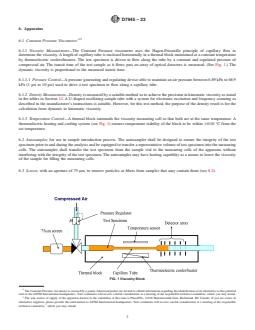
6.1.1 Viscosity Measurement—The Constant Pressure viscometer uses the Hagen-Poiseuille principle of capillary flow to
determine the viscosity. A length of capillary tube is enclosed horizontally in a thermal block maintained at a constant temperature
by thermoelectric coolers/heaters. The test specimen is driven to flow along the tube by a constant and regulated pressure of
compressed air. The transit time of the test sample as it flows past an array of optical detectors is measured. (See Fig. 1.) The
dynamic viscosity is proportional to the measured transit time.
6.1.1.1 Pressure Control—A pressure generating and regulating device able to maintain an air pressure between 6.89 kPa to 68.9
kPa (1 psi to 10 psi) used to drive a test specimen to flow along a capillary tube.
6.1.2 Density Measurement—Density is measured by a suitable method so to achieve the precision in kinematic viscosity as stated
in the tables in Section 12. A U-shaped oscillating sample tube with a system for electronic excitation and frequency counting as
described in the manufacturer’s instructions is suitable. However, for this test method, the purpose of the density result is for the
calculation from dynamic to kinematic viscosity.
6.1.3 Temperature Control—A thermal block surrounds the viscosity measuring cell so that both are at the same temperature. A
thermoelectric heating and cooling system (see Fig. 1) ensures temperature stability of the block to be within 60.01 °C from the
set temperature.
6.2 Autosampler, for use in sample introduction process. The autosampler shall be designed to ensure the integrity of the test
specimen prior to and during the analysis and be equipped to transfer a representative volume of test specimen into the measuring
cells. The autosampler shall transfer the test specimen from the sample vial to the measuring cells of the apparatus without
interfering with the integrity of the test specimen. The autosampler may have heating capability as a means to lower the viscosity
of the sample for filling the measuring cells.
6.3 Screen, with an aperture of 75 μm, to remove particles or fibers from samples that may contain them (see 8.2).
FIG. 1 Viscosity Block
The Constant Pressure viscometer is covered by a patent. Interested parties are invited to submit information regarding the identification of an alternative to this patented
item to the ASTM International headquarters. Your comments will receive careful consideration at a meeting of the responsible technical committee, which you may attend.
The sole source of supply of the apparatus known to the committee at this time is PhasePSL, 11168 Hammersmith Gate, Richmond, BC Canada. If you are aware of
alternative suppliers, please provide this information to ASTM International headquarters. Your comments will receive careful consideration at a meeting of the responsible
technical committee, which you may attend.
D7945 − 23
7. Reagents and Materials
7.1 Sample Solvent, completely miscible with the sample.
7.1.1 For samples that are mutually soluble such as jet fuels and light middle distillate test specimen, the use of the same or similar
middle distillates as solvent is suitable. If the solvent dries up without residues in an applicable time frame, the use of a separate
drying solvent is not required.
7.1.2 For more viscous test specimen, an aromatic solvent such as toluene is suitable.
7.2 Drying Solvent, a volatile solvent miscible with the sample solvent (see 7.1).
7.2.1 n-Pentane is suitable.
7.3 Dry Air, for blowing and drying of the measuring cells.
NOTE 1—If the measuring cell temperature is below or near the dew point temperature of the ambient air, the use of an appropriate desiccator is
recommended.
8. Sampling, Test Specimens, and Test Units
8.1 Sampling is defined as all the steps required to obtain an aliquot, and to place the sample into the laboratory test container.
The laboratory test container shall be of sufficient volume to mix the sample and obtain a homogeneous sample for analysis.
8.2 Test Specimen—A volume of sample obtained from the laboratory sample and delivered to the measuring cells. The test
specimen is obtained as follows:
8.2.1 Mix the sample, if required, to homogenize at room temperature into an open sample vial. If loss of volatile material can
occur in an open container, then mixing in closed containers, or at sub-ambient temperatures is recommended.
8.2.2 Deliver the test specimen from a properly mixed laboratory sample to the measuring cells using an autosampler. For waxy
or other samples with a high pour point, before delivering the test specimen, heat the laboratory sample to the desired test
temperature, which has to be high enough to dissolve the wax crystals.
9. Calibration and Verification
9.1 Use only a calibrated apparatus as described in section 6.1.1 and as shown in Fig. 1. The calibration shall be checked as defined
by the lab QA procedures using certified reference standards as described in 9.2. The recommended interval for viscosity and
density calibration is once a year as a minimum or when lab QA procedures dictate. For the calibration procedure, follow the
instructions of the manufacturer of the apparatus.
9.2 Certified Viscosity and Density Reference Standards—These are for use as confirmatory checks on the procedure in the
laboratory. Certified viscosity and density reference standards shall be certified by a laboratory, which has shown to meet the
requirements of ISO/IEC 17025 or a corresponding national standard by independent assessment. Viscosity standards shall be
traceable to master viscometer procedures described in Test Method D2162. Density standards shall have a certified uncertainty
of the density values of 0.0001 g/cm . The uncertainty of the reference standards shall be stated for each certified value (k = 2;
95% confidence level). See ISO 5725.
9.2.1 Use certified reference standards appropriate to the desired measuring temperatures of viscosity and density measurements
for both calibration and verification.
10. Procedure
10.1 Standard Procedure Using an Autosampler:
10.1.1 Set the internal temperature control to the desired measuring temperature.
D7945 − 23
10.1.1.1 For jet fuels, it is optional to set the internal temperature control to more than one desired measuring temperatures (for
example, –20.0 °C and –40.0 °C). See instrument operations
...