

ASTM D7712-18
(Terminology)Standard Terminology for Sampling and Analysis of Asbestos
General Information
- Abstract
SCOPE
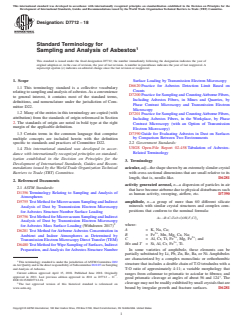
1.1 This terminology standard is a collective vocabulary relating to sampling and analysis of asbestos. As a convenience to general interest, it contains most of the standard terms, definitions, and nomenclature under the jurisdiction of Committee D22.
1.2 Many of the entries in this terminology are copied (with attribution) from the standards of origin referenced in Section 2. The standards of origin are noted in bold type at the right margin of the applicable definition.
1.3 Certain terms in the common language that comprise multiple concepts are included herein with the definition specific to standards and practices of Committee D22.
1.4 This international standard was developed in accordance with internationally recognized principles on standardization established in the Decision on Principles for the Development of International Standards, Guides and Recommendations issued by the World Trade Organization Technical Barriers to Trade (TBT) Committee.
- Status
- Published
- Publication Date
- 14-Apr-2018
- Technical Committee
- D22 - Air Quality
Overview
ASTM D7712-18: Standard Terminology for Sampling and Analysis of Asbestos is an internationally recognized standard developed by ASTM Committee D22 on Air Quality. This standard provides a comprehensive and authoritative collection of terms, definitions, and nomenclature used in asbestos sampling and analysis. By offering a consistent vocabulary, ASTM D7712-18 supports clear communication and improved reliability across industries involved in asbestos detection and control, including laboratories, regulatory agencies, contractors, consultants, and manufacturers.
The scope of ASTM D7712-18 covers terminology relevant to the sampling and analysis of asbestos in various matrices such as air, dust, and bulk materials. It is designed to align with globally accepted principles for the development of standards as established by the World Trade Organization's Technical Barriers to Trade (TBT) Committee.
Key Topics
ASTM D7712-18 addresses terminology in the following central areas:
- Types of asbestos: Definitions for common asbestos minerals, such as chrysotile, amosite, crocidolite, actinolite, tremolite, and anthophyllite.
- Morphology and characteristics:
- Asbestiform versus non-asbestiform
- Fibers, bundles, clusters, matrices
- Aspect ratio and fiber morphology
- Sampling methods:
- Area sample, personal sample, field blank, laboratory blank
- Wipe sampling, microvacuum techniques, air sampling
- Analytical methods:
- Transmission Electron Microscopy (TEM)
- Phase Contrast Microscopy (PCM)
- Analytical sensitivity and detection limits
- Data interpretation:
- Structure counts, fiber counts, background, detection limits
- Sample quality and controls:
- Blanks, controls, calibration, replicate sampling
This terminology enables effective communication among professionals and ensures consistency and clarity when implementing asbestos regulations, conducting risk assessments, and performing laboratory analyses.
Applications
ASTM D7712-18 has widespread practical applications, enhancing safety, compliance, and best practices in the following settings:
- Environmental health and safety: Facilitates the accurate identification and communication of asbestos hazards in workplaces, schools, and public buildings.
- Industrial hygiene and occupational safety: Supports the assessment and monitoring of airborne fibers, exposure analysis, and compliance with occupational exposure limits.
- Laboratory analysis: Provides the standardized vocabulary needed for sample preparation, analysis, data reporting, and inter-laboratory comparison.
- Regulatory compliance: Assists organizations in meeting local, national, and international asbestos regulations by ensuring terminology is clearly defined and universally understood.
- Consulting and remediation: Enables environmental consultants, contractors, and remediation teams to prepare reports and plans that use standardized, unambiguous terminology for all stakeholders.
Related Standards
ASTM D7712-18 references and is supported by several related standards central to asbestos sampling and analysis, including:
- ASTM D1356: Terminology Relating to Sampling and Analysis of Atmospheres
- ASTM D2946: Terminology for Asbestos and Asbestos–Cement Products
- ASTM D5755: Microvacuum Sampling and Indirect Analysis of Dust by TEM
- ASTM D6281 / D6480: Methods for Airborne Asbestos Concentration and Surface Dust Sampling
- ASTM D6620: Practice for Asbestos Detection Limit Based on Counts
- ASTM D7200 / D7201: Practice for Sampling and Counting Airborne Fibers (Air Monitoring in Mines, Quarries, and Workplaces)
- ASTM D7390: Guide for Evaluating Asbestos in Dust on Surfaces
Utilizing ASTM D7712-18 in conjunction with these documents ensures robust, reliable, and defensible asbestos assessments.
Keywords: ASTM D7712-18, asbestos terminology, asbestos sampling, asbestos analysis, environmental health, asbestos fiber, air quality standards, laboratory analysis, occupational safety, regulatory compliance.
Relations
- Effective Date
- 15-Apr-2018
- Effective Date
- 01-Sep-2020
- Effective Date
- 15-Apr-2020
- Effective Date
- 15-Mar-2020
- Effective Date
- 01-Jun-2019
- Effective Date
- 01-Jun-2018
- Effective Date
- 01-Jun-2018
- Effective Date
- 15-Oct-2015
- Effective Date
- 01-Jul-2015
- Effective Date
- 01-Dec-2014
- Effective Date
- 01-May-2014
- Effective Date
- 15-Jan-2014
- Effective Date
- 01-Oct-2012
- Effective Date
- 01-Oct-2011
- Effective Date
- 01-Oct-2010
Get Certified
Connect with accredited certification bodies for this standard

DIBt (Deutsches Institut für Bautechnik)
German Institute for Building Technology.
DIN CERTCO
DIN Group product certification.

Aboma Certification B.V.
Specialized in construction, metal, and transport sectors.
Sponsored listings
Frequently Asked Questions
ASTM D7712-18 is a standard published by ASTM International. Its full title is "Standard Terminology for Sampling and Analysis of Asbestos". This standard covers: SCOPE 1.1 This terminology standard is a collective vocabulary relating to sampling and analysis of asbestos. As a convenience to general interest, it contains most of the standard terms, definitions, and nomenclature under the jurisdiction of Committee D22. 1.2 Many of the entries in this terminology are copied (with attribution) from the standards of origin referenced in Section 2. The standards of origin are noted in bold type at the right margin of the applicable definition. 1.3 Certain terms in the common language that comprise multiple concepts are included herein with the definition specific to standards and practices of Committee D22. 1.4 This international standard was developed in accordance with internationally recognized principles on standardization established in the Decision on Principles for the Development of International Standards, Guides and Recommendations issued by the World Trade Organization Technical Barriers to Trade (TBT) Committee.
SCOPE 1.1 This terminology standard is a collective vocabulary relating to sampling and analysis of asbestos. As a convenience to general interest, it contains most of the standard terms, definitions, and nomenclature under the jurisdiction of Committee D22. 1.2 Many of the entries in this terminology are copied (with attribution) from the standards of origin referenced in Section 2. The standards of origin are noted in bold type at the right margin of the applicable definition. 1.3 Certain terms in the common language that comprise multiple concepts are included herein with the definition specific to standards and practices of Committee D22. 1.4 This international standard was developed in accordance with internationally recognized principles on standardization established in the Decision on Principles for the Development of International Standards, Guides and Recommendations issued by the World Trade Organization Technical Barriers to Trade (TBT) Committee.
ASTM D7712-18 is classified under the following ICS (International Classification for Standards) categories: 01.040.91 - Construction materials and building (Vocabularies); 91.100.15 - Mineral materials and products. The ICS classification helps identify the subject area and facilitates finding related standards.
ASTM D7712-18 has the following relationships with other standards: It is inter standard links to ASTM D7712-11e1, ASTM D1356-20a, ASTM D7201-06(2020), ASTM D1356-20, ASTM D6480-19, ASTM D7390-18e1, ASTM D7390-18, ASTM D1356-15a, ASTM D1356-15, ASTM D1356-14b, ASTM D1356-14a, ASTM D1356-14, ASTM D7390-07(2012), ASTM D7201-06(2011), ASTM D6620-06(2010). Understanding these relationships helps ensure you are using the most current and applicable version of the standard.
ASTM D7712-18 is available in PDF format for immediate download after purchase. The document can be added to your cart and obtained through the secure checkout process. Digital delivery ensures instant access to the complete standard document.
Standards Content (Sample)
This international standard was developed in accordance with internationally recognized principles on standardization established in the Decision on Principles for the
Development of International Standards, Guides and Recommendations issued by the World Trade Organization Technical Barriers to Trade (TBT) Committee.
Designation: D7712 − 18
Standard Terminology for
Sampling and Analysis of Asbestos
This standard is issued under the fixed designation D7712; the number immediately following the designation indicates the year of
original adoption or, in the case of revision, the year of last revision. A number in parentheses indicates the year of last reapproval. A
superscript epsilon (´) indicates an editorial change since the last revision or reapproval.
1. Scope Surface Loading by Transmission Electron Microscopy
D6620 Practice for Asbestos Detection Limit Based on
1.1 This terminology standard is a collective vocabulary
Counts
relatingtosamplingandanalysisofasbestos.Asaconvenience
D7200 Practice for Sampling and CountingAirborne Fibers,
to general interest, it contains most of the standard terms,
Including Asbestos Fibers, in Mines and Quarries, by
definitions, and nomenclature under the jurisdiction of Com-
Phase Contrast Microscopy and Transmission Electron
mittee D22.
Microscopy
1.2 Many of the entries in this terminology are copied (with
D7201 Practice for Sampling and CountingAirborne Fibers,
attribution) from the standards of origin referenced in Section
Including Asbestos Fibers, in the Workplace, by Phase
2. The standards of origin are noted in bold type at the right
Contrast Microscopy (with an Option of Transmission
margin of the applicable definition.
Electron Microscopy)
D7390 Guide for Evaluating Asbestos in Dust on Surfaces
1.3 Certain terms in the common language that comprise
multiple concepts are included herein with the definition by Comparison Between Two Environments
2.2 Government Standards:
specific to standards and practices of Committee D22.
USGS Open-File Report 02-458 Tabulation of Asbestos-
1.4 This international standard was developed in accor-
Related Terminology
dance with internationally recognized principles on standard-
ization established in the Decision on Principles for the
3. Terminology
Development of International Standards, Guides and Recom-
acicular,adj—theshapeshownbyanextremelyslendercrystal
mendations issued by the World Trade Organization Technical
with cross-sectional dimensions that are small relative to its
Barriers to Trade (TBT) Committee.
length, that is, needle-like. D6281
2. Referenced Documents
activity generated aerosol, n—a dispersion of particles in air
2.1 ASTM Standards:
that have become airborne due to physical disturbances such
D1356 Terminology Relating to Sampling and Analysis of
as human activity, sweeping, airflow, etc. D7390
Atmospheres
amphibole, n—a group of more than 60 different silicate
D5755 TestMethodforMicrovacuumSamplingandIndirect
minerals with similar crystal structures and complex com-
Analysis of Dust by Transmission Electron Microscopy
positions that conform to the nominal formula:
for Asbestos Structure Number Surface Loading
D5756 TestMethodforMicrovacuumSamplingandIndirect
A B C T O OH,F,Cl
~ !
021 2 5 8 22
Analysis of Dust by Transmission Electron Microscopy
where:
for Asbestos Mass Surface Loading (Withdrawn 2017)
A = K, Na, Ca;
D6281 Test Method for Airborne Asbestos Concentration in
2+
B =Fe , Mn, Mg, Ca, Na;
Ambient and Indoor Atmospheres as Determined by
3+ 2+
C = Al, Cr, Ti, Fe , Mg, Fe ; and
TransmissionElectronMicroscopyDirectTransfer(TEM)
3+
Mn and T = Si, Al, Cr, Fe ,Ti.
D6480 Test Method forWipe Sampling of Surfaces, Indirect
In some varieties of amphibole, these elements can be
Preparation, and Analysis for Asbestos Structure Number
partially substituted by Li, Pb, Zn, Be, Ba, or Ni. Amphiboles
are characterized by a complex monoclinic or orthorhombic
This terminology standard is under the jurisdiction of ASTM Committee D22
structure that includes a double chain of T-O tetrahedra with a
onAirQualityandisthedirectresponsibilityofSubcommitteeD22.07onSampling
T:O ratio of approximately 4:11; a variable morphology that
and Analysis of Asbestos.
Current edition approved April 15, 2018. Published June 2018. Originally
ranges from columnar to prismatic to acicular to fibrous; and
ɛ1
approved in 2011. Last previous edition approved in 2011 as D7712 – 11 .
good prismatic cleavage at angles of about 56 and 124°. The
DOI:10.1520/D7712-18.
cleavagemaynotbereadilyexhibitedbysmallcrystalsthatare
The last approved version of this historical standard is referenced on
www.astm.org. bound by irregular growth and fracture surfaces. D6281
Copyright © ASTM International, 100 Barr Harbor Drive, PO Box C700, West Conshohocken, PA 19428-2959. United States
D7712 − 18
amphibole asbestos, n—amphibole in an asbestiform habit. n—a collective term that describes a group of naturally
D6281 occurring, inorganic, highly-fibrous, silicate minerals, that are
D6480 easily separated into long, thin, flexible, strong fibers when
crushed or processed.
analytical sensitivity, n—the calculated airborne asbestos
DISCUSSION—Included in the definition are the asbestiform varieties
structure concentration in asbestos structures/L, equivalent
of serpentine (chrysotile); riebeckite (crocidolite); grunerite (grunerite
to the counting of one asbestos structure in the analysis.
asbestos [Amosite]); anthophyllite (anthophyllite asbestos); tremolite
(tremolite asbestos); and actinolite (actinolite asbestos).The amphibole
D6281
mineral compositions are defined according to the nomenclature of the
n—the calculated airborne asbestos structure concentration
International Mineralogical Association. D6281
in asbestos structures/square centimeter, equivalent to counting
D6480
of one asbestos structure in the analysis calculated using Eq. 2
n—atermappliedtosixspecificsilicatemineralsbelonging
in D6480. D6480
to the serpentine and amphibole groups, which have crystal-
area sample, n—an air sample collected so as to represent the
lized in the asbestiform habit, causing them to be easily
concentration of airborne dust in a specific mine location, or
separated into long, thin, flexible, strong fibers when crushed
area, or room of a workplace. D7200
or processed. The Chemical Abstracts Service Registry Num-
bers of the most common asbestos varieties are: chrysotile
n—an air sample collected so as to represent the concen-
(12001-29-5), riebeckite asbestos (crocidolite) (12001-28-4),
tration of airborne dust in a specific area or room, which, in the
grunerite asbestos (Amosite) (12172-73-5), anthophyllite as-
case of this practice, refers to an area or room of a workplace.
bestos (77536-67-5), tremolite asbestos (77536-68-6) and ac-
D7201
tinolite asbestos (77536-66-4). The precise chemical composi-
tion of each species varies with the location from which it was
asbestiform, adj—a special type of fibrous habit in which the
fibers are separable into thinner fibers and ultimately into mined. Other amphibole minerals which exhibit the character-
istics of asbestos have also been observed. The nominal
fibrils. This habit accounts for greater flexibility and higher
tensilestrengththanotherhabitsofthesamemineral. D5755 compositions of the most common asbestos varieties are:
Chrysotile Mg Si O (OH) , Crocidolite
D5756
3 2 5 4
2+ 3+
Na Fe Fe Si O (OH) , Amosite (Mg,Fe)7Si8O22(OH)2,
2 3 2 8 22 2
adj—a specific type of fibrous habit in which the fibers are
Anthophyllite (Mg,Fe)7Si8O22(OH)2, Tremolite Ca (Mg,
separable into thinner fibers and ultimately into fibrils. This
2+
Fe) Si O (OH) [Mg/(Mg+Fe ) 0.9-1.0],Actinolite Ca (Mg,
5 8 22 2 2
habit accounts for greater flexibility and higher tensile strength
2+
Fe) Si O (OH) [Mg/(Mg+Fe ) 0.5-0.9].
5 8 22 2
than other habits of the same mineral. D6281
2+
NOTE1—ActinolitecompositionsinwhichMg/(Mg+Fe )isbetween0
adj—a specific type of fibrous mineral growth habit in
and 0.5 are referred to as ferroactinolite. D7200
which the fibers and fibrils exhibit a polyfilamentous growth
D7201
habit and possess high tensile strength and flexibility. All
materials regulated as asbestos are asbestiform, but not all
asbestos fiber, n—a fiber of asbestos that meets the criteria
asbestiform minerals are classified as asbestos. Characteristics
specified below for “fiber.” Phase Contrast Microscopy
such as tensile strength and flexibility cannot be ascertained
(PCM) does not identify fibers unequivocally as asbestos.
from microscopic evaluation. D7200
Under the light microscope, a population of asbestos fibers
D7201
may appear as a mixture of fiber agglomerates, fiber bundles
(polyfilamentous growth, unique to asbestiform fibers), fi-
asbestos, n—a collective term that describes a group of
berswithsplitends,andsinglefibers,therelativeoccurrence
naturally occurring, inorganic, highly fibrous, silicate domi-
and frequency of each type depending on the situation.
nated minerals, which are easily separated into long, thin,
D7200
flexible fibers when crushed or processed.
D7201
DISCUSSION—Included in the definition are the asbestiform varieties
of: serpentine (chrysotile); riebeckite (crocidolite); grunerite (grunerite asbestos structure, n—a term applied to isolated fibers or to
asbestos); anthophyllite (anthophyllite asbestos); tremolite (tremolite
any connected or overlapping grouping of asbestos fibers or
asbestos); and actinolite (actinolite asbestos). The amphibole mineral
bundles, with or without other nonasbestos particles. D6281
compositions are defined in accordance with the nomenclature of the
n—a term applied to isolated fibers or to any connected or
International Mineralogical Association. D5755
overlapping grouping of asbestos fibers or bundles, with or
n—a collective term that describes a group of naturally
without other nonasbestos particles. D6480
occurring, inorganic, highly fibrous, silicate minerals, which
areeasilyseparatedintolong,thin,flexiblefiberswhencrushed aspect ratio, n—the ratio of the length of a fibrous particle to
or processed. its average width. D5755
D5756
DISCUSSION—Included in the definition are the asbestiform varieties
of: serpentine (chrysotile); riebeckite (crocidolite); grunerite (amosite);
n—the ratio of length to width of a particle. D6281
anthophyllite (anthophyllite asbestos); tremolite (tremolite asbestos);
D6480
and actinolite (actinolite asbestos). The amphibole mineral composi-
tions are defined according to nomenclature of the International n—the ratio of the length of a fiber to its width. D7200
Mineralogical Association. D5756 D7201
D7712 − 18
background, n—a statistical distribution of structures intro- fragments would be included in the fiber definition used in
duced by (i) analyst counting errors and (ii) contamination this method. D6281
on an unused filter or contamination as a consequence of the
n—mineral particles, normally formed by comminution of
sample collection and sample preparation steps.
minerals, which often are characterized by parallel sides and a
DISCUSSION—This definition of background is specific to this prac-
moderateaspectratio(usuallylessthan20:1).Non-asbestiform
tice. The only counting errors considered in this definition of back-
cleavagefragmentsdonotexhibitfibrillarbundlingatanylevel
ground are errors that result in an over-count (that is, false positives).
of examination. D7200
Analyst counting errors are errors such as, determining the length of
structures or fibers and whether, based on length, they should be
cluster, n—a structure with fibers in a random arrangement
counted; counting artifacts as fibers; determining the number of
such that all fibers are intermixed and no single fiber is
structures protruding from a matrix; and interpreting a cluster as one,
isolated from the group; groupings of fibers must have more
two, or more structures that should be counted only as zero or one
structure. For purposes of developing the DL, assume that background than two points touching. D5755
contamination sources have been reduced to their lowest achievable
D6480
levels. D6620
n—an aggregate of two or more randomly oriented fibers,
with or without bundles. Clusters occur as two varieties:
background samples,n—samples taken from surfaces that are
disperse clusters and compact clusters. D5756
considered to have concentrations of asbestos in surface dust
that are representative of conditions that exist in an environ-
n—a structure in which two or more fibers or fiber bundles
ment that is affected by only prevailing conditions and has
are randomly oriented in a connected grouping. D6281
notexperiencedevents,disturbancesoractivitiesunusualfor
compact cluster, n—a complex and tightly bound network in
the environment. D7390
whichoneorbothendsofeachindividualfiberorbundleare
blank, n—a structure count made onTEM specimens prepared
obscured, such that the dimensions of individual fibers or
from an unused filter to determine the background
bundles cannot be unambiguously measured. D5756
measurement. D6281
compact matrix, n—a structure consisting of a particle or
n—a filter that has not been used to collect asbestos from
linked group of particles, in which fibers or bundles can be
the target environment. D6620
seen either within the structure or projecting from it, such
DISCUSSION—Blanks are used in this practice to determine the degree
that the dimensions of individual fibers and bundles cannot
of asbestos contamination that is reflected in asbestos measurements.
be unambiguously determined. D5756
Contamination may be on the virgin filter or introduced in handling the
filter in the field or when preparing it for inspection with a microscope.
control, n—an area that is used as the basis for a comparison.
The data required to determine the degree of contamination consists,
This could be an area where the dust has been previously
therefore, of measurements of field blanks that have experienced the
characterized, an area thought to be suitable for occupancy,
full preparation process.
an area that has not experienced a disturbance of asbestos-
bundle, n—a structure composed of three or more fibers in a
containingmaterials,orthatisforsomeotherreasondeemed
parallel arrangement with the fibers closer than one fiber
to be suitable as the basis for a comparison. D7390
diameter to each other. D5755
control samples, n—samples collected for comparison to the
D5756
study samples.These differ from background samples in that
D6480
they are collected either: in an area where the dust has been
camera length, n—the equivalent projection length between
previously characterized, or in an area that has not experi-
the specimen and its electron 195 diffraction pattern, in the
encedadisturbanceofasbestoscontainingmaterials,orinan
absence of lens action. D6281
area that is for some other reason deemed to be suitable as
D6480
the basis for comparison. D7390
chrysotile, n—a group of fibrous minerals of the serpentine
count, n—the number of fibers or structures identified in a
group that have the nominal composition Mg Si O (OH)
sample. D6620
3 2 5 4
and have the crystal structure of either clinochrysotile,
d-spacing or interplanar spacing, n—the perpendicular dis-
orthochrysotile, or parachryosotile. Most natural chrysotile
tancebetweenidenticaladjacentandparallelplanesofatoms
deviates little from this nominal composition. Chrysotile
in a crystal. D6480
may be partially dehydrated or magnesium-leached, both in
nature and in building materials. In some varieties of
d-value or interplanar spacing,n—theperpendiculardistance
3+
chrysotile, minor substitution of silicon by Al may occur.
between identical adjacent and parallel planes of atoms in a
Chrysotile is the most prevalent type of asbestos. D6281
crystal. D6281
D6480
debris, n—materials that are of an amount and size (particles
cleavage, v—the breaking of a mineral along one of its
greaterthan1mmindiameter)thatcanbevisuallyidentified
crystallographic directions. D6281
as to their source. D5755
cleavage fragment, n—a fragment of a crystal that is bounded n—materials that are of an amount and size (particles
in whole or in part by cleavage faces. Some cleavage greater than 1 mm in diameter as defined by a 1.0 by 1.0 mm
D7712 − 18
screen)thatcanbevisuallyidentified(bycolor,texture,etc.)as n—an elongated particle that has parallel or stepped sides.
to their source. D5756 Forthepurposesofthistestmethod,afiberisdefinedashaving
an aspect ratio equal to or greater than 5:1 and a minimum
detection limit, n—the mean of a structure count population
length of 0.5 µm. D6281
that is sufficiently large so a measurement from this popu-
n—an elongate particle with parallel or stepped sides. For
lation would have a high probability (for example, 0.95 or
the purposes of this test method, a fiber is defined to have an
larger) of exceeding the decision value that determines
aspect ratio eq
...
This document is not an ASTM standard and is intended only to provide the user of an ASTM standard an indication of what changes have been made to the previous version. Because
it may not be technically possible to adequately depict all changes accurately, ASTM recommends that users consult prior editions as appropriate. In all cases only the current version
of the standard as published by ASTM is to be considered the official document.
´1
Designation: D7712 − 11 D7712 − 18
Standard Terminology for
Sampling and Analysis of Asbestos
This standard is issued under the fixed designation D7712; the number immediately following the designation indicates the year of
original adoption or, in the case of revision, the year of last revision. A number in parentheses indicates the year of last reapproval. A
superscript epsilon (´) indicates an editorial change since the last revision or reapproval.
ε NOTE—Editorial corrections were made to 1.3 in October 2016.
1. Scope
1.1 This terminology standard is a collective vocabulary relating to sampling and analysis of asbestos. As a convenience to
general interest, it contains most of the standard terms, definitions, and nomenclature under the jurisdiction of Committee D22.
1.2 Many of the entries in this terminology are copied (with attribution) from the standards of origin referenced in Section 2.
The standards of origin are noted in bold type at the right margin of the applicable definition.
1.3 Certain terms in the common language that comprise multiple concepts are included herein with the definition specific to
standards and practices of Committee D22.
1.4 This international standard was developed in accordance with internationally recognized principles on standardization
established in the Decision on Principles for the Development of International Standards, Guides and Recommendations issued
by the World Trade Organization Technical Barriers to Trade (TBT) Committee.
2. Referenced Documents
2.1 ASTM Standards:
D1356 Terminology Relating to Sampling and Analysis of Atmospheres
D2946 Terminology for Asbestos and Asbestos–Cement Products
D5755 Test Method for Microvacuum Sampling and Indirect Analysis of Dust by Transmission Electron Microscopy for
Asbestos Structure Number Surface Loading
D5756 Test Method for Microvacuum Sampling and Indirect Analysis of Dust by Transmission Electron Microscopy for
Asbestos Mass Surface Loading (Withdrawn 2017)
D6281 Test Method for Airborne Asbestos Concentration in Ambient and Indoor Atmospheres as Determined by Transmission
Electron Microscopy Direct Transfer (TEM)
D6480 Test Method for Wipe Sampling of Surfaces, Indirect Preparation, and Analysis for Asbestos Structure Number Surface
Loading by Transmission Electron Microscopy
D6620 Practice for Asbestos Detection Limit Based on Counts
D7200 Practice for Sampling and Counting Airborne Fibers, Including Asbestos Fibers, in Mines and Quarries, by Phase
Contrast Microscopy and Transmission Electron Microscopy
D7201 Practice for Sampling and Counting Airborne Fibers, Including Asbestos Fibers, in the Workplace, by Phase Contrast
Microscopy (with an Option of Transmission Electron Microscopy)
D7390 Guide for Evaluating Asbestos in Dust on Surfaces by Comparison Between Two Environments
2.2 Government Standards:
USGS Open-File Report 02-458 Tabulation of Asbestos-Related Terminology
3. Terminology
acicular, adj—the shape shown by an extremely slender crystal with cross-sectional dimensions that are small relative to its length,
that is, needle-like. D6281
actinolite asbestos, n—asbestiform variety of the monoclinic amphibole silicate minerals of the tremolite-actinolite series. D2946
This terminology standard is under the jurisdiction of ASTM Committee D22 on Air Quality and is the direct responsibility of Subcommittee D22.07 on Sampling and
Analysis of Asbestos.
Current edition approved Sept. 1, 2011April 15, 2018. Published October 2011June 2018. DOI:10.1520/D7712-11E01. Originally approved in 2011. Last previous edition
ɛ1
approved in 2011 as D7712 – 11 . DOI:10.1520/D7712-18.
The last approved version of this historical standard is referenced on www.astm.org.
Copyright © ASTM International, 100 Barr Harbor Drive, PO Box C700, West Conshohocken, PA 19428-2959. United States
D7712 − 18
activity generated aerosol, n—a dispersion of particles in air that have become airborne due to physical disturbances such as
human activity, sweeping, airflow, etc. D7390
amosite, n—the acronym assigned to grunerite asbestos, and derived from the name of the first developers of a major deposit of
this mineral. D2946
amphibole, n—a group of more than 60 different silicate minerals with similar crystal structures and complex compositions that
conform to the nominal formula:
A B C T O OH,F,Cl
~ !
021 2 5 8 22
where:
A = K, Na, Ca;
2+
B = Fe , Mn, Mg, Ca, Na;
3+ 2+
C = Al, Cr, Ti, Fe , Mg, Fe ;and
3+ 2+
C = Al, Cr, Ti, Fe , Mg, Fe ; and
3+
Mn and T = Si, Al, Cr, Fe , Ti.
In some varieties of amphibole, these elements can be partially substituted by Li, Pb, Zn, Be, Ba, or Ni. Amphiboles are
characterized by a complex monoclinic or orthorhombic structure that includes a double chain of T-O tetrahedra with a T:O ratio
of approximately 4:11; a variable morphology that ranges from columnar to prismatic to acicular to fibrous; and good prismatic
cleavage at angles of about 56 and 124°. The cleavage may not be readily exhibited by small crystals that are bound by irregular
growth and fracture surfaces. D6281
amphibole asbestos, n—asbestiform amphibole silicate minerals including the orthorhombic anthophyllite series and the
monoclinic cummingtonite (grunerite asbestos [amosite]) series, the tremolite-actinolite series, and the alkali amphibole
(riebeckite asbestos [crocidolite]) series, among others.amphibole in an asbestiform habit.
DISCUSSION—
The amphiboles contain essential (OH) groups in the structure, and the Si:O ratio is 4:11. A considerable amount of elemental substitution can take
place in these varieties of asbestos. The crystal structures are composed of strips or ribbons of linked polyhedral that join to form fibrils. The individual
strips are made up from three components; these are two double chains of linked (Si, Al)O4 tetrahedra and a strip of linked MgO , FeO or AlO
6 6, 6
octahedra. D2946D6281
D6480
, n—amphibole in an asbestiform habit. D6281
D6480
analytical sensitivity, n—the calculated airborne asbestos structure concentration in asbestos structures/L, equivalent to the
counting of one asbestos structure in the analysis. D6281
, n—then—the calculated airborne asbestos structure concentration in asbestos structures/square centimeter, equivalent to
counting of one asbestos structure in the analysis calculated using Eq. 2 in D6480. D6480
anthophyllite asbestos, n—asbestiform variety of the orthorhombic amphibole silicate minerals of the anthophyllite series.
DISCUSSION—
Its empirical formula is Mg Si O (OH) . Its Chemical Abstracts number is 77536-67-5. D2946
7 8 22 2
area sample, n—an air sample collected so as to represent the concentration of airborne dust in a specific mine location, or area,
or room of a workplace. D7200
, n—ann—an air sample collected so as to represent the concentration of airborne dust in a specific area or room, which, in
the case of this practice, refers to an area or room of a workplace. D7201
asbestiform, adj—having an inherent fine-textured morphology, resulting from unequal relative development of the principal
crystal axes in a silicate mineral, that predetermines subdivision into strong flexible fibers having microscopic to submicroscopic
thickness and a high length to width ratio when the mineral is subjected to comminution.a special type of fibrous habit in which
the fibers are separable into thinner fibers and ultimately into fibrils. This habit accounts for greater flexibility and higher tensile
strength than other habits of the same mineral.
DISCUSSION—
D7712 − 18
Term derived from “asbestos.” D2946D5755
D5756
, adj—a special type of fibrous habit in which the fibers are separable into thinner fibers and ultimately into fibrils. This habit
accounts for greater flexibility and higher tensile strength than other habits of the same mineral. D5755
D5756
, adj—aadj—a specific type of fibrous habit in which the fibers are separable into thinner fibers and ultimately into fibrils. This
habit accounts for greater flexibility and higher tensile strength than other habits of the same mineral. D6281
, adj—aadj—a specific type of fibrous mineral growth habit in which the fibers and fibrils exhibit a polyfilamentous growth
habit and possess high tensile strength and flexibility. All materials regulated as asbestos are asbestiform, but not all asbestiform
minerals are classified as asbestos. Characteristics such as tensile strength and flexibility cannot be ascertained from microscopic
evaluation. D7200
D7201
asbestos, n—the generic term for naturally occurring inorganic hydrated silicates, occurring in layered structures composed of
chains of silicon and oxygen tetrahedra, that can subdivide into flexible fibers.a collective term that describes a group of naturally
occurring, inorganic, highly fibrous, silicate dominated minerals, which are easily separated into long, thin, flexible fibers when
crushed or processed.
DISCUSSION—
Included in the definition are the asbestiform varieties of: serpentine (chrysotile); riebeckite (crocidolite); grunerite (grunerite asbestos); anthophyllite
(anthophyllite asbestos); tremolite (tremolite asbestos); and actinolite (actinolite asbestos). The amphibole mineral compositions are defined in
accordance with the nomenclature of the International Mineralogical Association. D2946D5755
, n—an—a collective term that describes a group of naturally occurring, inorganic, highly fibrous, silicate dominated minerals,
which are easily separated into long, thin, flexible fibers when crushed or processed.
DISCUSSION—
Included in the definition are the asbestiform varieties of: serpentine (chrysotile); riebeckite (crocidolite); grunerite (grunerite asbestos); (amosite);
anthophyllite (anthophyllite asbestos); tremolite (tremolite asbestos); and actinolite (actinolite asbestos). The amphibole mineral compositions are
defined in accordance with the according to nomenclature of the International Mineralogical Association. D5755D5756
, n—a collective term that describes a group of naturally occurring, inorganic, highly fibrous, silicate minerals, which are easily
separated into long, thin, flexible fibers when crushed or processed.
DISCUSSION—
Included in the definition are the asbestiform varieties of: serpentine (chrysotile); riebeckite (crocidolite); grunerite (amosite); anthophyllite
(anthophyllite asbestos); tremolite (tremolite asbestos); and actinolite (actinolite asbestos). The amphibole mineral compositions are defined according
to nomenclature of the International Mineralogical Association. D5756
, n—an—a collective term that describes a group of naturally occurring, inorganic, highly-fibrous, silicate minerals, that are
easily separated into long, thin, flexible, strong fibers when crushed or processed.
DISCUSSION—
Included in the definition are the asbestiform varieties of serpentine (chrysotile); riebeckite (crocidolite); grunerite (grunerite asbestos [Amosite]);
anthophyllite (anthophyllite asbestos); tremolite (tremolite asbestos); and actinolite (actinolite asbestos). The amphibole mineral compositions are
defined according to the nomenclature of the International Mineralogical Association. D6281
D6480
, n—an—a term applied to six specific silicate minerals belonging to the serpentine and amphibole groups, which have
crystallized in the asbestiform habit, causing them to be easily separated into long, thin, flexible, strong fibers when crushed or
processed. The Chemical Abstracts Service Registry Numbers of the most common asbestos varieties are: chrysotile (12001-29-5),
riebeckite asbestos (crocidolite) (12001-28-4), grunerite asbestos (Amosite) (12172-73-5), anthophyllite asbestos (77536-67-5),
tremolite asbestos (77536-68-6) and actinolite asbestos (77536-66-4). The precise chemical composition of each species varies
with the location from which it was mined. Other amphibole minerals which exhibit the characteristics of asbestos have also been
observed. The nominal compositions of the most common asbestos varieties are: Chrysotile Mg Si O (OH) , Crocidolite
3 2 5 4
2+ 3+
Na Fe Fe Si O (OH) , Amosite (Mg,Fe)7Si8O22(OH)2, Anthophyllite (Mg,Fe)7Si8O22(OH)2, Tremolite Ca (Mg,
2 3 2 8 22 2 2
2+ 2+
Fe) Si O (OH) [Mg/(Mg+Fe ) 0.9-1.0], Actinolite Ca (Mg,Fe) Si O (OH) [Mg/(Mg+Fe ) 0.5-0.9].
5 8 22 2 2 5 8 22 2
D7712 − 18
2+
NOTE 1—Actinolite compositions in which Mg/(Mg+Fe ) is between 0 and 0.5 are referred to as ferroactinolite. D7200
D7201
asbestos fiber, n—acicular silicate mineral, with a structure based upon silicon-oxygen tetrahedra, that fits the definition of a fiber,
and is composed of single crystals in predominately parallel orientation.a fiber of asbestos that meets the criteria specified below
for “fiber.” Phase Contrast Microscopy (PCM) does not identify fibers unequivocally as asbestos. Under the light microscope,
a population of asbestos fibers may appear as a mixture of fiber agglomerates, fiber bundles (polyfilamentous growth, unique
to asbestiform fibers), fibers with split ends, and single fibers, the relative occurrence and frequency of each type depending on
the situation.
DISCUSSION—
Common usage also designates a collectivity of asbestos fibers as asbestos fiber. D2946D7200
D7201
, n—a fiber of asbestos that meets the criteria specified below for “fiber.” Phase Contrast Microscopy (PCM) does not identify
fibers unequivocally as asbestos. Under the light microscope, a population of asbestos fibers may appear as a mixture of fiber
agglomerates, fiber bundles (polyfilamentous growth, unique to asbestiform fibers), fibers with split ends, and single fibers, the
relative occurrence and frequency of each type depending on the situation. D7200
D7201
asbestos structure, n—a term applied to isolated fibers or to any connected or overlapping grouping of asbestos fibers or bundles,
with or without other nonasbestos particles. D6281
, n—an—a term applied to isolated fibers or to any connected or overlapping grouping of asbestos fibers or bundles, with or
without other nonasbestos particles. D6480
aspect ratio, n—the ratio of the length of a fibrous particle to its average width. D5755
D5756
, n—then—the ratio of length to width of a particle. D6281
D6480
, n—then—the ratio of the length of a fiber to its width. D7200
D7201
background, n—a statistical distribution of structures introduced by (i) analyst counting errors and (ii) contamination on an unused
filter or contamination as a consequence of the sample collection and sample preparation steps.
DISCUSSION—
This definition of background is specific to this practice. The only counting errors considered in this definition of background are errors that result in
an over-count (that is, false positives). Analyst counting errors are errors such as, determining the length of structures or fibers and whether, based on
length, they should be counted; counting artifacts as fibers; determining the number of structures protruding from a matrix; and interpreting a cluster
as one, two, or more structures that should be counted only as zero or one structure. For purposes of developing the DL, assume that background
contamination sources have been reduced to their lowest achievable levels. D6620
background samples, n—samples taken from surfaces that are considered to have concentrations of asbestos in surface dust that
are representative of conditions that exist in an environment that is affected by only prevailing conditions and has not
experienced events, disturbances or activities unusual for the environment. D7390
blank, n—a structure count made on TEM specimens prepared from an unused filter to determine the background measurement.
D6281
, n—an—a filter that has not been used to collect asbestos from the target environment. D6620
DISCUSSION—
Blanks are used in this practice to determine the degree of asbestos contamination that is reflected in asbestos measurements. Contamination may be
on the virgin filter or introduced in handling the filter in the field or when preparing it for inspection with a microscope. The data required to determine
the degree of contamination consists, therefore, of measurements of field blanks that have experienced the full preparation process.
bundle, n—an assemblage of asbestos in which the fibers remain entirely in their original close packed parallel configuration (or
not appreciably displaced therefrom) and having a transverse dimension typically between 2 and 8 mm.a structure composed of
three or more fibers in a parallel arrangement with the fibers closer than one fiber diameter to each other. D2946D5755
D7712 − 18
D5756
D6480
, n—a structure composed of three or more fibers in a parallel arrangement with the fibers closer than one fiber diameter to each
other. D5755
D5756
D6480
camera length, n—the equivalent projection length between the specimen and its electron 195 diffraction pattern, in the absence
of lens action. D6281
D6480
chrysotile, n—an asbestos mineral belonging to the serpentine group, having a chemical composition close to a group of fibrous
minerals of the serpentine group that have the nominal composition Mg SiOSi O (OH) . and have the crystal structure of either
3 2 5 4
clinochrysotile, orthochrysotile, or parachryosotile. Most natural chrysotile deviates little from this nominal composition.
Chrysotile may be partially dehydrated or magnesium-leached, both in nature and in building materials. In some varieties of
3+
chrysotile, minor substitution of silicon by Al may occur. Chrysotile is the most prevalent type of asbestos.
DISCUSSION—
Moderate amounts of aluminum may substitute for silicon and moderate amounts of iron may substitute for magnesium. Small amounts of MnO, CaO,
K O, and Na O are also reported in the chemical analysis. The crystal structure of chrysotile asbestos consists of double layers, each consisting of a
2 2
layer of linked SiO tetrahedra that is coordinated to a second layer of linked MgO (OH) octahedra linked through the sharing of oxygen atoms; the
4 2 4
composite double layer rolls up, like a scroll to form long hollow tubes. The outer diameters of the individual tubes are in the order of 25 nm; the
length-to-diameter ratio can vary from 20 to well over 10 000. Chrysotile is characterized by a combination of distinctive morphology, a chemical
composition close to Mg Si O (OH) , and characteristic X-ray and electron diffraction patterns. Its Chemical Abstracts number is 12001-29-5.
3 2 5 4
D2946D6281
D6480
, n—a group of fibrous minerals of the serpentine group that have the nominal composition Mg Si O (OH) and have the crystal
3 2 5 4
structure of either clinochrysotile, orthochrysotile, or parachryosotile. Most natural chrysotile deviates little from this nominal
composition. Chrysotile may be partially dehydrated or magnesium-leached, both in nature and in building materials. In some
3+
varieties of chrysotile, minor substitution of silicon by Al may occur. Chrysotile is the most prevalent type of asbestos. D6281
D6480
cleavage, v—the breaking of a mineral along one of its crystallographic directions. D6281
cleavage fragment, n—a fragment of a crystal that is bounded in whole or in part by cleavage faces. Some cleavage fragments
would be included in the fiber definition used in this method. D6281
, n—mineraln—mineral particles, normally formed by comminution of minerals, which often are characterized by parallel sides
and a moderate aspect ratio (usually less than 20:1). Non-asbestiform cleavage fragments do not exhibit fibrillar bundling at any
level of examination. D7200
cluster, n—a structure with fibers in a random arrangement such that all fibers are intermixed and no single fiber is isolated from
the group; groupings of fibers must have more than two points touching. D5755
D6480
, n—ann—an aggregate of two or more randomly oriented fibers, with or without bundles. Clusters occur as two varieties:
disperse clusters and compact clusters. D5756
, n—an—a structure in which two or more fibers or fiber bundles are randomly oriented in a connected grouping. D6281
compact cluster, n—a complex and tightly bound network in which one or both ends of each individual fiber or bundle are
obscured, such that the dimensions of individual fibers or bundles cannot be unambiguously measured. D5756
compact matrix, n—a structure consisting of a particle or linked group of particles, in which fibers or bundles can be seen either
within the structure or projecting from it, such that the dimensions of individual fibers and bundles cannot be unambiguously
determined. D5756
control, n—an area that is used as the basis for a comparison. This could be an area where the dust has been previously
characterized, an area thought to be suitable for occupancy, an area that has not experienced a disturbance of asbestos-containing
materials, or that is for some other reason deemed to be suitable as the basis for a comparison. D7390
control samples, n—samples collected for comparison to the study samples. These differ from background samples in that they
are collected eithe
...