

ASTM D7078/D7078M-20e1
(Test Method)Standard Test Method for Shear Properties of Composite Materials by V-Notched Rail Shear Method
General Information
- Abstract
SIGNIFICANCE AND USE
5.1 This shear test is designed to produce shear property data for material specifications, research and development, quality assurance, and structural design and analysis. Either in-plane or interlaminar shear properties may be evaluated, depending upon the orientation of the material coordinate system relative to the loading axis. Factors that influence the shear response and should therefore be reported include: material, methods of material preparation and lay-up, specimen stacking sequence, specimen preparation, specimen conditioning, environment of testing, specimen alignment and gripping, speed of testing, time at temperature, void content, and volume percent reinforcement.
5.2 In anisotropic materials, properties may be obtained in any of the six possible shear planes by orienting the testing plane of the specimen with the desired material plane (1-2 or 2-1, 1-3 or 3-1, 2-3 or 3-2). Only a single shear plane may be evaluated for any given specimen. Properties, in the test direction, which may be obtained from this test method, include the following:
5.2.1 Shear stress versus engineering shear strain response,
5.2.2 Ultimate shear strength,
5.2.3 Ultimate engineering shear strain, and
5.2.4 Shear chord modulus of elasticity.
SCOPE
1.1 This test method covers the determination of the shear properties of high-modulus fiber-reinforced composite materials by clamping the ends of a V-notched specimen between two pairs of loading rails. When loaded in tension, the rails introduce shear forces into the specimen through the specimen faces. In comparison, the specimen of Test Method D5379/D5379M is loaded through its top and bottom edges. Face loading allows higher shear forces to be applied to the specimen, if required. Additionally, the present test method utilizes a specimen with a larger gage section than the V-notched specimen of Test Method D5379/D5379M. In both test methods, the use of a V-notched specimen increases the gage section shear stresses in relation to the shear stresses in the vicinity of the grips, thus localizing the failure within the gage section while causing the shear stress distribution to be more uniform than in a specimen without notches. In comparison, Test Method D4255/D4255M utilizes an unnotched specimen clamped between two pairs of loading rails that are loaded in tension. Also, in contrast to Test Method D4255/D4255M, the present test method provides specimen gripping without the need for holes in the specimen.
The composite materials are limited to continuous-fiber or discontinuous-fiber-reinforced composites in the following material forms:
1.1.1 Laminates composed only of unidirectional fibrous laminae, with the fiber direction oriented either parallel or perpendicular to the fixture rails.
1.1.2 Laminates of balanced and symmetric construction, with the 0° direction oriented either parallel or perpendicular to the fixture rails.
1.1.3 Laminates composed of woven, braided, or knitted fabric filamentary laminae.
1.1.4 Short-fiber-reinforced composites with a majority of the fibers being randomly distributed.
1.2 Units—The values stated in either SI units or inch-pound units are to be regarded separately as standard. The values stated in each system are not necessarily exact equivalents; therefore, to ensure conformance with the standard, each system shall be used independently of the other, and values from the two systems shall not be combined.
1.2.1 Within the text, the inch-pound units are shown in brackets.
1.3 This standard does not purport to address all of the safety concerns, if any, associated with its use. It is the responsibility of the user of this standard to establish appropriate safety, health, and environmental practices and determine the applicability of regulatory limitations prior to use.
1.4 This international standard was developed in accordance with internationally recognized principles on stand...
- Status
- Published
- Publication Date
- 31-Mar-2020
- Technical Committee
- D30 - Composite Materials
- Drafting Committee
- D30.04 - Lamina and Laminate Test Methods
Overview
ASTM D7078/D7078M-20e1 is a test method developed by ASTM International for determining the shear properties of high-modulus fiber-reinforced composite materials. Using the V-Notched Rail Shear method, this standard supports the accurate measurement of both in-plane and interlaminar shear properties, which are critical for composite material characterization in material specifications, research and development, quality assurance, and structural design and analysis.
The test involves clamping the ends of a specialized, V-notched specimen between two loading rails, introducing shear forces through the specimen faces when tension is applied. This method provides significant practical advantages over alternative shear test methods, including more uniform shear stress distribution and localized failure in the gage section. This ensures more reliable, high-quality data relevant to the behavior of advanced composite materials under shear loading.
Key Topics
- Shear Properties Assessed: The method provides data on shear stress versus engineering shear strain, ultimate shear strength, ultimate engineering shear strain, and shear chord modulus of elasticity.
- Material Types Covered:
- Unidirectional fiber laminates (fiber direction parallel or perpendicular to fixture rails)
- Balanced and symmetric laminate constructions
- Laminates made from woven, braided, or knitted fabric
- Short-fiber-reinforced composites with randomly distributed fibers
- Test Specimen: Specimens feature V-notched geometry to focus the failure and promote uniform shear stress/strain distributions, with precise dimensional requirements.
- Orientation Flexibility: Shear properties can be determined in any of the six principal material planes (1-2, 2-1, 1-3, 3-1, 2-3, 3-2) depending on how the specimen is oriented relative to the loading axis.
- Influencing Factors: Results are impacted by factors such as material type, laminate preparation, specimen alignment, environmental conditioning, test velocity, and specimen handling practices; all should be properly reported for reproducibility.
Applications
- Material Specifications: Establishes reliable baseline shear data for material datasheets and qualification.
- Research & Development: Facilitates development and comparison of new composite systems by enabling accurate property measurement.
- Quality Assurance: Supports consistent production control for composites manufacturing, ensuring that shear properties meet design and regulatory requirements.
- Structural Design & Analysis: Supplies key data to engineers for finite element models and safety calculations, reducing risk in load-bearing applications in industries such as aerospace, automotive, marine, and civil infrastructure.
The method is especially valued in high-performance industries that depend on advanced composite materials for lightweight, high-strength, and durable structural components.
Related Standards
- ASTM D5379/D5379M: Test method for shear properties of composite materials by V-Notched Beam Method, utilizing different loading orientation.
- ASTM D4255/D4255M: Test method for in-plane shear properties using unnotched specimens.
- ASTM D792: Density and specific gravity of plastics.
- ASTM D2584, D2734, D3171: Evaluation methods for composite constituent content, void content, and resin content.
- ASTM D6856: Guide for testing textile composite materials.
- ASTM E4, E251: Practices and test methods for force verification of testing machines and strain gauge calibration.
By offering detailed protocols for specimen preparation, testing, and data interpretation, ASTM D7078/D7078M ensures reproducibility and comparability of shear properties for composite materials, supporting industry-wide consistency, regulatory compliance, and innovation in composite applications.
For organizations seeking robust shear testing methodologies for composites, this ASTM standard delivers practical value through improved reliability and industry alignment.
Relations
- Effective Date
- 01-Feb-2024
- Effective Date
- 01-Nov-2023
- Effective Date
- 01-Oct-2023
- Effective Date
- 01-Apr-2022
- Effective Date
- 15-Aug-2020
- Effective Date
- 01-Jun-2020
- Effective Date
- 01-May-2020
- Effective Date
- 01-Mar-2020
- Effective Date
- 01-Jan-2020
- Effective Date
- 15-Oct-2019
- Effective Date
- 01-Aug-2019
- Effective Date
- 15-Apr-2019
- Effective Date
- 15-Apr-2019
- Effective Date
- 01-Feb-2019
- Effective Date
- 01-Dec-2018
Get Certified
Connect with accredited certification bodies for this standard

DIN CERTCO
DIN Group product certification.

Smithers Quality Assessments
US management systems and product certification.
Sponsored listings
Frequently Asked Questions
ASTM D7078/D7078M-20e1 is a standard published by ASTM International. Its full title is "Standard Test Method for Shear Properties of Composite Materials by V-Notched Rail Shear Method". This standard covers: SIGNIFICANCE AND USE 5.1 This shear test is designed to produce shear property data for material specifications, research and development, quality assurance, and structural design and analysis. Either in-plane or interlaminar shear properties may be evaluated, depending upon the orientation of the material coordinate system relative to the loading axis. Factors that influence the shear response and should therefore be reported include: material, methods of material preparation and lay-up, specimen stacking sequence, specimen preparation, specimen conditioning, environment of testing, specimen alignment and gripping, speed of testing, time at temperature, void content, and volume percent reinforcement. 5.2 In anisotropic materials, properties may be obtained in any of the six possible shear planes by orienting the testing plane of the specimen with the desired material plane (1-2 or 2-1, 1-3 or 3-1, 2-3 or 3-2). Only a single shear plane may be evaluated for any given specimen. Properties, in the test direction, which may be obtained from this test method, include the following: 5.2.1 Shear stress versus engineering shear strain response, 5.2.2 Ultimate shear strength, 5.2.3 Ultimate engineering shear strain, and 5.2.4 Shear chord modulus of elasticity. SCOPE 1.1 This test method covers the determination of the shear properties of high-modulus fiber-reinforced composite materials by clamping the ends of a V-notched specimen between two pairs of loading rails. When loaded in tension, the rails introduce shear forces into the specimen through the specimen faces. In comparison, the specimen of Test Method D5379/D5379M is loaded through its top and bottom edges. Face loading allows higher shear forces to be applied to the specimen, if required. Additionally, the present test method utilizes a specimen with a larger gage section than the V-notched specimen of Test Method D5379/D5379M. In both test methods, the use of a V-notched specimen increases the gage section shear stresses in relation to the shear stresses in the vicinity of the grips, thus localizing the failure within the gage section while causing the shear stress distribution to be more uniform than in a specimen without notches. In comparison, Test Method D4255/D4255M utilizes an unnotched specimen clamped between two pairs of loading rails that are loaded in tension. Also, in contrast to Test Method D4255/D4255M, the present test method provides specimen gripping without the need for holes in the specimen. The composite materials are limited to continuous-fiber or discontinuous-fiber-reinforced composites in the following material forms: 1.1.1 Laminates composed only of unidirectional fibrous laminae, with the fiber direction oriented either parallel or perpendicular to the fixture rails. 1.1.2 Laminates of balanced and symmetric construction, with the 0° direction oriented either parallel or perpendicular to the fixture rails. 1.1.3 Laminates composed of woven, braided, or knitted fabric filamentary laminae. 1.1.4 Short-fiber-reinforced composites with a majority of the fibers being randomly distributed. 1.2 Units—The values stated in either SI units or inch-pound units are to be regarded separately as standard. The values stated in each system are not necessarily exact equivalents; therefore, to ensure conformance with the standard, each system shall be used independently of the other, and values from the two systems shall not be combined. 1.2.1 Within the text, the inch-pound units are shown in brackets. 1.3 This standard does not purport to address all of the safety concerns, if any, associated with its use. It is the responsibility of the user of this standard to establish appropriate safety, health, and environmental practices and determine the applicability of regulatory limitations prior to use. 1.4 This international standard was developed in accordance with internationally recognized principles on stand...
SIGNIFICANCE AND USE 5.1 This shear test is designed to produce shear property data for material specifications, research and development, quality assurance, and structural design and analysis. Either in-plane or interlaminar shear properties may be evaluated, depending upon the orientation of the material coordinate system relative to the loading axis. Factors that influence the shear response and should therefore be reported include: material, methods of material preparation and lay-up, specimen stacking sequence, specimen preparation, specimen conditioning, environment of testing, specimen alignment and gripping, speed of testing, time at temperature, void content, and volume percent reinforcement. 5.2 In anisotropic materials, properties may be obtained in any of the six possible shear planes by orienting the testing plane of the specimen with the desired material plane (1-2 or 2-1, 1-3 or 3-1, 2-3 or 3-2). Only a single shear plane may be evaluated for any given specimen. Properties, in the test direction, which may be obtained from this test method, include the following: 5.2.1 Shear stress versus engineering shear strain response, 5.2.2 Ultimate shear strength, 5.2.3 Ultimate engineering shear strain, and 5.2.4 Shear chord modulus of elasticity. SCOPE 1.1 This test method covers the determination of the shear properties of high-modulus fiber-reinforced composite materials by clamping the ends of a V-notched specimen between two pairs of loading rails. When loaded in tension, the rails introduce shear forces into the specimen through the specimen faces. In comparison, the specimen of Test Method D5379/D5379M is loaded through its top and bottom edges. Face loading allows higher shear forces to be applied to the specimen, if required. Additionally, the present test method utilizes a specimen with a larger gage section than the V-notched specimen of Test Method D5379/D5379M. In both test methods, the use of a V-notched specimen increases the gage section shear stresses in relation to the shear stresses in the vicinity of the grips, thus localizing the failure within the gage section while causing the shear stress distribution to be more uniform than in a specimen without notches. In comparison, Test Method D4255/D4255M utilizes an unnotched specimen clamped between two pairs of loading rails that are loaded in tension. Also, in contrast to Test Method D4255/D4255M, the present test method provides specimen gripping without the need for holes in the specimen. The composite materials are limited to continuous-fiber or discontinuous-fiber-reinforced composites in the following material forms: 1.1.1 Laminates composed only of unidirectional fibrous laminae, with the fiber direction oriented either parallel or perpendicular to the fixture rails. 1.1.2 Laminates of balanced and symmetric construction, with the 0° direction oriented either parallel or perpendicular to the fixture rails. 1.1.3 Laminates composed of woven, braided, or knitted fabric filamentary laminae. 1.1.4 Short-fiber-reinforced composites with a majority of the fibers being randomly distributed. 1.2 Units—The values stated in either SI units or inch-pound units are to be regarded separately as standard. The values stated in each system are not necessarily exact equivalents; therefore, to ensure conformance with the standard, each system shall be used independently of the other, and values from the two systems shall not be combined. 1.2.1 Within the text, the inch-pound units are shown in brackets. 1.3 This standard does not purport to address all of the safety concerns, if any, associated with its use. It is the responsibility of the user of this standard to establish appropriate safety, health, and environmental practices and determine the applicability of regulatory limitations prior to use. 1.4 This international standard was developed in accordance with internationally recognized principles on stand...
ASTM D7078/D7078M-20e1 is classified under the following ICS (International Classification for Standards) categories: 83.120 - Reinforced plastics; 83.140.20 - Laminated sheets. The ICS classification helps identify the subject area and facilitates finding related standards.
ASTM D7078/D7078M-20e1 has the following relationships with other standards: It is inter standard links to ASTM D883-24, ASTM D883-23, ASTM D2734-23, ASTM E456-13a(2022)e1, ASTM E1237-20, ASTM E251-20a, ASTM E251-20, ASTM D5229/D5229M-20, ASTM D883-20, ASTM D3878-19a, ASTM D883-19c, ASTM D883-19a, ASTM D3878-19, ASTM D883-19, ASTM D883-18a. Understanding these relationships helps ensure you are using the most current and applicable version of the standard.
ASTM D7078/D7078M-20e1 is available in PDF format for immediate download after purchase. The document can be added to your cart and obtained through the secure checkout process. Digital delivery ensures instant access to the complete standard document.
Standards Content (Sample)
This international standard was developed in accordance with internationally recognized principles on standardization established in the Decision on Principles for the
Development of International Standards, Guides and Recommendations issued by the World Trade Organization Technical Barriers to Trade (TBT) Committee.
´1
Designation: D7078/D7078M − 20
Standard Test Method for
Shear Properties of Composite Materials by V-Notched Rail
Shear Method
This standard is issued under the fixed designation D7078/D7078M; the number immediately following the designation indicates the
year of original adoption or, in the case of revision, the year of last revision. A number in parentheses indicates the year of last
reapproval. A superscript epsilon (´) indicates an editorial change since the last revision or reapproval.
ε NOTE—Editorial corrections were made to the adjunct information in March 2021.
1. Scope 1.1.4 Short-fiber-reinforced composites with a majority of
the fibers being randomly distributed.
1.1 This test method covers the determination of the shear
1.2 Units—The values stated in either SI units or inch-
properties of high-modulus fiber-reinforced composite materi-
pound units are to be regarded separately as standard. The
alsbyclampingtheendsofaV-notchedspecimenbetweentwo
values stated in each system are not necessarily exact equiva-
pairs of loading rails. When loaded in tension, the rails
lents; therefore, to ensure conformance with the standard, each
introduce shear forces into the specimen through the specimen
system shall be used independently of the other, and values
faces. In comparison, the specimen of Test Method D5379/
from the two systems shall not be combined.
D5379M is loaded through its top and bottom edges. Face
1.2.1 Within the text, the inch-pound units are shown in
loading allows higher shear forces to be applied to the
brackets.
specimen, if required. Additionally, the present test method
utilizes a specimen with a larger gage section than the
1.3 This standard does not purport to address all of the
V-notched specimen of Test Method D5379/D5379M. In both
safety concerns, if any, associated with its use. It is the
test methods, the use of a V-notched specimen increases the
responsibility of the user of this standard to establish appro-
gage section shear stresses in relation to the shear stresses in
priate safety, health, and environmental practices and deter-
the vicinity of the grips, thus localizing the failure within the
mine the applicability of regulatory limitations prior to use.
gage section while causing the shear stress distribution to be
1.4 This international standard was developed in accor-
more uniform than in a specimen without notches. In
dance with internationally recognized principles on standard-
comparison, Test Method D4255/D4255M utilizes an un-
ization established in the Decision on Principles for the
notched specimen clamped between two pairs of loading rails
Development of International Standards, Guides and Recom-
that are loaded in tension. Also, in contrast to Test Method
mendations issued by the World Trade Organization Technical
D4255/D4255M, the present test method provides specimen
Barriers to Trade (TBT) Committee.
gripping without the need for holes in the specimen.
2. Referenced Documents
The composite materials are limited to continuous-fiber or
discontinuous-fiber-reinforcedcompositesinthefollowingma-
2.1 ASTM Standards:
terial forms: D792Test Methods for Density and Specific Gravity (Rela-
1.1.1 Laminates composed only of unidirectional fibrous tive Density) of Plastics by Displacement
D883Terminology Relating to Plastics
laminae, with the fiber direction oriented either parallel or
perpendicular to the fixture rails. D2584Test Method for Ignition Loss of Cured Reinforced
Resins
1.1.2 Laminates of balanced and symmetric construction,
D2734TestMethodsforVoidContentofReinforcedPlastics
withthe0°directionorientedeitherparallelorperpendicularto
D3171Test Methods for Constituent Content of Composite
the fixture rails.
Materials
1.1.3 Laminates composed of woven, braided, or knitted
D3878Terminology for Composite Materials
fabric filamentary laminae.
D4255/D4255MTest Method for In-Plane Shear Properties
of Polymer Matrix Composite Materials by the Rail Shear
Method
This test method is under the jurisdiction of ASTM Committee D30 on
Composite Materials and is the direct responsibility of Subcommittee D30.04 on
Lamina and Laminate Test Methods. For referenced ASTM standards, visit the ASTM website, www.astm.org, or
Current edition approved April 1, 2020. Published April 2020. Originally contact ASTM Customer Service at service@astm.org. For Annual Book of ASTM
approved in 2005. Last previous edition approved in 2019 as D7078/D7078M–19. Standards volume information, refer to the standard’s Document Summary page on
DOI: 10.1520/D7078_D7078M-20E01. the ASTM website.
Copyright © ASTM International, 100 Barr Harbor Drive, PO Box C700, West Conshohocken, PA 19428-2959. United States
´1
D7078/D7078M − 20
D5229/D5229MTestMethodforMoistureAbsorptionProp- 3.2.1 in-plane shear, n—shear associated with shear forces
erties and Equilibrium Conditioning of Polymer Matrix or deformation applied to the 1-2 material plane such that the
Composite Materials resultingsheardeformationsoccurintheplaneofthelaminate.
D5379/D5379MTest Method for Shear Properties of Com- (See also material coordinate system).
posite Materials by the V-Notched Beam Method
3.2.2 interlaminar shear, n—any of the shear properties
D6856Guide for Testing Fabric-Reinforced “Textile” Com-
describing the response resulting from a shear force or defor-
posite Materials
mation applied to the 1-3 or 2-3 material planes. (See also
E4Practices for Force Verification of Testing Machines
material coordinate system).
E6Terminology Relating to Methods of Mechanical Testing
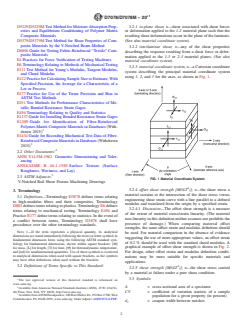
3.2.3 material coordinate system, n—a Cartesian coordinate
E111Test Method for Young’s Modulus, Tangent Modulus,
system describing the principal material coordinate system
and Chord Modulus
using 1, 2, and 3 for the axes, as shown in Fig. 1.
E122PracticeforCalculatingSampleSizetoEstimate,With
Specified Precision, the Average for a Characteristic of a
Lot or Process
E177Practice for Use of the Terms Precision and Bias in
ASTM Test Methods
E251Test Methods for Performance Characteristics of Me-
tallic Bonded Resistance Strain Gages
E456Terminology Relating to Quality and Statistics
E1237Guide for Installing Bonded Resistance Strain Gages
E1309 Guide for Identification of Fiber-Reinforced
Polymer-Matrix Composite Materials in Databases (With-
drawn 2015)
E1434Guide for Recording Mechanical Test Data of Fiber-
ReinforcedCompositeMaterialsinDatabases(Withdrawn
2015)
2.2 Other Documents:
ANSI Y14.5M-1982 Geometric Dimensioning and Toler-
ancing
ANSI/ASME B 46.1-1985 Surface Texture (Surface
Roughness, Waviness, and Lay)
2.3 ASTM Adjuncts:
FIG. 1 Material Coordinate System
V-Notched Rail Shear Fixture Machining Drawings
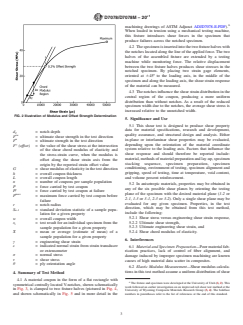
3.2.4 offset shear strength [M/(LT )], n—the shear stress a
3. Terminology
material sustains at the intersection of the shear stress versus
3.1 Definitions—Terminology D3878 defines terms relating
engineering shear strain curve with a line parallel to a defined
to high-modulus fibers and their composites. Terminology
modulus and translated from the origin by a specified strain.
D883definestermsrelatingtoplastics.TerminologyE6defines
3.2.4.1 Discussion—The offset shear strength is a measure
terms relating to mechanical testing. Terminology E456 and
of the extent of material stress/strain linearity. (The material
Practice E177 define terms relating to statistics. In the event of
non-linearityinthisdefinitionneitherassumesnorprohibitsthe
a conflict between terms, Terminology D3878 shall have
presence of damage.) When comparing material offset
precedence over the other terminology standards.
strengths, the same offset strain and modulus definition should
NOTE 1—If the term represents a physical quantity, its analytical
be used. For material comparison in the absence of evidence
dimensionsarestatedimmediatelyfollowingtheterm(orlettersymbol)in
suggesting the use of more appropriate values, an offset strain
fundamental dimension form, using the following ASTM standard sym-
of 0.2% should be used with the standard chord modulus. A
bology for fundamental dimensions, shown within square brackets: [M]
graphical example of offset shear strength is shown in Fig. 2.
formass,[L]forlength,[T]fortime,[Θ]forthermodynamictemperature,
and [nd] for nondimensional quantities. Use of these symbols is restricted For design, other offset strain and modulus definition combi-
to analytical dimensions when used with square brackets, as the symbols
nations may be more suitable for specific materials and
may have other definitions when used without the brackets.
applications.
3.2 Definitions of Terms Specific to This Standard:
3.2.5 shear strength [M/(LT )], n—the shear stress carried
by a material at failure under a pure shear condition.
3 3.3 Symbols:
The last approved version of this historical standard is referenced on
www.astm.org.
A = cross-sectional area of a specimen
Available fromAmerican National Standards Institute (ANSI), 25 W. 43rd St.,
4th Floor, New York, NY 10036, http://www.ansi.org. CV = coefficient of variation statistic of a sample
AvailablefromASTMHeadquarters,100BarrHarborDr.,POBoxC700,West
population for a given property (in percent)
Conshohocken, PA19428-2959, www.astm.org. OrderAdjunct ADJD7078-E-PDF.
d = coupon width between notches
´1
D7078/D7078M − 20
machining drawings of ASTM Adjunct ADJD7078-E-PDF).
When loaded in tension using a mechanical testing machine,
this fixture introduces shear forces in the specimen that
produce failures across the notched specimen.
4.2 Thespecimenisinsertedintothetwofixturehalveswith
thenotcheslocatedalongthelineoftheappliedforce.Thetwo
halves of the assembled fixture are extended by a testing
machine while monitoring force. The relative displacement
between the two fixture halves produces shear stresses in the
notched specimen. By placing two strain gage elements,
oriented at 645º to the loading axis, in the middle of the
specimen and along the loading axis, the shear strain response
of the material can be measured.
4.3 The notches influence the shear strain distribution in the
central region of the coupon, producing a more uniform
distribution than without notches. As a result of the reduced
specimen width due to the notches, the average shear stress is
increased relative to the unnotched width.
FIG. 2 Illustration of Modulus and Offset Strength Determination
5. Significance and Use
5.1 This shear test is designed to produce shear property
data for material specifications, research and development,
d = notch depth
su
quality assurance, and structural design and analysis. Either
F = ultimate shear strength in the test direction
u
in-plane or interlaminar shear properties may be evaluated,
F = ultimate strength in the test direction
depending upon the orientation of the material coordinate
F° (offset) = the value of the shear stress at the intersection
system relative to the loading axis. Factors that influence the
of the shear chord modulus of elasticity and
shear response and should therefore be reported include:
the stress-strain curve, when the modulus is
material,methodsofmaterialpreparationandlay-up,specimen
offset along the shear strain axis from the
stacking sequence, specimen preparation, specimen
origin by the reported strain offset value
conditioning, environment of testing, specimen alignment and
G = shearmodulusofelasticityinthetestdirection
h = overall coupon thickness gripping, speed of testing, time at temperature, void content,
L = overall coupon length and volume percent reinforcement.
n = number of coupons per sample population
5.2 In anisotropic materials, properties may be obtained in
P = force carried by test coupon
any of the six possible shear planes by orienting the testing
f
P = force carried by test coupon at failure
max plane of the specimen with the desired material plane (1-2 or
P = maximum force carried by test coupon before
2-1, 1-3 or 3-1, 2-3 or 3-2). Only a single shear plane may be
failure
evaluated for any given specimen. Properties, in the test
r = notch radius
direction, which may be obtained from this test method,
S = standard deviation statistic of a sample popu-
n-1
include the following:
lation for a given property
5.2.1 Shear stress versus engineering shear strain response,
w = overall coupon width
5.2.2 Ultimate shear strength,
x = test result for an individual specimen from the
i
5.2.3 Ultimate engineering shear strain, and
sample population for a given property
¯
5.2.4 Shear chord modulus of elasticity.
X = mean or average (estimate of mean) of a
sample population for a given property
6. Interferences
γ = engineering shear strain
ε = indicated normal strain from strain transducer
6.1 Material and Specimen Preparation—Poormaterialfab-
or extensometer
rication practices, lack of control of fiber alignment, and
σ = normal stress
damage induced by improper specimen machining are known
τ = shear stress
causes of high material data scatter in composites.
θ = ply orientation angle
6.2 Elastic Modulus Measurement—Shear modulus calcula-
tionsinthistestmethodassumeauniformdistributionofshear
4. Summary of Test Method
4.1 A material coupon in the form of a flat rectangle with
The fixture and specimen were developed at the University of Utah (1, 2).This
symmetrical centrally located V-notches, shown schematically
work followed an earlier investigation on an improved rail shear test method at the
in Fig. 3, is clamped to two fixture halves (pictured in Fig. 4,
University of Wyoming Composite Materials Research Group (3, 4). The boldface
and shown schematically in Fig. 5 and in more detail in the numbers in parentheses refer to the list of references at the end of this standard.
´1
D7078/D7078M − 20
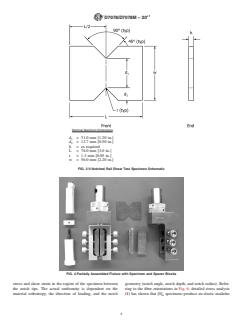
Nominal Specimen Dimensions
d = 31.0 mm [1.20 in.]
d = 12.7 mm [0.50 in.]
h = as required
L = 76.0 mm [3.0 in.]
r = 1.3 mm [0.05 in.]
w = 56.0 mm [2.20 in.]
FIG. 3 V-Notched Rail Shear Test Specimen Schematic
FIG. 4 Partially Assembled Fixture with Specimen and Spacer Blocks
stress and shear strain in the region of the specimen between geometry (notch angle, notch depth, and notch radius). Refer-
the notch tips. The actual uniformity is dependent on the ring to the fiber orientations in Fig. 6, detailed stress analysis
material orthotropy, the direction of loading, and the notch (1) has shown that [0] specimens produce an elastic modulus
n
´1
D7078/D7078M − 20
FIG. 5 Assembled V-Notched Rail Shear Apparatus
recommended that at least one specimen of each sample be
tested with back-to-back two-element strain gages to evaluate
thedegreeoftwist.Evaluatethepercenttwistforthespecimen
by substituting the shear modulus from each side, G and G ,
a b
into | (G – G )/(G + G ) | × 100, evaluated at 0.004
a b a b
engineering shear strain. If the amount of twist is greater than
3%, the specimens should be examined for cause of the
twisting, and corrected, if possible. If no cause is apparent or
correction possible, and the twisting persists, the shear modu-
lusmeasurementshouldbemadeusingtheaverageresponseof
back-to-back two-element strain gages.
6.5 Determination of Failure—Referring to the fiber orien-
FIG. 6 Fiber Orientations in V-Notched Shear Specimen
tations in Fig. 6:
6.5.1 [0] Unidirectional Specimens—The use of [0] uni-
n n
measurement that is too high (5-10% too high for carbon/
directional specimens is not recommended, since they produce
epoxy), whereas [0/90] specimens produce a relatively accu-
ns
shear modulus measurements that are too high (5-10% too
rate elastic modulus measurement. Further, stress analysis has
high for carbon/epoxy). A visible crack typically develops in
shown that specimens with between 25% and 100% 645º
[0] unidirectionalspecimensatthenotchroot,causingasmall
n
plies produce relatively accurate elastic laminate modulus
drop in force (5 to 10% of ultimate force) before ultimate
measurements.
failure. The small force drop accompanying the notch root
6.3 Specimen Geometry Modifications—Variations in the crack is not considered the failure force; rather the force that
notch geometry (notch angle, notch depth, and notch radius) accompanies failure in the test section shall be used as the
affect the degree of nonuniformity of shear stress and shear failure force.
strain in the region of the specimen between the notches.
6.5.2 [90] Unidirectional Specimens—The use of [90]
n n
Recommendations for notch dimensions versus the degree of
unidirectional specimens is not recommended, since no rein-
material orthotropy have not been fully developed. Thus, a
forcing fibers span the width of the specimen between the
single notch geometry has been adopted. Variations to the
fixture halves.Therefore, the specimen is subject to damage or
notch angle, notch depth, and notch radius for the purpose of
failure when loading into the test fixture.
increasing the uniformity of the shear stress/shear strain
6.5.3 [0/90] Tape and Fabric Specimens—The shear fail-
ns
distributions for a particular material and laminate are accept-
ure force may be lower than the maximum force attainable
able when the variations are clearly noted in the report.
during the test. For such laminates, the fibers may rotate
6.4 Force Eccentricity—Twisting of the specimen during following shear failure, subsequently allowing the fibers to
loading can occur, affecting strength results, and especially carry a major portion of the force. In such cases, the shear
elastic modulus measurement. Twisting may occur due to an failure force can often be determined by correlating visual
out-of-tolerance fixture, an out-of-tolerance specimen, or from observationoffailureinthetestsectionwithaforcedroporby
a specimen that is improperly installed in the fixture. It is asustainedincreaseintheslopeoftheforce-displacementplot.
´1
D7078/D7078M − 20
6.5.4 Tape and Fabric Specimens with at Least 25 % 645º velocity of the movable head shall be capable of being
Plies—Highshearstrengthrailshearspecimens,especiallythin regulated as specified in 11.3.
ones, can buckle during force application. Buckling can be 7.5.3 Force Indicator—The testing machine force-sensing
detected by strain gage readings from opposite faces of the device shall be capable of indicating the total force being
specimens diverging by more than 10% during loading. Data carried by the test specimen. This device shall be essentially
measured with the specimen in a buckled state are not free from inertia lag at the specified rate of testing and shall
representative of the material shear properties. Modulus data indicate the force with an accuracy over the force range(s) of
must be checked to confirm that buckling has not occurred in interest of within 61% of the indicated value. The force
the modulus measurement range. Strength measurements must range(s) of interest may be fairly low for modulus evaluation,
be checked to confirm that shear strength has not been much higher for strength evaluation, or both, as required.
influenced by specimen buckling. Failure by buckling should
NOTE2—Obtainingprecisionforcedataoveralargerangeofinterestin
not be interpreted as indicating the maximum shear strength.
the same test, such as when both elastic modulus and ultimate force are
6.5.5 Ply delamination is another possible failure mode for
being determined, place extreme requirements on the load cell and its
calibration. For some equipment, a special calibration may be required.
tape and fabric laminates containing a large number of 645°
For some combinations of material and load cell, simultaneous precision
plies. This failure reflects instability of 645° plies with
measurement of both elastic modulus and ultimate strength may not be
compressive stresses in the fiber direction as contrasted to the
possible, and measurement of modulus and strength may have to be
overall specimen buckling failure previously described.
performed in separate tests using a different load cell range for each test.
Additionally, ply delamination may result from interlaminar
7.5.4 Fixturing—The fixture used shall be a two-rail fixture
stresses produced in multidirectional laminates under shear
shown schematically in Fig. 5, and in more detail in the
loading. Differences in strain gage readings due to ply delami-
machining drawings of ASTM Adjunct ADJD7078-E-PDF.
nation may not be noticeable, but the failure can be identified
Each half of the fixture contains a side rail and two gripping
by delaminated plies in contrast to fiber breakage.
plates that have a high coefficient of friction thermal spray
coating on the gripping surface. Three bolts apply pressure to
7. Apparatus
each gripping plate to secure the specimen during loading.The
7.1 Micrometers and Calipers—A micrometer witha4to
fixtureshownisloadedintension.Optionalspacerblocks,used
8mm[0.16to0.32in.]nominaldiameterballinterfaceoraflat
to maintain specimen alignment when installing in the fixture
anvil interface shall be used to measure the specimen thick-
halves, are shown in Fig. 4.
ness. A ball interface is recommended for thickness measure-
7.5.5 Attachments to Testing Machine—Both of the testing
ments when at least one surface is irregular (for example, a
machineheadsshallbecapableofbeingattachedtoonehalfof
course peel ply surface which is neither smooth nor flat). A
the V-notched rail shear fixture. If required, one of the
micrometer or caliper with a flat anvil interface shall be used
interfaces may be capable of relieving minor misalignments
for measuring length, shoulder width, and other machined
between the heads, such as a universal joint.
surface dimensions.Ablade micrometer or non-contact device
7.6 Strain Indicating Device—Bonded resistance strain
such as an optical comparator shall be used for measuring the
gages shall be used to measure strain.Aminimum of two gage
width between notches. The use of alternative measurement
elements are required, centered between the notch tips in the
devices is permitted if specified (or agreed to) by the test
gage section of the specimen. The gage elements shall be
requestor and reported by the testing laboratory. The accuracy
mounted at the +45° and -45° orientations shown in Fig. 6.If
oftheinstrumentsshallbesuitableforreadingtowithin1%of
specimen twisting is a concern, then two gage elements on
the specimen dimensions. For typical specimen geometries, an
each side of the specimen should be measured simultaneously
instrument with an accuracy of 60.0025mm [60.0001in.] is
to allow for a correction as a result of any twisting of the
adequateforthicknessmeasurements,whileaninstrumentwith
specimen,asdiscussedinSection6.Theoutputfromeachpair
an accuracy of 60.025mm [60.001in.] is adequate for
of gage elements may be monitored individually and the
measurementoflength,width,andothermachineddimensions.
outputs summed following the test. Additionally, each pair of
7.2 Torque Wrench, for measuring bolt torque of clamping
gage elements may be wired as a half-bridge such that the
bolts. Required to be calibrated within the torque range used.
recorded strain is the sum of the absolute value of the response
ofeachgageelement,thusyieldingtheengineeringshearstrain
7.3 Angle Measuring Device, for measuring the specimen
response directly.
notch angle, accurate to within 61°.
7.6.1 Bonded Resistance Strain Gage Selection—Strain
7.4 Radius Measuring Device, for measuring the specimen
gage selection is based on the type of material to be tested.An
notch radius, accurate to within 60.25 mm [60.01 in.].
active gage length of 1.5 mm [0.062 in.] is recommended for
7.5 Testing Machine—The testing machine shall be in con- composite laminates fabricated from unidirectional layers.
formance with Practices E4 and shall satisfy the following Larger strain gage sizes may be more suitable for some textile
requirements:
fabriclaminates.Whenthestraingageelementsaremountedat
7.5.1 Testing Machine Heads—The testing machine shall +45° and -45° to the loading axis, the width of the gage
have both an essentially stationary head and a movable head. elements should not be so large as to extend significantly
7.5.2 Drive Mechanism—The testing machine drive mecha- beyondtheareainwhichshearstrainisrelativelyuniform(see
nism shall be capable of imparting to the movable head a Note 3). Gage calibration certification shall comply with Test
controlled velocity with respect to the stationary head. The Methods E251. Strain gages with a minimum normal strain
´1
D7078/D7078M − 20
range of approximately 3% (yielding 6% engineering shear specimens, such as in the case of a designed experiment. For
strain)arerecommended.Whentestingtextilefabriclaminates, statistically significant data, consult the procedure outlined in
gage selection should consider the use of an active gage length Practice E122. Report the method of sampling.
thatisatleastasgreatasthecharacteristicrepeatingunitofthe
NOTE 4—If specimens are to undergo environmental conditioning to
fabric. Some guidelines on the use of strain gages on compos-
equilibrium, and are of such type or geometry that the weight change of
ites follow. A general reference on the subject is Tuttle and
the material cannot be properly measured by weighing the specimen itself
Brinson (5). Specific guidelines on the selection of strain gage (suchasatabbedmechanicalcoupon),thenanothertravelercouponofthe
same nominal thickness and appropriate size (but without tabs) shall be
size for use on textile fabric laminates are provided in Guide
used to determine when equilibrium has been reached for the specimens
D6856.
being conditioned.
NOTE 3—A typical gage would have a 0.062 to 0.125in. active gage
8.2 Geometry—The special coupon is a flat rectangle with
length, 350 Ω resistance, a strain rating of 3% or higher, and the
symmetrical centrally located V-notches. It is recommended
appropriate environmental resistance and thermal coefficient.
that laminates be at least 1.3 mm [0.050 in.] thick, since thin
7.6.1.1 Surface preparation of fiber-reinforced composites
laminates may buckle prior to shear failure. Significantly
in accordance with Guide E1237 can penetrate the matrix
thicker specimens, particularly those with a significant number
material and cause damage to the reinforcing fibers, resulting
of 645º plies, may have shear strengths exceeding the rail-
in improper coupon failures. Reinforcing fibers should not be
clamping capacity of the test fixture. The mandatory require-
exposed or damaged during the surface preparation process.
ments are described in 8.2.1. Recommendations on parameters
The strain gage manufacturer should be consulted regarding
that are not required are discussed in 8.2.2.
surface preparation guidelines and recommended bonding
8.2.1 Specimen Requirements:
agents for composites, pending the development of a set of
8.2.1.1 Shape, Dimensions, Tolerances, and
standard practices for strain gage installation surface prepara-
Configuration—Therequiredspecimenshape,dimensions,and
tion of fiber-reinforced composite materials.
tolerances are described in Fig. 7 (SI) and Fig. 8 (inch-pound).
7.6.1.2 Consideration should be given to the selection of
If required, adjust the standard notch angle of 90°, notch depth
gages having larger resistances to reduce heating effects on
of 12.5 mm [0.50 in.], and notch radius of 1.3 mm [0.050 in.]
low-conductivity materials. Resistances of 350 Ω or higher are
to meet special material requirements, but any deviation from
preferred. Additional consideration should be given to the use
these values must be recorded with the test results, and the
of the minimum possible gage excitation voltage consistent
standard tolerances on these features still apply. As discussed
with the desired accuracy (1 to 2Vis recommended) to reduce
in Section 6, the [0/90] specimen has been found to provide
ns
thepowerconsumedbythegage.Heatingofthecouponbythe
a more accurate elastic modulus determination, shows less
gage may affect the performance of the material directly or it
variationinthestrengthresults,andisgenerallypreferredover
may affect the indicated strain as a result of a difference
either the [0] or the (not recommended) [90] specimens.
n n
between the gage temperature compensation factor and the
8.2.2 Specific Recommendations:
coefficient of thermal expansion of the coupon material.
8.2.2.1 Specimen Thickness—Awiderangeisallowedinthe
7.6.1.3 Considerationofsomeformoftemperaturecompen-
requirement for specimen thickness to allow the user some
sation is recommended, even when testing at standard labora-
flexibility in unusual cases. When possible, however, the
tory atmosphere. Temperature compensation is required when
specimenthicknessshouldbekeptintherangefrom2to5mm
testing in nonambient temperature environments.
[0.080 to 0.200 in.].
7.6.1.4 Consideration should be given to the transverse
sensitivity of the selected strain gage. The strain gage
...