

ASTM B819-19
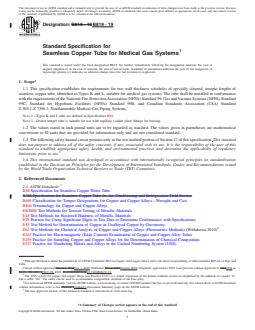
(Specification)Standard Specification for Seamless Copper Tube for Medical Gas Systems
General Information
- Abstract
ABSTRACT
This specification establishes the requirements for two wall thickness schedules of specially cleaned, straight lengths of seamless copper tube, identified as Types K and L, suitable for medical gas systems. The product shall be manufactured by such hot working necessary to convert the billet to a tubular shape and cold worked to the finished size. Seamless copper tube for medical gas systems shall be furnished in the H58 (Drawn General Purpose) temper. Tension test and Rockwell hardness test shall be performed to determine the tube's tensile strength and hardness, respectively. Eddy-current test, a nondestructive test, shall be performed as well. The tubes used for medical gas systems shall be cleaned by any of the following recommended methods: alkaline washing, steam solvent washing, steam detergent washing, steam washing, vapor degreasing, and refrigerant degreasing.
SIGNIFICANCE AND USE
17.1 For purpose of determining compliance with the specified limits for requirements of the properties listed in Table 9, an observed value or calculated value shall be rounded as indicated in accordance with the rounding of Practice E29.
SCOPE
1.1 This specification establishes the requirements for two wall thickness schedules of specially cleaned, straight lengths of seamless copper tube, identified as Types K and L, suitable for medical gas systems. The tube shall be installed in conformance with the requirements of the National Fire Protection Association (NFPA) Standard 99, Gas and Vacuum Systems (NFPA) Standard 99C, Standard for Hypobaric Facilities (NFPA) Standard 99B, and Canadian Standards Association (CSA) Standard Z 305.1/Z 7396.1, Nonflammable Medical Gas Piping Systems.
Note 1: Types K and L tube are defined in Specification B88.
Note 2: Drawn temper tube is suitable for use with capillary (solder joint) fittings for brazing.
1.2 The values stated in inch-pound units are to be regarded as standard. The values given in parentheses are mathematical conversions to SI units that are provided for information only and are not considered standard.
1.3 The following safety hazard caveat pertains only to the test method portion of Section 12 of this specification. This standard does not purport to address all of the safety concerns, if any, associated with its use. It is the responsibility of the user of this standard to establish appropriate safety, health, and environmental practices and determine the applicability of regulatory limitations prior to use.2
1.4 This international standard was developed in accordance with internationally recognized principles on standardization established in the Decision on Principles for the Development of International Standards, Guides and Recommendations issued by the World Trade Organization Technical Barriers to Trade (TBT) Committee.
- Status
- Published
- Publication Date
- 30-Sep-2019
- Technical Committee
- B05 - Copper and Copper Alloys
- Drafting Committee
- B05.04 - Pipe and Tube
Buy Documents
ASTM B819-19 - Standard Specification for Seamless Copper Tube for Medical Gas Systems
REDLINE ASTM B819-19 - Standard Specification for Seamless Copper Tube for Medical Gas Systems
Overview
ASTM B819-19 is the internationally recognized standard specification for seamless copper tubes used in medical gas systems. Developed by ASTM International, this standard sets requirements for the material, manufacturing, cleanliness, mechanical properties, and identification of seamless copper tube types K and L. Its primary focus is to ensure the integrity, reliability, and cleanliness of copper tubing designed for the safe conveyance of medical gases and vacuum systems in healthcare facilities.
The tubes covered by ASTM B819-19 are fabricated from high-purity copper alloy (UNS C12200) and are specifically processed and tested to meet the rigorous demands of medical environments, including hospitals, clinics, and laboratories. The specification aligns with standards established by the National Fire Protection Association (NFPA) and the Canadian Standards Association (CSA) to ensure international compliance.
Key Topics
Scope and Compliance
- Covers two thickness schedules (Types K and L) of straight, seamless copper tubing.
- Tubes must be manufactured and installed in accordance with NFPA 99, NFPA 99B, NFPA 99C, and CSA Z305.1/Z7396.1.
Material and Manufacturing
- Made from Copper Alloy UNS C12200 with a minimum copper (plus silver) content of 99.9%.
- Manufactured through hot and cold working processes; supplied primarily in H58 (Drawn General Purpose) temper, with H55 (Light Drawn) as an option.
Mechanical and Nondestructive Testing
- Tubes are subject to tension and Rockwell hardness tests to verify mechanical properties.
- Each tube undergoes eddy-current testing for nondestructive examination, ensuring suitability and integrity without compromising the tube.
Cleanliness Requirements
- Tubes must be specially cleaned for oxygen and medical gas service using methods such as alkaline washing, steam or solvent washing, vapor degreasing, and refrigerant degreasing.
- Strict maximum residue levels ensure interior cleanliness for patient safety.
Identification and Marking
- Permanent markings indicate manufacturer, tube type, and country of origin.
- Color-coded for easy type identification: green for Type K, blue for Type L, with continual markings including intended use (e.g., “OXY,” “MED”).
Applications
Seamless copper tubes specified in ASTM B819-19 are crucial in:
- Medical Gas Pipeline Systems: Used for distribution of life-supporting medical gases such as oxygen, nitrous oxide, air, and vacuum within hospitals and healthcare facilities.
- Clean Room and Laboratory Gas Supply: For critical environments where cleanliness, purity, and integrity of piping are essential.
- Health and Safety Compliance: Supporting infrastructure that meets NFPA and CSA requirements for safe, nonflammable, and leak-proof gas delivery.
Practically, these copper tubes enable healthcare providers to deliver vital gases safely to patients, making them essential in surgery rooms, intensive care units, dental clinics, and specialist care centers.
Related Standards
- ASTM B88: Specification for seamless copper water tube, defining Types K and L tubes.
- ASTM B280: Standard for seamless copper tube used in air conditioning and refrigeration.
- ASTM B601: Classification for copper and copper alloy tempers.
- ASTM E8/E8M: Test methods for tension testing of metallic materials.
- ASTM E18: Test methods for Rockwell hardness of metallic materials.
- ASTM E243: Practice for eddy-current examination of copper tubes.
- NFPA 99 / NFPA 99B / NFPA 99C: National standards for medical gas and vacuum systems.
- CSA Z305.1 / Z7396.1: Canadian standards for nonflammable medical gas piping systems.
Keywords: seamless copper tube, ASTM B819, medical gas systems, Type K, Type L, NFPA 99, medical gas piping, medical copper tubing, healthcare gas systems, copper tube standards.
Relations
- Effective Date
- 01-Oct-2019
- Effective Date
- 01-Jan-2024
- Effective Date
- 01-Aug-2019
- Effective Date
- 01-Jan-2019
- Effective Date
- 01-Oct-2018
- Effective Date
- 01-Jul-2018
- Effective Date
- 01-Jun-2018
- Effective Date
- 01-Mar-2018
- Effective Date
- 01-Jul-2017
- Effective Date
- 01-Oct-2016
- Effective Date
- 01-Oct-2016
- Effective Date
- 15-Jul-2016
- Effective Date
- 01-Feb-2015
- Effective Date
- 01-Sep-2014
- Effective Date
- 01-Dec-2013
Buy Documents
ASTM B819-19 - Standard Specification for Seamless Copper Tube for Medical Gas Systems
REDLINE ASTM B819-19 - Standard Specification for Seamless Copper Tube for Medical Gas Systems
Get Certified
Connect with accredited certification bodies for this standard

BSI Group
BSI (British Standards Institution) is the business standards company that helps organizations make excellence a habit.

TÜV Rheinland
TÜV Rheinland is a leading international provider of technical services.

TÜV SÜD
TÜV SÜD is a trusted partner of choice for safety, security and sustainability solutions.
Sponsored listings
Frequently Asked Questions
ASTM B819-19 is a technical specification published by ASTM International. Its full title is "Standard Specification for Seamless Copper Tube for Medical Gas Systems". This standard covers: ABSTRACT This specification establishes the requirements for two wall thickness schedules of specially cleaned, straight lengths of seamless copper tube, identified as Types K and L, suitable for medical gas systems. The product shall be manufactured by such hot working necessary to convert the billet to a tubular shape and cold worked to the finished size. Seamless copper tube for medical gas systems shall be furnished in the H58 (Drawn General Purpose) temper. Tension test and Rockwell hardness test shall be performed to determine the tube's tensile strength and hardness, respectively. Eddy-current test, a nondestructive test, shall be performed as well. The tubes used for medical gas systems shall be cleaned by any of the following recommended methods: alkaline washing, steam solvent washing, steam detergent washing, steam washing, vapor degreasing, and refrigerant degreasing. SIGNIFICANCE AND USE 17.1 For purpose of determining compliance with the specified limits for requirements of the properties listed in Table 9, an observed value or calculated value shall be rounded as indicated in accordance with the rounding of Practice E29. SCOPE 1.1 This specification establishes the requirements for two wall thickness schedules of specially cleaned, straight lengths of seamless copper tube, identified as Types K and L, suitable for medical gas systems. The tube shall be installed in conformance with the requirements of the National Fire Protection Association (NFPA) Standard 99, Gas and Vacuum Systems (NFPA) Standard 99C, Standard for Hypobaric Facilities (NFPA) Standard 99B, and Canadian Standards Association (CSA) Standard Z 305.1/Z 7396.1, Nonflammable Medical Gas Piping Systems. Note 1: Types K and L tube are defined in Specification B88. Note 2: Drawn temper tube is suitable for use with capillary (solder joint) fittings for brazing. 1.2 The values stated in inch-pound units are to be regarded as standard. The values given in parentheses are mathematical conversions to SI units that are provided for information only and are not considered standard. 1.3 The following safety hazard caveat pertains only to the test method portion of Section 12 of this specification. This standard does not purport to address all of the safety concerns, if any, associated with its use. It is the responsibility of the user of this standard to establish appropriate safety, health, and environmental practices and determine the applicability of regulatory limitations prior to use.2 1.4 This international standard was developed in accordance with internationally recognized principles on standardization established in the Decision on Principles for the Development of International Standards, Guides and Recommendations issued by the World Trade Organization Technical Barriers to Trade (TBT) Committee.
ABSTRACT This specification establishes the requirements for two wall thickness schedules of specially cleaned, straight lengths of seamless copper tube, identified as Types K and L, suitable for medical gas systems. The product shall be manufactured by such hot working necessary to convert the billet to a tubular shape and cold worked to the finished size. Seamless copper tube for medical gas systems shall be furnished in the H58 (Drawn General Purpose) temper. Tension test and Rockwell hardness test shall be performed to determine the tube's tensile strength and hardness, respectively. Eddy-current test, a nondestructive test, shall be performed as well. The tubes used for medical gas systems shall be cleaned by any of the following recommended methods: alkaline washing, steam solvent washing, steam detergent washing, steam washing, vapor degreasing, and refrigerant degreasing. SIGNIFICANCE AND USE 17.1 For purpose of determining compliance with the specified limits for requirements of the properties listed in Table 9, an observed value or calculated value shall be rounded as indicated in accordance with the rounding of Practice E29. SCOPE 1.1 This specification establishes the requirements for two wall thickness schedules of specially cleaned, straight lengths of seamless copper tube, identified as Types K and L, suitable for medical gas systems. The tube shall be installed in conformance with the requirements of the National Fire Protection Association (NFPA) Standard 99, Gas and Vacuum Systems (NFPA) Standard 99C, Standard for Hypobaric Facilities (NFPA) Standard 99B, and Canadian Standards Association (CSA) Standard Z 305.1/Z 7396.1, Nonflammable Medical Gas Piping Systems. Note 1: Types K and L tube are defined in Specification B88. Note 2: Drawn temper tube is suitable for use with capillary (solder joint) fittings for brazing. 1.2 The values stated in inch-pound units are to be regarded as standard. The values given in parentheses are mathematical conversions to SI units that are provided for information only and are not considered standard. 1.3 The following safety hazard caveat pertains only to the test method portion of Section 12 of this specification. This standard does not purport to address all of the safety concerns, if any, associated with its use. It is the responsibility of the user of this standard to establish appropriate safety, health, and environmental practices and determine the applicability of regulatory limitations prior to use.2 1.4 This international standard was developed in accordance with internationally recognized principles on standardization established in the Decision on Principles for the Development of International Standards, Guides and Recommendations issued by the World Trade Organization Technical Barriers to Trade (TBT) Committee.
ASTM B819-19 is classified under the following ICS (International Classification for Standards) categories: 11.040.10 - Anaesthetic, respiratory and reanimation equipment. The ICS classification helps identify the subject area and facilitates finding related standards.
ASTM B819-19 has the following relationships with other standards: It is inter standard links to ASTM B819-18, ASTM E8/E8M-24, ASTM B846-19a, ASTM B846-19, ASTM B601-18a, ASTM E18-18, ASTM E243-18, ASTM B601-18, ASTM E18-17, ASTM B601-16, ASTM B88-16, ASTM E8/E8M-16, ASTM E8/E8M-15, ASTM B88-14, ASTM E243-13. Understanding these relationships helps ensure you are using the most current and applicable version of the standard.
ASTM B819-19 is available in PDF format for immediate download after purchase. The document can be added to your cart and obtained through the secure checkout process. Digital delivery ensures instant access to the complete standard document.
Standards Content (Sample)
This international standard was developed in accordance with internationally recognized principles on standardization established in the Decision on Principles for the
Development of International Standards, Guides and Recommendations issued by the World Trade Organization Technical Barriers to Trade (TBT) Committee.
Designation:B819 −19
Standard Specification for
Seamless Copper Tube for Medical Gas Systems
This standard is issued under the fixed designation B819; the number immediately following the designation indicates the year of
original adoption or, in the case of revision, the year of last revision.Anumber in parentheses indicates the year of last reapproval.A
superscript epsilon (´) indicates an editorial change since the last revision or reapproval.
1. Scope* mendations issued by the World Trade Organization Technical
Barriers to Trade (TBT) Committee.
1.1 This specification establishes the requirements for two
wall thickness schedules of specially cleaned, straight lengths
2. Referenced Documents
of seamless copper tube, identified as Types K and L, suitable
2.1 ASTM Standards:
for medical gas systems. The tube shall be installed in
B88Specification for Seamless Copper Water Tube
conformance with the requirements of the National Fire
B601ClassificationforTemperDesignationsforCopperand
Protection Association (NFPA) Standard99, Gas and Vacuum
Copper Alloys—Wrought and Cast
Systems(NFPA)Standard99C,StandardforHypobaricFacili-
B846Terminology for Copper and Copper Alloys
ties (NFPA) Standard 99B, and Canadian Standards Associa-
E8/E8MTest Methods for Tension Testing of Metallic Ma-
tion (CSA) Standard Z305.1⁄Z7396.1, Nonflammable Medi-
terials
cal Gas Piping Systems.
E18Test Methods for Rockwell Hardness of Metallic Ma-
NOTE 1—Types K and L tube are defined in Specification B88.
terials
NOTE 2—Drawn temper tube is suitable for use with capillary (solder
E29Practice for Using Significant Digits in Test Data to
joint) fittings for brazing.
Determine Conformance with Specifications
1.2 Thevaluesstatedininch-poundunitsaretoberegarded
E53Test Method for Determination of Copper in Unalloyed
as standard. The values given in parentheses are mathematical
Copper by Gravimetry
conversions to SI units that are provided for information only
E62Test Methods for Chemical Analysis of Copper and
and are not considered standard. 4
CopperAlloys(PhotometricMethods)(Withdrawn2010)
1.3 The following safety hazard caveat pertains only to the E243PracticeforElectromagnetic(EddyCurrent)Examina-
test method portion of Section 12 of this specification. This
tion of Copper and Copper-Alloy Tubes
standard does not purport to address all of the safety concerns,
E255Practice for Sampling Copper and Copper Alloys for
if any, associated with its use. It is the responsibility of the user
the Determination of Chemical Composition
of this standard to establish appropriate safety, health, and
E527Practice for Numbering Metals and Alloys in the
environmental practices and determine the applicability of
Unified Numbering System (UNS)
regulatory limitations prior to use.
2.2 Other Standards:
1.4 This international standard was developed in accor-
National Fire Protection Association (NFPA) 99,Gas and
dance with internationally recognized principles on standard-
Vacuum Systems (NFPA) 99C and Standard for Hypo-
ization established in the Decision on Principles for the baric Facilities (NFPA) 99B
Development of International Standards, Guides and Recom-
CompressedGasAssociation(CGA)G-4.1,CleaningEquip-
ment for Oxygen Service
1 3
ThisspecificationisunderthejurisdictionofASTMCommitteeB05onCopper For referenced ASTM standards, visit the ASTM website, www.astm.org, or
and CopperAlloys and is the direct responsibility of Subcommittee B05.04 on Pipe contact ASTM Customer Service at service@astm.org. For Annual Book of ASTM
and Tube. Standards volume information, refer to the standard’s Document Summary page on
Current edition approved Oct. 1, 2019. Published October 2019. Originally the ASTM website.
approved in 1992. Last previous edition approved in 2018 as B819–18. DOI: The last approved version of this historical standard is referenced on
10.1520/B0819–19. www.astm.org.
2 5
The UNS system for copper and copper alloys (see Practice E527) is a simple Available from National Fire Protection Association (NFPA), 1 Batterymarch
expansion of the former standard system accomplished by the addition of a prefix Park, Quincy, MA 02169, http://www.nfpa.org.
“C”andasuffix“00.”Thesuffixcanbeusedtoaccommodatecompositionvariation Available from Compressed Gas Association (CGA), 14501 George Carter
of the base alloy. Way, Suite 103, Chantilly VA 20151-2923, http://www.cganet.com.
*A Summary of Changes section appears at the end of this standard
Copyright © ASTM International, 100 Barr Harbor Drive, PO Box C700, West Conshohocken, PA 19428-2959. United States
B819−19
Canadian Standards Association (CSA) Z305.1⁄Z7396.1, 4.2.2 Whether the tube shall be charged with dry, oil-free
Nonflammable Medical Gas Piping Systems nitrogen during capping, closing, or plugging (see 11.8),
4.2.3 Certification, if required (see Section 20), and
3. Terminology
4.2.4 Mill Test Report, if required, (see Section 21).
3.1 For definitions of terms related to copper and copper
4.2.5 Inaddition,whenmaterialispurchasedforagenciesof
alloys, refer to Terminology B846.
the U.S. government, it shall conform to the Supplementary
3.2 Definitions of Terms Specific to This Standard:
Requirements as defined herein when specified in the contract
3.2.1 lengths—straight pieces of the product.
or purchase order.
3.2.2 standard—uniform lengths established as commercial
5. Materials and Manufacture
standards.
3.2.3 tube, copper water—a seamless copper tube conform-
5.1 Material—The materials of manufacture shall be a cast
ing to the particular dimensions commercially known as
billet of Copper Alloy UNS C12200 of such purity and
CopperWaterTubeanddesignatedasTypesKandL(seeTable
soundness as to be suitable for processing into the products
1).
prescribed herein.
3.2.4 tube, seamless—a tube produced with a continuous
5.2 Manufacture—The product shall be manufactured by
periphery in all stages of the operations.
such hot working necessary to convert the billet to a tubular
shape and cold worked to the finished size.
4. Ordering Information
4.1 Ordersformaterialunderthisspecificationshallinclude
6. Chemical Composition
the following information:
6.1 The material shall conform to the following chemical
4.1.1 Specification B819–00.
requirements of Copper UNS No. C12200:
4.1.2 Nominal or standard size (Column 1 of Table 1) and
whether Type K or L (Sections 3 and 10), Copper (incl silver), % 99.9 minimum
Phosphorous, % 0.015 to 0.040
4.1.3 Temper (Sections 7 and 8),
4.1.4 Length (see 10.5),
6.2 These specification limits do not preclude the presence
4.1.5 Quantity (pieces) of each size and type,
of other elements. Limits for unnamed elements may be
establishedbyagreementbetweenthemanufacturerorsupplier
4.2 The following options are available and should be
and the purchaser.
specified at the time of placing the order when required.
4.2.1 Whethertensiontestdeterminationsarerequired(Sec-
7. Temper
tion 8),
7.1 Seamless copper tube for medical gas systems shall be
furnished in the H55 (Light Drawn) temper or H58 (Drawn
Available from Canadian Standards Association (CSA), 178 Rexdale Blvd.,
General Purpose) temper, as defined in Classification B601.
Toronto, ON M9W 1R3, Canada, http://www.csagroup.org.
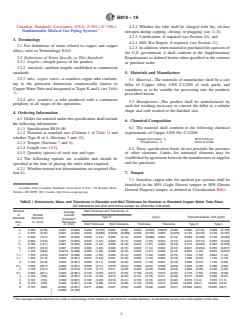
TABLE 1 Dimensions, Mass, and Tolerances in Diameter and Wall Thickness for Nominal or Standard Copper Water Tube Sizes
(All tolerances are plus and minus except as otherwise indicated)
Nominal Wall Thickness and Tolerances, in.
Average
or Outside
Outside
A Type K Type L Theoretical Mass, lb/ft (kg/m)
Standard Diameter,
Diameter
Size, in. (mm) Tolerances,
Wall Thickness Wall Tolerance Thickness Tolerance Type K Type L
in. (mm)
in.
⁄8 0.250 (6.35) 0.001 (0.025) 0.030 (0.762) 0.003 (0.08) 0.025 (0.635) 0.0025 (0.06) 0.080 (0.119) 0.068 (0.102)
⁄4 0.375 (9.52) 0.001 (0.025) 0.035 (0.889) 0.0035 (0.089) 0.030 (0.762) 0.003 (0.076) 0.145 (0.216) 0.126 (0.187)
⁄8 0.500 (12.7) 0.001 (0.025) 0.049 (1.24) 0.005 (0.13) 0.035 (0.889) 0.004 (0.10) 0.269 (0.400) 0.198 (0.295)
⁄2 0.625 (15.9) 0.001 (0.025) 0.049 (1.24) 0.005 (0.13) 0.040 (1.02) 0.004 (0.10) 0.344 (0.512) 0.285 (0.424)
⁄8 0.750 (19.1) 0.001 (0.025) 0.049 (1.24) 0.005 (0.13) 0.042 (1.07) 0.004 (0.10) 0.418 (0.622) 0.362 (0.539)
⁄4 0.875 (22.3) 0.001 (0.025) 0.065 (1.65) 0.006 (0.15) 0.045 (1.14) 0.004 (0.10) 0.641 (0.954) 0.455 (0.677)
1 1.125 (28.6) 0.0015 (0.038) 0.065 (1.65) 0.006 (0.15) 0.050 (1.27) 0.005 (0.13) 0.839 (1.25) 0.655 (0.975)
1 ⁄4 1.375 (34.9) 0.0015 (0.038) 0.065 (1.65) 0.006 (0.15) 0.055 (1.40) 0.006 (0.15) 1.040 (1.55) 0.884 (1.32)
1 ⁄2 1.625 (41.3) 0.002 (0.051) 0.072 (1.83) 0.007 (0.18) 0.060 (1.52) 0.006 (0.15) 1.360 (2.02) 1.140 (1.70)
2 2.125 (54.0) 0.002 (0.051) 0.083 (2.11) 0.008 (0.20) 0.070 (1.78) 0.007 (0.18) 2.060 (3.07) 1.750 (2.60)
2 ⁄2 2.625 (66.7) 0.002 (0.051) 0.095 (2.41) 0.010 (0.25) 0.080 (2.03) 0.008 (0.20) 2.930 (4.36) 2.480 (3.69)
3 3.125 (79.4) 0.002 (0.510) 0.109 (2.77) 0.011 (0.28) 0.090 (2.29) 0.009 (0.23) 4.000 (5.95) 3.330 (4.96)
3 ⁄2 3.625 (92.1) 0.002 (0.051) 0.120 (3.05) 0.012 (0.30) 0.100 (2.54) 0.010 (0.25) 5.120 (7.62) 4.290 (6.38)
4 4.125 (105) 0.002 (0.051) 0.134 (3.40) 0.013 (0.33) 0.110 (2.79) 0.011 (0.28) 6.510 (9.69) 5.380 (8.01)
5 5.125 (130) 0.002 (0.051) 0.160 (4.06) 0.016 (0.41) 0.125 (3.18) 0.012 (0.30) 9.670 (14.4) 7.610 (11.3)
6 6.125 (156) 0.002 (0.051) 0.192 (4.88) 0.019 (0.48) 0.140 (3.56) 0.014 (0.36) 13.900 (20.7) 10.200 (15.2)
8 8.125 (206) +0.002 (0.051) 0.271 (6.88) 0.027 (0.69) 0.200 (5.08) 0.020 (0.51) 25.900 (38.5) 19.300 (28.7)
−0.006 (0.150)
H
A
The average outside diameter of a tube is the average of the maximum and minimum outside diameter, as determined at any one cross section of the tube.
B819−19
8. Mechanical Properties
Tube Outside Diameter of Drilled
Diameter, in. Holes, in. Drill Number
8.1 The tube shall conform to the mechanical property
1 3
⁄4 to ⁄4, incl 0.025 72
requirements specified in Table 2 when tested in accordance
Over
⁄4 to 1, incl 0.031 68
withTestMethodsE18andE8/E8M,respectively.Tensiontest
Over 1 to 1 ⁄4, incl 0.036 64
1 1
determinationsneednotbemadeexceptwhenindicatedbythe
Over 1 ⁄4 to 1 ⁄2, incl 0.042 58
1 3
Over 1 ⁄2 to 1 ⁄4, incl 0.046 58
purchaseratthetimeofplacingtheorder.Aconvenientmethod
Over 1 ⁄4 to 2, incl 0.052 55
ofindicatingthatthesetestsaretobemadeistostatethat“Test
9.1.2 Tubes that do not activate the signalling device of the
Procedure T” is required (see 4.2.1). Where agreement on the
eddy-current testers shall be considered as conforming to the
Rockwellhardnesstestscannotbereached,thetensilestrength
requirements of this test. Tubes with discontinuities indicated
requirements of Table 2 shall be the basis for acceptance or
by the testing unit may at the option of the manufacturer be
rejection.
reexamined or retested to determine whether the discontinuing
is cause for rejection. Signals that are found to have been
9. Nondestructive Testing
causedbyminormechanicaldamage,soilormoisture,shallnot
9.1 Each tube up to and including 3 in. (76.2 mm) standard
be cause for rejection of the tubes provided the tube dimen-
size, 3 ⁄8 in. (79.4 mm) outside diameter, shall be subjected to
sions are still within prescribed limits and the tube is suitable
an eddy-current test. Testing shall follow the procedures of
for its intended application.
Practice E243, except for the determination of “end effect.”
9.2 Tube made to this specification shall be capable of
Tubes shall be passed through an eddy-current test unit
withstanding the pressure test of 9.2.1 or 9.2.2. Should subse-
adjusted to provide information on the suitability of the tube
quent testing by the purchaser establish that the material does
for the intended application.
not meet these requirements, the material may be rejected.
9.1.1 Either notch depth or drilled hole standards shall be
9.2.1 The tube shall stand without showing evidence of
used.
leakage, and an internal hydrostatic pressure sufficient to
9.1.1.1 Notch-depth standards, rounded to the nearest
subject the material to a fiber stress of 6000 psi (41 MPa)
0.001in. (0.025 mm) shall be 22% of the wall thickness. The
calculated from the following equation for thin hollow cylin-
notch-depth tolerance shall be plus and minus 0.0005 in.
ders under tension:
(0.013mm). Alternatively at the option of the manufacturer
2 St
usingspeed-insensitiveeddy-currentunitsthatareequippedso
P 5 (1)
D 20.8t
that a fraction of the maximum imbalance signal can be
selected, the following percent maximum imbalance signals
where:
may be used:
P = hydrostatic pressure, psi (MPa);
Maximum Percent Imbalance
S = allowable stress of the material, psi (MPa);
Standard Tube Size, in. Signal Magnitude
t = wall thickness, in. (mm); and
D = outside diameter of the tube, in. (mm).
Up to ⁄8, incl 0.2
⁄2 to 2, incl 0.3
9.2.2 Thetubeshallstandaninternalairpressureof60psig
Over 2 to 3, incl 0.4
(415kPa)for5swithoutshowingevidenceofleakage.Thetest
9.1.1.2 Drilled holes shall be drilled radially through the
method used shall permit easy visual detection of any leakage,
wall using a suitable drill jig that has a bushing to guide the
such as by having the tube under water or by the pressure
drill, care being taken to avoid distortion of the tube while
differential method.
drilling.Thediameterofthedrilledholeshallbeinaccordance
with the following and shall not vary by more than+0.001 in.
10. Dimensions, Mass and Permissible Variations
(+0.026 mm),−0.000 in. (−0.000 mm) of the hole diameter
10.1 For the purpose of determining conformance with the
specified.
dimensional requirements specified in this specification, any
measured value outside the specified limiting values for any
dimensions may be cause for rejection.
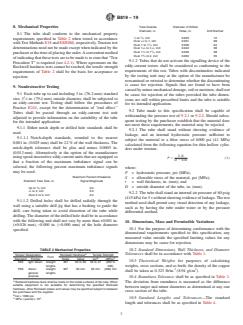
TABLE 2 Mechanical Properties 10.2 Standard Dimensions, Wall Thickness, and Diameter
A
Tolerances shall be in accordance with Table 1.
Temper Designation Rockwell Hardness Tensile Strength
Form
B C
Standard Former Scale Value ksi (MPa)
10.3 Theoretical Weights for purposes of calculating
H55 light drawn straight 30T 30 to 60 36 to 47 (250 to
lengths 325) weights, cross sections, and so forth, the density of the copper
3 3
H58 drawn straight 30T 30 min 36 min (250) min
shall be taken as 0.323 lb/in. (8.94 g/cm ).
general lengths
purpose
10.4 Roundness Tolerance shall be as specified in Table 3.
A
Rockwellhardnesstestsshallbemadeontheinsidesurfacesofthetube.When
The deviation from roundness is measured as the difference
suitable equipment is not available for determining the specified Rockwell
between major and minor diameters as determined at any one
hardness, other Rockwell scales and values may be specified subject to between
cross section of the tube.
the purchaser and the supplier.
B
ksi = 1000 psi.
C 6 10.5 Standard Lengths and Tolerances—The standard
MPa = pascal × 10 .
length and tolerances shall be as specified in Table 4.
B819−19
TABLE 3 Roundness Tolerance
12. Cleanness Requirements
Roundness Tolerance %
12.1 The tube shall be capable of passing the following
t/D (Ratio of Wall Thickness of Outside Diameter
cleanness test, although actual performance of this test is not
to Outside Diameter) (Expressed to Nearest
0.001 in. or 0.010 mm)
mandatory under the terms of this specification unless speci-
0.01 to 0.03, incl 1.5
fied. Cleanness requirements in addition to those of this
Over 0.03 to 0.05, incl 1.0
specification are the responsibility of the user.
Over 0.05 to 0.10, incl 0.8
12.1.1 Theinsideoftubewithsealedorclosedendsshallbe
sufficientlycleansothatwhentheinteriorofthetubeiswashed
withtrichloroethylene,orothersuitablesolventsuchasmethyl
TABLE 4 Standard Lengths and Tolerances
chloroformorredistilledtrichloroethylene,theresidueremain-
Nominal or
Tolerance (All Plus),
Standard Size, Type Standard Length, ft (m) ing upon evaporation of the solvent shall not exceed 0.0035
in. (mm)
2 2
in.
g/ft (0.038g/m )ofinteriorsurface.Themaximumamountof
Tubes Furnished in Straight Lengths
residue in grams per tube shall not exceed the requirements
Up to 8 incl K,L 20 (6.1) 1 in. (25)
specified in Table 5 or Table 6.
12.1.2 Toperformthetest,cap(orplug)oneendofthetube
andfillwithsolventtooneeighthofitscapacity.Cap(orplug)
10.6 Squareness of Cut—The departure from squareness of
the opposite end and roll tubes on horizontal supports to wash
the end of any tube shall not exceed more than 0.010 in.
the inside surfaces thoroughly (Note 4). Remove cap or plug
(0.25mm) for tube up to and including ⁄2 in. (12.7 mm)
and pour solvent into a suitable clean weighed container. The
standardsize;andnotmorethan0.016in./in.(0.40mm/mm)of
solvent in the container shall be evaporated to dryness on a
outsidediameterfortubelargerthan ⁄2in.(12.7mm)standard
low-temperature hot plate or sand bath. Overheating of the
size.
container should be avoided to prevent charring of the residue.
The container shall then be dried in an oven at 100 to 110°C
11. Tube Cleaned for Medical Gas Systems
for 10 min, cooled in a desiccator, and weighed. A blank
11.1 Tube for medical gas systems shall be cleaned to meet
determination shall be run on the determined quantity of
the requirements of Section 12. The following are recom-
solventandthegaininweightfortheblankshallbesubtracted
mended practices for cleaning, but the producer is not limited
fromtheweighingoftheresiduesample.Thecorrectedweight
to these procedur
...
This document is not an ASTM standard and is intended only to provide the user of an ASTM standard an indication of what changes have been made to the previous version. Because
it may not be technically possible to adequately depict all changes accurately, ASTM recommends that users consult prior editions as appropriate. In all cases only the current version
of the standard as published by ASTM is to be considered the official document.
Designation: B819 − 18 B819 − 19
Standard Specification for
Seamless Copper Tube for Medical Gas Systems
This standard is issued under the fixed designation B819; the number immediately following the designation indicates the year of
original adoption or, in the case of revision, the year of last revision. A number in parentheses indicates the year of last reapproval. A
superscript epsilon (´) indicates an editorial change since the last revision or reapproval.
1. Scope*
1.1 This specification establishes the requirements for two wall thickness schedules of specially cleaned, straight lengths of
seamless copper tube, identified as Types K and L, suitable for medical gas systems. The tube shall be installed in conformance
with the requirements of the National Fire Protection Association (NFPA) Standard 99, Gas and Vacuum Systems (NFPA) Standard
99C, Standard for Hypobaric Facilities (NFPA) Standard 99B, and Canadian Standards Association (CSA) Standard
Z 305.1 ⁄Z 7396.1, Nonflammable Medical Gas Piping Systems.
NOTE 1—Types K and L tube are defined in Specification B88.
NOTE 2—Drawn temper tube is suitable for use with capillary (solder joint) fittings for brazing.
1.2 The values stated in inch-pound units are to be regarded as standard. The values given in parentheses are mathematical
conversions to SI units that are provided for information only and are not considered standard.
1.3 The following safety hazard caveat pertains only to the test method portion of Section 12 of this specification. This standard
does not purport to address all of the safety concerns, if any, associated with its use. It is the responsibility of the user of this
standard to establish appropriate safety, health, and environmental practices and determine the applicability of regulatory
limitations prior to use.
1.4 This international standard was developed in accordance with internationally recognized principles on standardization
established in the Decision on Principles for the Development of International Standards, Guides and Recommendations issued
by the World Trade Organization Technical Barriers to Trade (TBT) Committee.
2. Referenced Documents
2.1 ASTM Standards:
B88 Specification for Seamless Copper Water Tube
B280 Specification for Seamless Copper Tube for Air Conditioning and Refrigeration Field Service
B601 Classification for Temper Designations for Copper and Copper Alloys—Wrought and Cast
B846 Terminology for Copper and Copper Alloys
E8/E8M Test Methods for Tension Testing of Metallic Materials
E18 Test Methods for Rockwell Hardness of Metallic Materials
E29 Practice for Using Significant Digits in Test Data to Determine Conformance with Specifications
E53 Test Method for Determination of Copper in Unalloyed Copper by Gravimetry
E62 Test Methods for Chemical Analysis of Copper and Copper Alloys (Photometric Methods) (Withdrawn 2010)
E243 Practice for Electromagnetic (Eddy Current) Examination of Copper and Copper-Alloy Tubes
E255 Practice for Sampling Copper and Copper Alloys for the Determination of Chemical Composition
E527 Practice for Numbering Metals and Alloys in the Unified Numbering System (UNS)
This specification is under the jurisdiction of ASTM Committee B05 on Copper and Copper Alloys and is the direct responsibility of Subcommittee B05.04 on Pipe and
Tube.
Current edition approved March 1, 2018Oct. 1, 2019. Published March 2018October 2019. Originally approved in 1992. Last previous edition approved in 20112018 as
B819 – 00 (2011).B819–18. DOI: 10.1520/B0819-18.10.1520/B0819–19.
The UNS system for copper and copper alloys (see Practice E527) is a simple expansion of the former standard system accomplished by the addition of a prefix “C”
and a suffix “00.” The suffix can be used to accommodate composition variation of the base alloy.
For referenced ASTM standards, visit the ASTM website, www.astm.org, or contact ASTM Customer Service at service@astm.org. For Annual Book of ASTM Standards
volume information, refer to the standard’sstandard’s Document Summary page on the ASTM website.
The last approved version of this historical standard is referenced on www.astm.org.
*A Summary of Changes section appears at the end of this standard
Copyright © ASTM International, 100 Barr Harbor Drive, PO Box C700, West Conshohocken, PA 19428-2959. United States
B819 − 19
2.2 Other Standards:
National Fire Protection Association (NFPA) 99, Gas and Vacuum Systems (NFPA) 99C and Standard for Hypobaric Facilities
(NFPA) 99B
Compressed Gas Association (CGA) G-4.1, Cleaning Equipment for Oxygen Service
Available from National Fire Protection Association (NFPA), 1 Batterymarch Park, Quincy, MA 02169, http://www.nfpa.org.
Available from Compressed Gas Association (CGA), 14501 George Carter Way, Suite 103, Chantilly VA 20151-2923, http://www.cganet.com.
B819 − 19
Canadian Standards Association (CSA) Z 305.1 ⁄Z 7396.1, Nonflammable Medical Gas Piping Systems
3. Terminology
3.1 For definitions of terms related to copper and copper alloys, refer to Terminology B846.
3.2 Definitions of Terms Specific to This Standard:
3.2.1 lengths—straight pieces of the product.
3.2.2 standard—uniform lengths established as commercial standards.
3.2.3 tube, copper water—a seamless copper tube conforming to the particular dimensions commercially known as Copper
Water Tube and designated as Types K and L (see Table 1).
3.2.4 tube, seamless—a tube produced with a continuous periphery in all stages of the operations.
4. Ordering Information
4.1 Orders for material under this specification shall include the following information:
4.1.1 Specification B819–00.
4.1.2 Nominal or standard size (Column 1 of Table 1) and whether Type K or L (Sections 3 and 10),
4.1.3 Temper (Sections 7 and 8),
4.1.4 Length (see 10.5),
4.1.5 Quantity (pieces) of each size and type,
4.2 The following options are available and should be specified at the time of placing the order when required.
4.2.1 Whether tension test determinations are required (Section 8),
4.2.2 Whether the tube shall be charged with dry, oil-free nitrogen during capping, closing, or plugging (see 11.8),
4.2.3 Certification, if required (see Section 20), and
4.2.4 Mill Test Report, if required, (see Section 21).
4.2.5 In addition, when material is purchased for agencies of the U.S. government, it shall conform to the Supplementary
Requirements as defined herein when specified in the contract or purchase order.
5. Materials and Manufacture
5.1 Material—The materials of manufacture shall be a cast billet of Copper Alloy UNS C12200 of such purity and soundness
as to be suitable for processing into the products prescribed herein.
5.2 Manufacture—The product shall be manufactured by such hot working necessary to convert the billet to a tubular shape and
cold worked to the finished size.
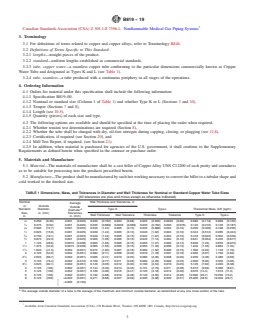
TABLE 1 Dimensions, Mass, and Tolerances in Diameter and Wall Thickness for Nominal or Standard Copper Water Tube Sizes
(All tolerances are plus and minus except as otherwise indicated)
Nominal Wall Thickness and Tolerances, in.
Average
or Outside
Outside
A Type K Type L Theoretical Mass, lb/ft (kg/m)
Standard Diameter,
Diameter
Size, in. (mm) Tolerances,
Wall Thickness Wall Tolerance Thickness Tolerance Type K Type L
in. (mm)
in.
⁄8 0.250 (6.35) 0.001 (0.025) 0.030 (0.762) 0.003 (0.08) 0.025 (0.635) 0.0025 (0.06) 0.080 (0.119) 0.068 (0.102)
⁄4 0.375 (9.52) 0.001 (0.025) 0.035 (0.889) 0.0035 (0.089) 0.030 (0.762) 0.003 (0.076) 0.145 (0.216) 0.126 (0.187)
⁄8 0.500 (12.7) 0.001 (0.025) 0.049 (1.24) 0.005 (0.13) 0.035 (0.889) 0.004 (0.10) 0.269 (0.400) 0.198 (0.295)
⁄2 0.625 (15.9) 0.001 (0.025) 0.049 (1.24) 0.005 (0.13) 0.040 (1.02) 0.004 (0.10) 0.344 (0.512) 0.285 (0.424)
⁄8 0.750 (19.1) 0.001 (0.025) 0.049 (1.24) 0.005 (0.13) 0.042 (1.07) 0.004 (0.10) 0.418 (0.622) 0.362 (0.539)
⁄4 0.875 (22.3) 0.001 (0.025) 0.065 (1.65) 0.006 (0.15) 0.045 (1.14) 0.004 (0.10) 0.641 (0.954) 0.455 (0.677)
1 1.125 (28.6) 0.0015 (0.038) 0.065 (1.65) 0.006 (0.15) 0.050 (1.27) 0.005 (0.13) 0.839 (1.25) 0.655 (0.975)
1 ⁄4 1.375 (34.9) 0.0015 (0.038) 0.065 (1.65) 0.006 (0.15) 0.055 (1.40) 0.006 (0.15) 1.040 (1.55) 0.884 (1.32)
1 ⁄2 1.625 (41.3) 0.002 (0.051) 0.072 (1.83) 0.007 (0.18) 0.060 (1.52) 0.006 (0.15) 1.360 (2.02) 1.140 (1.70)
2 2.125 (54.0) 0.002 (0.051) 0.083 (2.11) 0.008 (0.20) 0.070 (1.78) 0.007 (0.18) 2.060 (3.07) 1.750 (2.60)
2 ⁄2 2.625 (66.7) 0.002 (0.051) 0.095 (2.41) 0.010 (0.25) 0.080 (2.03) 0.008 (0.20) 2.930 (4.36) 2.480 (3.69)
3 3.125 (79.4) 0.002 (0.510) 0.109 (2.77) 0.011 (0.28) 0.090 (2.29) 0.009 (0.23) 4.000 (5.95) 3.330 (4.96)
3 ⁄2 3.625 (92.1) 0.002 (0.051) 0.120 (3.05) 0.012 (0.30) 0.100 (2.54) 0.010 (0.25) 5.120 (7.62) 4.290 (6.38)
4 4.125 (105) 0.002 (0.051) 0.134 (3.40) 0.013 (0.33) 0.110 (2.79) 0.011 (0.28) 6.510 (9.69) 5.380 (8.01)
5 5.125 (130) 0.002 (0.051) 0.160 (4.06) 0.016 (0.41) 0.125 (3.18) 0.012 (0.30) 9.670 (14.4) 7.610 (11.3)
6 6.125 (156) 0.002 (0.051) 0.192 (4.88) 0.019 (0.48) 0.140 (3.56) 0.014 (0.36) 13.900 (20.7) 10.200 (15.2)
8 8.125 (206) +0.002 (0.051) 0.271 (6.88) 0.027 (0.69) 0.200 (5.08) 0.020 (0.51) 25.900 (38.5) 19.300 (28.7)
−0.006 (0.150)
H
A
The average outside diameter of a tube is the average of the maximum and minimum outside diameter, as determined at any one cross section of the tube.
Available from Canadian Standards Association (CSA), 178 Rexdale Blvd., Toronto, ON M9W 1R3, Canada, http://www.csagroup.org.
B819 − 19
6. Chemical Composition
6.1 The material shall conform to the following chemical requirements of Copper UNS No. C12200:
Copper (incl silver), % 99.9 minimum
Phosphorous, % 0.015 to 0.040
6.2 These specification limits do not preclude the presence of other elements. Limits for unnamed elements may be established
by agreement between the manufacturer or supplier and the purchaser.
7. Temper
7.1 Seamless copper tube for medical gas systems shall be furnished in the H55 (Light Drawn) temper or H58 (Drawn General
Purpose) temper, as defined in Classification B601.
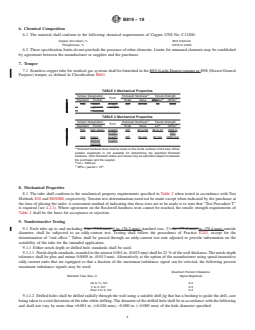
TABLE 2 Mechanical Properties
A
Temper Designation Rockwell Hardness Tensile Strength
Form
B C
Standard Former Scale Value min, ksi (MPa)
H58 drawn straight 30T 30 min 36 (250)
general lengths
purpose
TABLE 2 Mechanical Properties
A
Temper Designation Rockwell Hardness Tensile Strength
Form
B C
Standard Former Scale Value ksi (MPa)
H55 light drawn straight 30T 30 to 60 36 to 47 (250 to
lengths 325)
H58 drawn straight 30T 30 min 36 min (250) min
general lengths
purpose
A
Rockwell hardness tests shall be made on the inside surfaces of the tube. When
suitable equipment is not available for determining the specified Rockwell
hardness, other Rockwell scales and values may be specified subject to between
the purchaser and the supplier.
B
ksi = 1000 psi.
C 6
MPa = pascal × 10 .
8. Mechanical Properties
8.1 The tube shall conform to the mechanical property requirements specified in Table 2 when tested in accordance with Test
Methods E18 and E8/E8M, respectively. Tension test determinations need not be made except when indicated by the purchaser at
the time of placing the order. A convenient method of indicating that these tests are to be made is to state that “Test Procedure T”
is required (see 4.2.1). Where agreement on the Rockwell hardness tests cannot be reached, the tensile strength requirements of
Table 2 shall be the basis for acceptance or rejection.
9. Nondestructive Testing
9.1 Each tube up to and including 3-in. (76.2-mm) 3 in. (76.2 mm) standard size, 3 ⁄8-in. (79.4-mm) in. (79.4 mm) outside
diameter, shall be subjected to an eddy-current test. Testing shall follow the procedures of Practice E243, except for the
determination of “end effect.” Tubes shall be passed through an eddy-current test unit adjusted to provide information on the
suitability of the tube for the intended application.
9.1.1 Either notch depth or drilled hole standards shall be used.
9.1.1.1 Notch-depth standards, rounded to the nearest 0.001 in. (0.025 mm) shall be 22 % of the wall thickness. The notch-depth
tolerance shall be plus and minus 0.0005 in. (0.013 mm). Alternatively at the option of the manufacturer using speed-insensitive
eddy-current units that are equipped so that a fraction of the maximum imbalance signal can be selected, the following percent
maximum imbalance signals may be used:
Maximum Percent Imbalance
Standard Tube Size, in. Signal Magnitude
Up to ⁄8, incl 0.2
⁄2 to 2, incl 0.3
Over 2 to 3, incl 0.4
9.1.1.2 Drilled holes shall be drilled radially through the wall using a suitable drill jig that has a bushing to guide the drill, care
being taken to avoid distortion of the tube while drilling. The diameter of the drilled hole shall be in accordance with the following
and shall not vary by more than +0.001 in. (+0.026 mm), −0.000 in. (−0.000 mm) of the hole diameter specified.
B819 − 19
Tube Outside Diameter of Drilled
Diameter, in. Holes, in. Drill Number
1 3
⁄4 to ⁄4, incl 0.025 72
Over ⁄4 to 1, incl 0.031 68
Over 1 to 1 ⁄4, incl 0.036 64
1 1
Over 1 ⁄4 to 1 ⁄2, incl 0.042 58
1 3
Over 1 ⁄2 to 1 ⁄4, incl 0.046 58
Over 1 ⁄4 to 2, incl 0.052 55
9.1.2 Tubes that do not activate the signalling device of the eddy-current testers shall be considered as conforming to the
requirements of this test. Tubes with discontinuities indicated by the testing unit may at the option of the manufacturer be
reexamined or retested to determine whether the discontinuing is cause for rejection. Signals that are found to have been caused
by minor mechanical damage, soil or moisture, shall not be cause for rejection of the tubes provided the tube dimensions are still
within prescribed limits and the tube is suitable for its intended application.
9.2 Tube made to this specification shall be capable of withstanding the pressure test of 9.2.1 or 9.2.2. Should subsequent testing
by the purchaser establish that the material does not meet these requirements, the material may be rejected.
9.2.1 The tube shall stand without showing evidence of leakage, and an internal hydrostatic pressure sufficient to subject the
material to a fiber stress of 6000 psi (41 MPa) calculated from the following equation for thin hollow cylinders under tension:
2 St
P 5 (1)
D 2 0.8t
where:
P = hydrostatic pressure, psi (MPa);
S = allowable stress of the material, psi (MPa);
t = wall thickness, in. (mm); and
D = outside diameter of the tube, in. (mm).
9.2.2 The tube shall stand an internal air pressure of 60 psig (415 kPa) for 5 s without showing evidence of leakage. The test
method used shall permit easy visual detection of any leakage, such as by having the tube under water or by the pressure differential
method.
10. Dimensions, Mass and Permissible Variations
10.1 For the purpose of determining conformance with the dimensional requirements specified in this specification, any
measured value outside the specified limiting values for any dimensions may be cause for rejection.
10.2 Standard Dimensions, Wall Thickness, and Diameter Tolerances shall be in accordance with Table 1.
10.3 Theoretical Weights for purposes of calculating weights, cross sections, and so forth, the density of the copper shall be
3 3
taken as 0.323 lb/in. (8.94 g/cm ).
10.4 Roundness Tolerance shall be as specified in Table 3. The deviation from roundness is measured as the difference between
major and minor diameters as determined at any one cross section of the tube.
10.5 Standard Lengths and Tolerances—The standard length and tolerances shall be as specified in Table 4.
10.6 Squareness of Cut—The departure from squareness of the end of any tube shall not exceed more than 0.010 in. (0.25 mm)
for tube up to and including ⁄2-in. (12.7-mm) in. (12.7 mm) standard size; and not more than 0.016 in./in. (0.40 mm/mm) of outside
diameter for tube larger than ⁄2-in. (12.7-mm) in. (12.7 mm) standard size.
11. Tube Cleaned for Medical Gas Systems
11.1 Tube for medical gas systems shall be cleaned to meet the requirements of Section 12. The following are recommended
practices for cleaning, but the producer is not limited to these procedures.
NOTE 3—Some cleaning techniques are found in CGA G-4.1.
TABLE 3 Roundness Tolerance
Roundness Tolerance %
t/D (Ratio of Wall Thickness of Outside Diameter
to Outside Diameter) (Expressed to Nearest
0.001 in. or 0.010 mm)
0.01 to 0.03, incl 1.5
Over 0.03 to 0.05, incl 1.0
Over 0.05 to 0.10, incl 0.8
B819 − 19
TABLE 4 Standard Lengths and Tolerances
Nominal or
Tolerance (All Plus),
Standard Size, Type Standard Length, ft (m)
in. (mm)
in.
Tubes Furnished in Straight Lengths
Up to 8 incl K,L 20 (6.1) 1 in. (25)
11.2 Alkaline Washing—Washing in a solution of approximately 4 oz of commercial alkaline cleaner per gallon (30 g/L) of hot
water at approximately 180 °F (82 °C), followed by rinsing thoroughly first with cold then with clean hot water and drying. The
cleaner may contain but is not restricted to tri or tetra sodium phosphate, sodium carbonate, sodium hydroxide, sodium
metasilicate, or sodium orthosilicate plus a wetting agent or any combination of the foregoing.
11.3 Steam Solvent Washing—Washing by flushing with steam containing Stoddard Solvent or its equivalent, rinsing thoroughly
with clean steam, and purging with hot or dry air.
11.4 Steam Detergent Washing—Washing by flushing with steam containing a detergent, rinsing thoroughly with clean steam,
and purging with hot or dry air.
11.5 Steam Washing—Washing by flushing with clean steam and purging with hot or dry air.
11.6 Vapor Degreasing—Washing thoroughly with trichloroethylene or 1,1,1 trichloroethane (methyl chloroform) solvent by
“vapor-immersion” or “vapor-flushing-vapor” techniques and then purging with dry air.
11.7 Refrigerant Degreasing—Vapor flushing with refrigerant and purging with hot or dry air.
11.8 After washing and drying, the tube shall be immediately capped, plugged, or otherwise sealed or closed at both ends. In
addition, and as an option, th
...