

ASTM D7336/D7336M-22
(Test Method)Standard Test Method for Static Energy Absorption Properties of Honeycomb Sandwich Core Materials
General Information
- Abstract
SIGNIFICANCE AND USE
5.1 Sandwich honeycomb core materials are used extensively in energy absorption applications, due to their ability to sustain compressive loading while being crushed. Proper design of energy absorption devices utilizing sandwich honeycomb core materials requires knowledge of the compressive crush stress and crush stroke properties of the honeycomb core material.
5.2 The procedures contained within this test method are intended to assess the crush stress and crush stroke properties of the sandwich honeycomb core material under static compressive loading. The dynamic crush stress of the honeycomb core material may vary from that measured under static loading, depending upon factors such as honeycomb core material thickness, core material density, impact velocity, etc.
5.3 This test method provides a standard method of obtaining the compressive crush stress and crush stroke for sandwich honeycomb core material structural design properties, material specifications, research and development applications, and quality assurance.
5.4 This test method is not intended for use in crush testing of stabilized honeycomb core materials (for which the facing plane surfaces of the honeycomb core material are dipped in resin to resist local crushing) or sandwich specimens (for which face sheets are bonded to the honeycomb core material).
5.5 Factors that influence the compressive crush stress and crush stroke and shall therefore be reported include the following: honeycomb core material, methods of material fabrication, core material geometry (nominal cell size), core material density, specimen geometry, specimen preparation, specimen conditioning, environment of testing, specimen alignment, pre-crush procedure, pre-crush depth, loading procedure, and speed of testing.
SCOPE
1.1 This test method determines the static energy absorption properties (compressive crush stress and crush stroke) of honeycomb sandwich core materials. These properties are usually determined for design purposes in a direction normal to the plane of the face sheets (also referred to as the facing plane) as the honeycomb core material would be placed in a structural sandwich construction.
1.2 Permissible core materials are limited to those in honeycomb form.
1.3 This test method is not intended for use in crush testing of stabilized honeycomb core materials (for which the facing plane surfaces of the honeycomb core material are dipped in resin to resist local crushing) or sandwich specimens (for which facings are bonded to the honeycomb core material).
1.4 Units—The values stated in either SI units or inch-pound units are to be regarded separately as standard. The values stated in each system are not necessarily exact equivalents; therefore, to ensure conformance with the standard, each system shall be used independently of the other, and values from the two systems shall not be combined.
1.4.1 Within the text, the inch-pound units are shown in brackets.
1.5 This standard does not purport to address all of the safety concerns, if any, associated with its use. It is the responsibility of the user of this standard to establish appropriate safety, health, and environmental practices and determine the applicability of regulatory limitations prior to use.
1.6 This international standard was developed in accordance with internationally recognized principles on standardization established in the Decision on Principles for the Development of International Standards, Guides and Recommendations issued by the World Trade Organization Technical Barriers to Trade (TBT) Committee.
- Status
- Published
- Publication Date
- 30-Apr-2022
- Technical Committee
- D30 - Composite Materials
- Drafting Committee
- D30.09 - Sandwich Construction
Buy Documents
ASTM D7336/D7336M-22 - Standard Test Method for Static Energy Absorption Properties of Honeycomb Sandwich Core Materials
REDLINE ASTM D7336/D7336M-22 - Standard Test Method for Static Energy Absorption Properties of Honeycomb Sandwich Core Materials
Overview
ASTM D7336/D7336M-22 is the internationally recognized standard test method for determining the static energy absorption properties-specifically compressive crush stress and crush stroke-of honeycomb sandwich core materials. Developed by ASTM International, this test method is essential for engineers, designers, and quality assurance professionals working with honeycomb core structures used in lightweight, high-strength, and energy absorption applications. It provides a reliable framework for assessing the material’s capability to sustain loads while undergoing crushing, serving as a basis for structural design, material selection, and ongoing research and development.
Key Topics
- Energy Absorption Properties: Measures the compressive crush stress and crush stroke of honeycomb core materials when loaded perpendicular to the plane of the face sheets, simulating operational conditions in structural sandwich assemblies.
- Applicable Materials: Restricts testing to core materials specifically in honeycomb form, excluding stabilized honeycomb core materials (where resin is applied to the faces) and sandwich specimens where face sheets are already bonded.
- Test Procedure: Specifies the use of uniaxial static compressive loading, precise specimen preparation, recording of force vs. displacement data, and detailed calculation methods for evaluating material performance.
- Parameters Influencing Results: Factors such as core material geometry, cell size, core density, environmental conditioning, specimen alignment, and pre-crushing procedures must be controlled and reported for accurate, repeatable outcomes.
Applications
ASTM D7336/D7336M-22 is critical in sectors where lightweight structures with high energy absorption are required, including:
- Aerospace engineering: Evaluating core materials for aircraft panels, flooring, and energy-absorbing components.
- Automotive industry: Assessing crash structures, impact mitigators, and lightweight panels.
- Marine & rail industries: Verifying core properties for structural sandwich panels in ships and trains to ensure safety and performance.
- Research & material development: Providing a basis for innovation and comparison between honeycomb core materials.
- Quality assurance & procurement: Establishing benchmarks for material acceptance, product certification, and supplier evaluation.
Related Standards
When implementing ASTM D7336/D7336M-22, referencing additional ASTM standards ensures comprehensive material assessment and reporting:
- ASTM C271/C271M: Test Method for Density of Sandwich Core Materials-important for verifying density as a parameter in core performance.
- ASTM D883: Terminology Relating to Plastics-providing definitions relevant to composite and honeycomb materials.
- ASTM D3878: Terminology for Composite Materials-defining terms for high-modulus fiber composites and sandwich construction.
- ASTM D5229/D5229M: Test Method for Moisture Absorption Properties and Equilibrium Conditioning.
- ASTM E4: Practices for Force Calibration and Verification of Testing Machines-ensuring testing machine accuracy.
Practical Value
By standardizing the measurement of honeycomb sandwich core static energy absorption, ASTM D7336/D7336M-22:
- Supports robust structural design by providing key data for energy absorption and failure limits.
- Assists in material selection for applications requiring specific crush stress and stroke properties.
- Enables quality control through repeatable, reportable testing procedures.
- Facilitates compliance and safety with internationally recognized practices aligned to global trade and regulatory requirements.
Keywords: honeycomb core materials, energy absorption, static compressive testing, sandwich panel design, ASTM standards, crush stress, crush stroke, structural lightweight materials, aerospace composites, quality assurance.
Relations
- Effective Date
- 01-Feb-2024
- Effective Date
- 01-Nov-2023
- Effective Date
- 01-Apr-2022
- Effective Date
- 01-Mar-2020
- Effective Date
- 01-Jan-2020
- Effective Date
- 15-Oct-2019
- Effective Date
- 01-Aug-2019
- Effective Date
- 15-Apr-2019
- Effective Date
- 15-Apr-2019
- Effective Date
- 01-Feb-2019
- Effective Date
- 01-Dec-2018
- Effective Date
- 01-Nov-2018
- Effective Date
- 01-Jul-2018
- Effective Date
- 01-Apr-2018
- Effective Date
- 01-Oct-2017
Buy Documents
ASTM D7336/D7336M-22 - Standard Test Method for Static Energy Absorption Properties of Honeycomb Sandwich Core Materials
REDLINE ASTM D7336/D7336M-22 - Standard Test Method for Static Energy Absorption Properties of Honeycomb Sandwich Core Materials
Get Certified
Connect with accredited certification bodies for this standard

DIN CERTCO
DIN Group product certification.

Smithers Quality Assessments
US management systems and product certification.
Sponsored listings
Frequently Asked Questions
ASTM D7336/D7336M-22 is a standard published by ASTM International. Its full title is "Standard Test Method for Static Energy Absorption Properties of Honeycomb Sandwich Core Materials". This standard covers: SIGNIFICANCE AND USE 5.1 Sandwich honeycomb core materials are used extensively in energy absorption applications, due to their ability to sustain compressive loading while being crushed. Proper design of energy absorption devices utilizing sandwich honeycomb core materials requires knowledge of the compressive crush stress and crush stroke properties of the honeycomb core material. 5.2 The procedures contained within this test method are intended to assess the crush stress and crush stroke properties of the sandwich honeycomb core material under static compressive loading. The dynamic crush stress of the honeycomb core material may vary from that measured under static loading, depending upon factors such as honeycomb core material thickness, core material density, impact velocity, etc. 5.3 This test method provides a standard method of obtaining the compressive crush stress and crush stroke for sandwich honeycomb core material structural design properties, material specifications, research and development applications, and quality assurance. 5.4 This test method is not intended for use in crush testing of stabilized honeycomb core materials (for which the facing plane surfaces of the honeycomb core material are dipped in resin to resist local crushing) or sandwich specimens (for which face sheets are bonded to the honeycomb core material). 5.5 Factors that influence the compressive crush stress and crush stroke and shall therefore be reported include the following: honeycomb core material, methods of material fabrication, core material geometry (nominal cell size), core material density, specimen geometry, specimen preparation, specimen conditioning, environment of testing, specimen alignment, pre-crush procedure, pre-crush depth, loading procedure, and speed of testing. SCOPE 1.1 This test method determines the static energy absorption properties (compressive crush stress and crush stroke) of honeycomb sandwich core materials. These properties are usually determined for design purposes in a direction normal to the plane of the face sheets (also referred to as the facing plane) as the honeycomb core material would be placed in a structural sandwich construction. 1.2 Permissible core materials are limited to those in honeycomb form. 1.3 This test method is not intended for use in crush testing of stabilized honeycomb core materials (for which the facing plane surfaces of the honeycomb core material are dipped in resin to resist local crushing) or sandwich specimens (for which facings are bonded to the honeycomb core material). 1.4 Units—The values stated in either SI units or inch-pound units are to be regarded separately as standard. The values stated in each system are not necessarily exact equivalents; therefore, to ensure conformance with the standard, each system shall be used independently of the other, and values from the two systems shall not be combined. 1.4.1 Within the text, the inch-pound units are shown in brackets. 1.5 This standard does not purport to address all of the safety concerns, if any, associated with its use. It is the responsibility of the user of this standard to establish appropriate safety, health, and environmental practices and determine the applicability of regulatory limitations prior to use. 1.6 This international standard was developed in accordance with internationally recognized principles on standardization established in the Decision on Principles for the Development of International Standards, Guides and Recommendations issued by the World Trade Organization Technical Barriers to Trade (TBT) Committee.
SIGNIFICANCE AND USE 5.1 Sandwich honeycomb core materials are used extensively in energy absorption applications, due to their ability to sustain compressive loading while being crushed. Proper design of energy absorption devices utilizing sandwich honeycomb core materials requires knowledge of the compressive crush stress and crush stroke properties of the honeycomb core material. 5.2 The procedures contained within this test method are intended to assess the crush stress and crush stroke properties of the sandwich honeycomb core material under static compressive loading. The dynamic crush stress of the honeycomb core material may vary from that measured under static loading, depending upon factors such as honeycomb core material thickness, core material density, impact velocity, etc. 5.3 This test method provides a standard method of obtaining the compressive crush stress and crush stroke for sandwich honeycomb core material structural design properties, material specifications, research and development applications, and quality assurance. 5.4 This test method is not intended for use in crush testing of stabilized honeycomb core materials (for which the facing plane surfaces of the honeycomb core material are dipped in resin to resist local crushing) or sandwich specimens (for which face sheets are bonded to the honeycomb core material). 5.5 Factors that influence the compressive crush stress and crush stroke and shall therefore be reported include the following: honeycomb core material, methods of material fabrication, core material geometry (nominal cell size), core material density, specimen geometry, specimen preparation, specimen conditioning, environment of testing, specimen alignment, pre-crush procedure, pre-crush depth, loading procedure, and speed of testing. SCOPE 1.1 This test method determines the static energy absorption properties (compressive crush stress and crush stroke) of honeycomb sandwich core materials. These properties are usually determined for design purposes in a direction normal to the plane of the face sheets (also referred to as the facing plane) as the honeycomb core material would be placed in a structural sandwich construction. 1.2 Permissible core materials are limited to those in honeycomb form. 1.3 This test method is not intended for use in crush testing of stabilized honeycomb core materials (for which the facing plane surfaces of the honeycomb core material are dipped in resin to resist local crushing) or sandwich specimens (for which facings are bonded to the honeycomb core material). 1.4 Units—The values stated in either SI units or inch-pound units are to be regarded separately as standard. The values stated in each system are not necessarily exact equivalents; therefore, to ensure conformance with the standard, each system shall be used independently of the other, and values from the two systems shall not be combined. 1.4.1 Within the text, the inch-pound units are shown in brackets. 1.5 This standard does not purport to address all of the safety concerns, if any, associated with its use. It is the responsibility of the user of this standard to establish appropriate safety, health, and environmental practices and determine the applicability of regulatory limitations prior to use. 1.6 This international standard was developed in accordance with internationally recognized principles on standardization established in the Decision on Principles for the Development of International Standards, Guides and Recommendations issued by the World Trade Organization Technical Barriers to Trade (TBT) Committee.
ASTM D7336/D7336M-22 is classified under the following ICS (International Classification for Standards) categories: 83.140.99 - Other rubber and plastics products. The ICS classification helps identify the subject area and facilitates finding related standards.
ASTM D7336/D7336M-22 has the following relationships with other standards: It is inter standard links to ASTM D883-24, ASTM D883-23, ASTM E456-13a(2022)e1, ASTM D5229/D5229M-20, ASTM D883-20, ASTM D3878-19a, ASTM D883-19c, ASTM D3878-19, ASTM D883-19a, ASTM D883-19, ASTM D883-18a, ASTM D883-18, ASTM E18-18, ASTM D3878-18, ASTM E456-13A(2017)e3. Understanding these relationships helps ensure you are using the most current and applicable version of the standard.
ASTM D7336/D7336M-22 is available in PDF format for immediate download after purchase. The document can be added to your cart and obtained through the secure checkout process. Digital delivery ensures instant access to the complete standard document.
Standards Content (Sample)
This international standard was developed in accordance with internationally recognized principles on standardization established in the Decision on Principles for the
Development of International Standards, Guides and Recommendations issued by the World Trade Organization Technical Barriers to Trade (TBT) Committee.
Designation: D7336/D7336M − 22
Standard Test Method for
Static Energy Absorption Properties of Honeycomb
Sandwich Core Materials
This standard is issued under the fixed designation D7336/D7336M; the number immediately following the designation indicates the
year of original adoption or, in the case of revision, the year of last revision. A number in parentheses indicates the year of last
reapproval. A superscript epsilon (´) indicates an editorial change since the last revision or reapproval.
1. Scope 2. Referenced Documents
1.1 This test method determines the static energy absorption 2.1 ASTM Standards:
properties (compressive crush stress and crush stroke) of C271/C271M Test Method for Density of Sandwich Core
honeycomb sandwich core materials. These properties are Materials
usuallydeterminedfordesignpurposesinadirectionnormalto D883 Terminology Relating to Plastics
theplaneofthefacesheets(alsoreferredtoasthefacingplane) D3878 Terminology for Composite Materials
as the honeycomb core material would be placed in a structural D5229/D5229M Test Method for MoistureAbsorption Prop-
sandwich construction. erties and Equilibrium Conditioning of Polymer Matrix
Composite Materials
1.2 Permissible core materials are limited to those in hon-
E4 Practices for Force Calibration and Verification of Test-
eycomb form.
ing Machines
1.3 This test method is not intended for use in crush testing
E6 Terminology Relating to Methods of Mechanical Testing
of stabilized honeycomb core materials (for which the facing
E18 Test Methods for Rockwell Hardness of Metallic Ma-
plane surfaces of the honeycomb core material are dipped in
terials
resin to resist local crushing) or sandwich specimens (for
E122 Practice for Calculating Sample Size to Estimate,With
which facings are bonded to the honeycomb core material).
Specified Precision, the Average for a Characteristic of a
1.4 Units—The values stated in either SI units or inch- Lot or Process
E177 Practice for Use of the Terms Precision and Bias in
pound units are to be regarded separately as standard. The
values stated in each system are not necessarily exact equiva- ASTM Test Methods
E456 Terminology Relating to Quality and Statistics
lents; therefore, to ensure conformance with the standard, each
system shall be used independently of the other, and values
3. Terminology
from the two systems shall not be combined.
1.4.1 Within the text, the inch-pound units are shown in
3.1 Definitions—Terminology D3878 defines terms relating
brackets.
to high-modulus fibers and their composites, as well as terms
relating to sandwich constructions. Terminology D883 defines
1.5 This standard does not purport to address all of the
terms relating to plastics. Terminology E6 defines terms
safety concerns, if any, associated with its use. It is the
relating to mechanical testing. Terminology E456 and Practice
responsibility of the user of this standard to establish appro-
E177 define terms relating to statistics. In the event of a
priate safety, health, and environmental practices and deter-
conflict between terms, Terminology D3878 shall have prece-
mine the applicability of regulatory limitations prior to use.
dence over the other terminologies.
1.6 This international standard was developed in accor-
dance with internationally recognized principles on standard-
NOTE 1—If the term represents a physical quantity, its analytical
ization established in the Decision on Principles for the
dimensionsarestatedimmediatelyfollowingtheterm(orlettersymbol)in
fundamental dimension form, using the following ASTM standard sym-
Development of International Standards, Guides and Recom-
bology for fundamental dimensions, shown within square brackets: [M]
mendations issued by the World Trade Organization Technical
for mass, [L] for length, [T] for time, [θ] for thermodynamic temperature,
Barriers to Trade (TBT) Committee.
and[nd]fornon-dimensionalquantities.Useofthesesymbolsisrestricted
to analytical dimensions when used with square brackets, as the symbols
may have other definitions when used without the brackets.
This test method is under the jurisdiction of ASTM Committee D30 on
Composite Materials and is the direct responsibility of Subcommittee D30.09 on
Sandwich Construction. For referenced ASTM standards, visit the ASTM website, www.astm.org, or
Current edition approved May 1, 2022. Published May 2022. Originally contact ASTM Customer Service at service@astm.org. For Annual Book of ASTM
approved in 2007. Last previous edition approved in 2016 as D7336/D7336M – 16. Standards volume information, refer to the standard’s Document Summary page on
DOI: 10.1520/D7336_D7336M-22. the ASTM website.
Copyright © ASTM International, 100 Barr Harbor Drive, PO Box C700, West Conshohocken, PA 19428-2959. United States
D7336/D7336M − 22
3.2 Definitions of Terms Specific to This Standard: 5.2 The procedures contained within this test method are
intended to assess the crush stress and crush stroke properties
3.2.1 cell size [L], n—in a honeycomb core, the distance
of the sandwich honeycomb core material under static com-
between two parallel and opposite cell walls at node bond
pressive loading. The dynamic crush stress of the honeycomb
areas, measured transverse to the ribbon direction.
core material may vary from that measured under static
3.2.2 node bond area, n—in a honeycomb core, the area
loading, depending upon factors such as honeycomb core
betweentwocellsatwhichthecomponentwallsofthecellsare
material thickness, core material density, impact velocity, etc.
bonded or attached.
5.3 This test method provides a standard method of obtain-
3.3 Symbols:
ing the compressive crush stress and crush stroke for sandwich
honeycomb core material structural design properties, material
A = cross-sectional area of a test specimen prior to com-
specifications, research and development applications, and
pressive crush testing
quality assurance.
CV = coefficientofvariationstatisticofasamplepopulation
for a given property (in percent)
5.4 This test method is not intended for use in crush testing
K = initial chord slope of the force versus displacement/
A of stabilized honeycomb core materials (for which the facing
deformation curve
plane surfaces of the honeycomb core material are dipped in
K = post-crush slope of the force versus displacement/
B
resin to resist local crushing) or sandwich specimens (for
deformation curve
which face sheets are bonded to the honeycomb core material).
P = average force carried by test specimen during com-
cr
5.5 Factors that influence the compressive crush stress and
pressive crushing
crush stroke and shall therefore be reported include the
s = crush stroke in percent
cr
following: honeycomb core material, methods of material
S = standard deviation statistic of a sample population for
n-1
fabrication, core material geometry (nominal cell size), core
a given property
material density, specimen geometry, specimen preparation,
t = thickness of a test specimen prior to compressive
i
crush testing specimen conditioning, environment of testing, specimen
x = test result for an individual specimen from the sample alignment, pre-crush procedure, pre-crush depth, loading
procedure, and speed of testing.
population for a given property
x¯ = mean or average (estimate of mean) of a sample
population for a given property
6. Interferences
δ = recorded displacement/deflection
6.1 Material and Specimen Preparation—Poormaterialfab-
δ = displacement/deflection at which the initial chord
A
rication practices and damage induced by improper specimen
slope intersects the displacement/deformation axis
machining are known causes of high data scatter in composites
δ = displacement/deflection at which the post-crushing
B
and sandwich structures in general. Important aspects of
slope equals the initial chord slope
sandwich core material specimen preparation that contribute to
δ = crush stroke
cr
data scatter include the existence of joints, voids or other core
∆ = normalized displacement/deflection
material discontinuities, out-of-plane curvature/warpage, and
σ = average compressive crush stress
cr
surface roughness.
4. Summary of Test Method
6.2 System Alignment—Non-uniform loading over the sur-
face of the test specimen may cause premature or uneven
4.1 This test method consists of subjecting a sandwich
crushing. This may occur as a result from non-uniform
honeycomb core material to a uniaxial compressive force
thickness, failing to locate the specimen concentrically in the
normal to the plane of the face sheets as the honeycomb core
fixture, or system or fixture misalignment.
material would be placed in a structural sandwich construction.
The force is transmitted to the sandwich honeycomb core
6.3 Geometry—Specific geometric factors that affect com-
material using loading platens attached to the testing machine.
pressive crush stress and crush stroke include honeycomb core
Compressive force is applied past the initial failure force, such
material cell geometry, core material thickness, and specimen
that the honeycomb core material is crushed under continuous
shape (square or circular). Thicker specimens are generally
displacement of the loading platens. Force versus loading
desirable, as the crush stroke is greater for thick specimens
platen displacement data are recorded and used to determine
compared to thin specimens.
the crush stress and crush stroke.
6.4 Pre-Crushing—It is recommended to pre-crush honey-
comb core material specimens prior to test, as historical crush
5. Significance and Use
force versus displacement data for pre-crushed specimens have
5.1 Sandwich honeycomb core materials are used exten- displayed greater uniformity (consistency of the crush force
sively in energy absorption applications, due to their ability to level for varying crush stroke) than have similar data for non
sustain compressive loading while being crushed. Proper pre-crushed specimens. If tests are performed using analog
design of energy absorption devices utilizing sandwich honey- equipment to record force versus displacement data, pre-
comb core materials requires knowledge of the compressive crushingmaybenecessarytoensurethecrushforceisrecorded
crush stress and crush stroke properties of the honeycomb core on a high sensitivity force scale (if not pre-crushed, the peak
material. force to initially fail the specimen may be substantially higher
D7336/D7336M − 22
than the crush force). Pre-crushing also aids interpretation of
force versus displacement data and calculation of crush stroke
values. Results are affected by the pre-crush depth and unifor-
mity of pre-crushing.
6.5 Environment—Resultsareaffectedbytheenvironmental
conditions under which specimens are conditioned, as well as
the conditions under which the tests are conducted. Specimens
tested in various environments can exhibit significant differ-
ences in both crush stress and crush stroke. Critical environ-
ments must be assessed independently for each honeycomb
core material tested.
7. Apparatus
7.1 Micrometers and Calipers—A micrometer having a flat
anvil interface, or a caliper of suitable size, shall be used. The
accuracy of the instrument(s) shall be suitable for reading to
within 1 % of the sample length and width (or diameter) and
thickness. For typical specimen geometries, an instrument with
an accuracy of 6250 µm [60.010 in.] is desirable for
thickness, length and width (or diameter) measurement.
7.2 Loading Platens—Force shall be introduced into the
specimen using fixed flat platens (58 HRC minimum as
specified in Test Methods E18). One platen may be of the
spherical seat (self-aligning) type, if it is capable of being
locked in a fixed position once the platen has contacted and
aligned with the specimen. The platens shall be well-aligned
(centered with respect to the drive mechanism loading train)
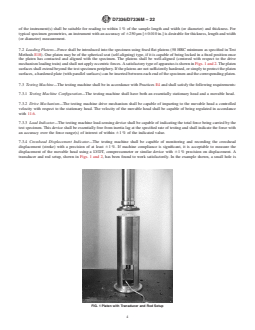
FIG. 1 Platen with Transducer and Rod Setup
and shall not apply eccentric forces. A satisfactory type of
apparatus is shown in Figs. 1 and 2. The platen surfaces shall
extend beyond the test specimen periphery. If the platens are
not sufficiently hardened, or simply to protect the platen
surfaces, a hardened plate (with parallel surfaces) can be
inserted between each end of the specimen and the correspond-
ing platen.
7.3 Testing Machine—The testing machine shall be in ac-
cordance with Practices E4 and shall satisfy the following
requirements:
7.3.1 Testing Machine Configuration—The testing machine
shall have both an essentially stationary head and a movable
head.
7.3.2 Drive Mechanism—The testing machine drive mecha-
nism shall be capable of imparting to the movable head a
controlled velocity with respect to the stationary head. The
velocity of the movable head shall be capable of being
regulated in accordance with 11.6.
7.3.3 Load Indicator—The testing machine load-sensing
FIG. 2 Close-up of Specimen Between Loading Platens
device shall be capable of indicating the total force being
Being Crushed
carried by the test specimen. This device shall be essentially
free from inertia lag at the specified rate of testing and shall
indicate the force with an accuracy over the force range(s) of
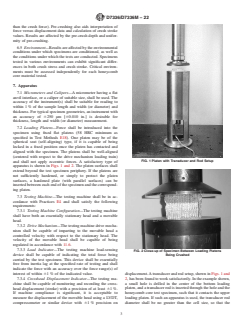
interest of within 61 % of the indicated value. displacement.Atransducer and rod setup, shown in Figs. 1 and
7.3.4 Crosshead Displacement Indicator—The testing ma- 2, has been found to work satisfactorily. In the example shown,
chine shall be capable of monitoring and recording the cross- a small hole is drilled in the center of the bottom loading
head displacement (stroke) with a precision of at least 61%. platen,andatransducerrodisinsertedthroughtheholeandthe
If machine compliance is significant, it is acceptable to honeycomb core test specimen, such that it contacts the upper
measure the displacement of the movable head using a LVDT, loading platen. If such an apparatus is used, the transducer rod
compressometer or similar device with 61 % precision on diameter shall be no greater than the cell size, so that the
D7336/D7336M − 22
transducer rod can be inserted through the test specimen 8. Sampling and Test Specimens
without distorting the core cell geometry.
8.1 Sampling—Test at least five specimens per test condi-
7.4 Conditioning Chamber—When conditioning materials tion unless valid results can be gained through the use of fewer
specimens, as in the case of a designed experiment. For
at non-laboratory environments, a temperature/vapor-level
controlled environment conditioning chamber is required that statistically significant data, consult the procedures outlined in
Practice E122. Report the method of sampling.
shall be capable of maintaining the required temperature to
within 63°C[6 5°F] and the required relative humidity level
8.2 Geometry—Test specimens shall have a square or cir-
to within 63 % RH. Chamber conditions shall be monitored
cular cross-section and a minimum thickness of 25 mm
either on an automated continuous basis or on a manual basis
[1.0 in.].Therequiredfacingareaofthespecimenisdependent
at regular intervals.
upon the cell size, to ensure a minimum number of cells are
tested. Minimum facing areas are recommended in Table 1 for
7.5 Environmental Test Chamber—An environmental test
the more common cell sizes. These are intended to provide
chamber is required for testing environments other than ambi-
approximately 60 cells minimum in the test specimen. The
ent testing laboratory conditions. This chamber shall be ca-
2 2
pable of maintaining the gauge section of the test specimen at largest facing area listed in the table (5625 mm [9.0 in. ]) is a
practical maximum for this test method. Core materials with
the required test environment during the mechanical test. The
test temperature shall be maintained within 63°C[65 °F] of cell sizes larger than 9 mm [0.375 in.] may require a smaller
number of cells to be tested in the specimen.
the required temperature, and the relative humidity level shall
NOTE 2—The specimen’s cross-sectional area is defined in the facing
be maintained to within 63 % RH of the required humidity
plane, in regard to the orientation that the honeycomb core material would
level.
be placed in a structural sandwich construction. For a honeycomb core
7.6 Pre-Crushing Device—Crush strength and stroke data material, the cross-sectional area is defined in the plane of the cells, which
is perpendicular to the orientation of the cell walls.
for pre-crushed honeycomb core materials typically display
greater uniformity than have similar data for non pre-crushed 8.3 Specimen Preparation and Machining—Prepare the test
specimens. Serrated plates have been used successfully as specimens so that the reference loading surfaces are parallel to
pre-crushing devices for honeycomb core materials; acceptable each other and perpendicular to the sides of the specimen.Take
reference serrated plate configurations are shown inFigs. 3 and precautions when cutting specimens from large sheets of
4. The pre-crushing device must be capable of providing a honeycomb core material to avoid notches, undercuts, rough or
relatively uniform pre-crush depth of 1.0 6 0.5 mm uneven surfaces due to inappropriate machining methods.
[0.03 6 0.02 in.]. Obtain final dimensions by water-lubricated precision sawing,
FIG. 3 Representative Serrated Plate for Honeycomb Core Material Pre-Crushing (SI Version)
D7336/D7336M − 22
FIG. 4 Representative Serrated Plate for Honeycomb Core Material Pre-Crushing (Inch-Pound Version)
TABLE 1 Recommended Minimum Specimen
byTest Method D5229/D5229M; however, if the test requestor
Cross-Sectional Area
doesnotexplicitlyspecifyapre-testconditioningenvironment,
Minimum
no conditioning is required and the test specimens may be
Minimum Cell Size Maximum Cell Size
Cross-Sectional Area
(mm [in.]) (mm [in.])
tested as prepared.
2 2
(mm [in. ])
— 3.0 [0.125] 625 [1.0]
10.2 The pre-test specimen conditioning process, to include
3.0 [0.125] 6.0 [0.250] 2500 [4.0]
specified environmental exposure levels and resulting moisture
6.0 [0.250] 9.0 [0.375] 5625 [9.0]
content, shall
...
This document is not an ASTM standard and is intended only to provide the user of an ASTM standard an indication of what changes have been made to the previous version. Because
it may not be technically possible to adequately depict all changes accurately, ASTM recommends that users consult prior editions as appropriate. In all cases only the current version
of the standard as published by ASTM is to be considered the official document.
Designation: D7336/D7336M − 16 D7336/D7336M − 22
Standard Test Method for
Static Energy Absorption Properties of Honeycomb
Sandwich Core Materials
This standard is issued under the fixed designation D7336/D7336M; the number immediately following the designation indicates the
year of original adoption or, in the case of revision, the year of last revision. A number in parentheses indicates the year of last
reapproval. A superscript epsilon (´) indicates an editorial change since the last revision or reapproval.
1. Scope
1.1 This test method determines the static energy absorption properties (compressive crush stress and crush stroke) of honeycomb
sandwich core materials. These properties are usually determined for design purposes in a direction normal to the plane of facings
as the the face sheets (also referred to as the facing plane) as the honeycomb core material would be placed in a structural sandwich
construction.
1.2 Permissible core materials are limited to those in honeycomb form.
1.3 This test method is not intended for use in crush testing of stabilized honeycomb core materials (for which the facing plane
surfaces of the honeycomb core material are dipped in resin to resist local crushing) or sandwich specimens (for which facings are
bonded to the honeycomb core material).
1.4 Units—The values stated in either SI units or inch-pound units are to be regarded separately as standard. The values stated in
each system mayare not benecessarily exact equivalents; therefore, to ensure conformance with the standard, each system shall be
used independently of the other. Combiningother, and values from the two systems may result in non-conformance with the
standard.shall not be combined.
1.4.1 Within the text, the inch-pound units are shown in brackets.
1.5 This standard does not purport to address all of the safety concerns, if any, associated with its use. It is the responsibility
of the user of this standard to establish appropriate safety safety, health, and healthenvironmental practices and determine the
applicability of regulatory limitations prior to use.
1.6 This international standard was developed in accordance with internationally recognized principles on standardization
established in the Decision on Principles for the Development of International Standards, Guides and Recommendations issued
by the World Trade Organization Technical Barriers to Trade (TBT) Committee.
2. Referenced Documents
2.1 ASTM Standards:
C271/C271M Test Method for Density of Sandwich Core Materials
D883 Terminology Relating to Plastics
This test method is under the jurisdiction of ASTM Committee D30 on Composite Materials and is the direct responsibility of Subcommittee D30.09 on Sandwich
Construction.
Current edition approved April 1, 2016May 1, 2022. Published April 2016May 2022. Originally approved in 2007. Last previous edition approved in 20122016 as
D7336/D7336M – 12.D7336/D7336M – 16. DOI: 10.1520/D7336_D7336M-16.10.1520/D7336_D7336M-22.
For referenced ASTM standards, visit the ASTM website, www.astm.org, or contact ASTM Customer Service at service@astm.org. For Annual Book of ASTM Standards
volume information, refer to the standard’s Document Summary page on the ASTM website.
Copyright © ASTM International, 100 Barr Harbor Drive, PO Box C700, West Conshohocken, PA 19428-2959. United States
D7336/D7336M − 22
D3878 Terminology for Composite Materials
D5229/D5229M Test Method for Moisture Absorption Properties and Equilibrium Conditioning of Polymer Matrix Composite
Materials
E4 Practices for Force Calibration and Verification of Testing Machines
E6 Terminology Relating to Methods of Mechanical Testing
E18 Test Methods for Rockwell Hardness of Metallic Materials
E122 Practice for Calculating Sample Size to Estimate, With Specified Precision, the Average for a Characteristic of a Lot or
Process
E177 Practice for Use of the Terms Precision and Bias in ASTM Test Methods
E456 Terminology Relating to Quality and Statistics
3. Terminology
3.1 Definitions—Terminology D3878 defines terms relating to high-modulus fibers and their composites, as well as terms relating
to sandwich constructions. Terminology D883 defines terms relating to plastics. Terminology E6 defines terms relating to
mechanical testing. Terminology E456 and Practice E177 define terms relating to statistics. In the event of a conflict between terms,
Terminology D3878 shall have precedence over the other terminologies.
NOTE 1—If the term represents a physical quantity, its analytical dimensions are stated immediately following the term (or letter symbol) in fundamental
dimension form, using the following ASTM standard symbology for fundamental dimensions, shown within square brackets: [M] for mass, [L] for length,
[T] for time, [θ] for thermodynamic temperature, and [nd] for non-dimensional quantities. Use of these symbols is restricted to analytical dimensions when
used with square brackets, as the symbols may have other definitions when used without the brackets.
3.2 Definitions of Terms Specific to This Standard:
3.2.1 cell size [L], n—in a honeycomb core, the distance between two parallel and opposite cell walls at node bond areas, measured
transverse to the ribbon direction.
3.2.2 node bond area, n—in a honeycomb core, the area between two cells at which the component walls of the cells are bonded
or attached.
3.3 Symbols:
A = cross-sectional area of a test specimen prior to compressive crush testing
CV = coefficient of variation statistic of a sample population for a given property (in percent)
K = initial chord slope of the force versus displacement/deformation curve
A
K = post-crush slope of the force versus displacement/deformation curve
B
P = average force carried by test specimen during compressive crushing
cr
s = crush stroke in percent
cr
S = standard deviation statistic of a sample population for a given property
n-1
t = thickness of a test specimen prior to compressive crush testing
i
x = test result for an individual specimen from the sample population for a given property
x¯ = mean or average (estimate of mean) of a sample population for a given property
δ = recorded displacement/deflection
δ = displacement/deflection at which the initial chord slope intersects the displacement/deformation axis
A
δ = displacement/deflection at which the post-crushing slope equals the initial chord slope
B
δ = crush stroke
cr
Δ = normalized displacement/deflection
σ = average compressive crush stress
cr
4. Summary of Test Method
4.1 This test method consists of subjecting a sandwich honeycomb core material to a uniaxial compressive force normal to the
plane of the facings face sheets as the honeycomb core material would be placed in a structural sandwich construction. The force
is transmitted to the sandwich honeycomb core material using loading platens attached to the testing machine. Compressive force
is applied past the initial failure force, such that the honeycomb core material is crushed under continuous displacement of the
loading platens. Force versus loading platen displacement data are recorded and used to determine the crush stress and crush stroke.
D7336/D7336M − 22
5. Significance and Use
5.1 Sandwich honeycomb core materials are used extensively in energy absorption applications, due to their ability to sustain
compressive loading while being crushed. Proper design of energy absorption devices utilizing sandwich honeycomb core
materials requires knowledge of the compressive crush stress and crush stroke properties of the honeycomb core material.
5.2 The procedures contained within this standard test method are intended to assess the crush stress and crush stroke properties
of the sandwich honeycomb core material under static compressive loading. The dynamic crush stress of the honeycomb core
material may vary from that measured under static loading, depending upon factors such as honeycomb core material thickness,
core material density, impact velocity, etc.
5.3 This test method provides a standard method of obtaining the compressive crush stress and crush stroke for sandwich
honeycomb core material structural design properties, material specifications, research and development applications, and quality
assurance.
5.4 This test method is not intended for use in crush testing of stabilized honeycomb core materials (for which the facing plane
surfaces of the honeycomb core material are dipped in resin to resist local crushing) or sandwich specimens (for which facings face
sheets are bonded to the honeycomb core material).
5.5 Factors that influence the compressive crush stress and crush stroke and shall therefore be reported include the following:
honeycomb core material, methods of material fabrication, core material geometry (nominal cell size), core material density,
specimen geometry, specimen preparation, specimen conditioning, environment of testing, specimen alignment, pre-crush
procedure, pre-crush depth, loading procedure, and speed of testing.
6. Interferences
6.1 Material and Specimen Preparation—Poor material fabrication practices and damage induced by improper specimen
machining are known causes of high data scatter in composites and sandwich structures in general. Important aspects of sandwich
core material specimen preparation that contribute to data scatter include the existence of joints, voids or other core material
discontinuities, out-of-plane curvature/warpage, and surface roughness.
6.2 System Alignment—Non-uniform loading over the surface of the test specimen may cause premature or uneven crushing. This
may occur as a result from non-uniform thickness, failing to locate the specimen concentrically in the fixture, or system or fixture
misalignment.
6.3 Geometry—Specific geometric factors that affect compressive crush stress and crush stroke include honeycomb core material
cell geometry, core material thickness, and specimen shape (square or circular). Thicker specimens are generally desirable, as the
crush stroke is greater for thick specimens compared to thin specimens.
6.4 Pre-Crushing—It is recommended to pre-crush honeycomb core material specimens prior to test, as historical crush force
versus displacement data for pre-crushed specimens have displayed greater uniformity (consistency of the crush force level for
varying crush stroke) than have similar data for non pre-crushed specimens. If tests are performed using analog equipment to
record force versus displacement data, pre-crushing may be necessary to ensure the crush force is recorded on a high sensitivity
force scale (if not pre-crushed, the peak force to initially fail the specimen may be substantially higher than the crush force).
Pre-crushing also aids interpretation of force versus displacement data and calculation of crush stroke values. Results are affected
by the pre-crush depth and uniformity of pre-crushing.
6.5 Environment—Results are affected by the environmental conditions under which specimens are conditioned, as well as the
conditions under which the tests are conducted. Specimens tested in various environments can exhibit significant differences in
both crush stress and crush stroke. Critical environments must be assessed independently for each honeycomb core material tested.
7. Apparatus
7.1 Micrometers and Calipers—A micrometer having a flat anvil interface, or a caliper of suitable size, shall be used. The accuracy
D7336/D7336M − 22
of the instrument(s) shall be suitable for reading to within 1 % of the sample length and width (or diameter) and thickness. For
typical specimen geometries, an instrument with an accuracy of 6250 μm [60.010 in.] is desirable for thickness, length and width
(or diameter) measurement.
7.2 Loading Platens—Force shall be introduced into the specimen using fixed flat platens (58 HRC minimum as specified in Test
Methods E18). One platen may be of the spherical seat (self-aligning) type, if it is capable of being locked in a fixed position once
the platen has contacted and aligned with the specimen. The platens shall be well-aligned (centered with respect to the drive
mechanism loading train) and shall not apply eccentric forces. A satisfactory type of apparatus is shown in Figs. 1 and 2. The platen
surfaces shall extend beyond the test specimen periphery. If the platens are not sufficiently hardened, or simply to protect the platen
surfaces, a hardened plate (with parallel surfaces) can be inserted between each end of the specimen and the corresponding platen.
7.3 Testing Machine—The testing machine shall be in accordance with Practices E4 and shall satisfy the following requirements:
7.3.1 Testing Machine Configuration—The testing machine shall have both an essentially stationary head and a movable head.
7.3.2 Drive Mechanism—The testing machine drive mechanism shall be capable of imparting to the movable head a controlled
velocity with respect to the stationary head. The velocity of the movable head shall be capable of being regulated in accordance
with 11.6.
7.3.3 Load Indicator—The testing machine load-sensing device shall be capable of indicating the total force being carried by the
test specimen. This device shall be essentially free from inertia lag at the specified rate of testing and shall indicate the force with
an accuracy over the force range(s) of interest of within 61 % of the indicated value.
7.3.4 Crosshead Displacement Indicator—The testing machine shall be capable of monitoring and recording the crosshead
displacement (stroke) with a precision of at least 61 %. If machine compliance is significant, it is acceptable to measure the
displacement of the movable head using a LVDT, compressometer or similar device with 61 % precision on displacement. A
transducer and rod setup, shown in Figs. 1 and 2, has been found to work satisfactorily. In the example shown, a small hole is
FIG. 1 Platen with Transducer and Rod Setup
D7336/D7336M − 22
FIG. 2 Close-up of Specimen Between Loading Platens
Being Crushed
drilled in the center of the bottom loading platen, and a transducer rod is inserted through the hole and the honeycomb core test
specimen, such that it contacts the upper loading platen. If such an apparatus is used, the transducer rod diameter shall be no greater
than the cell size, so that the transducer rod can be inserted through the test specimen without distorting the core cell geometry.
7.4 Conditioning Chamber—When conditioning materials at non-laboratory environments, a temperature/vapor-level controlled
environmentalenvironment conditioning chamber is required that shall be capable of maintaining the required temperature to
within 63°C [65°F]63 °C [6 5°F] and the required relative humidity level to within 63 %. 63 % RH. Chamber conditions shall
be monitored either on an automated continuous basis or on a manual basis at regular intervals.
7.5 Environmental Test Chamber—An environmental test chamber is required for testtesting environments other than ambient
testing laboratory conditions. This chamber shall be capable of maintaining the gagegauge section of the test specimen at the
required test environment during the mechanical test. The test temperature shall be maintained within 63 °C [65 °F] of the
required temperature, and the relative humidity level shall be maintained to within 63 % RH of the required humidity level.
7.6 Pre-Crushing Device—Crush strength and stroke data for pre-crushed honeycomb core materials typically display greater
uniformity than have similar data for non pre-crushed specimens. Serrated plates have been used successfully as pre-crushing
devices for honeycomb core materials; acceptable reference serrated plate configurations are shown in Figs. 3 and 4. The
pre-crushing device must be capable of providing a relatively uniform pre-crush depth of 1.0 6 0.5 mm [0.03 6 0.02 in.].
8. Sampling and Test Specimens
8.1 Sampling—Test at least five specimens per test condition unless valid results can be gained through the use of fewer specimens,
as in the case of a designed experiment. For statistically significant data, consult the procedures outlined in Practice E122. Report
the method of sampling.
8.2 Geometry—Test specimens shall have a square or circular cross-section and a minimum thickness of 25 mm [1.0 in.]. The
required facing area of the specimen is dependent upon the cell size, to ensure a minimum number of cells are tested. Minimum
facing areas are recommended in Table 1 for the more common cell sizes. These are intended to provide approximately 60 cells
2 2
minimum in the test specimen. The largest facing area listed in the table (5625 mm [9.0 in. ]) is a practical maximum for this test
method. Core materials with cell sizes larger than 9 mm [0.375 in.] may require a smaller number of cells to be tested in the
specimen.
NOTE 2—The specimen’s cross-sectional area is defined in the facing plane, in regard to the orientation that the honeycomb core material would be placed
in a structural sandwich construction. For a honeycomb core material, the cross-sectional area is defined in the plane of the cells, which is perpendicular
to the orientation of the cell walls.
8.3 Specimen Preparation and Machining—Prepare the test specimens so that the reference loading surfaces are parallel to each
D7336/D7336M − 22
FIG. 3 Representative Serrated Plate for Honeycomb Core Material Pre-Crushing (SI Version)
FIG. 4 Representative Serrated Plate for Honeycomb Core Material Pre-Crushing (Inch-Pound Version)
D7336/D7336M − 22
TABLE 1 Recommended Minimum Specimen
Cross-Sectional Area
Minimum
Minimum Cell Size Maximum Cell Size
Cross-Sectional Area
(mm [in.]) (mm [in.])
2 2
(mm [in. ])
— 3.0 [0.125] 625 [1.0]
3.0 [0.125] 6.0 [0.250] 2500 [4.0]
6.0 [0.250] 9.0 [0.375] 5625 [9.0]
other and perpendicular to the sides of the specimen. Take precautions when cutting specimens from large sheets of honeycomb
core material to avoid notches, undercuts, rough or uneven surfaces due to inappropriate machining methods. Obtain final
dimensions by water-lubricated precision sawing, milling, or grinding. The use of diamond tooling has been found to be extremely
effective for many material systems. Record and report the specimen cutting preparation method.
8.4 If honeycomb core material density is to be reported, samples used to determine density shall be obt
...