

ASTM D7290-06(2022)
(Practice)Standard Practice for Evaluating Material Property Characteristic Values for Polymeric Composites for Civil Engineering Structural Applications
General Information
- Abstract
SIGNIFICANCE AND USE
4.1 This practice covers the procedures for computing material property characteristic values for polymeric composite materials intended for use in civil engineering structural applications. A characteristic value represents a statistical lower bound on the material property structural member resistance factors for civil engineering design codes for composite structures.
4.2 This practice may be used to obtain characteristic values for stiffness and strength properties of composite materials obtained from measurements using applicable test methods.
SCOPE
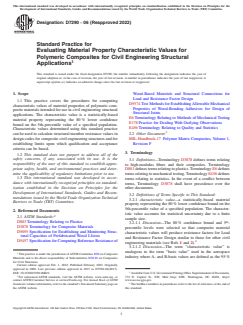
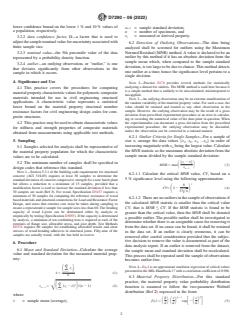
1.1 This practice covers the procedures for computing characteristic values of material properties of polymeric composite materials intended for use in civil engineering structural applications. The characteristic value is a statistically-based material property representing the 80 % lower confidence bound on the 5th-percentile value of a specified population. Characteristic values determined using this standard practice can be used to calculate structural member resistance values in design codes for composite civil engineering structures and for establishing limits upon which qualification and acceptance criteria can be based.
1.2 This standard does not purport to address all of the safety concerns, if any, associated with its use. It is the responsibility of the user of this standard to establish appropriate safety, health, and environmental practices and determine the applicability of regulatory limitations prior to use.
1.3 This international standard was developed in accordance with internationally recognized principles on standardization established in the Decision on Principles for the Development of International Standards, Guides and Recommendations issued by the World Trade Organization Technical Barriers to Trade (TBT) Committee.
- Status
- Published
- Publication Date
- 31-Jan-2022
- Technical Committee
- D30 - Composite Materials
- Drafting Committee
- D30.10 - Composites for Civil Structures

Overview
ASTM D7290-06(2022) is the recognized standard practice for evaluating material property characteristic values of polymeric composite materials used in civil engineering structural applications. Developed by ASTM International, this standard outlines statistical methodologies for determining characteristic values, which are critical to ensuring safety, reliability, and compliance in composite construction and design. These characteristic values serve as lower-bound estimates of material properties such as stiffness and strength, and are used for calculating structural member resistance factors in accordance with civil engineering design codes.
Key Topics
- Characteristic Value Determination: Defines a characteristic value as a statistically-based material property representing the 80% lower confidence bound on the 5th-percentile value of a sample population.
- Statistical Methods: Outlines procedures for data analysis, including calculating sample mean, standard deviation, and application of the Weibull distribution for probabilistic modeling.
- Sample Requirements: Specifies the importance of representative sampling and provides guidance on minimum sample sizes for robust analysis.
- Outlier Management: Covers detection and handling of outlying observations using the Maximum Normed Residual (MNR) method to ensure data quality.
- Report Procedures: Details reporting requirements, including sample sizes, outlier rationale, and computed values to maintain transparency and repeatability.
- Compliance with International Standards: Developed in accordance with internationally recognized principles, ensuring acceptance and harmonization with global trade and regulatory frameworks.
Applications
Structural Design & Analysis
- Composite Structure Engineering: Ensures material property data used for fiber-reinforced polymer (FRP) and other polymeric composites in civil structures are statistically sound.
- Design Codes Compliance: Enables engineers to derive resistance values in line with Load and Resistance Factor Design (LRFD) for bridges, buildings, and infrastructure made from polymeric composites.
- Quality Assurance & Acceptance Testing: Provides guidelines to establish limits for qualification and acceptance of composite materials in new and existing civil engineering projects.
Material Selection & Specification
- Product Development: Assists manufacturers and engineers in specifying composite materials with quantified confidence in performance properties.
- Research and Development: Supports academic and industrial research where statistically robust material property data are required for simulation and modeling.
Regulatory and Certification Processes
- Inspection and Certification: Facilitates the establishment of property thresholds for regulatory compliance, third-party inspection, and certification programs targeting polymeric composite civil applications.
Related Standards
- ASTM D3878: Terminology for Composite Materials - provides definitions related to high-modulus fibers and composites.
- ASTM D883: Terminology Relating to Plastics - offers foundational terminology for plastic and polymeric materials.
- ASTM D5055: Specification for Establishing and Monitoring Structural Capacities of Prefabricated Wood I-Joists - relevant for analogous statistical approaches in construction materials.
- ASTM D5457: Specification for Computing Reference Resistance of Wood-Based Materials and Structural Connections - provides methodological insights particularly for load and resistance factor design.
- ASTM E6, E178, E456: Terminologies and practices related to mechanical testing and statistical analysis.
- MIL-Handbook-17: Reference for polymer matrix composites and material property characterization.
- ACI 318: Building Code Requirements for Structural Concrete - for comparison and alignment in confidence-bound approaches to material property estimation.
ASTM D7290-06(2022) is essential for engineers, manufacturers, researchers, and regulators seeking to assure the strength and durability of polymeric composite materials in civil engineering, providing confidence and rigor in the design and assessment of advanced construction materials.
Relations
- Effective Date
- 01-Feb-2024
- Effective Date
- 01-Nov-2023
- Effective Date
- 01-Apr-2022
- Effective Date
- 01-Jan-2020
- Effective Date
- 15-Oct-2019
- Effective Date
- 01-Aug-2019
- Effective Date
- 01-Jul-2019
- Effective Date
- 15-Apr-2019
- Effective Date
- 15-Apr-2019
- Effective Date
- 15-Apr-2019
- Effective Date
- 01-Apr-2019
- Effective Date
- 01-Mar-2019
- Effective Date
- 01-Feb-2019
- Effective Date
- 01-Jan-2019
- Effective Date
- 01-Dec-2018
Get Certified
Connect with accredited certification bodies for this standard

DIN CERTCO
DIN Group product certification.

Smithers Quality Assessments
US management systems and product certification.
Sponsored listings
Frequently Asked Questions
ASTM D7290-06(2022) is a standard published by ASTM International. Its full title is "Standard Practice for Evaluating Material Property Characteristic Values for Polymeric Composites for Civil Engineering Structural Applications". This standard covers: SIGNIFICANCE AND USE 4.1 This practice covers the procedures for computing material property characteristic values for polymeric composite materials intended for use in civil engineering structural applications. A characteristic value represents a statistical lower bound on the material property structural member resistance factors for civil engineering design codes for composite structures. 4.2 This practice may be used to obtain characteristic values for stiffness and strength properties of composite materials obtained from measurements using applicable test methods. SCOPE 1.1 This practice covers the procedures for computing characteristic values of material properties of polymeric composite materials intended for use in civil engineering structural applications. The characteristic value is a statistically-based material property representing the 80 % lower confidence bound on the 5th-percentile value of a specified population. Characteristic values determined using this standard practice can be used to calculate structural member resistance values in design codes for composite civil engineering structures and for establishing limits upon which qualification and acceptance criteria can be based. 1.2 This standard does not purport to address all of the safety concerns, if any, associated with its use. It is the responsibility of the user of this standard to establish appropriate safety, health, and environmental practices and determine the applicability of regulatory limitations prior to use. 1.3 This international standard was developed in accordance with internationally recognized principles on standardization established in the Decision on Principles for the Development of International Standards, Guides and Recommendations issued by the World Trade Organization Technical Barriers to Trade (TBT) Committee.
SIGNIFICANCE AND USE 4.1 This practice covers the procedures for computing material property characteristic values for polymeric composite materials intended for use in civil engineering structural applications. A characteristic value represents a statistical lower bound on the material property structural member resistance factors for civil engineering design codes for composite structures. 4.2 This practice may be used to obtain characteristic values for stiffness and strength properties of composite materials obtained from measurements using applicable test methods. SCOPE 1.1 This practice covers the procedures for computing characteristic values of material properties of polymeric composite materials intended for use in civil engineering structural applications. The characteristic value is a statistically-based material property representing the 80 % lower confidence bound on the 5th-percentile value of a specified population. Characteristic values determined using this standard practice can be used to calculate structural member resistance values in design codes for composite civil engineering structures and for establishing limits upon which qualification and acceptance criteria can be based. 1.2 This standard does not purport to address all of the safety concerns, if any, associated with its use. It is the responsibility of the user of this standard to establish appropriate safety, health, and environmental practices and determine the applicability of regulatory limitations prior to use. 1.3 This international standard was developed in accordance with internationally recognized principles on standardization established in the Decision on Principles for the Development of International Standards, Guides and Recommendations issued by the World Trade Organization Technical Barriers to Trade (TBT) Committee.
ASTM D7290-06(2022) is classified under the following ICS (International Classification for Standards) categories: 83.140.99 - Other rubber and plastics products. The ICS classification helps identify the subject area and facilitates finding related standards.
ASTM D7290-06(2022) has the following relationships with other standards: It is inter standard links to ASTM D883-24, ASTM D883-23, ASTM E456-13a(2022)e1, ASTM D883-20, ASTM D3878-19a, ASTM D883-19c, ASTM D5457-19c, ASTM D5457-19b, ASTM D883-19a, ASTM D3878-19, ASTM D5457-19a, ASTM D5055-19, ASTM D883-19, ASTM D5457-19, ASTM D883-18a. Understanding these relationships helps ensure you are using the most current and applicable version of the standard.
ASTM D7290-06(2022) is available in PDF format for immediate download after purchase. The document can be added to your cart and obtained through the secure checkout process. Digital delivery ensures instant access to the complete standard document.
Standards Content (Sample)
This international standard was developed in accordance with internationally recognized principles on standardization established in the Decision on Principles for the
Development of International Standards, Guides and Recommendations issued by the World Trade Organization Technical Barriers to Trade (TBT) Committee.
Designation: D7290 − 06 (Reapproved 2022)
Standard Practice for
Evaluating Material Property Characteristic Values for
Polymeric Composites for Civil Engineering Structural
Applications
This standard is issued under the fixed designation D7290; the number immediately following the designation indicates the year of
original adoption or, in the case of revision, the year of last revision. A number in parentheses indicates the year of last reapproval. A
superscript epsilon (´) indicates an editorial change since the last revision or reapproval.
1. Scope Wood-Based Materials and Structural Connections for
Load and Resistance Factor Design
1.1 This practice covers the procedures for computing
D5574 Test Methods for EstablishingAllowable Mechanical
characteristic values of material properties of polymeric com-
Properties of Wood-Bonding Adhesives for Design of
posite materials intended for use in civil engineering structural
Structural Joints
applications. The characteristic value is a statistically-based
E6 Terminology Relating to Methods of Mechanical Testing
material property representing the 80 % lower confidence
E178 Practice for Dealing With Outlying Observations
bound on the 5th-percentile value of a specified population.
E456 Terminology Relating to Quality and Statistics
Characteristic values determined using this standard practice
can be used to calculate structural member resistance values in 2.2 Other Document:
design codes for composite civil engineering structures and for MIL-Handbook-17 Polymer Matrix Composites, Volume 1,
Revision F
establishing limits upon which qualification and acceptance
criteria can be based.
3. Terminology
1.2 This standard does not purport to address all of the
safety concerns, if any, associated with its use. It is the
3.1 Definitions—Terminology D3878 defines terms relating
responsibility of the user of this standard to establish appro-
to high-modulus fibers and their composites. Terminology
priate safety, health, and environmental practices and deter-
D883definestermsrelatingtoplastics.TerminologyE6defines
mine the applicability of regulatory limitations prior to use.
termsrelatingtomechanicaltesting.TerminologyE456defines
1.3 This international standard was developed in accor-
terms relating to statistics. In the event of a conflict between
dance with internationally recognized principles on standard-
terms, Terminology D3878 shall have precedence over the
ization established in the Decision on Principles for the
other documents.
Development of International Standards, Guides and Recom-
3.2 Definitions of Terms Specific to This Standard:
mendations issued by the World Trade Organization Technical
3.2.1 characteristic value—a statistically-based material
Barriers to Trade (TBT) Committee.
property representing the 80 % lower confidence bound on the
5th-percentile value of a specified population. The character-
2. Referenced Documents
istic value accounts for statistical uncertainty due to a finite
2.1 ASTM Standards:
sample size.
th
D883 Terminology Relating to Plastics
3.2.1.1 Discussion—The 80 % confidence bound and 5 -
D3878 Terminology for Composite Materials
percentile levels were selected so that composite material
D5055 Specification for Establishing and Monitoring Struc-
characteristic values will produce resistance factors for Load
tural Capacities of Prefabricated Wood I-Joists
and Resistance Factor Design similar to those for other civil
D5457 Specification for Computing Reference Resistance of
engineering materials (see Refs 1 and 2).
3.2.1.2 Discussion—The term “characteristic value” is
analogous to the term “basis value” used in the aerospace
This practice is under the jurisdiction ofASTM Committee D30 on Composite
industry where A- and B-basis values are defined as the 95 %
Materials and is the direct responsibility of Subcommittee D30.10 on Composites
for Civil Structures.
Current edition approved Feb. 1, 2022. Published February 2022. Originally
approved in 2006. Last previous edition approved in 2017 as D7290–06(2017).
DOI: 10.1520/D7290-06R22. AvailablefromU.S.GovernmentPrintingOfficeSuperintendentofDocuments,
For referenced ASTM standards, visit the ASTM website, www.astm.org, or 732 N. Capitol St., NW, Mail Stop: SDE, Washington, DC 20401, http://
contact ASTM Customer Service at service@astm.org. For Annual Book of ASTM www.access.gpo.gov.
Standards volume information, refer to the standard’s Document Summary page on The boldface numbers in parentheses refer to the list of references at the end of
the ASTM website. this standard.
Copyright © ASTM International, 100 Barr Harbor Drive, PO Box C700, West Conshohocken, PA 19428-2959. United States
D7290 − 06 (2022)
lower confidence bound on the lower 1 % and 10 % values of
s = sample standard deviation,
n-1
a population, respectively.
n = number of specimens, and
x = measured or derived property.
3.2.2 data confidence factor, Ω—a factor that is used to i
adjustthesamplenominalvalueforuncertaintyassociatedwith
6.2 Detection of Outlying Observations—The data being
finite sample size.
analyzed shall be screened for outliers using the Maximum
Normed Residual (MNR) method.Avalue is declared to be an
3.2.3 nominal value—the 5th percentile value of the data
outlier by this method if it has an absolute deviation from the
represented by a probability density function.
sample mean which, when compared to the sample standard
3.2.4 outlier—an outlying observation, or “outlier,” is one
deviation, is too large to be due to chance.This method detects
that deviates significantly from other observations in the
one outlier at a time; hence the significance level pertains to a
sample in which it occurs.
single decision.
4. Significance and Use
NOTE 2—Practice E178 provides several methods for statistically
analyzing a dataset for outliers. The MNR method is used here because it
4.1 This practice covers the procedures for computing
is a simple method that is unlikely to be miscalculated, misinterpreted or
materialpropertycharacteristicvaluesforpolymericcomposite
misapplied.
materials intended for use in civil engineering structural
NOTE 3—An outlying observation may be an extreme manifestation of
applications. A characteristic value represents a statistical
the random variability of the material property value. For such a case, the
value should be retained and treated as any other observation in the
lower bound on the material property structural member
sample. However, the outlying observation may be the result of a gross
resistance factors for civil engineering design codes for com-
deviation from prescribed experimental procedure or an error in calculat-
posite structures.
ing or recording the numerical value of the data point in question. When
the experimentalist can document a gross deviation from the prescribed
4.2 Thispracticemaybeusedtoobtaincharacteristicvalues
experimental procedure, the outlying observation may be discarded,
for stiffness and strength properties of composite materials
unless the observation can be corrected in a rational manner.
obtained from measurements using applicable test methods.
6.2.1 Outlier Criteria for Single Samples—For a sample of
5. Sampling
size n, arrange the data values {x , x , x , .x } in order of
1 2 3 n
increasing magnitude with x being the largest value. Calculate
5.1 Samples selected for analysis shall be representative of n
the MNR statistic as the maximum absolute deviation from the
the material property population for which the characteristic
sample mean divided by the sample standard deviation:
values are to be calculated.
x 2 x¯
5.2 The minimum number of samples shall be specified in ? i ?
MNR 5 max (3)
S D
s
design codes that reference this standard. n21
NOTE 1—Section 5.3.1 of the building code requirements for structural
6.2.1.1 Calculate the critical MNR value, CV, based on a
concrete (ACI 318-05) requires at least 30 samples to determine the
5 % significance level using the following approximation:
standard deviation of concrete compressive strength for a new batch plant
but allows a reduction to a minimum of 15 samples, provided that a
modification factor is used to increase the standard deviation if less than CV' 2 2 (4)
S D
5=n
30 samples are used (Ref 3). F
...