


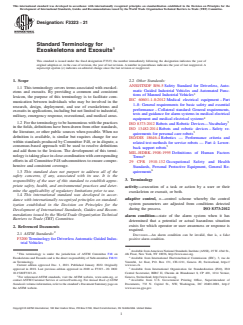
ASTM F3323-21
(Terminology)Standard Terminology for Exoskeletons and Exosuits
Standard Terminology for Exoskeletons and Exosuits
SCOPE
1.1 This terminology covers terms associated with exoskeletons and exosuits. By providing a common and consistent lexicon, the purpose of this terminology is to facilitate communication between individuals who may be involved in the research, design, deployment, and use of exoskeletons and exosuits in applications, including but not limited to industrial, military, emergency response, recreational, and medical areas.
1.2 For the terminology to be harmonious with the practices in the fields, definitions have been drawn from other standards, the literature, or other public sources when possible. When no definition is available, is similar but requires change for use within standards produced by Committee F48, or in dispute, a consensus-based approach will be used to resolve definitions and add them to the lexicon. The development of this terminology is taking place in close coordination with corresponding efforts in all Committee F48 subcommittees to ensure comprehensive and consistent coverage.
1.3 This standard does not purport to address all of the safety concerns, if any, associated with its use. It is the responsibility of the user of this standard to establish appropriate safety, health, and environmental practices and determine the applicability of regulatory limitations prior to use.
1.4 This international standard was developed in accordance with internationally recognized principles on standardization established in the Decision on Principles for the Development of International Standards, Guides and Recommendations issued by the World Trade Organization Technical Barriers to Trade (TBT) Committee.
General Information
- Status
- Published
- Publication Date
- 30-Nov-2021
- Technical Committee
- F48 - Exoskeletons and Exosuits
- Drafting Committee
- F48.91 - Terminology
Relations
- Effective Date
- 01-Dec-2023
- Effective Date
- 15-Nov-2019
- Effective Date
- 01-Apr-2018
- Effective Date
- 01-Feb-2018
- Effective Date
- 15-Aug-2017
- Effective Date
- 01-Jun-2017
- Effective Date
- 15-May-2017
- Effective Date
- 15-Oct-2016
Overview
ASTM F3323-21: Standard Terminology for Exoskeletons and Exosuits establishes a common lexicon of terms related to exoskeletons and exosuits. Developed by ASTM Committee F48, this standard enhances clarity and consistency for stakeholders in the fields of research, design, deployment, and use of wearable robotics. By harmonizing language and definitions, ASTM F3323-21 supports effective communication among professionals across industrial, military, medical, emergency response, and recreational applications. This terminology standard draws from existing literature and standards wherever possible, ensuring relevancy and international alignment.
Key Topics
ASTM F3323-21 addresses essential terminology to facilitate discussions and documentation regarding exoskeletons and exosuits, covering:
Definitions of Key Terms
Including exoskeleton, exosuit, exoskeleton system, user, operator, supplier, assistance (caloric, metabolic), and relevant safety terms such as hazard, harm, and personal protective equipment.Activity and Control Mechanisms
Terms related to user interaction, motion input, adaptive control, and force/torque capabilities.Human Factors
Incorporates anthropometric dimensions, qualified person, and assistant, supporting integration with ergonomics and safety protocols.Test and Evaluation
Defines terms for test settings, test supervisor, technician, developmental test and evaluation (DT&E), and test requestor to standardize the assessment of wearable devices.Domains of Application
Clarifies industrial domain, military domain, and contexts where terminology varies or overlaps, such as logistics and medical practice.
By referencing established standards, such as ISO 8373, IEC 60601-1-8, and OSHA guidelines, F3323-21 ensures that the terminology aligns with global best practices for safety, quality, and performance.
Applications
Standardized terminology for exoskeletons and exosuits delivers practical benefits in a range of sectors:
Industrial
Supports the deployment of exoskeletons for material handling, logistics, and manufacturing, ensuring clear communication for workplace safety and productivity.Medical
Facilitates assessment and integration of exosuits for rehabilitation, patient support, and physical therapy, enhancing interdisciplinary collaboration.Military
Enables precise dialogue around exoskeletons for soldier assistance, load carriage, and logistics, which is essential for training, procurement, and field operations.Emergency Response
Assists in specification and deployment of wearable robotics for search and rescue, disaster relief, and hazardous environments.Recreational and Personal Use
Standardizes terms for developers and users in emerging markets, including sports performance enhancement and personal mobility assistance.
Manufacturers, researchers, system integrators, healthcare providers, and end-users benefit from a unified vocabulary, fostering innovation, regulatory compliance, and safety in the growing market for wearable assistive technologies.
Related Standards
ASTM F3323-21 references and harmonizes with several important international standards, including:
- ASTM F3200 - Terminology for Driverless Automatic Guided Industrial Vehicles
- ANSI/ITSDF B56.5 - Safety Standard for Driverless, Automatic Guided Industrial Vehicles
- IEC 60601-1-8 - Medical electrical equipment - General requirements for alarm systems
- ISO 8373 - Robots and Robotic Devices - Vocabulary
- ISO 13482 - Safety requirements for personal care robots
- ISO/DIS 18646-4 - Robotics - Lower-back support robots
- MIL-HDBK-1908 - Human Factors Terms
- 29 CFR 1910.132 - OSHA Personal Protective Equipment Requirements
By aligning with these standards, ASTM F3323-21 promotes interoperability and consistency in the terminology used throughout the exoskeleton and robotics community.
Keywords: exoskeletons, exosuits, wearable devices, wearable robots, terminology, standards, occupational safety, assistive technology, ASTM F3323-21.



Get Certified
Connect with accredited certification bodies for this standard

BSI Group
BSI (British Standards Institution) is the business standards company that helps organizations make excellence a habit.

TÜV Rheinland
TÜV Rheinland is a leading international provider of technical services.

TÜV SÜD
TÜV SÜD is a trusted partner of choice for safety, security and sustainability solutions.
Sponsored listings
Frequently Asked Questions
ASTM F3323-21 is a standard published by ASTM International. Its full title is "Standard Terminology for Exoskeletons and Exosuits". This standard covers: SCOPE 1.1 This terminology covers terms associated with exoskeletons and exosuits. By providing a common and consistent lexicon, the purpose of this terminology is to facilitate communication between individuals who may be involved in the research, design, deployment, and use of exoskeletons and exosuits in applications, including but not limited to industrial, military, emergency response, recreational, and medical areas. 1.2 For the terminology to be harmonious with the practices in the fields, definitions have been drawn from other standards, the literature, or other public sources when possible. When no definition is available, is similar but requires change for use within standards produced by Committee F48, or in dispute, a consensus-based approach will be used to resolve definitions and add them to the lexicon. The development of this terminology is taking place in close coordination with corresponding efforts in all Committee F48 subcommittees to ensure comprehensive and consistent coverage. 1.3 This standard does not purport to address all of the safety concerns, if any, associated with its use. It is the responsibility of the user of this standard to establish appropriate safety, health, and environmental practices and determine the applicability of regulatory limitations prior to use. 1.4 This international standard was developed in accordance with internationally recognized principles on standardization established in the Decision on Principles for the Development of International Standards, Guides and Recommendations issued by the World Trade Organization Technical Barriers to Trade (TBT) Committee.
SCOPE 1.1 This terminology covers terms associated with exoskeletons and exosuits. By providing a common and consistent lexicon, the purpose of this terminology is to facilitate communication between individuals who may be involved in the research, design, deployment, and use of exoskeletons and exosuits in applications, including but not limited to industrial, military, emergency response, recreational, and medical areas. 1.2 For the terminology to be harmonious with the practices in the fields, definitions have been drawn from other standards, the literature, or other public sources when possible. When no definition is available, is similar but requires change for use within standards produced by Committee F48, or in dispute, a consensus-based approach will be used to resolve definitions and add them to the lexicon. The development of this terminology is taking place in close coordination with corresponding efforts in all Committee F48 subcommittees to ensure comprehensive and consistent coverage. 1.3 This standard does not purport to address all of the safety concerns, if any, associated with its use. It is the responsibility of the user of this standard to establish appropriate safety, health, and environmental practices and determine the applicability of regulatory limitations prior to use. 1.4 This international standard was developed in accordance with internationally recognized principles on standardization established in the Decision on Principles for the Development of International Standards, Guides and Recommendations issued by the World Trade Organization Technical Barriers to Trade (TBT) Committee.
ASTM F3323-21 is classified under the following ICS (International Classification for Standards) categories: 01.040.11 - Health care technology (Vocabularies); 01.040.25 - Manufacturing engineering (Vocabularies); 11.180.01 - Aids for disabled and handicapped persons in general; 25.040.30 - Industrial robots. Manipulators. The ICS classification helps identify the subject area and facilitates finding related standards.
ASTM F3323-21 has the following relationships with other standards: It is inter standard links to ASTM F3200-23, ASTM F3200-19, ASTM F3200-18a, ASTM F3200-18, ASTM F3200-17b, ASTM F3200-17a, ASTM F3200-17, ASTM F3200-16. Understanding these relationships helps ensure you are using the most current and applicable version of the standard.
ASTM F3323-21 is available in PDF format for immediate download after purchase. The document can be added to your cart and obtained through the secure checkout process. Digital delivery ensures instant access to the complete standard document.
Standards Content (Sample)
This international standard was developed in accordance with internationally recognized principles on standardization established in the Decision on Principles for the
Development of International Standards, Guides and Recommendations issued by the World Trade Organization Technical Barriers to Trade (TBT) Committee.
Designation: F3323 − 21
Standard Terminology for
Exoskeletons and Exosuits
This standard is issued under the fixed designation F3323; the number immediately following the designation indicates the year of
original adoption or, in the case of revision, the year of last revision. A number in parentheses indicates the year of last reapproval. A
superscript epsilon (´) indicates an editorial change since the last revision or reapproval.
1. Scope 2.2 Other Standards:
ANSI/ITSDF B56.5 Safety Standard for Driverless, Auto-
1.1 This terminology covers terms associated with exoskel-
matic Guided Industrial Vehicles and Automated Func-
etons and exosuits. By providing a common and consistent
tions of Manned Industrial Vehicles
lexicon, the purpose of this terminology is to facilitate com-
IEC 60601-1-8:2012 Medical electrical equipment – Part
munication between individuals who may be involved in the
1–8: General requirements for basic safety and essential
research, design, deployment, and use of exoskeletons and
performance – Collateral standard: General requirements,
exosuits in applications, including but not limited to industrial,
tests and guidance for alarm systems in medical electrical
military, emergency response, recreational, and medical areas.
equipment and medical electrical systems
1.2 For the terminology to be harmonious with the practices
ISO 8373:2012 Robots and Robotic Devices—Vocabulary
in the fields, definitions have been drawn from other standards,
ISO 13482:2014 Robots and robotic devices – Safety re-
the literature, or other public sources when possible. When no
quirements for personal care robots
definition is available, is similar but requires change for use
ISO/DIS 18646-4 Robotics — Performance criteria and
within standards produced by Committee F48, or in dispute, a
related test methods for service robots — Part 4: Lower-
consensus-based approach will be used to resolve definitions
back support robots
and add them to the lexicon. The development of this termi-
MIL-HDBK-1908:1995 Definitions of Human Factors
nologyistakingplaceinclosecoordinationwithcorresponding
Terms
efforts in all Committee F48 subcommittees to ensure compre-
29 CFR 1910.132 Occupational Safety and Health
hensive and consistent coverage.
Standards, Personal Protective Equipment, General Re-
1.3 This standard does not purport to address all of the quirements
safety concerns, if any, associated with its use. It is the
3. Terminology
responsibility of the user of this standard to establish appro-
priate safety, health, and environmental practices and deter-
activity—execution of a task or action by a user or their
mine the applicability of regulatory limitations prior to use.
exoskeleton or exosuit, or both.
1.4 This international standard was developed in accor-
adaptive control, n—control scheme whereby the control
dance with internationally recognized principles on standard-
system parameters are adjusted from conditions detected
ization established in the Decision on Principles for the
during the process. ISO 8373:2012
Development of International Standards, Guides and Recom-
mendations issued by the World Trade Organization Technical
alarm condition—state of the alarm system when it has
Barriers to Trade (TBT) Committee.
determined that a potential or actual hazardous situation
exists for which operator or user awareness or response is
2. Referenced Documents
required.
2.1 ASTM Standards:
DISCUSSION—An alarm condition can be invalid, that is, a false
F3200 Terminology for DriverlessAutomatic Guided Indus-
positive alarm condition.
trial Vehicles
Available from American National Standards Institute (ANSI), 25 W. 43rd St.,
This terminology is under the jurisdiction of ASTM Committee F48 on 4th Floor, New York, NY 10036, http://www.ansi.org.
Exoskeletons and Exosuits and is the direct responsibility of Subcommittee F48.91 Available from International Electrotechnical Commission (IEC), 3, rue de
on Terminology. Varembé, 1st floor, P.O. Box 131, CH-1211, Geneva 20, Switzerland, https://
Current edition approved Dec. 1, 2021. Published January 2022. Originally www.iec.ch.
approved in 2018. Last previous edition approved in 2020 as F3323 – 20. DOI: Available from International Organization for Standardization (ISO), ISO
10.1520/F3323-21. Central Secretariat, BIBC II, Chemin de Blandonnet 8, CP 401, 1214 Vernier,
For referenced ASTM standards, visit the ASTM website, www.astm.org, or Geneva, Switzerland, http://www.iso.org.
contact ASTM Customer Service at service@astm.org. For Annual Book of ASTM Available from U.S. Government Printing Office, Superintendent of
Standards volume information, refer to the standard’s Document Summary page on Documents, 732 N. Capitol St., NW, Washington, DC 20401-0001, http://
the ASTM website. www.access.gpo.gov.
Copyright © ASTM International, 100 Barr Harbor Drive, PO Box C700, West Conshohocken, PA 19428-2959. United States
F3323 − 21
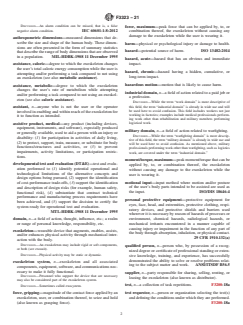
DISCUSSION—An alarm condition can be missed, that is, a false
force, maximum—peak force that can be applied by, to, or
negative alarm condition. IEC 60601-1-8:2012
combination thereof, the exoskeleton without causing any
damage to the exoskeleton while the user is wearing it.
anthropometric dimensions—measured dimensions that de-
scribe the size and shape of the human body. These dimen-
harm—physical or psychological injury or damage to health.
sions are often presented in the form of summary statistics
hazard—potential source of harm. ISO 13482:2014
that describe the range of body dimensions that are observed
in a population. MIL-HDBK-1908 11 December 1995
hazard, acute—hazard that has an obvious and immediate
assistance, caloric—degree to which the exoskeleton changes impact.
the user’s total caloric energy consumption while the user is
hazard, chronic—hazard having a hidden, cumulative, or
attempting and/or performing a task compared to not using
long-term impact.
an exoskeleton (see also metabolic assistance).
hazardous motion—motion
...
This document is not an ASTM standard and is intended only to provide the user of an ASTM standard an indication of what changes have been made to the previous version. Because
it may not be technically possible to adequately depict all changes accurately, ASTM recommends that users consult prior editions as appropriate. In all cases only the current version
of the standard as published by ASTM is to be considered the official document.
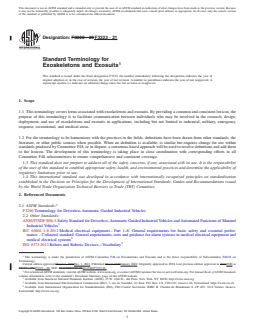
Designation: F3323 − 20 F3323 − 21
Standard Terminology for
Exoskeletons and Exosuits
This standard is issued under the fixed designation F3323; the number immediately following the designation indicates the year of
original adoption or, in the case of revision, the year of last revision. A number in parentheses indicates the year of last reapproval. A
superscript epsilon (´) indicates an editorial change since the last revision or reapproval.
1. Scope
1.1 This terminology covers terms associated with exoskeletons and exosuits. By providing a common and consistent lexicon, the
purpose of this terminology is to facilitate communication between individuals who may be involved in the research, design,
deployment, and use of exoskeletons and exosuits in applications, including but not limited to industrial, military, emergency
response, recreational, and medical areas.
1.2 For the terminology to be harmonious with the practices in the fields, definitions have been drawn from other standards, the
literature, or other public sources when possible. When no definition is available, is similar but requires change for use within
standards produced by Committee F48, or in dispute, a consensus-based approach will be used to resolve definitions and add them
to the lexicon. The development of this terminology is taking place in close coordination with corresponding efforts in all
Committee F48 subcommittees to ensure comprehensive and consistent coverage.
1.3 This standard does not purport to address all of the safety concerns, if any, associated with its use. It is the responsibility
of the user of this standard to establish appropriate safety, health, and environmental practices and determine the applicability of
regulatory limitations prior to use.
1.4 This international standard was developed in accordance with internationally recognized principles on standardization
established in the Decision on Principles for the Development of International Standards, Guides and Recommendations issued
by the World Trade Organization Technical Barriers to Trade (TBT) Committee.
2. Referenced Documents
2.1 ASTM Standards:
F3200 Terminology for Driverless Automatic Guided Industrial Vehicles
2.2 Other Standards:
ANSI/ITSDF B56.5 Safety Standard for Driverless, Automatic Guided Industrial Vehicles and Automated Functions of Manned
Industrial Vehicles
IEC 60601-1-8:2012 Medical electrical equipment – Part 1–8: General requirements for basic safety and essential perfor-
mance – Collateral standard: General requirements, tests and guidance for alarm systems in medical electrical equipment and
medical electrical systems
ISO 8373:2012 Robots and Robotic Devices—Vocabulary
This terminology is under the jurisdiction of ASTM Committee F48 on Exoskeletons and Exosuits and is the direct responsibility of Subcommittee F48.91 on
Terminology.
Current edition approved March 1, 2020Dec. 1, 2021. Published March 2020January 2022. Originally approved in 2018. Last previous edition approved in 20192020 as
F3323 – 19a.F3323 – 20. DOI: 10.1520/F3323-20.10.1520/F3323-21.
For referenced ASTM standards, visit the ASTM website, www.astm.org, or contact ASTM Customer Service at service@astm.org. For Annual Book of ASTM Standards
volume information, refer to the standard’s Document Summary page on the ASTM website.
Available from American National Standards Institute (ANSI), 25 W. 43rd St., 4th Floor, New York, NY 10036, http://www.ansi.org.
Available from International Electrotechnical Commission (IEC), 3, rue de Varembé, 1st floor, P.O. Box 131, CH-1211, Geneva 20, Switzerland, https://www.iec.ch.
Available from International Organization for Standardization (ISO), ISO Central Secretariat, BIBC II, Chemin de Blandonnet 8, CP 401, 1214 Vernier, Geneva,
Switzerland, http://www.iso.org.
Copyright © ASTM International, 100 Barr Harbor Drive, PO Box C700, West Conshohocken, PA 19428-2959. United States
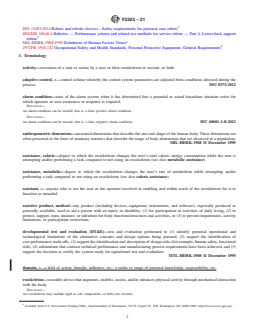
F3323 − 21
ISO 13482:2014 Robots and robotic devices – Safety requirements for personal care robots
ISO/DIS 18646-4 Robotics — Performance criteria and related test methods for service robots — Part 4: Lower-back support
robots
MIL-HDBK-1908:1995 Definitions of Human Factors Terms
29 CFR 1910.132 Occupational Safety and Health Standards, Personal Protective Equipment, General Requirements
3. Terminology
activity—execution of a task or action by a user or their exoskeleton or exosuit, or both.
adaptive control, n—control scheme whereby the control system parameters are adjusted from conditions detected during the
process. ISO 8373:2012
alarm condition—state of the alarm system when it has determined that a potential or actual hazardous situation exists for
which operator or user awareness or response is required.
DISCUSSION—
An alarm condition can be invalid, that is, a false positive alarm condition.
DISCUSSION—
An alarm condition can be missed, that is, a false negative alarm condition. IEC 60601-1-8:2012
anthropometric dimensions—measured dimensions that describe the size and shape of the human body. These dimensions are
often presented in the form of summary statistics that describe the range of body dimensions that are observed in a population.
MIL-HDBK-1908 11 December 1995
assistance, caloric—degree to which the exoskeleton changes the user’s total caloric energy consumption while the user is
attempting and/or performing a task compared to not using an exoskeleton (see also metabolic assistance).
assistance, metabolic—degree to which the exoskeleton changes the user’s rate of metabolism while attempting and/or
performing a task compared to not using an exoskeleton (see also caloric assistance).
assistant, n—anyone who is not the user or the operator involved in enabling and within reach of the exoskeleton for it to
function as intended.
assistive product, medical—any product (including devices, equipment, instruments, and software), especially produced or
generally available, used to aid a person with an injury or disability: (1) for participation in activities of daily living, (2) to
protect, support, train, measure, or substitute for body functions/structures and activities, or (3) to prevent impair
...
Questions, Comments and Discussion
Ask us and Technical Secretary will try to provide an answer. You can facilitate discussion about the standard in here.
Loading comments...