

ASTM E2499-18
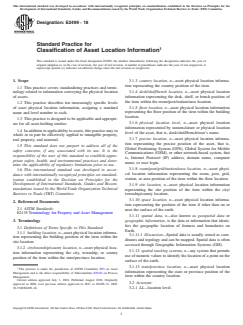
(Practice)Standard Practice for Classification of Asset Location Information
General Information
- Abstract
SIGNIFICANCE AND USE
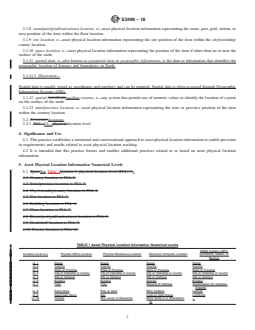
4.1 This practice establishes a notational and conversational approach to asset physical location information to enable precision in requirements and results related to asset physical location tracking.
4.2 It is intended that this practice fosters and enables additional practices related to or based on asset physical location information.
SCOPE
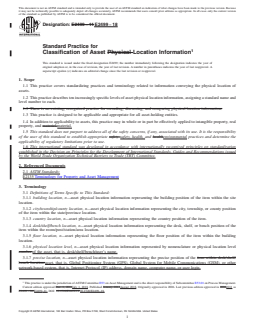
1.1 This practice covers standardizing practices and terminology related to information conveying the physical location of assets.
1.2 This practice describes ten increasingly specific levels of asset physical location information, assigning a standard name and level number to each.
1.3 This practice is designed to be applicable and appropriate for all asset-holding entities.
1.4 In addition to applicability to assets, this practice may in whole or in part be effectively applied to intangible property, real property, and material.
1.5 This standard does not purport to address all of the safety concerns, if any, associated with its use. It is the responsibility of the user of this standard to establish appropriate safety, health, and environmental practices and determine the applicability of regulatory limitations prior to use.
1.6 This international standard was developed in accordance with internationally recognized principles on standardization established in the Decision on Principles for the Development of International Standards, Guides and Recommendations issued by the World Trade Organization Technical Barriers to Trade (TBT) Committee.
- Status
- Published
- Publication Date
- 30-Jun-2018
- Technical Committee
- E53 - Asset Management
- Drafting Committee
- E53.01 - Process Management




Overview
ASTM E2499-18: Standard Practice for Classification of Asset Location Information establishes a consistent framework for recording, communicating, and comparing the physical location of assets. Developed by ASTM International, this standard specifies standardized terminology and ten defined levels of asset physical location information. The practice applies to any organization or entity that manages assets, and it provides a clear methodology for precision in asset physical location tracking. By fostering a uniform approach, ASTM E2499-18 enhances the accuracy and efficiency of asset management operations across diverse industries.
Key Topics
- Standardized Asset Location Terminology: E2499-18 defines precise terms for each level of asset location, such as building, floor, room, or desk.
- Numerical Levels of Location Information: The practice introduces ten physical location levels (PLLs), from the most general (space, country) to the most specific (desk, precise coordinates).
- Applicability to Various Asset Types: While focused on physical assets, the standard can be extended to intangible property, real property, and materiel.
- Procedures for Effective Asset Tracking: Guidelines help organizations choose the appropriate level of detail for asset tracking, depending on operational needs and cost considerations.
- Support for Spatial Data and Tracking Systems: The standard acknowledges the use of geospatial data, GPS, and other spatial coordinate systems for advanced asset location management.
Applications
ASTM E2499-18 has broad practical applications across industries concerned with asset management, physical inventory control, and property management. Relevant scenarios include:
- Corporate Asset Management: Improving accuracy in the management, movement, and tracking of office equipment, IT infrastructure, and furniture.
- Warehousing and Facilities Management: Enhancing inventory control by specifying whether an asset is tracked to a building, floor, row, or precise bin.
- Information Technology: Enabling integration of physical and logical asset locations through network-based identifiers such as IP addresses or MAC addresses.
- Public Sector and Defense: Enhancing property accountability and transparency for government or defense assets by standardizing location reporting.
- Healthcare and Laboratories: Supporting precise tracking of medical devices, laboratory equipment, and critical materials for compliance and safety.
- Utilities and Real Estate: Applying the same hierarchical location system to monitor the status and movement of field equipment, meters, or real property holdings.
Key benefits include:
- Uniform Communication: Facilitates clear and consistent communication regarding asset locations between departments, sites, and external stakeholders.
- Improved Compliance: Helps meet internal policies and external regulatory requirements for asset location tracking.
- Enhanced Auditability: Provides traceable, standardized records to support audits and inventories.
- Flexibility: Enables organizations to select appropriate location levels for different asset categories to balance precision and cost-effectiveness.
Related Standards
Organizations implementing ASTM E2499-18 often consider the following related standards:
- ASTM E2135 - Terminology for Property and Asset Management: Provides essential terms and definitions for related asset management practices.
- ISO 55000 Series - Asset Management Standards: International standards covering the management of physical and intangible assets.
- ASTM E2452 - Standard Practice for Equipment Inventory Records: Addresses recordkeeping practices critical for asset inventories.
- ISO 19115 - Geographic Information – Metadata: Supports the standardized description of geospatial location data.
- Best Practices in Geographic Information Systems (GIS): Relevant for integrating spatial data formats and geographic coordinates into asset management systems.
By referencing ASTM E2499-18, organizations can establish a robust foundation for consistent, precise physical location information, enhancing asset control and property management processes.
Relations
- Effective Date
- 01-Jul-2018
- Effective Date
- 01-May-2017
- Effective Date
- 15-Oct-2010
- Effective Date
- 15-Oct-2010
- Effective Date
- 15-Oct-2010
- Effective Date
- 01-Jul-2010
- Effective Date
- 15-Jun-2007
- Effective Date
- 15-Jun-2007
- Effective Date
- 15-Feb-2006
- Effective Date
- 01-Sep-2004
- Effective Date
- 10-Aug-2002
- Effective Date
- 10-Feb-2001
- Effective Date
- 01-Jul-2018
- Effective Date
- 01-Jul-2018
- Referred By
ASTM E2604-21 - Standard Practice for Data Characteristics of Personal Property Asset Record - Effective Date
- 01-Jul-2018
Get Certified
Connect with accredited certification bodies for this standard

BSI Group
BSI (British Standards Institution) is the business standards company that helps organizations make excellence a habit.

Bureau Veritas
Bureau Veritas is a world leader in laboratory testing, inspection and certification services.

DNV
DNV is an independent assurance and risk management provider.
Sponsored listings
Frequently Asked Questions
ASTM E2499-18 is a standard published by ASTM International. Its full title is "Standard Practice for Classification of Asset Location Information". This standard covers: SIGNIFICANCE AND USE 4.1 This practice establishes a notational and conversational approach to asset physical location information to enable precision in requirements and results related to asset physical location tracking. 4.2 It is intended that this practice fosters and enables additional practices related to or based on asset physical location information. SCOPE 1.1 This practice covers standardizing practices and terminology related to information conveying the physical location of assets. 1.2 This practice describes ten increasingly specific levels of asset physical location information, assigning a standard name and level number to each. 1.3 This practice is designed to be applicable and appropriate for all asset-holding entities. 1.4 In addition to applicability to assets, this practice may in whole or in part be effectively applied to intangible property, real property, and material. 1.5 This standard does not purport to address all of the safety concerns, if any, associated with its use. It is the responsibility of the user of this standard to establish appropriate safety, health, and environmental practices and determine the applicability of regulatory limitations prior to use. 1.6 This international standard was developed in accordance with internationally recognized principles on standardization established in the Decision on Principles for the Development of International Standards, Guides and Recommendations issued by the World Trade Organization Technical Barriers to Trade (TBT) Committee.
SIGNIFICANCE AND USE 4.1 This practice establishes a notational and conversational approach to asset physical location information to enable precision in requirements and results related to asset physical location tracking. 4.2 It is intended that this practice fosters and enables additional practices related to or based on asset physical location information. SCOPE 1.1 This practice covers standardizing practices and terminology related to information conveying the physical location of assets. 1.2 This practice describes ten increasingly specific levels of asset physical location information, assigning a standard name and level number to each. 1.3 This practice is designed to be applicable and appropriate for all asset-holding entities. 1.4 In addition to applicability to assets, this practice may in whole or in part be effectively applied to intangible property, real property, and material. 1.5 This standard does not purport to address all of the safety concerns, if any, associated with its use. It is the responsibility of the user of this standard to establish appropriate safety, health, and environmental practices and determine the applicability of regulatory limitations prior to use. 1.6 This international standard was developed in accordance with internationally recognized principles on standardization established in the Decision on Principles for the Development of International Standards, Guides and Recommendations issued by the World Trade Organization Technical Barriers to Trade (TBT) Committee.
ASTM E2499-18 is classified under the following ICS (International Classification for Standards) categories: 03.100.10 - Purchasing. Procurement. Logistics. The ICS classification helps identify the subject area and facilitates finding related standards.
ASTM E2499-18 has the following relationships with other standards: It is inter standard links to ASTM E2499-11, ASTM E2135-10a(2017), ASTM E2135-10a, ASTM E2135-10ae2, ASTM E2135-10ae1, ASTM E2135-10, ASTM E2135-07e1, ASTM E2135-07, ASTM E2135-06, ASTM E2135-04, ASTM E2135-02, ASTM E2135-01, ASTM E2675-22, ASTM E2135-22, ASTM E2604-21. Understanding these relationships helps ensure you are using the most current and applicable version of the standard.
ASTM E2499-18 is available in PDF format for immediate download after purchase. The document can be added to your cart and obtained through the secure checkout process. Digital delivery ensures instant access to the complete standard document.
Standards Content (Sample)
This international standard was developed in accordance with internationally recognized principles on standardization established in the Decision on Principles for the
Development of International Standards, Guides and Recommendations issued by the World Trade Organization Technical Barriers to Trade (TBT) Committee.
Designation:E2499 −18
Standard Practice for
Classification of Asset Location Information
This standard is issued under the fixed designation E2499; the number immediately following the designation indicates the year of
original adoption or, in the case of revision, the year of last revision. A number in parentheses indicates the year of last reapproval. A
superscript epsilon (´) indicates an editorial change since the last revision or reapproval.
1. Scope 3.1.3 country location, n—asset physical location informa-
tion representing the country position of the item.
1.1 This practice covers standardizing practices and termi-
3.1.4 desk/shelf/bench location, n—asset physical location
nology related to information conveying the physical location
of assets. information representing the desk, shelf, or bench position of
the item within the room/post/station/area location.
1.2 This practice describes ten increasingly specific levels
3.1.5 floor location, n—asset physical location information
of asset physical location information, assigning a standard
representing the floor position of the item within the building
name and level number to each.
location.
1.3 This practice is designed to be applicable and appropri-
3.1.6 physical location level, n—asset physical location
ate for all asset-holding entities.
information represented by nomenclature or physical location
1.4 In addition to applicability to assets, this practice may in
level of the asset, that is, desk/shelf/bench/user’s name.
whole or in part be effectively applied to intangible property,
3.1.7 precise location, n—asset physical location informa-
real property, and material.
tion representing the precise position of the asset, that is,
1.5 This standard does not purport to address all of the
Global Positioning System (GPS), Global System for Mobile
safety concerns, if any, associated with its use. It is the
Communications (GSM), or other network-based system, that
responsibility of the user of this standard to establish appro-
is, Internet Protocol (IP) address, domain name, computer
priate safety, health, and environmental practices and deter-
name, or user login.
mine the applicability of regulatory limitations prior to use.
3.1.8 room/post/grid/station/area location, n—asset physi-
1.6 This international standard was developed in accor-
cal location information representing the room, post, grid,
dance with internationally recognized principles on standard-
station, or area position of the item within the floor location.
ization established in the Decision on Principles for the
Development of International Standards, Guides and Recom- 3.1.9 site location, n—asset physical location information
mendations issued by the World Trade Organization Technical
representing the site position of the item within the city/
Barriers to Trade (TBT) Committee.
township/county location.
3.1.10 space location, n—asset physical location informa-
2. Referenced Documents
tion representing the position of the item if other than on or
2.1 ASTM Standards:
near the surface of the earth.
E2135 Terminology for Property and Asset Management
3.1.11 spatial data, n—also known as geospatial data or
geographic information, is the data or information that identi-
3. Terminology
fies the geographic location of features and boundaries on
3.1 Definitions of Terms Specific to This Standard:
Earth.
3.1.1 building location, n—asset physical location informa-
3.1.11.1 Discussion—Spatial data is usually stored as coor-
tion representing the building position of the item within the
dinates and topology and can be mapped. Spatial data is often
site location.
accessed through Geographic Information Systems (GIS).
3.1.2 city/township/county location, n—asset physical loca-
3.1.12 spatial tracking systems, n—any system that permits
tion information representing the city, township, or county
use of numeric values to identify the location of a point on the
position of the item within the state/province location.
surface of the earth.
3.1.13 state/province location, n—asset physical location
This practice is under the jurisdiction of ASTM Committee E53 on Asset
information representing the state or province position of the
Management and is the direct responsibility of Subcommittee E53.01 on Process
Management. item within the country location.
Current edition approved July 1, 2018. Published August 2018. Originally
3.2 Acronym:
approved in 2006. Last previous edition approved in 2011 as E2499–11. DOI:
10.1520/E2499–18. 3.2.1 LL—location level.
Copyright © ASTM International, 100 Barr Harbor Drive, PO Box C700, West Conshohocken, PA 19428-2959. United States
E2499−18
TABLE 1 Asset Physical Location Information Numerical Levels
GNSS location
...
This document is not an ASTM standard and is intended only to provide the user of an ASTM standard an indication of what changes have been made to the previous version. Because
it may not be technically possible to adequately depict all changes accurately, ASTM recommends that users consult prior editions as appropriate. In all cases only the current version
of the standard as published by ASTM is to be considered the official document.
Designation: E2499 − 11 E2499 − 18
Standard Practice for
Classification of Asset Physical Location Information
This standard is issued under the fixed designation E2499; the number immediately following the designation indicates the year of
original adoption or, in the case of revision, the year of last revision. A number in parentheses indicates the year of last reapproval. A
superscript epsilon (´) indicates an editorial change since the last revision or reapproval.
1. Scope
1.1 This practice covers standardizing practices and terminology related to information conveying the physical location of
assets.
1.2 This practice describes ten increasingly specific levels of asset physical location information, assigning a standard name and
level number to each.
1.3 There is no existing, recognized practice for recording, discussing, and comparing physical location information.
1.3 This practice is designed to be applicable and appropriate for all asset-holding entities.
1.4 In addition to applicability to assets, this practice may in whole or in part be effectively applied to intangible property, real
property, and materiel.material.
1.5 This standard does not purport to address all of the safety concerns, if any, associated with its use. It is the responsibility
of the user of this standard to establish appropriate safety safety, health, and healthenvironmental practices and determine the
applicability of regulatory limitations prior to use.
1.6 This international standard was developed in accordance with internationally recognized principles on standardization
established in the Decision on Principles for the Development of International Standards, Guides and Recommendations issued
by the World Trade Organization Technical Barriers to Trade (TBT) Committee.
2. Referenced Documents
2.1 ASTM Standards:
E2135 Terminology for Property and Asset Management
3. Terminology
3.1 Definitions of Terms Specific to This Standard:
3.1.1 building location, n—asset physical location information representing the building position of the item within the site
location.
3.1.2 city/township/county location, n—asset physical location information representing the city, township, or county position
of the item within the state/province location.
3.1.3 country location, n—asset physical location information representing the country position of the item.
3.1.4 desk/shelf/bench location, n—asset physical location information representing the desk, shelf, or bench position of the
item within the room/post/station/area location.
3.1.5 floor location, n—asset physical location information representing the floor position of the item within the building
location.
3.1.6 physical location level, n—asset physical location information represented by nomenclature or physical location level
number.of the asset, that is, desk/shelf/bench/user’s name.
3.1.7 precise location, n—asset physical location information representing the precise position of the item within desk/shelf/
bench location.asset, that is, Global Positioning System (GPS), Global System for Mobile Communications (GSM), or other
network-based system, that is, Internet Protocol (IP) address, domain name, computer name, or user login.
This practice is under the jurisdiction of ASTM Committee E53 on Asset Management and is the direct responsibility of Subcommittee E53.01 on Process Management.
Current edition approved Dec. 1, 2011July 1, 2018. Published January 2012August 2018. Originally approved in 2006. Last previous edition approved in 20062011 as
E2499 – 06.E2499–11. DOI: 10.1520/E2499-11.10.1520/E2499–18.
Copyright © ASTM International, 100 Barr Harbor Drive, PO Box C700, West Conshohocken, PA 19428-2959. United States
E2499 − 18
3.1.8 room/post/grid/station/area location, n—asset physical location information representing the room, post, grid, station, or
area position of the item within the floor location.
3.1.9 site location, n—asset physical location information representing the site position of the item within the city/township/
county location.
3.1.10 space location, n—asset physical location information representing the position of the item if other than on or near the
surface of the earth.
3.1.11 spatial data, n—also known as geospatial data or geographic information, is the data or information that identifies the
geographic location of features and boundaries on Earth.
3.1.11.1 Discussion—
Spatial data is usually stored as coordinates and topology and can be mapped. Spatial data is often accessed through Geographic
Information Systems (GIS).
3.1.12 spatial coordinatetracking systems, n—any system that permits use of numeric values to identify the location of a point
on the surface of the earth.
3.1.13 state/province location, n—asset physical location information representing the state or province position of the item
within the country location.
3.2 Acronyms:Acronym:
3.2.1 PLL—LL—physical location level.
4. Significance and Use
4.1 This practice establishes a notational and conversational approach to asset physical location information to enable precision
in requirements and results related to asset physical location tracking.
4.2 It is intended that this practice fosters and enables additional practices related to or based on asset physical location
information.
5. Asset Physical Location Information Numerical Levels
5.1 SpaceSee Table 1location is physical location level (PLL) 1.
4.2 Country location is PLL 2.
4.3 State/province location is PLL 3.
4.4 City/township/county location is PLL 4.
4.5 Site location is PLL 5.
4.6 Building location is PLL 6.
4.7 Floor location is PLL 7.
4.8 Room/post/grid/station/area location is PLL 8.
4.9 Desk/shelf location
...