

ASTM D5983-21
(Specification)Standard Specification for Methyl Tertiary-Butyl Ether (MTBE) for Blending With Gasolines for Use as Automotive Spark-Ignition Engine Fuel
General Information
- Abstract
ABSTRACT
This specification covers requirements for fuel grade methyl tertiary-butyl ether utilized in commerce, terminal blending, or downstream blending with fuels for spark-ignition engines. The following test methods shall be conducted to meet the specified requirements: appearance; sulfur; solvent-washed gum content; MTBE mass percentage; methanol mass percentage; API gravity; density; copper strip corrosion; water content; vapor pressure; and color.
SCOPE
1.1 This specification covers requirements for fuel grade methyl tertiary-butyl ether utilized in blending with gasolines at 1 % to 15 % by volume (equivalent to 2.7 % by weight oxygen) for use as automotive spark-ignition engine fuel covered by Specification D4814 as well as other automotive fuel applications involving MTBE. Other MTBE grades may be available for blending that are not covered by this specification.
1.2 The values stated in SI units are to be regarded as standard. No other units of measurement are included in this standard.
1.3 This international standard was developed in accordance with internationally recognized principles on standardization established in the Decision on Principles for the Development of International Standards, Guides and Recommendations issued by the World Trade Organization Technical Barriers to Trade (TBT) Committee.
- Status
- Published
- Publication Date
- 30-Jun-2021
- Technical Committee
- D02 - Petroleum Products, Liquid Fuels, and Lubricants
- Drafting Committee
- D02.A0.02 - Oxygenated Fuels and Components
Buy Documents

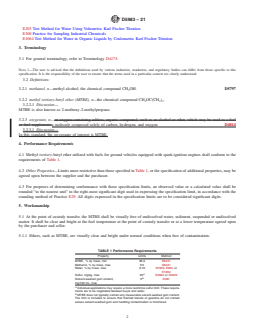
ASTM D5983-21 - Standard Specification for Methyl Tertiary-Butyl Ether (MTBE) for Blending With Gasolines for Use as Automotive Spark-Ignition Engine Fuel
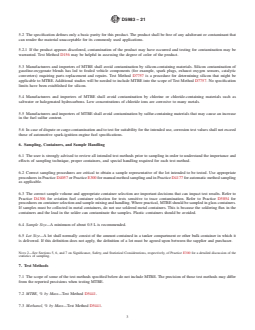
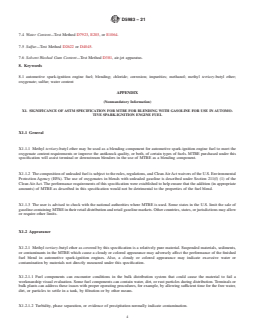
REDLINE ASTM D5983-21 - Standard Specification for Methyl Tertiary-Butyl Ether (MTBE) for Blending With Gasolines for Use as Automotive Spark-Ignition Engine Fuel
Overview
ASTM D5983-21 specifies the requirements for fuel-grade methyl tertiary-butyl ether (MTBE) intended for blending with gasolines for use in automotive spark-ignition engine fuel. Developed by ASTM International, this standard supports the proper and safe inclusion of MTBE as an oxygenate in gasoline blends, helping to meet regulatory requirements and enhance engine performance. The standard details criteria for MTBE composition, appearance, purity, and essential contaminants, as well as test methods and appropriate sampling procedures. Complying with ASTM D5983-21 ensures the reliability and environmental compatibility of gasoline blends using MTBE as a component.
Key Topics
- Scope: Applies to MTBE used as a blending component in gasolines, typically at 1% to 15% by volume for automotive engines designed for spark ignition.
- Performance Specifications: Defines minimum purity requirements for MTBE, maximum allowable limits for methanol, water, sulfur, and solvent-washed gum content.
- Test Methods: Relies on established ASTM test standards for evaluating MTBE quality, including tests for appearance, sulfur content, gum content, density, corrosion, water, vapor pressure, and color.
- Sampling and Handling: Outlines critical procedures for sampling, container selection, and sample volume to ensure reliable test results and product integrity.
- Workmanship: Requires that MTBE at custody transfer be visually clear, free of undissolved water or other contaminants.
- Contaminant Control: Addresses avoidance of contamination by silicon, chlorine, sulfur, and other materials that could impair fuel quality or cause downstream equipment issues.
Applications
Fuel Formulation
- Oxygenate Blending: MTBE is used to increase the oxygen content in gasoline, improving combustion efficiency and reducing harmful emissions in compliance with environmental regulations.
- Antiknock Agent: Enhances the octane rating of fuel blends, supporting improved engine performance and reducing engine knocking.
- Terminal and Downstream Blending: Provides a standard reference for MTBE purity and handling in fuel blending operations throughout the supply chain, ensuring final fuel meets regulatory and engine requirements.
Industry Compliance
- Regulatory Obligation: Assists fuel producers, distributors, and importers in fulfilling local, national, and international standards for automotive fuels containing MTBE.
- Quality Assurance: Establishes clear testing protocols and acceptance criteria to ensure safe, effective, and contaminant-free fuel blending stock.
- Environmental Responsibility: Limiting impurities such as sulfur, methanol, and water in MTBE contributes to lower emissions, less engine and catalyst deterioration, and overall improvement in air quality.
Related Standards
- ASTM D4814: Specification for Automotive Spark-Ignition Engine Fuel; primary gasoline specification referenced when blending MTBE.
- ASTM D5441: Test Method for Analysis of MTBE by Gas Chromatography.
- ASTM D7923, E203, E1064: Methods for determining water content in fuels and organic liquids.
- ASTM D2622, D4045: Methods for sulfur analysis in petroleum products.
- ASTM D381: Measurement of solvent-washed gum content.
- ASTM D4057, D4177, E300, D5854: Practices for manual and automatic sampling, handling, and container selection for fuel samples.
- ASTM D7757: Method for silicon content determination, important for preventing contamination.
By following ASTM D5983-21, stakeholders in the automotive fuel industry can utilize MTBE safely and efficiently for gasoline blending, ensuring legal compliance, protecting engines, and supporting environmental objectives.
Relations
- Effective Date
- 01-Jan-2024
- Effective Date
- 01-Jan-2024
- Effective Date
- 01-Jan-2024
- Refers
ASTM D4175-23a - Standard Terminology Relating to Petroleum Products, Liquid Fuels, and Lubricants - Effective Date
- 15-Dec-2023
- Effective Date
- 01-Dec-2023
- Effective Date
- 01-Oct-2023
- Refers
ASTM D4175-23e1 - Standard Terminology Relating to Petroleum Products, Liquid Fuels, and Lubricants - Effective Date
- 01-Jul-2023
- Effective Date
- 01-Feb-2020
- Effective Date
- 01-Dec-2019
- Effective Date
- 01-Jun-2019
- Effective Date
- 01-Oct-2018
- Effective Date
- 01-Apr-2018
- Effective Date
- 01-Jan-2018
- Effective Date
- 01-Jul-2017
- Effective Date
- 01-Jul-2017
Buy Documents
ASTM D5983-21 - Standard Specification for Methyl Tertiary-Butyl Ether (MTBE) for Blending With Gasolines for Use as Automotive Spark-Ignition Engine Fuel
REDLINE ASTM D5983-21 - Standard Specification for Methyl Tertiary-Butyl Ether (MTBE) for Blending With Gasolines for Use as Automotive Spark-Ignition Engine Fuel
Get Certified
Connect with accredited certification bodies for this standard

Element Materials Technology
Materials testing and product certification.

ABS Group Brazil
ABS Group certification services in Brazil.

ABS Quality Evaluations Inc.
American Bureau of Shipping quality certification.
Sponsored listings
Frequently Asked Questions
ASTM D5983-21 is a technical specification published by ASTM International. Its full title is "Standard Specification for Methyl Tertiary-Butyl Ether (MTBE) for Blending With Gasolines for Use as Automotive Spark-Ignition Engine Fuel". This standard covers: ABSTRACT This specification covers requirements for fuel grade methyl tertiary-butyl ether utilized in commerce, terminal blending, or downstream blending with fuels for spark-ignition engines. The following test methods shall be conducted to meet the specified requirements: appearance; sulfur; solvent-washed gum content; MTBE mass percentage; methanol mass percentage; API gravity; density; copper strip corrosion; water content; vapor pressure; and color. SCOPE 1.1 This specification covers requirements for fuel grade methyl tertiary-butyl ether utilized in blending with gasolines at 1 % to 15 % by volume (equivalent to 2.7 % by weight oxygen) for use as automotive spark-ignition engine fuel covered by Specification D4814 as well as other automotive fuel applications involving MTBE. Other MTBE grades may be available for blending that are not covered by this specification. 1.2 The values stated in SI units are to be regarded as standard. No other units of measurement are included in this standard. 1.3 This international standard was developed in accordance with internationally recognized principles on standardization established in the Decision on Principles for the Development of International Standards, Guides and Recommendations issued by the World Trade Organization Technical Barriers to Trade (TBT) Committee.
ABSTRACT This specification covers requirements for fuel grade methyl tertiary-butyl ether utilized in commerce, terminal blending, or downstream blending with fuels for spark-ignition engines. The following test methods shall be conducted to meet the specified requirements: appearance; sulfur; solvent-washed gum content; MTBE mass percentage; methanol mass percentage; API gravity; density; copper strip corrosion; water content; vapor pressure; and color. SCOPE 1.1 This specification covers requirements for fuel grade methyl tertiary-butyl ether utilized in blending with gasolines at 1 % to 15 % by volume (equivalent to 2.7 % by weight oxygen) for use as automotive spark-ignition engine fuel covered by Specification D4814 as well as other automotive fuel applications involving MTBE. Other MTBE grades may be available for blending that are not covered by this specification. 1.2 The values stated in SI units are to be regarded as standard. No other units of measurement are included in this standard. 1.3 This international standard was developed in accordance with internationally recognized principles on standardization established in the Decision on Principles for the Development of International Standards, Guides and Recommendations issued by the World Trade Organization Technical Barriers to Trade (TBT) Committee.
ASTM D5983-21 is classified under the following ICS (International Classification for Standards) categories: 75.160.20 - Liquid fuels. The ICS classification helps identify the subject area and facilitates finding related standards.
ASTM D5983-21 has the following relationships with other standards: It is inter standard links to ASTM E203-24, ASTM E1064-24, ASTM D4814-24, ASTM D4175-23a, ASTM D4814-23a, ASTM D156-23, ASTM D4175-23e1, ASTM D4814-20, ASTM D4814-19a, ASTM D7923-19, ASTM D4814-18c, ASTM D4814-18a, ASTM D4814-18, ASTM D7923-17ae1, ASTM D7923-17a. Understanding these relationships helps ensure you are using the most current and applicable version of the standard.
ASTM D5983-21 is available in PDF format for immediate download after purchase. The document can be added to your cart and obtained through the secure checkout process. Digital delivery ensures instant access to the complete standard document.
Standards Content (Sample)
This international standard was developed in accordance with internationally recognized principles on standardization established in the Decision on Principles for the
Development of International Standards, Guides and Recommendations issued by the World Trade Organization Technical Barriers to Trade (TBT) Committee.
Designation:D5983 −21
Standard Specification for
Methyl Tertiary-Butyl Ether (MTBE) for Blending With
Gasolines for Use as Automotive Spark-Ignition Engine
Fuel
This standard is issued under the fixed designation D5983; the number immediately following the designation indicates the year of
original adoption or, in the case of revision, the year of last revision. A number in parentheses indicates the year of last reapproval. A
superscript epsilon (´) indicates an editorial change since the last revision or reapproval.
1. Scope* D4175 Terminology Relating to Petroleum Products, Liquid
Fuels, and Lubricants
1.1 This specification covers requirements for fuel grade
D4177 Practice for Automatic Sampling of Petroleum and
methyl tertiary-butyl ether utilized in blending with gasolines
Petroleum Products
at 1 % to 15 % by volume (equivalent to 2.7 % by weight
D4306 Practice for Aviation Fuel Sample Containers for
oxygen) for use as automotive spark-ignition engine fuel
Tests Affected by Trace Contamination
covered by Specification D4814 as well as other automotive
D4814 Specification for Automotive Spark-Ignition Engine
fuel applications involving MTBE. Other MTBE grades may
Fuel
be available for blending that are not covered by this specifi-
D5441 Test Method forAnalysis of Methyl Tert-Butyl Ether
cation.
(MTBE) by Gas Chromatography
1.2 The values stated in SI units are to be regarded as
D5854 Practice for Mixing and Handling of Liquid Samples
standard. No other units of measurement are included in this
of Petroleum and Petroleum Products
standard.
D7757 Test Method for Silicon in Gasoline and Related
1.3 This international standard was developed in accor- Products by Monochromatic Wavelength Dispersive
dance with internationally recognized principles on standard-
X-ray Fluorescence Spectrometry
ization established in the Decision on Principles for the D7923 Test Method for Water in Ethanol and Hydrocarbon
Development of International Standards, Guides and Recom-
Blends by Karl Fischer Titration
mendations issued by the World Trade Organization Technical E29 Practice for Using Significant Digits in Test Data to
Barriers to Trade (TBT) Committee.
Determine Conformance with Specifications
E203 Test Method for Water Using Volumetric Karl Fischer
2. Referenced Documents
Titration
2.1 ASTM Standards: E300 Practice for Sampling Industrial Chemicals
E1064 Test Method for Water in Organic Liquids by Coulo-
D156 Test Method for Saybolt Color of Petroleum Products
(Saybolt Chromometer Method) metric Karl Fischer Titration
D381 Test Method for Gum Content in Fuels by Jet Evapo-
ration 3. Terminology
D2622 Test Method for Sulfur in Petroleum Products by
3.1 For general terminology, refer to Terminology D4175.
Wavelength Dispersive X-ray Fluorescence Spectrometry
NOTE 1—The user is advised that the definitions used by various
D4045 Test Method for Sulfur in Petroleum Products by
industries, marketers, and regulatory bodies can differ from those specific
Hydrogenolysis and Rateometric Colorimetry
to this specification. It is the responsibility of the user to ensure that the
D4057 Practice for Manual Sampling of Petroleum and
terms used in a particular context are clearly understood.
Petroleum Products
3.2 Definitions:
3.2.1 methanol, n—methyl alcohol, the chemical compound
This specification is under the jurisdiction of ASTM Committee D02 on
CH OH. D5797
Petroleum Products, Liquid Fuels, and Lubricants and is the direct responsibility of
Subcommittee D02.A0.02 on Oxygenated Fuels and Components.
3.2.2 methyl tertiary-butyl ether (MTBE), n—the chemical
Current edition approved July 1, 2021. Published July 2021. Originally approved
compound CH OC(CH ) .
3 3 3
in 1996. Last previous edition approved in 2018 as D5983 – 18. DOI: 10.1520/
3.2.2.1 Discussion—MTBE is also known as 2-methoxy-2-
D5983-21.
For referenced ASTM standards, visit the ASTM website, www.astm.org, or methylpropane.
contact ASTM Customer Service at service@astm.org. For Annual Book of ASTM
3.2.3 oxygenate, n—a molecule composed solely of carbon,
Standards volume information, refer to the standard’s Document Summary page on
the ASTM website. hydrogen, and oxygen. D4814
*A Summary of Changes section appears at the end of this standard
Copyright © ASTM International, 100 Barr Harbor Drive, PO Box C700, West Conshohocken, PA 19428-2959. United States
D5983−21
3.2.3.1 Discussion—In this standard, the oxygenate of inter- will be needed to include MTBE into the scope ofTest Method
est is MTBE. D7757. No specification limits have been established for
silicon.
4. Performance Requirements
5.4 Manufacturers and importers of MTBE shall avoid
4.1 Methyl tertiary-butyl ether utilized with fuels for contamination by chlorine or chloride-containing materials
ground vehicles equipped with spark-ignition engines shall
such as saltwater or halogenated hydrocarbons. Low concen-
conform to the requirements of Table 1.
trations of chloride ions are corrosive to many metals.
4.2 Other Properties—Limits more restrictive than those
5.5 Manufacturers and importers of MTBE shall avoid
specified in Table 1, or the specification of additional
contaminationbysulfur-containingmaterialsthatmaycausean
properties, may be agreed upon between the supplier and the
increase in the fuel sulfur content.
purchaser.
5.6 In case of dispute or cargo contamination and to test for
4.3 For purposes of determining conformance with these
suitability for the intended use, corrosion test values shall not
specification limits, an observed value or a calculated value
exceed those of automotive spark-ignition engine fuel specifi-
shall be rounded “to the nearest unit” in the right-most cations.
significant digit used in expressing the specification limit, in
6. Sampling, Containers, and Sample Handling
accordance with the rounding method of Practice E29. All
digits expressed in the specification limits are to be considered
6.1 The user is strongly advised to review all intended test
significant digits.
methods prior to sampling in order to understand the impor-
tance and effects of sampling technique, proper containers, and
5. Workmanship
special handling required for each test method.
5.1 At the point of custody transfer, the MTBE shall be
6.2 Correct sampling procedures are critical to obtain a
visually free of undissolved water, sediment, suspended or
sample representative of the lot intended to be tested. Use
undissolved matter. It shall be clear and bright at the fuel
appropriate procedures in Practice D4057 or Practice E300 for
temperature at the point of custody transfer or at a lower
manual method sampling and in Practice D4177 for automatic
temperature agreed upon by the purchaser and seller.
method sampling as applicable.
5.1.1 Ethers, such as MTBE, are visually clear and bright
6.3 The correct sample volume and appropriate container
under normal conditions when free of contamination.
selection are important decisions that can impact test results.
5.2 The specification defines only a basic purity for this
Refer to Practice D4306 for aviation fuel container selection
product. The product shall be free of any adulterant or
for tests sensitive to trace contamination. Refer to Practice
contaminant that can render the material unacceptable for its
D5854 for procedures on container selection and sample
commonly used applications.
mixing and handling. Where practical, MTBE should be
5.2.1 Iftheproductappearsdiscolored,contaminationofthe
sampled in glass containers. If samples must be collected in
product may have occurred and testing for contamination may
metal containers, do not use soldered metal containers. This is
be warranted. Test Method D156 may be helpful in assessing
because the soldering flux in the containers and the lead in the
the degree of color of the product.
solder can contaminate the samples. Plastic containers should
be avoided.
5.3 Manufacturers and importers of MTBE shall avoid
contamination by silicon-containing materials. Silicon con-
6.4 Sample Size—A minimum of about 0.5 L is recom-
tamination of gasoline-oxygenate blends has led to fouled
mended.
vehicle components (for example, spark plugs, exhaust oxygen
6.5 Lot Size—A lot shall normally consist of the amount
sensors, catalytic converters) requiring parts replacement and
contained in a tanker compartment or other bulk container in
repairs. Test Method D7757 is a procedure for determining
which it is delivered. If this definition does not apply, the
silicon that might be applicable to MTBE. Additional studies
definition of a lot must be agreed upon between the supplier
and purchaser.
NOTE 2—See Sections 5, 6, and 7 on Significance, Safety, and
TABLE 1 Performance Requirements
Statistical Considerations, respectively, of Practice E300 for a detailed
Property Limits Method discussion of the statistics of sampling.
MTBE, % by mass, min 95.0 D5441
7. Test Methods
Methanol, % by mass, max 0.5 D5441
Water, % by mass, max 0.10 D7923, E203,or
7.1 The scope of
...
This document is not an ASTM standard and is intended only to provide the user of an ASTM standard an indication of what changes have been made to the previous version. Because
it may not be technically possible to adequately depict all changes accurately, ASTM recommends that users consult prior editions as appropriate. In all cases only the current version
of the standard as published by ASTM is to be considered the official document.
Designation: D5983 − 18 D5983 − 21
Standard Specification for
Methyl Tertiary-Butyl Ether (MTBE) for Blending With
Gasolines for Use as Automotive Spark-Ignition Engine
Fuel
This standard is issued under the fixed designation D5983; the number immediately following the designation indicates the year of
original adoption or, in the case of revision, the year of last revision. A number in parentheses indicates the year of last reapproval. A
superscript epsilon (´) indicates an editorial change since the last revision or reapproval.
1. Scope*
1.1 This specification covers requirements for fuel grade methyl tertiary-butyl ether utilized in blending with gasolines at 1 % to
15 % by volume (equivalent to 2.7 % by weight oxygen) for use as automotive spark-ignition engine fuel covered by Specification
D4814 as well as other automotive fuel applications involving MTBE. Other MTBE grades may be available for blending that are
not covered by this specification.
1.2 The values stated in SI units are to be regarded as standard. No other units of measurement are included in this standard.
1.3 This international standard was developed in accordance with internationally recognized principles on standardization
established in the Decision on Principles for the Development of International Standards, Guides and Recommendations issued
by the World Trade Organization Technical Barriers to Trade (TBT) Committee.
2. Referenced Documents
2.1 ASTM Standards:
D156 Test Method for Saybolt Color of Petroleum Products (Saybolt Chromometer Method)
D381 Test Method for Gum Content in Fuels by Jet Evaporation
D2622 Test Method for Sulfur in Petroleum Products by Wavelength Dispersive X-ray Fluorescence Spectrometry
D4045 Test Method for Sulfur in Petroleum Products by Hydrogenolysis and Rateometric Colorimetry
D4057 Practice for Manual Sampling of Petroleum and Petroleum Products
D4175 Terminology Relating to Petroleum Products, Liquid Fuels, and Lubricants
D4177 Practice for Automatic Sampling of Petroleum and Petroleum Products
D4306 Practice for Aviation Fuel Sample Containers for Tests Affected by Trace Contamination
D4814 Specification for Automotive Spark-Ignition Engine Fuel
D5441 Test Method for Analysis of Methyl Tert-Butyl Ether (MTBE) by Gas Chromatography
D5854 Practice for Mixing and Handling of Liquid Samples of Petroleum and Petroleum Products
D7757 Test Method for Silicon in Gasoline and Related Products by Monochromatic Wavelength Dispersive X-ray Fluorescence
Spectrometry
D7923 Test Method for Water in Ethanol and Hydrocarbon Blends by Karl Fischer Titration
E29 Practice for Using Significant Digits in Test Data to Determine Conformance with Specifications
This specification is under the jurisdiction of ASTM Committee D02 on Petroleum Products, Liquid Fuels, and Lubricants and is the direct responsibility of Subcommittee
D02.A0.02 on Oxygenated Fuels and Components.
Current edition approved Dec. 1, 2018July 1, 2021. Published January 2019July 2021. Originally approved in 1996. Last previous edition approved in 20172018 as
D5983 – 17.D5983 – 18. DOI: 10.1520/D5983-18.10.1520/D5983-21.
For referenced ASTM standards, visit the ASTM website, www.astm.org, or contact ASTM Customer Service at service@astm.org. For Annual Book of ASTM Standards
volume information, refer to the standard’s Document Summary page on the ASTM website.
*A Summary of Changes section appears at the end of this standard
Copyright © ASTM International, 100 Barr Harbor Drive, PO Box C700, West Conshohocken, PA 19428-2959. United States
D5983 − 21
E203 Test Method for Water Using Volumetric Karl Fischer Titration
E300 Practice for Sampling Industrial Chemicals
E1064 Test Method for Water in Organic Liquids by Coulometric Karl Fischer Titration
3. Terminology
3.1 For general terminology, refer to Terminology D4175.
NOTE 1—The user is advised that the definitions used by various industries, marketers, and regulatory bodies can differ from those specific to this
specification. It is the responsibility of the user to ensure that the terms used in a particular context are clearly understood.
3.2 Definitions:
3.2.1 methanol, n—methyl alcohol, the chemical compound CH OH. D5797
3.2.2 methyl tertiary-butyl ether (MTBE), n—the chemical compound CH OC(CH ) .
3 3 3
3.2.2.1 Discussion—
MTBE is also known as 2-methoxy-2-methylpropane.
3.2.3 oxygenate, n—an oxygen-containing ashless, organic compound, such as an alcohol or ether, which may be used as a fuel
or fuel supplement.a molecule composed solely of carbon, hydrogen, and oxygen. D4814
3.2.3.1 Discussion—
In this standard, the oxygenate of interest is MTBE.
4. Performance Requirements
4.1 Methyl tertiary-butyl ether utilized with fuels for ground vehicles equipped with spark-ignition engines shall conform to the
requirements of Table 1.
4.2 Other Properties—Limits more restrictive than those specified in Table 1, or the specification of additional properties, may be
agreed upon between the supplier and the purchaser.
4.3 For purposes of determining conformance with these specification limits, an observed value or a calculated value shall be
rounded “to the nearest unit” in the right-most significant digit used in expressing the specification limit, in accordance with the
rounding method of Practice E29. All digits expressed in the specification limits are to be considered significant digits.
5. Workmanship
5.1 At the point of custody transfer, the MTBE shall be visually free of undissolved water, sediment, suspended or undissolved
matter. It shall be clear and bright at the fuel temperature at the point of custody transfer or at a lower temperature agreed upon
by the purchaser and seller.
5.1.1 Ethers, such as MTBE, are visually clear and bright under normal conditions when free of contamination.
TABLE 1 Performance Requirements
Property Limits Method
MTBE, % by mass, min 95.0 D5441
Methanol, % by mass, max 0.5 D5441
Water, % by mass, max 0.10 D7923, E203, or
E1064
A
Sulfur, mg/kg, max 30 D2622 or D4045
B
Solvent-washed gum content, 5 D381
mg/100 mL, max
A
Individual applications may require a more restrictive sulfur limit. These require-
ments are to be negotiated between buyer and seller.
B
MTBE does not typically contain any measurable solvent-washed gum content.
The limit is included to ensure that finished blends of gasoline do not contain
excess solvent-washed gum and handling contamination is minimized.
D5983 − 21
5.2 The specification defines only a basic purity for this product. The product shall be free of any adulterant or contaminant that
can render the material unacceptable for its commonly used applications.
5.2.1 If the product appears discolored, contamination of the product may have occurred and testing for contamination may be
warranted. Test Method D156 may be helpful in assessing the degree of color of the product.
5.3 Manufacturers and importers of MTBE shall avoid contamination by silicon-containing materials. Silicon contamination of
gasoline-oxygenate blends has led to fouled vehicle components (for example, spark plugs, exhaust oxygen sensors, catalytic
converters) requiring parts replacement and repairs. Test Method D7757 is a procedure for determining silicon that might be
applicable to MTBE. Additional studies will be needed to include MTBE into the scope of Test Method D7757. No specification
limits have been established for silicon.
5.4 Manufacturers and importers of MTBE shall avoid contamination by chlorine or chloride-containing materials such as
saltwater or halogenated hydrocarbons. Low concentrations of chloride ions are corrosive to many metals.
5.5 Manufacturers and importers of MTBE shall avoid contamination by sulfur-containing materials that may cause an increase
in the fuel sulfur content.
5.6 In case of dispute or cargo contamination and to test for suitability for the intended use, corrosion test values shall not exceed
those of automotive spark-ignition engine fuel specifications.
6. Sampling, Containers, and Sample Handling
6.1 The user is strongly advised to review all intended test methods prior to sampling in order to understand the importance and
effects of sampling technique, proper containers, and special handling required for each test method.
6.2 Correct sampling procedures are critical to obtain a sample representative of the lot intended to be tested. Use appropriate
procedures in Practice D4057 or Practice E300 for manual method sampling and in Practice D4177 for automatic method sampling
as applicable.
6.3 The correct sample volume and appropriate container selection are important decisions that can impact test results. Refer to
Practice D4306 for aviation fuel container selection for tests sensitive to trace contamination. Refer to Practice D5854 for
procedures on container selection and sample mixing and handling. Where practical, MTBE should be sampled in glass containers.
If samples must be collected in metal containers, do not use soldered metal containers. This is because the soldering flux in the
containers and the lead in the solder can contaminate the samples. Plastic containers should be avoided.
6.4 Sample Size—A minimum of about 0.5 L is recommended.
6.5 Lot Size—A lot shall normally consist of the amount contained in a tanker compartment or other bulk container in which it
is delivered. If this definition does not apply, the definition of a lo
...