

ASTM D1946-90(2019)
(Practice)Standard Practice for Analysis of Reformed Gas by Gas Chromatography
General Information
- Abstract
SIGNIFICANCE AND USE
4.1 The information about the chemical composition can be used to calculate physical properties of the gas, such as heating (calorific) value and relative density. Combustion characteristics, products of combustion, toxicity, and interchangeability with other fuel gases may also be inferred from the chemical composition.
SCOPE
1.1 This practice covers the determination of the chemical composition of reformed gases and similar gaseous mixtures containing the following components: hydrogen, oxygen, nitrogen, carbon monoxide, carbon dioxide, methane, ethane, and ethylene.
1.2 The values stated in SI units are to be regarded as standard. No other units of measurement are included in this standard.
1.3 This standard does not purport to address all of the safety concerns, if any, associated with its use. It is the responsibility of the user of this standard to establish appropriate safety, health, and environmental practices and determine the applicability of regulatory limitations prior to use.
1.4 This international standard was developed in accordance with internationally recognized principles on standardization established in the Decision on Principles for the Development of International Standards, Guides and Recommendations issued by the World Trade Organization Technical Barriers to Trade (TBT) Committee.
- Status
- Published
- Publication Date
- 30-Nov-2019
- Technical Committee
- D03 - Gaseous Fuels
Overview
ASTM D1946-90(2019): Standard Practice for Analysis of Reformed Gas by Gas Chromatography establishes procedures for determining the chemical composition of reformed gases and similar gaseous mixtures. Developed by ASTM International, this standard provides guidelines for using gas chromatography to analyze key components in such mixtures, including hydrogen, oxygen, nitrogen, carbon monoxide, carbon dioxide, methane, ethane, and ethylene.
The results obtained from this analysis are critical for calculating the physical and combustion properties of the gas, such as calorific value and relative density. This standard plays a significant role in industries utilizing gaseous fuels, supporting evaluation of combustion characteristics, product safety, and interchangeability with other fuel gases.
Key Topics
- Scope of Analysis:
- Identification and quantification of major components in reformed gas using gas chromatography
- Applicable to gases containing hydrogen, oxygen, nitrogen, carbon monoxide, carbon dioxide, methane, ethane, and ethylene
- Significance of Results:
- Calculation of physical properties like heating value and density
- Assessment of combustion characteristics and oxygen content
- Evaluation of safety concerns, such as toxicity and regulatory compliance
- Apparatus Requirements:
- Use of thermal conductivity detectors or devices with equivalent sensitivity and stability
- Inclusion of sample inlet systems and columns constructed of inert, nonadsorptive materials (preferably stainless steel)
- Calibration and Reference Standards:
- Requirement for moisture-free reference gas mixtures of known composition
- Use of both adsorption and partition columns for effective component separation
- Normalization and calculation procedures for accurate compositional assessment
- Precision and Quality Control:
- Guidelines for repeatability and reproducibility of test results within defined tolerances
- Recommendations for manual and electronic chromatogram interpretation
- Safety and Compliance:
- Emphasis on establishing appropriate safety, health, and environmental controls
- Adherence to international principles on standardization (as per WTO TBT Committee)
Applications
The ASTM D1946-90(2019) standard is widely used in the following areas:
- Fuel Gas Processing: Essential for natural gas reforming operations, syngas production, and downstream fuel applications where precise composition impacts process efficiency and output quality.
- Energy Sector: Supports calculations of calorific value and relative density critical for power generation, gas distribution, and emissions control.
- Laboratory Analysis: Provides a standardized method for routine laboratory quality assurance of gas mixtures, ensuring consistency and regulatory compliance.
- Industrial Safety: Enables the assessment of combustion products and potential toxicities, contributing to workplace and environmental safety management.
- Product Specification: Assists manufacturers and suppliers in certifying the quality and interchangeability of gaseous fuels as per market and regulatory requirements.
Related Standards
- ASTM E260 – Practice for Packed Column Gas Chromatography
- Various national and international fuel gas standards, including those covering gas composition analysis, safety, and quality testing
- Compliance with WTO TBT Committee decisions on international standardization processes
Keywords: gas chromatography, reformed gas analysis, ASTM D1946, gaseous fuel composition, calorific value, standard gas analysis, hydrogen determination, gas quality control, laboratory gas analysis, fuel interchangeability, reference standard gas mixtures.
Relations
- Effective Date
- 01-Sep-2019
- Effective Date
- 01-Nov-2011
- Effective Date
- 01-Mar-2006
- Effective Date
- 01-Jan-2001
- Effective Date
- 01-Jan-2001
Get Certified
Connect with accredited certification bodies for this standard

Element Materials Technology
Materials testing and product certification.

ABS Group Brazil
ABS Group certification services in Brazil.

ABS Quality Evaluations Inc.
American Bureau of Shipping quality certification.
Sponsored listings
Frequently Asked Questions
ASTM D1946-90(2019) is a standard published by ASTM International. Its full title is "Standard Practice for Analysis of Reformed Gas by Gas Chromatography". This standard covers: SIGNIFICANCE AND USE 4.1 The information about the chemical composition can be used to calculate physical properties of the gas, such as heating (calorific) value and relative density. Combustion characteristics, products of combustion, toxicity, and interchangeability with other fuel gases may also be inferred from the chemical composition. SCOPE 1.1 This practice covers the determination of the chemical composition of reformed gases and similar gaseous mixtures containing the following components: hydrogen, oxygen, nitrogen, carbon monoxide, carbon dioxide, methane, ethane, and ethylene. 1.2 The values stated in SI units are to be regarded as standard. No other units of measurement are included in this standard. 1.3 This standard does not purport to address all of the safety concerns, if any, associated with its use. It is the responsibility of the user of this standard to establish appropriate safety, health, and environmental practices and determine the applicability of regulatory limitations prior to use. 1.4 This international standard was developed in accordance with internationally recognized principles on standardization established in the Decision on Principles for the Development of International Standards, Guides and Recommendations issued by the World Trade Organization Technical Barriers to Trade (TBT) Committee.
SIGNIFICANCE AND USE 4.1 The information about the chemical composition can be used to calculate physical properties of the gas, such as heating (calorific) value and relative density. Combustion characteristics, products of combustion, toxicity, and interchangeability with other fuel gases may also be inferred from the chemical composition. SCOPE 1.1 This practice covers the determination of the chemical composition of reformed gases and similar gaseous mixtures containing the following components: hydrogen, oxygen, nitrogen, carbon monoxide, carbon dioxide, methane, ethane, and ethylene. 1.2 The values stated in SI units are to be regarded as standard. No other units of measurement are included in this standard. 1.3 This standard does not purport to address all of the safety concerns, if any, associated with its use. It is the responsibility of the user of this standard to establish appropriate safety, health, and environmental practices and determine the applicability of regulatory limitations prior to use. 1.4 This international standard was developed in accordance with internationally recognized principles on standardization established in the Decision on Principles for the Development of International Standards, Guides and Recommendations issued by the World Trade Organization Technical Barriers to Trade (TBT) Committee.
ASTM D1946-90(2019) is classified under the following ICS (International Classification for Standards) categories: 75.160.30 - Gaseous fuels. The ICS classification helps identify the subject area and facilitates finding related standards.
ASTM D1946-90(2019) has the following relationships with other standards: It is inter standard links to ASTM E260-96(2019), ASTM E260-96(2011), ASTM E260-96(2006), ASTM E260-96(2001), ASTM E260-96. Understanding these relationships helps ensure you are using the most current and applicable version of the standard.
ASTM D1946-90(2019) is available in PDF format for immediate download after purchase. The document can be added to your cart and obtained through the secure checkout process. Digital delivery ensures instant access to the complete standard document.
Standards Content (Sample)
This international standard was developed in accordance with internationally recognized principles on standardization established in the Decision on Principles for the
Development of International Standards, Guides and Recommendations issued by the World Trade Organization Technical Barriers to Trade (TBT) Committee.
Designation: D1946 − 90 (Reapproved 2019)
Standard Practice for
Analysis of Reformed Gas by Gas Chromatography
This standard is issued under the fixed designation D1946; the number immediately following the designation indicates the year of
original adoption or, in the case of revision, the year of last revision. A number in parentheses indicates the year of last reapproval. A
superscript epsilon (´) indicates an editorial change since the last revision or reapproval.
1. Scope 4. Significance and Use
1.1 This practice covers the determination of the chemical 4.1 The information about the chemical composition can be
composition of reformed gases and similar gaseous mixtures used to calculate physical properties of the gas, such as heating
containing the following components: hydrogen, oxygen, (calorific) value and relative density. Combustion
nitrogen, carbon monoxide, carbon dioxide, methane, ethane, characteristics, products of combustion, toxicity, and inter-
and ethylene. changeability with other fuel gases may also be inferred from
the chemical composition.
1.2 The values stated in SI units are to be regarded as
standard. No other units of measurement are included in this
5. Apparatus
standard.
5.1 Detector—The detector shall be a thermal conductivity
1.3 This standard does not purport to address all of the
type or its equivalent in stability and sensitivity. The thermal
safety concerns, if any, associated with its use. It is the
conductivity detector must be sufficiently sensitive to produce
responsibility of the user of this standard to establish appro-
a signal of at least 0.5 mV for 1 mol % methane in a 0.5-mL
priate safety, health, and environmental practices and deter-
sample.
mine the applicability of regulatory limitations prior to use.
5.2 Recording Instruments—Either strip chart recorders or
1.4 This international standard was developed in accor-
electronic integrators, or both, are used to display the separated
dance with internationally recognized principles on standard-
components. It is highly desirable to evaluate the performance
ization established in the Decision on Principles for the
of strip chart recorders or electronic integrators.
Development of International Standards, Guides and Recom-
5.2.1 The recorder, when used, shall be a strip chart recorder
mendations issued by the World Trade Organization Technical
with a full-range scale of 5 mV or less (1 mV preferred). The
Barriers to Trade (TBT) Committee.
width of the chart shall be not less than 150 mm. A maximum
2. Referenced Documents pen response time of 2 s (1 s preferred) and a minimum chart
speed of 10 mm/min shall be required. Faster speeds up to 100
2.1 ASTM Standards:
mm/min are desirable if the chromatogram is to be interpreted
E260 Practice for Packed Column Gas Chromatography
using manual methods to obtain areas.
3. Summary of Practice 5.2.2 Electronic or Computing Integrators—Proof of sepa-
ration and response equivalent to that for the recorder is
3.1 Components in a sample of reformed gas are physically
required for displays other than by chart recorder.
separated by gas chromatography and compared to correspond-
ing components of a reference standard separated under 5.3 Attenuator—If manual methods are used to interpret the
identical operating conditions, using a reference standard chromatogram, an attenuator must be used with the detector
mixture of known composition. The composition of the re- output signal to keep the peak maxima within the range of the
formed gas is calculated by comparison of either the peak recorder chart. The attenuator must be accurate to within 0.5 %
height or area response of each component with the corre- between the attenuator range steps.
sponding value of that component in the reference standard.
5.4 Sample Inlet System:
5.4.1 The sample inlet system must be constructed of
This practice is under the jurisdiction of ASTM Committee D03 on Gaseous
materials that are inert and nonadsorptive with respect to the
Fuels and is the direct responsibility of Subcommittee D03.06.01 on Analysis of
components in the sample. The preferred material of construc-
Major Constituents by Gas Chromatography.
tion is stainless steel. Copper and copper-bearing alloys are
Current edition approved Dec. 1, 2019. Published January 2020. Originally
ε1
unacceptable.
approved in 1962. Last previous edition approved in 2015 as D1946 – 90(2015) .
DOI: 10.1520/D1946-90R19.
5.4.2 Provision must be made to introduce into the carrier
For referenced ASTM standards, visit the ASTM website, www.astm.org, or
gas ahead of the analyzing column a gas-phase sample that has
contact ASTM Customer Service at service@astm.org. For Annual Book of ASTM
been entrapped in either a fixed volume loop or tubular section.
Standards volume information, refer to the standard’s Document Summary page on
the ASTM website. The injected volume must be reproducible such that successive
Copyright © ASTM International, 100 Barr Harbor Drive, PO Box C700, West Conshohocken, PA 19428-2959. United States
D1946 − 90 (2019)
runs of the same sample agree within the limits of repeatability 5.8 Columns:
for the concentration range as specified in 11.1.1.
5.8.1 The columns shall be constructed of materials that are
5.4.3 If the instrument is calibrated with pure components,
inert and nonadsorptive with respect to the components in the
the inlet system shall be equipped to introduce a sample at less
sample. The preferred material of construction is stainless
than atmospheric pressure. The pressure-sensing device must
steel. Copper and copper-bearing alloys are unacceptable.
be accurate to 0.1 kPa (1 mm Hg).
5.8.2 Either an adsorption-type column or a partition-type
column, or both, may be used to make the analysis.
5.5 Column Temperature Control:
5.5.1 Isothermal—When isothermal operation is used, the
NOTE 1—See Practice E260 for general gas chromatography proce-
analytical columns shall be maintained at a temperature con-
dures.
stant to 0.3°C during the course of the sample run and the
5.8.2.1 Adsorption Column—This column must completely
corresponding reference run.
separate hydrogen, oxygen, nitrogen, methane, and carbon
5.5.2 Temperature Programming—Temperature program-
monoxide. If a recorder is used, the recorder pen must return to
ming may be used, as feasible. The oven temperature shall not
the baseline between each successive peak. Equivalent proof of
exceed the recommended temperature limit for the materials in
separation is required for displays other than by chart recorder.
the column.
Fig. 1 is an example chromatogram obtained with an adsorp-
5.6 Detector Temperature Control—The detector tempera-
tion column.
ture shall be maintained at a temperature constant to 0.3°C
(1) Because of similarities in thermal conductivities, he-
during the course of the sample run and the corresponding
lium should not be used as the carrier gas for hydrogen when
reference run. The detector temperature shall be equal to, or
hydrogen is less than 1 % of the sample. Either argon or
greater than, the maximum column temperature.
nitrogen carrier gas is suitable for both percent and parts per
5.7 Carrier Gas—The instrument shall be equipped with million quantities of hydrogen.
suitable facilities to provide flow of carrier gas through the (2) The use of a carrier gas mixture of 8.5 % hydrogen and
analyzer and detector at a flow rate that is constant to 1 % 91.5 % helium will avoid the problem of reversing polarities of
throughout the analysis of the sample and the reference hydrogen responses as the concentration of hydrogen in the
standard. The purity of the carrier gas may be improved by sample is increased.
flowing the carrier gas through selective filters before its entry (3) The precision of measurement of hydrogen can be
into the chromatograph. Refer to 5.8.2.1(1) through (4) for the increased by using a separate injection for hydrogen, using
appropriate selection of carrier gases. either argon or nitrogen for the carrier gas.
Column: 2-m by 6-mm inside diameter Type 13× Flow rate: 60-mL helium/min
molecular sieves, 14 to 30 mesh Sample size: 0.5 mL
Temperature: 35°C
FIG. 1 Chromatogram of Reformed Gas on Molecular Sieve Column
D1946 − 90 (2019)
(4) Another technique for isolating the hydrogen in a 6. Reference Standards
sample is to use a palladium transfer tube at the end of the
6.1 Moisture-free mixtures of known composition are re-
adsorption column; this will permit only hydrogen to be
quired for comparison with the test sample. They must contain
transferred to a stream of argon or nitrogen carrier gas for
known percentages of the components, except oxygen (Note
analysis in a second thermal conductivity detector.
2), that are to be determined in the unknown sample. All
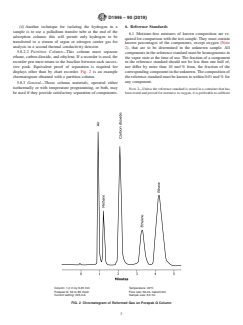
5.8.2.2 Partition Column—This column must separate
components in the reference standard must be homogeneous in
ethane, carbon dioxide, and ethylene. If a recorder is used, the
the vapor state at the time of use. The fraction of a component
recorder pen must return to the baseline between each succes- in the reference standard should not be less than one half of,
sive peak. Equivalent proof of separation is required for nor differ by more than 10 mol % from, the fraction of the
corresponding component in the unknown. The composition of
displays other than by chart recorder. Fig. 2 is an example
the reference standard must be known to within 0.01 mol % for
chromatogram obtained with a partition column.
any component.
5.8.3 General—Those column materials, operated either
isothermally or with temperature programming, or both, may
NOTE 2—Unless the reference standard is stored in a container that has
be used if they provide satisfactory separation of components. been tested and proved for inertness to oxygen, it is preferable to calibrate
Column: 1.2 m by 6.35 mm Temperature: 40°C
Porapak Q, 50 to 80 mesh Flow rate: 50-mL helium/min
...