

ASTM D5781/D5781M-18
(Guide)Standard Guide for Use of Dual-Wall Reverse-Circulation Drilling for Geoenvironmental Exploration and the Installation of Subsurface Water Quality Monitoring Devices
General Information
- Abstract
SIGNIFICANCE AND USE
4.1 Dual-wall reverse-circulation drilling can be used in support of geoenvironmental exploration and for installation of subsurface water quality monitoring devices in unconsolidated and consolidated sediment or bedrock. Dual-wall reverse-circulation drilling methods allows for the collection of water quality samples at most depth(s), the setting of temporary casing during drilling, and continual sampling of cuttings while drilling fluid is circulating, if warranted or needed. Other advantages of the dual-wall reverse-circulation drilling method include, but are not limited to: (1) the capability of drilling without the introduction of any drilling fluid(s) (for example, drilling mud or similar) to the subsurface; (2) maintenance of borehole stability for sampling purposes and monitoring well installation/construction in poorly-indurated to unconsolidated sediment.
4.1.1 The user of dual-wall reverse-circulation drilling for geoenvironmental exploration and monitoring-device installations should be cognizant of both the physical (temperature and airborne particles) and chemical (compressor lubricants and other fluid additives) qualities of compressed air that may be used as the circulating medium.
4.2 The application of dual-wall reverse-circulation drilling to geoenvironmental exploration may involve soil or rock sampling, or in situ soil/sediment, rock, or pore-fluid testing.
Note 2: The user may install a monitoring device within the same borehole wherein sampling, in situ or pore-fluid testing, or coring was performed.
4.3 The subsurface water quality monitoring devices that are addressed in this guide consist generally of a screened- or porous-intake device and riser pipe(s) that are usually installed with a filter pack to enhance the longevity of the intake unit, and with isolation seals and low-permeability backfill to deter the vertical movement of fluids or infiltration of surface water between hydrologic units penetrated by the borehole (see Pr...
SCOPE
1.1 This guide covers how dual-wall reverse-circulation drilling may be used for geoenvironmental exploration and installation of subsurface water quality monitoring devices. The term reverse circulation with respect to dual-wall drilling in this guide indicates that the circulating fluid is forced down the annular space between the double-wall drill pipe and transports soil/sediment and rock particles to the surface through the inner pipe.
Note 1: This guide does not include considerations for geotechnical site characterizations that are addressed in a separate guide.
1.2 Dual-wall reverse-circulation for geoenvironmental exploration and monitoring-device installations will often involve safety planning, administration, and documentation. This guide does not purport to specifically address exploration and site safety.
1.3 The values stated in either SI units or inch-pound units are to be regarded separately as standard. The values stated in each system may not be exact equivalents; therefore, each system shall be used independently of the other. Combining values from the two systems may result in non-conformance with the standard.
1.4 This standard does not purport to address all of the safety concerns, if any, associated with its use. It is the responsibility of the user of this standard to establish appropriate safety, health, and environmental practices and determine the applicability of regulatory limitations prior to use.
1.5 This guide offers an organized collection of information or a series of options and does not recommend a specific course of action. This document cannot replace education or experience and should be used in conjunction with professional judgment. Not all aspects of this guide may be applicable in all circumstances. This ASTM standard is not intended to represent or replace the standard of care by which the adequacy of a given professional service must be judged, nor should this ...
- Status
- Published
- Publication Date
- 31-May-2018
- Technical Committee
- D18 - Soil and Rock
- Drafting Committee
- D18.21 - Groundwater and Vadose Zone Investigations
Buy Documents
ASTM D5781/D5781M-18 - Standard Guide for Use of Dual-Wall Reverse-Circulation Drilling for Geoenvironmental Exploration and the Installation of Subsurface Water Quality Monitoring Devices
REDLINE ASTM D5781/D5781M-18 - Standard Guide for Use of Dual-Wall Reverse-Circulation Drilling for Geoenvironmental Exploration and the Installation of Subsurface Water Quality Monitoring Devices
Overview
ASTM D5781/D5781M-18 is the Standard Guide for Use of Dual-Wall Reverse-Circulation Drilling for Geoenvironmental Exploration and the Installation of Subsurface Water Quality Monitoring Devices. Published by ASTM International, this guide describes best practices for dual-wall reverse-circulation drilling methods to support geoenvironmental investigations and the installation of subsurface water quality monitoring tools. The standard applies to drilling in both unconsolidated sediment and bedrock, where precise water quality sampling and borehole stability are paramount.
Dual-wall reverse-circulation drilling is recognized for its unique advantages in minimizing subsurface disturbance and enabling efficient collection of soil, rock, and water quality samples. This approach is essential for environmental site assessments, groundwater monitoring, and installation of monitoring wells in various hydrogeologic settings.
Key Topics
Dual-Wall Reverse-Circulation Drilling
- Allows for fluid-circulation down the annulus of a double-walled drill pipe, transporting soil and rock cuttings upward through the inner pipe.
- Supports continual sampling during drilling, aiding in accurate subsurface characterization.
Advantages
- Minimizes the introduction of foreign drilling fluids (e.g., mud) to prevent sample contamination.
- Maintains borehole stability, especially in unconsolidated formations, improving reliability during monitoring well installation.
- Collects water quality samples at targeted depths, vital for site remediation and hydrogeologic studies.
Monitoring Device Installation
- Guide addresses practices for installing screened or porous-intake monitoring devices, typically combined with filter packs, seals, and low-permeability backfill to prevent cross-contamination between hydrologic units.
Circulating Medium Considerations
- Highlights the importance of assessing the physical and chemical properties of compressed air (or other circulating media), including potential impacts of lubricants and additives on water quality.
Drilling Safety and Documentation
- Emphasizes the necessity of thorough safety planning and field documentation, although specific safety procedures are outside the scope of this standard.
Applications
The ASTM D5781/D5781M-18 standard provides practical value in several environmental and geological fields:
Geoenvironmental Exploration
- Enables detailed investigation of subsurface soil, sediment, and bedrock as part of site assessments, brownfield redevelopment, and contamination studies.
- Supports the collection of continuous cuttings samples and in-situ testing at multiple depths, crucial for accurate site delineation.
Groundwater Quality Monitoring
- Facilitates the installation of monitoring wells and devices to assess and monitor groundwater quality.
- Helps maintain sample integrity by minimizing contamination during drilling and installation.
Water Resource Development
- Used in constructing wells for groundwater extraction, ensuring correct placement and protection of subsurface water sources.
Environmental Compliance
- Aids consultants, engineers, and regulators in meeting regulatory requirements for environmental site investigations, monitoring, and remediation projects.
Related Standards
The guidance provided in ASTM D5781/D5781M-18 is closely linked with other ASTM and industry standards, including:
- ASTM D5092 - Practice for Design and Installation of Groundwater Monitoring Wells
- ASTM D5088 and D5608 - Practices for Decontamination of Field Equipment
- ASTM D5521 - Guide for Development of Groundwater Monitoring Wells in Granular Aquifers
- ASTM D653 - Terminology Relating to Soil, Rock, and Contained Fluids
- ASTM D1452, D1586, D1587, D3550 - Sampling and field logging methods
- ASTM D3740 - Practice for Minimum Requirements for Agencies Engaged in Testing and/or Inspection of Soil and Rock
- API Specifications - Drilling tool sizes and equipment
Professionals applying ASTM D5781/D5781M-18 should also refer to the indicated practices for field decontamination, well development, and the selection of drilling and well completion materials to ensure comprehensive, high-integrity subsurface investigations and installations.
Relations
- Effective Date
- 01-Jun-2018
- Effective Date
- 01-Nov-2023
- Effective Date
- 01-May-2020
- Effective Date
- 01-Oct-2019
- Effective Date
- 01-Feb-2016
- Effective Date
- 01-Aug-2015
- Effective Date
- 15-Jan-2015
- Effective Date
- 01-Aug-2014
- Effective Date
- 01-May-2012
- Effective Date
- 01-Mar-2012
- Effective Date
- 01-Sep-2011
- Effective Date
- 01-Sep-2011
- Effective Date
- 01-May-2010
- Effective Date
- 01-Mar-2010
- Effective Date
- 01-May-2009
Buy Documents
ASTM D5781/D5781M-18 - Standard Guide for Use of Dual-Wall Reverse-Circulation Drilling for Geoenvironmental Exploration and the Installation of Subsurface Water Quality Monitoring Devices
REDLINE ASTM D5781/D5781M-18 - Standard Guide for Use of Dual-Wall Reverse-Circulation Drilling for Geoenvironmental Exploration and the Installation of Subsurface Water Quality Monitoring Devices
Get Certified
Connect with accredited certification bodies for this standard

Bureau Veritas Chile
Bureau Veritas certification services in Chile.
Bureau Veritas Peru
Bureau Veritas certification services in Peru.
BVQI Peru
Bureau Veritas certification in Peru.
Sponsored listings
Frequently Asked Questions
ASTM D5781/D5781M-18 is a guide published by ASTM International. Its full title is "Standard Guide for Use of Dual-Wall Reverse-Circulation Drilling for Geoenvironmental Exploration and the Installation of Subsurface Water Quality Monitoring Devices". This standard covers: SIGNIFICANCE AND USE 4.1 Dual-wall reverse-circulation drilling can be used in support of geoenvironmental exploration and for installation of subsurface water quality monitoring devices in unconsolidated and consolidated sediment or bedrock. Dual-wall reverse-circulation drilling methods allows for the collection of water quality samples at most depth(s), the setting of temporary casing during drilling, and continual sampling of cuttings while drilling fluid is circulating, if warranted or needed. Other advantages of the dual-wall reverse-circulation drilling method include, but are not limited to: (1) the capability of drilling without the introduction of any drilling fluid(s) (for example, drilling mud or similar) to the subsurface; (2) maintenance of borehole stability for sampling purposes and monitoring well installation/construction in poorly-indurated to unconsolidated sediment. 4.1.1 The user of dual-wall reverse-circulation drilling for geoenvironmental exploration and monitoring-device installations should be cognizant of both the physical (temperature and airborne particles) and chemical (compressor lubricants and other fluid additives) qualities of compressed air that may be used as the circulating medium. 4.2 The application of dual-wall reverse-circulation drilling to geoenvironmental exploration may involve soil or rock sampling, or in situ soil/sediment, rock, or pore-fluid testing. Note 2: The user may install a monitoring device within the same borehole wherein sampling, in situ or pore-fluid testing, or coring was performed. 4.3 The subsurface water quality monitoring devices that are addressed in this guide consist generally of a screened- or porous-intake device and riser pipe(s) that are usually installed with a filter pack to enhance the longevity of the intake unit, and with isolation seals and low-permeability backfill to deter the vertical movement of fluids or infiltration of surface water between hydrologic units penetrated by the borehole (see Pr... SCOPE 1.1 This guide covers how dual-wall reverse-circulation drilling may be used for geoenvironmental exploration and installation of subsurface water quality monitoring devices. The term reverse circulation with respect to dual-wall drilling in this guide indicates that the circulating fluid is forced down the annular space between the double-wall drill pipe and transports soil/sediment and rock particles to the surface through the inner pipe. Note 1: This guide does not include considerations for geotechnical site characterizations that are addressed in a separate guide. 1.2 Dual-wall reverse-circulation for geoenvironmental exploration and monitoring-device installations will often involve safety planning, administration, and documentation. This guide does not purport to specifically address exploration and site safety. 1.3 The values stated in either SI units or inch-pound units are to be regarded separately as standard. The values stated in each system may not be exact equivalents; therefore, each system shall be used independently of the other. Combining values from the two systems may result in non-conformance with the standard. 1.4 This standard does not purport to address all of the safety concerns, if any, associated with its use. It is the responsibility of the user of this standard to establish appropriate safety, health, and environmental practices and determine the applicability of regulatory limitations prior to use. 1.5 This guide offers an organized collection of information or a series of options and does not recommend a specific course of action. This document cannot replace education or experience and should be used in conjunction with professional judgment. Not all aspects of this guide may be applicable in all circumstances. This ASTM standard is not intended to represent or replace the standard of care by which the adequacy of a given professional service must be judged, nor should this ...
SIGNIFICANCE AND USE 4.1 Dual-wall reverse-circulation drilling can be used in support of geoenvironmental exploration and for installation of subsurface water quality monitoring devices in unconsolidated and consolidated sediment or bedrock. Dual-wall reverse-circulation drilling methods allows for the collection of water quality samples at most depth(s), the setting of temporary casing during drilling, and continual sampling of cuttings while drilling fluid is circulating, if warranted or needed. Other advantages of the dual-wall reverse-circulation drilling method include, but are not limited to: (1) the capability of drilling without the introduction of any drilling fluid(s) (for example, drilling mud or similar) to the subsurface; (2) maintenance of borehole stability for sampling purposes and monitoring well installation/construction in poorly-indurated to unconsolidated sediment. 4.1.1 The user of dual-wall reverse-circulation drilling for geoenvironmental exploration and monitoring-device installations should be cognizant of both the physical (temperature and airborne particles) and chemical (compressor lubricants and other fluid additives) qualities of compressed air that may be used as the circulating medium. 4.2 The application of dual-wall reverse-circulation drilling to geoenvironmental exploration may involve soil or rock sampling, or in situ soil/sediment, rock, or pore-fluid testing. Note 2: The user may install a monitoring device within the same borehole wherein sampling, in situ or pore-fluid testing, or coring was performed. 4.3 The subsurface water quality monitoring devices that are addressed in this guide consist generally of a screened- or porous-intake device and riser pipe(s) that are usually installed with a filter pack to enhance the longevity of the intake unit, and with isolation seals and low-permeability backfill to deter the vertical movement of fluids or infiltration of surface water between hydrologic units penetrated by the borehole (see Pr... SCOPE 1.1 This guide covers how dual-wall reverse-circulation drilling may be used for geoenvironmental exploration and installation of subsurface water quality monitoring devices. The term reverse circulation with respect to dual-wall drilling in this guide indicates that the circulating fluid is forced down the annular space between the double-wall drill pipe and transports soil/sediment and rock particles to the surface through the inner pipe. Note 1: This guide does not include considerations for geotechnical site characterizations that are addressed in a separate guide. 1.2 Dual-wall reverse-circulation for geoenvironmental exploration and monitoring-device installations will often involve safety planning, administration, and documentation. This guide does not purport to specifically address exploration and site safety. 1.3 The values stated in either SI units or inch-pound units are to be regarded separately as standard. The values stated in each system may not be exact equivalents; therefore, each system shall be used independently of the other. Combining values from the two systems may result in non-conformance with the standard. 1.4 This standard does not purport to address all of the safety concerns, if any, associated with its use. It is the responsibility of the user of this standard to establish appropriate safety, health, and environmental practices and determine the applicability of regulatory limitations prior to use. 1.5 This guide offers an organized collection of information or a series of options and does not recommend a specific course of action. This document cannot replace education or experience and should be used in conjunction with professional judgment. Not all aspects of this guide may be applicable in all circumstances. This ASTM standard is not intended to represent or replace the standard of care by which the adequacy of a given professional service must be judged, nor should this ...
ASTM D5781/D5781M-18 is classified under the following ICS (International Classification for Standards) categories: 73.100.30 - Equipment for drilling and mine excavation. The ICS classification helps identify the subject area and facilitates finding related standards.
ASTM D5781/D5781M-18 has the following relationships with other standards: It is inter standard links to ASTM D5781/D5781M-13, ASTM D3740-23, ASTM D5088-20, ASTM D3740-19, ASTM D5608-16, ASTM D5088-15a, ASTM D5088-15, ASTM D653-14, ASTM D3740-12a, ASTM D3740-12, ASTM D653-11, ASTM D3740-11, ASTM D5608-10, ASTM D3740-10, ASTM D5434-09. Understanding these relationships helps ensure you are using the most current and applicable version of the standard.
ASTM D5781/D5781M-18 is available in PDF format for immediate download after purchase. The document can be added to your cart and obtained through the secure checkout process. Digital delivery ensures instant access to the complete standard document.
Standards Content (Sample)
This international standard was developed in accordance with internationally recognized principles on standardization established in the Decision on Principles for the
Development of International Standards, Guides and Recommendations issued by the World Trade Organization Technical Barriers to Trade (TBT) Committee.
Designation: D5781/D5781M − 18
Standard Guide for
Use of Dual-Wall Reverse-Circulation Drilling for
Geoenvironmental Exploration and the Installation of
Subsurface Water Quality Monitoring Devices
This standard is issued under the fixed designation D5781/D5781M; the number immediately following the designation indicates the
year of original adoption or, in the case of revision, the year of last revision. A number in parentheses indicates the year of last
reapproval. A superscript epsilon (´) indicates an editorial change since the last revision or reapproval.
1. Scope* sent or replace the standard of care by which the adequacy of
a given professional service must be judged, nor should this
1.1 This guide covers how dual-wall reverse-circulation
document be applied without consideration of a project’s many
drilling may be used for geoenvironmental exploration and
unique aspects. The word “Standard” in the title of this
installation of subsurface water quality monitoring devices.
document means only that the document has been approved
The term reverse circulation with respect to dual-wall drilling
through the ASTM consensus process.
in this guide indicates that the circulating fluid is forced down
1.6 This international standard was developed in accor-
the annular space between the double-wall drill pipe and
dance with internationally recognized principles on standard-
transports soil/sediment and rock particles to the surface
ization established in the Decision on Principles for the
through the inner pipe.
Development of International Standards, Guides and Recom-
NOTE 1—This guide does not include considerations for geotechnical
mendations issued by the World Trade Organization Technical
site characterizations that are addressed in a separate guide.
Barriers to Trade (TBT) Committee.
1.2 Dual-wall reverse-circulation for geoenvironmental ex-
2. Referenced Documents
ploration and monitoring-device installations will often in-
volvesafetyplanning,administration,anddocumentation.This
2.1 ASTM Standards:
guide does not purport to specifically address exploration and
D653 Terminology Relating to Soil, Rock, and Contained
site safety.
Fluids
D3740 Practice for Minimum Requirements for Agencies
1.3 The values stated in either SI units or inch-pound units
are to be regarded separately as standard. The values stated in Engaged in Testing and/or Inspection of Soil and Rock as
each system may not be exact equivalents; therefore, each Used in Engineering Design and Construction
system shall be used independently of the other. Combining D4428/D4428M Test Methods for Crosshole Seismic Test-
values from the two systems may result in non-conformance ing
with the standard. D5088 Practice for Decontamination of Field Equipment
Used at Waste Sites
1.4 This standard does not purport to address all of the
D5092 Practice for Design and Installation of Groundwater
safety concerns, if any, associated with its use. It is the
Monitoring Wells
responsibility of the user of this standard to establish appro-
D5434 Guide for Field Logging of Subsurface Explorations
priate safety, health, and environmental practices and deter-
of Soil and Rock
mine the applicability of regulatory limitations prior to use.
D5521 Guide for Development of Groundwater Monitoring
1.5 This guide offers an organized collection of information
Wells in Granular Aquifers
or a series of options and does not recommend a specific
D5608 Practices for Decontamination of Sampling and Non
course of action. This document cannot replace education or
Sample Contacting Equipment Used at Low Level Radio-
experienceandshouldbeusedinconjunctionwithprofessional
active Waste Sites
judgment. Not all aspects of this guide may be applicable in all
circumstances. This ASTM standard is not intended to repre-
3. Terminology
3.1 Definitions—For definitions of general terms used
within this standard, refer to Terminology D653.
This guide is under the jurisdiction ofASTM Committee D18 on Soil and Rock
and is the direct responsibility of Subcommittee D18.21 on Groundwater and
Vadose Zone Investigations. For referenced ASTM standards, visit the ASTM website, www.astm.org, or
CurrenteditionapprovedJune1,2018.PublishedJuly2018.Originallyapproved contact ASTM Customer Service at service@astm.org. For Annual Book of ASTM
in 1995. Last previous edition approved in 2013 as D5781 – 13. DOI: 10.1520/ Standards volume information, refer to the standard’s Document Summary page on
D5781_D5781M-18. the ASTM website.
*A Summary of Changes section appears at the end of this standard
Copyright © ASTM International, 100 Barr Harbor Drive, PO Box C700, West Conshohocken, PA 19428-2959. United States
D5781/D5781M − 18
4. Significance and Use device (cyclone separator).The dual-wall drill advanced by the
percussive action of an above-ground pile hammer or by
4.1 Dual-wall reverse-circulation drilling can be used in
rotation from a rotary-drive unit. Other methods, such as
support of geoenvironmental exploration and for installation of
vibratoryequipmentsonicresonators,maybeusedtoapplythe
subsurface water quality monitoring devices in unconsolidated
energy needed to advance the dual-wall drill pipe.
and consolidated sediment or bedrock. Dual-wall reverse-
5.1.1 dual-wall drill pipe, consists of an inner pipe secured
circulation drilling methods allows for the collection of water
concentrically within an outer pipe. Inner-pipe connections
quality samples at most depth(s), the setting of temporary
utilize pin and box components with seals. Outer-pipe connec-
casingduringdrilling,andcontinualsamplingofcuttingswhile
tions are flush threaded.
drilling fluid is circulating, if warranted or needed. Other
advantages of the dual-wall reverse-circulation drilling method
NOTE 4—Drill pipes usually require lubricants on the threads to allow
include, but are not limited to: (1) the capability of drilling easy unthreading (breaking) of the connecting joints. Some lubricants
have organic or metallic constituents, or both, that could be interpreted as
without the introduction of any drilling fluid(s) (for example,
contaminants if detected in a water quality sample. Various lubricants are
drilling mud or similar) to the subsurface; (2) maintenance of
available that have components of known chemistry. The effect of
borehole stability for sampling purposes and monitoring well
pipe-thread lubricants on chemical analyses of samples should be consid-
installation/construction in poorly-indurated to unconsolidated
ered and documented when using dual-wall reverse-circulation drilling.
The same consideration and documentation should be given to lubricants
sediment.
used with water swivels, hoisting swivels, or other devices used near the
4.1.1 The user of dual-wall reverse-circulation drilling for
drilling axis.
geoenvironmental exploration and monitoring-device installa-
5.1.2 The drill bit is attached to the bottom of the dual-wall
tionsshouldbecognizantofboththephysical(temperatureand
drill pipe and provides the soil- or rock-cutting capability. Drill
airborne particles) and chemical (compressor lubricants and
bit types include tricone roller, down-the-hole (DTH) hammer
other fluid additives) qualities of compressed air that may be
or, open faced. Drill bit selection should be based upon the
used as the circulating medium.
character of the soils/sediment or rocks encountered and
4.2 The application of dual-wall reverse-circulation drilling
penetrated. DTH lubricants should be documented.
to geoenvironmental exploration may involve soil or rock
sampling, or in situ soil/sediment, rock, or pore-fluid testing. NOTE 5—In NorthAmerica, the sizes of casings bits, drill rods and core
barrels are standardized by American Petroleum Institute (API) and the
NOTE 2—The user may install a monitoring device within the same
Diamond Core Drill Manufacturers Association (DCDMA). Refer to the
borehole wherein sampling, in situ or pore-fluid testing, or coring was
DCDMAtechnical manual and to published materials ofAPI for available
performed.
sizes and capacities of drilling tools equipment.
4.3 The subsurface water quality monitoring devices that
5.1.3 The air compressor and filter(s) should provide an
are addressed in this guide consist generally of a screened- or
adequate volume of air for removal of cuttings without
porous-intake device and riser pipe(s) that are usually installed
significant contamination generated at the drill bit.Air require-
with a filter pack to enhance the longevity of the intake unit,
ments will vary depending upon the size and configuration of
and with isolation seals and low-permeability backfill to deter
the drill pipe used, and the character of the soil/sediment and
the vertical movement of fluids or infiltration of surface water
rock encountered and penetrated.The air-flow rates are usually
between hydrologic units penetrated by the borehole (see
based on maintaining an upflow air velocity of about 1400
Practice D5092). Since a piezometer is primarily a device used
m/min [4500 ft/min].
for measuring subsurface hydraulic heads, the conversion of a
5.1.4 The quality of compressed air entering the borehole
piezometer to a water quality monitoring device should be
and the quality of air discharged from the borehole and
made only after consideration of the overall quality and
air-cleaning devices should be considered. If not adequately
integrity of the installation to include the quality of materials
filtered, the air produced by most oil-lubricated air compres-
that will contact sampled water or gas. Both water quality
sors inherently introduces a significant quantity of oil into the
monitoring devices and piezometers should have adequate
circulation system. High-efficiency, in-line, air filters are usu-
casing seals, annular isolation seals, and backfills to deter
ally needed to prevent significant contamination of the bore-
cross-communication of contaminants between hydrogeologic
hole.Air-quality monitoring may be needed and, if performed,
units.
results should be documented.
5.1.5 A water pump may be used to inject water into the
NOTE 3—The quality of the results produced by this guide is dependent
on the competence of the personnel performing it and the suitability of the circulatingairstreamormaybeusedtoinjectwaterwithoutair
equipment and facilities used. Agencies that meet the criteria of Practice
as the circulating fluid. If water is injected, the approximate
D3740 are generally considered capable of competent and objective
volumes and locations should be reported.
testing. Users of this test method are cautioned that compliance with
5.1.6 A discharge hose conducts discharged drill cuttings
Practice D3740 does not in itself ensure reliable results. Reliable results
depend on many factors; Practice D3740 provides a means of evaluating and circulation-return air away from the borehole.
some of those factors.
5.1.7 Air-Cleaning Device System, generally called a cy-
clone separator, separates cuttings from the air returning from
5. Apparatus
the borehole.
5.1 The basic mechanical components of dual-wall reverse-
NOTE 6—A correctly sized cyclone separator can remove most of the
circulation drilling systems include dual-wall pipe, drill com-
cuttingsfromthereturnair.Asmallquantityoffineparticles,however,are
pressor and filter(s), water pump, discharge hose, cleaning usually discharged to the atmosphere with the “cleaned” air. Some
D5781/D5781M − 18
air-cleaning devices consist of a cyclone separator alone. In certain cases,
the cyclone separator can be combined with a HEPA (high-efficiency
particulate air) filter for removing dust particles that might be radioactive.
In other special situations, the cyclone separator may be used in
conjunction with a charcoal-filtering arrangement for removal of organic
volatiles. Samples of drill cuttings can be collected for analyses of
materials penetrated. If samples are obtained, the depth(s) and interval(s)
of sample collection should be documented.
5.1.8 Pile Hammer, is commonly used to advance dual-wall
drill pipe. The percussive force of the pile hammer is applied
only to the outer pipe.
5.1.9 Rotary-Drive Unit, may be used to advance dual-wall
drillpipebyrotation.Torquegeneratedfromarotary-driveunit
is applied only to the outer pipe.
6. Drilling Procedures
6.1 As a prelude to and throughout the drilling process
stabilize the drill rig, and raise the drill-rig mast and position
the cyclone separator. If air-monitoring operations are per-
formed the prevalent wind direction relative to the exhaust
fromthedrillrigshouldbeconsidered.Also,thelocationofthe
cyclone relative to the rig exhaust should be considered since
air-quality monitoring will be performed at the cyclone sepa-
rator discharge point.
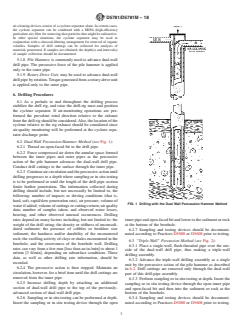
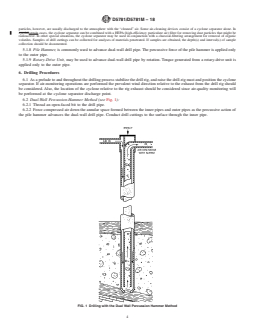
6.2 Dual-Wall Percussion-Hammer Method (see Fig. 1):
6.2.1 Thread an open-faced bit to the drill pipe.
6.2.2 Force compressed air down the annular space formed
between the inner pipes and outer pipes as the percussive
action of the pile hammer advances the dual-wall drill pipe.
Conduct drill cuttings to the surface through the inner pipe.
6.2.3 Continueaircirculationandthepercussiveactionuntil
drilling progresses to a depth where sampling or in situ testing
is to be performed or until the length of the drill-pipe section
limits further penetration. The information collected during
drilling should include, but not necessarily be limited to, the
following: number of impacts or driving conditions (that is,
hard, soft, rapid/slow penetration rate), air pressure; volume of
FIG. 1 Drilling with the Dual Wall Percussion Hammer Method
waterifadded;volumeofcuttingsorcuttingsreturn;airquality
data; number of samples taken; and observed water losses,
heaving, and other observed unusual occurrences. Drilling
rates depend on many factors including, but not limited to: the innerpipeandopen-facedbitandlowertothesedimentorrock
weight of the drill string; the density or stiffness of unconsoli-
at the bottom of the borehole.
dated sediment; the presence of cobbles or boulders size 6.2.7 Sampling and testing devices should be decontami-
sediment; the hardness and/or durability of the encountered nated according to Practices D5088 or D5608 prior to testing.
rock; the swelling activity of clays or shales encountered in the
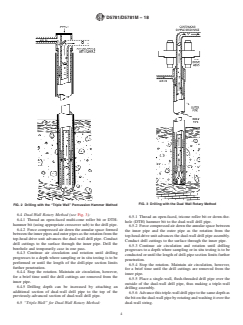
6.3 “Triple-Wall” Percussion Method (see Fig. 2):
borehole; and the erosiveness of the borehole wall. Drilling
6.3.1 Place a single-wall, flush-threaded pipe over the out-
rates can vary from a few mm [less than an in./min] to about 1
side of the dual-wall drill pipe, thus making a triple-wall
m/min [3 ft/min], depending on subsurface conditions. These
drilling assembly.
data, as well as other drilling rate information, should be
6.3.2 Advance the triple-wall drilling assembly as a single
recorded.
unit by the percussive action of the pile hammer as described
6.2.4 The percussive action is then stopped. Maintain air
in 6.2. Drill cuttings are removed only through the dual-wall
circulation, however, for a brief time until the drill cuttings are
part of this drill-pipe assembly.
removed from the inner pipe.
6.3.3 Perform sampling or in situ testing at depth. Insert the
6.2.5 Increase drilling depth by attaching an additional
sampling or in situ testing device through the open inner pipe
section of dual-wall drill pipe to the top of the previously-
and open-faced bit and then into the sediment or rock at the
advanced section of dual-wall drill pipe.
bottom of the borehole.
6.2.6 Sampling or in situ testing can be performed at depth. 6.3.4 Sampling and testing devices should be decontami-
Insert the sampling or in situ testing device through the open nated according to Practices D5088 or D5608 prior to testing.
D5781/D5781M − 18
FIG. 3 Drilling with the Dual Wall Rotary Method
FIG. 2 Drilling with the “Triple Wall” Percussion Hammer Method
6.4 Dual-Wall Rotary Method (see Fig. 3):
6.5.1 Thread an open-faced, tricone roller bit or down-the-
6.4.1 Thread an open-faced multi-cone roller bit or DTH-
hole (DTH) hammer bit to the dual-wall drill pipe.
hammer bit (using appropriate crossover sub) to the drill pipe.
6.5.2 Force compressed air down the annular space between
6.4.2 Force compressed air down the annular space formed
the inner pipe and the outer pipe as the rotation from the
betweentheinnerpipesandouterpipesastherotationfromthe
top-head-drive unit advances the dual-wall drill pipe assembly.
top-head drive unit advances the dual-wall drill pipe. Conduct
Conduct drill cuttings to the surface through the inner pipe.
drill cuttings to the surface through the inner pipe. Drill the
6.5.3 Continue air circulation and rotation until drilling
borehole and temporarily case in one pass.
progresses to a depth where sampling or in situ testing is to be
6.4.3 Continue air circulation and rotation until drilling
conducted or until the length of drill-pipe section limits further
progresses to a depth where sampling or in situ testing is to be
penetration.
performed or until the length of the drill-pipe section limits
6.5.4 Stop the rotation. Maintain air circulation, however,
further penetration.
for a brief time until the drill cuttings are removed from the
6.4.4 Stop the rotation. Maintain air circulation, however,
inner pipe.
for a brief time until the drill cuttings are removed from the
6.5.5 Place a single-wall, flush-threaded drill pipe over the
inner pipe.
outside of the dual-wall drill pipe, thus making a triple-wall
6.4.5 Drilling depth can be increased by attaching an
drilling assembly.
additional section of dual-wall drill pipe to the top of the
6.5.6 Advancethistriple-walldrillpipetothesamedepthas
previously-advanced section of dual-wall drill pipe.
thebitonthedual-wallpipebyrota
...
This document is not an ASTM standard and is intended only to provide the user of an ASTM standard an indication of what changes have been made to the previous version. Because
it may not be technically possible to adequately depict all changes accurately, ASTM recommends that users consult prior editions as appropriate. In all cases only the current version
of the standard as published by ASTM is to be considered the official document.
Designation: D5781/D5781M − 13 D5781/D5781M − 18
Standard Guide for
Use of Dual-Wall Reverse-Circulation Drilling for
Geoenvironmental Exploration and the Installation of
Subsurface Water-Quality Water Quality Monitoring Devices
This standard is issued under the fixed designation D5781/D5781M; the number immediately following the designation indicates the
year of original adoption or, in the case of revision, the year of last revision. A number in parentheses indicates the year of last
reapproval. A superscript epsilon (´) indicates an editorial change since the last revision or reapproval.
1. Scope*
1.1 This guide covers how dual-wall reverse-circulation drilling may be used for geoenvironmental exploration and installation
of subsurface water-quality water quality monitoring devices. The term reverse circulation with respect to dual-wall drilling in this
guide indicates that the circulating fluid is forced down the annular space between the double-wall drill pipe and transports
soilsoil/sediment and rock particles to the surface through the inner pipe.
NOTE 1—This guide does not include considerations for geotechnical site characterizations that are addressed in a separate guide.
1.2 Dual-wall reverse-circulation for geoenvironmental exploration and monitoring-device installations will often involve
safety planning, administration, and documentation. This guide does not purport to specifically address exploration and site safety.
1.3 The values stated in either SI units or inch-pound units are to be regarded separately as standard. The values stated in each
system may not be exact equivalents; therefore, each system shall be used independently of the other. Combining values from the
two systems may result in non-conformance with the standard.
1.4 This standard does not purport to address all of the safety concerns, if any, associated with its use. It is the responsibility
of the user of this standard to establish appropriate safety safety, health, and healthenvironmental practices and determine the
applicability of regulatory limitations prior to use.
1.5 This guide offers an organized collection of information or a series of options and does not recommend a specific course
of action. This document cannot replace education or experience and should be used in conjunction with professional judgment.
Not all aspects of this guide may be applicable in all circumstances. This ASTM standard is not intended to represent or replace
the standard of care by which the adequacy of a given professional service must be judged, nor should this document be applied
without consideration of a project’s many unique aspects. The word “Standard” in the title of this document means only that the
document has been approved through the ASTM consensus process.
1.6 This international standard was developed in accordance with internationally recognized principles on standardization
established in the Decision on Principles for the Development of International Standards, Guides and Recommendations issued
by the World Trade Organization Technical Barriers to Trade (TBT) Committee.
2. Referenced Documents
2.1 ASTM Standards:
D653 Terminology Relating to Soil, Rock, and Contained Fluids
D1452 Practice for Soil Exploration and Sampling by Auger Borings
D1586 Test Method for Standard Penetration Test (SPT) and Split-Barrel Sampling of Soils
D1587 Practice for Thin-Walled Tube Sampling of Fine-Grained Soils for Geotechnical Purposes
D3550 Practice for Thick Wall, Ring-Lined, Split Barrel, Drive Sampling of Soils
D3740 Practice for Minimum Requirements for Agencies Engaged in Testing and/or Inspection of Soil and Rock as Used in
Engineering Design and Construction
D4428/D4428M Test Methods for Crosshole Seismic Testing
This guide is under the jurisdiction of ASTM Committee D18 on Soil and Rock and is the direct responsibility of Subcommittee D18.21 on Groundwater and Vadose
Zone Investigations.
Current edition approved May 1, 2013June 1, 2018. Published June 2013July 2018. Originally approved in 1995. Last previous edition approved in 20062013 as
D5781 – 95D5781 – 13. (2006). DOI: 10.1520/D5781_D5781M-13.10.1520/D5781_D5781M-18.
For referenced ASTM standards, visit the ASTM website, www.astm.org, or contact ASTM Customer Service at service@astm.org. For Annual Book of ASTM Standards
volume information, refer to the standard’s Document Summary page on the ASTM website.
*A Summary of Changes section appears at the end of this standard
Copyright © ASTM International, 100 Barr Harbor Drive, PO Box C700, West Conshohocken, PA 19428-2959. United States
D5781/D5781M − 18
D5088 Practice for Decontamination of Field Equipment Used at Waste Sites
D5092 Practice for Design and Installation of Groundwater Monitoring Wells
D5099 Test Methods for Rubber—Measurement of Processing Properties Using Capillary Rheometry
D5434 Guide for Field Logging of Subsurface Explorations of Soil and Rock
D5521 Guide for Development of Groundwater Monitoring Wells in Granular Aquifers
D5608 Practices for Decontamination of Sampling and Non Sample Contacting Equipment Used at Low Level Radioactive
Waste Sites
3. Terminology
3.1 Definitions—For definitions of general terms used within this guide, refer to Terminology D653.
3.1 Definitions—For definitions of general terms used within this standard, refer to Terminology D653.
3.2 Definitions of Terms Specific to This Standard:
3.2.1 bentonite—common name for drilling-fluid additives and well-construction products consisting mostly of naturally-
occurring montmorillonite. Some bentonite products have chemical additives that may affect water-quality analyses.
3.2.2 bentonite granules and chips—irregularly-shaped particles of bentonite (free from additives) that have been dried and
separated into a specific size range.
3.2.3 bentonite pellets—roughly spherical- or disc-shaped units of compressed bentonite powder (some pellet manufacturers
coat the bentonite with chemicals that may affect the water quality analysis).
3.2.4 drawworks—a power-driven winch, or several winches, usually equipped with a clutch and brake system(s) for hoisting
or lowering a drilling string.
3.2.5 filter pack—also known as a gravel pack or a primary filter pack in the practice of monitoring-well installations. The gravel
pack is usually granular material, having selected grain size characteristics, that is placed between a monitoring device and the
borehole wall. The basic purpose of the filter pack or gravel envelope is to act as: (1) a non-clogging filter when the aquifer is not
suited to natural development or, (2) act as a formation stabilizer when the aquifer is suitable for natural development.
3.2.5.1 Discussion—
Under most circumstances a clean, quartz sand or gravel should be used. In some cases a pre-packed screen may be used.
3.2.6 hoisting line—or drilling line, is wire rope used on the drawworks to hoist and lower the drill string.
3.2.7 in-situ testing devices—sensors or probes, used for obtaining mechanical or chemical-test data, that are typically pushed,
rotated or driven below the bottom of a borehole following completion of an increment of drilling. However, some in-situ testing
devices (such as electronic pressure transducers, gas-lift samplers, tensiometers, and etc.) may require lowering and setting of the
device(s) in a pre-existing borehole by means of a suspension line or a string of lowering rods or pipe. Centralizers may be required
to correctly position the device(s) in the borehole.
3.2.8 intermittent-sampling devices—usually barrel-type samplers that are driven or pushed below the bottom of a borehole
following completion of an increment of drilling. The user is referred to the following ASTM Standards relating to suggested
sampling methods and procedures: Practice D1452, Test Method D1586, Practice D3550, and Practice D1587.
3.2.9 mast—or derrick, on a drilling rig is used for supporting the crown block, top drive, pulldown chains, hoisting lines, etc.
It must be constructed to safely carry the expected loads encountered in drilling and completion of wells of the diameter and depth
for which the rig manufacturer specifies the equipment.
3.2.9.1 Discussion—
To allow for contingencies, it is recommended that the rated capacity of the mast should be at least twice the anticipated weight
load or normal pulling load.
3.2.10 subsurface water-quality monitoring device—an instrument placed below ground surface to obtain a sample for analysis
of the chemical, biological or radiological characteristics of subsurface-pore water or to make in-situ measurements.
4. Significance and Use
4.1 Dual-wall reverse-circulation drilling can be used in support of geoenvironmental exploration and for installation of
subsurface water-quality water quality monitoring devices in unconsolidated and consolidated materials. sediment or bedrock.
Dual-wall reverse-circulation drilling methods permit allows for the collection of water-quality water quality samples at anymost
depth(s), allows the setting of temporary casing during drilling, cuttings samples can be taken continuously as circulation is
maintained at all times during drilling. and continual sampling of cuttings while drilling fluid is circulating, if warranted or needed.
Other advantages of the dual-wall reverse-circulation drilling method include: include, but are not limited to: (1) the capability of
D5781/D5781M − 18
drilling without the introduction of any drilling fluid(s) (for example, drilling mud or similar) to the subsurface; (2) maintenance
of holeborehole stability for sampling purposes and monitor-well monitoring well installation/construction in poorly-indurated to
unconsolidated materials.sediment.
4.1.1 The user of dual-wall reverse-circulation drilling for geoenvironmental exploration and monitoring-device installations
should be cognizant of both the physical (temperature and airborne particles) and chemical (compressor lubricants and
possibleother fluid additives) qualities of compressed air that may be used as the circulating medium.
4.2 The application of dual-wall reverse-circulation drilling to geoenvironmental exploration may involve soil or rock sampling,
or in-situ soil, in situ soil/sediment, rock, or pore-fluid testing.
NOTE 2—The user may install a monitoring device within the same borehole wherein sampling, in-situ in situ or pore-fluid testing, or coring was
performed.
4.3 The subsurface water-quality water quality monitoring devices that are addressed in this guide consist generally of a
screened- or porous-intake device and riser pipe(s) that are usually installed with a filter pack to enhance the longevity of the intake
unit, and with isolation seals and low-permeability backfill to deter the vertical movement of fluids or infiltration of surface water
between hydrologic units penetrated by the borehole (see Practice D5092). Inasmuch as Since a piezometer is primarily a device
used for measuring subsurface hydraulic heads, the conversion of a piezometer to a water-quality water quality monitoring device
should be made only after consideration of the overall quality and integrity of the installation to include the quality of materials
that will contact sampled water or gas. Both water-quality water quality monitoring devices and piezometers should have adequate
casing seals, annular isolation seals, and backfills to deter communicationcross-communication of contaminants between
hydrologichydrogeologic units.
NOTE 3—The quality of the results produced by this guide is dependent on the competence of the personnel performing it and the suitability of the
equipment and facilities used. Agencies that meet the criteria of Practice D3740 are generally considered capable of competent and objective testing. Users
of this test method are cautioned that compliance with Practice D3740 does not in itself ensure reliable results. Reliable results depend on many factors;
Practice D3740 provides a means of evaluating some of those factors.
5. Apparatus
5.1 The basic mechanical components of dual-wall reverse-circulation drilling systems include dual-wall pipe, drill compressor
and filter(s), water pump, discharge hose, cleaning device (cyclone separator). The dual-wall drill advanced by the percussive
action of an above-ground pile hammer or by rotation from a rotary-drive unit. Other methods, such as vibratory equipment sonic
resonators, may be used to apply the energy requiredneeded to advance the dual-wall drill pipe.
5.1.1 dual-wall drill pipe, consists of an inner pipe secured concentrically within an outer pipe. Inner-pipe connections utilize
pin and box components with seals. Outer-pipe connections are flush threaded.
NOTE 4—Drill pipes usually require lubricants on the threads to allow easy unthreading (breaking) of the connecting joints. Some lubricants have
organic or metallic constituents, or both, that could be interpreted as contaminants if detected in a water quality sample. Various lubricants are available
that have components of known chemistry. The effect of pipe-thread lubricants on chemical analyses of samples should be considered and documented
when using dual-wall reverse-circulation drilling. The same consideration and documentation should be given to lubricants used with water swivels,
hoisting swivels, or other devices used near the drilling axis.
5.1.2 The drill bit is attached to the bottom of the dual-wall drill pipe and provides the soil- or rock-cutting capability. Drill bit
types include tricone roller, down-the-hole (DTH) hammer or, open faced. Drill bit selection should be based upon the character
of the soilssoils/sediment or rocks encountered and penetrated. DTH lubricants should be documented.
NOTE 5—In North America, the sizes of casings bits, drill rods and core barrels are standardized by American Petroleum Institute (API) and the
Diamond Core Drill Manufacturers Association (DCDMA). Refer to the DCDMA technical manual and to published materials of API for available sizes
and capacities of drilling tools equipment.
5.1.3 The air compressor and filter(s) should provide an adequate volume of air for removal of cuttings without significant
contamination generated at the drill bit. Air requirements will vary depending upon the size and configuration of the drill pipe used,
and the character of the soilsoil/sediment and rock encountered and penetrated. The air-flow rates are usually based on maintaining
an upflow air velocity of about 1400 m/min [4500 ft/min].
5.1.4 The quality of compressed air entering the borehole and the quality of air discharged from the borehole and air-cleaning
devices mustshould be considered. If not adequately filtered, the air produced by most oil-lubricated air compressors inherently
introduces a significant quantity of oil into the circulation system. High-efficiency, in-line, air filters are usually requiredneeded
to prevent significant contamination of the borehole. Air-quality monitoring may be requiredneeded and, if performed, results
should be documented.
5.1.5 A water pump may be used to inject water into the circulating air stream or may be used to inject water without air as
the circulating fluid. If water is injected, the approximate volumes and locations should be reported.
5.1.6 A discharge hose conducts discharged drill cuttings and circulation-return air away from the borehole.
5.1.7 Air-Cleaning Device System, generally called a cyclone separator, separates cuttings from the air returning from the
borehole.
NOTE 6—A properly-sized correctly sized cyclone separator can remove practically all most of the cuttings from the return air. A small quantity of fine
D5781/D5781M − 18
particles, however, are usually discharged to the atmosphere with the “cleaned” air. Some air-cleaning devices consist of a cyclone separator alone. In
specialcertain cases, the cyclone separator can be combined with a HEPA (high-efficiency particulate air) filter for removing dust particles that might be
radioactive. In other special situations, the cyclone separator may be used in conjunction with a charcoal-filtering arrangement for removal of organic
volatiles. Samples of drill cuttings can be collected for analyses of materials penetrated. If samples are obtained, the depth(s) and interval(s) of sample
collection should be documented.
5.1.8 Pile Hammer, is commonly used to advance dual-wall drill pipe. The percussive force of the pile hammer is applied only
to the outer pipe.
5.1.9 Rotary-Drive Unit, may be used to advance dual-wall drill pipe by rotation. Torque generated from a rotary-drive unit is
applied only to the outer pipe.
6. Drilling Procedures
6.1 As a prelude to and throughout the drilling process stabilize the drill rig, and raise the drill-rig mast and position the cyclone
separator. If air-monitoring operations are performed the prevalent wind direction relative to the exhaust from the drill rig should
be considered. Also, the location of the cyclone relative to the rig exhaust should be considered since air-quality monitoring will
be performed at the cyclone separator discharge point.
6.2 Dual-Wall Percussion-Hammer Method (see Fig. 1):
6.2.1 Thread an open-faced bit to the drill pipe.
6.2.2 Force compressed air down the annular space formed between the inner pipes and outer pipes as the percussive action of
the pile hammer advances the dual-wall drill pipe. Conduct drill cuttings to the surface through the inner pipe.
FIG. 1 Drilling with the Dual Wall Percussion Hammer Method
D5781/D5781M − 18
6.2.3 Continue air circulation and the percussive action until drilling progresses to a depth where sampling or in-situ in situ
testing is to be performed or until the length of the drill-pipe section limits further penetration. The information collected during
drilling should include, but not necessarily be limited to, the following: number of impacts or driving conditions (that is, hard, soft,
rapid/slow penetration rate), air pressures, water added, pressure; volume of water if added; volume of cuttings or cuttings
return,return; air quality data, samples taken, data; number of samples taken; and observed water losses, heaving, and anyother
observed unusual occurrences. Drilling rates depend on many factors such as the including, but not limited to: the weight of the
drill string; the density or stiffness of unconsolidated material and sediment; the existencepresence of cobbles or boulders, boulders
size sediment; the hardness and/or durability of the rock, encountered rock; the swelling activity of clays or shales encountered
in the boreholeborehole; and the erosiveness of the borehole wall. Drilling rates can vary from a few mm [less than an in./min]
to about 1 m/min [3 ft/min], depending on subsurface conditions. Other factors influencing drilling rates include the weight of the
drill string. These dataThese data, as well as any other drilling-rate information other drilling rate information, should be recorded.
6.2.4 The percussive action is then stopped. Maintain air circulation, however, for a shortbrief time until the drill cuttings are
removed from the inner pipe.
6.2.5 Increase drilling depth by attaching an additional section of dual-wall drill pipe to the top of the previously-advanced
section of dual-wall drill pipe.
6.2.6 Sampling or in-situ in situ testing can be performed at any depth. Insert the sampling or in-situ in situ testing device
through the open inner pipe and open-faced bit and lower to the material sediment or rock at the bottom of the borehole.
6.2.7 Sampling and testing devices should be decontaminated according to Practices D5088 or D5608 prior to testing.
6.3 “Triple-Wall” Percussion Method (see Fig. 2):
FIG. 2 Drilling with the “Triple Wall” Percussion Hammer Method
D5781/D5781M − 18
6.3.1 Place a single-wall, flush-threaded pipe over the outside of the dual-wall drill pipe, thus making a triple-wall drilling
assembly.
6.3.2 Advance the triple-wall drilling assembly as a single unit by the percussive action of the pile hammer as described in 6.2.
Drill cuttings are removed only through the dual-wall part of this drill-pipe assembly.
6.3.3 Perform sampling or in-situ in situ testing at any depth. Insert the sampling or in-situ in situ testing device through the
open inner pipe and open-faced bit and thencethen into the material sediment or rock at the bottom of the borehole.
6.3.4 Sampling and testing devices should be decontaminated according to Practices D5088 or D5608 prior to testing.
6.4 Dual-Wall Rotary Method (see Fig. 3):
6.4.1 Thread an op
...