

ASTM D5787-20
(Practice)Standard Practice for Monitoring Well Protection At or Near Land Surface
General Information
- Abstract
SIGNIFICANCE AND USE
4.1 An adequately designed and installed surface protection system will mitigate the consequences of natural damage (e.g., freeze/thaw damage) in susceptible areas, or anthropogenic damages, which could otherwise occur and result in either changes to water level and/or groundwater quality data, or complete loss of the monitoring well.
4.2 The extent of application of this practice may depend upon the importance of the monitoring data, cost of monitoring well replacement, expected or design life of the monitoring well, the presence or absence of potential risks, and setting or location of the well.
4.3 Monitoring well surface protection should be a part of the well design process, and installation of the protective system should be completed at the time of monitoring well installation and development.
4.4 Information determined at the time of installation of the protective system will form a baseline for future monitoring well inspection and maintenance. Additionally, elements of the protection system will satisfy some regulatory requirements such as for protection of near surface groundwater and well identification.
SCOPE
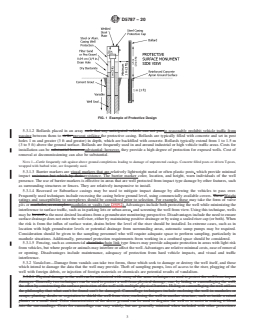
1.1 This practice identifies design and construction considerations to be applied to monitoring wells for protection from events, which may impair the intended purpose of the well such as water level or water quality monitoring data.
1.2 The installation and development of a well is a costly and detailed activity with the goal of providing representative samples and data throughout the design life of the well. Damage to the well at the surface frequently results in the loss of the well or can potentially impact measured water level and/or groundwater quality data. This standard provides for access control so that tampering with the installation should be evident.
1.3 This practice may be applied to other surface or subsurface monitoring devices, such as piezometers, permeameters, temperature or moisture monitors, or seismic devices.
1.4 Units—The values stated in SI units are to be regarded as the standard. The inch/pound units given in parentheses are for information only. Reporting of test results in units other than SI shall not be regarded as non-conformance with the standard.
1.5 All observed and calculated values shall conform to the guidelines for significant digits and rounding established in Practice D6026, unless superseded by this standard.
1.6 This practice offers a set of instructions for performing one or more specific operations. This document cannot replace education or experience and should be used in conjunction with professional judgment. Not all aspects of this practice may be applicable in all circumstances. This ASTM standard is not intended to represent or replace the standard of care by which the adequacy of a given professional service must be judged, nor should this document be applied without consideration of a project's many unique aspects. The word “Standard” in the title of this document means only that the document has been approved through the ASTM consensus process.
1.7 This standard does not purport to address all of the safety concerns, if any, associated with its use. It is the responsibility of the user of this standard to establish appropriate safety, health, and environmental practices and determine the applicability of regulatory limitations prior to use.
1.8 This international standard was developed in accordance with internationally recognized principles on standardization established in the Decision on Principles for the Development of International Standards, Guides and Recommendations issued by the World Trade Organization Technical Barriers to Trade (TBT) Committee.
- Status
- Published
- Publication Date
- 31-Dec-2019
- Technical Committee
- D18 - Soil and Rock
- Drafting Committee
- D18.21 - Groundwater and Vadose Zone Investigations
Overview
ASTM D5787-20 - Standard Practice for Monitoring Well Protection At or Near Land Surface provides guidance on the design, installation, and documentation of surface protection systems for monitoring wells. This standard, published by ASTM International, aims to ensure the long-term reliability and data integrity of groundwater monitoring wells by mitigating risks from both natural events and human activities. Adequate well protection supports representative water level and groundwater quality measurements throughout a monitoring well's design life and helps comply with regulatory requirements for groundwater protection and well identification.
Key Topics
ASTM D5787-20 addresses several design and implementation considerations for monitoring well protection:
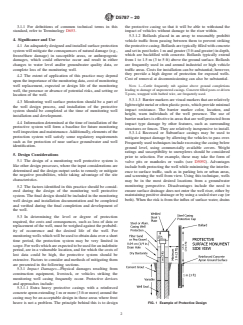
- Surface Protection Systems: Guidance on measures to prevent or reduce damage to monitoring wells from events such as vehicle impacts, livestock interference, freeze/thaw cycles, flooding, vandalism, landslides, and planned elevation changes.
- Risk Assessment and Design Life: Recommendations on determining the appropriate level of protection based on the importance of monitoring data, replacement costs, life expectancy of the well, potential risks, and the well's location.
- Protection Methods and Devices:
- Heavy-duty protective casings and reinforced concrete aprons
- Bollards to block vehicle traffic
- Barrier markers for visual identification
- Recessed or subsurface casings to allow vehicle pass-over and minimize tampering
- Fencing to deter animal and casual human interference
- Camouflage techniques and multi-layered barriers to discourage vandalism
- Sealed caps and risers for flood and surface water protection
- Recordkeeping and Baseline Documentation: Requirements to record initial and ongoing well protection configurations, elevations, and maintenance or incident histories.
- Signage: Guidelines for signage to identify wells for maintenance or warning purposes, while weighing the security risks of visual identification.
- Decommissioning Considerations: Planning for efficient removal of protection systems and reducing the risk of contamination from abandoned wells.
Applications
The recommendations within ASTM D5787-20 are critical for:
- Groundwater Monitoring Wells: Ensuring reliable and uncontaminated sample and data collection in environmental, industrial, and regulatory monitoring programs.
- Other Monitoring Devices: Application to protection of piezometers, permeameters, temperature/moisture monitors, and seismic devices installed at or near ground level.
- Regulatory Compliance: Supporting adherence to environmental and safety regulations for well protection, signage, and groundwater data integrity.
- Asset Management: Reducing the risk of costly well loss or data corruption, thus protecting long-term monitoring investments.
- Construction and Landfill Sites: Implementing robust well protection in areas subject to elevation changes, heavy machinery traffic, or fill operations.
Related Standards
ASTM D5787-20 references and complements several related ASTM standards important for groundwater monitoring and protection, including:
- ASTM D653 - Terminology Relating to Soil, Rock, and Contained Fluids
- ASTM D5918 - Test Methods for Frost Heave and Thaw Weakening Susceptibility of Soils
- ASTM D5092 - Practice for Design and Installation of Groundwater Monitoring Wells
- ASTM D6026 - Practice for Using Significant Digits in Geotechnical Data
These standards, together with ASTM D5787-20, form a comprehensive framework for the design, installation, protection, and maintenance of groundwater monitoring infrastructure.
Keywords: monitoring well protection, groundwater monitoring, surface protection system, ASTM D5787-20, well vandalism, environmental compliance, well installation standards.
Relations
- Effective Date
- 01-Jan-2020
- Effective Date
- 01-Aug-2014
- Refers
ASTM D5918-13 - Standard Test Methods for Frost Heave and Thaw Weakening Susceptibility of Soils - Effective Date
- 01-Feb-2013
- Effective Date
- 01-Sep-2011
- Effective Date
- 01-Jan-2009
- Effective Date
- 01-Dec-2008
- Effective Date
- 01-Nov-2008
- Effective Date
- 15-Dec-2007
- Effective Date
- 01-Nov-2007
- Effective Date
- 01-Aug-2007
- Effective Date
- 01-Jul-2007
- Effective Date
- 01-May-2007
- Refers
ASTM D5918-06 - Standard Test Methods for Frost Heave and Thaw Weakening Susceptibility of Soils - Effective Date
- 01-Nov-2006
- Effective Date
- 01-Nov-2006
- Effective Date
- 01-Nov-2006
Get Certified
Connect with accredited certification bodies for this standard

Bureau Veritas Chile
Bureau Veritas certification services in Chile.
Bureau Veritas Peru
Bureau Veritas certification services in Peru.
BVQI Peru
Bureau Veritas certification in Peru.
Sponsored listings
Frequently Asked Questions
ASTM D5787-20 is a standard published by ASTM International. Its full title is "Standard Practice for Monitoring Well Protection At or Near Land Surface". This standard covers: SIGNIFICANCE AND USE 4.1 An adequately designed and installed surface protection system will mitigate the consequences of natural damage (e.g., freeze/thaw damage) in susceptible areas, or anthropogenic damages, which could otherwise occur and result in either changes to water level and/or groundwater quality data, or complete loss of the monitoring well. 4.2 The extent of application of this practice may depend upon the importance of the monitoring data, cost of monitoring well replacement, expected or design life of the monitoring well, the presence or absence of potential risks, and setting or location of the well. 4.3 Monitoring well surface protection should be a part of the well design process, and installation of the protective system should be completed at the time of monitoring well installation and development. 4.4 Information determined at the time of installation of the protective system will form a baseline for future monitoring well inspection and maintenance. Additionally, elements of the protection system will satisfy some regulatory requirements such as for protection of near surface groundwater and well identification. SCOPE 1.1 This practice identifies design and construction considerations to be applied to monitoring wells for protection from events, which may impair the intended purpose of the well such as water level or water quality monitoring data. 1.2 The installation and development of a well is a costly and detailed activity with the goal of providing representative samples and data throughout the design life of the well. Damage to the well at the surface frequently results in the loss of the well or can potentially impact measured water level and/or groundwater quality data. This standard provides for access control so that tampering with the installation should be evident. 1.3 This practice may be applied to other surface or subsurface monitoring devices, such as piezometers, permeameters, temperature or moisture monitors, or seismic devices. 1.4 Units—The values stated in SI units are to be regarded as the standard. The inch/pound units given in parentheses are for information only. Reporting of test results in units other than SI shall not be regarded as non-conformance with the standard. 1.5 All observed and calculated values shall conform to the guidelines for significant digits and rounding established in Practice D6026, unless superseded by this standard. 1.6 This practice offers a set of instructions for performing one or more specific operations. This document cannot replace education or experience and should be used in conjunction with professional judgment. Not all aspects of this practice may be applicable in all circumstances. This ASTM standard is not intended to represent or replace the standard of care by which the adequacy of a given professional service must be judged, nor should this document be applied without consideration of a project's many unique aspects. The word “Standard” in the title of this document means only that the document has been approved through the ASTM consensus process. 1.7 This standard does not purport to address all of the safety concerns, if any, associated with its use. It is the responsibility of the user of this standard to establish appropriate safety, health, and environmental practices and determine the applicability of regulatory limitations prior to use. 1.8 This international standard was developed in accordance with internationally recognized principles on standardization established in the Decision on Principles for the Development of International Standards, Guides and Recommendations issued by the World Trade Organization Technical Barriers to Trade (TBT) Committee.
SIGNIFICANCE AND USE 4.1 An adequately designed and installed surface protection system will mitigate the consequences of natural damage (e.g., freeze/thaw damage) in susceptible areas, or anthropogenic damages, which could otherwise occur and result in either changes to water level and/or groundwater quality data, or complete loss of the monitoring well. 4.2 The extent of application of this practice may depend upon the importance of the monitoring data, cost of monitoring well replacement, expected or design life of the monitoring well, the presence or absence of potential risks, and setting or location of the well. 4.3 Monitoring well surface protection should be a part of the well design process, and installation of the protective system should be completed at the time of monitoring well installation and development. 4.4 Information determined at the time of installation of the protective system will form a baseline for future monitoring well inspection and maintenance. Additionally, elements of the protection system will satisfy some regulatory requirements such as for protection of near surface groundwater and well identification. SCOPE 1.1 This practice identifies design and construction considerations to be applied to monitoring wells for protection from events, which may impair the intended purpose of the well such as water level or water quality monitoring data. 1.2 The installation and development of a well is a costly and detailed activity with the goal of providing representative samples and data throughout the design life of the well. Damage to the well at the surface frequently results in the loss of the well or can potentially impact measured water level and/or groundwater quality data. This standard provides for access control so that tampering with the installation should be evident. 1.3 This practice may be applied to other surface or subsurface monitoring devices, such as piezometers, permeameters, temperature or moisture monitors, or seismic devices. 1.4 Units—The values stated in SI units are to be regarded as the standard. The inch/pound units given in parentheses are for information only. Reporting of test results in units other than SI shall not be regarded as non-conformance with the standard. 1.5 All observed and calculated values shall conform to the guidelines for significant digits and rounding established in Practice D6026, unless superseded by this standard. 1.6 This practice offers a set of instructions for performing one or more specific operations. This document cannot replace education or experience and should be used in conjunction with professional judgment. Not all aspects of this practice may be applicable in all circumstances. This ASTM standard is not intended to represent or replace the standard of care by which the adequacy of a given professional service must be judged, nor should this document be applied without consideration of a project's many unique aspects. The word “Standard” in the title of this document means only that the document has been approved through the ASTM consensus process. 1.7 This standard does not purport to address all of the safety concerns, if any, associated with its use. It is the responsibility of the user of this standard to establish appropriate safety, health, and environmental practices and determine the applicability of regulatory limitations prior to use. 1.8 This international standard was developed in accordance with internationally recognized principles on standardization established in the Decision on Principles for the Development of International Standards, Guides and Recommendations issued by the World Trade Organization Technical Barriers to Trade (TBT) Committee.
ASTM D5787-20 is classified under the following ICS (International Classification for Standards) categories: 73.100.30 - Equipment for drilling and mine excavation. The ICS classification helps identify the subject area and facilitates finding related standards.
ASTM D5787-20 has the following relationships with other standards: It is inter standard links to ASTM D5787-14, ASTM D653-14, ASTM D5918-13, ASTM D653-11, ASTM D653-09, ASTM D653-08a, ASTM D653-08, ASTM D653-07f, ASTM D653-07e, ASTM D653-07d, ASTM D653-07c, ASTM D653-07b, ASTM D5918-06, ASTM D6026-06, ASTM D653-06. Understanding these relationships helps ensure you are using the most current and applicable version of the standard.
ASTM D5787-20 is available in PDF format for immediate download after purchase. The document can be added to your cart and obtained through the secure checkout process. Digital delivery ensures instant access to the complete standard document.
Standards Content (Sample)
This international standard was developed in accordance with internationally recognized principles on standardization established in the Decision on Principles for the
Development of International Standards, Guides and Recommendations issued by the World Trade Organization Technical Barriers to Trade (TBT) Committee.
Designation: D5787 − 20
Standard Practice for
Monitoring Well Protection At or Near Land Surface
This standard is issued under the fixed designation D5787; the number immediately following the designation indicates the year of
original adoption or, in the case of revision, the year of last revision. A number in parentheses indicates the year of last reapproval. A
superscript epsilon (´) indicates an editorial change since the last revision or reapproval.
INTRODUCTION
This practice for monitoring well protection is provided to promote durable and reliable protection
of installed monitoring wells against natural and anthropogenic damage, which may compromise the
condition of the well to provide representative potentiometric and water quality data for which it was
constructed. The practices contained promote the development and planning of monitoring well
protection during the design and installation stage.
1. Scope* be applicable in all circumstances. This ASTM standard is not
intended to represent or replace the standard of care by which
1.1 This practice identifies design and construction consid-
the adequacy of a given professional service must be judged,
erations to be applied to monitoring wells for protection from
nor should this document be applied without consideration of
events, which may impair the intended purpose of the well
a project’s many unique aspects. The word “Standard” in the
such as water level or water quality monitoring data.
title of this document means only that the document has been
1.2 The installation and development of a well is a costly
approved through the ASTM consensus process.
and detailed activity with the goal of providing representative
1.7 This standard does not purport to address all of the
samples and data throughout the design life of the well.
safety concerns, if any, associated with its use. It is the
Damage to the well at the surface frequently results in the loss
responsibility of the user of this standard to establish appro-
of the well or can potentially impact measured water level
priate safety, health, and environmental practices and deter-
and/or groundwater quality data. This standard provides for
mine the applicability of regulatory limitations prior to use.
access control so that tampering with the installation should be
1.8 This international standard was developed in accor-
evident.
dance with internationally recognized principles on standard-
1.3 This practice may be applied to other surface or subsur-
ization established in the Decision on Principles for the
face monitoring devices, such as piezometers, permeameters,
Development of International Standards, Guides and Recom-
temperature or moisture monitors, or seismic devices.
mendations issued by the World Trade Organization Technical
Barriers to Trade (TBT) Committee.
1.4 Units—The values stated in SI units are to be regarded
as the standard. The inch/pound units given in parentheses are
2. Referenced Documents
for information only. Reporting of test results in units other
2.1 ASTM Standards:
than SI shall not be regarded as non-conformance with the
D653 Terminology Relating to Soil, Rock, and Contained
standard.
Fluids
1.5 All observed and calculated values shall conform to the
D5918 Test Methods for Frost Heave and Thaw Weakening
guidelines for significant digits and rounding established in
Susceptibility of Soils
Practice D6026, unless superseded by this standard.
D5092 Practice for Design and Installation of Groundwater
1.6 This practice offers a set of instructions for performing
Monitoring Wells
one or more specific operations. This document cannot replace
D6026 Practice for Using Significant Digits in Geotechnical
education or experience and should be used in conjunction
Data
with professional judgment. Not all aspects of this practice may
3. Terminology
3.1 Definitions:
This practice is under the jurisdiction of ASTM Committee D18 on Soil and
Rock and is the direct responsibility of Subcommittee D18.21 on Groundwater and
Vadose Zone Investigations. For referenced ASTM standards, visit the ASTM website, www.astm.org, or
Current edition approved Jan. 1, 2020. Published January 2020. Originally contact ASTM Customer Service at service@astm.org. For Annual Book of ASTM
approved in 1995. Last previous edition approved in 2014 as D5787 – 14. DOI: Standards volume information, refer to the standard’s Document Summary page on
10.1520/D5787-20. the ASTM website.
*A Summary of Changes section appears at the end of this standard
Copyright © ASTM International, 100 Barr Harbor Drive, PO Box C700, West Conshohocken, PA 19428-2959. United States
D5787 − 20
3.1.1 For definitions of common technical terms in this the protective casing so that it will be able to withstand the
standard, refer to Terminology D653. impact of vehicles without damage to the riser within.
5.3.1.2 Bollards placed in an array to reasonably prohibit
4. Significance and Use
vehicle traffic from passing between them to prevent striking
theprotectivecasing.Bollardsaretypicallyfilledwithconcrete
4.1 An adequately designed and installed surface protection
system will mitigate the consequences of natural damage (e.g., and set in post holes 1 m and greater (3 ft and greater) in depth,
which are backfilled with concrete. Bollards typically extend
freeze/thaw damage) in susceptible areas, or anthropogenic
damages, which could otherwise occur and result in either from 1 to 1.5 m (3 to 5 ft) above the ground surface. Bollards
are frequently used in and around industrial or high vehicle
changes to water level and/or groundwater quality data, or
complete loss of the monitoring well. traffic areas. Costs for installation can be substantial; however,
they provide a high degree of protection for exposed wells.
4.2 The extent of application of this practice may depend
Cost of removal at decommissioning can also be substantial.
upon the importance of the monitoring data, cost of monitoring
well replacement, expected or design life of the monitoring NOTE 1—Cattle frequently rub against above ground completions
leading to damage of unprotected casings. Concrete filled posts or driven
well, the presence or absence of potential risks, and setting or
T-posts, wrapped with barbed wire, are frequently used.
location of the well.
5.3.1.3 Barriermarkersarevisualmarkersthatarerelatively
4.3 Monitoring well surface protection should be a part of
lightweightmetaloroftenplasticposts,whichprovideminimal
the well design process, and installation of the protective
impact resistance. The barrier marker color, location, and
system should be completed at the time of monitoring well
height, warn individuals of the well presence. The use of
installation and development.
barriermarkersiseffectiveinareasthatarewellprotectedfrom
4.4 Information determined at the time of installation of the
impact type damage by other features, such as surrounding
protective system will form a baseline for future monitoring
structures or fences. They are relatively inexpensive to install.
well inspection and maintenance.Additionally, elements of the
5.3.1.4 Recessed or Subsurface casings may be used to
protection system will satisfy some regulatory requirements
mitigate impact damage by allowing the vehicles to pass over.
such as for protection of near surface groundwater and well
Frequently used techniques include recessing the casing below
identification.
ground level, using commercially available covers. Weight
ratings and susceptibility to snowplows should be considered
5. Design Considerations
prior to selection. For example, these may take the form of
5.1 The design of a monitoring well protective system is
valve pits or manholes or vaults (see D5092). Advantages
like other design processes, where the input considerations are
include both protecting the well while minimizing the interfer-
determined and the design output seeks to remedy or mitigate
ence to surface traffic, such as in parking lots or urban areas,
the negative possibilities, while taking advantage of the site
and screening the well from view. Using this technique, wells
characteristics.
may be in the most desired locations from a groundwater
monitoring perspective. Disadvantages include the need to
5.2 The factors identified in this practice should be consid-
ensure surface drainage does not enter the well riser, either by
ered during the design of the monitoring well protective
maintaining positive drainage or by using a sealed riser cap (or
system. The final design should be included in the monitoring
both). When the risk is from the influx of surface water, drains
well design and installation documentation and be completed
and verified during the final completion and development of
the well.
5.3 In determining the level or degree of protection
required, the costs and consequences, such as loss of data or
replacement of the well, must be weighed against the probabil-
ity of occurrence and the desired life of the well. For
monitoring wells which will be used to obtain data over a short
time period, the protection system may be very limited in
scope.Forwellswhichareexpectedtobeusedforanindefinite
period, are in a vulnerable location, and for which the costs of
lost data could be high, the protective system should be
extensive. Factors to consider and methods of mitigating them
are presented in the following sections.
5.3.1 Impact Damages—Physical damages resulting from
construction equipment, livestock, or vehicles striking the
monitoring well casing frequently occur. Protective devices
and approaches include:
5.3.1.1 Extra heavy protective casings with a reinforced
concreteapronextending1mormore(3ftormore)aroundthe
casing may be an acceptable design in those areas where frost
heave is not a problem. The principle behind this is to design FIG. 1 Example of Protective Design
D5787 − 20
below the level of the riser should be installed. In extreme 5.3.2.2 Protection of the well and the data, (for example,
cases, such as in location with high groundwater levels or groundwater level elevations and/or groundwater quality) that
potential drainage from surrounding areas, automatic sump the well will provide can be generally achieved by the physical
pumps may be required. Consideration should be given to the barrierspreviouslydescribed.Detectionofunauthorizedaccess
samplingpersonnelwhowillrequireadequatespacetoperform to a well should also be considered. While not protecting the
sampling, particularly in manhole situations. Additionally, well and the sample data directly, it will be valuable in
personnel protection requirements from working in a confined evaluating the data derived from the well samples. Sampling
space should be considered. personnel should be alert and inspect the well and the protec-
tive devices for signs of vandalism. Foil or paper seals can be
5.3.1.5 Fencing, such as commercial chain link type fences
appliedtotheriserandcapattheendofeachsamplingtoallow
may provide adequate protection in areas with light risk from
visual verification that the riser cap has not been disturbed
vehicles, but where people or animals may interfere or affect
between samplings. Seals are inexpensive and provide assur-
the well. Advantages are relative minimal costs, ease of
ance of the well integrity and should be considered for use on
removal or opening. Disadvantages include maintenance, ad-
all wells.
equacy of protection from hard vehicle impacts, and visual and
traffic interference. 5.3.3 Landslides—Movement of the surface layers of soil
due to seismic activity or other changes can result in lateral
5.3.2 Vandalism—Damage from vandals can take two
movement with the riser being bent or ultimately sheared. The
forms, those which seek to damage or destroy the well itself,
primary protection against this type of damage is location.
and those which intend to damage the data that the well may
Whenever possible, the well should be located outside of the
provide. Theft of sampling pumps, loss of access to the riser,
slide area.When relocation is not possible, and the moving soil
plugging of the well with foreign debris, or injection of foreign
layer is relatively thin, limited protection may be achieved by
materials
...
This document is not an ASTM standard and is intended only to provide the user of an ASTM standard an indication of what changes have been made to the previous version. Because
it may not be technically possible to adequately depict all changes accurately, ASTM recommends that users consult prior editions as appropriate. In all cases only the current version
of the standard as published by ASTM is to be considered the official document.
Designation: D5787 − 14 D5787 − 20
Standard Practice for
Monitoring Well Protection At or Near Land Surface
This standard is issued under the fixed designation D5787; the number immediately following the designation indicates the year of
original adoption or, in the case of revision, the year of last revision. A number in parentheses indicates the year of last reapproval. A
superscript epsilon (´) indicates an editorial change since the last revision or reapproval.
INTRODUCTION
This practice for monitoring well protection is provided to promote durable and reliable protection
of installed monitoring wells against natural and man caused damage. anthropogenic damage, which
may compromise the condition of the well to provide representative potentiometric and water quality
data for which it was constructed. The practices contained promote the development and planning of
monitoring well protection during the design and installation stage.
1. Scope*
1.1 This practice identifies design and construction considerations to be applied to monitoring wells for protection from damage
and/or impacts.events, which may impair the intended purpose of the well such as water level or water quality monitoring data.
1.2 The installation and development of a well is a costly and detailed activity with the goal of providing representative samples
and data throughout the design life of the well. DamagesDamage to the well at the surface frequently resultresults in the loss of
the well or changes in the can potentially impact measured water level and/or groundwater quality data. This standard provides
for access control so that tampering with the installation should be evident. The design and installation of appropriate surface
protection will mitigate the likelihood of damage or loss.
1.3 This practice may be applied to other surface or subsurface monitoring device locations, devices, such as piezometers,
permeameters, temperature or moisture monitors, or seismic devices to provide protection.devices.
1.4 Units—The values stated in SI (inch-pound) units are to be regarded as standard. No other units of measurement are included
in this the standard. The inch/pound units given in parentheses are for information only. Reporting of test results in units other than
SI shall not be regarded as non-conformance with the standard.
1.5 All observed and calculated values shall conform to the guidelines for significant digits and rounding established in Practice
D6026, unless superseded by this standard.
1.6 This practice offers a set of instructions for performing one or more specific operations. This document cannot replace
education or experience and should be used in conjunction with professional judgment. Not all aspects of this practice may be
applicable in all circumstances. This ASTM standard is not intended to represent or replace the standard of care by which the
adequacy of a given professional service must be judged, nor should this document be applied without consideration of a project’s
many unique aspects. The word “Standard” in the title of this document means only that the document has been approved through
the ASTM consensus process.
1.7 This standard does not purport to address all of the safety concerns, if any, associated with its use. It is the responsibility
of the user of this standard to establish appropriate safety safety, health, and healthenvironmental practices and determine the
applicability of regulatory limitations prior to use.
1.8 This international standard was developed in accordance with internationally recognized principles on standardization
established in the Decision on Principles for the Development of International Standards, Guides and Recommendations issued
by the World Trade Organization Technical Barriers to Trade (TBT) Committee.
This practice is under the jurisdiction of ASTM Committee D18 on Soil and Rock and is the direct responsibility of Subcommittee D18.21 on Groundwater and Vadose
Zone Investigations.
Current edition approved Oct. 1, 2014Jan. 1, 2020. Published October 2014January 2020. Originally approved in 1995. Last previous edition approved in 20002014 as
D5787 – 95 (2009).D5787 – 14. DOI: 10.1520/D5787-14.10.1520/D5787-20.
*A Summary of Changes section appears at the end of this standard
Copyright © ASTM International, 100 Barr Harbor Drive, PO Box C700, West Conshohocken, PA 19428-2959. United States
D5787 − 20
2. Referenced Documents
2.1 ASTM Standards:
D653 Terminology Relating to Soil, Rock, and Contained Fluids
D5918 Test Methods for Frost Heave and Thaw Weakening Susceptibility of Soils
D5092 Practice for Design and Installation of Groundwater Monitoring Wells
D6026 Practice for Using Significant Digits in Geotechnical Data
3. Terminology
3.1 Definitions:
3.1.1 For definitions of common technical terms in this standard, refer to Terminology D653.
3.2 Definitions of Terms Specific to This Standard:
3.2.1 barrier, n—any device that physically prevents access or damage to an area.
3.2.2 barrier markers, n—plastic, or metal posts, often in bright colors, placed around a monitoring well to aid in identifying
or locating the well.
3.2.3 bollards, n—steel pipe, typically from 10 to 30 cm (4 to 12 in.) in diameter and normally filled with concrete or grout that
are placed around a well location to protect the well from physical damage, such as from vehicles.
3.2.4 sealed cap, n—a PVC, steel, or alloy pipe end cap, normally gasketed or sealed, that is designed to prevent water or other
substances from entering into, or out of the well riser.
4. Significance and Use
4.1 An adequately designed and installed surface protection system will mitigate the consequences of natural damage (that is,
(e.g., freeze/thaw damage) in susceptible areas, or man caused damages (that is, from vehicles), anthropogenic damages, which
could otherwise occur and result in either changes to the water level and/or groundwater quality data, or complete loss of the
monitoring well.
4.2 The extent of application of this practice may depend upon the importance of the monitoring data, cost of monitoring well
replacement, expected or design life of the monitoring well, the presence or absence of potential risks, and setting or location of
the well.
4.3 Monitoring well surface protection should be a part of the well design process, and installation of the protective system
should be completed at the time of monitoring well installation and development.
4.4 Information determined at the time of installation of the protective system will form a baseline for future monitoring well
inspection and maintenance. Additionally, elements of the protection system will satisfy some regulatory requirements such as for
protection of near surface groundwater and well identification.
5. Design Considerations
5.1 The design of a monitoring well protective system is like other design processes, where the input considerations are
determined and the design output seeks to remedy or mitigate the negative possibilities, while taking advantage of the site
characteristics.
5.2 The factors identified in this practice should be considered during the design of the monitoring well protective system. The
final design should be included in the monitoring well design and installation documentation and be completed and verified during
the final completion and development of the well.
5.3 In determining the level or degree of protection required, the costs and consequences, such as loss of data or replacement
of the well, must be weighed against the probability of occurrence and the desired life of the well. For monitoring wells which
will be used to obtain data over a short time period, the protection system may be minimal. very limited in scope. For wells which
are expected to be used for an indefinite period, are in a vulnerable location, and for which the costs of lost data could be high,
the protective system should be extensive. Factors to consider and methods of mitigating them are presented in the following
sections.
5.3.1 Impact Damages—Physical damages resulting from construction equipment, livestock, or vehicles striking the monitoring
well casing frequently occur. Protective devices and approaches include:
5.3.1.1 Extra heavy protective casings with a reinforced concrete apron extending 1 m or more (3 ft or more) around the casing
may be an acceptable design in those areas where frost heave is not a problem. The principle behind this is to design the protective
casing so that it will be able to withstand the impact of vehicles without damage to the riser within.
For referenced ASTM standards, visit the ASTM website, www.astm.org, or contact ASTM Customer Service at service@astm.org. For Annual Book of ASTM Standards
volume information, refer to the standard’s Document Summary page on the ASTM website.
D5787 − 20
FIG. 1 Example of Protective Design
5.3.1.2 Bollards placed in an array such that any anticipated vehicle can not passto reasonably prohibit vehicle traffic from
passing between them to strike prevent striking the protective casing. Bollards are typically filled with concrete and set in post
holes 1 m and greater (3 ft and greater) in depth, which are backfilled with concrete. Bollards typically extend from 1 to 1.5 m
(3 to 5 ft) above the ground surface. Bollards are frequently used in and around industrial or high vehicle traffic areas. Costs for
installation can be substantial howeversubstantial; however, they provide a high degree of protection for exposed wells. Cost of
removal at decommissioning can also be substantial.
NOTE 1—Cattle frequently rub against above ground completions leading to damage of unprotected casings. Concrete filled posts or driven T-posts,
wrapped with barbed wire, are frequently used.
5.3.1.3 Barrier markers are visual markers that are relatively lightweight metal or often plastic posts, which provide minimal
impact resistance but which by their resistance. The barrier marker color, location, and height, warn individuals of the well
presence. The use of barrier markers is effective in areas that are well protected from impact type damage by other features, such
as surrounding structures or fences. They are relatively inexpensive to install.
5.3.1.4 Recessed or Subsurface casings may be used to mitigate impact damage by allowing the vehicles to pass over.
Frequently used techniques include recessing the casing below ground level, using commercially available covers. These Weight
ratings and susceptibility to snowplows should be considered prior to selection. For example, these may take the form of valve
pits or manholes, as examples. manholes or vaults (see D5092). Advantages include both protecting the well while minimizing the
interference to surface traffic, such as in parking lots or urban areas, and screening the well from view. Using this technique, wells
may be located in the most desired locations from a groundwater monitoring perspective. Disadvantages include the need to ensure
surface drainage does not enter the well riser, either by maintaining positive drainage or by using a sealed riser cap (or both). When
the risk is from the influx of surface water, drains below the level of the riser should be installed. In extreme cases, such as in
location with high groundwater levels or potential drainage from surrounding areas, automatic sump pumps may be required.
Consideration should be given to the sampling personnel who will require adequate space to perform sampling, particularly in
manhole situations. Additionally, personnel protection requirements from working in a confined space should be considered.
5.3.1.5 Fencing, such as commercial chainlink chain link type fences may provide adequate protection in areas with light risk
from vehicles, but where people or animals may interfere or affect the well. Advantages are relative minimal costs, ease of removal
or opening. Disadvantages include maintenance, adequacy of protection from hard vehicle impacts, and visual and traffic
interference.
5.3.2 Vandalism—Damage from vandals can take two forms, those which seek to damage or destroy the well itself, and those
which intend to damage the data that the well may provide. Theft of sampling pumps, loss of access to the riser, plugging of the
well with foreign debris, or injection of foreign materials or chemicals are potential results of vandalism.
5.3.2.1 Physical damage to the well can be minimized with many of the same techniques as used to protect the well from impact
damages. Generally two techniques can be used to protect a well from physical damage, one, by hiding or camouflaging the well,
the other by constructing the surface protection of the well with multiple physical barriers. Hiding or camouflaging the well utilizes
the philosophy that what can’t be found can’t be damaged. Camouflage techniques include enclosing the well in manholes or
sumps, planting shrubs or vegetation to shield the well from view, enclosing the well in another structure, such as inside a raised
planter or a small shed. Color characteristics of the above ground can be used to disguise the well or to assist in making it blend
into the surroundings. Costs for camouflage can vary widely, but are generally minimal when included with other protections.
D5787 − 20
Disadvantages are that if found, the well is still susceptible to damage by vandals, that damage may be undetected, and that
sampling personnel not familiar with the well may have difficulty locating it.
5.3.2.1 Protection from vandalism is generally achieved by constructing multiple physical barriers. Physical damage to the well
can be minimized with many of the same techniques as used to protect the well from impact damages. Generally, two techniques
can b
...