

ASTM D5753-18
(Guide)Standard Guide for Planning and Conducting Geotechnical Borehole Geophysical Logging
General Information
- Abstract
SIGNIFICANCE AND USE
5.1 An appropriately developed, documented, and executed guide is essential for the proper collection and application of borehole geophysical logs.
5.2 Borehole geophysical techniques yield direct and indirect measurements with depth of the (1) physical, lithologic, mechanical, stresses, hydrologic, discontinuities, and chemical properties of the rock matrix and/or fluid around the borehole, (2) fluid contained in the borehole, and (3) construction of the borehole.
5.3 The benefits of its use include improving the following:
5.3.1 Selection of logging methods and equipment,
5.3.2 Log quality and reliability, and
5.3.3 Usefulness of the log data for subsequent display and interpretation.
SCOPE
1.1 Purpose and Application:
1.1.1 This guide covers the documentation and general procedures necessary to plan and conduct a geophysical borehole logging program as commonly applied to geologic, engineering, groundwater, and environmental (hereafter referred to as geotechnical) site characterizations.
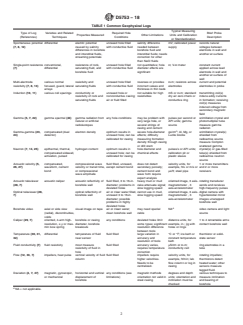
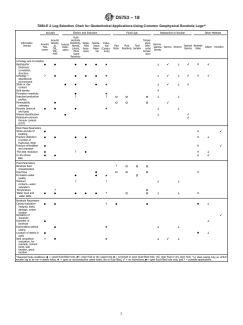
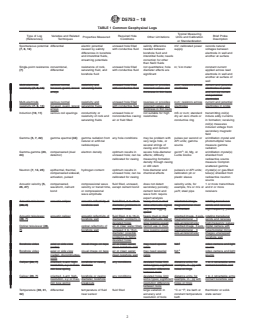
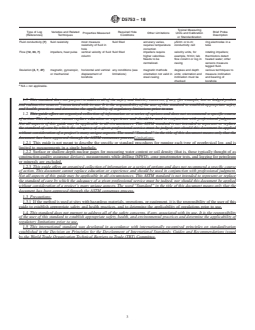
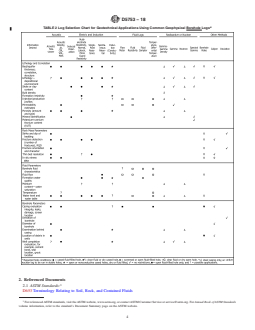
1.1.2 This guide applies to commonly used logging methods (see Tables 1 and 2) for geotechnical site characterizations.
1.1.3 This guide provides an overview of the following:
(1) the uses of single borehole geophysical methods,
(2) general logging procedures,
(3) documentation,
(4) calibration, and
(5) factors that can affect the quality of borehole geophysical logs and their subsequent interpretation. Log interpretation is very important, but specific methods are too diverse to be described in this guide.
1.1.4 Logging procedures must be adapted to meet the needs of a wide range of applications and stated in general terms so that flexibility or innovation are not suppressed.
1.1.5 To obtain detailed information on operating methods, publications (for example, 1, 2, 3, 4, 5, 6, 7, 8, and 9)2 should be consulted. A limited amount of tutorial information is provided, but other publications listed herein, including a glossar y of terms and general texts on the subject, should be consulted for more complete background information.
1.2 Limitations:
1.2.1 This guide is not meant to describe the specific or standard procedures for running each type of geophysical log, and is limited to measurements in a single borehole.
1.2.2 Surface or shallow-depth nuclear gages for measuring water content or soil density (that is, those typically thought of as construction quality assurance devices), measurements while drilling (MWD), cone penetrometer tests, and logging for petroleum or minerals are excluded.
1.2.3 This guide offers an organized collection of information or a series of options and does not recommend a specific course of action. This document cannot replace education or experience and should be used in conjunction with professional judgment. Not all aspects of this guide may be applicable in all circumstances. This ASTM standard is not intended to represent or replace the standard of care by which the adequacy of a given professional service must be judged, nor should this document be applied without consideration of a project's many unique aspects. The word “Standard” in the title of this document means only that the document has been approved through the ASTM consensus process.
1.3 Precautions:
1.3.1 If the method is used at sites with hazardous materials, operations, or equipment, it is the responsibility of the user of this guide to establish appropriate safety and health practices, and to determine the applicability of regulations prior to use.
1.4 This standard does not purport to address all of the safety concerns, if any, associated with its use. It is the responsibility of the user of this standard to establish appropriate safety, health, and environmental practices and determine the applicability of regulatory limitations prior to use.
1.5 This international standard was developed in accordance with internationally recognized princi...
- Status
- Published
- Publication Date
- 31-Jan-2018
- Technical Committee
- D18 - Soil and Rock
- Drafting Committee
- D18.01 - Surface and Subsurface Investigation
Buy Documents
ASTM D5753-18 - Standard Guide for Planning and Conducting Geotechnical Borehole Geophysical Logging
REDLINE ASTM D5753-18 - Standard Guide for Planning and Conducting Geotechnical Borehole Geophysical Logging
Overview
ASTM D5753-18: Standard Guide for Planning and Conducting Geotechnical Borehole Geophysical Logging provides essential guidance for the planning, documentation, and execution of borehole geophysical logging programs used in geotechnical site characterizations. Published by ASTM International, this guide applies to common geophysical logging methods for geological, engineering, groundwater, and environmental investigations. The standard emphasizes the importance of a structured approach to enhance the collection, reliability, and application of borehole log data.
Key Topics
Purpose and Scope
ASTM D5753-18 outlines general procedures for planning and conducting borehole geophysical logging. This includes selection of appropriate tools, documentation, calibration, and quality control, ensuring the proper use and interpretation of geophysical log data.Types of Geophysical Logs
The guide covers commonly used borehole geophysical logging methods, such as:- Spontaneous potential logs
- Single-point resistance logs
- Resistivity logs
- Gamma and gamma-gamma logs
- Neutron and acoustic logs
- Borehole video and optical televiewer logs
- Temperature, fluid conductivity, and flow logs These methods provide direct and indirect measurements of the physical, mechanical, hydrologic, and chemical properties of subsurface materials.
Documentation and Calibration
Proper documentation of field conditions, equipment parameters, and data collection procedures is crucial. The guide stresses routine calibration and standardization to enhance the accuracy and repeatability of geophysical logs. It also advises the establishment of a quality control plan for all phases of logging operations.Procedure and Quality Assurance
ASTM D5753-18 encourages the development of a work plan prior to logging, assessment of borehole conditions, careful selection of logging sequences, and meticulous field reporting. Regular equipment checks, use of trained personnel, and thorough data management help ensure data validity.Interpretation and Reporting
Recognizing that log interpretation is a critical part of geophysical investigations, the guide specifies requirements for documentation, reporting, and combining geophysical log data with lithology and hydrogeological information for effective site characterization.
Applications
ASTM D5753-18 is widely applicable in the following areas:
Geotechnical Investigations
Used to assess subsurface conditions, stratigraphy, and material properties for construction and engineering projects.Groundwater Studies
Supports the identification of aquifers, monitoring of water quality, and evaluation of well construction.Environmental Site Assessments
Assists in the delineation of contamination plumes, locating bedrock, and understanding hydrogeological frameworks.Engineering Design Support
Provides data necessary for foundation design, tunnel alignment, and infrastructure development by characterizing subsurface variability and detecting discontinuities.
The standard is not intended for use in petroleum, mineral logging, measurements while drilling, or assessment with surface nuclear gauges for construction quality control.
Related Standards
For comprehensive geotechnical and environmental site characterization, the following related ASTM standards are referenced and recommended:
- ASTM D653: Terminology Relating to Soil, Rock, and Contained Fluids
- ASTM D5088: Practice for Decontamination of Field Equipment Used at Waste Sites
- ASTM D5608: Practices for Decontamination of Sampling and Non-Sample Contacting Equipment Used at Low-Level Radioactive Waste Sites
These standards provide additional foundational terminology and protocols complementary to the guidance in ASTM D5753-18.
By following ASTM D5753-18, professionals can plan and execute borehole geophysical logging programs that yield high-quality, interpretable geotechnical data, supporting robust engineering, groundwater management, and environmental decision-making.
Relations
- Replaces
ASTM D5753-05(2010) - Standard Guide for Planning and Conducting Borehole Geophysical Logging - Effective Date
- 01-Feb-2018
- Effective Date
- 01-May-2020
- Effective Date
- 01-Feb-2016
- Effective Date
- 01-Aug-2015
- Effective Date
- 15-Jan-2015
- Effective Date
- 01-Aug-2014
- Effective Date
- 01-Sep-2011
- Effective Date
- 01-May-2010
- Effective Date
- 01-Jan-2009
- Effective Date
- 01-Dec-2008
- Effective Date
- 01-Nov-2008
- Refers
ASTM D5088-02(2008) - Standard Practice for Decontamination of Field Equipment Used at Waste Sites - Effective Date
- 15-Sep-2008
- Effective Date
- 15-Dec-2007
- Effective Date
- 01-Nov-2007
- Effective Date
- 01-Aug-2007
Buy Documents
ASTM D5753-18 - Standard Guide for Planning and Conducting Geotechnical Borehole Geophysical Logging
REDLINE ASTM D5753-18 - Standard Guide for Planning and Conducting Geotechnical Borehole Geophysical Logging
Get Certified
Connect with accredited certification bodies for this standard

Zavod za gradbeništvo Slovenije (ZAG) - Inšpekcija
ZAG inspection body for construction products, structures, and materials.
Sponsored listings
Frequently Asked Questions
ASTM D5753-18 is a guide published by ASTM International. Its full title is "Standard Guide for Planning and Conducting Geotechnical Borehole Geophysical Logging". This standard covers: SIGNIFICANCE AND USE 5.1 An appropriately developed, documented, and executed guide is essential for the proper collection and application of borehole geophysical logs. 5.2 Borehole geophysical techniques yield direct and indirect measurements with depth of the (1) physical, lithologic, mechanical, stresses, hydrologic, discontinuities, and chemical properties of the rock matrix and/or fluid around the borehole, (2) fluid contained in the borehole, and (3) construction of the borehole. 5.3 The benefits of its use include improving the following: 5.3.1 Selection of logging methods and equipment, 5.3.2 Log quality and reliability, and 5.3.3 Usefulness of the log data for subsequent display and interpretation. SCOPE 1.1 Purpose and Application: 1.1.1 This guide covers the documentation and general procedures necessary to plan and conduct a geophysical borehole logging program as commonly applied to geologic, engineering, groundwater, and environmental (hereafter referred to as geotechnical) site characterizations. 1.1.2 This guide applies to commonly used logging methods (see Tables 1 and 2) for geotechnical site characterizations. 1.1.3 This guide provides an overview of the following: (1) the uses of single borehole geophysical methods, (2) general logging procedures, (3) documentation, (4) calibration, and (5) factors that can affect the quality of borehole geophysical logs and their subsequent interpretation. Log interpretation is very important, but specific methods are too diverse to be described in this guide. 1.1.4 Logging procedures must be adapted to meet the needs of a wide range of applications and stated in general terms so that flexibility or innovation are not suppressed. 1.1.5 To obtain detailed information on operating methods, publications (for example, 1, 2, 3, 4, 5, 6, 7, 8, and 9)2 should be consulted. A limited amount of tutorial information is provided, but other publications listed herein, including a glossar y of terms and general texts on the subject, should be consulted for more complete background information. 1.2 Limitations: 1.2.1 This guide is not meant to describe the specific or standard procedures for running each type of geophysical log, and is limited to measurements in a single borehole. 1.2.2 Surface or shallow-depth nuclear gages for measuring water content or soil density (that is, those typically thought of as construction quality assurance devices), measurements while drilling (MWD), cone penetrometer tests, and logging for petroleum or minerals are excluded. 1.2.3 This guide offers an organized collection of information or a series of options and does not recommend a specific course of action. This document cannot replace education or experience and should be used in conjunction with professional judgment. Not all aspects of this guide may be applicable in all circumstances. This ASTM standard is not intended to represent or replace the standard of care by which the adequacy of a given professional service must be judged, nor should this document be applied without consideration of a project's many unique aspects. The word “Standard” in the title of this document means only that the document has been approved through the ASTM consensus process. 1.3 Precautions: 1.3.1 If the method is used at sites with hazardous materials, operations, or equipment, it is the responsibility of the user of this guide to establish appropriate safety and health practices, and to determine the applicability of regulations prior to use. 1.4 This standard does not purport to address all of the safety concerns, if any, associated with its use. It is the responsibility of the user of this standard to establish appropriate safety, health, and environmental practices and determine the applicability of regulatory limitations prior to use. 1.5 This international standard was developed in accordance with internationally recognized princi...
SIGNIFICANCE AND USE 5.1 An appropriately developed, documented, and executed guide is essential for the proper collection and application of borehole geophysical logs. 5.2 Borehole geophysical techniques yield direct and indirect measurements with depth of the (1) physical, lithologic, mechanical, stresses, hydrologic, discontinuities, and chemical properties of the rock matrix and/or fluid around the borehole, (2) fluid contained in the borehole, and (3) construction of the borehole. 5.3 The benefits of its use include improving the following: 5.3.1 Selection of logging methods and equipment, 5.3.2 Log quality and reliability, and 5.3.3 Usefulness of the log data for subsequent display and interpretation. SCOPE 1.1 Purpose and Application: 1.1.1 This guide covers the documentation and general procedures necessary to plan and conduct a geophysical borehole logging program as commonly applied to geologic, engineering, groundwater, and environmental (hereafter referred to as geotechnical) site characterizations. 1.1.2 This guide applies to commonly used logging methods (see Tables 1 and 2) for geotechnical site characterizations. 1.1.3 This guide provides an overview of the following: (1) the uses of single borehole geophysical methods, (2) general logging procedures, (3) documentation, (4) calibration, and (5) factors that can affect the quality of borehole geophysical logs and their subsequent interpretation. Log interpretation is very important, but specific methods are too diverse to be described in this guide. 1.1.4 Logging procedures must be adapted to meet the needs of a wide range of applications and stated in general terms so that flexibility or innovation are not suppressed. 1.1.5 To obtain detailed information on operating methods, publications (for example, 1, 2, 3, 4, 5, 6, 7, 8, and 9)2 should be consulted. A limited amount of tutorial information is provided, but other publications listed herein, including a glossar y of terms and general texts on the subject, should be consulted for more complete background information. 1.2 Limitations: 1.2.1 This guide is not meant to describe the specific or standard procedures for running each type of geophysical log, and is limited to measurements in a single borehole. 1.2.2 Surface or shallow-depth nuclear gages for measuring water content or soil density (that is, those typically thought of as construction quality assurance devices), measurements while drilling (MWD), cone penetrometer tests, and logging for petroleum or minerals are excluded. 1.2.3 This guide offers an organized collection of information or a series of options and does not recommend a specific course of action. This document cannot replace education or experience and should be used in conjunction with professional judgment. Not all aspects of this guide may be applicable in all circumstances. This ASTM standard is not intended to represent or replace the standard of care by which the adequacy of a given professional service must be judged, nor should this document be applied without consideration of a project's many unique aspects. The word “Standard” in the title of this document means only that the document has been approved through the ASTM consensus process. 1.3 Precautions: 1.3.1 If the method is used at sites with hazardous materials, operations, or equipment, it is the responsibility of the user of this guide to establish appropriate safety and health practices, and to determine the applicability of regulations prior to use. 1.4 This standard does not purport to address all of the safety concerns, if any, associated with its use. It is the responsibility of the user of this standard to establish appropriate safety, health, and environmental practices and determine the applicability of regulatory limitations prior to use. 1.5 This international standard was developed in accordance with internationally recognized princi...
ASTM D5753-18 is classified under the following ICS (International Classification for Standards) categories: 93.020 - Earthworks. Excavations. Foundation construction. Underground works. The ICS classification helps identify the subject area and facilitates finding related standards.
ASTM D5753-18 has the following relationships with other standards: It is inter standard links to ASTM D5753-05(2010), ASTM D5088-20, ASTM D5608-16, ASTM D5088-15a, ASTM D5088-15, ASTM D653-14, ASTM D653-11, ASTM D5608-10, ASTM D653-09, ASTM D653-08a, ASTM D653-08, ASTM D5088-02(2008), ASTM D653-07f, ASTM D653-07e, ASTM D653-07d. Understanding these relationships helps ensure you are using the most current and applicable version of the standard.
ASTM D5753-18 is available in PDF format for immediate download after purchase. The document can be added to your cart and obtained through the secure checkout process. Digital delivery ensures instant access to the complete standard document.
Standards Content (Sample)
This international standard was developed in accordance with internationally recognized principles on standardization established in the Decision on Principles for the
Development of International Standards, Guides and Recommendations issued by the World Trade Organization Technical Barriers to Trade (TBT) Committee.
Designation: D5753 − 18
Standard Guide for
Planning and Conducting Geotechnical Borehole
Geophysical Logging
This standard is issued under the fixed designation D5753; the number immediately following the designation indicates the year of
original adoption or, in the case of revision, the year of last revision. A number in parentheses indicates the year of last reapproval. A
superscript epsilon (´) indicates an editorial change since the last revision or reapproval.
1. Scope* 1.2.1 This guide is not meant to describe the specific or
standard procedures for running each type of geophysical log,
1.1 Purpose and Application:
and is limited to measurements in a single borehole.
1.1.1 This guide covers the documentation and general
1.2.2 Surface or shallow-depth nuclear gages for measuring
procedures necessary to plan and conduct a geophysical
water content or soil density (that is, those typically thought of
borehole logging program as commonly applied to geologic,
as construction quality assurance devices), measurements
engineering, groundwater, and environmental (hereafter re-
while drilling (MWD), cone penetrometer tests, and logging
ferred to as geotechnical) site characterizations.
for petroleum or minerals are excluded.
1.1.2 Thisguideappliestocommonlyusedloggingmethods
1.2.3 This guide offers an organized collection of informa-
(see Tables 1 and 2) for geotechnical site characterizations.
tion or a series of options and does not recommend a specific
1.1.3 This guide provides an overview of the following:
course of action. This document cannot replace education or
(1) the uses of single borehole geophysical methods,
experienceandshouldbeusedinconjunctionwithprofessional
(2) general logging procedures,
judgment. Not all aspects of this guide may be applicable in all
(3) documentation,
circumstances. This ASTM standard is not intended to repre-
(4) calibration, and
sent or replace the standard of care by which the adequacy of
(5) factors that can affect the quality of borehole geophysi-
a given professional service must be judged, nor should this
cal logs and their subsequent interpretation. Log interpretation
document be applied without consideration of a project’s many
is very important, but specific methods are too diverse to be
unique aspects. The word “Standard” in the title of this
described in this guide.
document means only that the document has been approved
1.1.4 Logging procedures must be adapted to meet the
through the ASTM consensus process.
needs of a wide range of applications and stated in general
terms so that flexibility or innovation are not suppressed. 1.3 Precautions:
1.1.5 To obtain detailed information on operating methods, 1.3.1 Ifthemethodisusedatsiteswithhazardousmaterials,
publications (for example, 1, 2, 3, 4, 5, 6, 7, 8, and 9) should operations, or equipment, it is the responsibility of the user of
be consulted. A limited amount of tutorial information is this guide to establish appropriate safety and health practices,
provided, but other publications listed herein, including a and to determine the applicability of regulations prior to use.
glossar y of terms and general texts on the subject, should be
1.4 This standard does not purport to address all of the
consulted for more complete background information.
safety concerns, if any, associated with its use. It is the
responsibility of the user of this standard to establish appro-
1.2 Limitations:
priate safety, health, and environmental practices and deter-
mine the applicability of regulatory limitations prior to use.
ThisguideisunderthejurisdictionofASTMCommitteeD18onSoilandRock
1.5 This international standard was developed in accor-
and is the direct responsibility of Subcommittee D18.01 on Surface and Subsurface
dance with internationally recognized principles on standard-
Characterization.
Current edition approved Feb. 1, 2018. Published March 2018. Originally
ization established in the Decision on Principles for the
approved in 1995. Last previous edition approved in 2010 as D5753–05(2010).
Development of International Standards, Guides and Recom-
DOI: 10.1520/D5753-18.
mendations issued by the World Trade Organization Technical
The boldface numbers in parentheses refer to a list of references at the end of
this standard. Barriers to Trade (TBT) Committee.
*A Summary of Changes section appears at the end of this standard
Copyright © ASTM International, 100 Barr Harbor Drive, PO Box C700, West Conshohocken, PA 19428-2959. United States
D5753 − 18
TABLE 1 Common Geophysical Logs
Typical Measuring
Type of Log Varieties and Related Required Hole Brief Probe
Properties Measured Other Limitations Units and Calibration
(References) Techniques Conditions Description
or Standardization
Spontaneous potential differential electric potential uncased hole filled salinity difference mV; calibrated power records natural
(7,8,12) caused by salinity with conductive fluid needed between supply voltages between
differences in borehole borehole fluid and electrode in well and
and interstitial fluids, interstitial fluids; needs another at surface
streaming potentials correction for other
than NaCl fluids
Single-point resistance conventional, resistance of rock, uncased hole filled not quantitative; hole Ω;V-Ω meter constant current
(7) differential saturating fluid, and with conductive fluid diameter effects are applied across lead
borehole fluid significant electrode in well and
another at surface of
well
Multi-electrode various normal resistivity and uncased hole filled reverses or provides Ω-m; resistors across current and potential
resistivity (7,8,13) focused, guard, lateral saturating fluids with conductive fluid incorrect values and electrodes electrodes in probe
arrays thickness in thin beds
Induction (10, 11) various coil spacings conductivity or uncased hole or not suitable for high mS orΩ-m; standard transmitting coil(s)
resistivity of rock and nonconductive casing; resistivities dry air zero check or induce eddy currents
saturating fluids air or fluid filled conductive ring in formation; receiving
coil(s) measures
induced voltage from
secondary magnetic
field
Gamma (5,7,22) gamma spectral (44) gamma radiation from any hole conditions may be problem with pulses per second or scintillation crystal and
natural or artificial very large hole, or API units; gamma photomultiplier tube
radioisotopes several strings of source measure gamma
casing and cement radiation
Gamma-gamma (23, compensated (dual electron density optimum results in severe hole-diameter gs/cm ; Al, Mg, or scintillation crystal(s)
24) detector) uncased hole; can be effects; difficulty Lucite blocks shielded from
calibrated for casing measuring formation radioactive source
density through casing measure Compton
or drill stem scattered gamma
Neutron (7, 14, 25) epithermal, thermal, hydrogen content optimum results in hole diameter and pulses/s or API units; crystal(s) or gas-filled
compensated sidewall, uncased hole; can be chemical effects calibration pit or tube(s) shielded from
activation, pulsed calibrated for casing plastic sleeve radioactive neutron
source
Acoustic velocity (5, compensated, compressional wave fluid filled, uncased, does not detect velocity units, for 1 or more transmitters
26, 27) waveform, cement velocity or transit time, except cement bond secondary porosity; example, ft/s or m/s or and 2 or more
bond or compressional cement bond and µs/ft; steel pipe receivers
wave amplitude wave form require
expert analysis
Acoustic televiewer acoustic caliper acoustic reflectivity of fluid filled, 3 to 16-in. heavy mud or mud oriented image, 3 axis- rotating transducer
(28, 7) borehole wall diameter; problems in cake attenuate signal; magnetometer , 3 sends and receives
deviated holes slow logging speed axis-accelerometer high-frequency pulses
Optical televiewer (28, optical reflectivity of air or clear water filled, cannot use in mud, oriented image, 3 axis- digital camera with
7) borehole wall uncased 3 to 16-in. slow logging speed magnetometer , 3 hyperboloidal mirror
diameter; possible axis-accelerometer images unwrapped
problems in highly borehole wall
deviated holes
A
Borehole video axial or side view visual image on tape air or clean water; may need special NA video camera and light
(radial), discontinuities, clean borehole wall cable source
voids
Caliper (29, 7) oriented, 4-arm high- borehole or casing any conditions deviated holes limit distance units, for 1 to 4 retractable arms
resolution, x-y or max- diameter, borehole some types; significant example, in.; jig with contact borehole wall
min bow spring breakouts resolution difference holes or rings
between tools
Temperature (30, 31, differential temperature of fluid fluid filled large variation in °C or °F; ice bath or thermistor or solid-
32) near sensor accuracy and constant temperature state sensor
resolution of tools bath
Fluid conductivity (7) fluid resistivity most measure fluid filled accuracy varies, µS/cm orΩ-m; ring electrodes in a
resistivity of fluid in requires temperature conductivity cell tube
hole correction
Flow (12, 33, 7) impellers, heat pulse vertical velocity of fluid fluid filled impellers require velocity units, for rotating impellers;
column higher velocities. example, ft/min; lab thermistors detect
Needs to be flow column or log in heated water; other
centralized. casing sensors measure
tagged fluid.
Deviation (4,7,47) magnetic, gyroscopic, horizontal and vertical any conditions (see magnetic methods degrees and depth various techniques to
or mechanical displacement of limitations) orientation not valid in units; orientation and measure inclination
borehole steel casing inclination must be and bearing of
checked borehole
A
NA = not applicable.
D5753 − 18
A
TABLE 2 Log Selection Chart for Geotechnical Applications Using Common Geophysical Borehole Logs
D5753 − 18
2. Referenced Documents 5.3 The benefits of its use include improving the following:
3 5.3.1 Selection of logging methods and equipment,
2.1 ASTM Standards:
5.3.2 Log quality and reliability, and
D653 Terminology Relating to Soil, Rock, and Contained
5.3.3 Usefulness of the log data for subsequent display and
Fluids
interpretation.
D5088 Practice for Decontamination of Field Equipment
Used at Waste Sites
6. Apparatus
D5608 Practices for Decontamination of Sampling and Non
6.1 Geophysical Logging System:
Sample Contacting Equipment Used at Low Level Radio-
6.1.1 Logging probes, also called sondes or tools, enclose
active Waste Sites
the sensors, sources, electronics for transmitting and receiving
signals, and power supplies.
3. Terminology
6.1.2 Loggingcableroutinelycarriessignalstoandfromthe
3.1 Definitions—For definitions of common technical terms
logging probe and supports the weight of the probe.
used in this standard, refer to Terminology D653.
6.1.3 Draw Works—Moves the logging cable and probe up
3.2 Descriptions of Terms Specific to This Standard—Terms and down the borehole and provide the connection with the
shall be in accordance with Ref (10). interfaces and surface controls.
6.1.4 A depth measurement system, which provides probe
4. Summary of Guide
depth information for the interfaces and surface controls and
recording systems.
4.1 This guide applies to borehole geophysical techniques
6.1.5 Surface interfaces and controls that provide some or
that are commonly used in geotechnical site characterizations.
all of the following: electrical connection, signal conditioning,
Thisguidebrieflydescribesthesignificanceanduse,apparatus,
power, and data transmission between the recording system
calibration and standardization, procedures and reports for
and probe.
planning and conducting borehole geophysical logging. These
6.1.6 Recording system includes the digital recorder and an
techniques are described briefly in Table 1 and their applica-
analog display or hard copy device.
tions in Table 2.
6.2 Special cases for probes containing any controlled
4.2 Many other logging techniques and applications are
substances.
described in the textbooks in the reference list. There are a
number of logging techniques with potential geotechnical
6.3 Special badges and/or clothing for working with equip-
applications that are either still in the developmental stage or
ment containing any controlled substances.
havelimitedcommercialavailability.Someofthesetechniques
7. Calibration and Standardization of Geophysical Logs
and a reference on each are as follows: buried electrode direct
current resistivity (11), deeply penetrating electromagnetic 7.1 General:
techniques (12), gravimeter (13), magnetic susceptibility (14), 7.1.1 National Institute of Standards and Technology
magnetometer, nuclear activation (15), dielectric constant (16),
(NIST) calibration and operating procedures do not exist for
radar (17), deeply penetrating seismic (13), electrical polariz- the borehole geophysical logging industry. However, calibra-
ability (18), sequential fluid conductivity (19), and diameter
tion or standardization physical models are available (see
(20). Many of the guidelines described in this guide also apply Appendix X1).
totheuseofthesenewertechniquesthatarestillintheresearch
7.1.2 Geophysical logs can be used in a qualitative (for
phase. Accepted practices should be followed at the present example, comparative) or quantitative manner, depending on
time for these techniques.
the project objectives. (For example, a gamma-gamma log can
be used to indicate that one rock is more or less dense than
5. Significance and Use
another, or it can be expressed in density units.)
7.1.3 The calibration and standardization scope and fre-
5.1 An appropriately developed, documented, and executed
quency shall be sufficient for project objectives.
guide is essential for the proper collection and application of
7.1.3.1 Calibration or standardization should be performed
borehole geophysical logs.
eachtimealoggingprobeismodifiedorrepairedoratperiodic
5.2 Borehole geophysical techniques yield direct and indi-
intervals.
rect measurements with depth of the (1) physical, lithologic,
7.2 Calibration:
mechanical, stresses, hydrologic, discontinuities, and chemical
7.2.1 Calibration is the process of establishing values for
properties of the rock matrix and/or fluid around the borehole,
log response. It can be accomplished with a representative
(2) fluid contained in the borehole, and (3) construction of the
physical model or laboratory analysis of representative
borehole.
samples. Calibration data values related to the physical prop-
erties (for example, porosity) may be recorded in units (for
example, pulses/s or µm/ft) that can be converted to apparent
For referenced ASTM standards, visit the ASTM website, www.astm.org, or
contact ASTM Customer Service at service@astm.org. For Annual Book of ASTM
porosity units.
Standards volume information, refer to the standard’s Document Summary page on
7.2.1.1 At least three, and preferably more, values are
the ASTM website.
needed to establish a calibration curve, and the interface or
The references indicated in these tables should be consulted for detailed
information on each of these techniques and applications. contact between different values in the model should be
D5753 − 18
recorded. Because of the variability in subsurface conditions, changes (for example, changes in output with time due to
many more values are needed if sample analyses are used for system drift or changes of equipment).
calibration. 7.3.3.2 Selected log intervals should be repeated (that is,
7.2.1.2 The statistical scatter in regression of core analysis re-logged). Repeat logs provide information on the stability of
logging equipment.
againstgeophysicallogvaluesmaybecausedbythedifference
between the sample size and geophysical volume of investiga- 7.3.3.3 Arepresentative borehole may be used to check log
tion and may not represent measurement error. responseperiodically.Thisboreholeenvironmentandtherocks
7.2.2 Physical Models—A representative model simulates and fluids penetrated may change with time.
thechemicalandphysicalcompositionoftherockandfluidsto
8. Procedure
be measured.
7.2.2.1 Physical models include calibration pits, coils, 8.1 Planning the Logging Program:
resistors, rings, temperature baths, etc.
8.1.1 Awork plan should be developed prior to implement-
7.2.2.2 The calibration of nuclear probes should be per- ing the logging program.
formed in a physical model that is nearly infinite with respect 8.1.2 The key steps in developing a logging work plan
to probe response. should include the following:
7.2.2.3 Some probes have internal devices such as resistors, 8.1.2.1 Log Selection—See Table 1 and Table 2.
but this does not substitute for checking the probe response in 8.1.2.2 Personnel Selection—See 8.3.2.
an environment that simulates borehole conditions, and the use 8.1.2.3 Quality Control and Documentation—See 8.4.
of such devices is considered standardization. 8.1.2.4 Calibration and Standardization Procedures—See
7.2.2.4 Calibration Facilities—Commonly used calibration Section 7.
8.1.2.5 Equipment Liability—See 1.4.
pits or models for use by anyone at the present time are listed
inAppendixX1 (21-4).Theusershouldinquireconcerningthe 8.1.2.6 Equipment Decontamination—In environmental
investigations, equipment decontamination may be required
present validity of any facility and identify any new or
alternative facilities. before, after, and between individual wells. Equipment decon-
tamination may involve a number of standardized procedures,
7.2.3 Sample Analyses:
depending on the nature of the project (see Practices D5088
7.2.3.1 Representative samples from boreholes in the proj-
and D5608). A decontamination program should be agreed
ect area that have been collected carefully and analyzed
upon by all parties before logging commences, and procedures
quantitatively also may be used to calibrate log response.
specified by the work plan should be followed.
7.2.3.2 To reduce depth errors, the sample recovery of rock
8.1.2.7 Log Interpretation—See 8.5.
cores in calibration holes needs to approach 100 % for the
intervals used for calibration. Log response should be used to
8.2 Field Assessment of Borehole Conditions:
select sample depths to span the range of desired log calibra-
8.2.1 Borehole conditions can have a profound influence on
tion values and to be within thick units to minimize the effects
the quality of log data and subsequent interpretation. Important
of potential depth errors. Samples need to be analyzed imme-
parameters to consider include the following:
diately or steps taken to preserve them for later analysis.
8.2.1.1 Drilling method, casing, drill hole history, and well
7.2.3.3 Samples to be used for log calibration should be
completion materials.
analyzed only from depth intervals at which the log response is
8.2.1.2 Borehole Fluid Properties—Resistivity,
relatively uniform for a depth interval considerably greater
temperature, density, viscosity, and chemistry at the time of
than the vertical dimension of the volume of investigation of
logging.
the logging probe. Samples near lithologic contacts or fluid
8.2.1.3 Borehole diameter, rugosity, and stability.
interfaces should not be used because of possible boundary
8.2.1.4 Deviation of borehole.
effects or depth errors.
8.2.1.5 Wellhead pressure.
8.2.2 Logging Operations:
7.3 Standardization:
8.2.2.1 Determine the sequence and direction of logging or
7.3.1 Standardization is the process of checking the log
if needed to be run incrementally after incremental advance-
response to reveal evidence of repeatability and consistency.
ment or retreat of borehole casing. The sequence in which a
7.3.2 Standardization is needed to establish comparability
suite of logs is run is important from both a data quality and
between logs made with different equipment or at different
operational viewpoint. Because logging operations mix the
times and to ensure the accuracy of measurements.
borehole fluid, logs of fluid properties (for example,
7.3.2.1 Standardization checks should include at least two
temperature, fluid resistivity, and fluid sampling should be run
different measurement values approximating the range of
prior to other logs). Consideration should also be given to
interest (For example, aluminum and magnesium or plastic
when borehole video surveys are performed because some
blocks are used commonly to check the response of gamma-
logging tools may degrade borehole clarity. Tools that have
gamma density logging systems in the field.)
arms or bowsprings that contact the borehole wall should be
7.3.3 Standardization uses some type of a standard that may
run late in the logging sequence because of the greater
be used in the field or laboratory and repeat logs.
7.3.3.1 Log response needs to be checked using field stan-
dards often enough to satisfy the project objectives. Standard-
Equipment decontamination procedures may have specific safety and equip-
ization of the log response provides the basis for correcting for ment limitations that must be addressed prior to their use.
D5753 − 18
possibility of material from the borehole wall falling into the operation of geophysical logging equipment, applicable
borehole. Because of the consequences of losing a tool with a decontamination, and format for presenting geophysical well
radioactive source, these tools should be run last, and after a
log data. Repair, standardization, and calibration information
caliperlog.Alllogsexceptfluidpropertiesandvideoshouldbe should also be documented. Probes should be numbered to
run with the probe moving up the borehole to reduce depth
simplify the identification of associated documentation. Docu-
errors.
ment all field problems including equipment malfunctions.
8.2.2.2 Select the depth reference. The selected depth ref-
This should include the steps taken to solve the problem and
erence needs to be stable and accessible.
how the logs might have been affected. Repeat runs and field
8.2.2.3 Unstable boreholes should not be logged with radio-
standardization should be more frequent when equ
...
This document is not an ASTM standard and is intended only to provide the user of an ASTM standard an indication of what changes have been made to the previous version. Because
it may not be technically possible to adequately depict all changes accurately, ASTM recommends that users consult prior editions as appropriate. In all cases only the current version
of the standard as published by ASTM is to be considered the official document.
Designation: D5753 − 05 (Reapproved 2010) D5753 − 18
Standard Guide for
Planning and Conducting Geotechnical Borehole
Geophysical Logging
This standard is issued under the fixed designation D5753; the number immediately following the designation indicates the year of
original adoption or, in the case of revision, the year of last revision. A number in parentheses indicates the year of last reapproval. A
superscript epsilon (´) indicates an editorial change since the last revision or reapproval.
1. Scope Scope*
1.1 This guide covers the documentation and general procedures necessary to plan and conduct a geophysical log program as
commonly applied to geologic, engineering, groundwater, and environmental (hereafter referred to as geotechnical) investigations.
It is not intended to describe the specific or standard procedures for running each type of geophysical log and is limited to
measurements in a single borehole. It is anticipated that standard guides will be developed for specific methods subsequent to this
guide.
1.2 Surface or shallow-depth nuclear gages for measuring water content or soil density (that is, those typically thought of as
construction quality assurance devices), measurements while drilling (MWD), cone penetrometer tests, and logging for petroleum
or minerals are excluded.
1.3 Borehole geophysical techniques yield direct and indirect measurements with depth of the (1) physical and chemical
properties of the rock matrix and fluid around the borehole, (2) fluid contained in the borehole, and (3) construction of the borehole.
1.1 To obtain detailed information on operating methods, publications (for example, 1, 2, 3, 4, 5, 6, 7, 8, and 9) should be
consulted. A limited amount of tutorial information is provided, but other publications listed herein, including a glossary of terms
and general texts on the subject, should be consulted for more complete background information.Purpose and Application:
1.1.1 This guide covers the documentation and general procedures necessary to plan and conduct a geophysical borehole
logging program as commonly applied to geologic, engineering, groundwater, and environmental (hereafter referred to as
geotechnical) site characterizations.
1.1.2 This guide applies to commonly used logging methods (see Tables 1 and 2) for geotechnical site characterizations.
1.1.3 This guide provides an overview of the following:
(1) the uses of single borehole geophysical methods,
(2) general logging procedures,
(3) documentation,
(4) calibration, and
(5) factors that can affect the quality of borehole geophysical logs and their subsequent interpretation. Log interpretation is very
important, but specific methods are too diverse to be described in this guide.
1.1.4 Logging procedures must be adapted to meet the needs of a wide range of applications and stated in general terms so that
flexibility or innovation are not suppressed.
1.1.5 To obtain detailed information on operating methods, publications (for example, 1, 2, 3, 4, 5, 6, 7, 8, and 9) should be
consulted. A limited amount of tutorial information is provided, but other publications listed herein, including a glossar y of terms
and general texts on the subject, should be consulted for more complete background information.
1.5 This guide provides an overview of the following: (1) the uses of single borehole geophysical methods, (2) general logging
procedures, (3) documentation, (4) calibration, and (5) factors that can affect the quality of borehole geophysical logs and their
subsequent interpretation. Log interpretation is very important, but specific methods are too diverse to be described in this guide.
1.6 Logging procedures must be adapted to meet the needs of a wide range of applications and stated in general terms so that
flexibility or innovation are not suppressed.
This guide is under the jurisdiction of ASTM Committee D18 on Soil and Rock and is the direct responsibility of Subcommittee D18.01 on Surface and Subsurface
Characterization.
Current edition approved May 1, 2010Feb. 1, 2018. Published September 2010March 2018. Originally approved in 1995. Last previous edition approved in 20052010 as
D5753D5753–05(2010).–05. DOI: 10.1520/D5753-05R10.10.1520/D5753-18.
The boldface numbers in parentheses refer to a list of references at the end of this standard.
*A Summary of Changes section appears at the end of this standard
Copyright © ASTM International, 100 Barr Harbor Drive, PO Box C700, West Conshohocken, PA 19428-2959. United States
D5753 − 18
TABLE 1 Common Geophysical Logs
Typical Measuring
Type of Log Varieties and Related Required Hole Brief Probe
Properties Measured Other Limitations Units and Calibration
(References) Techniques Conditions Description
or Standardization
Spontaneous potential differential electric potential uncased hole filled salinity difference mV; calibrated power records natural
(7, 8, 12) caused by salinity with conductive fluid needed between supply voltages between
differences in borehole borehole fluid and electrode in well and
and interstitial fluids, interstitial fluids; needs another at surface
streaming potentials correction for other
than NaCl fluids
Single-point resistance conventional, resistance of rock, uncased hole filled not quantitative; hole Ω; V-Ω meter constant current
(7) differential saturating fluid, and with conductive fluid diameter effects are applied across lead
borehole fluid significant electrode in well and
another at surface of
well
Multi-electrode various normal resistivity and uncased hole filled reverses or provides Ω-m; resistors across current and potential
resistivity (7, 8, 13) focused, guard, lateral saturating fluids with conductive fluid incorrect values and electrodes electrodes in probe
arrays thickness in thin beds and remote current
and potential
electrodes
Multi-electrode various normal resistivity and uncased hole filled reverses or provides Ω-m; resistors across current and potential
resistivity (7, 8, 13) focused, guard, lateral saturating fluids with conductive fluid incorrect values and electrodes electrodes in probe
arrays thickness in thin beds
Induction (10, 11) various coil spacings conductivity or uncased hole or not suitable for high mS or Ω-m; standard transmitting coil(s)
resistivity of rock and nonconductive casing; resistivities dry air zero check or induce eddy currents
saturating fluids air or fluid filled conductive ring in formation; receiving
coil(s) measures
induced voltage from
secondary magnetic
field
Gamma (5, 7, 22) gamma spectral (44) gamma radiation from any hole conditions may be problem with pulses per second or scintillation crystal and
natural or artificial very large hole, or API units; gamma photomultiplier tube
radioisotopes several strings of source measure gamma
casing and cement radiation
Gamma-gamma (23, compensated (dual electron density optimum results in severe hole-diameter gs/cm ; Al, Mg, or scintillation crystal(s)
24) detector) uncased hole; can be effects; difficulty Lucite blocks shielded from
calibrated for casing measuring formation radioactive source
density through casing measure Compton
or drill stem scattered gamma
Neutron (7, 14, 25) epithermal, thermal, hydrogen content optimum results in hole diameter and pulses/s or API units; crystal(s) or gas-filled
compensated sidewall, uncased hole; can be chemical effects calibration pit or tube(s) shielded from
activation, pulsed calibrated for casing plastic sleeve radioactive neutron
source
Acoustic velocity (5, compensated, compressional wave fluid filled, uncased, does not detect velocity units, for 1 or more transmitters
26, 27) waveform, cement velocity or transit time, except cement bond secondary porosity; example, ft/s or m/s or and 2 or more
bond or compressional cement bond and μs/ft; steel pipe receivers
wave amplitude wave form require
expert analysis
Acoustic televiewer acoustic caliper acoustic reflectivity of fluid filled, 3 to 16-in. heavy mud or mud orientated image- rotating transducer
(28, 7) borehole wall diameter; problems in cake attenuate signal; magnetometer must sends and receives
deviated holes very slow logging be checked high-frequency pulses
speed
Acoustic televiewer acoustic caliper acoustic reflectivity of fluid filled, 3 to 16-in. heavy mud or mud oriented image, 3 axis- rotating transducer
(28, 7) borehole wall diameter; problems in cake attenuate signal; magnetometer , 3 sends and receives
deviated holes slow logging speed axis-accelerometer high-frequency pulses
Optical televiewer (28, optical reflectivity of air or clear water filled, cannot use in mud, oriented image, 3 axis- digital camera with
7) borehole wall uncased 3 to 16-in. slow logging speed magnetometer , 3 hyperboloidal mirror
diameter; possible axis-accelerometer images unwrapped
problems in highly borehole wall
deviated holes
A
Borehole video axial or side view visual image on tape air or clean water; may need special NA video camera and light
(radial) clean borehole wall cable source
A
Borehole video axial or side view visual image on tape air or clean water; may need special NA video camera and light
(radial), discontinuities, clean borehole wall cable source
voids
Caliper (29, 7) oriented, 4-arm high- borehole or casing any conditions deviated holes limit distance units, for 1 to 4 retractable arms
resolution, x-y or max- diameter some types; significant example, in.; jig with contact borehole wall
min bow spring resolution difference holes or rings
between tools
Caliper (29, 7) oriented, 4-arm high- borehole or casing any conditions deviated holes limit distance units, for 1 to 4 retractable arms
resolution, x-y or max- diameter, borehole some types; significant example, in.; jig with contact borehole wall
min bow spring breakouts resolution difference holes or rings
between tools
Temperature (30, 31, differential temperature of fluid fluid filled large variation in °C or °F; ice bath or thermistor or solid-
32) near sensor accuracy and constant temperature state sensor
resolution of tools bath
D5753 − 18
Typical Measuring
Type of Log Varieties and Related Required Hole Brief Probe
Properties Measured Other Limitations Units and Calibration
(References) Techniques Conditions Description
or Standardization
Fluid conductivity (7) fluid resistivity most measure fluid filled accuracy varies, μS/cm or Ω-m; ring electrodes in a
resistivity of fluid in requires temperature conductivity cell tube
hole correction
Flow (12, 33, 7) impellers, heat pulse vertical velocity of fluid fluid filled impellers require velocity units, for rotating impellers;
column higher velocities. example, ft/min; lab thermistors detect
Needs to be flow column or log in heated water; other
centralized. casing sensors measure
tagged fluid.
Deviation (4, 7, 47) magnetic, gyroscopic, horizontal and vertical any conditions (see magnetic methods degrees and depth various techniques to
or mechanical displacement of limitations) orientation not valid in units; orientation and measure inclination
borehole steel casing inclination must be and bearing of
checked borehole
A
NA = not applicable.
1.7 This standard does not purport to address all of the safety and liability concerns, if any, (for example, lost or lodged probes
and radioactive sources ) associated with its use. It is the responsibility of the user of this standard to establish appropriate safety
and health practices and determine the applicability of regulatory limitations prior to use.
1.2 This guide offers an organized collection of information or a series of options and does not recommend a specific course
of action. This document cannot replace education or experience and should be used in conjunction with professional judgment.
Not all aspects of this guide may be applicable in all circumstances. This ASTM standard is not intended to represent or replace
the standard of care by which the adequacy of a given professional service must be judged, nor should this document be applied
without consideration of a project’s many unique aspects. The word “Standard” in the title of this document means only that the
document has been approved through the ASTM consensus process.Limitations:
1.2.1 This guide is not meant to describe the specific or standard procedures for running each type of geophysical log, and is
limited to measurements in a single borehole.
1.2.2 Surface or shallow-depth nuclear gages for measuring water content or soil density (that is, those typically thought of as
construction quality assurance devices), measurements while drilling (MWD), cone penetrometer tests, and logging for petroleum
or minerals are excluded.
1.2.3 This guide offers an organized collection of information or a series of options and does not recommend a specific course
of action. This document cannot replace education or experience and should be used in conjunction with professional judgment.
Not all aspects of this guide may be applicable in all circumstances. This ASTM standard is not intended to represent or replace
the standard of care by which the adequacy of a given professional service must be judged, nor should this document be applied
without consideration of a project’s many unique aspects. The word “Standard” in the title of this document means only that the
document has been approved through the ASTM consensus process.
1.3 Precautions:
1.3.1 If the method is used at sites with hazardous materials, operations, or equipment, it is the responsibility of the user of this
guide to establish appropriate safety and health practices, and to determine the applicability of regulations prior to use.
1.4 This standard does not purport to address all of the safety concerns, if any, associated with its use. It is the responsibility
of the user of this standard to establish appropriate safety, health, and environmental practices and determine the applicability of
regulatory limitations prior to use.
1.5 This international standard was developed in accordance with internationally recognized principles on standardization
established in the Decision on Principles for the Development of International Standards, Guides and Recommendations issued
by the World Trade Organization Technical Barriers to Trade (TBT) Committee.
D5753 − 18
A
TABLE 2 Log Selection Chart for Geotechnical Applications Using Common Geophysical Borehole Logs
2. Referenced Documents
2.1 ASTM Standards:
D653 Terminology Relating to Soil, Rock, and Contained Fluids
For referenced ASTM standards, visit the ASTM website, www.astm.org, or contact ASTM Customer Service at service@astm.org. For Annual Book of ASTM Standards
volume information, refer to the standard’s Document Summary page on the ASTM website.
D5753 − 18
D5088 Practice for Decontamination of Field Equipment Used at Waste Sites
D5608 Practices for Decontamination of Sampling and Non Sample Contacting Equipment Used at Low Level Radioactive
Waste Sites
3. Terminology
3.1 Definitions—Definitions shall be in accordance with For definitions of common technical terms used in this standard, refer
to Terminology D653.
3.2 Descriptions of Terms Specific to This Standard—Terms shall be in accordance with Ref (10).
4. Summary of Guide
4.1 This guide applies to borehole geophysical techniques that are commonly used in geotechnical investigations. site
characterizations. This guide briefly describes the significance and use, apparatus, calibration and standardization, procedures and
reports for planning and conducting borehole geophysical logging. These techniques are described briefly in Table 1 and their
applications in Table 2.
4.2 Many other logging techniques and applications are described in the textbooks in the reference list. There are a number of
logging techniques with potential geotechnical applications that are either still in the developmental stage or have limited
commercial availability. Some of these techniques and a reference on each are as follows: buried electrode direct current resistivity
(11), deeply penetrating electromagnetic techniques (12), gravimeter (13), magnetic susceptibility (14), magnetometer, nuclear
activation (15), dielectric constant (16), radar (17), deeply penetrating seismic (13), electrical polarizability (18), sequential fluid
conductivity (19), and diameter (20). Many of the guidelines described in this guide also apply to the use of these newer techniques
that are still in the research phase. Accepted practices should be followed at the present time for these techniques.
5. Significance and Use
5.1 An appropriately developed, documented, and executed guide is essential for the proper collection and application of
borehole geophysical logs.
5.2 Borehole geophysical techniques yield direct and indirect measurements with depth of the (1) physical, lithologic,
mechanical, stresses, hydrologic, discontinuities, and chemical properties of the rock matrix and/or fluid around the borehole, (2)
fluid contained in the borehole, and (3) construction of the borehole.
5.3 An appropriately developed, documented, and executed guide is essential for the proper collection and application of
borehole geophysical logs.The benefits of its use include improving the following:
5.3.1 Selection of logging methods and equipment,
5.3.2 Log quality and reliability, and
5.3.3 The benefits of its use include improving the following:Usefulness of the log data for subsequent display and
interpretation.
5.1.1.1 Selection of logging methods and equipment,
5.1.1.2 Log quality and reliability, and
5.1.1.3 Usefulness of the log data for subsequent display and interpretation.
5.1.2 This guide applies to commonly used logging methods (see Table 1 and Table 2) for geotechnical investigations.
5.1.3 It is essential that personnel (see 7.3.3) consult up-to-date textbooks and reports on each of the logging techniques,
applications, and interpretation methods. A partial list of selected publications is given at the end of this guide.
5.1.4 This guide is not meant to describe the specific or standard procedures for running each type of geophysical log and is
limited to measurements in a single borehole.
6. Apparatus
6.1 Geophysical Logging System,System: including probes, cable, draw works, depth measurement system, interfaces and
surface controls, and digital and analog recording equipment.
6.1.1 Logging probes, also called sondes or tools, enclose the sensors, sources, electronics for transmitting and receiving signals,
and power supplies.
6.1.2 Logging cable routinely carries signals to and from the logging probe and supports the weight of the probe.
6.1.3 Draw Works—The draw works move Moves the logging cable and probe up and down the borehole and provide the
connection with the interfaces and surface controls.
6.1.4 TheA depth measurement system system, which provides probe depth information for the interfaces and surface controls
and recording systems.
The references indicated in these tables should be consulted for detailed information on each of these techniques and applications.
D5753 − 18
6.1.5 The surface Surface interfaces and controls that provide some or all of the following: electrical connection, signal
conditioning, power, and data transmission between the recording system and probe.
6.1.6 The recording Recording system includes the digital recorder and an analog display or hard copy device.
6.2 Special cases for probes containing any controlled substances.
6.3 Special badges and/or clothing for working with equipment containing any controlled substances.
7. Calibration and Standardization of Geophysical Logs
7.1 General:
7.1.1 National Institute of Standards and Technology (NIST) calibration and operating procedures do not exist for the borehole
geophysical logging industry. However, calibration or standardization physical models are available (see Appendix X1).
7.1.2 Geophysical logs can be used in a qualitative (for example, comparative) or quantitative manner, depending on the project
objectives. (For example, a gamma-gamma log can be used to indicate that one rock is more or less dense than another, or it can
be expressed in density units.)
7.1.3 The calibration and standardization scope and frequency shall be sufficient for project objectives.
7.1.3.1 Calibration or standardization should be performed each time a logging probe is modified or repaired or at periodic
intervals.
7.2 Calibration:
7.2.1 Calibration is the process of establishing values for log response. It can be accomplished with a representative physical
model or laboratory analysis of representative samples. Calibration data values related to the physical properties (for example,
porosity) may be recorded in units (for example, pulses/s or μm/ft) that can be converted to apparent porosity units.
7.2.1.1 At least three, and preferably more, values are needed to establish a calibration curve, and the interface or contact
between different values in the model should be recorded. Because of the variability in subsurface conditions, many more values
are needed if sample analyses are used for calibration.
7.2.1.2 The statistical scatter in regression of core analysis against geophysical log values may be caused by the difference
between the sample size and geophysical volume of investigation and may not represent measurement error.
7.2.2 Physical Models—A representative model simulates the chemical and physical composition of the rock and fluids to be
measured.
7.2.2.1 Physical models include calibration pits, coils, resistors, rings, temperature baths, etc.
7.2.2.2 The calibration of nuclear probes should be performed in a physical model that is nearly infinite with respect to probe
response.
7.2.2.3 Some probes have internal devices such as resistors, but this does not substitute for checking the probe response in an
environment that simulates borehole conditions, and the use of such devices is considered standardization.
7.2.2.4 Calibration Facilities—Commonly used calibration pits or models for use by anyone at the present time are listed in
Appendix X1 (21-4). The user should inquire concerning the present validity of any facility.facility and identify any new or
alternative facilities.
7.2.3 Sample Analyses:
7.2.3.1 Representative samples from boreholes in the project area that have been collected carefully and analyzed quantitatively
also may be used to calibrate log response.
7.2.3.2 To reduce depth errors, the sample recovery of rock cores in calibration holes needs to approach 100 % for the intervals
used for calibration. Log response should be used to select sample depths to span the range of desired log calibration values and
to be within thick units to minimize the effects of potential depth errors. Samples need to be analyzed immediately or steps taken
to preserve them for later analysis.
7.2.3.3 Samples to be used for log calibration should be analyzed only from depth intervals at which the log response is
relatively uniform for a depth interval considerably greater than the vertical dimension of the volume of investigation of the
logging probe. Samples near lithologic contacts or fluid interfaces should not be used because of possible boundary effects or depth
errors.
7.3 Standardization:
7.3.1 Standardization is the process of checking the log response to reveal evidence of repeatability and consistency.
7.3.2 Standardization is needed to establish comparability between logs made with different equipment or at different times and
to ensure the accuracy of measurements.
7.3.2.1 Standardization checks should include at least two different measurement values approximating the range of interest (For
example, aluminum and magnesium or plastic blocks are used commonly to check the response of gamma-gamma density logging
systems in the field.)
7.3.3 Standardization uses some type of a standard that may be used in the field or laboratory and repeat logs.
7.3.3.1 Log response needs to be checked using field standards often enough to satisfy the project objectives. Standardization
of the log response provides the basis for correcting for changes (for example, changes in output with time due to system drift or
changes of equipment).
D5753 − 18
7.3.3.2 Selected log intervals should be repeated (that is, re-logged). Repeat logs provide information on the stability of logging
equipment.
7.3.3.3 A representative borehole may be used to check log response periodically. This borehole environment and the rocks and
fluids penetrated may change with time.
8. Procedure
8.1 Planning the Logging Program:
8.1.1 A work plan should be developed prior to implementing the logging program.
8.1.2 The key steps in developing a logging work plan should include the following:
8.1.2.1 Log Selection—See Table 1 and Table 2.
8.1.2.2 Personnel Selection—See 8.3.2.
8.1.2.3 Quality Control and Documentation—See 8.4.
8.1.2.4 Calibration and Standardization Procedures—See Section 7.
8.1.2.5 Equipment Liability—See 1.71.4.
8.1.2.6 Equipment Decontamination—In environmental investigations, equipment decontamination may be required before,
after, and between individual wells. Equipment decontamination may involve a number of standardized procedures, depending on
the nature of the project (see Practices D5088 and D5608). A decontamination program should be agreed upon by all parties before
logging commences, and procedures specified by the work plan should be followed.
8.1.2.7 Log Interpretation—See 8.5.
8.2 Field Assessment of Borehole Conditions:
8.2.1 Borehole conditions can have a profound influence on the quality of log data and subsequent interpretation. Important
parameters to consider include the following:
8.2.1.1 Drilling method, casing, drill hole history, and well completion materials.
8.2.1.2 Borehole Fluid Properties—Resistivity, temperature, density, viscosity, and chemistry at the time of logging.
8.2.1.3 Borehole diameter, rugosity, and stability.
8.2.1.4 Deviation of borehole.
8.2.1.5 Wellhead pressure.
...