

ASTM D5853-17a
(Test Method)Standard Test Method for Pour Point of Crude Oils
General Information
- Abstract
SIGNIFICANCE AND USE
5.1 The pour point of a crude oil is an index of the lowest temperature of handleability for certain applications.
5.2 This is the only pour point method specifically designed for crude oils.
5.3 The maximum and minimum pour point temperatures provide a temperature window where a crude oil, depending on its thermal history, might appear in the liquid as well as the solid state.
5.4 The test method can be used to supplement other measurements of cold flow behavior. It is especially useful for the screening of the effect of wax interaction modifiers on the flow behavior of crude oils.
SCOPE
1.1 This test method covers two procedures for the determination of the pour point temperatures of crude oils down to −36 °C. Procedure A provides a measure of the maximum (upper) pour point temperature and is described in 9.1. Procedure B provides a measure of the minimum (lower) pour point temperature and is described in 9.2.
1.2 The use of this test method is limited to use for crude oils. Pour point temperatures of other petroleum products can be determined by Test Method D97.
1.3 The values stated in SI units are to be regarded as standard. No other units of measurement are included in this standard.
1.4 WARNING—Mercury has been designated by many regulatory agencies as a hazardous material that can cause central nervous system, kidney, and liver damage. Mercury, or its vapor, may be hazardous to health and corrosive to materials. Caution should be taken when handling mercury and mercury-containing products. See the applicable product Material Safety Data Sheet (MSDS) for details and EPA’s website—http://www.epa.gov/mercury/faq.htm—for additional information. Users should be aware that selling mercury and/or mercury containing products in your state or country may be prohibited by law.
1.5 This standard does not purport to address all of the safety concerns, if any, associated with its use. It is the responsibility of the user of this standard to establish appropriate safety, health, and environmental practices and determine the applicability of regulatory limitations prior to use. For specific hazard statements, see Section 7.
1.6 This international standard was developed in accordance with internationally recognized principles on standardization established in the Decision on Principles for the Development of International Standards, Guides and Recommendations issued by the World Trade Organization Technical Barriers to Trade (TBT) Committee.
- Status
- Published
- Publication Date
- 14-Dec-2017
- Technical Committee
- D02 - Petroleum Products, Liquid Fuels, and Lubricants
- Drafting Committee
- D02.07 - Flow Properties
Overview
ASTM D5853-17a: Standard Test Method for Pour Point of Crude Oils is an internationally recognized procedure developed by ASTM for accurately determining the pour point of crude oils. The pour point is a key temperature property, representing the lowest temperature at which a crude oil remains flowable under specific conditions. Knowing the pour point is critical for crude oil exploration, transportation, and refinery operations, as it helps identify the boundaries of safe storage and handling in cold environments.
The method described in ASTM D5853-17a addresses crude oils exclusively and is the only pour point test specifically tailored for these materials. It accommodates measurements down to −36 °C, ensuring robust cold flow property analysis for a wide variety of crude oil types.
Key Topics
Purpose and Significance
- Indicates the lowest temperature at which crude oil can be effectively handled or pumped.
- Essential for assessing the operational limits of pipelines, storage, and processing systems in cold climates.
- Provides valuable data for optimizing crude oil transport and blending strategies.
Specialization for Crude Oils
- Unlike general petroleum pour point tests, ASTM D5853 is designed specifically for the unique composition and thermal behavior of crude oil.
- Evaluates both the maximum (upper) and minimum (lower) pour point depending on the oil's thermal history.
Test Procedures
- Procedure A: Determines the maximum pour point after promoting wax gelation.
- Procedure B: Determines the minimum pour point after delaying gelation.
- Both procedures help establish a temperature window where crude oil may transition between liquid and solid states.
Cold Flow Behavior Insights
- Supplements other cold flow property tests by assessing the impact of wax interaction modifiers and additives.
- Particularly important for screening flow-improving treatments.
Safety and Compliance
- Strong emphasis on sample handling safety, especially regarding hazardous materials (e.g., mercury in thermometers) and safe heating techniques.
- Addresses sample integrity and regulatory compliance for safe and reliable results.
Applications
Pipeline Transport and Storage
- Enables operators to optimize pipeline heating and insulation strategies by understanding oil behavior at low temperatures.
- Prevents blockages and flow interruptions.
Crude Oil Blending and Refining
- Supports blending decisions to ensure the final product meets low-temperature transport and processing requirements.
- Assists in the selection and evaluation of additives designed to improve winter performance.
Field Operations and Export
- Determines operational limits for onshore and offshore oilfield production, storage tanks, and shipping logistics.
- Key to ensuring crude oils remain manageable and commercially viable during transport in cold conditions.
Research and Product Development
- Used by chemists and engineers to evaluate new crude blends or flow modifiers.
- Enhances crude oil cold flow performance characterization.
Related Standards
For comprehensive crude oil and petroleum product analysis, ASTM D5853-17a is used in conjunction with the following standards:
- ASTM D97: Standard Test Method for Pour Point of Petroleum Products (applies to refined products, not crude oils).
- ASTM D4057: Practice for Manual Sampling of Petroleum and Petroleum Products.
- ASTM D4177: Practice for Automatic Sampling of Petroleum and Petroleum Products.
- ASTM D323: Test Method for Vapor Pressure of Petroleum Products (Reid Method).
- ASTM E1, E77, E1137/E644, E2251, E2877: Thermometer specifications and calibration procedures.
These associated methods help ensure accurate measurement, sampling, and thermal characterization within the oil and gas industry.
Keywords: ASTM D5853, pour point, crude oil, cold flow, petroleum standards, oil transportation, wax modifiers, sample handling, ASTM standards, oilfield operations
Relations
- Effective Date
- 01-Nov-2019
- Effective Date
- 01-May-2019
- Effective Date
- 01-Dec-2016
- Effective Date
- 01-Dec-2015
- Effective Date
- 01-Apr-2015
- Effective Date
- 01-Apr-2015
- Effective Date
- 01-May-2014
- Effective Date
- 01-May-2013
- Effective Date
- 01-Dec-2012
- Effective Date
- 01-Nov-2012
- Effective Date
- 01-Nov-2012
- Effective Date
- 01-Jun-2011
- Refers
ASTM D4057-06(2011) - Standard Practice for Manual Sampling of Petroleum and Petroleum Products - Effective Date
- 01-Jun-2011
- Effective Date
- 01-May-2011
- Effective Date
- 01-May-2011
Get Certified
Connect with accredited certification bodies for this standard

Element Materials Technology
Materials testing and product certification.

ABS Group Brazil
ABS Group certification services in Brazil.

ABS Quality Evaluations Inc.
American Bureau of Shipping quality certification.
Sponsored listings
Frequently Asked Questions
ASTM D5853-17a is a standard published by ASTM International. Its full title is "Standard Test Method for Pour Point of Crude Oils". This standard covers: SIGNIFICANCE AND USE 5.1 The pour point of a crude oil is an index of the lowest temperature of handleability for certain applications. 5.2 This is the only pour point method specifically designed for crude oils. 5.3 The maximum and minimum pour point temperatures provide a temperature window where a crude oil, depending on its thermal history, might appear in the liquid as well as the solid state. 5.4 The test method can be used to supplement other measurements of cold flow behavior. It is especially useful for the screening of the effect of wax interaction modifiers on the flow behavior of crude oils. SCOPE 1.1 This test method covers two procedures for the determination of the pour point temperatures of crude oils down to −36 °C. Procedure A provides a measure of the maximum (upper) pour point temperature and is described in 9.1. Procedure B provides a measure of the minimum (lower) pour point temperature and is described in 9.2. 1.2 The use of this test method is limited to use for crude oils. Pour point temperatures of other petroleum products can be determined by Test Method D97. 1.3 The values stated in SI units are to be regarded as standard. No other units of measurement are included in this standard. 1.4 WARNING—Mercury has been designated by many regulatory agencies as a hazardous material that can cause central nervous system, kidney, and liver damage. Mercury, or its vapor, may be hazardous to health and corrosive to materials. Caution should be taken when handling mercury and mercury-containing products. See the applicable product Material Safety Data Sheet (MSDS) for details and EPA’s website—http://www.epa.gov/mercury/faq.htm—for additional information. Users should be aware that selling mercury and/or mercury containing products in your state or country may be prohibited by law. 1.5 This standard does not purport to address all of the safety concerns, if any, associated with its use. It is the responsibility of the user of this standard to establish appropriate safety, health, and environmental practices and determine the applicability of regulatory limitations prior to use. For specific hazard statements, see Section 7. 1.6 This international standard was developed in accordance with internationally recognized principles on standardization established in the Decision on Principles for the Development of International Standards, Guides and Recommendations issued by the World Trade Organization Technical Barriers to Trade (TBT) Committee.
SIGNIFICANCE AND USE 5.1 The pour point of a crude oil is an index of the lowest temperature of handleability for certain applications. 5.2 This is the only pour point method specifically designed for crude oils. 5.3 The maximum and minimum pour point temperatures provide a temperature window where a crude oil, depending on its thermal history, might appear in the liquid as well as the solid state. 5.4 The test method can be used to supplement other measurements of cold flow behavior. It is especially useful for the screening of the effect of wax interaction modifiers on the flow behavior of crude oils. SCOPE 1.1 This test method covers two procedures for the determination of the pour point temperatures of crude oils down to −36 °C. Procedure A provides a measure of the maximum (upper) pour point temperature and is described in 9.1. Procedure B provides a measure of the minimum (lower) pour point temperature and is described in 9.2. 1.2 The use of this test method is limited to use for crude oils. Pour point temperatures of other petroleum products can be determined by Test Method D97. 1.3 The values stated in SI units are to be regarded as standard. No other units of measurement are included in this standard. 1.4 WARNING—Mercury has been designated by many regulatory agencies as a hazardous material that can cause central nervous system, kidney, and liver damage. Mercury, or its vapor, may be hazardous to health and corrosive to materials. Caution should be taken when handling mercury and mercury-containing products. See the applicable product Material Safety Data Sheet (MSDS) for details and EPA’s website—http://www.epa.gov/mercury/faq.htm—for additional information. Users should be aware that selling mercury and/or mercury containing products in your state or country may be prohibited by law. 1.5 This standard does not purport to address all of the safety concerns, if any, associated with its use. It is the responsibility of the user of this standard to establish appropriate safety, health, and environmental practices and determine the applicability of regulatory limitations prior to use. For specific hazard statements, see Section 7. 1.6 This international standard was developed in accordance with internationally recognized principles on standardization established in the Decision on Principles for the Development of International Standards, Guides and Recommendations issued by the World Trade Organization Technical Barriers to Trade (TBT) Committee.
ASTM D5853-17a is classified under the following ICS (International Classification for Standards) categories: 75.040 - Crude petroleum. The ICS classification helps identify the subject area and facilitates finding related standards.
ASTM D5853-17a has the following relationships with other standards: It is inter standard links to ASTM E644-11(2019), ASTM E2877-12(2019), ASTM D7962-16, ASTM D7962-15a, ASTM D323-15, ASTM D7962-15, ASTM E77-14, ASTM E1-13, ASTM D97-12, ASTM E2877-12, ASTM E2877-12e1, ASTM D97-11, ASTM D4057-06(2011), ASTM E644-11, ASTM E2251-11. Understanding these relationships helps ensure you are using the most current and applicable version of the standard.
ASTM D5853-17a is available in PDF format for immediate download after purchase. The document can be added to your cart and obtained through the secure checkout process. Digital delivery ensures instant access to the complete standard document.
Standards Content (Sample)
This international standard was developed in accordance with internationally recognized principles on standardization established in the Decision on Principles for the
Development of International Standards, Guides and Recommendations issued by the World Trade Organization Technical Barriers to Trade (TBT) Committee.
Designation: D5853 − 17a
Designation: 441/99 (2004)
Standard Test Method for
Pour Point of Crude Oils
This standard is issued under the fixed designation D5853; the number immediately following the designation indicates the year of
original adoption or, in the case of revision, the year of last revision.Anumber in parentheses indicates the year of last reapproval.A
superscript epsilon (´) indicates an editorial change since the last revision or reapproval.
1. Scope* mendations issued by the World Trade Organization Technical
Barriers to Trade (TBT) Committee.
1.1 This test method covers two procedures for the deter-
mination of the pour point temperatures of crude oils down to
2. Referenced Documents
−36°C. Procedure A provides a measure of the maximum
2.1 ASTM Standards:
(upper) pour point temperature and is described in 9.1. Proce-
D97Test Method for Pour Point of Petroleum Products
dure B provides a measure of the minimum (lower) pour point
D130Test Method for Corrosiveness to Copper from Petro-
temperature and is described in 9.2.
leum Products by Copper Strip Test
1.2 The use of this test method is limited to use for crude
D323TestMethodforVaporPressureofPetroleumProducts
oils. Pour point temperatures of other petroleum products can
(Reid Method)
be determined by Test Method D97.
D4057Practice for Manual Sampling of Petroleum and
1.3 The values stated in SI units are to be regarded as Petroleum Products
standard. No other units of measurement are included in this
D4177Practice for Automatic Sampling of Petroleum and
standard. Petroleum Products
D7962Practice for Determination of Minimum Immersion
1.4 WARNING—Mercury has been designated by many
Depth and Assessment of Temperature Sensor Measure-
regulatory agencies as a hazardous material that can cause
ment Drift
central nervous system, kidney, and liver damage. Mercury, or
E1Specification for ASTM Liquid-in-Glass Thermometers
its vapor, may be hazardous to health and corrosive to
E77Test Method for Inspection and Verification of Ther-
materials.Cautionshouldbetakenwhenhandlingmercuryand
mometers
mercury-containing products. See the applicable product Ma-
E644Test Methods for Testing Industrial Resistance Ther-
terial Safety Data Sheet (MSDS) for details and EPA’s
mometers
website—http://www.epa.gov/mercury/faq.htm—for addi-
E2251Specification for Liquid-in-Glass ASTM Thermom-
tional information. Users should be aware that selling mercury
eters with Low-Hazard Precision Liquids
and/or mercury containing products in your state or country
E2877Guide for Digital Contact Thermometers
may be prohibited by law.
1.5 This standard does not purport to address all of the
3. Terminology
safety concerns, if any, associated with its use. It is the
3.1 Definitions of Terms Specific to This Standard:
responsibility of the user of this standard to establish appro-
3.1.1 digital contact thermometer (DCT), n—an electronic
priate safety, health, and environmental practices and deter-
device consisting of a digital display and associated tempera-
mine the applicability of regulatory limitations prior to use.
ture sensing probe.
For specific hazard statements, see Section 7.
1.6 This international standard was developed in accor-
3.1.1.1 Discussion—This device consists of a temperature
dance with internationally recognized principles on standard- sensor connected to a measuring instrument; this instrument
ization established in the Decision on Principles for the
measures the temperature-dependent quantity of the sensor,
Development of International Standards, Guides and Recom- computes the temperature from the measured quantity, and
provides a digital output. This digital output goes to a digital
displayand/orrecordingdevicethatmaybeinternalorexternal
This test method is under the jurisdiction of ASTM Committee D02 on
Petroleum Products, Liquid Fuels, and Lubricants and is the direct responsibility of
Subcommittee D02.07 on Flow Properties. For referenced ASTM standards, visit the ASTM website, www.astm.org, or
Current edition approved Dec. 15, 2017. Published February 2018. Originally contact ASTM Customer Service at service@astm.org. For Annual Book of ASTM
approved in 1995. Last previous edition approved in 2017 as D5853–17. DOI: Standards volume information, refer to the standard’s Document Summary page on
10.1520/D5853-17A. the ASTM website.
*A Summary of Changes section appears at the end of this standard
Copyright © ASTM International, 100 Barr Harbor Drive, PO Box C700, West Conshohocken, PA 19428-2959. United States
D5853 − 17a
to the device. These devices are sometimes referred to as a 5.3 The maximum and minimum pour point temperatures
“digital thermometer.” provideatemperaturewindowwhereacrudeoil,dependingon
3.1.1.2 Discussion—PET is an acronym for portable elec-
its thermal history, might appear in the liquid as well as the
tronic thermometers, a subset of digital contact thermometers
solid state.
(DCT).
5.4 The test method can be used to supplement other
3.1.2 maximum (upper) pour point, n—the pour point ob-
measurements of cold flow behavior. It is especially useful for
tained after the test specimen has been subjected to a pre-
the screening of the effect of wax interaction modifiers on the
scribed treatment designed to enhance gelation of wax crystals
flow behavior of crude oils.
and solidification of the test specimen.
3.1.3 minimum (lower) pour point, n—the pour point ob-
6. Apparatus
tained after the test specimen has been subjected to a pre-
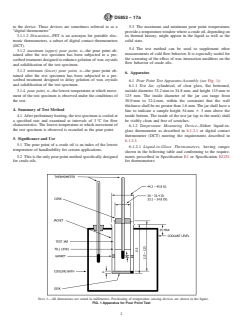
scribed treatment designed to delay gelation of wax crystals 6.1 Pour Point Test Apparatus Assembly (see Fig. 1):
and solidification of the test specimen.
6.1.1 Test Jar, cylindrical, of clear glass, flat bottomed,
3.1.4 pour point, n—the lowest temperature at whichmove-
outside diameter 33.2mm to 34.8 mm, and height 115mm to
ment of the test specimen is observed under the conditions of 125 mm. The inside diameter of the jar can range from
the test.
30.0mm to 32.4mm, within the constraint that the wall
thickness shall be no greater than 1.6 mm.The jar shall have a
4. Summary of Test Method
line to indicate a sample height 54mm 6 3 mm above the
4.1 Afterpreliminaryheating,thetestspecimeniscooledat inside bottom. The inside of the test jar (up to the mark) shall
a specified rate and examined at intervals of 3°C for flow be visibly clean and free of scratches.
characteristics. The lowest temperature at which movement of
6.1.2 Temperature Measuring Device—Either liquid-in-
the test specimen is observed is recorded as the pour point.
glass thermometer as described in 6.1.2.1 or digital contact
thermometer (DCT) meeting the requirements described in
5. Significance and Use
6.1.2.3.
5.1 The pour point of a crude oil is an index of the lowest
6.1.2.1 Liquid-in-Glass Thermometers, having ranges
temperature of handleability for certain applications.
shown in the following table and conforming to the require-
ments prescribed in Specification E1 or Specification E2251
5.2 Thisistheonlypourpointmethodspecificallydesigned
for crude oils. for thermometers:
NOTE 1—All dimensions are stated in millimetres. Positioning of temperature sensing devices are shown in the figure.
FIG. 1 Apparatus for Pour Point Test
D5853 − 17a
may be necessary to use a 1000Ω sensor in order to obtain accurate
Thermometer
measurements.
Number
Thermometer Temperature Range
ASTM IP
NOTE 2—When the DCT display is mounted on the end to the probe’s
sheath,thetestjarwiththeprobeinsertedwillbeunstable.Toresolvethis,
High cloud and pour −38 °C to +50 °C 5C, S5C 1C
it is recommended that the probe be between 15 cm and 30 cm in length.
Low cloud and pour −80 °C to +20 °C 6C 2C
A 5 cm long stopper that has a low thermal conductivity with approxi-
Melting point +32 °C to +127 °C 61C 63C
mately half of it inserted in the sample tube will improve stability.
6.1.2.2 Since separation of liquid column thermometers
6.1.2.4 The DCT calibration drift shall be checked at least
occasionally occurs and may escape detection, the ice point of
annually by either measuring the ice point or against a
the thermometers shall be checked prior to the test and used
reference thermometer in a constant temperature bath at the
only if they are accurate within 61°C (seeTest Method E77).
prescribedimmersiondepthtoensurecompliancewith6.1.2.3.
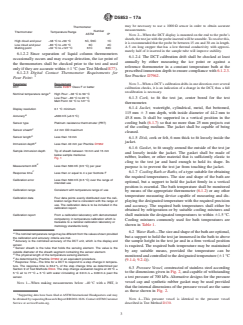
6.1.2.3 Digital Contact Thermometer Requirements for
See Practice D7962.
Pour Point:
Parameter Requirement NOTE 3—When a DCT’s calibration drifts in one direction over several
DCT Guide E2877 Class F or better
calibration checks, it is an indication of a change in the DCT, thus a full
recalibration is necessary.
A
Nominal temperature range High Pour: –38 °C to 50 °C
Low Pour: –80 °C to 20 °C 6.1.3 Cork, to fit the test jar, center bored for the test
Melt Point: 32 °C to 127 °C
thermometer.
Display resolution 0.1 °C minimum 6.1.4 Jacket, watertight, cylindrical, metal, flat bottomed,
115 mm 6 3 mm depth, with inside diameter of 44.2mm to
B
Accuracy ±500 mK (±0.5 °C)
45.8 mm. It shall be supported in a vertical position in the
Sensor type Platinum resistance thermometer (PRT) cooling bath (6.1.7) so that no more than 25 mm projects out
of the cooling medium. The jacket shall be capable of being
C
Sensor sheath 4.2 mm OD maximum
cleaned.
D
Sensor length Less than 10 mm
6.1.5 Disk, cork or felt, 6 mm thick to fit loosely inside the
jacket.
E
Immersion depth Less than 40 mm per Practice D7962
6.1.6 Gasket, to fit snugly around the outside of the test jar
Sample immersion depth Tip of sheath between 10 mm and 15 mm
and loosely inside the jacket. The gasket shall be made of
below sample meniscus
rubber, leather, or other material that is sufficiently elastic to
Fig. 1
cling to the test jar and hard enough to hold its shape. Its
E
Measurement drift Less than 500 mK (0.5 °C) per year
purpose is to prevent the test jar from touching the jacket.
F
6.1.7 Cooling Bath or Baths,ofatypesuitableforobtaining
Response time Less than or equal to 4 s per footnote F
the required temperatures. The size and shape of the bath are
Calibration error Less than 500 mK (0.5 °C) over the range of
optional, but a support to hold the jacket firmly in a vertical
intended use
position is essential. The bath temperature shall be monitored
Calibration range Consistent with temperature range of use
by means of the appropriate thermometer (6.1.2) or any other
temperature measuring device capable of measuring and dis-
Calibration data Four data points evenly distributed over the cali-
bration range that is consistent with the range of playing the designated temperature with the required precision
use. The calibration data is to be included in the
and accuracy. The required bath temperatures shall either be
calibration report.
obtained by refrigeration or by suitable cooling mixtures and
Calibration report From a calibration laboratory with demonstrated shall maintain the designated temperatures to within 61.5°C.
competency in temperature calibration which is
Cooling mixtures commonly used for bath temperatures are
traceable to a national calibration laboratory or
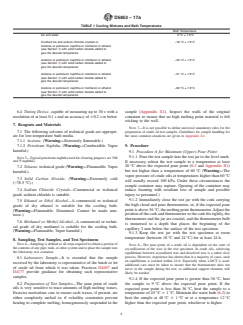
shown in Table 1.
metrology standards body
6.2 WaterBath—Thesizeandshapeofthebathareoptional,
A
The nominal temperature range may be different from the values shown provided
but a support to hold the test jar immersed in the bath to above
the calibration and accuracy criteria are met.
B
Accuracy is the combined accuracy of the DCT unit, which is the display and the sample height in the test jar and in a firm vertical position
sensor.
is required. The required bath temperature may be maintained
C
Sensor sheath is the tube that holds the sensing element. The value is the
by any suitable means, provided the temperature can be
outside diameter of the sheath segment containing the sensor element.
D
The physical length of the temperature sensing element.
monitoredandcontrolledtothedesignatedtemperature(61°C
E
As determined by Practice D7962 or an equivalent procedure.
(9.1.4; 9.2.4)).
F
Response Time—The time for a DCT to respond to a step change in tempera-
ture. The response time is 63.2 % of the step change time as determined per
6.3 Pressure Vessel, constructed of stainless steel according
Section 9 of Test Methods E644. The step change evaluation begins at 20 °C ±
to the dimensions given in Fig. 2, and capable of withstanding
5 °C air to 77 °C ± 5 °C with water circulating at 0.9 m ⁄s ± 0.09 m ⁄s past the
sensor.
a test pressure of 700 kPa.Alternative designs for the pressure
vessel cap and synthetic rubber gasket may be used provided
NOTE 1—When making measurements below –40°C with a PRT, it
thattheinternaldimensionsofthepressurevesselarethesame
as those shown in Fig. 2.
Supporting data have been filed atASTM International Headquarters and may
beobtainedbyrequestingResearchReportRR:D02-1826.ContactASTMCustomer NOTE 4—This pressure vessel is identical to the pressure vessel
Service at service@astm.org. described in Test Method D130.
D5853 − 17a
TABLE 1 Cooling Mixtures and Bath Temperatures
Bath Temperature
Ice and water 0 °C ± 1.5°C
Crushed ice and sodium chloride crystals or −18 °C ± 1.5°C
Acetone or petroleum naphtha or methanol or ethanol
(see Section 7) with solid carbon dioxide added to
give the desired temperature
Acetone or petroleum naphtha or methanol or ethanol –33 °C ± 1.5°C
(see Section 7) with solid carbon dioxide added to
give the desired temperature
Acetone or petroleum naphtha or methanol or ethanol –51 °C ± 1.5°C
(see Section 7) with solid carbon dioxide added to
give the desired temperature
Acetone or petroleum naphtha or methanol or ethanol –69 °C ± 1.5°C
(see Section 7) with solid carbon dioxide added to
give the desired temperature
6.4 Timing Device, capable of measuring up to 30 s with a sample (Appendix X1). Inspect the walls of the original
resolution of at least 0.1 s and an accuracy of 60.2 s or better. container to ensure that no high melting point material is left
sticking to the wall.
7. Reagents and Materials
NOTE 7—It is not possible to define universal mandatory rules for the
7.1 The following solvents of technical grade are appropri-
preparation of crude oil test samples. Guidelines for sample handling for
ate for low-temperature bath media. the most common situations are given in Appendix X1.
7.1.1 Acetone, (Warning—Extremely flammable.)
9. Procedure
7.1.2 Petroleum Naphtha, (Warning—Combustible. Vapor
harmful.)
9.1 Procedure A for Maximum (Upper) Pour Point:
9.1.1 Pour the test sample into the test jar to the level mark.
NOTE5—TypicalpetroleumnaphthausedforcleaningpurposesareVM
and P naphthas.
If necessary, reheat the test sample to a temperature at least
20°C above the expected pour point (8.2 and Appendix X1)
7.2 Toluene, technical grade (Warning—Flammable.Vapor
but not higher than a temperature of 60°C (Warning—The
harmful.).
vapor pressure of crude oils at temperatures higher than 60°C
7.3 Solid Carbon Dioxide, (Warning—Extremely cold
will usually exceed 100 kPa. Under these circumstances the
(−78.5°C).)
sample container may rupture. Opening of the container may
7.4 Sodium Chloride Crystals—Commercial or technical
induce foaming with resultant loss of sample and possible
grade sodium chloride is suitable.
injury to personnel.)
9.1.2 Immediately close the test jar with the cork carrying
7.5 Ethanol or Ethyl Alcohol—A commercial or technical
the high cloud and pour thermometer, or, if the expected pour
grade of dry ethanol is suitable for the cooling bath.
pointisabove36°C,themeltingpointthermometer.Adjustthe
(Warning—Flammable. Denatured. Cannot be made non-
positionofthecorkandthermometersothecorkfitstightly,the
toxic.)
thermometer and the jar are coaxial, and the thermometer bulb
7.6 Methanol or Methyl Alcohol—A commercial or techni-
is immersed to a depth that places the beginning of the
cal grade of dry methanol is suitable for the cooling bath.
capillary 3 mm below the surface of the test specimen.
(Warning—Flammable. Vapor harmful.)
9.1.3 Keep the test jar with the test specimen at room
temperature (between 18°C and 24°C) for at least 24 h.
8. Sampling, Test Samples, and Test Specimens
NOTE6—Samplingisdefinedasallstepsrequiredtoobtainaportionof
NOTE 8—The pour point of a crude oil is dependent on the state of
thecontentsofanypipe,tank,orothersystemandtoplacethesampleinto
crystallization of the wax in the test specimen. In crude oils, achieving
the laboratory test container.
equilibrium between crystallized wax and dissolved wax is a rather slow
process. However, experience has shown that in a majority of cases, such
8.1 Laboratory Sample—It is essential that the sample
an equilibrium is reached within 24 h. Especially when a DCT is used,
received by the laboratory is representative of the batch or lot
additional care must be taken to ensure that the thermometer does not
of crude oil from which it was taken. Practices D4057 and
move in the sample during the test, so additional support elements will
D4177 provide guidance for obtaining such representative
likely be needed.
samples.
9.1.4 If the expected pour point is greater than 36°C, heat
8.2 Preparation of Test Samples—The pour point of crude the sample to 9°C above the expected pour point. If the
oils is very sensitive to trace amounts of high melting waxes. expected pour point is less than 36°C, heat the sample to a
Exercise meticulous care to ensure such waxes, if present, are temperature of 45°C 6 1°C. Maintain the water bath (6.2)to
either completely melted or, if volatility constraints prevent heat the sample at 48°C 6 1°C or at a temperature 12°C
heating to complete melting, homogeneously suspended in the higher than the expected pour point, whichever is higher.
D5853 − 17a
FIG. 2 Pressure Vessel
9.1.4.1 As soon as the test specimen has reached the 9.1.5 Ensure that the disk, gasket, and the inside of the
required temperature, remove the cork carrying the thermom- jacket are clean and dry. Place the disk in the bottom of the
eter and stir the test specimen gently with a spatula or similar jacket. Place the disk and jacket in the cooling medium a
device. Put the cork carrying the thermometer back in place minimum of 10 min before the test jar is inserted. The use of
(see 9.1.2). a jacket cover, while the empty jacket is cooling, is permitted.
D5853 − 17a
9.1.7 until the specification temperature is reached. Report the sample as
Remove the test jar from the water bath and dry with a tissue.
passing or failing the specification limit.
Place the gasket around the test jar, 25 mm from the bottom.
Insert the test jar into the jacket in the first bath maintained at
9.2 Procedure B for Minimum (Lower) Pour Point:
21°C and comm
...
This document is not an ASTM standard and is intended only to provide the user of an ASTM standard an indication of what changes have been made to the previous version. Because
it may not be technically possible to adequately depict all changes accurately, ASTM recommends that users consult prior editions as appropriate. In all cases only the current version
of the standard as published by ASTM is to be considered the official document.
Designation: D5853 − 17 D5853 − 17a
Designation: 441/99 (2004)
Standard Test Method for
Pour Point of Crude Oils
This standard is issued under the fixed designation D5853; the number immediately following the designation indicates the year of
original adoption or, in the case of revision, the year of last revision. A number in parentheses indicates the year of last reapproval. A
superscript epsilon (´) indicates an editorial change since the last revision or reapproval.
1. Scope*
1.1 This test method covers two procedures for the determination of the pour point temperatures of crude oils down to −36 °C.
Procedure A provides a measure of the maximum (upper) pour point temperature and is described in 9.1. Procedure B provides
a measure of the minimum (lower) pour point temperature and is described in 9.2.
1.2 The use of this test method is limited to use for crude oils. Pour point temperatures of other petroleum products can be
determined by Test Method D97.
1.3 The values stated in SI units are to be regarded as standard. No other units of measurement are included in this standard.
1.4 WARNING—Mercury has been designated by many regulatory agencies as a hazardous material that can cause central
nervous system, kidney, and liver damage. Mercury, or its vapor, may be hazardous to health and corrosive to materials. Caution
should be taken when handling mercury and mercury-containing products. See the applicable product Material Safety Data Sheet
(MSDS) for details and EPA’s website—http://www.epa.gov/mercury/faq.htm—for additional information. Users should be aware
that selling mercury and/or mercury containing products in your state or country may be prohibited by law.
1.5 This standard does not purport to address all of the safety concerns, if any, associated with its use. It is the responsibility
of the user of this standard to establish appropriate safety safety, health, and healthenvironmental practices and determine the
applicability of regulatory limitations prior to use. For specific hazard statements, see Section 7.
1.6 This international standard was developed in accordance with internationally recognized principles on standardization
established in the Decision on Principles for the Development of International Standards, Guides and Recommendations issued
by the World Trade Organization Technical Barriers to Trade (TBT) Committee.
2. Referenced Documents
2.1 ASTM Standards:
D97 Test Method for Pour Point of Petroleum Products
D130 Test Method for Corrosiveness to Copper from Petroleum Products by Copper Strip Test
D323 Test Method for Vapor Pressure of Petroleum Products (Reid Method)
D4057 Practice for Manual Sampling of Petroleum and Petroleum Products
D4177 Practice for Automatic Sampling of Petroleum and Petroleum Products
D7962 Practice for Determination of Minimum Immersion Depth and Assessment of Temperature Sensor Measurement Drift
E1 Specification for ASTM Liquid-in-Glass Thermometers
E77 Test Method for Inspection and Verification of Thermometers
E1137E644 Specification Test Methods for Testing Industrial Platinum Resistance Thermometers
E2251 Specification for Liquid-in-Glass ASTM Thermometers with Low-Hazard Precision Liquids
E2877 Guide for Digital Contact Thermometers
3. Terminology
3.1 Definitions of Terms Specific to This Standard:
This test method is under the jurisdiction of ASTM Committee D02 on Petroleum Products, Liquid Fuels, and Lubricants and is the direct responsibility of Subcommittee
D02.07 on Flow Properties.
Current edition approved May 1, 2017Dec. 15, 2017. Published May 2017February 2018. Originally approved in 1995. Last previous edition approved in 20162017 as
D5853 – 16.D5853 – 17. DOI: 10.1520/D5853-17.10.1520/D5853-17A.
For referenced ASTM standards, visit the ASTM website, www.astm.org, or contact ASTM Customer Service at service@astm.org. For Annual Book of ASTM Standards
volume information, refer to the standard’s Document Summary page on the ASTM website.
*A Summary of Changes section appears at the end of this standard
Copyright © ASTM International, 100 Barr Harbor Drive, PO Box C700, West Conshohocken, PA 19428-2959. United States
D5853 − 17a
3.1.1 digital contact thermometer (DCT), n—an electronic device consisting of a digital display and associated temperature
sensing probe.
3.1.1.1 Discussion—
This device consists of a temperature sensor connected to a measuring instrument; this instrument measures the temperature-
dependent quantity of the sensor, computes the temperature from the measured quantity, and provides a digital output. This digital
output goes to a digital display and/or recording device that may be internal or external to the device. These devices are sometimes
referred to as a “digital thermometer.”
3.1.1.2 Discussion—
PET is an acronym for portable electronic thermometers, a subset of digital contact thermometers (DCT).
3.1.2 maximum (upper) pour point, n—the pour point obtained after the test specimen has been subjected to a prescribed
treatment designed to enhance gelation of wax crystals and solidification of the test specimen.
3.1.3 minimum (lower) pour point, n—the pour point obtained after the test specimen has been subjected to a prescribed
treatment designed to delay gelation of wax crystals and solidification of the test specimen.
3.1.4 pour point, n—the lowest temperature at which movement of the test specimen is observed under the conditions of the
test.
4. Summary of Test Method
4.1 After preliminary heating, the test specimen is cooled at a specified rate and examined at intervals of 3 °C for flow
characteristics. The lowest temperature at which movement of the test specimen is observed is recorded as the pour point.
5. Significance and Use
5.1 The pour point of a crude oil is an index of the lowest temperature of handleability for certain applications.
5.2 This is the only pour point method specifically designed for crude oils.
5.3 The maximum and minimum pour point temperatures provide a temperature window where a crude oil, depending on its
thermal history, might appear in the liquid as well as the solid state.
5.4 The test method can be used to supplement other measurements of cold flow behavior. It is especially useful for the
screening of the effect of wax interaction modifiers on the flow behavior of crude oils.
6. Apparatus
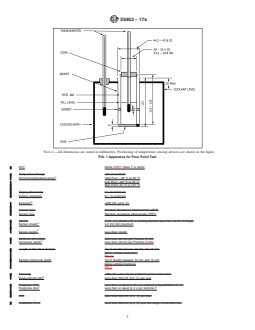
6.1 Pour Point Test Apparatus Assembly (see Fig. 1):
6.1.1 Test Jar, cylindrical, of clear glass, flat bottomed, outside diameter 33.2 mm to 34.8 mm, and height 115 mm to 125 mm.
The inside diameter of the jar can range from 30.0 mm to 32.4 mm, within the constraint that the wall thickness shall be no greater
than 1.6 mm. The jar shall have a line to indicate a sample height 54 mm 6 3 mm above the inside bottom. The inside of the test
jar (up to the mark) shall be visibly clean and free of scratches.
6.1.2 Temperature Measuring Device—Either liquid-in-glass thermometer as described in 6.1.2.1 or digital contact thermometer
(DCT) meeting the requirements described in 6.1.2.3 and 6.1.2.4.
6.1.2.1 Liquid-in-Glass Thermometers, having ranges shown in the following table and conforming to the requirements
prescribed in Specification E1 or Specification E2251 for thermometers:
Thermometer
Number
Thermometer Temperature Range
ASTM IP
High cloud and pour −38 °C to +50 °C 5C, S5C 1C
Low cloud and pour −80 °C to +20 °C 6C 2C
Melting point +32 °C to +127 °C 61C 63C
6.1.2.2 Since separation of liquid column thermometers occasionally occurs and may escape detection, the ice point of the
thermometers shall be checked prior to the test and used only if they are accurate within 61 °C (see Test Method E77).
6.1.2.3 Digital Contact Thermometer Requirements for Pour Point: Digital contact thermometer requirements for pour point:
Parameter Requirement
DCT Guide E2877 Class G or better
Supporting data have been filed at ASTM International Headquarters and may be obtained by requesting Research Report RR:D02-1826. Contact ASTM Customer
Service at service@astm.org.
D5853 − 17a
NOTE 1—All dimensions are stated in millimetres. Positioning of temperature sensing devices are shown in the figure.
FIG. 1 Apparatus for Pour Point Test
DCT Guide E2877 Class F or better
Temperature Range –80 °C to 50 °C
A
Nominal temperature range High Pour: –38 °C to 50 °C
Low Pour: –80 °C to 20 °C
Melt Point: 32 °C to 127 °C
Display Resolution 0.1 °C minimum
Display resolution 0.1 °C minimum
B
Accuracy ±500 mK (±0.5 °C)
Sensor Type Platinum Resistance Thermometer (PRT)
Sensor type Platinum resistance thermometer (PRT)
Sensor 3 mm o.d. sheath with a sensing element less than 10 mm in length
C
Sensor sheath 4.2 mm OD maximum
D
Sensor length Less than 10 mm
Minimum Immersion Less than 40 mm per Practice D7962
E
Immersion depth Less than 40 mm per Practice D7962
Length of Sheath in Sample Tip of sheath between 10 mm and 15 mm
below sample meniscus (
Fig. 1).
Sample immersion depth Tip of sheath between 10 mm and 15 mm
below sample meniscus
Fig. 1
Accuracy ±500 mK (±0.5 °C) for combined probe and sensor
E
Measurement drift Less than 500 mK (0.5 °C) per year
Response Time Less than or equal to 25 s as defined in Specification E1137
F
Response time Less than or equal to 4 s per footnote F
Drift Less than 500 mK (0.5 °C) per year
Calibration Error Less than 500 mK (0.5 °C) over the range of intended use.
D5853 − 17a
Calibration error Less than 500 mK (0.5 °C) over the range of intended use
Calibration Range –40 °C or lower to 50 °C
Calibration range Consistent with temperature range of use
Calibration Data 4 data points evenly distributed over calibration range with data included in calibration report.
Calibration data Four data points evenly distributed over the calibration range that is consistent with the range of
use. The calibration data is to be included in the calibration report.
Calibration Report From a calibration laboratory with demonstrated competency in temperature calibration which is
traceable to a national calibration laboratory or metrology standards body.
Calibration report From a calibration laboratory with demonstrated competency in temperature calibration which is
traceable to a national calibration laboratory or metrology standards body
A
The nominal temperature range may be different from the values shown provided the calibration and accuracy criteria are met.
B
Accuracy is the combined accuracy of the DCT unit, which is the display and sensor.
C
Sensor sheath is the tube that holds the sensing element. The value is the outside diameter of the sheath segment containing the sensor element.
D
The physical length of the temperature sensing element.
E
As determined by Practice D7962 or an equivalent procedure.
F
Response Time—The time for a DCT to respond to a step change in temperature. The response time is 63.2 % of the step change time as determined per Section 9
of Test Methods E644. The step change evaluation begins at 20 °C ± 5 °C air to 77 °C ± 5 °C with water circulating at 0.9 m ⁄s ± 0.09 m ⁄s past the sensor.
6.1.2.4 Digital contact thermometer requirements for melting point:
Parameter Requirement
DCT Guide E2877 Class E or better
Temperature Range 32 °C to 130 °C
Display Resolution 0.1 °C minimum
Sensor Type Platinum Resistance Thermometer (PRT)
Sensor 3 mm o.d. sheath with a sensing element less than 24 mm in length
Minimum Immersion Less than 40 mm per Practice D7962
Length of Sheath in Sample Tip of sheath between 10 mm and 15 mm below sample meniscus (Fig. 1).
Accuracy ±500 mK (±0.5 °C) for combined probe and sensor
Response Time Less than or equal to 25 s as defined in Specification E1137
Drift Less than 500 mK (0.5 °C) per year
Calibration Error Less than 500 mK (0.5 °C) over the range of intended use.
Calibration Range 32 °C or lower to 130 °C
Calibration Data 4 data points evenly distributed over calibration range with data included in calibration report.
Calibration Report From a calibration laboratory with demonstrated competency in temperature calibration which
is traceable to a national calibration laboratory or metrology standards body.
NOTE 1—When the DCT display is mounted on the end to the probe’s sheath, the test jar with the probe inserted will be unstable. To resolve this, it
is recommended that the probe be between 15 cm and 30 cm in length. A 5 cm long stopper that has a low thermal conductivity with approximately half
of it inserted in the sample tube will improve stability.
NOTE 1—When making measurements below –40 °C with a PRT, it may be necessary to use a 1000 Ω sensor in order to obtain accurate measurements.
NOTE 2—When the DCT display is mounted on the end to the probe’s sheath, the test jar with the probe inserted will be unstable. To resolve this, it
is recommended that the probe be between 15 cm and 30 cm in length. A 5 cm long stopper that has a low thermal conductivity with approximately half
of it inserted in the sample tube will improve stability.
6.1.2.4 The DCT calibration drift shall be checked at least annually by either measuring the ice point or against a reference
thermometer in a constant temperature bath at the prescribed immersion depth to ensure compliance with 6.1.2.3 or 6.1.2.4. See
Practice D7962.
NOTE 3—When a DCT’s calibration drifts in one direction over several calibration checks, it is an indication of a change in the DCT, thus a full
recalibration is necessary.
6.1.3 Cork, to fit the test jar, center bored for the test thermometer.
6.1.4 Jacket, watertight, cylindrical, metal, flat bottomed, 115 mm 6 3 mm depth, with inside diameter of 44.2 mm to 45.8 mm.
It shall be supported in a vertical position in the cooling bath (6.1.7) so that no more than 25 mm projects out of the cooling
medium. The jacket shall be capable of being cleaned.
6.1.5 Disk, cork or felt, 6 mm thick to fit loosely inside the jacket.
D5853 − 17a
6.1.6 Gasket, to fit snugly around the outside of the test jar and loosely inside the jacket. The gasket shall be made of rubber,
leather, or other material that is sufficiently elastic to cling to the test jar and hard enough to hold its shape. Its purpose is to prevent
the test jar from touching the jacket.
6.1.7 Cooling Bath or Baths, of a type suitable for obtaining the required temperatures. The size and shape of the bath are
optional, but a support to hold the jacket firmly in a vertical position is essential. The bath temperature shall be monitored by means
of the appropriate thermometer (6.1.2) or any other temperature measuring device capable of measuring and displaying the
designated temperature with the required precision and accuracy. The required bath temperatures shall either be obtained by
refrigeration or by suitable cooling mixtures and shall maintain the designated temperatures to within 61.5 °C. Cooling mixtures
commonly used for bath temperatures are shown in Table 1.
6.2 Water Bath—The size and shape of the bath are optional, but a support to hold the test jar immersed in the bath to above
the sample height in the test jar and in a firm vertical position is required. The required bath temperature may be maintained by
any suitable means, provided the temperature can be monitored and controlled to the designated temperature (61 °C (9.1.4; 9.2.4)).
6.3 Pressure Vessel, constructed of stainless steel according to the dimensions given in Fig. 2, and capable of withstanding a
test pressure of 700 kPa. Alternative designs for the pressure vessel cap and synthetic rubber gasket may be used provided that
the internal dimensions of the pressure vessel are the same as those shown in Fig. 2.
NOTE 4—This pressure vessel is identical to the pressure vessel described in Test Method D130.
6.4 Timing Device, capable of measuring up to 30 s with a resolution of at least 0.1 s and an accuracy of 60.2 s or better.
7. Reagents and Materials
7.1 The following solvents of technical grade are appropriate for low-temperature bath media.
7.1.1 Acetone, (Warning—Extremely flammable.)
7.1.2 Petroleum Naphtha, (Warning—Combustible. Vapor harmful.)
NOTE 5—Typical petroleum naphtha used for cleaning purposes are VM and P naphthas.
7.2 Toluene, technical grade (Warning—Flammable. Vapor harmful.).
7.3 Solid Carbon Dioxide, (Warning—Extremely cold (−78.5 °C).)
7.4 Sodium Chloride Crystals—Commercial or technical grade sodium chloride is suitable.
7.5 Ethanol or Ethyl Alcohol—A commercial or technical grade of dry ethanol is suitable for the cooling bath. (Warning—
Flammable. Denatured. Cannot be made nontoxic.)
7.6 Methanol or Methyl Alcohol—A commercial or technical grade of dry methanol is suitable for the cooling bath.
(Warning—Flammable. Vapor harmful.)
8. Sampling, Test Samples, and Test Specimens
NOTE 6—Sampling is defined as all steps required to obtain a portion of the contents of any pipe, tank, or other system and to place the sample into
the laboratory test container.
8.1 Laboratory Sample—It is essential that the sample received by the laboratory is representative of the batch or lot of crude
oil from which it was taken. Practices D4057 and D4177 provide guidance for obtaining such representative samples.
TABLE 1 Cooling Mixtures and Bath Temperatures
Bath Temperature
Ice and water 0 °C ± 1.5°C
Crushed ice and sodium chloride crystals or −18 °C ± 1.5°C
Acetone or petroleum naphtha or methanol or ethanol
(see Section 7) with solid carbon dioxide added to
give the desired temperature
Acetone or petroleum naphtha or methanol or ethanol –33 °C ± 1.5°C
(see Section 7) with solid carbon dioxide added to
give the desired temperature
Acetone or petroleum naphtha or methanol or ethanol –51 °C ± 1.5°C
(see Section 7) with solid carbon dioxide added to
give the desired temperature
Acetone or petroleum naphtha or methanol or ethanol –69 °C ± 1.5°C
(see Section 7) with solid carbon dioxide added to
give the desired temperature
D5853 − 17a
FIG. 2 Pressure Vessel
8.2 Preparation of Test Samples—The pour point of crude oils is very sensitive to trace amounts of high melting waxes. Exercise
meticulous care to ensure such waxes, if present, are either completely melted or, if volatility constraints prevent heating to
complete melting, homogeneously suspended in the sample (Appendix X1). Inspect the walls of the original container to ensure
that no high melting point material is left sticking to the wall.
NOTE 7—It is not possible to define universal mandatory rules for the preparation of crude oil test samples. Guidelines for sample handling for the most
common situations are given in Appendix X1.
9. Procedure
9.1 Procedure A for Maximum (Upper) Pour Point:
D5853 − 17a
9.1.1 Pour the test sample into the test jar to the level mark. If necessary, reheat the test sample to a temperature at least 20 °C
above the expected pour point (8.2 and Appendix X1) but not higher than a temperature of 60 °C (Warning—The vapor pressure
of crude oils at temperatures higher than 60 °C will usually exceed 100 kPa. Under these circumstances the sample container may
rupture. Opening of the container may induce foaming with resultant loss of sample and possible injury to personnel.)
9.1.2 Immediately close the test jar with the cork carrying the high cloud and pour thermometer, or, if the expected pour point
is above 36 °C, the melting point thermometer. Adjust the position of the cork and thermometer so the cork fits tightly, the
thermometer and the jar are coaxial, and the thermometer bulb is immersed to a depth that places the beginning of the capillary
3 mm below the surface of the test specimen.
9.1.3 Keep the test jar with the test specimen at room temperature (between 18 °C and 24 °C) for at least 24 h.
NOTE 8—The pour point of a crude oil is dependent on the state of crystallization of the wax in the test specimen. In crude oils, achieving equilibrium
between crystallized wax and dissolved wax is a rather slow process. However, experience has shown that in a majority of cases, such an equilibrium
is reached within 24 h. Especially when a DCT is used, additional care must be taken to ensure that the thermometer does not move in the sample during
the test, so additional support elements will likely be needed.
9.1.4 If the expected pour point is greater than 36 °C, heat the sample to 9
...