

ASTM D3236-15(2021)
(Test Method)Standard Test Method for Apparent Viscosity of Hot Melt Adhesives and Coating Materials
General Information
- Abstract
SIGNIFICANCE AND USE
5.1 This test method distinguishes between hot melts having different apparent viscosities. It is believed that apparent viscosity determined by this procedure is related to flow performance in application machinery operating under conditions of low shear rate. Apparent viscosity as determined by this test method may not correlate well with end-use applications where high shear rates are encountered.
5.2 Materials of the type described in this procedure may be quite non-Newtonian and as such, the apparent viscosity will be a function of shear rate under the conditions of test. Although the viscometer described in this test method generally operates under conditions of relatively low shear rate, differences in shear effect can exist depending upon the spindle and rotational speed conditions selected for the test program. Maximum correlation between laboratories, therefore, depends upon testing under conditions of equivalent shear.
SCOPE
1.1 This test method covers the determination of the apparent viscosity of hot melt adhesives and coating materials compounded with additives and having apparent viscosities up to 200 000 millipascal second (mPa·s) (Note 3) at temperatures up to 175 °C (347 °F).
Note 1: Although precision has not been studied, this procedure may be adaptable to viscosities higher than the present 200 000 mPa·s limit and temperatures above 175 °C (347 °F). Equipment described in this test method permits testing of materials having viscosities as high as 16 × 106 mPa·s and provides temperatures up to 260 °C (500 °F).
Note 2: For petroleum waxes and their blends having apparent viscosities below 15 mPa·s, Test Method D445 is especially applicable.
Note 3: One pascal second (Pa·s) = 1000 centipoise (cP); one millipascal-second = one centipoise.
1.2 The values stated in SI units are to be regarded as the standard. The values in parentheses are for information only.
1.3 This standard does not purport to address all of the safety concerns, if any, associated with its use. It is the responsibility of the user of this standard to establish appropriate safety, health, and environmental practices and determine the applicability of regulatory limitations prior to use.
1.4 This international standard was developed in accordance with internationally recognized principles on standardization established in the Decision on Principles for the Development of International Standards, Guides and Recommendations issued by the World Trade Organization Technical Barriers to Trade (TBT) Committee.
- Status
- Published
- Publication Date
- 31-Dec-2020
- Technical Committee
- D02 - Petroleum Products, Liquid Fuels, and Lubricants
Overview
ASTM D3236-15(2021): Standard Test Method for Apparent Viscosity of Hot Melt Adhesives and Coating Materials provides an internationally recognized methodology for determining the apparent viscosity of hot melt adhesives and coating materials. Developed by ASTM International, this standard is especially valuable for assessing materials with viscosities up to 200,000 millipascal-seconds (mPa·s) at temperatures up to 175°C (347°F). The procedure is adaptable for higher viscosities and temperatures with proper equipment, supporting quality assurance in manufacturing and R&D environments.
The standard is applicable to a range of non-Newtonian materials often used in industrial settings. It enables reliable differentiation among products with varying flow characteristics, thereby supporting decision-making in formulation, process design, and material selection.
Key Topics
- Apparent Viscosity Measurement: The test measures the flow resistance of molten hot melt adhesives and coatings under low shear rate conditions, relevant to real-world machinery operations.
- Low Shear Conditions: Particularly suited for applications where materials are subject to low mechanical stress during processing.
- Use of Rotational Viscometer: Employs a concentric cylinder rotational viscometer with a precision temperature-controlled environment to ensure reproducible results.
- Range of Applicability: Covers materials with viscosities up to 200,000 mPa·s at temperatures up to 175°C, adaptable to higher values with recommended equipment.
- Testing Variables: Recognizes the impact of spindle choice, rotational speed, and other operational parameters due to the non-Newtonian nature of many hot melts.
- Laboratory Correlation: Emphasizes testing under equivalent shear conditions for maximum reproducibility between laboratories.
- Safety and Compliance: Users are responsible for establishing appropriate safety, health, and environmental practices.
Applications
Adhering to ASTM D3236-15(2021) supports manufacturers, quality control teams, and R&D specialists in:
- Product Development: Characterizing the apparent viscosity of new hot melt adhesive and coating formulations to tailor properties for specific end-use requirements.
- Quality Control: Verifying material consistency and flow performance before large-scale application or shipment.
- Process Optimization: Informing the selection of application machinery settings, as apparent viscosity is closely related to flow under operational conditions.
- Comparative Testing: Distinguishing between different batches or types of adhesives and coatings to guarantee performance and reliability.
- Certification and Compliance: Demonstrating adherence to internationally recognized standards for customers and regulatory bodies.
Industries benefiting from this standard include packaging, woodworking, automotive assembly, labeling, textiles, and electronics - anywhere hot melt adhesives or coating materials are critical to process efficiency and product integrity.
Related Standards
- ASTM D445: Test Method for Kinematic Viscosity of Transparent and Opaque Liquids. Particularly relevant for petroleum waxes and blends with viscosities below 15 mPa·s.
- Other ASTM Viscosity Standards: Such as ASTM D2170 and D2196, for specialized materials or different viscosity measurement techniques.
- International Standards: Developed in line with World Trade Organization (WTO) principles, facilitating global trade and regulatory acceptance.
By following ASTM D3236-15(2021), organizations ensure consistent and reliable viscosity measurement for hot melt adhesive and coating materials, underpinning product quality and compliance in manufacturing processes around the world.
Relations
- Effective Date
- 01-Apr-2024
- Effective Date
- 01-Nov-2023
- Effective Date
- 15-Dec-2016
- Effective Date
- 01-Jul-2014
- Effective Date
- 01-Jul-2014
- Effective Date
- 15-Apr-2012
- Effective Date
- 15-May-2006
- Effective Date
- 01-Nov-2004
- Effective Date
- 01-Nov-2004
- Effective Date
- 01-May-2004
- Effective Date
- 10-Mar-2003
- Effective Date
- 10-Jan-2001
Get Certified
Connect with accredited certification bodies for this standard

DIN CERTCO
DIN Group product certification.
DVS-ZERT GmbH
German welding certification society.
CARES (UK Certification Authority for Reinforcing Steels)
UK certification for reinforcing steels and construction.
Sponsored listings
Frequently Asked Questions
ASTM D3236-15(2021) is a standard published by ASTM International. Its full title is "Standard Test Method for Apparent Viscosity of Hot Melt Adhesives and Coating Materials". This standard covers: SIGNIFICANCE AND USE 5.1 This test method distinguishes between hot melts having different apparent viscosities. It is believed that apparent viscosity determined by this procedure is related to flow performance in application machinery operating under conditions of low shear rate. Apparent viscosity as determined by this test method may not correlate well with end-use applications where high shear rates are encountered. 5.2 Materials of the type described in this procedure may be quite non-Newtonian and as such, the apparent viscosity will be a function of shear rate under the conditions of test. Although the viscometer described in this test method generally operates under conditions of relatively low shear rate, differences in shear effect can exist depending upon the spindle and rotational speed conditions selected for the test program. Maximum correlation between laboratories, therefore, depends upon testing under conditions of equivalent shear. SCOPE 1.1 This test method covers the determination of the apparent viscosity of hot melt adhesives and coating materials compounded with additives and having apparent viscosities up to 200 000 millipascal second (mPa·s) (Note 3) at temperatures up to 175 °C (347 °F). Note 1: Although precision has not been studied, this procedure may be adaptable to viscosities higher than the present 200 000 mPa·s limit and temperatures above 175 °C (347 °F). Equipment described in this test method permits testing of materials having viscosities as high as 16 × 106 mPa·s and provides temperatures up to 260 °C (500 °F). Note 2: For petroleum waxes and their blends having apparent viscosities below 15 mPa·s, Test Method D445 is especially applicable. Note 3: One pascal second (Pa·s) = 1000 centipoise (cP); one millipascal-second = one centipoise. 1.2 The values stated in SI units are to be regarded as the standard. The values in parentheses are for information only. 1.3 This standard does not purport to address all of the safety concerns, if any, associated with its use. It is the responsibility of the user of this standard to establish appropriate safety, health, and environmental practices and determine the applicability of regulatory limitations prior to use. 1.4 This international standard was developed in accordance with internationally recognized principles on standardization established in the Decision on Principles for the Development of International Standards, Guides and Recommendations issued by the World Trade Organization Technical Barriers to Trade (TBT) Committee.
SIGNIFICANCE AND USE 5.1 This test method distinguishes between hot melts having different apparent viscosities. It is believed that apparent viscosity determined by this procedure is related to flow performance in application machinery operating under conditions of low shear rate. Apparent viscosity as determined by this test method may not correlate well with end-use applications where high shear rates are encountered. 5.2 Materials of the type described in this procedure may be quite non-Newtonian and as such, the apparent viscosity will be a function of shear rate under the conditions of test. Although the viscometer described in this test method generally operates under conditions of relatively low shear rate, differences in shear effect can exist depending upon the spindle and rotational speed conditions selected for the test program. Maximum correlation between laboratories, therefore, depends upon testing under conditions of equivalent shear. SCOPE 1.1 This test method covers the determination of the apparent viscosity of hot melt adhesives and coating materials compounded with additives and having apparent viscosities up to 200 000 millipascal second (mPa·s) (Note 3) at temperatures up to 175 °C (347 °F). Note 1: Although precision has not been studied, this procedure may be adaptable to viscosities higher than the present 200 000 mPa·s limit and temperatures above 175 °C (347 °F). Equipment described in this test method permits testing of materials having viscosities as high as 16 × 106 mPa·s and provides temperatures up to 260 °C (500 °F). Note 2: For petroleum waxes and their blends having apparent viscosities below 15 mPa·s, Test Method D445 is especially applicable. Note 3: One pascal second (Pa·s) = 1000 centipoise (cP); one millipascal-second = one centipoise. 1.2 The values stated in SI units are to be regarded as the standard. The values in parentheses are for information only. 1.3 This standard does not purport to address all of the safety concerns, if any, associated with its use. It is the responsibility of the user of this standard to establish appropriate safety, health, and environmental practices and determine the applicability of regulatory limitations prior to use. 1.4 This international standard was developed in accordance with internationally recognized principles on standardization established in the Decision on Principles for the Development of International Standards, Guides and Recommendations issued by the World Trade Organization Technical Barriers to Trade (TBT) Committee.
ASTM D3236-15(2021) is classified under the following ICS (International Classification for Standards) categories: 25.220.60 - Organic coatings; 83.180 - Adhesives. The ICS classification helps identify the subject area and facilitates finding related standards.
ASTM D3236-15(2021) has the following relationships with other standards: It is inter standard links to ASTM D445-24, ASTM D445-23, ASTM D445-16, ASTM D445-14e1, ASTM D445-14, ASTM D445-12, ASTM D445-06, ASTM D445-04e1, ASTM D445-04e2, ASTM D445-04, ASTM D445-03, ASTM D445-97. Understanding these relationships helps ensure you are using the most current and applicable version of the standard.
ASTM D3236-15(2021) is available in PDF format for immediate download after purchase. The document can be added to your cart and obtained through the secure checkout process. Digital delivery ensures instant access to the complete standard document.
Standards Content (Sample)
This international standard was developed in accordance with internationally recognized principles on standardization established in the Decision on Principles for the
Development of International Standards, Guides and Recommendations issued by the World Trade Organization Technical Barriers to Trade (TBT) Committee.
Designation: D3236 − 15 (Reapproved 2021)
Standard Test Method for
Apparent Viscosity of Hot Melt Adhesives and Coating
Materials
This standard is issued under the fixed designation D3236; the number immediately following the designation indicates the year of
original adoption or, in the case of revision, the year of last revision. A number in parentheses indicates the year of last reapproval. A
superscript epsilon (´) indicates an editorial change since the last revision or reapproval.
1. Scope and Opaque Liquids (and Calculation of Dynamic Viscos-
ity)
1.1 This test method covers the determination of the appar-
ent viscosity of hot melt adhesives and coating materials
3. Terminology
compounded with additives and having apparent viscosities up
3.1 Definitions:
to 200 000 millipascal second (mPa·s) (Note 3) at temperatures
3.1.1 apparent viscosity, n—the viscosity determined by this
up to 175 °C (347 °F).
test method and expressed in millipascal seconds. Its value
NOTE 1—Although precision has not been studied, this procedure may
may vary with the spindle and rotational speed selected
be adaptable to viscosities higher than the present 200 000 mPa·s limit and
because many hot melts are non-Newtonian.
temperatures above 175 °C (347 °F). Equipment described in this test
method permits testing of materials having viscosities as high as
3.1.2 viscosity, n—the ratio of shear stress to shear rate. The
16 × 10 mPa·s and provides temperatures up to 260 °C (500 °F).
viscosity of a liquid is a measure of the internal friction of the
NOTE 2—For petroleum waxes and their blends having apparent
liquid in motion. The unit of dynamic viscosity is the pascal
viscosities below 15 mPa·s, Test Method D445 is especially applicable.
second. For a Newtonian liquid, the viscosity is constant at all
NOTE 3—One pascal second (Pa·s) = 1000 centipoise (cP); one milli-
shear rates. For a non-Newtonian liquid, viscosity will vary
pascal-second = one centipoise.
depending on shear rate.
1.2 The values stated in SI units are to be regarded as the
standard. The values in parentheses are for information only.
4. Summary of Test Method
1.3 This standard does not purport to address all of the
4.1 A representative sample of the molten material to be
safety concerns, if any, associated with its use. It is the
tested is maintained in a thermally controlled sample chamber.
responsibility of the user of this standard to establish appro-
Apparent viscosity is determined under temperature equilib-
priate safety, health, and environmental practices and deter-
rium conditions using a precision rotating spindle type viscom-
mine the applicability of regulatory limitations prior to use.
eter. Data obtained at several temperatures can be plotted on
1.4 This international standard was developed in accor-
appropriate semi-logarithmic graph paper and apparent viscos-
dance with internationally recognized principles on standard-
ity at intermediate temperatures can be estimated.
ization established in the Decision on Principles for the
Development of International Standards, Guides and Recom-
5. Significance and Use
mendations issued by the World Trade Organization Technical
5.1 This test method distinguishes between hot melts having
Barriers to Trade (TBT) Committee.
different apparent viscosities. It is believed that apparent
viscosity determined by this procedure is related to flow
2. Referenced Documents
performance in application machinery operating under condi-
2.1 ASTM Standards:
tions of low shear rate. Apparent viscosity as determined by
D445 Test Method for Kinematic Viscosity of Transparent
this test method may not correlate well with end-use applica-
tions where high shear rates are encountered.
1 5.2 Materials of the type described in this procedure may be
This test method is under the jurisdiction of ASTM Committee D02 on
Petroleum Products, Liquid Fuels, and Lubricants and is the direct responsibility of
quite non-Newtonian and as such, the apparent viscosity will
Subcommittee D02.10 on Properties of Petroleum Waxes and Alternative Wax-like
be a function of shear rate under the conditions of test.
Materials.
Although the viscometer described in this test method gener-
Current edition approved Jan. 1, 2021. Published February 2021. Originally
ally operates under conditions of relatively low shear rate,
approved in 1973. Last previous edition approved in 2015 as D3236 – 15. DOI:
10.1520/D3236-15R21.
differences in shear effect can exist depending upon the spindle
For referenced ASTM standards, visit the ASTM website, www.astm.org, or
and rotational speed conditions selected for the test program.
contact ASTM Customer Service at service@astm.org. For Annual Book of ASTM
Maximum correlation between laboratories, therefore, depends
Standards volume information, refer to the standard’s Document Summary page on
the ASTM website. upon testing under conditions of equivalent shear.
Copyright © ASTM International, 100 Barr Harbor Drive, PO Box C700, West Conshohocken, PA 19428-2959. United States
D3236 − 15 (2021)
6. Apparatus
6.1 Viscometer, Concentric Cylinder Rotational—The es-
sential instrumentation required providing the minimum ratio-
nal viscometer analytical capabilities include:
6.1.1 Drive motor, to apply a unidirectional rotational dis-
placement to the specimen at a rate of 0.5 r ⁄min to 60 r ⁄min
constant to 61 %.
6.1.2 Force sensor, to measure the torque developed by the
specimen in response to the rotational displacement.
6.1.3 Coupling shaft, or other means to transmit the rota-
tional displacement from the motor to the specimen.
NOTE 4—It is helpful to have a mark on the shaft to indicate appropriate
test fluid level.
6.1.4 Stainless steel rotational element, spindle, or tool, for
the type shown in Fig. 1 to fix the specimen between the draft
shaft and a stationary position.
6.1.5 Data collection device, to provide a means of
acquiring, storing, and displaying measured or calculated
signals, or both. The minimum output signals required for
rotational viscometry are torque, rotational speed, temperature,
and time.
NOTE 5—Manual observation and recording of data are acceptable.
6.1.6 Temperature measuring device, to provide an indica-
tion of the specimen temperature over their range of 100 °C to
200 °C to within 60.2 °C.
6.1.7 Stand, to support, level, and adjust the height of the
drive motor, shaft and rotational element.
6.1.8 Specimen container, fitted with an insulated cover, to
contain the test specimen during testing.
6.1.9 Auxiliary instrumentation considered necessary or
useful in conducting this method includes:
6.1.9.1 Data analysis capability to provide viscosity, stress,
or other useful parameters derived from measured signals.
6.1.9.2 Level to indicate the vertical plumb of the drive
motor, shaft, and rotational element.
6.1.9.3 A guard to protect the rotational element from
mechanical damage.
6.2 Temperature Bath and precision proportional tempera-
ture controller that provides a controlled isothermal tempera-
ture environment over the range of 100 °C to 200 °C (212 °F to
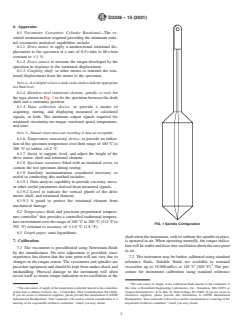
FIG. 1 Spindle Configuration
392 °F) constant to accuracy of 61.0 °C (1.8 °F).
6.3 Graph paper, semi-logarithmic.
shaft when the instrument, with or without the spindle in place,
7. Calibration is operated in air. When operating normally, the torque indica-
tion will be stable and have free oscillation about the zero point
7.1 The viscometer is precalibrated using Newtonian fluids
in air.
by the manufacturer. No zero adjustment is provided, since
experience has shown that the zero point will not vary due to 7.2 The instrument may be further calibrated using standard
changes in the torque sensor. The viscometer and spindles are reference fluids. Suitable fluids are available in nominal
precision equipment and should be kept from undue shock and viscosities up to 15 000 mPa·s at 149 °C (300 °F). The pro-
mishandling. Physical damage to the instrument will often cedure for instrument calibration using standard reference
reveal itself as erratic torque indication or no oscillation of the
The sole source of supply of the calibration fluids known to the committee at
The sole source of supply of the temperature controller known to the committee this time is Brookfield Engineering Laboratories, Inc., Stoughton, MA 02072 or
at this time is Athena Controls, Inc., 2 Union Rd., West Conshohocken, PA 19428. Cannon Instrument Co., P. O. Box 16, State College, PA 16801. If you are aware of
If you are aware of alternative suppliers, please provide this information to ASTM alternative suppliers, please provide this information to ASTM International
International Headquarters. Your comments will receive careful consideration at a Headquarters. Your comments will receive careful consideration at a meeting of the
1 1
meeting of the responsible technical committee, which you may attend. responsible technical committee, which you may attend.
D3236 − 15 (2021)
fluids is that encompassed by this test method. Results obtained 8.4.1 Ensure that the material in the sample chamber is
using standard reference fluids should not deviate from the completely molten and that the test specimen is equilibrated to
nominal viscosity by more than 2 %. the selected temperature controller settings.
8.4.2 Initiate the spindle rotation at the lowest spindle speed
7.3 To further check the controller and further establish
available to minimize temperature gradients in the sample as
controller settings, use the following procedure: Place a suffi-
well as possible shear effects.
cient quantity of low viscosity (500 mPa·s or less) hot melt in
8.4.3 When temperature equilibrium is indicated, stop the
the sample container to permit immersion of the appropriate
spindle rotation, remove the insulating cap, raise the viscom-
ASTM thermometer to the proper depth.
eter and spindle, and inspect the liquid level on the spindle
NOTE 6—Do not permit the temperature sensor to rest on the bottom of
shaft. It should extend about 3 mm ( ⁄8 in.) up the spindle shaft
the sample container.
beyond the upper, tapered portion of the spindle. If the liquid
level varies significantly f
...