

ASTM F2276-23
(Specification)Standard Specification for Fitness Equipment
General Information
- Abstract
ABSTRACT
This specification establishes parameters for the design and manufacture of fitness equipment intended for use by individuals age 12 and above. The design and construction requirements for the following are specified: (1) stability, (2) support, (3) edges, corners, and tube ends, and (4) moving parts in accessible areas such as rotating and reciprocating points. The equipment shall meet the guarding, enclosure, and spacing requirements specified for: (1) squeeze, shear, and crush points, (2) adjustment and locking means, (3) handgrips (integral, applied, and rotating) and foot support, (4) load development and transmitting components such as ropes, belts, chains, and other means, and chain or gear drives, and (5) intrinsic, extrinsic, and endurance loading. The documentation shall include the following: assembly instructions, list of equipment parts, operational instructions, and maintenance instructions. Adequate warnings or warning labels alerting users, third parties, and service personnel to hazards associated with use and service of the equipment shall be provided for consumer, commercial, and institutional fitness equipment. The requirements for site-specific labels and user weight restrictions are specified.
SCOPE
1.1 This specification establishes parameters for the design and manufacture of fitness equipment as defined in 3.1.9.
1.2 It is intended that these fitness products be used in an indoor setting or environment.
1.3 It is the intent of this specification to specify products for use by individuals age 13 and above.
1.4 This standard is to be used in conjunction with Test Methods F2571.
1.5 The values stated in SI units are to be regarded as the standard. The values given in parentheses are for information only.
1.6 This standard does not purport to address all of the safety concerns, if any, associated with its use. It is the responsibility of the user of this standard to establish appropriate safety, health, and environmental practices and determine the applicability of regulatory limitations prior to use.
1.7 This international standard was developed in accordance with internationally recognized principles on standardization established in the Decision on Principles for the Development of International Standards, Guides and Recommendations issued by the World Trade Organization Technical Barriers to Trade (TBT) Committee.
- Status
- Published
- Publication Date
- 31-Jul-2023
- Technical Committee
- F08 - Sports Equipment, Playing Surfaces, and Facilities
- Drafting Committee
- F08.30 - Fitness Products
Overview
ASTM F2276-23: Standard Specification for Fitness Equipment is an internationally recognized standard developed by ASTM International. This specification establishes comprehensive parameters for the design and manufacture of stationary fitness equipment intended for use by individuals aged 13 and above. The standard covers both consumer and institutional fitness equipment used primarily in indoor environments, aiming to ensure safety, functional performance, and proper documentation for users, manufacturers, and facility operators.
ASTM F2276-23 serves as a foundational guide for stakeholders seeking to meet regulatory, safety, and performance requirements in the fitness industry, helping minimize hazards such as pinch, crush, and entrapment points. The standard is applicable to a range of stationary fitness machines and must be used in conjunction with relevant test methods (e.g., ASTM F2571).
Key Topics
Design and Construction Requirements
- Stability: Equipment must remain stable during use, loading, and storage.
- Support: User-supporting components like seats and footrests must safely withstand intended weight and loads without breakage.
- Edges, Corners, and Tubes: All accessible edges and corners must be free of sharp points or burrs, and tube ends must be securely closed.
- Moving Parts: Pinch, shear, and crush points must be guarded, and minimum clearances must be maintained to prevent injury.
- Electrical Components: Must be guarded to prevent inadvertent contact with hazardous elements.
Guarding and Safety Labels
- Accessible areas must be protected against squeeze, shear, and crush hazards, either by design or clear, conspicuous warning labels.
- Chain and gear drives must comply with applicable guarding standards.
- Warning and site-specific labels should draw attention to hazards for users and third parties.
Documentation and Instructions
- Detailed assembly, operation, and maintenance instructions are required.
- Manuals must include safety warnings, part lists, operational guidance, and maintenance requirements.
- Documentation must be accessible, including ADA-compliant formats and digital copies available for several years after production.
Load and Endurance Testing
- Equipment must safely support both intrinsic (user body weight) and extrinsic (added loads) loading.
- Structural elements and moving components should meet specific endurance standards for cycle counts, based on intended usage environment (consumer or institutional).
Applications
- Manufacturers: Ensures design and manufacturing consistency, enabling the production of safer, more reliable fitness equipment that meets global market demands.
- Fitness Facilities and Commercial Gyms: Facilitates procurement of equipment that meets stringent safety and labeling requirements, reducing liability and injury risks for users and third parties.
- Consumers: Provides reassurance that equipment meets published safety and performance standards, with accessible operational and maintenance information.
- Testing Laboratories and Certifying Bodies: Supports standardized test methods and performance benchmarks for fitness equipment evaluation and certification.
Related Standards
- ASTM F2571: Test Methods for Evaluating Design and Performance Characteristics of Fitness Equipment - Used in conjunction with ASTM F2276 for comprehensive evaluation.
- ASTM F1749: Specification for Fitness Equipment and Fitness Facility Safety Signage and Labels - Provides detailed requirements for safety warnings and labels.
- ANSI B29.1: Precision Power Transmission Roller Chains, Attachments, and Sprockets - Referenced for guarding requirements of chain and gear drives.
- EN 957-1: Stationary Training Equipment–Part 1: General Safety Requirements and Test Methods - Related European standard for stationary fitness equipment.
Practical Value
Adherence to ASTM F2276-23 fosters enhanced product safety, quality, and usability in the fitness equipment industry. By following this standard, organizations can:
- Minimize user injuries and operational hazards
- Facilitate regulatory compliance and international market access
- Ensure clear communication of operational and maintenance procedures
- Support ongoing product reliability through standardized endurance and safety testing
Keywords: fitness equipment standard, ASTM F2276, safety requirements, stationary training equipment, fitness product compliance, extrinsic loading, fitness equipment labeling, maintenance instructions, fitness equipment design.
Relations
- Effective Date
- 01-May-2020
- Effective Date
- 01-Apr-2015
- Effective Date
- 15-Nov-2009
- Effective Date
- 01-Jun-2009
- Effective Date
- 10-May-2002
- Effective Date
- 10-May-2002
Frequently Asked Questions
ASTM F2276-23 is a technical specification published by ASTM International. Its full title is "Standard Specification for Fitness Equipment". This standard covers: ABSTRACT This specification establishes parameters for the design and manufacture of fitness equipment intended for use by individuals age 12 and above. The design and construction requirements for the following are specified: (1) stability, (2) support, (3) edges, corners, and tube ends, and (4) moving parts in accessible areas such as rotating and reciprocating points. The equipment shall meet the guarding, enclosure, and spacing requirements specified for: (1) squeeze, shear, and crush points, (2) adjustment and locking means, (3) handgrips (integral, applied, and rotating) and foot support, (4) load development and transmitting components such as ropes, belts, chains, and other means, and chain or gear drives, and (5) intrinsic, extrinsic, and endurance loading. The documentation shall include the following: assembly instructions, list of equipment parts, operational instructions, and maintenance instructions. Adequate warnings or warning labels alerting users, third parties, and service personnel to hazards associated with use and service of the equipment shall be provided for consumer, commercial, and institutional fitness equipment. The requirements for site-specific labels and user weight restrictions are specified. SCOPE 1.1 This specification establishes parameters for the design and manufacture of fitness equipment as defined in 3.1.9. 1.2 It is intended that these fitness products be used in an indoor setting or environment. 1.3 It is the intent of this specification to specify products for use by individuals age 13 and above. 1.4 This standard is to be used in conjunction with Test Methods F2571. 1.5 The values stated in SI units are to be regarded as the standard. The values given in parentheses are for information only. 1.6 This standard does not purport to address all of the safety concerns, if any, associated with its use. It is the responsibility of the user of this standard to establish appropriate safety, health, and environmental practices and determine the applicability of regulatory limitations prior to use. 1.7 This international standard was developed in accordance with internationally recognized principles on standardization established in the Decision on Principles for the Development of International Standards, Guides and Recommendations issued by the World Trade Organization Technical Barriers to Trade (TBT) Committee.
ABSTRACT This specification establishes parameters for the design and manufacture of fitness equipment intended for use by individuals age 12 and above. The design and construction requirements for the following are specified: (1) stability, (2) support, (3) edges, corners, and tube ends, and (4) moving parts in accessible areas such as rotating and reciprocating points. The equipment shall meet the guarding, enclosure, and spacing requirements specified for: (1) squeeze, shear, and crush points, (2) adjustment and locking means, (3) handgrips (integral, applied, and rotating) and foot support, (4) load development and transmitting components such as ropes, belts, chains, and other means, and chain or gear drives, and (5) intrinsic, extrinsic, and endurance loading. The documentation shall include the following: assembly instructions, list of equipment parts, operational instructions, and maintenance instructions. Adequate warnings or warning labels alerting users, third parties, and service personnel to hazards associated with use and service of the equipment shall be provided for consumer, commercial, and institutional fitness equipment. The requirements for site-specific labels and user weight restrictions are specified. SCOPE 1.1 This specification establishes parameters for the design and manufacture of fitness equipment as defined in 3.1.9. 1.2 It is intended that these fitness products be used in an indoor setting or environment. 1.3 It is the intent of this specification to specify products for use by individuals age 13 and above. 1.4 This standard is to be used in conjunction with Test Methods F2571. 1.5 The values stated in SI units are to be regarded as the standard. The values given in parentheses are for information only. 1.6 This standard does not purport to address all of the safety concerns, if any, associated with its use. It is the responsibility of the user of this standard to establish appropriate safety, health, and environmental practices and determine the applicability of regulatory limitations prior to use. 1.7 This international standard was developed in accordance with internationally recognized principles on standardization established in the Decision on Principles for the Development of International Standards, Guides and Recommendations issued by the World Trade Organization Technical Barriers to Trade (TBT) Committee.
ASTM F2276-23 is classified under the following ICS (International Classification for Standards) categories: 97.220.30 - Indoor sports equipment. The ICS classification helps identify the subject area and facilitates finding related standards.
ASTM F2276-23 has the following relationships with other standards: It is inter standard links to ASTM F1749-15(2020), ASTM F1749-15, ASTM F2571-09, ASTM F1749-09, ASTM F1749-02, ASTM F1749-96. Understanding these relationships helps ensure you are using the most current and applicable version of the standard.
ASTM F2276-23 is available in PDF format for immediate download after purchase. The document can be added to your cart and obtained through the secure checkout process. Digital delivery ensures instant access to the complete standard document.
Standards Content (Sample)
This international standard was developed in accordance with internationally recognized principles on standardization established in the Decision on Principles for the
Development of International Standards, Guides and Recommendations issued by the World Trade Organization Technical Barriers to Trade (TBT) Committee.
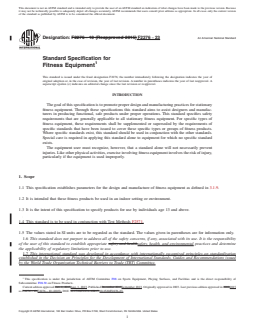
Designation: F2276 − 23 An American National Standard
Standard Specification for
Fitness Equipment
This standard is issued under the fixed designation F2276; the number immediately following the designation indicates the year of
original adoption or, in the case of revision, the year of last revision. A number in parentheses indicates the year of last reapproval. A
superscript epsilon (´) indicates an editorial change since the last revision or reapproval.
INTRODUCTION
The goal of this specification is to promote proper design and manufacturing practices for stationary
fitness equipment. Through these specifications this standard aims to assist designers and manufac-
turers in producing functional, safe products under proper operations. This standard specifies safety
requirements that are generally applicable to all stationary fitness equipment. For specific types of
fitness equipment, these requirements shall be supplemented or superseded by the requirements of
specific standards that have been issued to cover these specific types or groups of fitness products.
Where specific standards exist, this standard should be used in conjunction with the other standards.
Special care is required in applying this standard alone to equipment for which no specific standard
exists.
The equipment user must recognize, however, that a standard alone will not necessarily prevent
injuries. Like other physical activities, exercise involving fitness equipment involves the risk of injury,
particularly if the equipment is used improperly.
1. Scope mendations issued by the World Trade Organization Technical
Barriers to Trade (TBT) Committee.
1.1 This specification establishes parameters for the design
and manufacture of fitness equipment as defined in 3.1.9.
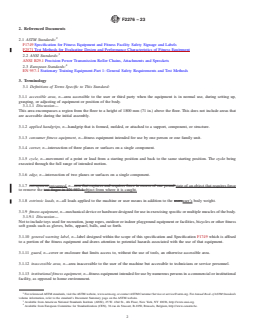
2. Referenced Documents
1.2 It is intended that these fitness products be used in an 2
2.1 ASTM Standards:
indoor setting or environment.
F1749 Specification for Fitness Equipment and Fitness Fa-
1.3 It is the intent of this specification to specify products
cility Safety Signage and Labels
for use by individuals age 13 and above.
F2571 Test Methods for Evaluating Design and Performance
Characteristics of Fitness Equipment
1.4 This standard is to be used in conjunction with Test
2.2 ANSI Standards:
Methods F2571.
ANSI B29.1 Precision Power Transmission Roller Chains,
1.5 The values stated in SI units are to be regarded as the
Attachments and Sprockets
standard. The values given in parentheses are for information
2.3 European Standards:
only.
EN 957-1 Stationary Training Equipment-Part 1: General
1.6 This standard does not purport to address all of the
Safety Requirements and Test Methods
safety concerns, if any, associated with its use. It is the
responsibility of the user of this standard to establish appro-
3. Terminology
priate safety, health, and environmental practices and deter-
3.1 Definitions of Terms Specific to This Standard:
mine the applicability of regulatory limitations prior to use.
3.1.1 accessible area, n—area accessible to the user or third
1.7 This international standard was developed in accor-
party when the equipment is in normal use, during setting up,
dance with internationally recognized principles on standard-
grasping, or adjusting of equipment or position of the body.
ization established in the Decision on Principles for the
Development of International Standards, Guides and Recom-
For referenced ASTM standards, visit the ASTM website, www.astm.org, or
contact ASTM Customer Service at service@astm.org. For Annual Book of ASTM
This specification is under the jurisdiction of ASTM Committee F08 on Sports Standards volume information, refer to the standard’s Document Summary page on
Equipment, Playing Surfaces, and Facilities and is the direct responsibility of the ASTM website.
Subcommittee F08.30 on Fitness Products. Available from American National Standards Institute (ANSI), 25 W. 43rd St.,
Current edition approved Aug. 1, 2023. Published September 2023. Originally 4th Floor, New York, NY 10036, http://www.ansi.org.
approved in 2003. Last previous edition approved in 2015 as F2276 – 10 (2015). Available from European Committee for Standardization (CEN), 36 rue de
DOI: 10.1520/F2276-23. Stassart, B-1050, Brussels, Belgium, http://www.cenorm.be.
Copyright © ASTM International, 100 Barr Harbor Drive, PO Box C700, West Conshohocken, PA 19428-2959. United States
F2276 − 23
3.1.1.1 Discussion—This area encompasses a region from 3.1.19 owner’s/user’s manual, n—documentation supplied
the floor to a height of 1800 mm (71 in.) above the floor. This and intended by the manufacturer to convey information,
does not include areas that are accessible during the initial including safety features and warnings, to the owner/user about
assembly. the equipment.
3.1.20 pinch point, n—location between two moving com-
3.1.2 applied handgrips, n—handgrip that is formed,
ponents or the location between a moving and fixed component
molded, or attached to a support, component, or structure.
that, when entered, causes a portion of the body to become
3.1.3 consumer fitness equipment, n—fitness equipment in-
entrapped.
tended for use by one person or one family unit.
3.1.21 pulley, n—component that guides ropes or belts and
3.1.4 corner, n—intersection of three planes or surfaces on a
redirects the forces of the rope or belt.
single component.
3.1.22 pull in point, n—location between two moving
3.1.5 cycle, n—movement of a point or load from a starting
components, or the location between a moving and a fixed
position and back to the same starting position. The cycle being
component, that when entered causes a portion of the body to
executed through the full range of intended motion.
be pulled into and entrapped between the components.
3.1.6 edge, n—intersection of two planes or surfaces on a
3.1.23 range of movement, n—space in which the user or
single component.
part of the user is moving when using the machine in
accordance to the instructions supplied by the manufacturer.
3.1.7 entrapped, n—state of an object that requires force to
remove the object from where it is caught.
3.1.24 resistance means, n—for the purpose of this
specification, the device or system that, when varied by the
3.1.8 extrinsic loads, n—all loads applied to the machine or
user, increases or decreases the force encountered by the user
user means in addition to the user’s body weight.
through the user means. For the purpose of the specification,
3.1.9 fitness equipment, n—mechanical device or hardware
such means include weights, pneumatic cylinders, or electronic
designed for use in exercising specific or multiple muscles of
systems and their controls.
the body.
3.1.25 shear point, n—location at which parts move past
3.1.9.1 Discussion—Not to include toys used for recreation,
one another or past a fixed point in such a manner that, when
jump ropes, outdoor or indoor playground equipment or
entered, causes a portion of the body to become entrapped in a
facilities, bicycles or other fitness soft goods such as gloves,
scissors action between the components.
belts, apparel, balls, and so forth.
3.1.26 site specific label, n—label designed within the scope
3.1.10 general warning label, n—label designed within the
of this specification and Specification F1749 which is affixed to
scope of this specification and Specification F1749 which is
a portion of the strength equipment and draws attention to a
affixed to a portion of the fitness equipment and draws attention
potential hazard in the immediate area of the label.
to potential hazards associated with the use of that equipment.
3.1.27 stationary training equipment, n—equipment that is
3.1.11 guard, n—cover or enclosure that limits access to,
used to exercise or to train muscles or muscle groups that does
without the use of tools, an otherwise accessible area.
not travel or move across the ground as a unit during use.
3.1.12 inaccessible area, n—area inaccessible to the user of
3.1.28 third party, n—someone other than the user who is in
the machine but accessible to technicians or service personnel.
the immediate area of the fitness equipment when it is in use.
3.1.13 institutional fitness equipment, n—fitness equipment
3.1.29 training envelope, n—maximum space in which the
intended for use by numerous persons in a commercial or
user and machine components traverse when the machine is
institutional facility, as opposed to home environment.
operated in accordance with the instructions.
3.1.14 integral handgrips, n—handgrips that are created by,
3.1.30 user weight (maximum), n—manufacturer defined
coating, texturing or other means, the material of a component
weight of the exerciser that the equipment was designed to
or support structure.
safely accommodate.
3.1.15 intended use, n—use of the fitness equipment as
4. Design and Construction Requirements
described in the manual or as is readily apparent from the
intended use as fitness equipment.
4.1 Stability—Fitness equipment shall be stable while in
storage, unloaded, and in the intrinsically and extrinsically
3.1.16 intrinsic loads, n—the loads applied to fitness equip-
loaded use conditions.
ment due only to the user’s body weight.
4.2 Support—Fitness equipment shall support the user and
3.1.17 maximum specified load, n—maximum working load
any additional loads applied by the user in normal operation
for the machine as set by the manufacturer.
without breakage. Examples include seats, footrests, backrests,
3.1.18 maximum tension developed, n—maximum static
etc.
tensile load experienced by a connector, fitting, rope, belt,
4.3 Edges, Corners, and Tube Ends:
chain, or other means, during use of the machine at the
maximum specified load for the machine including all extrinsic 4.3.1 Edges—All edges in accessible areas shall be free of
loads. burrs and sharp edges.
F2276 − 23
4.3.2 Corners—All corners in accessible areas shall be 4.8 Adjustment and Locking Means—All adjustment and
radiused or chamfered. locking means shall function securely at all adjustment posi-
tions. The possibility of inadvertent disengagement shall be
4.3.3 Tube Ends—Tube ends in the exposed accessible areas
reduced by spring retention, clamps, or other means.
shall be closed off either by other components or by plugs.
Plugs shall remain in place during normal operation and
4.8.1 Adjustment knobs and levers shall not interfere with
storage.
the user’s range of movement.
4.4 Guarding and Entrapment in Accessible Areas:
4.9 Handgrips/Foot Support:
4.4.1 General—Pinch, shear, crush points, and pull-in points
4.9.1 Integral Handgrips—Integral handgrips, if required
in the accessible area as defined in 3.1.1, 3.1.20, and 3.1.25
for proper use as defined by the manufacturer, shall be
shall be avoided or guarded. In the event that the hazard cannot
conspicuous and shall reduce slippage during normal use.
be removed or guarded, a site-specific warning label shall be
4.9.2 Applied Handgrips—Applied handgrips shall be of a
present alerting the user or third party to the presence of the
material that reduces slippage and shall withstand an applied
hazard. Guarding is not required if a minimum clearance
force of 90 N (20.2 lb) without movement in the direction of
between affected components of 60 mm (2.36 in.) can be
the applied force.
maintained. Exceptions to this requirement are as follows:
4.9.3 Rotating Handgrips—Rotating handgrips shall be con-
4.4.1.1 Fingers—If during operation or adjustment of the
strained against lateral movement along their rotational axis
equipment the only portion of the body that could become
and be constructed of a material that reduces slippage.
entrapped is the fingers then the spacing between the affected
4.9.4 Foot Support—Bars or plates designed to support the
components shall be less than 9.5 mm (0.37 in.) or greater than
user’s feet during exercise shall be fitted with or be of a
25 mm (0.98 in.).
...
This document is not an ASTM standard and is intended only to provide the user of an ASTM standard an indication of what changes have been made to the previous version. Because
it may not be technically possible to adequately depict all changes accurately, ASTM recommends that users consult prior editions as appropriate. In all cases only the current version
of the standard as published by ASTM is to be considered the official document.
Designation: F2276 − 10 (Reapproved 2015) F2276 − 23 An American National Standard
Standard Specification for
Fitness Equipment
This standard is issued under the fixed designation F2276; the number immediately following the designation indicates the year of
original adoption or, in the case of revision, the year of last revision. A number in parentheses indicates the year of last reapproval. A
superscript epsilon (´) indicates an editorial change since the last revision or reapproval.
INTRODUCTION
The goal of this specification is to promote proper design and manufacturing practices for stationary
fitness equipment. Through these specifications this standard aims to assist designers and manufac-
turers in producing functional, safe products under proper operations. This standard specifies safety
requirements that are generally applicable to all stationary fitness equipment. For specific types of
fitness equipment, these requirements shall be supplemented or superseded by the requirements of
specific standards that have been issued to cover these specific types or groups of fitness products.
Where specific standards exist, this standard should be used in conjunction with the other standards.
Special care is required in applying this standard alone to equipment for which no specific standard
exists.
The equipment user must recognize, however, that a standard alone will not necessarily prevent
injuries. Like other physical activities, exercise involving fitness equipment involves the risk of injury,
particularly if the equipment is used improperly.
1. Scope
1.1 This specification establishes parameters for the design and manufacture of fitness equipment as defined in 3.1.9.
1.2 It is intended that these fitness products be used in an indoor setting or environment.
1.3 It is the intent of this specification to specify products for use by individuals age 13 and above.
1.4 This standard is to be used in conjunction with Test Methods F2571.
1.5 The values stated in SI units are to be regarded as the standard. The values given in parentheses are for information only.
1.6 This standard does not purport to address all of the safety concerns, if any, associated with its use. It is the responsibility
of the user of this standard to establish appropriate safety and healthsafety, health, and environmental practices and determine
the applicability of regulatory limitations prior to use.
1.7 This international standard was developed in accordance with internationally recognized principles on standardization
established in the Decision on Principles for the Development of International Standards, Guides and Recommendations issued
by the World Trade Organization Technical Barriers to Trade (TBT) Committee.
This specification is under the jurisdiction of ASTM Committee F08 on Sports Equipment, Playing Surfaces, and Facilities and is the direct responsibility of
Subcommittee F08.30 on Fitness Products.
Current edition approved Oct. 1, 2015Aug. 1, 2023. Published December 2015September 2023. Originally approved in 2003. Last previous edition approved in 20102015
as F2276 – 10.F2276 – 10 (2015). DOI: 10.1520/F2276-10R15.10.1520/F2276-23.
Copyright © ASTM International, 100 Barr Harbor Drive, PO Box C700, West Conshohocken, PA 19428-2959. United States
F2276 − 23
2. Referenced Documents
2.1 ASTM Standards:
F1749 Specification for Fitness Equipment and Fitness Facility Safety Signage and Labels
F2571 Test Methods for Evaluating Design and Performance Characteristics of Fitness Equipment
2.2 ANSI Standards:
ANSI B29.1 Precision Power Transmission Roller Chains, Attachments and Sprockets
2.3 European Standards:
EN 957-1 Stationary Training Equipment-Part 1: General Safety Requirements and Test Methods
3. Terminology
3.1 Definitions of Terms Specific to This Standard:
3.1.1 accessible area, n—area accessible to the user or third party when the equipment is in normal use, during setting up,
grasping, or adjusting of equipment or position of the body.
3.1.1.1 Discussion—
This area encompasses a region from the floor to a height of 1800 mm (71 in.) above the floor. This does not include areas that
are accessible during the initial assembly.
3.1.2 applied handgrips, n—handgrip that is formed, molded, or attached to a support, component, or structure.
3.1.3 consumer fitness equipment, n—fitness equipment intended for use by one person or one family unit.
3.1.4 corner, n—intersection of three planes or surfaces on a single component.
3.1.5 cycle, n—movement of a point or load from a starting position and back to the same starting position. The cycle being
executed through the full range of intended motion.
3.1.6 edge, n—intersection of two planes or surfaces on a single component.
3.1.7 entrapment,entrapped, n—area that captures and requires force in excess of one pound state of an object that requires force
to remove the test finger in EN 957-1.object from where it is caught.
3.1.8 extrinsic loads, n—all loads applied to the machine or user means in addition to the usersuser’s body weight.
3.1.9 fitness equipment, n—mechanical device or hardware designed for use in exercising specific or multiple muscles of the body.
3.1.9.1 Discussion—
Not to include toys used for recreation, jump ropes, outdoor or indoor playground equipment or facilities, bicycles or other fitness
soft goods such as gloves, belts, apparel, balls, and so forth.
3.1.10 general warning label, n—label designed within the scope of this specification and Specification F1749 which is affixed
to a portion of the fitness equipment and draws attention to potential hazards associated with the use of that equipment.
3.1.11 guard, n—cover or enclosure that limits access to, without the use of tools, an otherwise accessible area.
3.1.12 inaccessible area, n—area inaccessible to the user of the machine but accessible to technicians or service personnel.
3.1.13 institutional fitness equipment, n—fitness equipment intended for use by numerous persons in a commercial or institutional
facility, as opposed to home environment.
For referenced ASTM standards, visit the ASTM website, www.astm.org, or contact ASTM Customer Service at service@astm.org. For Annual Book of ASTM Standards
volume information, refer to the standard’s Document Summary page on the ASTM website.
Available from American National Standards Institute (ANSI), 25 W. 43rd St., 4th Floor, New York, NY 10036, http://www.ansi.org.
Available from European Committee for Standardization (CEN), 36 rue de Stassart, B-1050, Brussels, Belgium, http://www.cenorm.be.
F2276 − 23
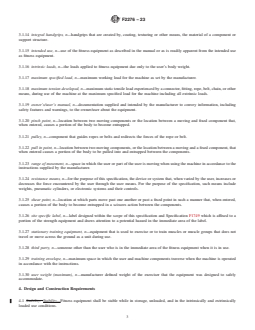
3.1.14 integral handgrips, n—handgrips that are created by, coating, texturing or other means, the material of a component or
support structure.
3.1.15 intended use, n—use of the fitness equipment as described in the manual or as is readily apparent from the intended use
as fitness equipment.
3.1.16 intrinsic loads, n—the loads applied to fitness equipment due only to the user’s body weight.
3.1.17 maximum specified load, n—maximum working load for the machine as set by the manufacturer.
3.1.18 maximum tension developed, n—maximum static tensile load experienced by a connector, fitting, rope, belt, chain, or other
means, during use of the machine at the maximum specified load for the machine including all extrinsic loads.
3.1.19 owner’s/user’s manual, n—documentation supplied and intended by the manufacturer to convey information, including
safety features and warnings, to the owner/user about the equipment.
3.1.20 pinch point, n—location between two moving components or the location between a moving and fixed component that,
when entered, causes a portion of the body to become entrapped.
3.1.21 pulley, n—component that guides ropes or belts and redirects the forces of the rope or belt.
3.1.22 pull in point, n—location between two moving components, or the location between a moving and a fixed component, that
when entered causes a portion of the body to be pulled into and entrapped between the components.
3.1.23 range of movement, n—space in which the user or part of the user is moving when using the machine in accordance to the
instructions supplied by the manufacturer.
3.1.24 resistance means, n—for the purpose of this specification, the device or system that, when varied by the user, increases or
decreases the force encountered by the user through the user means. For the purpose of the specification, such means include
weights, pneumatic cylinders, or electronic systems and their controls.
3.1.25 shear point, n—location at which parts move past one another or past a fixed point in such a manner that, when entered,
causes a portion of the body to become entrapped in a scissors action between the components.
3.1.26 site specific label, n—label designed within the scope of this specification and Specification F1749 which is affixed to a
portion of the strength equipment and draws attention to a potential hazard in the immediate area of the label.
3.1.27 stationary training equipment, n—equipment that is used to exercise or to train muscles or muscle groups that does not
travel or move across the ground as a unit during use.
3.1.28 third party, n—someone other than the user who is in the immediate area of the fitness equipment when it is in use.
3.1.29 training envelope, n—maximum space in which the user and machine components traverse when the machine is operated
in accordance with the instructions.
3.1.30 user weight (maximum), n—manufacturer defined weight of the exerciser that the equipment was designed to safely
accommodate.
4. Design and Construction Requirements
4.1 Stability: Stability—Fitness equipment shall be stable while in storage, unloaded, and in the intrinsically and extrinsically
loaded use conditions.
F2276 − 23
4.2 Support: Support—
4.2.1 Fitness equipment shall support the user and any additional loads applied by the user in normal operation without breakage.
Examples include: seats, foot rests, backrests, etc.Fitness equipment shall support the user and any additional loads applied by the
user in normal operation without breakage. Examples include seats, footrests, backrests, etc.
4.3 Edges, Corners, and Tube Ends:
4.3.1 Edges—All edges in accessible areas shall be free of burrs and sharp edges.
4.3.2 Corners—All corners in accessible areas shall be radiused or chamfered.
4.3.3 Tube Ends—Tube ends in the exposed accessible areas shall be closed off either by other components or by plugs. Plugs shall
remain in place during normal operation and storage.
4.4 Guarding and Entrapment in Accessible Areas:
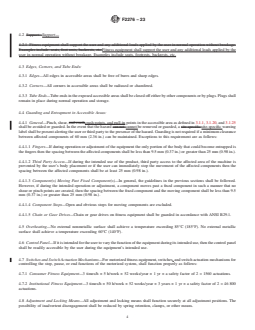
4.4.1 General—Pinch, shear, and crushcrush points, and pull-in points in the accessible area as defined in 3.1.1, 3.1.20, and 3.1.25
shall be avoided or guarded. In the event that the hazard can not cannot be removed or guarded, a site specific site-specific warning
label shall be present alerting the user or third party to the presence of the hazard. Guarding is not required if a minimum clearance
between affected components of 60 mm (2.36 in.) can be maintained. Exceptions to this requirement are as follows:
4.4.1.1 Fingers—If during operation or adjustment of the equipment the only portion of the body that could become entrapped is
the fingers then the spacing between the affected components shall be less than 9.5 mm (0.37 in.) or greater than 25 mm (0.98 in.).
4.4.1.2 Third Party Access—If during the intended use of the product, third party access to the affected area of the machine is
prevented by the user’s body placement or if the user can immediately stop the movement of the affected components then the
spacing between the affected components shall be at least 25 mm (0.98 in.).
4.4.1.3 Component(s) Moving Past Fixed Component(s)—In general, the guidelines in the previous sections shall be followed.
However, if during the intended operation or adjustment, a component moves past a fixed component in such a manner that no
shear or pinch points are created, then the spacing between the fixed component and the moving component shall be less than 9.5
mm (0.37 in.) or greater than 25 mm (0.98 in.).
4.4.1.4 Component Stops—Open and obvious stops for moving components are excluded.
4.4.1.5 Chain or Gear Drives—Chain or gear drives on fitness equipment shall be guarded in accordance with ANSI B29.1.
4.5 Overheating—No external nonmetallic surface shall achieve a temperature exceeding 85°C (185°F). No external metallic
surface shall achieve a temperature exceeding 60°C (140°F).
4.6 Control Panel—If it is intended for the user to vary the function of the equipment during its intended use, then the control panel
shall be readily accessible by the user during the equipment’s intended use.
4.7 Switches and Switch Actuation Mechanisms—For motorize
...