

ASTM F3105-20
(Specification)Standard Specification for Externally Loaded Strength Training Equipment, Strength Training Benches and External Weight Storage Equipment
General Information
- Abstract
ABSTRACT
This specification outlines parameters for the proper design and manufacture of externally loaded strength training equipment, strength training benches and external weight storage equipment. It aims to assist designers and manufacturers in reducing the possibility of injury when the products are used in accordance with the operational instructions. The fitness products are intended for use in an indoor setting or environment, and only by an individual age 13 and older.
The equipment types covered by this specification are: externally loaded strength training equipment, work arm actuated (type 1); externally loaded strength training equipment, linear slide actuated (type 2); strength training benches, designed for use with a barbell (type 3); strength training benches, designed for independent use or for use with optional equipment (type 4); external weight storage equipment, any device with the sole purpose to store external weights (type 5); multi-function systems, a machine whose function incorporates more than one station or operation intended for separate exercises (type 6); rack stations (type 7).
SCOPE
1.1 This specification establishes parameters for the design and manufacture of externally loaded strength training equipment, strength training benches and external weight storage equipment as defined in 3.1.
1.2 It is intended that these fitness products be used in an indoor setting or environment.
1.3 It is the intent of this standard to specify fitness products for use only by an individual age 13 and older.
1.4 This standard is to be used in conjunction with Specification F2276, Test Methods F2571, and Test Methods F3104.
1.5 This standard takes precedence over Specification F2276 and Test Methods F2571 in areas that are specific to Externally Loaded Strength Training Equipment, Strength Training Benches and External Weight Storage Equipment.
1.6 The values stated in SI units are to be regarded as standard. The values in parentheses are for information only.
1.7 This standard does not purport to address all of the safety concerns, if any, associated with its use. It is the responsibility of the user of this standard to establish appropriate safety, health, and environmental practices and determine the applicability of regulatory limitations prior to use.
1.8 This international standard was developed in accordance with internationally recognized principles on standardization established in the Decision on Principles for the Development of International Standards, Guides and Recommendations issued by the World Trade Organization Technical Barriers to Trade (TBT) Committee.
- Status
- Published
- Publication Date
- 14-Dec-2020
- Technical Committee
- F08 - Sports Equipment, Playing Surfaces, and Facilities
- Drafting Committee
- F08.30 - Fitness Products
Buy Documents
ASTM F3105-20 - Standard Specification for Externally Loaded Strength Training Equipment, Strength Training Benches and External Weight Storage Equipment
REDLINE ASTM F3105-20 - Standard Specification for Externally Loaded Strength Training Equipment, Strength Training Benches and External Weight Storage Equipment
Overview
ASTM F3105-20: Standard Specification for Externally Loaded Strength Training Equipment, Strength Training Benches, and External Weight Storage Equipment establishes essential parameters for the safe design and manufacture of externally loaded strength training equipment, strength training benches, and external weight storage systems. Issued by ASTM International, this standard targets the reduction of injury risk during proper use in indoor fitness settings, focusing on equipment intended for individuals aged 13 and older.
Key equipment types addressed include:
- Externally loaded strength training machines (work arm actuated or linear slide actuated)
- Strength training benches (for barbells or independent use)
- External weight storage equipment (e.g., weight trees, dumbbell racks)
- Multi-function systems incorporating multiple stations
- Rack stations, such as squat racks and lifting cages
This standard supports designers, manufacturers, facility operators, and users by specifying requirements for construction, documentation, warnings, and installation to promote safety and performance.
Key Topics
- Equipment Categories: Defines several types of strength training equipment, including free weight machines, bench systems, weight racks, and storage devices.
- Safety and Stability Requirements: Outlines design and construction specifications to ensure equipment can withstand significant loads and dynamic impacts, including stability when loaded asymmetrically.
- User Warnings and Instructions: Requires comprehensive and visible warning labels for weight limits, proper usage, required safety mechanisms (such as adjustable stops), and recommendations for spotter use.
- Operational and Maintenance Documentation: Specifies mandatory content for owner’s manuals, including operational instructions, assembly guidelines, maintenance procedures, and minimum clearance requirements.
- Compliance and Testing: Mandates product testing and installation instructions according to referenced ASTM test methods to verify load capacities and safe function.
- Labeling and Marking: Calls for clear posting of maximum user weight, permitted training load, and site-specific warnings directly on equipment.
- Intended Usage Environment: Restricts use to indoor applications and to users aged 13 and above.
Applications
ASTM F3105-20 is widely applicable in the fitness industry, facilitating:
- Manufacturing and Product Development: Ensures that equipment meets internationally recognized strength and safety thresholds, supporting the production of safe, reliable fitness equipment.
- Fitness Facilities and Gym Management: Assists in the selection, installation, and maintenance of strength training equipment by providing clear operational, installation, and maintenance guidelines.
- Regulatory Compliance: Aids manufacturers and facility operators in meeting regional, national, and international regulatory requirements for exercise equipment, including accessibility standards.
- Risk Mitigation: Reduces the likelihood of injuries for users of strength training machines and benches by enforcing design and labeling standards and promoting proper usage.
- Consumer Guidance: Supplies end users with information on safe operation, equipment limits, and the necessity of proper support and spacing when utilizing heavy or complex machines.
Related Standards
ASTM F3105-20 is designed to be used in conjunction with several key fitness equipment standards, including:
- ASTM F2276 - Specification for Fitness Equipment
- ASTM F2571 - Test Methods for Evaluating Design and Performance Characteristics of Fitness Equipment
- ASTM F3104 - Test Methods for Externally Loaded Strength Training Equipment
- ASTM F1749 - Specification for Fitness Equipment and Fitness Facility Safety Signage and Labels
- ASTM F2216 - Specification for Selectorized Strength Equipment
- ASTM F2277 - Test Methods for Selectorized Strength Equipment
- Federal ADA Standards - DOJ 2010 Standard for Accessible Design
Adherence to ASTM F3105-20 ensures compatibility with best practices in strength training equipment safety, maintenance, and operation, helping protect both facility operators and gym users.
Keywords: ASTM F3105, strength training equipment, weight benches, external weight storage, gym safety standards, free weight equipment, Olympic training equipment, ASTM International, fitness equipment compliance, gym equipment design requirements.
Relations
- Effective Date
- 01-May-2020
- Effective Date
- 01-Dec-2017
- Effective Date
- 01-Dec-2017
- Effective Date
- 15-May-2017
- Effective Date
- 01-Apr-2017
- Effective Date
- 01-Apr-2015
- Effective Date
- 01-Mar-2012
- Effective Date
- 01-Mar-2012
- Effective Date
- 01-Feb-2010
- Effective Date
- 01-Feb-2010
- Effective Date
- 15-Nov-2009
- Effective Date
- 01-Jun-2009
- Effective Date
- 01-Jun-2009
- Effective Date
- 01-Jan-2005
- Effective Date
- 01-Jan-2005
Buy Documents
ASTM F3105-20 - Standard Specification for Externally Loaded Strength Training Equipment, Strength Training Benches and External Weight Storage Equipment
REDLINE ASTM F3105-20 - Standard Specification for Externally Loaded Strength Training Equipment, Strength Training Benches and External Weight Storage Equipment
Frequently Asked Questions
ASTM F3105-20 is a technical specification published by ASTM International. Its full title is "Standard Specification for Externally Loaded Strength Training Equipment, Strength Training Benches and External Weight Storage Equipment". This standard covers: ABSTRACT This specification outlines parameters for the proper design and manufacture of externally loaded strength training equipment, strength training benches and external weight storage equipment. It aims to assist designers and manufacturers in reducing the possibility of injury when the products are used in accordance with the operational instructions. The fitness products are intended for use in an indoor setting or environment, and only by an individual age 13 and older. The equipment types covered by this specification are: externally loaded strength training equipment, work arm actuated (type 1); externally loaded strength training equipment, linear slide actuated (type 2); strength training benches, designed for use with a barbell (type 3); strength training benches, designed for independent use or for use with optional equipment (type 4); external weight storage equipment, any device with the sole purpose to store external weights (type 5); multi-function systems, a machine whose function incorporates more than one station or operation intended for separate exercises (type 6); rack stations (type 7). SCOPE 1.1 This specification establishes parameters for the design and manufacture of externally loaded strength training equipment, strength training benches and external weight storage equipment as defined in 3.1. 1.2 It is intended that these fitness products be used in an indoor setting or environment. 1.3 It is the intent of this standard to specify fitness products for use only by an individual age 13 and older. 1.4 This standard is to be used in conjunction with Specification F2276, Test Methods F2571, and Test Methods F3104. 1.5 This standard takes precedence over Specification F2276 and Test Methods F2571 in areas that are specific to Externally Loaded Strength Training Equipment, Strength Training Benches and External Weight Storage Equipment. 1.6 The values stated in SI units are to be regarded as standard. The values in parentheses are for information only. 1.7 This standard does not purport to address all of the safety concerns, if any, associated with its use. It is the responsibility of the user of this standard to establish appropriate safety, health, and environmental practices and determine the applicability of regulatory limitations prior to use. 1.8 This international standard was developed in accordance with internationally recognized principles on standardization established in the Decision on Principles for the Development of International Standards, Guides and Recommendations issued by the World Trade Organization Technical Barriers to Trade (TBT) Committee.
ABSTRACT This specification outlines parameters for the proper design and manufacture of externally loaded strength training equipment, strength training benches and external weight storage equipment. It aims to assist designers and manufacturers in reducing the possibility of injury when the products are used in accordance with the operational instructions. The fitness products are intended for use in an indoor setting or environment, and only by an individual age 13 and older. The equipment types covered by this specification are: externally loaded strength training equipment, work arm actuated (type 1); externally loaded strength training equipment, linear slide actuated (type 2); strength training benches, designed for use with a barbell (type 3); strength training benches, designed for independent use or for use with optional equipment (type 4); external weight storage equipment, any device with the sole purpose to store external weights (type 5); multi-function systems, a machine whose function incorporates more than one station or operation intended for separate exercises (type 6); rack stations (type 7). SCOPE 1.1 This specification establishes parameters for the design and manufacture of externally loaded strength training equipment, strength training benches and external weight storage equipment as defined in 3.1. 1.2 It is intended that these fitness products be used in an indoor setting or environment. 1.3 It is the intent of this standard to specify fitness products for use only by an individual age 13 and older. 1.4 This standard is to be used in conjunction with Specification F2276, Test Methods F2571, and Test Methods F3104. 1.5 This standard takes precedence over Specification F2276 and Test Methods F2571 in areas that are specific to Externally Loaded Strength Training Equipment, Strength Training Benches and External Weight Storage Equipment. 1.6 The values stated in SI units are to be regarded as standard. The values in parentheses are for information only. 1.7 This standard does not purport to address all of the safety concerns, if any, associated with its use. It is the responsibility of the user of this standard to establish appropriate safety, health, and environmental practices and determine the applicability of regulatory limitations prior to use. 1.8 This international standard was developed in accordance with internationally recognized principles on standardization established in the Decision on Principles for the Development of International Standards, Guides and Recommendations issued by the World Trade Organization Technical Barriers to Trade (TBT) Committee.
ASTM F3105-20 is classified under the following ICS (International Classification for Standards) categories: 97.220.30 - Indoor sports equipment. The ICS classification helps identify the subject area and facilitates finding related standards.
ASTM F3105-20 has the following relationships with other standards: It is inter standard links to ASTM F1749-15(2020), ASTM F2216-17a, ASTM F2277-17a, ASTM F2277-17, ASTM F2216-17, ASTM F1749-15, ASTM F2277-12, ASTM F2216-12, ASTM F2276-10, ASTM F2277-03(2010), ASTM F2571-09, ASTM F2276-09, ASTM F1749-09, ASTM F2216-05, ASTM F2276-05. Understanding these relationships helps ensure you are using the most current and applicable version of the standard.
ASTM F3105-20 is available in PDF format for immediate download after purchase. The document can be added to your cart and obtained through the secure checkout process. Digital delivery ensures instant access to the complete standard document.
Standards Content (Sample)
This international standard was developed in accordance with internationally recognized principles on standardization established in the Decision on Principles for the
Development of International Standards, Guides and Recommendations issued by the World Trade Organization Technical Barriers to Trade (TBT) Committee.
Designation:F3105 −20
Standard Specification for
Externally Loaded Strength Training Equipment, Strength
Training Benches and External Weight Storage Equipment
This standard is issued under the fixed designation F3105; the number immediately following the designation indicates the year of
original adoption or, in the case of revision, the year of last revision. A number in parentheses indicates the year of last reapproval. A
superscript epsilon (´) indicates an editorial change since the last revision or reapproval.
INTRODUCTION
Thegoalofthisspecificationistopromoteproperdesignandmanufacturingpracticesforexternally
loaded strength training equipment, strength training benches and external weight storage equipment.
Through these specifications, this specification aims to assist designers and manufactures in reducing
the possibility of injury when these products are used in accordance with the operational instructions.
The equipment user must recognize, however, that a standard alone will not necessarily prevent
injuries. Like other physical activities, exercise involving externally loaded strength training
equipment, strength training benches and external weight storage equipment involves the risk of
injury, particularly if the equipment is used improperly or not properly maintained. In addition, users
with physical limitations should seek medical advice and instruction from the fitness facility prior to
using this equipment. Certain physical conditions or limitations may preclude some persons from
using this equipment properly and without increasing the risk of serious injury.
1. Scope priate safety, health, and environmental practices and deter-
mine the applicability of regulatory limitations prior to use.
1.1 This specification establishes parameters for the design
1.8 This international standard was developed in accor-
and manufacture of externally loaded strength training
dance with internationally recognized principles on standard-
equipment, strength training benches and external weight
ization established in the Decision on Principles for the
storage equipment as defined in 3.1.
Development of International Standards, Guides and Recom-
1.2 It is intended that these fitness products be used in an
mendations issued by the World Trade Organization Technical
indoor setting or environment.
Barriers to Trade (TBT) Committee.
1.3 It is the intent of this standard to specify fitness products
2. Referenced Documents
for use only by an individual age 13 and older.
1.4 This standard is to be used in conjunction with Speci- 2.1 ASTM Standards:
F1749 Specification for Fitness Equipment and Fitness Fa-
fication F2276, Test Methods F2571, and Test Methods F3104.
cility Safety Signage and Labels
1.5 This standard takes precedence over Specification
F2216 Specification for Selectorized Strength Equipment
F2276 and Test Methods F2571 in areas that are specific to
F2276 Specification for Fitness Equipment
Externally Loaded Strength Training Equipment, Strength
F2277 Test Methods for Evaluating Design and Performance
Training Benches and External Weight Storage Equipment.
Characteristics of Selectorized Strength Equipment
1.6 The values stated in SI units are to be regarded as
F2571 Test Methods for Evaluating Design and Performance
standard. The values in parentheses are for information only.
Characteristics of Fitness Equipment
1.7 This standard does not purport to address all of the F3104 Test Methods for Evaluating Design and Performance
safety concerns, if any, associated with its use. It is the Characteristics of Externally Loaded Strength Training
responsibility of the user of this standard to establish appro- Equipment, Strength Training Benches and External
Weight Storage Equipment
This specification is under the jurisdiction ofASTM Committee F08 on Sports
Equipment, Playing Surfaces, and Facilities and is the direct responsibility of
Subcommittee F08.30 on Fitness Products. For referenced ASTM standards, visit the ASTM website, www.astm.org, or
Current edition approved Dec. 15, 2020. Published February 2021. Originally contact ASTM Customer Service at service@astm.org. For Annual Book of ASTM
approved in 2014. Last previous edition approved in 2014 as F3105 – 14. DOI: Standards volume information, refer to the standard’s Document Summary page on
10.1520/F3105-20. the ASTM website.
Copyright © ASTM International, 100 Barr Harbor Drive, PO Box C700, West Conshohocken, PA 19428-2959. United States
F3105−20
2.2 Federal Standard: 3.1.12 Smith press, n—a substantially vertical frame struc-
Department of Justice (DOJ) 2010 Standard for Accessible ture with a constrained bar for loading Olympic weight plates
Design, United States Department of Justice, Title II (28 onto that travels along linear shafts with indexing engagement
CFR 35) and Title III (28 CFR 36) means that allow the bar to be started and stopped at multiple
positions along the range of travel.
3. Terminology
3.1.13 strength training benches, n—a piece of equipment
3.1 Definitions—The terms listed below are unique to this
used to support the body of a user and/or the training load
specification. For terms not defined below, refer to Specifica-
during certain strength training exercises. A strength training
tion F2276.
bench does not have integral features to increase training
3.1.1 barbell, n—a long bar shaped device, usually made of
resistance but may have integral features for external weight
steel or aluminum used for holding weight discs to perform
storage.
certainexercises.Usedinconjunctionwithcertainbenchesand
3.1.14 training load, n—the amount of weight plates added
racks.
to the machine or bar to provide training resistance to the user.
3.1.2 break, v—shall not separate from the structure or fail
3.1.15 training resistance, n—the force exerted by the user
to support the load for the intended function.
to move lifting arm which may or may not be the same as the
3.1.3 catch, n—rest or holder for an barbell, Smith press, or
training load.
sled leg press carriage from which the user begins the exercise
lift and returns the bar or sled to at the completion of the 3.1.16 weight disc, n—a means for a given mass, usually of
exercise. steel or iron, for externally loaded equipment. Contains a bore
in the center of the disc for attachment to weight post.
3.1.4 dumbbell, n—a device of fixed mass designed to be
gripped with one hand. Selectively variable dumbbells where
3.1.17 weight post, n—astructureprotrudingfromtheframe
the amount of resistance is selected by the user are included in
of externally loaded strength equipment for the purpose of
this definition.
holding weight discs either for a resistance means or for
storage.
3.1.5 externally loaded strength training equipment,
n—strength training equipment that relies on user applied
weight discs on the movement arm for as primary means of 4. Equipment Types
resistance.
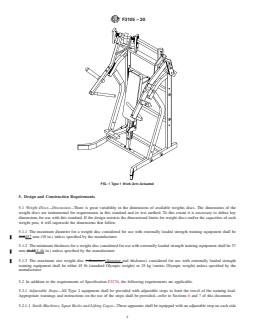
4.1 Externally Loaded Strength Training Equipment, work
3.1.6 external weight storage equipment, n—any piece of
arm actuated (Type 1)—The external load is attached directly
equipment whose sole function is to store external weights
or indirectly to a movement arm that is displaced intentionally
such as weight discs or dumbbells while not in use on
by the user, as shown in Fig. 1.
externally loaded strength equipment or other means of
4.2 Externally Loaded Strength Training Equipment, linear
strength training.
slide actuated (Type 2)—The external load is placed on a
3.1.7 maximum storage load, n—maximum load that can be
weight post affixed to a carriage that’s motion is limited via a
applied to weight post and/or external weight storage equip-
linear slide.
ment as set forth by the manufacturer.
4.2.1 Type 2a—A machine that has an angle, from
3.1.8 maximum specified training load, n—maximum work-
horizontal, greater than 45°. This type includes the Smith
ing load as set forth by the manufacture. This load does not
Machine as shown in Fig. 2.
include the user weight.
4.2.2 Type 2b—A machine that has an angle, from
3.1.9 movement arm, n—a component of certain strength
horizontal, of 45° or less. This type includes the sled style leg
training devices that allows for a controlled and directed
press as shown in Fig. 3.
motion of a resistance means for a specific exercise.
4.3 Strength Training Benches, designed for use with a
3.1.10 olympic,adj—asystemofexternaltrainingresistance
barbell (Type 3)—Any bench that has integral hooks or catches
that allows higher levels of resistance than standard weight
for a standard or Olympic style barbell. This classification also
discs and describing barbell combinations. One feature is the
encompasses stand alone barbell supports. See Fig. 4.
use of a large bore diameter [approximately 50 mm (1.98 in.)]
4.4 Strength Training Benches, designed for independent
for the interface between weight discs and barbells.
use or for use with optional equipment (Type 4)—Any bench
3.1.11 rack,n—astructureoftendescribedasacageorsquat
that is not included in the definition of a Type 3. Benches that
rack that will support an Olympic bar on catch assemblies or
aremovable,foruseinSmithorrackstyledevicesareincluded
hooks allowing the user to perform multiple freestyle exercises
in this type. This type also contains specialty equipment such
such as Olympic lifts, squats and similar exercises. The catch
as body weight style equipment. See Fig. 5.
assemblies or structures may be vertical or positioned along an
upward sloping frame structure typically 45° or greater.
4.5 External Weight Storage Equipment, any device with the
sole purpose to store external weights (Type 5)—These devices
only store weight, and are not used directly for fitness
AvailablefromU.S.GovernmentPrintingOfficeSuperintendentofDocuments,
exercises. This type includes weight trees and dumbbell racks.
732 N. Capitol St., NW, Mail Stop: SDE, Washington, DC 20401, http://
www.access.gpo.gov. See Fig. 6.
F3105−20
FIG. 2Type 2a Linear Slide Greater Than 45°
FIG. 1Type 1 Work Arm Actuated
5.1.1 The maximum diameter for a weight disc considered
forusewithexternallyloadedstrengthtrainingequipmentshall
4.6 Multi Function Systems, a machine whose function
be 457 mm (18 in.) unless specified by the manufacturer.
incorporates more than one station or operation intended for
separate exercises (Type 6)—This equipment may contain 5.1.2 The minimum thickness for a weight disc considered
forusewithexternallyloadedstrengthtrainingequipmentshall
functionality of equipment Types 1-4. Each station or function
shall meet the requirements for the equipment type as listed in be 37 mm (1.46 in.) unless specified by the manufacturer.
4.1 – 4.4. If the equipment also contains a selectorized station, 5.1.3 The maximum size weight disc (diameter and thick-
thentherequirementsofSpecificationF2216andTestMethods
ness) considered for use with externally loaded strength
F2277 are applicable to that station or function. See Fig. 7. training equipment shall be either 45 lb (standard Olympic
weight) or 25 kg (metric Olympic weight) unless specified by
4.7 Rack Stations (Type 7)—Apparatus or structures de-
the manufacturer.
signed to support an Olympic bar in multiple positions that
allow freestyle or unguided exercise with the Olympic bar. See
5.2 In addition to the requirements of Specification F2276,
Fig. 8.
the following requirements are applicable.
5.2.1 Adjustable Stops—All Type 2 equipment shall be
5. Design and Construction Requirements
provided with adjustable stops to limit the travel of the training
load. Appropriate warnings and instructions on the use of the
5.1 Weight Discs—Discussion—There is great variability in
stops shall be provided—refer to Sections 6 and 7 of this
the dimensions of available weights discs. The dimensions of
document.
the weight discs are instrumental for requirements in this
standard and its test method. To this extent it is necessary to 5.2.1.1 Smith Machines, Squat Racks and Lifting Cages—
define key dimensions for use with this standard. If the design These apparatus shall be equipped with an adjustable stop on
restricts the dimensional limits for weight discs and/or the each side that shall limit the downward travel of the lifting bar.
capacities of each weight post, it will supersede the dimensions One set of stop position shall stop the bar 711 mm (28 in.) or
that follow. higher from the floor (measured to the underside of the bar).
F3105−20
FIG. 5Type 4 Independent Use Strength Training Bench
FIG. 3Type 2b Linear Slide 45° or Less
FIG. 6Type 5 External Weight Storage—Dumbbells
5.2.1.2 Sled Leg Press Machines (Type 2b) shall be outfitted
withpermanentdeadstopsthatstopthedownwardtravelofthe
lifting sled. These dead stops shall stop the sled so that there is
at least 266 mm (10.5 in.) of space between the lowest most
portion of the foot platform and the front edge of the seat
assembly.
5.2.2 Weight Disc Retention—All weight posts used for
application of the training resistance shall contain a retention
means.Acceptable means include: Detent pins, clips or angling
of the weight post above horizontal. If angling of the weight
post is used then the weight post shall be angled 2° or greater
FIG. 4Type 3 Strength Training Bench With Barbell Support
with respect to horizontal throughout the entire range of
motion.
5.2.2.1 If weight posts are designed for weight plate size
less than 45 lb or 25 kg (as defined in 5.1), then the unit shall
This position shall be identified with a site specific label limit the use of such discs through the use of a site specific
indicating that for squat exercises the stops shall not be placed label.InstitutionalEquipmentmayusemechanicalinterference
below this level. to limit the capacity as referenced in 5.2.3.2.
F3105−20
FIG. 7Type 6 Multi Function Apparatus
FIG. 9Weight Size Limit Pin
40 mm (1.57 in.) when measured from the bottom of a 30 mm
(1.18 in.) barbell at rest in the hook. See Fig. 10.
5.3 Stability—Discussion—Externally Loaded Strength
Equipment requires additional stability guidelines over those
set forth in Specification F2276. The equipment shall be stable
in the unloaded, intrinsically and the extrinsically loaded
conditions. The equipment shall be stable with weights applied
to only one side and both sides of the equipment, supported
lifting bar or carriage. In addition, weight posts intended for
FIG. 8Type 7 Rack Station
5.2.3 Weight Disc Clearance—The distance between weight
discs and other movable or fixed parts shall be greater than 25
mm (0.98 in.).
5.2.3.1 Weight discs on the same weight post are exempt
from this requirement.
5.2.3.2 If a mechanical interference device is used to limit
the use of certain size weight plates, such as a pin parallel to
the weight posts, then it shall be exempt from the clearance
requirement between the weight disc and mechanical interfer-
ence device. A site specific warning shall be present in the
immediate area to warn as to the maximum weight plate size.
For consumer equipment, weight plate size restriction may be
specified in the owner’s manual.
5.2.4 Barbell Support Hook Dimensions—The rear part of
the barbell hook shall be at least 80 mm (3.15 in.) higher than
the front of the hook. The depth of the hook (front to back)
shallbeaminimumof40mm(1.57in.).Theheightofthefront
of the barbell hook, a, shall be between 20 mm (0.78 in.) and FIG. 10Barbell Support Dimensions
F3105−20
storage shall b
...
This document is not an ASTM standard and is intended only to provide the user of an ASTM standard an indication of what changes have been made to the previous version. Because
it may not be technically possible to adequately depict all changes accurately, ASTM recommends that users consult prior editions as appropriate. In all cases only the current version
of the standard as published by ASTM is to be considered the official document.
Designation: F3105 − 14 F3105 − 20 An American National Standard
Standard Specification for
Externally Loaded Strength Training Equipment, Strength
Training Benches and External Weight Storage Equipment
This standard is issued under the fixed designation F3105; the number immediately following the designation indicates the year of
original adoption or, in the case of revision, the year of last revision. A number in parentheses indicates the year of last reapproval. A
superscript epsilon (´) indicates an editorial change since the last revision or reapproval.
INTRODUCTION
The goal of this specification is to promote proper design and manufacturing practices for externally
loaded strength training equipment, strength training benches and external weight storage equipment.
Through these specifications, this specification aims to assist designers and manufactures in reducing
the possibility of injury when these products are used in accordance with the operational instructions.
The equipment user must recognize, however, that a standard alone will not necessarily prevent
injuries. Like other physical activities, exercise involving externally loaded strength training
equipment, strength training benches and external weight storage equipment involves the risk of
injury, particularly if the equipment is used improperly or not properly maintained. In addition, users
with physical limitations should seek medical advice and instruction from the fitness facility prior to
using this equipment. Certain physical conditions or limitations may preclude some persons from
using this equipment properly and without increasing the risk of serious injury.
1. Scope
1.1 This specification establishes parameters for the design and manufacture of externally loaded strength training equipment,
strength training benches and external weight storage equipment as defined in 3.1.
1.2 It is intended that these fitness products be used in an indoor setting or environment.
1.3 It is the intent of this standard to specify fitness products for use only by an individual age 13 and older.
1.4 This standard is to be used in conjunction with Specification F2276, Test Methods F2571, and Test Methods F3104.
1.5 This standard takes precedence over Specification F2276 and Test Methods F2571 in areas that are specific to Externally
Loaded Strength Training Equipment, Strength Training Benches and External Weight Storage Equipment.
1.6 The values stated in SI units are to be regarded as standard. The values in parentheses are for information only.
1.7 This standard does not purport to address all of the safety concerns, if any, associated with its use. It is the responsibility
of the user of this standard to establish appropriate safety, health, and environmental practices and determine the applicability of
regulatory limitations prior to use.
This specification is under the jurisdiction of ASTM Committee F08 on Sports Equipment, Playing Surfaces, and Facilities and is the direct responsibility of
Subcommittee F08.30 on Fitness Products.
Current edition approved Sept. 1, 2014Dec. 15, 2020. Published February 2015February 2021. Originally approved in 2014. Last previous edition approved in 2014 as
F3105 – 14. DOI: 10.1520/F3105-14.10.1520/F3105-20.
Copyright © ASTM International, 100 Barr Harbor Drive, PO Box C700, West Conshohocken, PA 19428-2959. United States
F3105 − 20
1.8 This international standard was developed in accordance with internationally recognized principles on standardization
established in the Decision on Principles for the Development of International Standards, Guides and Recommendations issued
by the World Trade Organization Technical Barriers to Trade (TBT) Committee.
2. Referenced Documents
2.1 ASTM Standards:
F1749 Specification for Fitness Equipment and Fitness Facility Safety Signage and Labels
F2216 Specification for Selectorized Strength Equipment
F2276 Specification for Fitness Equipment
F2277 Test Methods for Evaluating Design and Performance Characteristics of Selectorized Strength Equipment
F2571 Test Methods for Evaluating Design and Performance Characteristics of Fitness Equipment
F3104 Test Methods for Evaluating Design and Performance Characteristics of Externally Loaded Strength Training Equipment,
Strength Training Benches and External Weight Storage Equipment
2.2 Federal Standard:
Department of Justice (DOJ) 2010 Standard for Accessible Design, United States Department of Justice, Title II (28 CFR 35)
and Title III (28 CFR 36)
3. Terminology
3.1 Definitions—The terms listed below are unique to this specification. For terms not defined below, refer to Specification
F2276.
3.1.1 barbell, n—a long bar shaped device, usually made of steel or aluminum used for holding weight discs to perform certain
exercises. Used in conjunction with certain benches and racks.
3.1.2 break, v—shall not separate from the structure or fail to support the load for the intended function.
3.1.3 catch, n—rest or holder for an barbell, Smith press, or sled leg press carriage from which the user begins the exercise lift
and returns the bar or sled to at the completion of the exercise.
3.1.4 dumbbell, n—a device of fixed mass designed to be gripped with one hand. Selectively variable dumbbells where the amount
of resistance is selected by the user are included in this definition.
3.1.5 externally loaded strength training equipment, n—strength training equipment that relies on user applied weight discs on the
movement arm for as primary means of resistance.
3.1.6 external weight storage equipment, n—any piece of equipment whose sole function is to store external weights such as
weight discs or dumbbells while not in use on externally loaded strength equipment or other means of strength training.
3.1.7 maximum storage load, n—maximum load that can be applied to weight post and/or external weight storage equipment as
set forth by the manufacturer.
3.1.8 maximum specified training load, n—maximum working load as set forth by the manufacture. This load does not include the
user weight.
3.1.9 movement arm, n—a component of certain strength training devices that allows for a controlled and directed motion of a
resistance means for a specific exercise.
3.1.10 olympic, adj—a system of external training resistance that allows higher levels of resistance than standard weight discs and
describing barbell combinations. One feature is the use of a large bore diameter [approximately 50 mm (1.98 in.)] for the interface
between weight discs and barbells.
For referenced ASTM standards, visit the ASTM website, www.astm.org, or contact ASTM Customer Service at service@astm.org. For Annual Book of ASTM Standards
volume information, refer to the standard’s Document Summary page on the ASTM website.
Available from U.S. Government Printing Office Superintendent of Documents, 732 N. Capitol St., NW, Mail Stop: SDE, Washington, DC 20401, http://
www.access.gpo.gov.
F3105 − 20
3.1.11 rack, n—a structure often described as a cage or squat rack that will support an Olympic bar on catch assemblies or hooks
allowing the user to perform multiple freestyle exercises such as Olympic lifts, squats and similar exercises. The catch assemblies
or structures may be vertical or positioned along an upward sloping frame structure typically 45° or greater.
3.1.12 Smith press, n—a substantially vertical frame structure with a constrained bar for loading Olympic weight plates onto that
travels along linear shafts with indexing engagement means that allow the bar to be started and stopped at multiple positions along
the range of travel.
3.1.13 strength training benches, n—a piece of equipment used to support the body of a user and/or the training load during certain
strength training exercises. A strength training bench does not have integral features to increase training resistance but may have
integral features for external weight storage.
3.1.14 training load, n—the amount of weight plates added to the machine or bar to provide training resistance to the user.
3.1.15 training resistance, n—the force exerted by the user to move lifting arm which may or may not be the same as the training
load.
3.1.16 weight disc, n—a means for a given mass, usually of steel or iron, for externally loaded equipment. Contains a bore in the
center of the disc for attachment to weight post.
3.1.17 weight post, n—a structure protruding from the frame of externally loaded strength equipment for the purpose of holding
weight discs either for a resistance means or for storage.
4. Equipment Types
4.1 Externally Loaded Strength Training Equipment, work arm actuated (Type 1)—The external load is attached directly or
indirectly to a movement arm that is displaced intentionally by the user, as shown in Fig. 1.
4.2 Externally Loaded Strength Training Equipment, linear slide actuated (Type 2)—The external load is placed on a weight post
affixed to a carriage that’s motion is limited via a linear slide.
4.2.1 Type 2a—A machine that has an angle, from horizontal, greater than 45°. This type includes the Smith Machine as shown
in Fig. 2.
4.2.2 Type 2b—A machine that has an angle, from horizontal, of 45° or less. This type includes the sled style leg press as shown
in Fig. 3.
4.3 Strength Training Benches, designed for use with a barbell (Type 3)—Any bench that has integral hooks or catches for a
standard or Olympic style barbell. This classification also encompasses stand alone barbell supports. See Fig. 4.
4.4 Strength Training Benches, designed for independent use or for use with optional equipment (Type 4)—Any bench that is not
included in the definition of a Type 3. Benches that are movable, for use in Smith or rack style devices are included in this type.
This type also contains specialty equipment such as body weight style equipment. See Fig. 5.
4.5 External Weight Storage Equipment, any device with the sole purpose to store external weights (Type 5)—These devices only
store weight, and are not used directly for fitness exercises. This type includes weight trees and dumbbell racks. See Fig. 6.
4.6 Multi Function Systems, a machine whose function incorporates more than one station or operation intended for separate
exercises (Type 6)—This equipment may contain functionality of equipment Types 1-4. Each station or function shall meet the
requirements for the equipment type as listed in 4.1 – 4.4. If the equipment also contains a selectorized station, then the
requirements of Specification F2216 and Test Methods F2277 are applicable to that station or function. See Fig. 7.
4.7 Rack Stations (Type 7)—Apparatus or structures designed to support an Olympic bar in multiple positions that allow freestyle
or unguided exercise with the Olympic bar. See Fig. 8.
F3105 − 20
FIG. 1 Type 1 Work Arm Actuated
5. Design and Construction Requirements
5.1 Weight Discs—Discussion—There is great variability in the dimensions of available weights discs. The dimensions of the
weight discs are instrumental for requirements in this standard and its test method. To this extent it is necessary to define key
dimensions for use with this standard. If the design restricts the dimensional limits for weight discs and/or the capacities of each
weight post, it will supersede the dimensions that follow.
5.1.1 The maximum diameter for a weight disc considered for use with externally loaded strength training equipment shall be
460457 mm (18 in.) unless specified by the manufacturer.
5.1.2 The minimum thickness for a weight disc considered for use with externally loaded strength training equipment shall be 37
mm (1.45(1.46 in.) unless specified by the manufacturer.
5.1.3 The maximum size weight disc ( diameter (diameter and thickness) considered for use with externally loaded strength
training equipment shall be either 45 lb (standard Olympic weight) or 25 kg (metric Olympic weight) unless specified by the
manufacturer.
5.2 In addition to the requirements of Specification F2276, the following requirements are applicable.
5.2.1 Adjustable Stops—All Type 2 equipment shall be provided with adjustable stops to limit the travel of the training load.
Appropriate warnings and instructions on the use of the stops shall be provided—refer to Sections 6 and 7 of this document.
5.2.1.1 Smith Machines, Squat Racks and Lifting Cages—These apparatus shall be equipped with an adjustable stop on each side
F3105 − 20
FIG. 2 Type 2a Linear Slide Greater Than 45°
FIG. 3 Type 2b Linear Slide 45° or Less
that shall limit the downward travel of the lifting bar. One set of stop position shall stop the bar 711 mm (28 in.) or higher from
F3105 − 20
FIG. 4 Type 3 Strength Training Bench With Barbell Support
FIG. 5 Type 4 Independent Use Strength Training Bench
the floor (measured to the underside of the bar). This position shall be identified with a site specific label indicating that for squat
exercises the stops shall not be placed below this level.
5.2.1.2 Sled Leg Press Machines (Type 2b) shall be outfitted with permanent dead stops that stop the downward travel of the lifting
sled. These dead stops shall stop the sled so that there is at least 266 mm (10.5 in.) of space between the lowest most portion of
the foot platform and the front edge of the seat assembly.
5.2.2 Weight Disc Retention—All weight posts used for application of the training resistance shall contain a retention means.
Acceptable means include: Detent pins, clips or angling of the weight post above horizontal. If angling of the weight post is used
then the weight post shall be angled 2° or greater with respect to horizontal throughout the entire range of motion.
5.2.2.1 If weight posts are designed for weight plate size less than 45 lb or 25 kg (as defined in 5.1), then the unit shall limit the
use of such discs through the use of a site specific label. Institutional Equipment may use mechanical interference to limit the
capacity as referenced in 5.2.4.25.2.3.2.
F3105 − 20
FIG. 6 Type 5 External Weight Storage—Dumbbells
FIG. 7 Type 6 Multi Function Apparatus
5.2.3 Barbell Support Hook Dimensions—The rear part of the barbell hook shall be at least 80 mm (3.15 in.) higher than the front
of the hook. The depth of the hook (front to back) shall be a minimum of 40 mm (1.57 in.). The height of the front of the barbell
hook, a, shall be between 20 mm (0.78 in.) and 40 mm (1.57 in.) when measured from the bottom of a 30 mm (1.18 in.) barbell
at rest in the hook. See Fig. 9.
5.2.3 Weight Disc Clearance—The distance between weight discs and other movable or fixed parts shall be greater than 25 mm
(0.98 in.).
5.2.3.1 Weight discs on the same weight post are exempt from this requirement.
5.2.3.2 If a mechanical interference device is used to limit the use of certain size weight plates, such as a pin parallel to the weight
posts, then it shall be exempt from the clearance requirement between the weight disc and mechanical interference device. A site
specific warning shall be present in the immediate area to warn as to the maximum weight plate size. For consumer equipment,
weight plate size restriction may be specified in the owner’s manual.
5.2.4 Barbell Support Hook Dimensions—The rear part of the barbell hook shall be at least 80 mm (3.15 in.) higher than the front
F3105 − 20
FIG. 8 Type 7 Rack Station
FIG. 109 Weight Size Limit Pin
of the hook. The depth of the hook (front to back) shall be a minimum of 40 mm (1.57 in.). The height of the front of the barbell
hook, a, shall be between 20 mm (0.78 in.) and 40 mm (1.57 in.) when measured from the bottom of a 30 mm (1.18 in.) barbell
at rest in the hook. See Fig. 10.
5.3 Stability—Discussion—Externally Loaded Strength Equipment requires additional stability guidelines over those set forth in
Specification F2276. The equipment shall be stable in the unloaded, intrinsically and the extrinsically loaded conditions. The
equipment shall be stable with weights applied to only one side and both sides of the equipment, supported lifting bar or carriage.
In addition, weight posts intended for storage shall be evaluated separately from weight posts intended f
...