

ASTM F2811-15(2020)
(Test Method)Standard Test Methods for Evaluating Design and Performance Characteristics of Elliptical Trainers
General Information
- Abstract
SIGNIFICANCE AND USE
4.1 The purpose of these test methods is to provide reliable and repeatable test methods for the evaluation of elliptical trainers assembled and maintained according to the manufacturer’s specifications. Use of these test methods, in conjunction with Specification F2810, is intended to ensure appropriate performance and reliability of an elliptical trainer and reduce the risk of serious injury from design deficiencies.
SCOPE
1.1 These test methods specify procedures and equipment used for testing and evaluating elliptical trainers for compliance to Specification F2810. Both design and operational parameters will be evaluated. Where possible and applicable, accepted test methods from other recognized bodies will be used and referenced. In case of a conflict between this document and Specification F2810, Specification F2810 takes precedence.
1.2 Requirements—An elliptical trainer is to be tested for all of the following parameters:
1.2.1 Endurance,
1.2.2 Static loading,
1.2.2.1 Handlebars
1.2.2.2 Foot supports
1.2.3 Adjustable guide systems,
1.2.4 Control panel,
1.2.5 Warnings, and
1.2.6 Documentation.
1.3 This test method2 contains additional requirements to address the accessibility of the equipment for persons with disabilities.
1.4 The values stated in SI units are to be regarded as the standard. The values in parenthesis are for information only.
1.5 This standard does not purport to address all of the safety concerns, if any, associated with its use. It is the responsibility of the user of this standard to establish appropriate safety, health, and environmental practices and determine the applicability of regulatory limitations prior to use.
1.6 This international standard was developed in accordance with internationally recognized principles on standardization established in the Decision on Principles for the Development of International Standards, Guides and Recommendations issued by the World Trade Organization Technical Barriers to Trade (TBT) Committee.
- Status
- Published
- Publication Date
- 14-Dec-2020
- Technical Committee
- F08 - Sports Equipment, Playing Surfaces, and Facilities
- Drafting Committee
- F08.30 - Fitness Products
Overview
ASTM F2811-15(2020): Standard Test Methods for Evaluating Design and Performance Characteristics of Elliptical Trainers provides comprehensive procedures to assess the safety, durability, and reliability of elliptical trainers. Developed by ASTM International, this standard ensures that elliptical trainers, when assembled and maintained as per manufacturer instructions, meet performance criteria aligned with global best practices. Used in conjunction with ASTM Specification F2810, these test methods help reduce injury risks linked to potential design flaws and promote consistent product quality across the fitness equipment industry.
Key Topics
- Evaluation Procedures: Defines repeatable tests for both design and operational parameters of elliptical trainers, such as endurance and static loading.
- Test Parameters: Addresses critical features including:
- Endurance testing of primary components
- Static loading tests on handlebars and foot supports
- Adjustable guide systems for incline or resistance
- Control panel usability and integrity
- Presence and visibility of user warnings
- Adequacy of accompanying documentation
- Universal Design Considerations: Incorporates additional requirements to enhance accessibility for users with disabilities, referencing inclusive equipment design principles.
- Pass/Fail Criteria: Each test method sets out clear criteria, drawing on referenced specifications such as ASTM F2810, to determine compliance.
- Precision and Bias: Where applicable, the standard discusses uncertainties in measurement and operator skill, promoting accuracy and reliability in test results.
- Record Keeping: Specifies requirements for detailed reporting and documentation, including test summaries and manufacturer identification.
Applications
The test methods prescribed in ASTM F2811-15(2020) are essential for manufacturers, testing laboratories, and regulatory bodies involved in the development, certification, and market launch of elliptical trainers. Key practical uses include:
- Product Development and Quality Assurance: Enables manufacturers to validate design robustness, component endurance, and overall fitness equipment safety during the development phase.
- Third-Party Certification: Supports independent laboratories in performing impartial assessment of elliptical trainers for compliance, which is critical for market acceptance and consumer trust.
- Regulatory Compliance: Assists businesses in demonstrating adherence to international fitness equipment standards, reducing liability and improving user safety.
- Facility Procurement: Gym owners and institutional purchasers can reference test results under this standard to select equipment that meets recognized industry benchmarks.
- Enhancing Accessibility: Manufacturers can focus on universally accessible design features to widen their user base, including individuals with functional limitations or impairments.
Related Standards
ASTM F2811-15(2020) references several key related standards to provide a complete framework for evaluating elliptical trainers:
- ASTM F2810: Specification for Elliptical Trainers – primary reference for compliance criteria.
- ASTM F1749: Specification for Fitness Equipment and Fitness Facility Safety Signage and Labels.
- ASTM F2276: Specification for Fitness Equipment.
- ASTM F2571: Test Methods for Evaluating Design and Performance Characteristics of Fitness Equipment.
- ASTM F3021: Specification for Universal Design of Fitness Equipment for Inclusive Use.
- ASTM F3022: Test Method for Evaluating the Universal Design of Fitness Equipment for Inclusive Use.
European standards such as EN 957-1 and EN 957-9 covering general safety requirements and elliptical trainers specifically are also cited for consistency with global safety practices.
By adhering to ASTM F2811-15(2020), manufacturers and testers can ensure that elliptical trainers are safe, reliable, and accessible, supporting consumer confidence and regulatory acceptance in international markets. This standard is a vital tool in the lifecycle of fitness equipment development, testing, procurement, and use.
Relations
- Effective Date
- 15-Nov-2023
- Effective Date
- 01-May-2020
- Effective Date
- 01-Apr-2017
- Effective Date
- 01-Oct-2016
- Effective Date
- 01-Oct-2016
- Effective Date
- 01-Oct-2016
- Effective Date
- 01-Apr-2015
- Effective Date
- 01-Apr-2015
- Effective Date
- 01-Apr-2015
- Effective Date
- 01-Sep-2014
- Effective Date
- 01-Sep-2014
- Effective Date
- 01-Jun-2013
- Effective Date
- 01-Jun-2013
- Effective Date
- 01-May-2010
- Effective Date
- 01-Feb-2010
Frequently Asked Questions
ASTM F2811-15(2020) is a standard published by ASTM International. Its full title is "Standard Test Methods for Evaluating Design and Performance Characteristics of Elliptical Trainers". This standard covers: SIGNIFICANCE AND USE 4.1 The purpose of these test methods is to provide reliable and repeatable test methods for the evaluation of elliptical trainers assembled and maintained according to the manufacturer’s specifications. Use of these test methods, in conjunction with Specification F2810, is intended to ensure appropriate performance and reliability of an elliptical trainer and reduce the risk of serious injury from design deficiencies. SCOPE 1.1 These test methods specify procedures and equipment used for testing and evaluating elliptical trainers for compliance to Specification F2810. Both design and operational parameters will be evaluated. Where possible and applicable, accepted test methods from other recognized bodies will be used and referenced. In case of a conflict between this document and Specification F2810, Specification F2810 takes precedence. 1.2 Requirements—An elliptical trainer is to be tested for all of the following parameters: 1.2.1 Endurance, 1.2.2 Static loading, 1.2.2.1 Handlebars 1.2.2.2 Foot supports 1.2.3 Adjustable guide systems, 1.2.4 Control panel, 1.2.5 Warnings, and 1.2.6 Documentation. 1.3 This test method2 contains additional requirements to address the accessibility of the equipment for persons with disabilities. 1.4 The values stated in SI units are to be regarded as the standard. The values in parenthesis are for information only. 1.5 This standard does not purport to address all of the safety concerns, if any, associated with its use. It is the responsibility of the user of this standard to establish appropriate safety, health, and environmental practices and determine the applicability of regulatory limitations prior to use. 1.6 This international standard was developed in accordance with internationally recognized principles on standardization established in the Decision on Principles for the Development of International Standards, Guides and Recommendations issued by the World Trade Organization Technical Barriers to Trade (TBT) Committee.
SIGNIFICANCE AND USE 4.1 The purpose of these test methods is to provide reliable and repeatable test methods for the evaluation of elliptical trainers assembled and maintained according to the manufacturer’s specifications. Use of these test methods, in conjunction with Specification F2810, is intended to ensure appropriate performance and reliability of an elliptical trainer and reduce the risk of serious injury from design deficiencies. SCOPE 1.1 These test methods specify procedures and equipment used for testing and evaluating elliptical trainers for compliance to Specification F2810. Both design and operational parameters will be evaluated. Where possible and applicable, accepted test methods from other recognized bodies will be used and referenced. In case of a conflict between this document and Specification F2810, Specification F2810 takes precedence. 1.2 Requirements—An elliptical trainer is to be tested for all of the following parameters: 1.2.1 Endurance, 1.2.2 Static loading, 1.2.2.1 Handlebars 1.2.2.2 Foot supports 1.2.3 Adjustable guide systems, 1.2.4 Control panel, 1.2.5 Warnings, and 1.2.6 Documentation. 1.3 This test method2 contains additional requirements to address the accessibility of the equipment for persons with disabilities. 1.4 The values stated in SI units are to be regarded as the standard. The values in parenthesis are for information only. 1.5 This standard does not purport to address all of the safety concerns, if any, associated with its use. It is the responsibility of the user of this standard to establish appropriate safety, health, and environmental practices and determine the applicability of regulatory limitations prior to use. 1.6 This international standard was developed in accordance with internationally recognized principles on standardization established in the Decision on Principles for the Development of International Standards, Guides and Recommendations issued by the World Trade Organization Technical Barriers to Trade (TBT) Committee.
ASTM F2811-15(2020) is classified under the following ICS (International Classification for Standards) categories: 97.220.30 - Indoor sports equipment. The ICS classification helps identify the subject area and facilitates finding related standards.
ASTM F2811-15(2020) has the following relationships with other standards: It is inter standard links to ASTM F3021-23, ASTM F1749-15(2020), ASTM F3021-17, ASTM F3022-16, ASTM F3021-16, ASTM F3022-16e1, ASTM F3021-15, ASTM F1749-15, ASTM F3022-15, ASTM F3021-14, ASTM F3022-14, ASTM F3022-13, ASTM F3021-13, ASTM F2810-10, ASTM F2276-10. Understanding these relationships helps ensure you are using the most current and applicable version of the standard.
ASTM F2811-15(2020) is available in PDF format for immediate download after purchase. The document can be added to your cart and obtained through the secure checkout process. Digital delivery ensures instant access to the complete standard document.
Standards Content (Sample)
This international standard was developed in accordance with internationally recognized principles on standardization established in the Decision on Principles for the
Development of International Standards, Guides and Recommendations issued by the World Trade Organization Technical Barriers to Trade (TBT) Committee.
Designation: F2811 − 15 (Reapproved 2020) An American National Standard
Standard Test Methods for
Evaluating Design and Performance Characteristics of
Elliptical Trainers
This standard is issued under the fixed designation F2811; the number immediately following the designation indicates the year of
original adoption or, in the case of revision, the year of last revision. A number in parentheses indicates the year of last reapproval. A
superscript epsilon (´) indicates an editorial change since the last revision or reapproval.
INTRODUCTION
The goal of these test methods is to provide reliable and repeatable methods for the evaluation of
elliptical trainers. The equipment user must recognize, however, that a standard alone will not
necessarily prevent injuries. Like other physical activities, exercise involving fitness equipment
involvestheriskofinjury,particularlyiftheequipmentisusedimproperlyornotproperlymaintained.
In addition, users with physical limitations should seek medical advice or instruction from the fitness
facility, or both, prior to using this equipment. Certain physical conditions or limitations may preclude
some persons from using this equipment properly and without increasing the risk of serious injury.
1. Scope 1.4 The values stated in SI units are to be regarded as the
standard. The values in parenthesis are for information only.
1.1 These test methods specify procedures and equipment
1.5 This standard does not purport to address all of the
used for testing and evaluating elliptical trainers for compli-
safety concerns, if any, associated with its use. It is the
ance to Specification F2810. Both design and operational
responsibility of the user of this standard to establish appro-
parameters will be evaluated. Where possible and applicable,
priate safety, health, and environmental practices and deter-
accepted test methods from other recognized bodies will be
mine the applicability of regulatory limitations prior to use.
used and referenced. In case of a conflict between this
1.6 This international standard was developed in accor-
document and Specification F2810, Specification F2810 takes
dance with internationally recognized principles on standard-
precedence.
ization established in the Decision on Principles for the
1.2 Requirements—An elliptical trainer is to be tested for all
Development of International Standards, Guides and Recom-
of the following parameters:
mendations issued by the World Trade Organization Technical
1.2.1 Endurance,
Barriers to Trade (TBT) Committee.
1.2.2 Static loading,
1.2.2.1 Handlebars
2. Referenced Documents
1.2.2.2 Foot supports
2.1 ASTM Standards:
1.2.3 Adjustable guide systems,
F1749 Specification for Fitness Equipment and Fitness Fa-
1.2.4 Control panel,
cility Safety Signage and Labels
1.2.5 Warnings, and
F2276 Specification for Fitness Equipment
1.2.6 Documentation.
F2571 TestMethodsforEvaluatingDesignandPerformance
1.3 This test method contains additional requirements to
Characteristics of Fitness Equipment
address the accessibility of the equipment for persons with
F2810 Specification for Elliptical Trainers
disabilities.
F3021 Specification for Universal Design of Fitness Equip-
ment for Inclusive Use by Persons with Functional Limi-
tations and Impairments
These test methods are under the jurisdiction of ASTM Committee F08 on
F3022 Test Method for Evaluating the Universal Design of
Sports Equipment, Playing Surfaces, and Facilities and are the direct responsibility
Fitness Equipment for Inclusive Use by Persons with
of Subcommittee F08.30 on Fitness Products.
Current edition approved Dec. 15, 2020. Published January 2021. Originally Functional Limitations and Impairments
approved in 2010. Last previous edition approved in 2015 as F2811 – 15. DOI:
10.1520/F2811-15R20.
2 3
This work was funded, in part, by the Rehabilitation Engineering Research For referenced ASTM standards, visit the ASTM website, www.astm.org, or
Center on RecTech through the National Institute on Disability and Rehabilitation contact ASTM Customer Service at service@astm.org. For Annual Book of ASTM
Research under the US Department of Education grant #H133E070029 and Standards volume information, refer to the standard’s Document Summary page on
H133E120005. the ASTM website.
Copyright © ASTM International, 100 Barr Harbor Drive, PO Box C700, West Conshohocken, PA 19428-2959. United States
F2811 − 15 (2020)
3. Terminology 6.2.2 Handlebars—The purpose of this test is to verify the
existence of the handlebar.
3.1 Definitions—For definitions applicable to this standard,
6.2.2.1 Apparatus and Set Up—The sample shall be set up
see Specifications F2810 and F3021.
as described in 5.1.
6.2.2.2 Calibration—No calibration required.
4. Significance and Use
6.2.2.3 Procedure—Visually verify the presence of a
4.1 The purpose of these test methods is to provide reliable
handlebar.
and repeatable test methods for the evaluation of elliptical
6.2.2.4 Pass/Fail Criteria—The handlebar must be present
trainers assembled and maintained according to the manufac-
and conform to the requirements of subsection 5.2 of Specifi-
turer’s specifications. Use of these test methods, in conjunction
cation F2810.
with Specification F2810, is intended to ensure appropriate
6.2.2.5 Precision and Bias—No information is presented
performance and reliability of an elliptical trainer and reduce
abouteithertheprecisionorbiasofthistestsincethetestresult
the risk of serious injury from design deficiencies.
is non-quantitative.
6.2.3 Movable Handlebar Design—The purpose of this test
5. Sample Preparations
is to evaluate the dimensions of the movable handlebars used
5.1 Assembleandadjusttheellipticaltraineronahorizontal on the sample.
surface according to the manufacturer’s instructions. On train-
6.2.3.1 Apparatus and Set Up—The sample shall be set up
ers that are fully assembled, verify according to the manufac-
as described in 5.1.
turer’sinstructionsthatallcomponentsarefunctioningandthat
6.2.3.2 Calibration—Verify that the measurement device is
theyhavebeenadjustedandalignedproperly.Unlessotherwise
properly calibrated and has a resolution of 1 mm (0.04 in.).
stated, the trainer must pass the following tests without
6.2.3.3 Procedure—Measure the dimensions of the end
adjustment from this initial condition. Apply power to, if
portion of the movable handlebar. The evaluator shall also use
required, or use the trainer and verify that the unit functions
the elliptical trainer per the manufacturer’s instructions and
properly. If the unit is equipped with a guide system, operate it
observe the orientation of the end portion of the movable
through its full range.
handlebars with respect to the head of the evaluator throughout
the range of travel of the movable handlebars.
5.2 The individual test methods will describe any variations
6.2.3.4 Pass/Fail Criteria—The dimension of the end por-
or modifications that are required to the test sample.
tion of the movable handlebar shall conform to dimensional
5.3 Upon completion of the tests the equipment shall
requirements of subsection 5.2 of Specification F2810.
function as intended by the manufacturer.
Alternately, if the end portion of the movable handlebars is
always angled away from the user during operation of the
6. Test Methods and Procedures
elliptical trainer then it shall be concluded that the movable
6.1 In addition to the tests specified in Test Methods F2571,
handlebars meet the requirements of the specifications.
elliptical trainers shall be evaluated as follows:
6.2.3.5 Precision and Bias:
(1) Precision—The precision of this test method has not
6.2 Exterior Design:
been determined.
6.2.1 Foot Supports—The purpose of this test is to evaluate
(2) Bias—Thebiasofthistestmethodincludesquantitative
the dimensions of the foot supports used on the sample.
estimates of the uncertainties of the measuring devices, the
6.2.1.1 Apparatus and Set Up—The sample shall be set up
calibrations of testing equipment and the skill of the operators.
as described in 5.1.
At this time, the statements on bias should be limited to
6.2.1.2 Calibration—Verify that the measurement device is
documented performance of particular laboratories.
properly calibrated and has a resolution of 1 mm (0.04 in.).
6.2.1.3 Procedure—Measure the dimensions of the slip 6.3 Endurance—The purpose of this test is to confirm the
resistant area of the pedal. Measure the guard heights of the
endurance of the main components of the elliptical trainer.
pedal at the front and inside edges. Check for pinch or shear Load input to the elliptical trainer can be accomplished by
points along the outer edge of the footplate per Specification
securing weight to the foot pedals and lifting the weight using
F2276 and Test Methods F2571. If pinch or shear points exist, pneumatic cylinders, or by pushing down with pneumatic
measure the guard height of the pedal at the outside edge.
cylinders (with or without weight). Regardless of how the load
6.2.1.4 Pass/Fail Criteria—The dimensions of the slip re- is input to the elliptical trainer under test, careful consideration
sistant surface of each pedal shall conform to dimensional shallbegivenbythetestingfacilityastohowthetestapparatus
requirements of subsection 5.1 of Specification F2810. is constructed. The testing facility shall communicate with the
6.2.1.5 Precision and Bias: manufacturer prior to commencing the test and verify that the
(1) Precision—The precision of this test method has not apparatus functions and loads the elliptical trainer in a manner
been determined. similar to how a user would actually use and interface with the
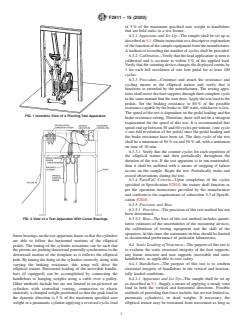
(2) Bias—Thebiasofthistestmethodincludesquantitative elliptical trainer. Figs. 1 and 2 illustrate pneumatic apparatuses
estimates of the uncertainties of the measuring devices, the that have been used successfully to conduct endurance testing.
calibrations of testing equipment and the skill of the operators. The elliptical trainer shown in Fig. 2 is driven by the two
At this time, the statements on bias should be limited to pneumatic cylinders which are attached to the footplates of the
documented performance of particular laboratories. device under test. The cylinders can be pivoted or mounted to
F2811 − 15 (2020)
of 5 % of the maximum specified user weight to handlebars
that are held static in a test fixture.
6.3.1 Apparatus and Set Up—The sample shall be set up as
describedin5.1.Obtaininstructionoradescriptiveexplanation
ofthefunctionofthesampleequipmentfromthemanufacturer.
Amethod of recording the number of cycles shall be provided.
6.3.2 Calibration—Verifythattheloadapplicationsystemis
calibrated and is accurate to within 5 % of the applied load.
Verifythatthecountingdevicechangesthedisplayedcountsby
1 for each full revolution of one foot pedal for at least 100
cycles.
6.3.3 Procedure—Construct and attach the resistance and
cycling means to the elliptical trainer and verify that it
functions as intended by the manufacturer. The testing appa-
ratus shall move the foot supports through their complete cycle
inthesamemannerthattheuserdoes.Applythetestloadtothe
pedals. Set the braking resistance to 80 % of the possible
resistance capable by the brake or 300 watts, whichever is less.
The speed of the test is dependant on the pedal loading and the
FIG. 1 Isometric View of a Pivoting Test Apparatus
brake resistance setting.Therefore, there will not be a stringent
requirement for the speed of this test. It is recommended that
speed end up between 30 and 60 cycles per minute, (one cycle
= one full revolution of the pedal) once the pedal loading and
the brake resistance have been set. The duty cycle of the test
shall be a minimum of 50 % on and 50 % off, with a minimum
on time of 30 min.
6.3.3.1 Verify that the counter cycles for each repetition of
the elliptical trainer and then periodically throughout the
duration of the test. If the test apparatus is to run unattended,
then it shall be outfitted with a means of stopping if failure
occurs on the sample. Begin the test. Periodically make and
record observations during the test.
6.3.4 Pass/Fail Criteria—Upon completion of the cycles
specified in Specification F2810, the trainer shall function as
per the operation instructions provided by the manufacturer
and conform to the requirements of subsection 5.3 of Specifi-
cation F2810.
6.3.5 Precision and Bias:
6.3.5.1 Precision—The precision of this test method has not
been determined.
FIG. 2 View of a Test Apparatus With Linear Bearings
6.3.5.2 Bias—The bias of this test method includes quanti-
tative estimates of the uncertainties of the measuring devices,
the calibrations of testing equipment and the skill of the
operators.Atthistime,thestatementsonbiasshouldbelimited
linear bearings on the test apparatus frame so that the cylinders
to documented performance of particular laboratories.
are able to follow the horizontal motions of the elliptical
6.4 Static Loading of Structures—The purpose of this test is
pedals. The timing of the cylinder actuations can be such that
to evaluate the static structural integrity of the foot supports,
thepistonsarepushingdownwardgenerallysynchronoustothe
any frame structure and user supports (moveable and static
downward motion of the footplate as it follows the elliptical
handlebars), as applicable to user safety.
path. By timing the firing of the cylinders correctly, along with
varying the braking resistance, this setup will drive the 6.4.1 Handlebars—The purpose of this test is to confirm
structural integrity of handlebars in the vertical and horizon-
elliptical trainer. Horizontal loading of the moveable handle-
bars (if equipped) can be accomplished by connecting the tally loaded conditions.
handlebars to hanging weights using a cable over a pulley. 6.4.1.1 Apparatus and Set Up—The sample shall be set up
Other methods include but are not limited to un-powered air as described in 5.1. Supply a means of app
...