

ASTM F1250-20
(Specification)Standard Specification for Stationary Upright and Recumbent Exercise Bicycles and Upper and Total Body Ergometers
General Information
- Abstract
ABSTRACT
This safety specification provides the safety design features and reasonable safety standards intended to reduce the demonstrated hazards associated with the use (including storage, movement, entry, use, and exit from the product) of stationary exercise bicycles assembled in accordance with the manufacturer's instructions for safe use. This standard is limited to exercise bicycles of the following classes: Class A, non-free-wheeling exercise bicycles with a directly driven flywheel; Class B, free-wheeling exercise bicycles; Class C, ergometer bicycles or those bicycles used to precisely measure work; and Class D, units designed to convert road bicycles to stationary exercise bicycles. Device stability, exterior design, overheating performance, inertia, and design characteristics of the individual parts such as the frame and seat post retention assembly, seat post and seat, handlebars, and pedals shall be tested as indicated herein, and should comply accordingly with the acceptance criteria specified for each the said requirements. Guidelines are also specified for appropriate documentation practices for the owner's/user's manual, assembly instructions, operational instructions, maintenance instructions, installation instructions, user weight restrictions, warnings/warning labels, and other product markings.
SCOPE
1.1 This standard establishes parameters for the design and manufacture of stationary upright and recumbent exercise bicycles and ergometers as defined in Section 3.
1.2 It is the intent of this standard to specify fitness products for use only by an individual age 13 and older.
1.3 This standard is to be used in conjunction with Specification F2276 and Test Methods F3023.
1.4 This specification is intended to reduce the demonstrated hazards associated with the use of stationary exercise upright and recumbent bicycles and ergometers.
1.5 This specification is written to provide reasonable safety standards for the user of stationary upright and recumbent exercise bicycles and ergometers during storage, movement, entry, use and exit from the product.
1.6 This standard does not apply to mechanisms that convert road bicycles into indoor stationary bicycles.
1.7 This specification2 establishes additional requirements not set forth in the referenced ASTM standards for the design of commercial fitness equipment to increase access and user independence by people with functional limitations or impairments.
1.8 The values stated in SI units are to be regarded as standard. The values in parentheses are for information only.
1.9 This standard does not purport to address all of the safety concerns, if any, associated with its use. It is the responsibility of the user of this standard to establish appropriate safety, health, and environmental practices and determine the applicability of regulatory limitations prior to use.
1.10 This international standard was developed in accordance with internationally recognized principles on standardization established in the Decision on Principles for the Development of International Standards, Guides and Recommendations issued by the World Trade Organization Technical Barriers to Trade (TBT) Committee.
- Status
- Published
- Publication Date
- 14-Dec-2020
- Technical Committee
- F08 - Sports Equipment, Playing Surfaces, and Facilities
- Drafting Committee
- F08.30 - Fitness Products
Buy Documents
ASTM F1250-20 - Standard Specification for Stationary Upright and Recumbent Exercise Bicycles and Upper and Total Body Ergometers
REDLINE ASTM F1250-20 - Standard Specification for Stationary Upright and Recumbent Exercise Bicycles and Upper and Total Body Ergometers
Overview
ASTM F1250-20 is the international standard specification for stationary upright and recumbent exercise bicycles, as well as upper and total body ergometers. Issued by ASTM International, this standard outlines minimum safety and performance requirements to address hazards associated with the use, movement, storage, entry, and exit of stationary exercise equipment. It covers equipment for both consumer and commercial (institutional) environments and incorporates accessibility requirements to ensure increased user independence, including those with functional limitations.
This specification is intended for use with products designed for individuals aged 13 and older. It works in conjunction with related ASTM standards such as ASTM F2276 for general fitness equipment specification and ASTM F3023 for test methods.
Key Topics
- Scope of Application: Covers upright and recumbent stationary exercise bicycles and ergometers, including those measuring precise workload.
- Design Classes:
- Class A: Non-free-wheeling, direct-drive flywheel bicycles
- Class B: Free-wheeling bicycles
- Class C: Ergometers for precise measurement
- Class D: Devices converting road bikes, not covered by this standard
- Safety Requirements:
- Device stability and structural integrity
- Exterior and design safety to prevent overheating or entrapment
- Slip-resistant pedal surfaces with right/left symmetry
- Robust retention and adjustment of seat and handlebars
- Universal and Inclusive Design:
- Accessibility criteria for commercial equipment to accommodate users with physical limitations
- Requirements for minimum adjustability and support to advance ADA compliance and user independence
- Documentation and Marking:
- Mandatory provision of assembly, operational, maintenance, and installation instructions
- Owner’s manual must include safety information, warnings, and use recommendations
- Product marking for clear manufacturer identification and warning labels
Applications
ASTM F1250-20 applies broadly to the fitness equipment industry, fitness centers, health clubs, rehabilitation facilities, and home exercise environments. Manufacturers, designers, and facility managers rely on the standard to:
- Ensure the safety and reliability of stationary exercise bicycles and ergometers
- Reduce the risk of user injury during storage, movement, mounting, dismounting, and use
- Address the needs of users with disabilities via inclusive design parameters
- Provide adequate safety labeling and thorough user documentation
- Support compliance with international regulations and trade guidelines
Facility operators use these guidelines to select, install, and maintain equipment that meets recognized international safety and accessibility standards, fostering a secure and inclusive environment for all users.
Related Standards
- ASTM F2276: Specification for Fitness Equipment - General safety and performance requirements for all fitness equipment types.
- ASTM F3023: Test Methods for Stationary Upright and Recumbent Exercise Bicycles and Ergometers - Test methods for verifying equipment safety and function.
- ASTM F1749: Specification for Fitness Facility Safety Signage and Labels - Requirements for warnings and user guidance.
- ASTM F3021: Specification for Universal Design of Fitness Equipment - Addresses inclusive use for individuals with functional limitations.
- EN ISO 20957-1, EN ISO 20957-5: International standards relating to safety and test methods for stationary training equipment.
Keywords: ASTM F1250-20, stationary exercise bicycle, recumbent exercise bike, ergometer, fitness equipment safety, inclusive fitness, accessibility, exercise bike standards, commercial gym equipment, ASTM standards, user manual, safety labeling, universal design.
Relations
- Effective Date
- 15-Nov-2023
- Effective Date
- 01-May-2020
- Effective Date
- 01-Jun-2018
- Effective Date
- 01-Apr-2017
- Effective Date
- 01-Oct-2016
- Effective Date
- 01-Apr-2015
- Effective Date
- 01-Apr-2015
- Effective Date
- 01-Sep-2014
- Effective Date
- 01-Jun-2013
- Effective Date
- 01-Jun-2013
- Effective Date
- 01-Feb-2010
- Effective Date
- 01-Jun-2009
- Effective Date
- 01-Jun-2009
- Effective Date
- 01-Jan-2005
- Effective Date
- 10-Jun-2003
Buy Documents
ASTM F1250-20 - Standard Specification for Stationary Upright and Recumbent Exercise Bicycles and Upper and Total Body Ergometers
REDLINE ASTM F1250-20 - Standard Specification for Stationary Upright and Recumbent Exercise Bicycles and Upper and Total Body Ergometers
Frequently Asked Questions
ASTM F1250-20 is a technical specification published by ASTM International. Its full title is "Standard Specification for Stationary Upright and Recumbent Exercise Bicycles and Upper and Total Body Ergometers". This standard covers: ABSTRACT This safety specification provides the safety design features and reasonable safety standards intended to reduce the demonstrated hazards associated with the use (including storage, movement, entry, use, and exit from the product) of stationary exercise bicycles assembled in accordance with the manufacturer's instructions for safe use. This standard is limited to exercise bicycles of the following classes: Class A, non-free-wheeling exercise bicycles with a directly driven flywheel; Class B, free-wheeling exercise bicycles; Class C, ergometer bicycles or those bicycles used to precisely measure work; and Class D, units designed to convert road bicycles to stationary exercise bicycles. Device stability, exterior design, overheating performance, inertia, and design characteristics of the individual parts such as the frame and seat post retention assembly, seat post and seat, handlebars, and pedals shall be tested as indicated herein, and should comply accordingly with the acceptance criteria specified for each the said requirements. Guidelines are also specified for appropriate documentation practices for the owner's/user's manual, assembly instructions, operational instructions, maintenance instructions, installation instructions, user weight restrictions, warnings/warning labels, and other product markings. SCOPE 1.1 This standard establishes parameters for the design and manufacture of stationary upright and recumbent exercise bicycles and ergometers as defined in Section 3. 1.2 It is the intent of this standard to specify fitness products for use only by an individual age 13 and older. 1.3 This standard is to be used in conjunction with Specification F2276 and Test Methods F3023. 1.4 This specification is intended to reduce the demonstrated hazards associated with the use of stationary exercise upright and recumbent bicycles and ergometers. 1.5 This specification is written to provide reasonable safety standards for the user of stationary upright and recumbent exercise bicycles and ergometers during storage, movement, entry, use and exit from the product. 1.6 This standard does not apply to mechanisms that convert road bicycles into indoor stationary bicycles. 1.7 This specification2 establishes additional requirements not set forth in the referenced ASTM standards for the design of commercial fitness equipment to increase access and user independence by people with functional limitations or impairments. 1.8 The values stated in SI units are to be regarded as standard. The values in parentheses are for information only. 1.9 This standard does not purport to address all of the safety concerns, if any, associated with its use. It is the responsibility of the user of this standard to establish appropriate safety, health, and environmental practices and determine the applicability of regulatory limitations prior to use. 1.10 This international standard was developed in accordance with internationally recognized principles on standardization established in the Decision on Principles for the Development of International Standards, Guides and Recommendations issued by the World Trade Organization Technical Barriers to Trade (TBT) Committee.
ABSTRACT This safety specification provides the safety design features and reasonable safety standards intended to reduce the demonstrated hazards associated with the use (including storage, movement, entry, use, and exit from the product) of stationary exercise bicycles assembled in accordance with the manufacturer's instructions for safe use. This standard is limited to exercise bicycles of the following classes: Class A, non-free-wheeling exercise bicycles with a directly driven flywheel; Class B, free-wheeling exercise bicycles; Class C, ergometer bicycles or those bicycles used to precisely measure work; and Class D, units designed to convert road bicycles to stationary exercise bicycles. Device stability, exterior design, overheating performance, inertia, and design characteristics of the individual parts such as the frame and seat post retention assembly, seat post and seat, handlebars, and pedals shall be tested as indicated herein, and should comply accordingly with the acceptance criteria specified for each the said requirements. Guidelines are also specified for appropriate documentation practices for the owner's/user's manual, assembly instructions, operational instructions, maintenance instructions, installation instructions, user weight restrictions, warnings/warning labels, and other product markings. SCOPE 1.1 This standard establishes parameters for the design and manufacture of stationary upright and recumbent exercise bicycles and ergometers as defined in Section 3. 1.2 It is the intent of this standard to specify fitness products for use only by an individual age 13 and older. 1.3 This standard is to be used in conjunction with Specification F2276 and Test Methods F3023. 1.4 This specification is intended to reduce the demonstrated hazards associated with the use of stationary exercise upright and recumbent bicycles and ergometers. 1.5 This specification is written to provide reasonable safety standards for the user of stationary upright and recumbent exercise bicycles and ergometers during storage, movement, entry, use and exit from the product. 1.6 This standard does not apply to mechanisms that convert road bicycles into indoor stationary bicycles. 1.7 This specification2 establishes additional requirements not set forth in the referenced ASTM standards for the design of commercial fitness equipment to increase access and user independence by people with functional limitations or impairments. 1.8 The values stated in SI units are to be regarded as standard. The values in parentheses are for information only. 1.9 This standard does not purport to address all of the safety concerns, if any, associated with its use. It is the responsibility of the user of this standard to establish appropriate safety, health, and environmental practices and determine the applicability of regulatory limitations prior to use. 1.10 This international standard was developed in accordance with internationally recognized principles on standardization established in the Decision on Principles for the Development of International Standards, Guides and Recommendations issued by the World Trade Organization Technical Barriers to Trade (TBT) Committee.
ASTM F1250-20 is classified under the following ICS (International Classification for Standards) categories: 97.220.30 - Indoor sports equipment. The ICS classification helps identify the subject area and facilitates finding related standards.
ASTM F1250-20 has the following relationships with other standards: It is inter standard links to ASTM F3021-23, ASTM F1749-15(2020), ASTM F3023-18, ASTM F3021-17, ASTM F3021-16, ASTM F1749-15, ASTM F3021-15, ASTM F3021-14, ASTM F3021-13, ASTM F3023-13, ASTM F2276-10, ASTM F1749-09, ASTM F2276-09, ASTM F2276-05, ASTM F2276-03. Understanding these relationships helps ensure you are using the most current and applicable version of the standard.
ASTM F1250-20 is available in PDF format for immediate download after purchase. The document can be added to your cart and obtained through the secure checkout process. Digital delivery ensures instant access to the complete standard document.
Standards Content (Sample)
This international standard was developed in accordance with internationally recognized principles on standardization established in the Decision on Principles for the
Development of International Standards, Guides and Recommendations issued by the World Trade Organization Technical Barriers to Trade (TBT) Committee.
Designation:F1250 −20 An American National Standard
Standard Specification for
Stationary Upright and Recumbent Exercise Bicycles and
Upper and Total Body Ergometers
This standard is issued under the fixed designation F1250; the number immediately following the designation indicates the year of
original adoption or, in the case of revision, the year of last revision. A number in parentheses indicates the year of last reapproval. A
superscript epsilon (´) indicates an editorial change since the last revision or reapproval.
INTRODUCTION
Thegoalofthisspecificationistopromoteproperdesignandmanufacturingpracticesforstationary
upright and recumbent exercise bicycles and ergometers. Through these specifications, this specifi-
cation aims to assist designers and manufacturers in reducing the possibility of injury when these
products are used in accordance with the operational instructions.
The equipment user must recognize, however, that a standard alone will not necessarily prevent
injuries. Like other physical activities, exercise involving this equipment involves the risk of injury,
particularly if the equipment is used improperly or is not properly maintained. In addition, users with
physical limitations should seek medical advice and instruction from the fitness facility prior to using
this equipment. Certain physical conditions or limitations may preclude some persons from using this
equipment as intended by the manufacturer, and using this equipment may increase the risk of injury.
1. Scope of commercial fitness equipment to increase access and user
independence by people with functional limitations or impair-
1.1 This standard establishes parameters for the design and
ments.
manufacture of stationary upright and recumbent exercise
bicycles and ergometers as defined in Section 3. 1.8 The values stated in SI units are to be regarded as
standard. The values in parentheses are for information only.
1.2 It is the intent of this standard to specify fitness products
1.9 This standard does not purport to address all of the
for use only by an individual age 13 and older.
safety concerns, if any, associated with its use. It is the
1.3 This standard is to be used in conjunction with Speci-
responsibility of the user of this standard to establish appro-
fication F2276 and Test Methods F3023.
priate safety, health, and environmental practices and deter-
1.4 This specification is intended to reduce the demon-
mine the applicability of regulatory limitations prior to use.
strated hazards associated with the use of stationary exercise
1.10 This international standard was developed in accor-
upright and recumbent bicycles and ergometers.
dance with internationally recognized principles on standard-
ization established in the Decision on Principles for the
1.5 This specification is written to provide reasonable safety
Development of International Standards, Guides and Recom-
standards for the user of stationary upright and recumbent
mendations issued by the World Trade Organization Technical
exercise bicycles and ergometers during storage, movement,
Barriers to Trade (TBT) Committee.
entry, use and exit from the product.
1.6 Thisstandarddoesnotapplytomechanismsthatconvert
2. Referenced Documents
road bicycles into indoor stationary bicycles.
2.1 ASTM Standards:
1.7 This specification establishes additional requirements
F1749 Specification for Fitness Equipment and Fitness Fa-
not set forth in the referenced ASTM standards for the design
cility Safety Signage and Labels
F2276 Specification for Fitness Equipment
F3021 Specification for Universal Design of Fitness Equip-
This safety specification is under the jurisdiction of ASTM Committee F08 on
Sports Equipment, Playing Surfaces, and Facilities and is the direct responsibility of ment for Inclusive Use by Persons with Functional Limi-
Subcommittee F08.30 on Fitness Products.
tations and Impairments
Current edition approved Dec. 15, 2020. Published February 2021. Originally
approved in 1989. Last previous edition approved in 2018 as F1250 – 18. DOI:
10.1520/F1250-20. For referenced ASTM standards, visit the ASTM website, www.astm.org, or
This work was funded, in part, by the Rehabilitation Engineering Research contact ASTM Customer Service at service@astm.org. For Annual Book of ASTM
Center on RecTech through the National Institute on Disability, Independent Living, Standards volume information, refer to the standard’s Document Summary page on
and Rehabilitation Research grant #90RE5009-01-00. the ASTM website.
Copyright © ASTM International, 100 Barr Harbor Drive, PO Box C700, West Conshohocken, PA 19428-2959. United States
F1250−20
F3023 TestMethodsforEvaluatingDesignandPerformance as shown in Fig. 2. The unit may have a back support; similar
Characteristics of Stationary Upright and Recumbent to a recumbent bicycle that supports the user’s back.
Exercise Bicycles and Upper and Total Body Ergometers 3.2.7.1 Discussion—Upper body ergometer is used to
specify an ergometer with only upper body components for
3. Terminology
motions. Total body ergometer is used to specify an ergometer
with both upper and lower body components for motion.
3.1 The terms listed below are unique to this specification.
For terms not defined below, refer to Specifications F2276 and
3.2.8 flywheel, n—a heavy wheel for opposing and
F3021.
moderating, by its inertia, fluctuations of speed in the exercise
bicycle on which it is mounted.
3.2 Definitions:
3.2.1 back support, n—part of the user support means that
3.2.9 freewheel, n—a mechanism that is designed to disen-
comes in contact with the user’s back during operation.
gage the flywheel from the pedal mechanism in one direction.
3.2.2 consumer exercise bicycle, n—stationary exercise bi-
3.2.10 handlebar, n—the means that are provided to a user
cycle intended for use by one person or family unit in a home
to enhance balance and stability by partially or substantially
environment.
supporting the user’s weight with the user’s arms.
3.2.3 crank, n—the means that are provided on an exercise
3.2.11 handlebar stem, n—connection between the handle-
bicycle or ergometer to transmit motion from the user’s upper
bar and frame, often provided to adjust the height of the
or lower body to the drive axle of the equipment.
handlebar.
3.2.4 crank handle, n—a device designed to be held by the
3.2.12 institutional exercise bicycle, n—stationary exercise
hand to rotate the ergometer crank while the user is performing
bicycle intended for use by numerous persons in a commercial
the exercise as intended by the manufacturer.
or institutional environment, as opposed to a consumer or
residential environment.
3.2.5 cycle, n—movement of a point or load from a starting
position and back to the same starting position, through one
3.2.13 pedal, n—a device designed to support the foot while
completerevolution.Thiscyclebeingexecutedthroughthefull
the user is performing the exercise as intended by the
range of intended motion.
manufacturer, or while the user mounts or dismounts the
3.2.5.1 Discussion—In this standard, cycle is only used per
equipment.
this definition and is not used to refer to a bicycle or ergometer.
3.2.14 recumbent exercise bicycle, n—stationary exercise
3.2.6 direct drive exercise bicycle, n—stationary exercise
bicycle where the lower body exercise is performed with the
bicycle wherein the flywheel is directly coupled to the pedals
user in a seated position with their back against a back support
without the use of a freewheel mechanism, also referred to as
and with the crank more in front of the body than underneath
fixed wheel exercise bicycle. These exercise bicycles are often
it, for example, Fig. 3 versus Fig. 4.
used in a “class” or group institutional setting.
3.2.15 seat, n—component on which the user sits thereby
3.2.7 ergometer, n—stationary exercise bicycle-like device
providing support for the user’s weight when in a sitting
where the user is in a seated or standing position and engages
posture.
the crank mechanism by hand as shown in Fig. 1 or the
3.2.16 seat post, n—connection between the seat and frame,
equipment may have both upper body and lower body cranks
often used to adjust the height of the seat.
3.2.17 seat sleeve tube, n—the part of the frame where the
seat post is inserted.
FIG. 1Upper Body Ergometer FIG. 2Total Body Ergometer
F1250−20
FIG. 3Recumbent Exercise Bicycle
FIG. 5Direct Drive Exercise Bicycle
5. Design and Construction Requirements
NOTE 1—In addition to the design and construction requirements set
forth in Specification F2276, the following requirements are applicable.
5.1 Seat Post:
5.1.1 Insertion Depth—The seat post for exercise bicycles
shall have a permanent line indicating the minimum insertion
depth of at least 1.5 times the largest cross section dimension
(for example, diameter or longest dimension of the inserted
seat post) into the seat sleeve tube.Amark is not required if the
minimum insertion depth is provided by the design, that is, the
seat post cannot be removed without the use of tools or the
design prevents placement in a position that will not support
the load requirement. Example: a seat post having a slot and an
outer sleeve tube with a pin or bolt that engages with the slot,
ensuring the minimum insertion depth of the seat post and
preventing removal of the seat post from the seat sleeve tube.
5.1.2 The seat shall be adjustable as specified by the
manufacturer. The seat post shall be retained by a clamp, pin,
or similar means.
FIG. 4Upright Exercise Bicycle
5.1.3 The seat shall be mounted onto the seat post with a
seat support plate or other means to protect against impale-
3.2.18 seat support, n—the part of the seat post where the
ment.
seat pad is secured or mounted.
5.1.4 The seat and seat post shall meet the intrinsic loading
3.2.19 stationary exercise bicycle, n—stationary training
requirements of Specification F2276 where the loading factor
equipment that positions a user’s upper or lower body in an
to be applied is 2.5 for both consumer and institutional
upright or recumbent position to turn a directly coupled or
equipment.
connected flywheel or freewheel crank mechanism with the
5.2 Seat Deflection or Tilt—When properly adjusted for use
user’s feet.
according to the manufacturer’s specifications, and tested in
3.2.20 upright exercise bicycle, n—stationary exercise bi-
accordance with the test method, the seat shall not pivot in an
cycle with a crank coupled to a freewheel mechanism, where
upward, downward about or through its connection means
the lower body exercise is performed with the user in a seated
through an angle greater than 2 6 ⁄2 ° when a load of 0.66
position and with the crank more underneath the body, for
times the maximum user body weight or 89.1 kg (196.4 lb),
example, Fig. 4 versus Fig. 3.
whichever is greater, is applied.
4. Equipment Types
5.3 Seat Back Support—The seat back support shall with-
4.1 See Figs. 1-5 for equipment types. stand a load applied to it in accordance with the test method
F1250−20
and per the specifications defined below, without breakage as 5.6 Pedals:
defined in Subsection 6.3 of Test Methods F3023. For con-
5.6.1 Pedals shall have right hand/left hand symmetry.
sumer exercise bicycles this load shall be 1.0 times the
5.6.2 The surface of the pedal contacted by the user during
maximum user weight (as defined by the manufacturer) or 135
use shall be slip-resistant.
kg (297.6 lb) whichever is greater. For institutional exercise
5.6.3 A minimum clearance of 60 mm (2.4 in.) shall be
bicycles, this load shall be 1.5 times the maximum user weight
provided below the pedals when they are in a horizontal
(as defined by the manufacturer) or 202.5 kg (446.4 lb)
position at the lowest level.
whichever is greater.
NOTE 2—Flexible components (such a foot straps or flexible toe cages)
5.4 Handlebar Stem Insertion – Insertion Depth—If a ver-
are allowed to hang below the pedals as long as the non-flexible
tical stem adjustment is used, the handlebar stem or equivalent
components maintain the 60 mm (2.4 in.) minimum clearance.
shall have a permanent line indicating the minimum insertion
5.6.4 Pedals shall meet the static loading requirements of
depth of at least 1.5 times the largest cross section dimension
Specification F2276 where the loading factor to be used is 2.5
(for example, diameter or longest dimension of the inserted
for both consumer and institutional equipment.
handlebar stem). A mark is not required if the minimum
insertion depth is provided by the design (for example, the
5.7 Pedal and Crank Endurance:
handlebar stem or equivalent cannot be removed without the
5.7.1 Pedals and crank arms on the equipment defined in
use of tools) or if the design prevents placement of the
this specification shall be tested for 1 000 000 vertical loading
handlebar stem or equivalent in a position that will not support
cycles (institutional) or 500 000 vertical loading cycles (con-
the load requirement. Example: a handlebar stem having a slot
sumer). These loading cycles do not involve crank arm
andanoutersleevetubewithapinorboltthatengageswiththe
rotation. The test load for each equipment type is provided
slot, ensuring the minimum insertion depth of the handlebar
below. There shall be no breakage throughout the cycle testing
stem and preventing removal of the handlebar stem from the
and the pedal and crank arm assembly shall function as
outer sleeve tube.
intended upon completion of the testing.
5.4.1 The handlebar shall be adjustable as prescribed by the
5.7.1.1 Direct Drive Exercise Bicycle Pedal Test Loads—
manufacturer’s specifications. The handlebar shall be retained
Institutional direct drive exercise bicycle pedals shall endure a
by a clamp, pin, or similar means.
load of weight 135 kg (297.6 lb) or 1.0 times the maximum
5.5 Static Loading of Handlebars:
user weight specified by the manufacturer, whichever is
5.5.1 Horizontal Axis Torque Evaluation—If a clamping
greater. Consumer direct drive exercise bicycle pedals shall
retention system is used to retain the handlebars then the
endure a load of weight 114 kg (251.3 lb) or 1.0 times the
handlebars shall not rotate about its longitudinal or lateral
maximum user weight specified by the manufacturer, which-
horizontalaxeswhenamomentof61N-m(45ft-lb)isapplied.
ever is greater.
5.5.2 Vertical Axis Torque Evaluation—If a clamping reten-
5.7.1.2 Upright Exercise Bicycle Pedal Test Loads—
tion system is used to retain the handlebars then the handlebar
Institutional upright bicycle pedals shall endure a load of 101.3
shall not rotate around its vertical axis when a moment of 47
kg (223.3 lb) or 0.75 times the maximum user weight specified
N-m (35 ft-lb) is applied.
by the manufacturer, whichever is greater. Consumer upright
5.5.3 Consumer bicycle handlebars for bicycles with a
bicycle pedals shall endure a load of 85.5 kg (188.5 lb) or 0.75
freewheel—Handlebars shall withstand a loading of 0.3 times
times the maximum user weight specified by the manufacturer,
themaximumuserbodyweightor34.2kg(75.4lb),whichever
whichever is greater.
is greater, without breakage.
5.7.1.3 Recumbent Exercise Bicycle Pedal Test Loads—
5.5.4 Consumer bicycle handlebars on direct drive exercise
Institutional recumbent bicycle pedals shall endure a load of
bicycles—Handlebarsshallwithstandaloadingof1.5timesthe
67.5 kg (148.8 lb) or 0.5 times the maximum user weight
maximum user body weight or 151.7 kg (334.4 lb), whichever
specified by the manufacturer, whichever is greater. Consumer
is greater, without breakage.
recumbent bicycle pedals shall endure a load of 57 kg (125.7
5.5.5 Institutional bicycle handlebars for bicycles with a
lb) or 0.5 times the maximum user weight specified by the
freewheel—Handlebars shall withstand a loading of 0.3 times
manufacturer, whichever is greater.
the maximum user body weight or 60.7 kg (133.8 lb), which-
5.7.1.4 Total Body Ergometer Pedal Test Loads—Totalbody
ever is greater, without breakage.
ergometer pedals shall endure a load at the pedal of 67.5 kg
5.5.6 Institutional bicycle handlebars on direct drive exer-
(148.8 lb) or 0.5 times the maximum user weight specified by
cise bicycles—Handlebars shall withstand a loading of 1.5
the manufacturer, whichever is greater.
times the maximum user body weight or 202.5 kg (446.4 lb),
whichever is greater, without breakage. 5.8 Crank Arm and Shroud Entrapment—The movement of
5.5.7 Recumbent Seat Support Handlebars—For both con- the crank arm relative to the shroud enclosure or other fixture
sumer and institutional recumbent exercise bicycles, handle- of the exercise bicycle/ergometer shall not create an entrap-
bars shall withstand a vertical load of 2.5 times the maximum ment hazard.
user weight specified by the manufacturer or 337.5 kg (744.1
5.9 Drive Train—DrivetrainelementsshallmeettheGuard-
lb), whichever is greater, without breakage. This load is to be
ing and Entrapment o
...
This document is not an ASTM standard and is intended only to provide the user of an ASTM standard an indication of what changes have been made to the previous version. Because
it may not be technically possible to adequately depict all changes accurately, ASTM recommends that users consult prior editions as appropriate. In all cases only the current version
of the standard as published by ASTM is to be considered the official document.
Designation: F1250 − 18 F1250 − 20 An American National Standard
Standard Specification for
Stationary Upright and Recumbent Exercise Bicycles and
Upper and Total Body Ergometers
This standard is issued under the fixed designation F1250; the number immediately following the designation indicates the year of
original adoption or, in the case of revision, the year of last revision. A number in parentheses indicates the year of last reapproval. A
superscript epsilon (´) indicates an editorial change since the last revision or reapproval.
INTRODUCTION
The goal of this specification is to promote proper design and manufacturing practices for stationary
upright and recumbent exercise bicycles and ergometers. Through these specifications, this specifi-
cation aims to assist designers and manufacturers in reducing the possibility of injury when these
products are used in accordance with the operational instructions.
The equipment user must recognize, however, that a standard alone will not necessarily prevent
injuries. Like other physical activities, exercise involving this equipment involves the risk of injury,
particularly if the equipment is used improperly or is not properly maintained. In addition, users with
physical limitations should seek medical advice and instruction from the fitness facility prior to using
this equipment. Certain physical conditions or limitations may preclude some persons from using this
equipment as intended by the manufacturer, and using this equipment may increase the risk of injury.
1. Scope
1.1 This standard establishes parameters for the design and manufacture of stationary upright and recumbent exercise bicycles and
ergometers as defined in Section 3.
1.2 It is the intent of this standard to specify fitness products for use only by an individual age 13 and older.
1.3 This standard is to be used in conjunction with Specification F2276 and Test Methods F3023.
1.4 This specification is intended to reduce the demonstrated hazards associated with the use of stationary exercise upright and
recumbent bicycles and ergometers.
1.5 This specification is written to provide reasonable safety standards for the user of stationary upright and recumbent exercise
bicycles and ergometers during storage, movement, entry, use and exit from the product.
1.6 This standard does not apply to mechanisms that convert road bicycles into indoor stationary bicycles.
This safety specification is under the jurisdiction of ASTM Committee F08 on Sports Equipment, Playing Surfaces, and Facilities and is the direct responsibility of
Subcommittee F08.30 on Fitness Products.
Current edition approved June 1, 2018Dec. 15, 2020. Published July 2018February 2021. Originally approved in 1989. Last previous edition approved in 20132018 as
F1250 – 13.F1250 – 18. DOI: 10.1520/F1250-18.10.1520/F1250-20.
Copyright © ASTM International, 100 Barr Harbor Drive, PO Box C700, West Conshohocken, PA 19428-2959. United States
F1250 − 20
1.7 This specification establishes additional requirements not set forth in the referenced ASTM standards for the design of
commercial fitness equipment to increase access and user independence by people with functional limitations or impairments.
1.8 The values stated in SI units are to be regarded as standard. The values in parentheses are for information only.
1.9 This standard does not purport to address all of the safety concerns, if any, associated with its use. It is the responsibility
of the user of this standard to establish appropriate safety, health, and environmental practices and determine the applicability of
regulatory limitations prior to use.
1.10 This international standard was developed in accordance with internationally recognized principles on standardization
established in the Decision on Principles for the Development of International Standards, Guides and Recommendations issued
by the World Trade Organization Technical Barriers to Trade (TBT) Committee.
2. Referenced Documents
2.1 ASTM Standards:
F1749 Specification for Fitness Equipment and Fitness Facility Safety Signage and Labels
F2276 Specification for Fitness Equipment
F3021 Specification for Universal Design of Fitness Equipment for Inclusive Use by Persons with Functional Limitations and
Impairments
F3023 Test Methods for Evaluating Design and Performance Characteristics of Stationary Upright and Recumbent Exercise
Bicycles and Upper and Total Body Ergometers
3. Terminology
3.1 The terms listed below are unique to this specification. For terms not defined below, refer to Specifications F2276 and F3021.
3.2 Definitions:
3.2.1 back support, n—part of the user support means that comes in contact with the user’s back during operation.
3.2.2 consumer exercise bicycle, n—stationary exercise bicycle intended for use by one person or family unit in a home
environment.
3.2.3 crank, n—the means that are provided on an exercise bicycle or ergometer to transmit motion from the user’s upper or lower
body to the drive axle of the equipment.
3.2.4 crank handle, n—a device designed to be held by the hand to rotate the ergometer crank while the user is performing the
exercise as intended by the manufacturer.
3.2.5 cycle, n—movement of a point or load from a starting position and back to the same starting position, through one complete
revolution. This cycle being executed through the full range of intended motion.
3.2.5.1 Discussion—
In this standard, cycle is only used per this definition and is not used to refer to a bicycle or ergometer.
3.2.6 direct drive exercise bicycle, n—stationary exercise bicycle wherein the flywheel is directly coupled to the pedals without
the use of a freewheel mechanism, also referred to as fixed wheel exercise bicycle. These exercise bicycles are often used in a
“class” or group institutional setting.
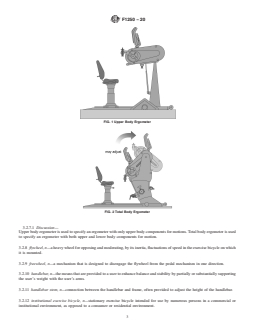
3.2.7 ergometer, n—stationary exercise bicycle-like device where the user is in a seated or standing position and engages the crank
mechanism by hand as shown in Fig. 1 or the equipment may have both upper body and lower body cranks as shown in Fig. 2.
The unit may have a back support; similar to a recumbent bicycle that supports the user’s back.
This work was funded, in part, by the Rehabilitation Engineering Research Center on RecTech through the National Institute on Disability, Independent Living, and
Rehabilitation Research grant #90RE5009-01-00.
For referenced ASTM standards, visit the ASTM website, www.astm.org, or contact ASTM Customer Service at service@astm.org. For Annual Book of ASTM Standards
volume information, refer to the standard’s Document Summary page on the ASTM website.
F1250 − 20
FIG. 1 Upper Body Ergometer
FIG. 2 Total Body Ergometer
3.2.7.1 Discussion—
Upper body ergometer is used to specify an ergometer with only upper body components for motions. Total body ergometer is used
to specify an ergometer with both upper and lower body components for motion.
3.2.8 flywheel, n—a heavy wheel for opposing and moderating, by its inertia, fluctuations of speed in the exercise bicycle on which
it is mounted.
3.2.9 freewheel, n—a mechanism that is designed to disengage the flywheel from the pedal mechanism in one direction.
3.2.10 handlebar, n—the means that are provided to a user to enhance balance and stability by partially or substantially supporting
the user’s weight with the user’s arms.
3.2.11 handlebar stem, n—connection between the handlebar and frame, often provided to adjust the height of the handlebar.
3.2.12 institutional exercise bicycle, n—stationary exercise bicycle intended for use by numerous persons in a commercial or
institutional environment, as opposed to a consumer or residential environment.
F1250 − 20
3.2.13 pedal, n—a device designed to support the foot while the user is performing the exercise as intended by the manufacturer,
or while the user mounts or dismounts the equipment.
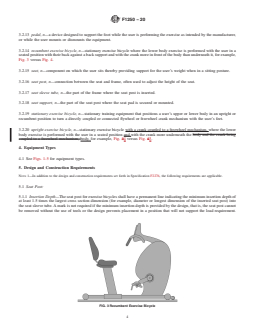
3.2.14 recumbent exercise bicycle, n—stationary exercise bicycle where the lower body exercise is performed with the user in a
seated position with their back against a back support and with the crank more in front of the body than underneath it, for example,
Fig. 3 versus Fig. 4.
3.2.15 seat, n—component on which the user sits thereby providing support for the user’s weight when in a sitting posture.
3.2.16 seat post, n—connection between the seat and frame, often used to adjust the height of the seat.
3.2.17 seat sleeve tube, n—the part of the frame where the seat post is inserted.
3.2.18 seat support, n—the part of the seat post where the seat pad is secured or mounted.
3.2.19 stationary exercise bicycle, n—stationary training equipment that positions a user’s upper or lower body in an upright or
recumbent position to turn a directly coupled or connected flywheel or freewheel crank mechanism with the user’s feet.
3.2.20 upright exercise bicycle, n—stationary exercise bicycle with a crank coupled to a freewheel mechanism, where the lower
body exercise is performed with the user in a seated position and with the crank more underneath the body and the crank being
coupled to a freewheel mechanism, body, for example, Fig. 34 versus Fig. 43.
4. Equipment Types
4.1 See Figs. 1-5 for equipment types.
5. Design and Construction Requirements
NOTE 1—In addition to the design and construction requirements set forth in Specification F2276, the following requirements are applicable.
5.1 Seat Post:
5.1.1 Insertion Depth—The seat post for exercise bicycles shall have a permanent line indicating the minimum insertion depth of
at least 1.5 times the largest cross section dimension (for example, diameter or longest dimension of the inserted seat post) into
the seat sleeve tube. A mark is not required if the minimum insertion depth is provided by the design, that is, the seat post cannot
be removed without the use of tools or the design prevents placement in a position that will not support the load requirement.
FIG. 3 Recumbent Exercise Bicycle
F1250 − 20
FIG. 4 Upright Exercise Bicycle
FIG. 5 Direct Drive Exercise Bicycle
Example: a slot in the insertion tube andseat post having a slot and an outer sleeve tube with a pin or bolt in the outer sleeve tube
that prevents removal and will only allow securing of the insertion tube at that engages with the slot, ensuring the minimum
insertion depth.depth of the seat post and preventing removal of the seat post from the seat sleeve tube.
5.1.2 The seat shall be adjustable as prescribedspecified by the manufacturer’s specifications. manufacturer. The seat post shall be
retained by a clamp, pin, or similar means.
5.1.3 The seat shall be mounted onto the seat post with a seat support plate.plate or other means to protect against impalement.
NOTE 2—This seat support plate is provided that protects the user from impalement in case of failure of the seat or seat post.
F1250 − 20
5.1.4 The seat and seat post shall meet the intrinsic loading requirements of Specification F2276 where the loading factor to be
applied is 2.5 for both consumer and institutional equipment.
5.2 Seat Deflection or Tilt—When properly adjusted for use according to the manufacturer’s specifications, and tested in
accordance with the test method, the seat shall not pivot in an upward, downward about or through its connection means through
an angle greater than 2 6 ⁄2 ° when a load of 0.66 times the maximum user body weight or 89.1 kg (196.4 lb), whichever is greater,
is applied.
5.3 Seat Back Support—The seat back support shall withstand a load applied to it in accordance with the test method and per the
specifications defined below, without breakage as defined in Subsection 6.3 of Test Methods F3023. For consumer exercise
bicycles this load shall be 1.0 times the maximum user weight (as defined by the manufacturer) or 135 kg (297.6 lb) whichever
is greater. For institutional exercise bicycles, this load shall be 1.5 times the maximum user weight (as defined by the manufacturer)
or 202.5 kg (446.4 lb) whichever is greater.
5.4 Handlebar Stem Insertion – Insertion Depth—If a vertical stem adjustment is used, the handlebar stem or equivalent shall have
a permanent line indicating the minimum insertion depth of at least 1.5 times the largest cross section dimension (for example,
diameter or longest dimension of the inserted handlebar stem). A mark is not required if the minimum insertion depth is provided
by the design (for example, the handlebar stem or equivalent cannot be removed without the use of tools) or if the design prevents
placement of the handlebar stem or equivalent in a position that will not support the load requirement. Example: a handlebar stem
having a slot and an outer sleeve tube with a pin or bolt that engages with the slot, ensuring the minimum insertion depth of the
handlebar stem and preventing removal of the handlebar stem from the outer sleeve tube.
NOTE 3—A mark is not required if the minimum insertion depth is provided by the design (for example, the handlebar stem or equivalent cannot be
removed without the use of tools) or if the design prevents placement of the handlebar stem or equivalent in a position that will not support the load
requirement.
5.4.1 The handlebar shall be adjustable as prescribed by the manufacturer’s specifications. The handlebar shall be retained by a
clamp, pin, or similar means.
5.5 Handlebar Static Loading: Static Loading of Handlebars:
5.5.1 Horizontal Axis Torque Evaluation—If a clamping retention system is used to retain the handlebars then the handlebars shall
not rotate about its longitudinal or lateral horizontal axes when a moment of 61 N-m (45 ft-lb) is applied.
5.5.2 Vertical Axis Torque Evaluation—If a clamping retention system is used to retain the handlebars then the handlebar shall not
rotate around its vertical axis when a moment of 47 N-m (35 ft-lb) is applied.
5.5.3 Consumer bicycle handlebars for bicycles with a freewheel—Handlebars shall withstand a loading of 0.3 times the maximum
user body weight or 60.7 kg (133.8 lb) for institutional or 34.2 kg (75.4 lb) for consumer, lb), whichever is greater without
breakage. Handlebars on direct drive exercise bicycles shall withstand a loading of 1.5 times the maximum user body weight or
202.5 kg (446.4 lb) for institutional or 151.7 kg (334.4 lb) for consumer.greater, without breakage.
5.5.4 Consumer bicycle handlebars on direct drive exercise bicycles—Handlebars shall withstand a loading of 1.5 times the
maximum user body weight or 151.7 kg (334.4 lb), whichever is greater, without breakage.
5.5.5 Institutional bicycle handlebars for bicycles with a freewheel—Handlebars shall withstand a loading of 0.3 times the
maximum user body weight or 60.7 kg (133.8 lb), whichever is greater, without breakage.
5.5.6 Institutional bicycle handlebars on direct drive exercise bicycles—Handlebars shall withstand a loading of 1.5 times the
maximum user body weight or 202.5 kg (446.4 lb), whichever is greater, without breakage.
5.5.7 Recumbent Seat Support Handlebars—Consumer For both consumer and institutional recumbent exercise bicyclebicycles,
handlebars shall withstand a vertical load of 2.5 times the maximum user weight specified by the manufacturer or 337.5 kg (744.1
lb)lb), whichever is greater without breakage.greater, without breakage. This load is to be distributed across both handlebars or ⁄2
the load may be applied to one seat support handlebar.
F1250 − 20
5.6 Pedals:
5.6.1 Pedals shall have right hand/left hand symmetry.
5.6.2 The surface of the pedal contacted by the user during use shall be slip-resistant.
5.6.3 A minimum clearance of 60 mm (2.4 in.) shall be provided below the pedals when they are in a horizontal position at the
lowest level.
NOTE 2—Flexible components (such a foot straps or flexible toe cages) are allowed to hang below the pedals as long as the non-flexible components
maintain the 60 mm (2.4 in.) minimum clearance.
5.6.4 Pedals shall meet the static loading requirements of Specification F2276 where the loading factor to be used is 2.5 for both
consumer and institutional equipment.
5.7 Pedal and Crank Endurance:
5.7.1 Pedals and crank arms on the equipment defined in this specification shall be tested for 1 000 000 vertical loading cycles
(institutional) or 500 000 vertical loading cycles (consumer). These loading cycles do not involve crank arm rotation. The test load
for each equipment type is provided below. There shall be no breakage throughout the cycle testing and the pedal and crank arm
assembly shall function as intended upon completion of the testing.
5.7.1.1 Direct Drive Exercise Bicycle Pedal Test Loads—Direct Institutional direct drive exercise bicycle pedals shall endure a
load of weight 135 kg (297.6 lb) for institutional and or 1.0 times the maximum user weight specified by the manufacturer,
whichever is greater. Consumer direct drive exercise bicycle pedals shall endure a load of weight 114 kg (251.3 lb) consumer or
1.0 times the maximum user weight specified by the manufacturer, whichever is greater.
5.7.1.2 Upright Exercise Bicycle Pedal Test Loads—Upright Institutional upright bicycle pedals shall endure a load of 101.3 kg
(223.3 lb) institutional and or 0.75 times the maximum user weight specified by the manufacturer, whichever is greater. Consumer
upright bicycle pedals shall endure a load of 85.5 kg (188.5 lb) consumer or 0.75 times the maximum user weight specified by
the manufacturer, whichever is greater.
5.7.1.3 Recumbent Exercise Bicycle Pedal Test Loads—Recumbent Institutional recumbent bicycle pedals shall endure a load of
67.5 kg (148.8 lb) for institutional and or 0.5 times the maximum user weight specified by the manufacturer, whichever is greater.
Consumer recumbent bicycle pedals shall endure a load of 57 kg (125.7 lb) consumeror 0.5 times the maximum user weight
specified b
...