


ASTM B777-15(2020)
(Specification)Standard Specification for Tungsten Base, High-Density Metal
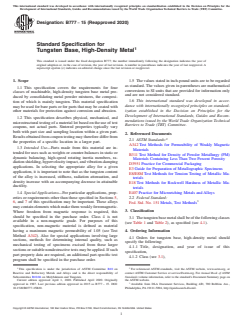
Standard Specification for Tungsten Base, High-Density Metal
ABSTRACT
This specification establishes the requirements for four classes of machinable, high-density tungsten base metal produced by consolidating metal powder mixtures, the composition of which is mainly tungsten. This material specification may be used for bare parts or for parts that may be coated with other materials for protection against corrosion and abrasion; intended for uses such as weights or counter-balances in static or dynamic balancing, high-speed rotating inertia members, radiation shielding, hypervelocity impact, and vibration-damping applications. The chemical; physical properties, such as microstructure and machinability; mechanical properties, such as tensile strength, yield strength, elongation, and hardness; and composition requirements, such as density; are detailed.
SCOPE
1.1 This specification covers the requirements for four classes of machinable, high-density tungsten base metal produced by consolidating metal powder mixtures, the composition of which is mainly tungsten. This material specification may be used for bare parts or for parts that may be coated with other materials for protection against corrosion and abrasion.
1.2 This specification describes physical, mechanical, and microstructural testing of a material lot based on the use of test coupons, not actual parts. Sintered properties typically vary both with part size and sampling location within a given part. Results obtained from coupon testing may therefore differ from the properties of a specific location in a larger part.
1.3 Intended Use—Parts made from this material are intended for uses such as weights or counter-balances in static or dynamic balancing, high-speed rotating inertia members, radiation shielding, hypervelocity impact, and vibration-damping applications. In selecting the appropriate alloy for a given application, it is important to note that as the tungsten content of the alloy is increased, stiffness, radiation attenuation, and density increase with an accompanying decrease in attainable ductility.
1.4 Special Applications—For particular applications, properties or requirements other than those specified in Sections 5, 6, and 7 of this specification may be important. These alloys may contain elements which make them weakly ferromagnetic. Where freedom from magnetic response is required, this should be specified in the purchase order. Class 4 is not available in a non-magnetic grade. For purposes of this specification, non-magnetic material is defined as material having a maximum magnetic permeability of 1.05 (see Test Method A342). Also for special applications involving large sections, methods for determining internal quality, such as mechanical testing of specimens excised from these larger sections or suitable nondestructive tests may be applied. If such part property data are required, an additional part-specific test program shall be specified in the purchase order.
1.5 The values stated in inch-pound units are to be regarded as standard. The values given in parentheses are mathematical conversions to SI units that are provided for information only and are not considered standard.
1.6 This international standard was developed in accordance with internationally recognized principles on standardization established in the Decision on Principles for the Development of International Standards, Guides and Recommendations issued by the World Trade Organization Technical Barriers to Trade (TBT) Committee.
General Information
- Status
- Published
- Publication Date
- 31-Mar-2020
- Technical Committee
- B10 - Reactive and Refractory Metals and Alloys
- Drafting Committee
- B10.04 - Molybdenum and Tungsten
Relations
- Effective Date
- 01-Apr-2020
- Effective Date
- 01-Jan-2024
- Effective Date
- 01-Nov-2023
- Effective Date
- 01-Oct-2023
- Effective Date
- 01-Jul-2018
- Effective Date
- 01-May-2018
- Effective Date
- 01-Jul-2017
- Effective Date
- 15-Jul-2016
- Effective Date
- 01-Dec-2015
- Effective Date
- 01-Jun-2015
- Effective Date
- 01-Feb-2015
- Effective Date
- 01-Jun-2013
- Effective Date
- 01-Apr-2013
- Effective Date
- 01-Dec-2012
- Effective Date
- 01-Dec-2011
Overview
ASTM B777-15(2020) - Standard Specification for Tungsten Base, High-Density Metal defines the requirements for four classes of machinable, high-density tungsten base metals. Developed by ASTM International, this specification applies to materials primarily composed of tungsten, manufactured by consolidating metal powder mixtures. These metals are designed for use either as bare parts or in coated forms, offering superior density and performance for specialized engineering applications.
Adhering to ASTM B777 ensures materials meet strict criteria regarding chemical composition, mechanical and physical properties, and microstructure. With comprehensive guidance on quality control and testing, this standard supports the production of high-performance tungsten alloys essential for modern industry requirements.
Key Topics
- Material Classes: Four distinct classes based on tungsten content, density, and hardness, providing options for varying performance needs.
- Physical and Mechanical Testing: Requirements for coupon-based testing of physical, mechanical, and microstructural properties like density, tungsten content, tensile strength, yield strength, elongation, and hardness.
- Microstructure Requirements: Ensures a uniform distribution of tungsten particles within a binder metal matrix.
- Magnetic Characteristics: Guidance for selecting non-magnetic material when application demands minimal magnetic permeability.
- Coating Compatibility: Specification allows for the use of protective coatings to enhance resistance against corrosion and abrasion.
- Quality Assurance: Details on sampling procedures, acceptance criteria, and lot identification to guarantee material quality and traceability.
- Packaging and Marking: Standards for packaging, preservation, and clear lot identification to ensure safe handling and delivery.
Applications
Tungsten base high-density metals specified in ASTM B777 are used across a wide range of demanding applications. Key uses include:
- Weights and Counterbalances: For static or dynamic balancing in aerospace, automotive, and industrial equipment.
- High-Speed Rotating Inertia Members: Essential in applications where high angular momentum is critical, such as gyroscopes and flywheels.
- Radiation Shielding: Tungsten’s high density makes it ideal for medical and industrial radiation protection.
- Hypervelocity Impact Structures: Suitable for defense and space industry components that require exceptional impact resistance.
- Vibration Damping: Used to minimize vibration in precision instruments and sensitive electronic devices.
Choosing the suitable tungsten alloy class from ASTM B777 is vital. As tungsten content increases, the material's stiffness, radiation attenuation, and density improve, although this may reduce ductility. The standard facilitates informed selection for different engineering challenges.
Related Standards
For comprehensive compliance and quality, ASTM B777 references several related standards, including:
- ASTM A342: Methods for permeability testing of weakly magnetic materials.
- ASTM B311: Test method for density of powder metallurgy (PM) materials.
- ASTM D3951: Practice for commercial packaging.
- ASTM E3: Guide for preparation of metallographic specimens.
- ASTM E8/E8M: Test methods for tension testing of metallic materials.
- ASTM E18: Test methods for Rockwell hardness of metallic materials.
- ASTM E407: Practice for microetching metals and alloys.
- Federal Standard No. 151: Methods for metals testing relevant to chemistry analysis.
By aligning with ASTM B777-15(2020) and its referenced standards, manufacturers and engineers can ensure superior performance, quality control, and reliability in the supply of tungsten base, high-density metal components. This supports critical applications in aerospace, defense, medical, and industrial sectors where high-density, machinable metals are essential.


Get Certified
Connect with accredited certification bodies for this standard

Element Materials Technology
Materials testing and product certification.

Inštitut za kovinske materiale in tehnologije
Institute of Metals and Technology. Materials testing, metallurgical analysis, NDT.
Sponsored listings
Frequently Asked Questions
ASTM B777-15(2020) is a technical specification published by ASTM International. Its full title is "Standard Specification for Tungsten Base, High-Density Metal". This standard covers: ABSTRACT This specification establishes the requirements for four classes of machinable, high-density tungsten base metal produced by consolidating metal powder mixtures, the composition of which is mainly tungsten. This material specification may be used for bare parts or for parts that may be coated with other materials for protection against corrosion and abrasion; intended for uses such as weights or counter-balances in static or dynamic balancing, high-speed rotating inertia members, radiation shielding, hypervelocity impact, and vibration-damping applications. The chemical; physical properties, such as microstructure and machinability; mechanical properties, such as tensile strength, yield strength, elongation, and hardness; and composition requirements, such as density; are detailed. SCOPE 1.1 This specification covers the requirements for four classes of machinable, high-density tungsten base metal produced by consolidating metal powder mixtures, the composition of which is mainly tungsten. This material specification may be used for bare parts or for parts that may be coated with other materials for protection against corrosion and abrasion. 1.2 This specification describes physical, mechanical, and microstructural testing of a material lot based on the use of test coupons, not actual parts. Sintered properties typically vary both with part size and sampling location within a given part. Results obtained from coupon testing may therefore differ from the properties of a specific location in a larger part. 1.3 Intended Use—Parts made from this material are intended for uses such as weights or counter-balances in static or dynamic balancing, high-speed rotating inertia members, radiation shielding, hypervelocity impact, and vibration-damping applications. In selecting the appropriate alloy for a given application, it is important to note that as the tungsten content of the alloy is increased, stiffness, radiation attenuation, and density increase with an accompanying decrease in attainable ductility. 1.4 Special Applications—For particular applications, properties or requirements other than those specified in Sections 5, 6, and 7 of this specification may be important. These alloys may contain elements which make them weakly ferromagnetic. Where freedom from magnetic response is required, this should be specified in the purchase order. Class 4 is not available in a non-magnetic grade. For purposes of this specification, non-magnetic material is defined as material having a maximum magnetic permeability of 1.05 (see Test Method A342). Also for special applications involving large sections, methods for determining internal quality, such as mechanical testing of specimens excised from these larger sections or suitable nondestructive tests may be applied. If such part property data are required, an additional part-specific test program shall be specified in the purchase order. 1.5 The values stated in inch-pound units are to be regarded as standard. The values given in parentheses are mathematical conversions to SI units that are provided for information only and are not considered standard. 1.6 This international standard was developed in accordance with internationally recognized principles on standardization established in the Decision on Principles for the Development of International Standards, Guides and Recommendations issued by the World Trade Organization Technical Barriers to Trade (TBT) Committee.
ABSTRACT This specification establishes the requirements for four classes of machinable, high-density tungsten base metal produced by consolidating metal powder mixtures, the composition of which is mainly tungsten. This material specification may be used for bare parts or for parts that may be coated with other materials for protection against corrosion and abrasion; intended for uses such as weights or counter-balances in static or dynamic balancing, high-speed rotating inertia members, radiation shielding, hypervelocity impact, and vibration-damping applications. The chemical; physical properties, such as microstructure and machinability; mechanical properties, such as tensile strength, yield strength, elongation, and hardness; and composition requirements, such as density; are detailed. SCOPE 1.1 This specification covers the requirements for four classes of machinable, high-density tungsten base metal produced by consolidating metal powder mixtures, the composition of which is mainly tungsten. This material specification may be used for bare parts or for parts that may be coated with other materials for protection against corrosion and abrasion. 1.2 This specification describes physical, mechanical, and microstructural testing of a material lot based on the use of test coupons, not actual parts. Sintered properties typically vary both with part size and sampling location within a given part. Results obtained from coupon testing may therefore differ from the properties of a specific location in a larger part. 1.3 Intended Use—Parts made from this material are intended for uses such as weights or counter-balances in static or dynamic balancing, high-speed rotating inertia members, radiation shielding, hypervelocity impact, and vibration-damping applications. In selecting the appropriate alloy for a given application, it is important to note that as the tungsten content of the alloy is increased, stiffness, radiation attenuation, and density increase with an accompanying decrease in attainable ductility. 1.4 Special Applications—For particular applications, properties or requirements other than those specified in Sections 5, 6, and 7 of this specification may be important. These alloys may contain elements which make them weakly ferromagnetic. Where freedom from magnetic response is required, this should be specified in the purchase order. Class 4 is not available in a non-magnetic grade. For purposes of this specification, non-magnetic material is defined as material having a maximum magnetic permeability of 1.05 (see Test Method A342). Also for special applications involving large sections, methods for determining internal quality, such as mechanical testing of specimens excised from these larger sections or suitable nondestructive tests may be applied. If such part property data are required, an additional part-specific test program shall be specified in the purchase order. 1.5 The values stated in inch-pound units are to be regarded as standard. The values given in parentheses are mathematical conversions to SI units that are provided for information only and are not considered standard. 1.6 This international standard was developed in accordance with internationally recognized principles on standardization established in the Decision on Principles for the Development of International Standards, Guides and Recommendations issued by the World Trade Organization Technical Barriers to Trade (TBT) Committee.
ASTM B777-15(2020) is classified under the following ICS (International Classification for Standards) categories: 77.120.99 - Other non-ferrous metals and their alloys. The ICS classification helps identify the subject area and facilitates finding related standards.
ASTM B777-15(2020) has the following relationships with other standards: It is inter standard links to ASTM B777-15, ASTM E8/E8M-24, ASTM E407-23, ASTM D3951-18(2023), ASTM E18-18, ASTM D3951-18, ASTM E18-17, ASTM E8/E8M-16, ASTM D3951-15, ASTM E407-07(2015)e1, ASTM E8/E8M-15, ASTM E8/E8M-13, ASTM B311-13, ASTM E18-12, ASTM E8/E8M-11. Understanding these relationships helps ensure you are using the most current and applicable version of the standard.
ASTM B777-15(2020) is available in PDF format for immediate download after purchase. The document can be added to your cart and obtained through the secure checkout process. Digital delivery ensures instant access to the complete standard document.
Standards Content (Sample)
This international standard was developed in accordance with internationally recognized principles on standardization established in the Decision on Principles for the
Development of International Standards, Guides and Recommendations issued by the World Trade Organization Technical Barriers to Trade (TBT) Committee.
Designation:B777 −15 (Reapproved 2020)
Standard Specification for
Tungsten Base, High-Density Metal
This standard is issued under the fixed designation B777; the number immediately following the designation indicates the year of
original adoption or, in the case of revision, the year of last revision. A number in parentheses indicates the year of last reapproval. A
superscript epsilon (´) indicates an editorial change since the last revision or reapproval.
1. Scope 1.5 The values stated in inch-pound units are to be regarded
as standard. The values given in parentheses are mathematical
1.1 This specification covers the requirements for four
conversions to SI units that are provided for information only
classes of machinable, high-density tungsten base metal pro-
and are not considered standard.
duced by consolidating metal powder mixtures, the composi-
1.6 This international standard was developed in accor-
tion of which is mainly tungsten. This material specification
dance with internationally recognized principles on standard-
may be used for bare parts or for parts that may be coated with
ization established in the Decision on Principles for the
other materials for protection against corrosion and abrasion.
Development of International Standards, Guides and Recom-
1.2 This specification describes physical, mechanical, and
mendations issued by the World Trade Organization Technical
microstructural testing of a material lot based on the use of test
Barriers to Trade (TBT) Committee.
coupons, not actual parts. Sintered properties typically vary
both with part size and sampling location within a given part.
2. Referenced Documents
Resultsobtainedfromcoupontestingmaythereforedifferfrom
2.1 ASTM Standards:
the properties of a specific location in a larger part.
A342 Test Methods for Permeability of Weakly Magnetic
1.3 Intended Use—Parts made from this material are in-
Materials
tended for uses such as weights or counter-balances in static or
B311 Test Method for Density of Powder Metallurgy (PM)
dynamic balancing, high-speed rotating inertia members, ra-
Materials Containing Less Than Two Percent Porosity
diationshielding,hypervelocityimpact,andvibration-damping
D3951 Practice for Commercial Packaging
applications. In selecting the appropriate alloy for a given
E3 Guide for Preparation of Metallographic Specimens
application, it is important to note that as the tungsten content
E8/E8M Test Methods for Tension Testing of Metallic Ma-
of the alloy is increased, stiffness, radiation attenuation, and
terials
density increase with an accompanying decrease in attainable
E18 Test Methods for Rockwell Hardness of Metallic Ma-
ductility.
terials
1.4 Special Applications—For particular applications, prop-
E407 Practice for Microetching Metals and Alloys
erties or requirements other than those specified in Sections 5,
2.2 Federal Standard:
6, and 7 of this specification may be important. These alloys
Fed. Std. No. 151 Metals, Test Methods
maycontainelementswhichmakethemweaklyferromagnetic.
3. Classification
Where freedom from magnetic response is required, this
should be specified in the purchase order. Class 4 is not
3.1 Thetungstenbasemetalshallbeofthefollowingclasses
available in a non-magnetic grade. For purposes of this
(see Table 1 and Table 2), as specified (see 4.1).
specification, non-magnetic material is defined as material
having a maximum magnetic permeability of 1.05 (see Test
4. Ordering Information
Method A342). Also for special applications involving large
4.1 Orders for tungsten base, high-density metal should
sections, methods for determining internal quality, such as
specify the following:
mechanical testing of specimens excised from these larger
4.1.1 Title, designation, and year of issue of this
sectionsorsuitablenondestructivetestsmaybeapplied.Ifsuch
specification,
part property data are required, an additional part-specific test
4.1.2 Class (see 3.1),
program shall be specified in the purchase order.
1 2
This specification is under the jurisdiction of ASTM Committee B10 on For referenced ASTM standards, visit the ASTM website, www.astm.org, or
Reactive and Refractory Metals and Alloys and is the direct responsibility of contact ASTM Customer Service at service@astm.org. For Annual Book of ASTM
Subcommittee B10.04 on Molybdenum and Tungsten. Standards volume information, refer to the standard’s Document Summary page on
Current edition approved April 1, 2020. Published April 2020. Originally the ASTM website.
approved in 1987. Last previous edition approved in 2015 as B777 – 15. DOI: Available from DLA Document Services, Building 4/D, 700 Robbins Ave.,
10.1520/B0777-15R20. Philadelphia, PA 19111-5094, http://quicksearch.dla.mil.
Copyright © ASTM International, 100 Barr Harbor Drive, PO Box C700, West Conshohocken, PA 19428-2959. United States
B777−15 (2020)
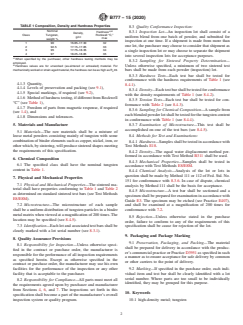
TABLE 1 Composition, Density and Hardness Properties
8.3 Quality Conformance Inspection:
A,B
Nominal
Hardness 8.3.1 Inspection Lot—An inspection lot shall consist of a
Density,
Class Tungsten, Rockwell “C,”
uniform blend from one batch of powder, and submitted for
g/cc
max
weight %
inspection at one time. If a shipment is made from more than
1 90 16.85–17.30 32
one lot, the purchaser may choose to consider that shipment as
2 92.5 17.15–17.85 33
3 95 17.75–18.35 34
a single inspection lot or may choose to separate the shipment
4 97 18.25–18.85 35
into several inspection lots for acceptance purposes.
A
When specified by the purchaser, other hardness testing methods may be
8.3.2 Sampling for Sintered Property Determination—
employed.
B
Unless otherwise specified, a minimum of two sintered test
Hardness values are for unworked (as-sintered or annealed) material. For
mechanically worked or strain aged material, the hardness can be as high as R 49.
bars shall be made from each powder (insp
...
Questions, Comments and Discussion
Ask us and Technical Secretary will try to provide an answer. You can facilitate discussion about the standard in here.
Loading comments...