

ASTM D1480-21
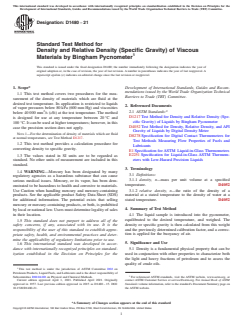
(Test Method)Standard Test Method for Density and Relative Density (Specific Gravity) of Viscous Materials by Bingham Pycnometer
General Information
- Abstract
SIGNIFICANCE AND USE
5.1 Density is a fundamental physical property that can be used in conjunction with other properties to characterize both the light and heavy fractions of petroleum and to assess the quality of crude oils.
5.2 Determination of the density or relative density of petroleum and its products is necessary for the conversion of measured volumes to volumes at the standard temperatures of 15 °C.
5.3 The determination of densities at the elevated temperatures of 40 °C and 100 °C is particularly useful in providing the data needed for the conversion of kinematic viscosities in mm2/s (centistokes) to the corresponding dynamic viscosities in mPa·s (centipoises).
SCOPE
1.1 This test method covers two procedures for the measurement of the density of materials which are fluid at the desired test temperature. Its application is restricted to liquids of vapor pressures below 80 kPa (600 mm Hg) and viscosities below 40 000 mm2/s (cSt) at the test temperature. The method is designed for use at any temperature between 20 °C and 100 °C. It can be used at higher temperatures; however, in this case the precision section does not apply.
Note 1: For the determination of density of materials which are fluid at normal temperatures, see Test Method D1217.
1.2 This test method provides a calculation procedure for converting density to specific gravity.
1.3 The values stated in SI units are to be regarded as standard. No other units of measurement are included in this standard.
1.4 WARNING—Mercury has been designated by many regulatory agencies as a hazardous substance that can cause serious medical issues. Mercury, or its vapor, has been demonstrated to be hazardous to health and corrosive to materials. Use Caution when handling mercury and mercury-containing products. See the applicable product Safety Data Sheet (SDS) for additional information. The potential exists that selling mercury or mercury-containing products, or both, is prohibited by local or national law. Users must determine legality of sales in their location.
1.5 This standard does not purport to address all of the safety concerns, if any, associated with its use. It is the responsibility of the user of this standard to establish appropriate safety, health, and environmental practices and determine the applicability of regulatory limitations prior to use.
1.6 This international standard was developed in accordance with internationally recognized principles on standardization established in the Decision on Principles for the Development of International Standards, Guides and Recommendations issued by the World Trade Organization Technical Barriers to Trade (TBT) Committee.
- Status
- Published
- Publication Date
- 31-Mar-2021
- Technical Committee
- D02 - Petroleum Products, Liquid Fuels, and Lubricants
- Drafting Committee
- D02.04.0D - Physical and Chemical Methods
Buy Documents
ASTM D1480-21 - Standard Test Method for Density and Relative Density (Specific Gravity) of Viscous Materials by Bingham Pycnometer
REDLINE ASTM D1480-21 - Standard Test Method for Density and Relative Density (Specific Gravity) of Viscous Materials by Bingham Pycnometer
Overview
ASTM D1480-21 is the internationally recognized standard test method for the determination of density and relative density (specific gravity) of viscous materials using a Bingham pycnometer. Developed by ASTM International, this standard is essential for accurately measuring and characterizing the density of petroleum products, crude oils, and other viscous liquids. The method is designed for fluids with vapor pressures below 80 kPa and viscosities under 40,000 mm²/s, within a temperature range of 20°C to 100°C. It supports calculation of specific gravity and is fundamental in quality assessments and conversions involving petroleum and related products.
Key Topics
- Density Measurement: Establishes procedures for determining the mass per unit volume (density) of viscous materials, providing critical data for laboratory and industrial settings.
- Relative Density/Specific Gravity: Outlines the conversion from density to specific gravity, enabling comparison against the density of water at stated temperatures.
- Test Applicability: Restricts use to fluid samples at test temperature, ensuring accurate results for materials with limited vapor pressure and viscosity.
- Temperature Range: Designed for tests between 20°C and 100°C, with provisions for higher temperatures where precision statements may not apply.
- Safety Precautions: Emphasizes careful handling of hazardous chemicals such as mercury and chromic acid, with attention to regulatory compliance and safety data sheets (SDS).
- Calculation and Correction: Details on vacuum correction for air buoyancy and the need for precise calibration using water density tables.
- Repeatability and Reproducibility: Defines the precision limits for inter- and intra-laboratory measurements, ensuring reliability and consistency in results.
Applications
ASTM D1480-21 is vital in various industries and research settings:
- Petroleum and Energy Sector: Used by refineries, laboratories, and petrochemical plants to measure and control the quality of crude oil and its fractions. Density data is essential for converting measured volumes to standard conditions (e.g., to 15°C).
- Product Quality Control: Assists manufacturers in evaluating batch-to-batch consistency and compliance with industry specifications for lubricants, fuels, and viscous chemicals.
- Viscosity Conversion: Supports the calculation of dynamic viscosity from kinematic viscosity at elevated temperatures (40°C and 100°C), aiding flow property characterization.
- Regulatory Compliance: Helps meet requirements for characterizing and transporting petroleum products in line with international regulatory standards.
- Research and Development: Provides a reproducible foundation for materials analysis in academic and industrial R&D settings.
Related Standards
Organizations and professionals using ASTM D1480-21 may also reference the following ASTM standards for related procedures and equipment:
- ASTM D1217: Test Method for Density and Relative Density (Specific Gravity) of Liquids by Bingham Pycnometer - suitable for less viscous liquids.
- ASTM D4052: Test Method for Density, Relative Density, and API Gravity of Liquids by Digital Density Meter.
- ASTM D8278: Specification for Digital Contact Thermometers for Test Methods Measuring Flow Properties of Fuels and Lubricants.
- ASTM E1: Specification for ASTM Liquid-in-Glass Thermometers.
- ASTM E2251: Specification for Liquid-in-Glass ASTM Thermometers with Low-Hazard Precision Liquids.
These related standards ensure that laboratories and industry professionals use the most appropriate and up-to-date methodologies and equipment for accurate density and viscosity analysis.
Keywords: ASTM D1480, density measurement, relative density, specific gravity, Bingham pycnometer, viscous materials, petroleum analysis, standard test method, quality control, viscosity conversion, laboratory standards.
Relations
- Effective Date
- 01-May-2020
- Effective Date
- 01-May-2013
- Effective Date
- 01-Nov-2012
- Effective Date
- 01-May-2011
- Effective Date
- 01-Nov-2010
- Effective Date
- 01-Dec-2007
- Effective Date
- 01-Nov-2007
- Effective Date
- 01-Nov-2007
- Effective Date
- 01-Nov-2005
- Effective Date
- 01-Nov-2003
- Effective Date
- 01-Nov-2003
- Effective Date
- 01-Nov-2003
- Effective Date
- 10-May-2003
- Effective Date
- 10-Jan-2003
- Effective Date
- 10-Oct-2001
Buy Documents
ASTM D1480-21 - Standard Test Method for Density and Relative Density (Specific Gravity) of Viscous Materials by Bingham Pycnometer
REDLINE ASTM D1480-21 - Standard Test Method for Density and Relative Density (Specific Gravity) of Viscous Materials by Bingham Pycnometer
Get Certified
Connect with accredited certification bodies for this standard

BSMI (Bureau of Standards, Metrology and Inspection)
Taiwan's standards and inspection authority.
Sponsored listings
Frequently Asked Questions
ASTM D1480-21 is a standard published by ASTM International. Its full title is "Standard Test Method for Density and Relative Density (Specific Gravity) of Viscous Materials by Bingham Pycnometer". This standard covers: SIGNIFICANCE AND USE 5.1 Density is a fundamental physical property that can be used in conjunction with other properties to characterize both the light and heavy fractions of petroleum and to assess the quality of crude oils. 5.2 Determination of the density or relative density of petroleum and its products is necessary for the conversion of measured volumes to volumes at the standard temperatures of 15 °C. 5.3 The determination of densities at the elevated temperatures of 40 °C and 100 °C is particularly useful in providing the data needed for the conversion of kinematic viscosities in mm2/s (centistokes) to the corresponding dynamic viscosities in mPa·s (centipoises). SCOPE 1.1 This test method covers two procedures for the measurement of the density of materials which are fluid at the desired test temperature. Its application is restricted to liquids of vapor pressures below 80 kPa (600 mm Hg) and viscosities below 40 000 mm2/s (cSt) at the test temperature. The method is designed for use at any temperature between 20 °C and 100 °C. It can be used at higher temperatures; however, in this case the precision section does not apply. Note 1: For the determination of density of materials which are fluid at normal temperatures, see Test Method D1217. 1.2 This test method provides a calculation procedure for converting density to specific gravity. 1.3 The values stated in SI units are to be regarded as standard. No other units of measurement are included in this standard. 1.4 WARNING—Mercury has been designated by many regulatory agencies as a hazardous substance that can cause serious medical issues. Mercury, or its vapor, has been demonstrated to be hazardous to health and corrosive to materials. Use Caution when handling mercury and mercury-containing products. See the applicable product Safety Data Sheet (SDS) for additional information. The potential exists that selling mercury or mercury-containing products, or both, is prohibited by local or national law. Users must determine legality of sales in their location. 1.5 This standard does not purport to address all of the safety concerns, if any, associated with its use. It is the responsibility of the user of this standard to establish appropriate safety, health, and environmental practices and determine the applicability of regulatory limitations prior to use. 1.6 This international standard was developed in accordance with internationally recognized principles on standardization established in the Decision on Principles for the Development of International Standards, Guides and Recommendations issued by the World Trade Organization Technical Barriers to Trade (TBT) Committee.
SIGNIFICANCE AND USE 5.1 Density is a fundamental physical property that can be used in conjunction with other properties to characterize both the light and heavy fractions of petroleum and to assess the quality of crude oils. 5.2 Determination of the density or relative density of petroleum and its products is necessary for the conversion of measured volumes to volumes at the standard temperatures of 15 °C. 5.3 The determination of densities at the elevated temperatures of 40 °C and 100 °C is particularly useful in providing the data needed for the conversion of kinematic viscosities in mm2/s (centistokes) to the corresponding dynamic viscosities in mPa·s (centipoises). SCOPE 1.1 This test method covers two procedures for the measurement of the density of materials which are fluid at the desired test temperature. Its application is restricted to liquids of vapor pressures below 80 kPa (600 mm Hg) and viscosities below 40 000 mm2/s (cSt) at the test temperature. The method is designed for use at any temperature between 20 °C and 100 °C. It can be used at higher temperatures; however, in this case the precision section does not apply. Note 1: For the determination of density of materials which are fluid at normal temperatures, see Test Method D1217. 1.2 This test method provides a calculation procedure for converting density to specific gravity. 1.3 The values stated in SI units are to be regarded as standard. No other units of measurement are included in this standard. 1.4 WARNING—Mercury has been designated by many regulatory agencies as a hazardous substance that can cause serious medical issues. Mercury, or its vapor, has been demonstrated to be hazardous to health and corrosive to materials. Use Caution when handling mercury and mercury-containing products. See the applicable product Safety Data Sheet (SDS) for additional information. The potential exists that selling mercury or mercury-containing products, or both, is prohibited by local or national law. Users must determine legality of sales in their location. 1.5 This standard does not purport to address all of the safety concerns, if any, associated with its use. It is the responsibility of the user of this standard to establish appropriate safety, health, and environmental practices and determine the applicability of regulatory limitations prior to use. 1.6 This international standard was developed in accordance with internationally recognized principles on standardization established in the Decision on Principles for the Development of International Standards, Guides and Recommendations issued by the World Trade Organization Technical Barriers to Trade (TBT) Committee.
ASTM D1480-21 is classified under the following ICS (International Classification for Standards) categories: 17.060 - Measurement of volume, mass, density, viscosity. The ICS classification helps identify the subject area and facilitates finding related standards.
ASTM D1480-21 has the following relationships with other standards: It is inter standard links to ASTM D1217-20, ASTM E1-13, ASTM D1217-12, ASTM E2251-11, ASTM E2251-10, ASTM D1217-93(2007), ASTM E2251-07, ASTM E1-07, ASTM E1-05, ASTM E2251-03a, ASTM D1217-93(2003)e1, ASTM E1-03a, ASTM E1-03, ASTM E2251-03, ASTM E1-98. Understanding these relationships helps ensure you are using the most current and applicable version of the standard.
ASTM D1480-21 is available in PDF format for immediate download after purchase. The document can be added to your cart and obtained through the secure checkout process. Digital delivery ensures instant access to the complete standard document.
Standards Content (Sample)
This international standard was developed in accordance with internationally recognized principles on standardization established in the Decision on Principles for the
Development of International Standards, Guides and Recommendations issued by the World Trade Organization Technical Barriers to Trade (TBT) Committee.
Designation:D1480 −21
Standard Test Method for
Density and Relative Density (Specific Gravity) of Viscous
Materials by Bingham Pycnometer
This standard is issued under the fixed designation D1480; the number immediately following the designation indicates the year of
original adoption or, in the case of revision, the year of last revision.Anumber in parentheses indicates the year of last reapproval.A
superscript epsilon (´) indicates an editorial change since the last revision or reapproval.
1. Scope* Development of International Standards, Guides and Recom-
mendations issued by the World Trade Organization Technical
1.1 This test method covers two procedures for the mea-
Barriers to Trade (TBT) Committee.
surement of the density of materials which are fluid at the
desired test temperature. Its application is restricted to liquids
2. Referenced Documents
of vapor pressures below 80kPa (600 mm Hg) and viscosities
2.1 ASTM Standards:
below 40000 mm /s (cSt) at the test temperature. The method
D1217Test Method for Density and Relative Density (Spe-
is designed for use at any temperature between 20°C and
cific Gravity) of Liquids by Bingham Pycnometer
100°C. It can be used at higher temperatures; however, in this
D4052Test Method for Density, Relative Density, and API
case the precision section does not apply.
Gravity of Liquids by Digital Density Meter
NOTE 1—For the determination of density of materials which are fluid
D8278Specification for Digital Contact Thermometers for
at normal temperatures, see Test Method D1217.
Test Methods Measuring Flow Properties of Fuels and
1.2 This test method provides a calculation procedure for
Lubricants
converting density to specific gravity.
E1Specification for ASTM Liquid-in-Glass Thermometers
E2251Specification for Liquid-in-Glass ASTM Thermom-
1.3 The values stated in SI units are to be regarded as
eters with Low-Hazard Precision Liquids
standard. No other units of measurement are included in this
standard.
3. Terminology
1.4 WARNING—Mercury has been designated by many
3.1 Definitions:
regulatory agencies as a hazardous substance that can cause
3.1.1 density, n—mass per unit volume at a specified
serious medical issues. Mercury, or its vapor, has been dem-
temperature. D4052
onstrated to be hazardous to health and corrosive to materials.
Use Caution when handling mercury and mercury-containing
3.1.2 relative density, n—the ratio of the density of a
products. See the applicable product Safety Data Sheet (SDS) material at a stated temperature to the density of water at a
for additional information. The potential exists that selling
stated temperature. D4052
mercury or mercury-containing products, or both, is prohibited
4. Summary of Test Method
by local or national law. Users must determine legality of sales
in their location.
4.1 The liquid sample is introduced into the pycnometer,
equilibrated to the desired temperature, and weighed. The
1.5 This standard does not purport to address all of the
density or specific gravity is then calculated from this weight
safety concerns, if any, associated with its use. It is the
and the previously determined calibration factor, and a correc-
responsibility of the user of this standard to establish appro-
tion is applied for the buoyancy of air.
priate safety, health, and environmental practices and deter-
mine the applicability of regulatory limitations prior to use.
5. Significance and Use
1.6 This international standard was developed in accor-
dance with internationally recognized principles on standard-
5.1 Density is a fundamental physical property that can be
ization established in the Decision on Principles for the used in conjunction with other properties to characterize both
the light and heavy fractions of petroleum and to assess the
quality of crude oils.
This test method is under the jurisdiction of ASTM Committee D02 on
Petroleum Products, Liquid Fuels, and Lubricants and is the direct responsibility of
Subcommittee D02.04.0D on Physical and Chemical Methods. For referenced ASTM standards, visit the ASTM website, www.astm.org, or
Current edition approved April 1, 2021. Published April 2021. Originally contact ASTM Customer Service at service@astm.org. For Annual Book of ASTM
approved in 1957. Last previous edition approved in 2015 as D1480–15. DOI: Standards volume information, refer to the standard’s Document Summary page on
10.1520/D1480-21. the ASTM website.
*A Summary of Changes section appears at the end of this standard
Copyright © ASTM International, 100 Barr Harbor Drive, PO Box C700, West Conshohocken, PA 19428-2959. United States
D1480−21
5.2 Determination of the density or relative density of the criteria for D02-DCT05 of Specification D8278 may also
petroleum and its products is necessary for the conversion of be used, and it offers the best means for observing temperature
measured volumes to volumes at the standard temperatures of changes in the bath.
15°C.
NOTE 3—For most hydrocarbons, the density coefficient is about
0.0008units ⁄ °C, and therefore an error of 60.013°C would cause an
5.3 The determination of densities at the elevated tempera-
error of 6 0.00001g⁄mL in density.
turesof40°Cand100°Cisparticularlyusefulinprovidingthe
data needed for the conversion of kinematic viscosities in 6.4 Thermal Shields, as shown in Fig. 2, to hold the
mm /s (centistokes) to the corresponding dynamic viscosities pycnometer and syringe during the filling procedure, con-
in mPa·s (centipoises). structed of two aluminum shells with suitably spaced viewing
ports,theupperboredtoholda30mLhypodermicsyringeand
6. Apparatus
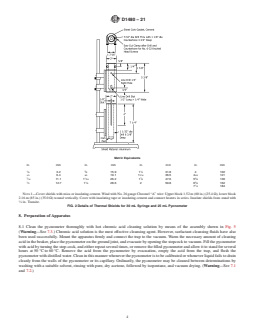
the lower bored to hold a 25 mL Bingham pycnometer. A
winding of No. 26 Chromel “A” wire, insulated from the
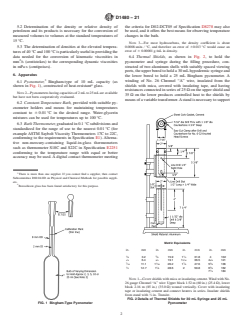
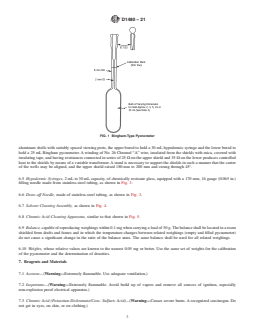
6.1 Pycnometer, Bingham-type of 10 mL capacity (as
shields with mica, covered with insulating tape, and having
shown in Fig. 1), constructed of heat-resistant glass.
resistances connected in series of 25 Ω on the upper shield and
NOTE2—Pycnometershavingcapacitiesof2mLto25mLareavailable
35 Ω on the lower produces controlled heat to the shields by
but have not been cooperatively evaluated.
meansofavariabletransformer.Astandisnecessarytosupport
6.2 Constant-Temperature Bath, provided with suitable py-
cnometer holders and means for maintaining temperatures
constant to 60.01°C in the desired range. Water-glycerin
mixtures can be used for temperatures up to 100°C.
6.3 Bath Thermometer,graduatedin0.1°Csubdivisionsand
standardized for the range of use to the nearest 0.01°C (for
exampleASTM Saybolt Viscosity Thermometers 17C to 22C,
conforming to the requirements in Specification E1). Alterna-
tive non-mercury-containing liquid-in-glass thermometers
such as thermometer S18C and S22C in Specification E2251
conforming to the temperature range with equal or better
accuracy may be used. A digital contact thermometer meeting
There is more than one supplier. If you cannot find a supplier, then contact
Subcommittee D02.04.0D on Physical and Chemical Methods for possible suppli-
ers.
Borosilicate glass has been found satisfactory for this purpose.
Metric Equivalents
in. mm in. mm in. mm in. mm
1 5 1
⁄8 3.2 ⁄8 15.9 1 ⁄4 31.8 4 102
1 3 7 3
⁄4 6.4 ⁄4 19.1 1 ⁄16 36.5 4 ⁄4 121
7 1 7 3
⁄16 11.1 1 ⁄32 26.2 1 ⁄8 47.6 5 ⁄8 136
1 1 3
⁄2 12.7 1 ⁄8 28.6 2 50.8 6 ⁄8 162
7 ⁄4 184
NOTE 1—Cover shields with mica or insulating cement.Wind with No.
26 gauge Chromel “A” wire: Upper block 1.52 m (60 in.) (25.4 Ω), lower
block 2.16 m (85 in.) (35.0 Ω) wound vertically. Cover with insulating
tape or insulating cement and connect heaters in series. Insulate shields
from stand with ⁄4in. Transite.
FIG. 2Details of Thermal Shields for 30 mL Syringe and 25 mL
FIG. 1 Bingham-Type Pycnometer Pycnometer
D1480−21
theshieldsinsuchamannerthatthecenterofthewellsmaybe 7. Reagents and Materials
aligned, and the upper shield raised 180mm to 200 mm and
7.1 Acetone—(Warning—Extremely flammable. Use ad-
swung through 45°.
equate ventilation.)
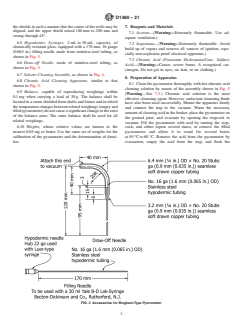
6.5 Hypodermic Syringes, 2 mL to 30 mL capacity, of
7.2 Isopentane—(Warning—Extremely flammable. Avoid
chemically resistant glass, equipped with a 170 mm, 16 gauge
build up of vapors and remove all sources of ignition, espe-
(0.065 in.) filling needle made from stainless-steel tubing, as
cially non-explosion proof electrical apparatus.)
shown in Fig. 3.
7.3 Chromic Acid (Potassium Dichromate/Conc. Sulfuric
6.6 Draw-off Needle, made of stainless-steel tubing, as
Acid)—(Warning—Causes severe burns. A recognized car-
shown in Fig. 3.
cinogen. Do not get in eyes, on skin, or on clothing.)
6.7 Solvent Cleaning Assembly, as shown in Fig. 4.
8. Preparation of Apparatus
6.8 Chromic Acid Cleaning Apparatus, similar to that
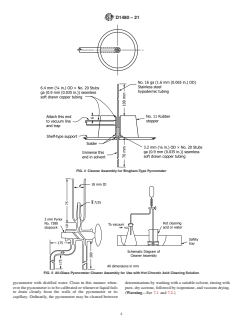
8.1 Clean the pycnometer thoroughly with hot chromic acid
shown in Fig. 5.
cleaning solution by means of the assembly shown in Fig. 5
6.9 Balance, capable of reproducing weighings within
(Warning—See 7.3.) Chromic acid solution is the most
0.1mg when carrying a load of 30g. The balance shall be
effective cleansing agent. However, surfactant cleansing fluids
located in a room shielded from drafts and fumes and in which
have also been used successfully. Mount the apparatus firmly
thetemperaturechangesbetweenrelatedweighings(emptyand
and connect the trap to the vacuum. Warm the necessary
filledpycnometer)donotcauseasignificantchangeintheratio
amountofcleaningacidinthebeaker,placethepycnometeron
of the balance arms. The same balance shall be used for all
the ground joint, and evacuate by opening the stopcock to
related weighings.
vacuum. Fill the pycnometer with acid by turning the stop-
6.10 Weights, whose relative values are known to the cock, and either repeat several times, or remove the filled
nearest 0.05 mg or better. Use the same set of weights for the pycnometer and allow it to stand for several hours
calibration of the pycnometer and the determination of densi- at50°Cto60°C. Remove the acid from the pycnometer by
ties. evacuation, empty the acid from the trap, and flush the
FIG. 3 Accessories for Bingham-Type Pycnometer
D1480−21
FIG. 4 Cleaner Assembly for Bingham-Type Pycnometer
FIG. 5 All-Glass Pycnometer Cleaner Assembly for Use with Hot Chromic Acid Cleaning Solution
pycnometer with distilled water. Clean in this manner when- determinationsbywashingwithasuitablesolvent,rinsingwith
everthepycnometeristobecalibratedorwheneverliquidfails
pure,dryacetone,followedbyisopentane,andvacuumdrying.
to drain cleanly from the walls of the pycnometer or its
(Warning—See 7.1 and 7.2.)
capillary. Ordinarily, the pycnometer may be cleaned between
D1480−21
8.2 Transfer the pycnometer to the cleaner assembly shown view, and readjust the liquid level to the mark by withdrawing
in Fig. 4, with vacuum line and trap attached to the side tube liquid through the steel draw-off needle until expansion has
as indicated. Place the pycnometer on the cleaner with the stopped, indicating that the liquid has reached the temperature
upper hypodermic needle extending upward into the of the thermostat. To minimize errors caused by faulty
pycnometer, and press the edge of the ground joint on the drainage, do not allow the liquid to expand more than 10 mm
rubber stopper until the vacuum holds it in place. Draw out all above the calibration mark at any time. Allow the contents to
theliquidorsample.Immersethelowerendofthehypodermic equilibrate an additional 10 min and draw the level down
tubeinasuitablesolventanddraw20mLto25mLthroughthe exactly to the calibration line, avoiding parallax and using a
pycnometer.Leavingthepycnometerinplace,drawairthrough magnifier, if necessary, to obtain good visibility. Remove any
it until it is dry. Clean the hypodermic syringe with the same liquid adhering to the walls above the calibration mark, with
apparatus. the draw-off needle or pipe cleaner, depending upon the
volatility of the sample. Portions in the overflow bulb can be
9. Calibration of Pycnometers
removed with a cotton swab moistened with acetone.
9.1 Weigh the clean, dry pycnometer to 0.1 mg and record
NOTE 5—For temperatures above 80°C calculate the volume from the
the weight.
coefficient of expansion of the glass observed from calibrations made at
60°C, 70°C, and 80°C.
NOTE 4—It is convenient to use the lightest of a set of pycnometers as
9.4 Replace the glass stopper, remove the pycnometer from
a tare. For best results the treatment and environmen
...
This document is not an ASTM standard and is intended only to provide the user of an ASTM standard an indication of what changes have been made to the previous version. Because
it may not be technically possible to adequately depict all changes accurately, ASTM recommends that users consult prior editions as appropriate. In all cases only the current version
of the standard as published by ASTM is to be considered the official document.
Designation: D1480 − 15 D1480 − 21
Standard Test Method for
Density and Relative Density (Specific Gravity) of Viscous
Materials by Bingham Pycnometer
This standard is issued under the fixed designation D1480; the number immediately following the designation indicates the year of
original adoption or, in the case of revision, the year of last revision. A number in parentheses indicates the year of last reapproval. A
superscript epsilon (´) indicates an editorial change since the last revision or reapproval.
1. Scope*
1.1 This test method covers two procedures for the measurement of the density of materials which are fluid at the desired test
temperature. Its application is restricted to liquids of vapor pressures below 80 kPa (600 mm Hg) and viscosities below 40 000
mm /s (cSt) at the test temperature. The method is designed for use at any temperature between 20 °C and 100 °C. It can be used
at higher temperatures; however, in this case the precision section does not apply.
NOTE 1—For the determination of density of materials which are fluid at normal temperatures, see Test Method D1217.
1.2 This test method provides a calculation procedure for converting density to specific gravity.
1.3 The values stated in SI units are to be regarded as standard. No other units of measurement are included in this standard.
1.4 WARNING—Mercury has been designated by many regulatory agencies as a hazardous materialsubstance that can cause
central nervous system, kidney and liver damage. serious medical issues. Mercury, or its vapor, may has been demonstrated to be
hazardous to health and corrosive to materials. Caution should be taken Use Caution when handling mercury and mercury
containing mercury-containing products. See the applicable product Material Safety Data Sheet (MSDS) for details and EPA’s
website—http://www.epa.gov/mercury/faq.htm—for additional information. Users should be aware (SDS) for additional informa-
tion. The potential exists that selling mercury and/or mercury containing products in your state or country may be prohibited by
law.or mercury-containing products, or both, is prohibited by local or national law. Users must determine legality of sales in their
location.
1.5 This standard does not purport to address all of the safety concerns, if any, associated with its use. It is the responsibility
of the user of this standard to establish appropriate safety safety, health, and healthenvironmental practices and determine the
applicability of regulatory limitations prior to use.
1.6 This international standard was developed in accordance with internationally recognized principles on standardization
established in the Decision on Principles for the Development of International Standards, Guides and Recommendations issued
by the World Trade Organization Technical Barriers to Trade (TBT) Committee.
2. Referenced Documents
2.1 ASTM Standards:
This test method is under the jurisdiction of ASTM Committee D02 on Petroleum Products, Liquid Fuels, and Lubricants and is the direct responsibility of Subcommittee
D02.04.0D on Physical and Chemical Methods.
Current edition approved Dec. 1, 2015April 1, 2021. Published February 2016April 2021. Originally approved in 1957. Last previous edition approved in 20122015 as
D1480D1480 – 15.–12. DOI: 10.1520/D1480-15.10.1520/D1480-21.
For referenced ASTM standards, visit the ASTM website, www.astm.org, or contact ASTM Customer Service at service@astm.org. For Annual Book of ASTM Standards
volume information, refer to the standard’s Document Summary page on the ASTM website.
*A Summary of Changes section appears at the end of this standard
Copyright © ASTM International, 100 Barr Harbor Drive, PO Box C700, West Conshohocken, PA 19428-2959. United States
D1480 − 21
D1217 Test Method for Density and Relative Density (Specific Gravity) of Liquids by Bingham Pycnometer
D4052 Test Method for Density, Relative Density, and API Gravity of Liquids by Digital Density Meter
D8278 Specification for Digital Contact Thermometers for Test Methods Measuring Flow Properties of Fuels and Lubricants
E1 Specification for ASTM Liquid-in-Glass Thermometers
E2251 Specification for Liquid-in-Glass ASTM Thermometers with Low-Hazard Precision Liquids
3. Terminology
3.1 Definitions:
3.1.1 density, n—mass per unit volume at a specified temperature. D4052
3.1.2 relative density, n—the ratio of the density of a material at a stated temperature to the density of water at a stated temperature.
D4052
4. Summary of Test Method
4.1 The liquid sample is introduced into the pycnometer, equilibrated to the desired temperature, and weighed. The density or
specific gravity is then calculated from this weight and the previously determined calibration factor, and a correction is applied for
the buoyancy of air.
5. Significance and Use
5.1 Density is a fundamental physical property that can be used in conjunction with other properties to characterize both the light
and heavy fractions of petroleum and to assess the quality of crude oils.
5.2 Determination of the density or relative density of petroleum and its products is necessary for the conversion of measured
volumes to volumes at the standard temperatures of 15 °C.
5.3 The determination of densities at the elevated temperatures of 40 °C and 100 °C is particularly useful in providing the data
needed for the conversion of kinematic viscosities in mm /s (centistokes) to the corresponding dynamic viscosities in mPa·s
(centipoises).
6. Apparatus
3 4
6.1 Pycnometer, Bingham-type Bingham-type of 10 mL capacity (as shown in Fig. 1), constructed of heat-resistant glass.
NOTE 2—Pycnometers having capacities of 2 mL to 25 mL are available but have not been cooperatively evaluated.
6.2 Constant-Temperature Bath, provided with suitable pycnometer holders and means for maintaining temperatures constant to
6 0.01 °C in the desired range. Water-glycerin mixtures can be used for temperatures up to 100 °C.
6.3 Bath Thermometer, graduated in 0.1 °C subdivisions and standardized for the range of use to the nearest 0.01 °C (ASTM (for
example ASTM Saybolt Viscosity Thermometers 17 °C17C to 22 °C,22C, conforming to the requirements in Specification E1, are
recommended). For most hydrocarbons ). Alternative non-mercury-containing liquid-in-glass thermometers such as thermometer
S18C and S22C in Specification E2251the density coefficient is about 0.0008 units conforming to the temperature range with equal
or⁄°C, and therefore an error of 6 0.013 °C would cause an error of 6 0.00001 g/mL in density. A standardized platinum better
accuracy may be used. A digital contact thermometer meeting the criteria for D02-DCT05 of Specification D8278 resistance
thermometer may also be used, and it offers the best means for observing temperature changes in the bath.
NOTE 3—For most hydrocarbons, the density coefficient is about 0.0008 units ⁄ °C, and therefore an error of 60.013 °C would cause an error of 6
0.00001 g ⁄mL in density.
6.4 Thermal Shields, as shown in Fig. 2, to hold the pycnometer and syringe during the filling procedure, constructed of two
There is more than one supplier. If you cannot find a supplier, then contact Subcommittee D02.04.0D on Physical and Chemical Methods for possible suppliers.
Borosilicate glass has been found satisfactory for this purpose.
D1480 − 21
FIG. 1 Bingham-Type Pycnometer
aluminum shells with suitably spaced viewing ports, the upper bored to hold a 30 mL hypodermic syringe and the lower bored to
hold a 25 mL Bingham pycnometer. A winding of No. 26 Chromel “A” wire, insulated from the shields with mica, covered with
insulating tape, and having resistances connected in series of 25 Ω on the upper shield and 35 Ω on the lower produces controlled
heat to the shields by means of a variable transformer. A stand is necessary to support the shields in such a manner that the center
of the wells may be aligned, and the upper shield raised 180 mm to 200 mm and swung through 45°.
6.5 Hypodermic Syringes, 2 mL to 30 mL capacity, of chemically resistant glass, equipped with a 170 mm, 16 gauge (0.065 in.)
filling needle made from stainless-steel tubing, as shown in Fig. 3.
6.6 Draw-off Needle, made of stainless-steel tubing, as shown in Fig. 3.
6.7 Solvent Cleaning Assembly, as shown in Fig. 4.
6.8 Chromic Acid Cleaning Apparatus, similar to that shown in Fig. 5.
6.9 Balance, capable of reproducing weighings within 0.1 mg when carrying a load of 30 g. The balance shall be located in a room
shielded from drafts and fumes and in which the temperature changes between related weighings (empty and filled pycnometer)
do not cause a significant change in the ratio of the balance arms. The same balance shall be used for all related weighings.
6.10 Weights, whose relative values are known to the nearest 0.05 mg or better. Use the same set of weights for the calibration
of the pycnometer and the determination of densities.
7. Reagents and Materials
7.1 Acetone—(Warning—Extremely flammable. Use adequate ventilation.)
7.2 Isopentane—(Warning—Extremely flammable. Avoid build up of vapors and remove all sources of ignition, especially
non-explosion proof electrical apparatus.)
7.3 Chromic Acid (Potassium Dichromate/Conc. Sulfuric Acid)—(Warning—Causes severe burns. A recognized carcinogen. Do
not get in eyes, on skin, or on clothing.)
D1480 − 21
Metric Equivalents
in. mm in. mm in. mm in. mm
1 5 1
⁄8 3.2 ⁄8 15.9 1 ⁄4 31.8 4 102
1 3 7 3
⁄4 6.4 ⁄4 19.1 1 ⁄16 36.5 4 ⁄4 121
7 1 7 3
⁄16 11.1 1 ⁄32 26.2 1 ⁄8 47.6 5 ⁄8 136
1 1 3
⁄2 12.7 1 ⁄8 28.6 2 50.8 6 ⁄8 162
7 ⁄4 184
NOTE 1—Cover shields with mica or insulating cement. Wind with No. 26 gauge Chromel “A” wire: Upper block 1.52 m (60 in.) (25.4 Ω), lower block
2.16 m (85 in.) (35.0 Ω) wound vertically. Cover with insulating tape or insulating cement and connect heaters in series. Insulate shields from stand with
⁄4 in. Transite.
FIG. 2 Details of Thermal Shields for 30 mL Syringe and 25 mL Pycnometer
8. Preparation of Apparatus
8.1 Clean the pycnometer thoroughly with hot chromic acid cleaning solution by means of the assembly shown in Fig. 5
(Warning—See 7.3.) Chromic acid solution is the most effective cleansing agent. However, surfactant cleansing fluids have also
been used successfully. Mount the apparatus firmly and connect the trap to the vacuum. Warm the necessary amount of cleaning
acid in the beaker, place the pycnometer on the ground joint, and evacuate by opening the stopcock to vacuum. Fill the pycnometer
with acid by turning the stop-cock, and either repeat several times, or remove the filled pycnometer and allow it to stand for several
hours at 50 °C to 60 °C. Remove the acid from the pycnometer by evacuation, empty the acid from the trap, and flush the
pycnometer with distilled water. Clean in this manner whenever the pycnometer is to be calibrated or whenever liquid fails to drain
cleanly from the walls of the pycnometer or its capillary. Ordinarily, the pycnometer may be cleaned between determinations by
washing with a suitable solvent, rinsing with pure, dry acetone, followed by isopentane, and vacuum drying. (Warning—See 7.1
and 7.2.)
D1480 − 21
FIG. 3 Accessories for Bingham-Type Pycnometer
8.2 Transfer the pycnometer to the cleaner assembly shown in Fig. 4, with vacuum line and trap attached to the side tube as
indicated. Place the pycnometer on the cleaner with the upper hypodermic needle extending upward into the pycnometer, and press
the edge of the ground joint on the rubber stopper until the vacuum holds it in place. Draw out all the liquid or sample. Immerse
the lower end of the hypodermic tube in a suitable solvent and draw 20 mL to 25 mL through the pycnometer. Leaving the
pycnometer in place, draw air through it until it is dry. Clean the hypodermic syringe with the same apparatus.
9. Calibration of Pycnometers
9.1 Weigh the clean, dry pycnometer to 0.1 mg and record the weight.
NOTE 4—It is convenient to use the lightest of a set of pycnometers as a tare. For best results the treatment and environment of both pycnometer and tare
should be identical for some time prior to weighing.
9.2 With a syringe of suitable size, transfer freshly boiled and cooled distilled water to the pycnometer through the filling needle
(Note 67). Avoid trapping air bubbles in the bulb or capillary of the pycnometer, removing bubbles, as they form, with the syringe,
when possible. Also remove any water above the calibration mark and dry the overflow chamber and capillary with a cotton-fiber
pipe cleaner or cotton swab which has been moistened slightly with acetone. Do not touch the plunger of the syringe or hypodermic
needle with fingers as minute quantities of oil transferred this way would cause faulty drainage in the capillary neck of the
pycnometer.
9.3 Close the pycnometer with the glass stopper and immerse it to a point above the calibration mark in the constant-temperature
bath adjusted to a constancy of 6 0.01 °C
...