

ASTM D2162-21
(Practice)Standard Practice for Basic Calibration of Master Viscometers and Viscosity Oil Standards
General Information
- Abstract
SIGNIFICANCE AND USE
5.1 Because there are surface tension or kinematic viscosity differences, or both, between the primary standard (7.4) and kinematic viscosity standards (7.5), special procedures using master viscometers are required to “step-up” from the kinematic viscosity of the primary standard to the kinematic viscosities of oil standards.
5.2 Using master viscometers calibrated according to this practice, an operator can calibrate kinematic viscometers in accordance with Specifications D446.
5.3 Using viscosity oil standards established in this practice, an operator can calibrate kinematic viscometers in accordance with Specifications D446.
SCOPE
1.1 This practice covers the calibration of master viscometers and viscosity oil standards, both of which may be used to calibrate routine viscometers as described in Test Method D445 and Specifications D446 over the temperature range from 15 °C to 100 °C.
1.2 The values stated in SI units are to be regarded as standard. No other units of measurement are included in this standard.
1.2.1 The SI-based units for calibration constants and kinematic viscosities are mm2/s2 and mm 2/s, respectively.
1.3 This standard does not purport to address all of the safety concerns, if any, associated with its use. It is the responsibility of the user of this standard to establish appropriate safety, health, and environmental practices and determine the applicability of regulatory limitations prior to use. For specific warning statements, see Section 7.
1.4 This international standard was developed in accordance with internationally recognized principles on standardization established in the Decision on Principles for the Development of International Standards, Guides and Recommendations issued by the World Trade Organization Technical Barriers to Trade (TBT) Committee.
- Status
- Published
- Publication Date
- 31-Mar-2021
- Technical Committee
- D02 - Petroleum Products, Liquid Fuels, and Lubricants
- Drafting Committee
- D02.07 - Flow Properties
Buy Documents
ASTM D2162-21 - Standard Practice for Basic Calibration of Master Viscometers and Viscosity Oil Standards
REDLINE ASTM D2162-21 - Standard Practice for Basic Calibration of Master Viscometers and Viscosity Oil Standards
Overview
ASTM D2162-21 is the standard practice for the basic calibration of master viscometers and viscosity oil standards. Developed by ASTM International, this standard outlines procedures for calibrating master viscometers and establishing viscosity oil standards, which are then used for the calibration of routine viscometers. The standard covers calibration across a temperature range of 15 °C to 100 °C, using values stated in SI units. The key application of this practice is to ensure precise and traceable measurement of kinematic viscosity in transparent and opaque liquids, especially petroleum products and lubricants.
By following the calibration methods detailed in ASTM D2162-21, laboratories and operators can achieve high accuracy and consistency in viscosity determinations, supporting quality control and regulatory compliance.
Key Topics
- Calibration of Master Viscometers: The standard details the stepwise calibration of master viscometers using primary water standards at 20 °C, and subsequent calibration at higher viscosities with established oil standards.
- Viscosity Oil Standards: Procedures are included for selecting and preparing viscosity oil standards, ensuring their traceable relationship to the kinematic viscosity of water.
- Temperature and Surface Tension Corrections: Guidance is provided for correcting measurements to compensate for buoyancy, temperature, and surface tension differences between calibration and test liquids.
- Apparatus Requirements: Specifications for viscometers (Cannon or Ubbelohde type), temperature measurement devices (digital contact thermometers or liquid-in-glass thermometers), thermostated baths, and accurate timing devices are included.
- Documentation and Traceability: Emphasis is placed on consistent and repeatable calibration methods, documented traceability, and the need for traceable calibration reports.
Applications
ASTM D2162-21 is widely used in:
- Calibration Laboratories: Ensuring that kinematic viscometers deliver accurate, SI-traceable measurements for quality assurance.
- Petroleum and Lubricant Industries: Providing reliable viscosity standards required for product specifications, research, and compliance with international regulations.
- Quality Control and R&D: Supporting the development and verification of new fluids and lubricants by establishing standard reference points for viscosity.
- Manufacturers of Viscometers and Oil Standards: Enabling production of precision reference equipment and materials that meet stringent calibration requirements.
Practically, this standard allows operators to calibrate routine viscometers as described in ASTM D445 and D446, ensuring test results are accurate and comparable across different laboratories and over time. The use of master viscometers and established oil standards is critical for maintaining traceability to the primary water standard, which underpins international consistency in viscosity measurements.
Related Standards
To ensure comprehensive viscosity calibration and testing, ASTM D2162-21 references and is often used in conjunction with the following standards:
- ASTM D445: Test Method for Kinematic Viscosity of Transparent and Opaque Liquids
- ASTM D446: Specifications and Operating Instructions for Glass Capillary Kinematic Viscometers
- ASTM D1193: Specification for Reagent Water
- ASTM D1480: Test Method for Density and Relative Density by Bingham Pycnometer
- ASTM D1590: Test Method for Surface Tension of Water
- ASTM D8278: Specification for Digital Contact Thermometers
- ISO 3666: Viscosity of Water
These related standards create a robust framework for viscosity measurement and calibration, supporting laboratories in achieving precise, reproducible results that align with global best practices.
Keywords: ASTM D2162-21, master viscometer calibration, viscosity oil standards, kinematic viscosity, petroleum product testing, SI unit calibration, viscosity measurement, laboratory standardization, quality assurance, ASTM D445, ASTM D446.
Relations
- Effective Date
- 01-Apr-2024
- Effective Date
- 01-Nov-2023
- Effective Date
- 01-Nov-2023
- Effective Date
- 01-Nov-2019
- Effective Date
- 01-May-2019
- Effective Date
- 01-May-2019
- Effective Date
- 15-Dec-2016
- Effective Date
- 01-May-2016
- Effective Date
- 01-Jul-2014
- Effective Date
- 01-Jul-2014
- Effective Date
- 01-May-2013
- Effective Date
- 01-Dec-2012
- Effective Date
- 01-Nov-2012
- Effective Date
- 01-Nov-2012
- Effective Date
- 01-Nov-2012
Buy Documents
ASTM D2162-21 - Standard Practice for Basic Calibration of Master Viscometers and Viscosity Oil Standards
REDLINE ASTM D2162-21 - Standard Practice for Basic Calibration of Master Viscometers and Viscosity Oil Standards
Get Certified
Connect with accredited certification bodies for this standard

BSMI (Bureau of Standards, Metrology and Inspection)
Taiwan's standards and inspection authority.
Sponsored listings
Frequently Asked Questions
ASTM D2162-21 is a standard published by ASTM International. Its full title is "Standard Practice for Basic Calibration of Master Viscometers and Viscosity Oil Standards". This standard covers: SIGNIFICANCE AND USE 5.1 Because there are surface tension or kinematic viscosity differences, or both, between the primary standard (7.4) and kinematic viscosity standards (7.5), special procedures using master viscometers are required to “step-up” from the kinematic viscosity of the primary standard to the kinematic viscosities of oil standards. 5.2 Using master viscometers calibrated according to this practice, an operator can calibrate kinematic viscometers in accordance with Specifications D446. 5.3 Using viscosity oil standards established in this practice, an operator can calibrate kinematic viscometers in accordance with Specifications D446. SCOPE 1.1 This practice covers the calibration of master viscometers and viscosity oil standards, both of which may be used to calibrate routine viscometers as described in Test Method D445 and Specifications D446 over the temperature range from 15 °C to 100 °C. 1.2 The values stated in SI units are to be regarded as standard. No other units of measurement are included in this standard. 1.2.1 The SI-based units for calibration constants and kinematic viscosities are mm2/s2 and mm 2/s, respectively. 1.3 This standard does not purport to address all of the safety concerns, if any, associated with its use. It is the responsibility of the user of this standard to establish appropriate safety, health, and environmental practices and determine the applicability of regulatory limitations prior to use. For specific warning statements, see Section 7. 1.4 This international standard was developed in accordance with internationally recognized principles on standardization established in the Decision on Principles for the Development of International Standards, Guides and Recommendations issued by the World Trade Organization Technical Barriers to Trade (TBT) Committee.
SIGNIFICANCE AND USE 5.1 Because there are surface tension or kinematic viscosity differences, or both, between the primary standard (7.4) and kinematic viscosity standards (7.5), special procedures using master viscometers are required to “step-up” from the kinematic viscosity of the primary standard to the kinematic viscosities of oil standards. 5.2 Using master viscometers calibrated according to this practice, an operator can calibrate kinematic viscometers in accordance with Specifications D446. 5.3 Using viscosity oil standards established in this practice, an operator can calibrate kinematic viscometers in accordance with Specifications D446. SCOPE 1.1 This practice covers the calibration of master viscometers and viscosity oil standards, both of which may be used to calibrate routine viscometers as described in Test Method D445 and Specifications D446 over the temperature range from 15 °C to 100 °C. 1.2 The values stated in SI units are to be regarded as standard. No other units of measurement are included in this standard. 1.2.1 The SI-based units for calibration constants and kinematic viscosities are mm2/s2 and mm 2/s, respectively. 1.3 This standard does not purport to address all of the safety concerns, if any, associated with its use. It is the responsibility of the user of this standard to establish appropriate safety, health, and environmental practices and determine the applicability of regulatory limitations prior to use. For specific warning statements, see Section 7. 1.4 This international standard was developed in accordance with internationally recognized principles on standardization established in the Decision on Principles for the Development of International Standards, Guides and Recommendations issued by the World Trade Organization Technical Barriers to Trade (TBT) Committee.
ASTM D2162-21 is classified under the following ICS (International Classification for Standards) categories: 17.060 - Measurement of volume, mass, density, viscosity. The ICS classification helps identify the subject area and facilitates finding related standards.
ASTM D2162-21 has the following relationships with other standards: It is inter standard links to ASTM D445-24, ASTM E1750-23, ASTM D445-23, ASTM E644-11(2019), ASTM D1250-19e1, ASTM E2877-12(2019), ASTM D445-16, ASTM E1750-10(2016), ASTM D445-14, ASTM D445-14e1, ASTM E1-13, ASTM D446-12, ASTM E2877-12, ASTM E2877-12e1, ASTM E2593-12. Understanding these relationships helps ensure you are using the most current and applicable version of the standard.
ASTM D2162-21 is available in PDF format for immediate download after purchase. The document can be added to your cart and obtained through the secure checkout process. Digital delivery ensures instant access to the complete standard document.
Standards Content (Sample)
This international standard was developed in accordance with internationally recognized principles on standardization established in the Decision on Principles for the
Development of International Standards, Guides and Recommendations issued by the World Trade Organization Technical Barriers to Trade (TBT) Committee.
Designation: D2162 − 21
Standard Practice for
Basic Calibration of Master Viscometers and Viscosity Oil
Standards
This standard is issued under the fixed designation D2162; the number immediately following the designation indicates the year of
original adoption or, in the case of revision, the year of last revision.Anumber in parentheses indicates the year of last reapproval.A
superscript epsilon (´) indicates an editorial change since the last revision or reapproval.
1. Scope* D1250Guide for the Use of the Joint API and ASTM
Adjunct for Temperature and Pressure Volume Correction
1.1 This practice covers the calibration of master viscom-
FactorsforGeneralizedCrudeOils,RefinedProducts,and
eters and viscosity oil standards, both of which may be used to
Lubricating Oils: API MPMS Chapter 11.1
calibrate routine viscometers as described in Test Method
D1480Test Method for Density and Relative Density (Spe-
D445andSpecificationsD446overthetemperaturerangefrom
cific Gravity) of Viscous Materials by Bingham Pycnom-
15°C to 100°C.
eter
1.2 The values stated in SI units are to be regarded as
D1590Test Method for Surface Tension of Water
standard. No other units of measurement are included in this
D8278Specification for Digital Contact Thermometers for
standard.
Test Methods Measuring Flow Properties of Fuels and
1.2.1 The SI-based units for calibration constants and kine-
Lubricants
2 2 2
matic viscosities are mm /s and mm /s, respectively.
E1Specification for ASTM Liquid-in-Glass Thermometers
1.3 This standard does not purport to address all of the
E563Practice for Preparation and Use of an Ice-Point Bath
safety concerns, if any, associated with its use. It is the as a Reference Temperature
responsibility of the user of this standard to establish appro-
E644Test Methods for Testing Industrial Resistance Ther-
priate safety, health, and environmental practices and deter- mometers
mine the applicability of regulatory limitations prior to use.
E1137SpecificationforIndustrialPlatinumResistanceTher-
For specific warning statements, see Section 7. mometers
1.4 This international standard was developed in accor-
E1750Guide for Use of Water Triple Point Cells
dance with internationally recognized principles on standard- E2593Guide for Accuracy Verification of Industrial Plati-
ization established in the Decision on Principles for the
num Resistance Thermometers
Development of International Standards, Guides and Recom-
E2877Guide for Digital Contact Thermometers
mendations issued by the World Trade Organization Technical
2.2 ISO Standard:
Barriers to Trade (TBT) Committee.
ISO 3666Viscosity of Water
2. Referenced Documents
3. Terminology
2.1 ASTM Standards:
3.1 Definitions:
D445Test Method for Kinematic Viscosity of Transparent
3.1.1 digital contact thermometer (DCT) , n—an electronic
andOpaqueLiquids(andCalculationofDynamicViscos-
device consisting of a digital display and associated tempera-
ity)
ture sensing probe.
D446Specifications and Operating Instructions for Glass
3.1.1.1 Discussion—This device consists of a temperature
Capillary Kinematic Viscometers
sensor connected to a measuring instrument; this instrument
D1193Specification for Reagent Water
measures the temperature-dependent quantity of the sensor,
computes the temperature from the measured quantity, and
provides a digital output. This digital output goes to a digital
This practice is under the jurisdiction ofASTM Committee D02 on Petroleum
displayand/orrecordingdevicethatmaybeinternalorexternal
Products, Liquid Fuels, and Lubricants and is the direct responsibility of Subcom-
to the device.
mittee D02.07 on Flow Properties.
Current edition approved April 1, 2021. Published April 2021. Originally
3.1.1.2 Discussion—The devices are often referred to as a
approved in 1963. Last previous edition approved in 2017 as D2162–17. DOI:
“digitalthermometers,”howeverthetermincludesdevicesthat
10.1520/D2162-21.
For referenced ASTM standards, visit the ASTM website, www.astm.org, or
contact ASTM Customer Service at service@astm.org. For Annual Book of ASTM
Standards volume information, refer to the standard’s Document Summary page on Available fromAmerican National Standards Institute (ANSI), 25 W. 43rd St.,
the ASTM website. 4th Floor, New York, NY 10036, http://www.ansi.org.
*A Summary of Changes section appears at the end of this standard
Copyright © ASTM International, 100 Barr Harbor Drive, PO Box C700, West Conshohocken, PA 19428-2959. United States
D2162 − 21
sense temperature by means other than being in physical 5.2 Using master viscometers calibrated according to this
contact with the media. practice, an operator can calibrate kinematic viscometers in
accordance with Specifications D446.
3.1.1.3 Discussion—PET is an acronym for portable elec-
tronic thermometers, a subset of digital contact thermometers
5.3 Usingviscosityoilstandardsestablishedinthispractice,
(DCT).
an operator can calibrate kinematic viscometers in accordance
with Specifications D446.
3.2 Definitions of Terms Specific to This Standard:
3.2.1 basic calibration, n—calibration based on the primary
6. Apparatus
standard, water.
4 5
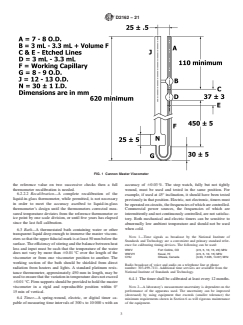
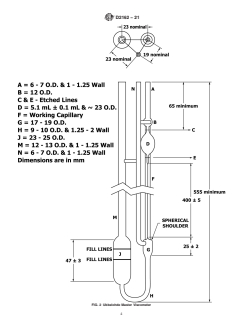
3.2.1.1 Discussion—Purewaterhasakinematicviscosityof 6.1 Master Viscometers: Cannon or Ubbelohde Type—
1.0034mm /s at 20°C. See ISO 3666. Acceptable viscometers are shown in Fig. 1 and Fig. 2.Two
masters are required with calibration constants in the
3.2.2 master viscometer, n—glass capillary viscometer with
2 2 2 2
0.001mm /s to 0.003mm /s range.Additional masters have
a liquid driving head of at least 400mm.
factors increasing in three-fold steps.
3.2.2.1 Discussion—It is specially designed to minimize
6.2 Temperature Measuring Devices—Use either a digital
errors due to surface tension, kinetic energy, and capillary end
contact thermometer (DCT) or a liquid-in-glass thermometer
effects.
meeting the requirements in 6.2.1 or 6.2.2 respectively:
3.2.3 viscosity oil standard, n—stableNewtonianliquid,the
6.2.1 Digital Contact Thermometer, which meets the re-
kinematic viscosity of which has been related to the kinematic
quirements for a D02-DCT08 listed in Specification D8278
viscosity of water through the step-up procedure described in
with a SPRT as the preferred sensor type.
this practice.
6.2.1.1 The DCT probe is to be immersed by more than its
3.3 Acronyms:
minimum immersion depth in a constant temperature bath so
3.3.1 PRT, n—Platinum Resistance Thermometer thatthecenteroftheprobe’ssensingregionisatthesamelevel
as the lower half of the working capillary provided the probes
3.3.1.1 Discussion—ThesensorusedinaPRTismadefrom
minimum immersion depth is met. The end of the probe’s
platinum, whose resistance varies with temperature.
sheath shall not extend past the bottom of the viscometer’s
3.3.2 SPRT, n—StandardPlatinumResistanceThermometer
lower reservoir.
3.3.2.1 Discussion—An SPRT is a high precision PRT with
6.2.1.2 Verify the calibration at least annually. The probe
an accuracy on the order of one mK (0.0010°C).
shallberecalibratedwhenthecheckvaluediffersbymorethan
0.01°C from the last probe calibration. Verification can be
4. Summary of Practice
accomplished with the use of a water triple point cell, an ice
bath or other suitable constant temperature device which has a
4.1 Two or more master viscometers, having calibration
2 2 2 2
known temperature value of suitable precision. See Practice
constants in the 0.001mm /s to 0.003mm /s range, are
E563, Guide E1750, and Guide E2593 for more information
calibratedwithwaterat20°C.Thekinematicviscositiesoftwo
regarding checking calibrations.
or more oil standards are measured at 40°C in these two
6.2.2 Liquid-in-Glass Thermometer—Kinematic viscosity
master viscometers. Corrections are made for buoyancy and,
thermometers having a range from 18.5°C to 21.5°C, or
where necessary, for temperature and surface tension.
38.5°C to 41.5°C, and conforming to the requirements for
4.2 Athirdmasterviscometer,withacalibrationconstantof
Thermometers 44C and 120C, as prescribed in Specification
2 2 2 2
0.003mm /s to0.009mm /s ,isthencalibratedat40°Cwith
E1, and calibrated to 65 mK (0.005°C). The thermometer
the two standard oils and its calibration factor calculated at
shallhaveareportoftemperaturecalibrationfromacalibration
standard conditions for water at 20°C. In like manner addi-
laboratory with a demonstrated competency in temperature
tionalviscosityoilstandardsandadditionalmasterviscometers
calibration traceable to a national calibration or metrology
are calibrated at 40°C using the average results from at least
standards body.
two master viscometers or two oil standards. Steps between
6.2.2.1 Calibration Check—Verify the thermometer at least
successive calibration constants or viscosities increase by a
annually against a reference thermometer in a constant tem-
factor of three or less until the desired viscosity range is
perature bath or an ice bath. The thermometer is to be inserted
covered.
to its immersion depth. If using an ice bath, the ice point
reading is to be taken within 60 min after the thermometer has
4.3 Oils are calibrated at other temperatures using the
been at test temperature for at least 3 min. If the corrected
average result from at least two master viscometers.
temperature reading deviates more than the calibration toler-
ance from the reference thermometer or the ice point then
5. Significance and Use
repeat this calibration check. If the thermometer deviates from
5.1 Because there are surface tension or kinematic viscosity
differences, or both, between the primary standard (7.4) and
kinematic viscosity standards (7.5), special procedures using
Cannon, M. R., “Viscosity Measurement, Master Viscometers,” Industrial and
master viscometers are required to “step-up” from the kine-
Engineering Chemistry. Analytical Edition, Vol 16, 1944, p. 708.
matic viscosity of the primary standard to the kinematic
Ubbelohde, L., “The Suspended Lever Viscometer,” Journal Institute Petro-
viscosities of oil standards. leum Technologists (London), Vol 22, 1936, p. 37.
D2162 − 21
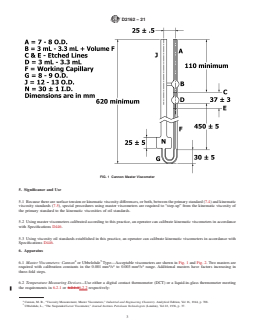
FIG. 1 Cannon Master Viscometer
the reference value on two successive checks then a full accuracy of 60.03%. The stop watch, fully but not tightly
thermometer recalibration is needed. wound, must be used and tested in the same position. For
6.2.2.2 Recalibration—A complete recalibration of the example, if used at 45° inclination, it should have been tested
liquid-in-glass thermometer, while permitted, is not necessary
previouslyinthatposition.Electric,notelectronic,timersmust
in order to meet the accuracy ascribed to liquid-in-glass
beoperatedoncircuits,thefrequenciesofwhicharecontrolled.
thermometer’s design until the thermometers corrected mea-
Commercial power sources, the frequencies of which are
sured temperature deviates from the reference thermometer or
intermittentlyandnotcontinuouslycontrolled,arenotsatisfac-
ice point by one scale division, or until five years has elapsed
tory. Both mechanical and electric timers can be sensitive to
since the last full calibration.
abnormally low ambient temperature and should not be used
when cold.
6.3 Bath—A thermostated bath containing water or other
transparent liquid deep enough to immerse the master viscom-
NOTE 1—Time signals as broadcast by the National Institute of
eterssothattheupperfiducialmarkisatleast50mmbelowthe
Standards and Technology are a convenient and primary standard refer-
surface.Theefficiencyofstirringandthebalancebetweenheat
ence for calibrating timing devices. The following can be used:
loss and input must be such that the temperature of the water
WWV Fort Collins, CO (2.5, 5, 10, 15, 20) MHz
does not vary by more than 60.01°C over the length of the
WWVH Kauai, HI (2.5, 5, 10, 15) MHz
CHU Ottawa, Canada (3.33, 7.335, 14.67) MHz
viscometer or from one viscometer position to another. The
working section of the bath should be shielded from direct
Radio broadcast of voice and audio on a telephone line at phone
radiation from heaters and lights. A standard platinum resis-
number: 303-499-7111. Additional time services are available from the
National Institute of Standards and Technology.
tance thermometer, approximately 450 mm in length, may be
usedtoensurethatthevariationintemperaturedoesnotexceed
6.4.1 Thetimershallbecalibratedatleastevery12months.
60.01°C.Firmsupportsshouldbeprovidedtoholdthemaster
NOTE 2—A laboratory’s measurement uncertainty is dependent on the
viscometer in a rigid and reproducible position within 0°
performance of the apparatus used. The uncertainty can be improved
15min of vertical.
(decreased) by using equipment that exceeds (smaller tolerance) the
6.4 Timer—A spring-wound, electric, or digital timer ca-
minimum requirements shown in Section 6 as will rigorous maintenance
pable of measuring time intervals of 300s to 10000 s with an of the equipment.
D2162 − 21
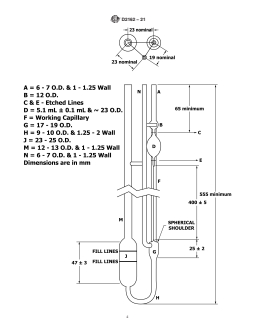
FIG. 2 Ubbelohde Master Viscometer
D2162 − 21
7. Reagents diameter solder lead. Remove the cork (or slot it) during the
test so that no back pressure is developed.
7.1 Acetone, reagent grade. (Warning—Extremely flam-
mable.) 8.5 Charge the Ubbelohde master as follows:
8.5.1 Tilt the instrument about 30° from the vertical with
7.2 ChromicAcid Cleaning Solution—Carefullypour1Lof
bulb A below the capillary and then introduce enough water
concentrated sulfuric acid (H SO , relative density 1.84) into
2 4
into large arm 1 to bring the level up to the lower filling line.
35 mL of a saturated solution of technical grade sodium
The level should not be above the upper filling line when the
dichromate (Na Cr O ) in water. Strongly oxidizing acid
2 2 7
viscometerisreturnedtotheverticalpositionandtheliquidhas
cleaning solutions containing no chromium may be substi-
been drained from tube 1. Charge the viscometer in such a
tuted to avoid disposal problems of chromium-containing
manner that the U-tube at the bottom fills completely without
solutions. (Warning—Causes severe burns.)
trapping air.
7.3 Petroleum Spirit, or other solvent completely miscible
8.5.2 Place the viscometer into a holder and place it in the
with petroleum oils. (Warning—Combustible. Vapor harm-
constant temperature bath. Align the large tube 1 in a vertical
ful.)
position with a plumb bob as described for the Cannon master.
7.4 Primary Standard Water, deionized or distilled, then
8.6 Allow the charged viscometer to stand in the bath long
distilled fresh the same day of use. Store in a glass-stoppered
enough for the sample to reach bath temperature. Fifteen
chromic acid-cleaned bottle of borosilicate glass. See Specifi-
minutes are usually sufficient.
cation D1193.
8.7 With gentle vacuum or pressure, force the liquid about
7.5 Viscosity Oil Standards—Stable petroleum oils selected
5mm above the upper timing mark.Avoid splashing liquid in
to cover the desired kinematic viscosity range.They should be
the upper bulb or forming any bubbles in the liquid. When
transparent and have vapor pressures below 10 mmHg at
usingaUbbelohdeviscometer,holdafingerovertheupperend
40°C. Store away from heat and light in suitable containers,
oftube3duringthisoperation;thenremoveitandimmediately
preferably glass.
place it over tube 2 until the liquid drops away from the lower
end of the capillary.
8. Calibration of Master Viscometers with Water at
8.8 Measure the efflux of water from upper to lower timing
20 °C
mark (which should be 300 s or more) to the nearest 0.1 s.
8.1 Maintainthewaterbathat20°C 60.01°Capplyingthe
Repeat this measurement two additional times and average if
necessary thermometer corrections. Two check thermometers
the lowest and highest times agree within 0.1%. If the
are recommended to detect any change in calibration.
measurements do not agree within this tolerance, repeat the
8.2 Clean a master viscometer having a calibration constant
procedure paying particular attention to cleaning the
2 2 2 2
of 0.001mm /s to 0.003mm /s with chromic acid cleaning viscometer, filtering the sample, avoiding contamination dur-
solution to remove organic deposits, rinse thoroughly with
ing filling and afte
...
This document is not an ASTM standard and is intended only to provide the user of an ASTM standard an indication of what changes have been made to the previous version. Because
it may not be technically possible to adequately depict all changes accurately, ASTM recommends that users consult prior editions as appropriate. In all cases only the current version
of the standard as published by ASTM is to be considered the official document.
Designation: D2162 − 17 D2162 − 21
Standard Practice for
Basic Calibration of Master Viscometers and Viscosity Oil
Standards
This standard is issued under the fixed designation D2162; the number immediately following the designation indicates the year of
original adoption or, in the case of revision, the year of last revision. A number in parentheses indicates the year of last reapproval. A
superscript epsilon (´) indicates an editorial change since the last revision or reapproval.
1. Scope*
1.1 This practice covers the calibration of master viscometers and viscosity oil standards, both of which may be used to calibrate
routine viscometers as described in Test Method D445 and Specifications D446 over the temperature range from 15 °C to 100 °C.
1.2 The values stated in SI units are to be regarded as standard. No other units of measurement are included in this standard.
2 2 2
1.2.1 The SI-based units for calibration constants and kinematic viscosities are mm /s and mm /s, respectively.
1.3 This standard does not purport to address all of the safety concerns, if any, associated with its use. It is the responsibility
of the user of this standard to establish appropriate safety safety, health, and healthenvironmental practices and determine the
applicability of regulatory limitations prior to use. For specific warning statements, see Section 7.
1.4 This international standard was developed in accordance with internationally recognized principles on standardization
established in the Decision on Principles for the Development of International Standards, Guides and Recommendations issued
by the World Trade Organization Technical Barriers to Trade (TBT) Committee.
2. Referenced Documents
2.1 ASTM Standards:
D445 Test Method for Kinematic Viscosity of Transparent and Opaque Liquids (and Calculation of Dynamic Viscosity)
D446 Specifications and Operating Instructions for Glass Capillary Kinematic Viscometers
D1193 Specification for Reagent Water
D1250 Guide for the Use of the Joint API and ASTM Adjunct for Temperature and Pressure Volume Correction Factors for
Generalized Crude Oils, Refined Products, and Lubricating Oils: API MPMS Chapter 11.1
D1480 Test Method for Density and Relative Density (Specific Gravity) of Viscous Materials by Bingham Pycnometer
D1590 Test Method for Surface Tension of Water
D8278 Specification for Digital Contact Thermometers for Test Methods Measuring Flow Properties of Fuels and Lubricants
E1 Specification for ASTM Liquid-in-Glass Thermometers
E563 Practice for Preparation and Use of an Ice-Point Bath as a Reference Temperature
E644 Test Methods for Testing Industrial Resistance Thermometers
E1137 Specification for Industrial Platinum Resistance Thermometers
E1750 Guide for Use of Water Triple Point Cells
E2593 Guide for Accuracy Verification of Industrial Platinum Resistance Thermometers
This practice is under the jurisdiction of ASTM Committee D02 on Petroleum Products, Liquid Fuels, and Lubricants and is the direct responsibility of Subcommittee
D02.07 on Flow Properties.
Current edition approved May 1, 2017April 1, 2021. Published May 2017April 2021. Originally approved in 1963. Last previous edition approved in 20142017 as
D2162 – 14.D2162 – 17. DOI: 10.1520/D2162-17.10.1520/D2162-21.
For referenced ASTM standards, visit the ASTM website, www.astm.org, or contact ASTM Customer Service at service@astm.org. For Annual Book of ASTM Standards
volume information, refer to the standard’s Document Summary page on the ASTM website.
*A Summary of Changes section appears at the end of this standard
Copyright © ASTM International, 100 Barr Harbor Drive, PO Box C700, West Conshohocken, PA 19428-2959. United States
D2162 − 21
E2877 Guide for Digital Contact Thermometers
2.2 ISO Standard:
ISO 3666 Viscosity of Water
3. Terminology
3.1 Definitions:
3.1.1 digital contact thermometer (DCT) , n—an electronic device consisting of a digital display and associated temperature
sensing probe.
3.1.1.1 Discussion—
This device consists of a temperature sensor connected to a measuring instrument; this instrument measures the temperature-
dependent quantity of the sensor, computes the temperature from the measured quantity, and provides a digital output. This digital
output goes to a digital display and/or recording device that may be internal or external to the device. These devices are sometimes
referred to as “digital thermometers.”
3.1.1.2 Discussion—
The devices are often referred to as a “digital thermometers,” however the term includes devices that sense temperature by means
other than being in physical contact with the media.
3.1.1.3 Discussion—
PET is an acronym for portable electronic thermometers, a subset of digital contact thermometers (DCT).
3.2 Definitions of Terms Specific to This Standard:
3.2.1 basic calibration, n—calibration based on the primary standard, water.
3.2.1.1 Discussion—
Pure water has a kinematic viscosity of 1.0034 mm /s at 20 °C. See ISO 3666.
3.2.2 master viscometer, n—glass capillary viscometer with a liquid driving head of at least 400 mm.
3.2.2.1 Discussion—
It is specially designed to minimize errors due to surface tension, kinetic energy, and capillary end effects.
3.2.3 viscosity oil standard, n—stable Newtonian liquid, the kinematic viscosity of which has been related to the kinematic
viscosity of water through the step-up procedure described in this practice.
3.3 Acronyms:
3.3.1 PRT, n—Platinum Resistance Thermometer
3.3.1.1 Discussion—
The sensor used in a PRT is made from platinum, whose resistance varies with temperature.
3.3.2 SPRT, n—Standard Platinum Resistance Thermometer
3.3.2.1 Discussion—
An SPRT is a high precision PRT with an accuracy on the order of one mK (0.0010 °C).
4. Summary of Practice
2 2 2 2
4.1 Two or more master viscometers, having calibration constants in the 0.001 mm /s to 0.003 mm /s range, are calibrated with
water at 20 °C. The kinematic viscosities of two or more oil standards are measured at 40 °C in these two master viscometers.
Corrections are made for buoyancy and, where necessary, for temperature and surface tension.
2 2 2 2
4.2 A third master viscometer, with a calibration constant of 0.003 mm /s to 0.009 mm /s , is then calibrated at 40 °C with the
two standard oils and its calibration factor calculated at standard conditions for water at 20 °C. In like manner additional viscosity
oil standards and additional master viscometers are calibrated at 40 °C using the average results from at least two master
viscometers or two oil standards. Steps between successive calibration constants or viscosities increase by a factor of three or less
until the desired viscosity range is covered.
4.3 Oils are calibrated at other temperatures using the average result from at least two master viscometers.
Available from American National Standards Institute (ANSI), 25 W. 43rd St., 4th Floor, New York, NY 10036, http://www.ansi.org.
D2162 − 21
FIG. 1 Cannon Master Viscometer
5. Significance and Use
5.1 Because there are surface tension or kinematic viscosity differences, or both, between the primary standard (7.4) and kinematic
viscosity standards (7.5), special procedures using master viscometers are required to “step-up” from the kinematic viscosity of
the primary standard to the kinematic viscosities of oil standards.
5.2 Using master viscometers calibrated according to this practice, an operator can calibrate kinematic viscometers in accordance
with Specifications D446.
5.3 Using viscosity oil standards established in this practice, an operator can calibrate kinematic viscometers in accordance with
Specifications D446.
6. Apparatus
4 5
6.1 Master Viscometers: Cannon or Ubbelohde Type—Acceptable viscometers are shown in Fig. 1 and Fig. 2. Two masters are
2 2 2 2
required with calibration constants in the 0.001 mm /s to 0.003 mm /s range. Additional masters have factors increasing in
three-fold steps.
6.2 Temperature Measuring Devices—Use either a digital contact thermometer (DCT) or a liquid-in-glass thermometer meeting
the requirements in 6.2.1 or 6.2.1.16.2.2 respectively:
Cannon, M. R., “Viscosity Measurement, Master Viscometers,” Industrial and Engineering Chemistry. Analytical Edition, Vol 16, 1944, p. 708.
Ubbelohde, L., “The Suspended Lever Viscometer,” Journal Institute Petroleum Technologists (London), Vol 22, 1936, p. 37.
D2162 − 21
D2162 − 21
FIG. 2 Ubbelohde Master Viscometer
6.2.1 Digital Contact Thermometer—Thermometer, A device conforming to Guide which meets the requirements for a
D02-DCT08 listed in Specification E2877D8278 Class A and meeting or exceeding the following additional requirements:with a
SPRT as the preferred sensor type.
(1) The only acceptable sensors are resistance temperature devices (RTD) or high precision thermistors. However a standard
platinum resistance thermometer (SPRT) is preferable.
(2) Meeting Class A requirements of Guide E2877 preferably with a minimum display resolution of 0.001 °C.
(3) A combined (display and probe) accuracy of 67 mK (0.007 °C) at a 95 % confidence level over intended range of use.
(4) A response time of less than 25 s as defined in Specification E1137.
(5) Linearity of less than 7 mK (0.007 °C) over the range of temperatures to be measured.
(6) Both the temperature sensor and measurement bridge components of the DCT shall have a report of temperature calibration
from a calibration laboratory with a demonstrated competency in temperature calibration traceable to a national calibration or
metrology standards body.
(7) The calibration report shall include data for the series of test points which are appropriate for the range of intended use.
(8) If the DCT display unit (measuring instrument such as a bridge) is calibrated separate from the probe, it should be calibrated
annually.
6.2.1.1 The DCT probe is to be immersed by more than its minimum immersion depth in a constant temperature bath so that the
center of the probe’s sensing region is at the same level as the lower half of the working capillary provided the probes minimum
immersion depth is met. The end of the probe’s sheath shall not extend past the bottom of the viscometer’s lower reservoir.
NOTE 1—With respect to DCT probe immersion depth, a procedure is available in Test Methods E644, Section 7, for determining the minimum depth.
With respect to an ice bath, Practice E563 provides guidance on the preparation of an ice bath however variance from the specific steps is permitted
provided preparation is consistent as it is being used to track change in calibration.
6.2.1.2 Verify the calibration at least annually. The probe shall be recalibrated when the check value differs by more than 0.01 °C
from the last probe calibration. Verification can be accomplished with the use of a water triple point cell, an ice bath or other
suitable constant temperature device which has a known temperature value of suitable precision. See Practice E563, Guide E1750,
and Guide E2593 for more information regarding checking calibrations.
6.2.2 Liquid-in-Glass Thermometer—Kinematic viscosity thermometers having a range from 18.5 °C to 21.5 °C, or 38.5 °C to
41.5 °C, and conforming to the requirements for Thermometers 44C and 120C, as prescribed in Specification E1, and calibrated
to 65 mK (0.005 °C). The thermometer shall have a report of temperature calibration from a calibration laboratory with a
demonstrated competency in temperature calibration traceable to a national calibration or metrology standards body.
6.2.2.1 Calibration Check—Verify the thermometer at least annually against a reference thermometer in a constant temperature
bath or an ice bath. The thermometer is to be inserted to its immersion depth. If using an ice bath, the ice point reading is to be
taken within 60 min after the thermometer has been at test temperature for at least 3 min. If the corrected temperature reading
deviates more than the calibration tolerance from the reference thermometer or the ice point then repeat this calibration check. If
the thermometer deviates from the reference value on two successive checks then a full thermometer recalibration is needed.
6.2.2.2 Recalibration—A complete recalibration of the liquid-in-glass thermometer, while permitted, is not necessary in order to
meet the accuracy ascribed to liquid-in-glass thermometer’s design until the thermometers corrected measured temperature
deviates from the reference thermometer or ice point by one scale division, or until five years has elapsed since the last full
calibration.
6.3 Bath—A thermostated bath containing water or other transparent liquid deep enough to immerse the master viscometers so that
the upper fiducial mark is at least 50 mm below the surface. The efficiency of stirring and the balance between heat loss and input
must be such that the temperature of the water does not vary by more than 60.01 °C over the length of the viscometer or from
one viscometer position to another. The working section of the bath should be shielded from direct radiation from heaters and
lights. A standard platinum resistance thermometer, approximately 450 mm in length, may be used to ensure that the variation in
temperature does not exceed 60.01 °C. Firm supports should be provided to hold the master viscometer in a rigid and reproducible
position within 0° 15 min of vertical.
6.4 Timer—A spring-wound, electric, or digital timer capable of measuring time intervals of 300 s to 10 000 s with an accuracy
D2162 − 21
of 60.03 %. The stop watch, fully but not tightly wound, must be used and tested in the same position. For example, if used at
45° inclination, it should have been tested previously in that position. Electric, not electronic, timers must be operated on circuits,
the frequencies of which are controlled. Commercial power sources, the frequencies of which are intermittently and not
continuously controlled, are not satisfactory. Both mechanical and electric timers can be sensitive to abnormally low ambient
temperature and should not be used when cold.
NOTE 1—Time signals as broadcast by the National Institute of Standards and Technology are a convenient and primary standard reference for calibrating
timing devices. The following can be used:
WWV Fort Collins, CO (2.5, 5, 10, 15, 20) MHz
WWVH Kauai, HI (2.5, 5, 10, 15) MHz
CHU Ottawa, Canada (3.33, 7.335, 14.67) MHz
Radio broadcast of voice and audio on a telephone line at phone number: 303-499-7111. Additional time services are available from the National
Institute of Standards and Technology.
6.4.1 The timer shall be calibrated at least every 12 months.
NOTE 2—A laboratory’s measurement uncertainty is dependent on the performance of the apparatus used. The uncertainty can be improved (decreased)
by using equipment that exceeds (smaller tolerance) the minimum requirements shown in Section 6 as will rigorous maintenance of the equipment.
7. Reagents
7.1 Acetone, reagent grade. (Warning—Extremely flammable.)
7.2 Chromic Acid Cleaning Solution— Carefully pour 1 L of concentrated sulfuric acid (H SO , relative density 1.84) into 35 mL
2 4
of a saturated solution of technical grade sodium dichromate (Na Cr O ) in water. Strongly oxidizing acid cleaning solutions
2 2 7
containing no chromium may be substituted to avoid disposal problems of chromium-containing solutions. (Warning—Causes
severe burns.)
7.3 Petroleum Spirit, or other solvent completely miscible with petroleum oils. (Warning—Combustible. Vapor harmful.)
7.4 Primary Standard Water, deionized or distilled, then distilled fresh the same day of use. Store in a glass-stoppered chromic
acid-cleaned bottle of borosilicate glass. See Specification D1193.
7.5 Viscosity Oil Standards—Stable petroleum oils selected to cover the desired kinematic viscosity range. They should be
transparent and have vapor pressures below 10 mmHg at 40 °C. Store away from heat and light in suitable containers, preferably
glass.
8. Calibration of Master Viscometers with Water at 20 °C
8.1 Maintain the water bath at 20 °C 6 0.01 °C applying the necessary thermometer corrections. Two check thermometers are
recommended to detect any change in calibration.
2 2 2 2
8.2 Clean a master viscometer having a calibration constant of 0.001 mm /s to 0.003 mm /s with chromic acid cleaning solution
to remove organic deposits, rinse thoroughly with distilled water and acetone and dry with a stream of filtered air.
8.3 Clean a 50 mL Erlenmeyer flask with cleaning solution and rinse thoroughly with distilled water. Add freshly distilled primary
standard water and bring to a boil to remove dissolved gases. Cover the flask to prevent entrance of dust and allow to cool. If a
Cannon master viscometer is being calibrated, cool the water to 20 °C 6 3 °C.
8.4 Charge the Cannon master as follows:
The sole source of supply of non-chromium containing cleaning solution known to the committee at this time is Godax Laboratories Inc., 480 Canal Street, New York,
NY 10013. If you are aware of alternative suppliers, please provide this information to ASTM International Headquarters. Your comments will receive careful consideration
at a meeting of the responsible technical committee, which you may attend.
D2162 − 21
8.4.1 Connect a rubber tube to large arm J. Invert the viscometer an
...