

ASTM E289-17
(Test Method)Standard Test Method for Linear Thermal Expansion of Rigid Solids with Interferometry
General Information
- Abstract
SIGNIFICANCE AND USE
5.1 Coefficients of linear expansion are required for design purposes and are used particularly to determine thermal stresses that can occur when a solid artifact composed of different materials may fail when it is subjected to a temperature excursion(s).
5.2 Many new composites are being produced that have very low thermal expansion coefficients for use in applications where very precise and critical alignment of components is necessary. Push rod dilatometry such as Test Methods D696 and E228, and thermomechanical analysis methods such as Test Method E831 are not sufficiently precise for reliable measurements either on such material and systems, or on very short specimens of materials having higher coefficients.
5.3 The precision of the absolute method allows for its use to:
5.3.1 Measure very small changes in length;
5.3.2 Develop reference materials and transfer standards for calibration of other less precise techniques;
5.3.3 Measure and compare precisely the differences in coefficient of “matched” materials.
5.4 The precise measurement of thermal expansion involves two parameters; change of length and change of temperature. Since precise measurements of the first parameter can be made by this test method, it is essential that great attention is also paid to the second, in order to ensure that calculated expansion coefficients are based on the required temperature difference. Thus in order to ensure the necessary uniformity in temperature of the specimen, it is essential that the uniform temperature zone of the surrounding furnace or environmental chamber shall be made significantly longer than the combined length of specimen and mirrors.
5.5 This test method contains essential details of the design principles, specimen configurations, and procedures to provide precise values of thermal expansion. It is not practical in a method of this type to try to establish specific details of design, construction, and procedures to cover all contingenci...
SCOPE
1.1 This test method covers the determination of linear thermal expansion of rigid solids using either a Michelson or Fizeau interferometer.
1.2 For this purpose, a rigid solid is defined as a material which, at test temperature and under the stresses imposed by instrumentation, has a negligible creep, insofar as significantly affecting the precision of thermal length change measurements.
1.3 It is recognized that many rigid solids require detailed preconditioning and specific thermal test schedules for correct evaluation of linear thermal expansion behavior for certain material applications. Since a general method of test cannot cover all specific requirements, details of this nature should be discussed in the particular material specifications.
1.4 This test method is applicable to the approximate temperature range −150°C to 700°C. The temperature range may be extended depending on the instrumentation and calibration materials used.
1.5 The precision of measurement of this absolute method (better than ±40 nm/(m·K)) is significantly higher than that of comparative methods such as push rod dilatometry (for example, Test Methods D696 and E228) and thermomechanical analysis (for example, Test Method E831) techniques. It is applicable to materials having low and either positive or negative coefficients of expansion (below 5 μm/(m·K)) and where only very limited lengths or thickness of other higher expansion coefficient materials are available.
1.6 The values stated in SI units are to be regarded as standard. No other units of measurement are included in this standard.
1.7 This standard does not purport to address all of the safety concerns, if any, associated with its use. It is the responsibility of the user of this standard to establish appropriate safety and health practices and determine the applicability of regulatory limitations prior to use.
1.8 This international standard was developed in accord...
- Status
- Published
- Publication Date
- 31-Mar-2017
- Technical Committee
- E37 - Thermal Measurements
- Drafting Committee
- E37.05 - Thermophysical Properties
Buy Documents
ASTM E289-17 - Standard Test Method for Linear Thermal Expansion of Rigid Solids with Interferometry
REDLINE ASTM E289-17 - Standard Test Method for Linear Thermal Expansion of Rigid Solids with Interferometry
Overview
ASTM E289-17 is the globally recognized standard test method for determining the linear thermal expansion of rigid solids utilizing interferometric techniques-specifically, the Michelson or Fizeau interferometer. Accurate measurement of the coefficient of linear thermal expansion is critical in material science and engineering, informing both design and quality assurance processes where thermal stresses and precise alignment are critical. This method is especially valuable for modern composite materials and small specimens where utmost precision is required and traditional methods fall short.
Key Topics
Scope and Applicability
- Suitable for rigid solids with negligible creep under test conditions.
- Applicable over a broad temperature range, approximately −150°C to 700°C (can be extended with suitable equipment).
- Particularly effective for materials with very low or negative coefficients of thermal expansion, or when only small or thin specimens are available.
Precision and Advantages
- Offers superior measurement precision (better than ±40 nm/(m·K)) over comparative techniques like push rod dilatometry (ASTM D696, E228) and thermomechanical analysis (ASTM E831).
- Allows for detection of very small dimensional changes, making it ideal for advanced materials and calibration standards.
Methodology Highlights
- Utilizes interferometric measurements, where expansion or contraction changes the optical path, producing a detectable fringe pattern change.
- The test method requires carefully prepared specimens with polished, reflective ends or flat surfaces.
- Measurement environments often require vacuum or low-pressure inert gases to mitigate refractive index instability in air.
Data Integrity
- Accurate temperature measurement is as vital as displacement determination; uniform temperature zones are crucial for validity.
- Reference materials with certified thermal expansion values are necessary to validate test system accuracy.
Applications
Material Characterization
- Used to rigorously characterize metals, ceramics, glasses, advanced composites, and specialty alloys, particularly where low thermal expansion is crucial.
Design and Engineering
- Essential in high-precision engineering fields such as aerospace, electronics, optics, and scientific instrumentation, where mismatched thermal expansion can lead to misalignment or component failure.
Reference Standards Development
- Supports the production and certification of reference materials and transfer standards for calibration of less precise measurement techniques.
Quality Control and Assurance
- Integral to ongoing quality checks and validation during production or research and development, especially for next-generation materials.
Related Standards
- ASTM D696 - Test Method for Coefficient of Linear Thermal Expansion of Plastics Between −30°C and 30°C with a Vitreous Silica Dilatometer
- ASTM E228 - Test Method for Linear Thermal Expansion of Solid Materials with a Push-Rod Dilatometer
- ASTM E831 - Test Method for Linear Thermal Expansion of Solid Materials by Thermomechanical Analysis
- ASTM E220 - Test Method for Calibration of Thermocouples By Comparison Techniques
- ASTM E473, E1142 - Terminology relating to thermal analysis and thermophysical properties
Practical Value
By following ASTM E289-17, laboratories and industry professionals ensure the highest accuracy in measuring linear thermal expansion-vital for developing reliable, high-performance materials and components. This standard supports critical applications in precision engineering and stringent regulatory environments, enabling informed material selection, failure prevention, and consistent product quality in thermally-sensitive applications.
Relations
- Effective Date
- 01-Apr-2017
- Effective Date
- 01-Oct-2023
- Effective Date
- 01-Oct-2023
- Effective Date
- 01-Apr-2019
- Effective Date
- 01-Sep-2016
- Effective Date
- 01-Apr-2016
- Effective Date
- 01-May-2015
- Effective Date
- 15-Aug-2014
- Effective Date
- 15-Aug-2014
- Effective Date
- 01-Aug-2014
- Effective Date
- 01-Apr-2014
- Effective Date
- 15-Feb-2014
- Effective Date
- 01-Nov-2013
- Effective Date
- 01-Nov-2013
- Effective Date
- 01-Sep-2012
Buy Documents
ASTM E289-17 - Standard Test Method for Linear Thermal Expansion of Rigid Solids with Interferometry
REDLINE ASTM E289-17 - Standard Test Method for Linear Thermal Expansion of Rigid Solids with Interferometry
Get Certified
Connect with accredited certification bodies for this standard

IMP NDT d.o.o.
Non-destructive testing services. Radiography, ultrasonic, magnetic particle, penetrant, visual inspection.
Inštitut za kovinske materiale in tehnologije
Institute of Metals and Technology. Materials testing, metallurgical analysis, NDT.
Q Techna d.o.o.
NDT and quality assurance specialist. 30+ years experience. NDT personnel certification per ISO 9712, nuclear and thermal power plant inspections, QA/
Sponsored listings
Frequently Asked Questions
ASTM E289-17 is a standard published by ASTM International. Its full title is "Standard Test Method for Linear Thermal Expansion of Rigid Solids with Interferometry". This standard covers: SIGNIFICANCE AND USE 5.1 Coefficients of linear expansion are required for design purposes and are used particularly to determine thermal stresses that can occur when a solid artifact composed of different materials may fail when it is subjected to a temperature excursion(s). 5.2 Many new composites are being produced that have very low thermal expansion coefficients for use in applications where very precise and critical alignment of components is necessary. Push rod dilatometry such as Test Methods D696 and E228, and thermomechanical analysis methods such as Test Method E831 are not sufficiently precise for reliable measurements either on such material and systems, or on very short specimens of materials having higher coefficients. 5.3 The precision of the absolute method allows for its use to: 5.3.1 Measure very small changes in length; 5.3.2 Develop reference materials and transfer standards for calibration of other less precise techniques; 5.3.3 Measure and compare precisely the differences in coefficient of “matched” materials. 5.4 The precise measurement of thermal expansion involves two parameters; change of length and change of temperature. Since precise measurements of the first parameter can be made by this test method, it is essential that great attention is also paid to the second, in order to ensure that calculated expansion coefficients are based on the required temperature difference. Thus in order to ensure the necessary uniformity in temperature of the specimen, it is essential that the uniform temperature zone of the surrounding furnace or environmental chamber shall be made significantly longer than the combined length of specimen and mirrors. 5.5 This test method contains essential details of the design principles, specimen configurations, and procedures to provide precise values of thermal expansion. It is not practical in a method of this type to try to establish specific details of design, construction, and procedures to cover all contingenci... SCOPE 1.1 This test method covers the determination of linear thermal expansion of rigid solids using either a Michelson or Fizeau interferometer. 1.2 For this purpose, a rigid solid is defined as a material which, at test temperature and under the stresses imposed by instrumentation, has a negligible creep, insofar as significantly affecting the precision of thermal length change measurements. 1.3 It is recognized that many rigid solids require detailed preconditioning and specific thermal test schedules for correct evaluation of linear thermal expansion behavior for certain material applications. Since a general method of test cannot cover all specific requirements, details of this nature should be discussed in the particular material specifications. 1.4 This test method is applicable to the approximate temperature range −150°C to 700°C. The temperature range may be extended depending on the instrumentation and calibration materials used. 1.5 The precision of measurement of this absolute method (better than ±40 nm/(m·K)) is significantly higher than that of comparative methods such as push rod dilatometry (for example, Test Methods D696 and E228) and thermomechanical analysis (for example, Test Method E831) techniques. It is applicable to materials having low and either positive or negative coefficients of expansion (below 5 μm/(m·K)) and where only very limited lengths or thickness of other higher expansion coefficient materials are available. 1.6 The values stated in SI units are to be regarded as standard. No other units of measurement are included in this standard. 1.7 This standard does not purport to address all of the safety concerns, if any, associated with its use. It is the responsibility of the user of this standard to establish appropriate safety and health practices and determine the applicability of regulatory limitations prior to use. 1.8 This international standard was developed in accord...
SIGNIFICANCE AND USE 5.1 Coefficients of linear expansion are required for design purposes and are used particularly to determine thermal stresses that can occur when a solid artifact composed of different materials may fail when it is subjected to a temperature excursion(s). 5.2 Many new composites are being produced that have very low thermal expansion coefficients for use in applications where very precise and critical alignment of components is necessary. Push rod dilatometry such as Test Methods D696 and E228, and thermomechanical analysis methods such as Test Method E831 are not sufficiently precise for reliable measurements either on such material and systems, or on very short specimens of materials having higher coefficients. 5.3 The precision of the absolute method allows for its use to: 5.3.1 Measure very small changes in length; 5.3.2 Develop reference materials and transfer standards for calibration of other less precise techniques; 5.3.3 Measure and compare precisely the differences in coefficient of “matched” materials. 5.4 The precise measurement of thermal expansion involves two parameters; change of length and change of temperature. Since precise measurements of the first parameter can be made by this test method, it is essential that great attention is also paid to the second, in order to ensure that calculated expansion coefficients are based on the required temperature difference. Thus in order to ensure the necessary uniformity in temperature of the specimen, it is essential that the uniform temperature zone of the surrounding furnace or environmental chamber shall be made significantly longer than the combined length of specimen and mirrors. 5.5 This test method contains essential details of the design principles, specimen configurations, and procedures to provide precise values of thermal expansion. It is not practical in a method of this type to try to establish specific details of design, construction, and procedures to cover all contingenci... SCOPE 1.1 This test method covers the determination of linear thermal expansion of rigid solids using either a Michelson or Fizeau interferometer. 1.2 For this purpose, a rigid solid is defined as a material which, at test temperature and under the stresses imposed by instrumentation, has a negligible creep, insofar as significantly affecting the precision of thermal length change measurements. 1.3 It is recognized that many rigid solids require detailed preconditioning and specific thermal test schedules for correct evaluation of linear thermal expansion behavior for certain material applications. Since a general method of test cannot cover all specific requirements, details of this nature should be discussed in the particular material specifications. 1.4 This test method is applicable to the approximate temperature range −150°C to 700°C. The temperature range may be extended depending on the instrumentation and calibration materials used. 1.5 The precision of measurement of this absolute method (better than ±40 nm/(m·K)) is significantly higher than that of comparative methods such as push rod dilatometry (for example, Test Methods D696 and E228) and thermomechanical analysis (for example, Test Method E831) techniques. It is applicable to materials having low and either positive or negative coefficients of expansion (below 5 μm/(m·K)) and where only very limited lengths or thickness of other higher expansion coefficient materials are available. 1.6 The values stated in SI units are to be regarded as standard. No other units of measurement are included in this standard. 1.7 This standard does not purport to address all of the safety concerns, if any, associated with its use. It is the responsibility of the user of this standard to establish appropriate safety and health practices and determine the applicability of regulatory limitations prior to use. 1.8 This international standard was developed in accord...
ASTM E289-17 is classified under the following ICS (International Classification for Standards) categories: 19.060 - Mechanical testing. The ICS classification helps identify the subject area and facilitates finding related standards.
ASTM E289-17 has the following relationships with other standards: It is inter standard links to ASTM E289-04(2016), ASTM E1142-23b, ASTM E473-23b, ASTM E831-19, ASTM E228-11(2016), ASTM D696-16, ASTM E1142-15, ASTM E1142-14b, ASTM E473-14, ASTM E831-14, ASTM E1142-14a, ASTM E1142-14, ASTM E220-13, ASTM E831-13, ASTM E1142-12. Understanding these relationships helps ensure you are using the most current and applicable version of the standard.
ASTM E289-17 is available in PDF format for immediate download after purchase. The document can be added to your cart and obtained through the secure checkout process. Digital delivery ensures instant access to the complete standard document.
Standards Content (Sample)
This international standard was developed in accordance with internationally recognized principles on standardization established in the Decision on Principles for the
Development of International Standards, Guides and Recommendations issued by the World Trade Organization Technical Barriers to Trade (TBT) Committee.
Designation: E289 −17
Standard Test Method for
Linear Thermal Expansion of Rigid Solids with
Interferometry
This standard is issued under the fixed designation E289; the number immediately following the designation indicates the year of
original adoption or, in the case of revision, the year of last revision.Anumber in parentheses indicates the year of last reapproval.A
superscript epsilon (´) indicates an editorial change since the last revision or reapproval.
1. Scope priate safety and health practices and determine the applica-
bility of regulatory limitations prior to use.
1.1 This test method covers the determination of linear
1.8 This international standard was developed in accor-
thermal expansion of rigid solids using either a Michelson or
dance with internationally recognized principles on standard-
Fizeau interferometer.
ization established in the Decision on Principles for the
1.2 For this purpose, a rigid solid is defined as a material
Development of International Standards, Guides and Recom-
which, at test temperature and under the stresses imposed by
mendations issued by the World Trade Organization Technical
instrumentation, has a negligible creep, insofar as significantly
Barriers to Trade (TBT) Committee.
affectingtheprecisionofthermallengthchangemeasurements.
1.3 It is recognized that many rigid solids require detailed
2. Referenced Documents
preconditioning and specific thermal test schedules for correct
2.1 ASTM Standards:
evaluation of linear thermal expansion behavior for certain
D696TestMethodforCoefficientofLinearThermalExpan-
material applications. Since a general method of test cannot
sion of Plastics Between −30°C and 30°C with a Vitreous
cover all specific requirements, details of this nature should be
Silica Dilatometer
discussed in the particular material specifications.
E220Test Method for Calibration of Thermocouples By
1.4 This test method is applicable to the approximate
Comparison Techniques
temperature range −150°C to 700°C. The temperature range
E228Test Method for Linear Thermal Expansion of Solid
may be extended depending on the instrumentation and cali-
Materials With a Push-Rod Dilatometer
bration materials used.
E473Terminology Relating to Thermal Analysis and Rhe-
1.5 The precision of measurement of this absolute method
ology
(better than 640 nm/(m·K)) is significantly higher than that of
E831Test Method for Linear Thermal Expansion of Solid
comparative methods such as push rod dilatometry (for
Materials by Thermomechanical Analysis
example, Test Methods D696 and E228) and thermomechani-
E1142Terminology Relating to Thermophysical Properties
cal analysis (for example, Test Method E831) techniques. It is
applicable to materials having low and either positive or
3. Terminology
negative coefficients of expansion (below 5 µm/(m·K)) and
3.1 Definitions:
where only very limited lengths or thickness of other higher
3.1.1 The following terms are applicable to this document
expansion coefficient materials are available.
and are listed in Terminology E473 and E1142: coeffıcient of
1.6 The values stated in SI units are to be regarded as
linear thermal expansion, thermodilatometry, and thermome-
standard. No other units of measurement are included in this
chanical analysis.
standard.
3.2 Definitions of Terms Specific to This Standard:
1.7 This standard does not purport to address all of the
3.2.1 mean coeffıcient of linear thermal expansion, α —the
m
safety concerns, if any, associated with its use. It is the
average change in length relative to the length of the specimen
responsibility of the user of this standard to establish appro-
accompanying a change in temperature between temperatures
T and T , expressed as follows:
1 2
This test method is under jurisdiction of ASTM Committee E37 on Thermal
Measurements and is the direct responsibility of Subcommittee E37.05 on Thermo-
physical Properties. For referenced ASTM standards, visit the ASTM website, www.astm.org, or
Current edition approved April 1, 2017. Published April 2017. Originally contact ASTM Customer service at service@astm.org. For Annual Book of ASTM
approved in 1965. Last previous edition approved in 2016 as E289–04 (2016). Standards volume information, refer to the standard’s Document Summary page on
DOI: 10.1520/E0289-17. the ASTM website.
Copyright © ASTM International, 100 Barr Harbor Drive, PO Box C700, West Conshohocken, PA 19428-2959. United States
E289 − 17
1 L 2 L 1 ∆L
2 1
αm 5 · 5 · (1)
L T 2 T L ∆T
0 2 1 o
where α is obtained by dividing the linear thermal expan-
m
sion (∆L/L ) by the change of temperature (∆T). It is nor-
mally expressed as µm/m·K. Dimensions (L) are normally
expressed in mm and wavelength (λ)innm.
3.2.2 spalling, n—the development of fragments, flakes, or
chips usually caused by stress resulting from mechanical
treatment.
3.2.3 thermal expansivity, α —at temperature T, is calcu-
T
lated as follows from slope of length v temperature curve:
1 L 2 L 1 dL
2 1
limit
α 5 5 withT ,T ,T (2)
T T →T 1 i 2
2 1
L T 2 T L dT
i 2 1 i
and expressed as µm/m·K.
3.2.3.1 Discussion—Thermal expansivity is sometimes re-
ferred to as instantaneous coefficient of linear expansion.
FIG. 1 Typical Specimen Configurations (a) Michelson Type,
(b–d) Fizeau Type
3.3 Symbols:
α = mean coefficient of linear thermal expansion, see 3.2.1,
m
–1
K
–1
α = expansivity at temperature T, see 3.2.3,K
T
5. Significance and Use
L = original length of specimen at temperature T ,mm
0 0
L = length at temperature T ,mm
1 1 5.1 Coefficients of linear expansion are required for design
L = length at temperature T ,mm
2 2
purposes and are used particularly to determine thermal
∆L = change in length of specimen between temperatures T
stresses that can occur when a solid artifact composed of
and T ,nm
∆L = change in length of reference specimen between T and
s 1 different materials may fail when it is subjected to a tempera-
T ,mm
ture excursion(s).
N = number of fringes including fractional parts that are
measured on changing temperature from T to T
1 2
5.2 Many new composites are being produced that have
n = index of refraction of gas at temperature T and pressure,
very low thermal expansion coefficients for use in applications
P
n = index of refraction of gas at reference condition of where very precise and critical alignment of components is
r
temperature 288 K and pressure of 100 kPa
necessary. Push rod dilatometry such as Test Methods D696
n ,n = index of refractive of gas at temperature T and T , and
1 2 1 2
and E228, and thermomechanical analysis methods such as
pressure, P
P = average pressure of gas during test, Pa (torr)
Test Method E831 are not sufficiently precise for reliable
Note—torr = 133.3 Pa.
measurements either on such material and systems, or on very
T = temperature at which initial length is L ,K
0 0
short specimens of materials having higher coefficients.
T ,T = two temperatures at which measurements are made, K
1 2
∆T = temperature difference between T and T ,K
2 1
5.3 The precision of the absolute method allows for its use
λ = wavelength of light used to produce fringes, nm
v
to:
4. Summary of Test Method
5.3.1 Measure very small changes in length;
5.3.2 Developreferencematerialsandtransferstandardsfor
4.1 A specimen of known geometry can be given polished
calibration of other less precise techniques;
reflective ends or placed between two flat reflecting surfaces
5.3.3 Measure and compare precisely the differences in
(mirrors). Typical configurations, as shown in Fig. 1, are a
coefficient of “matched” materials.
cylindricaltubeorarodwithhemisphericalorflatparallelends
or machined to provide a 3-point support. The mirrors consist 5.4 Theprecisemeasurementofthermalexpansioninvolves
of flat-uniform thickness pieces of silica or sapphire with the
two parameters; change of length and change of temperature.
surfaces partially coated with gold or other high reflectance Since precise measurements of the first parameter can be made
metal. Light, either parallel laser beam (Michelson, see Fig. 2
by this test method, it is essential that great attention is also
and Fig. 3) or from a point monochromatic source (Fizeau, see paidtothesecond,inordertoensurethatcalculatedexpansion
Fig. 4) illuminates each surface simultaneously to produce a
coefficients are based on the required temperature difference.
fringe pattern.As the specimen is heated or cooled, expansion Thusinordertoensurethenecessaryuniformityintemperature
or contraction of the specimen causes a change in the fringe
of the specimen, it is essential that the uniform temperature
pattern due to the optical pathlength difference between the
zone of the surrounding furnace or environmental chamber
reflecting surfaces. This change is detected and converted into
shall be made significantly longer than the combined length of
length change from which the expansion and expansion coef-
specimen and mirrors.
ficient can be determined (1-5).
5.5 This test method contains essential details of the design
principles, specimen configurations, and procedures to provide
precise values of thermal expansion. It is not practical in a
The boldface numbers in parentheses refer to a list of references at the end of
this standard. methodofthistypetotrytoestablishspecificdetailsofdesign,
E289 − 17
FIG. 2 (a) Principle of the Single Pass Michelson Interferometer, (b) Typical Single Pass System
FIG. 3 Typical Double Pass Michelson Interferometer System
FIG. 4 Principle of the Fizeau Interferometer
construction, and procedures to cover all contingencies that
might present difficulties to a person not having the technical
knowledge relating to the thermal measurements and general
6.2 If vitreous silica flats are used, continuous heating to
testing practice. Standardization of the method is not intended
high temperatures may cause them to distort and become
to restrict in any way further development of improved
cloudy resulting in poor fringe definition.
methodology.
7. Apparatus
5.6 The test method can be used for research, development,
7.1 Interferometer, Michelson Type:
specification acceptance and quality control and assurance.
7.1.1 The principle of the single pass absolute system is
6. Interferences
shown in Fig. 2a.Aparallel light beam usually generated from
6.1 Measurements should normally be undertaken with the a laser through a beam expander is split by a beam splitter B.
specimeninvacuumorinheliumatalowgaspressureinorder The resulting beams are reflected by mirrors M and M and
1 2
to off-set optical drifts resulting from instabilities of the recombinedonB.IfM' isinclinedslightlyoverthelight-beam
refractive index of air or other gases at normal pressures. its mirror image M' forms a small angle with M producing
2 1
However, due to the reduced heat transfer coefficient from the fringes of equal thickness located on the virtual face M' .
surrounding environment, measurement in vacuum or low 7.1.2 One example of a single contact type is shown in Fig.
pressure can make actual specimen temperature measurement 2b.Aprism or a polished very flat faced cylindrical specimen
more difficult. Additional care and longer equilibrium time to is placed on one mirror with one face also offered to the
ensure that the specimen is at a uniform temperature are incident light. An interference pattern is generated and this is
necessary. divided into two fields corresponding to each end of the
E289 − 17
specimen.The lens, L, projects the image of the fringes onto a
plane where two detectors are placed one on the specimen and
the other on the baseplate fields.As the specimen is heated or
cooled,boththespecimenandsupportchangeoflengthscause
the surface S and M to move relative to M at different rates.
2 1
Thedifferenceinthefringecountprovidesameasureofthenet
absolute expansion.
7.1.3 The principle of the double pass system is essentially
similartothesinglepasswiththreeimportantdistinctions.The
specimen can be a relatively simple cylinder with hemispheri-
cal or flat ends and requiring less precise machining, the
interfering beams are reflected twice from each face to the
specimen thus giving twice the sensitivity of the single pass,
and no reference arm is required. One example of the double
pass form is shown in Fig. 3.
7.1.4 It is common practice to use polarized laser light and
quarter wave plates to generate circularly polarized light. In
this way detectors combined with appropriate analyzers gen-
eratesignalseitherwithinformationonfringenumber,fraction
and motion sense for each beam or linear array data of light
intensity, which indicate the profile of the instantaneous whole
fringe pattern. The array data provides complete information
(position of fringe and distance between fringes) to determine
FIG. 5 Typical Furnace
theabsolutelengthchangeofthespecimendependinguponthe
system. These signals are normally processed electronically.
7.2 Fizeau Type:
7.2.1 This type is available in both absolute and compara-
tive versions.
7.2.2 The principle of the absolute method is illustrated in
Fig. 4. The specimen is retained between two parallel plates
and illuminated by the point source. Expansion or contraction
ofthespecimencausesspatialvariationbetweentheplatesand
radial motion of the circular fringe pattern.
7.2.3 The difference in the fringe counts yields the net
absolute expansion of the specimen.
7.2.4 In practice, P is wedge shaped (less than 30 min of
arc) such that light reflected by the upper face is diverted from
the viewing field, while the lower face of P is made to absorb
the incident light, depending upon the total separation of the
flats.
7.2.5 For use in the comparative mode, two forms are
available. These are described in detailed in Annex A1.
7.3 Furnace/Cryostat:
7.3.1 Fig.5andFig.6illustratetheconstructionofatypical
vertical type of furnace and cryostat that are suitable for use in
FIG. 6 Typical Low-Temperature Cryostat
undertaking these measurements. For the double pass Michel-
son system, horizontal forms of furnace and cryostat can be
used.
AWG or smaller wire) or thin foil thermocouples calibrated in
7.4 Temperature Measurement System:
accordance with Test Method E220.
7.4.1 The temperature measurement system shall consist of
7.4.1.2 TypesEandTarerecommendedforthetemperature
a calibrated sensor or sensors together with manual, electronic
range−190°Cto350°CandTypesKandSandNicrosilforthe
or equivalent read-out such that the indicated temperature can
temperature range from 0°C to 800°C. If Type K is used
be determined better than 60.5°C.
continuously, regular checking of the calibration should be
7.4.1.1 Since this method is used over a broad temperature undertaken to ensure that contamination or phase change
range, different types of sensors may have to be used to cover phenomena due to alloy component migration from the junc-
the complete range. The common sensor(s) is a fine gage (32 tion has not taken place during testing.
E289 − 17
7.4.1.3 In all cases where thermocouples are used they shall expansion of several reference materials available from two
be referenced to 0°C by means of an ice water bath or national standards organizations.
equivalent electronic reference system, insulated from the
9.2 The temperature uniformity over the specimen length
effects of temperature variations in the immediate surrounding
and the heating uniformity of the heating rate also should be
ambient.
established with a specimen instrumented with the appropriate
7.4.1.4 For temperatures below −190°C a calibrated carbon
temperature sensor(s).
or germanium resistance thermometer is used.
7.5 Ameasurementinstrumentsuchasanindexmicrometer
10. Procedure
orcaliperscapableofreadingto0.01mminordertodetermine
10.1 Set-Up:
the initial and final lengths of the test specimen (and other
10.1.1 Michelson Interferometer:
relevant components where required, see Section 8.1) and
10.1.1.1 Measure the initial length of the specimen after
adjusting the specimen length originally to obtain fringes.
carefully cleaning with a solvent.
10.1.1.2 Switch on the light source.
8. Test Specimen
10.1.1.3 Insertthespecimenbetweenthetwoflats(mirrors),
8.1 The specimen shall be selected from a sample in
orattachmirrors,mountinthefurnaceorcryostat.Themirrors
accordance with the sampling requirements of the appropriate
must remain parallel in order to obtain a fringe pattern. For the
materials standard. If possible, it may be fabricated in one of
doublepasssystem,thecylindricalspecimenisalignedparallel
the forms shown. For the Michelson interferometer, the form
to the axis of the expansion measurement. This is usually
with rounded ends shown in Fig. 1(a) gives point contact. For
accomplished by means of an appropriate combined parallel
flat panels, mirrors may be attached as described in Ref (6).
spring mechanism having minimal or no frictional force and
Configurations1b–1darethosebasedon3-pointsupportthatis
with the specimen placed in a special jig. Under these
most appropriate for the Fizeau interferometer. The legs must
circumstances and with the specimen having point contacts on
be ground flat such that they are all of the same length as
the mirror surfaces, the parallel spring mechanism will ensure
measured by the micrometer.
thatthemirrorsremainparallelduringthewholetest(seeNote
NOTE 1—Conditioning of specimens is often necessary before repro-
2).
ducible expansion data can be obtained. For example, heat treatments are
frequently necessary to eliminate certain effects (strain, moisture, and the
NOTE 2—Experience has shown that the diameter of the specimen
like), which may introduce length changes not associated with thermal should be uniform to 61 mrad and the radius of curvature of the
expansion.
h
...
This document is not an ASTM standard and is intended only to provide the user of an ASTM standard an indication of what changes have been made to the previous version. Because
it may not be technically possible to adequately depict all changes accurately, ASTM recommends that users consult prior editions as appropriate. In all cases only the current version
of the standard as published by ASTM is to be considered the official document.
Designation: E289 − 04 (Reapproved 2016) E289 − 17
Standard Test Method for
Linear Thermal Expansion of Rigid Solids with
Interferometry
This standard is issued under the fixed designation E289; the number immediately following the designation indicates the year of
original adoption or, in the case of revision, the year of last revision. A number in parentheses indicates the year of last reapproval. A
superscript epsilon (´) indicates an editorial change since the last revision or reapproval.
1. Scope
1.1 This test method covers the determination of linear thermal expansion of rigid solids using either a Michelson or Fizeau
interferometer.
1.2 For this purpose, a rigid solid is defined as a material which, at test temperature and under the stresses imposed by
instrumentation, has a negligible creep, insofar as significantly affecting the precision of thermal length change measurements.
1.3 It is recognized that many rigid solids require detailed preconditioning and specific thermal test schedules for correct
evaluation of linear thermal expansion behavior for certain material applications. Since a general method of test cannot cover all
specific requirements, details of this nature should be discussed in the particular material specifications.
1.4 This test method is applicable to the approximate temperature range −150−150°C to 700°C. The temperature range may be
extended depending on the instrumentation and calibration materials used.
1.5 The precision of measurement of this absolute method (better than 640 nm/(m·K)) is significantly higher than that of
comparative methods such as push rod dilatometry (for example, Test Methods D696 and E228) and thermomechanical analysis
(for example, Test Method E831) techniques. It is applicable to materials having low and either positive or negative coefficients
of expansion (below 5 μm/(m·K)) and where only very limited lengths or thickness of other higher expansion coefficient materials
are available.
1.6 Computer or electronic based instrumentation, techniques and data analysis systems equivalent to this test method can be
used. Users of the test method are expressly advised that all such instruments or techniques may not be equivalent. It is the
responsibility of the user to determine the necessary equivalency prior to use.
1.6 The values stated in SI units are to be regarded as standard. No other units of measurement are included in this standard.
1.7 This standard does not purport to address all of the safety concerns, if any, associated with its use. It is the responsibility
of the user of this standard to establish appropriate safety and health practices and determine the applicability of regulatory
limitations prior to use.
1.8 This international standard was developed in accordance with internationally recognized principles on standardization
established in the Decision on Principles for the Development of International Standards, Guides and Recommendations issued
by the World Trade Organization Technical Barriers to Trade (TBT) Committee.
2. Referenced Documents
2.1 ASTM Standards:
D696 Test Method for Coefficient of Linear Thermal Expansion of Plastics Between −30°C and 30°C with a Vitreous Silica
Dilatometer
E220 Test Method for Calibration of Thermocouples By Comparison Techniques
E228 Test Method for Linear Thermal Expansion of Solid Materials With a Push-Rod Dilatometer
E473 Terminology Relating to Thermal Analysis and Rheology
E831 Test Method for Linear Thermal Expansion of Solid Materials by Thermomechanical Analysis
This test method is under jurisdiction of ASTM Committee E37 on Thermal Measurements and is the direct responsibility of Subcommittee E37.05 on Thermophysical
Properties.
Current edition approved Sept. 1, 2016April 1, 2017. Published September 2016April 2017. Originally approved in 1965. Last previous edition approved in 20102016 as
E289 – 04 (2010).(2016). DOI: 10.1520/E0289-04R16.10.1520/E0289-17.
For referenced ASTM standards, visit the ASTM website, www.astm.org, or contact ASTM Customer service at service@astm.org. For Annual Book of ASTM Standards
volume information, refer to the standard’s Document Summary page on the ASTM website.
Copyright © ASTM International, 100 Barr Harbor Drive, PO Box C700, West Conshohocken, PA 19428-2959. United States
E289 − 17
E1142 Terminology Relating to Thermophysical Properties
3. Terminology
3.1 Definitions:
3.1.1 The following terms are applicable to this document and are listed in Terminology E473 and E1142: coeffıcient of linear
thermal expansion,thermodilatometry, and thermomechanical analysis.
3.2 Definitions of Terms Specific to This Standard:
3.2.1 mean coeffıcient of linear thermal expansion, α —the average change in length relative to the length of the specimen
m
accompanying a change in temperature between temperatures T and T , expressed as follows:
1 2
1 L 2 L 1 ΔL
2 1
αm 5 · 5 · (1)
L T 2 T L ΔT
0 2 1 o
where α is obtained by dividing the linear thermal expansion (ΔL/L ) by the change of temperature (ΔT). It is normally
m 0
expressed as μm/m·K. Dimensions (L) are normally expressed in mm and wavelength (λ) in nm.
3.2.2 spalling, n—the development of fragments, flakes, or chips usually caused by stress resulting from mechanical treatment.
3.2.3 thermal expansivity, α —at temperature T, is calculated as follows from slope of length v temperature curve:
T
1 L 2 L 1 dL
2 1
limit
α 5 5 with T ,T ,T (2)
T T →T 1 i 2
2 1
L T 2 T L dT
i 2 1 i
and expressed as μm/m·K.
3.2.3.1 Discussion—
Thermal expansivity is sometimes referred to as instantaneous coefficient of linear expansion.
3.3 Symbols:
α = mean coefficient of linear thermal expansion, see 3.2.2, /K
m
α = expansivity at temperature T, see 3.2.1, / K
T
L = original length of specimen at temperature T , mm
0 0
L = length at temperature T , mm
1 1
L = length at temperature T , mm
2 2
ΔL = change in length of specimen between temperatures T and T , nm
1 2
ΔL = change in length of reference specimen between T and T , mm
s 1 2
N = number of fringes including fractional parts that are measured on changing temperature from T to T
1 2
n = index of refraction of gas at temperature T and pressure, P
n = index of refraction of gas at reference condition of temperature 288K and pressure of 100 kPa
r
n , n = index of refractive of gas at temperature T and T , and pressure, P
1 2 1 2
P = average pressure of gas during test, torr
T = temperature at which initial length is L , K
0 0
T , T = two temperatures at which measurements are made, K
1 2
ΔT = temperature difference between T and T , K
2 1
λ = wavelength of light used to produce fringes, nm
v
–1
α = mean coefficient of linear thermal expansion, see 3.2.1, K
m
–1
α = expansivity at temperature T, see 3.2.3, K
T
L = original length of specimen at temperature T , mm
0 0
L = length at temperature T , mm
1 1
L = length at temperature T , mm
2 2
ΔL = change in length of specimen between temperatures T and T , nm
1 2
ΔL = change in length of reference specimen between T and T , mm
s 1 2
N = number of fringes including fractional parts that are measured on changing temperature from T to T
1 2
n = index of refraction of gas at temperature T and pressure, P
n = index of refraction of gas at reference condition of temperature 288 K and pressure of 100 kPa
r
n , n = index of refractive of gas at temperature T and T , and pressure, P
1 2 1 2
P = average pressure of gas during test, Pa (torr)
Note—torr = 133.3 Pa.
T = temperature at which initial length is L , K
0 0
T , T = two temperatures at which measurements are made, K
1 2
ΔT = temperature difference between T and T , K
2 1
λ = wavelength of light used to produce fringes, nm
v
4. Summary of Test Method
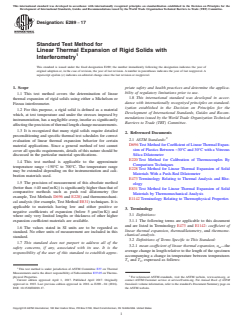
4.1 A specimen of known geometry can be given polished reflective ends or placed between two flat reflecting surfaces
(mirrors). Typical configurations, as shown in Fig. 1, are a cylindrical tube or a rod with hemispherical or flat parallel ends or
E289 − 17
FIG. 1 Typical Specimen Configurations (a) Michelson Type, (b–d) Fizeau Type
machined to provide a 3-point support. The mirrors consist of flat-uniform thickness pieces of silica or sapphire with the surfaces
partially coated with gold or other high reflectance metal. Light, either parallel laser beam (Michelson, see Fig. 2 and Fig. 3) or
from a point monochromatic source (Fizeau, see Fig. 4) illuminates each surface simultaneously to produce a fringe pattern. As
the specimen is heated or cooled, expansion or contraction of the specimen causes a change in the fringe pattern due to the optical
pathlength difference between the reflecting surfaces. This change is detected and converted into length change from which the
expansion and expansion coefficient can be determined (1-5).
5. Significance and Use
5.1 Coefficients of linear expansion are required for design purposes and are used particularly to determine thermal stresses that
can occur when a solid artifact composed of different materials may fail when it is subjected to a temperature excursion(s).
5.2 Many new composites are being produced that have very low thermal expansion coefficients for use in applications where
very precise and critical alignment of components is necessary. Push rod dilatometry such as Test Methods D696, and E228, and
TMA thermomechanical analysis methods such as Test MethodsMethod E831 are not sufficiently precise for reliable measurements
either on such material and systems, or on very short specimens of materials having higher coefficients.
5.3 The precision of the absolute method allows for its use to:
5.3.1 Measure very small changes in length;
5.3.2 Develop reference materials and transfer standards for calibration of other less precise techniques;
5.3.3 Measure and compare precisely the differences in coefficient of “matched” materials.
The boldface numbers in parentheses refer to a list of references at the end of this standard.
FIG. 2 (a) Principle of the Single Pass Michelson Interferometer, (b) Typical Single Pass System
E289 − 17
FIG. 3 Typical Double Pass Michelson Interferometer System
FIG. 4 Principle of the Fizeau Interferometer
5.4 The precise measurement of thermal expansion involves two parameters; change of length and change of temperature. Since
precise measurements of the first parameter can be made by this test method, it is essential that great attention is also paid to the
second, in order to ensure that calculated expansion coefficients are based on the required temperature difference. Thus in order
to ensure the necessary uniformity in temperature of the specimen, it is essential that the uniform temperature zone of the
surrounding furnace or environmental chamber shall be made significantly longer than the combined length of specimen and
mirrors.
5.5 This test method contains essential details of the design principles, specimen configurations, and procedures to provide
precise values of thermal expansion. It is not practical in a method of this type to try to establish specific details of design,
construction, and procedures to cover all contingencies that might present difficulties to a person not having the technical
knowledge relating to the thermal measurements and general testing practice. Standardization of the method is not intended to
restrict in any way further development of improved methodology.
5.6 The test method can be used for research, development, specification acceptance and quality control and assurance.
E289 − 17
6. Interferences
6.1 Measurements should normally be undertaken with the specimen in vacuum or in helium at a low gas pressure in order to
off-set optical drifts resulting from instabilities of the refractive index of air or other gases at normal pressures. However, due to
the reduced heat transfer coefficient from the surrounding environment, measurement in vacuum or low pressure can make actual
specimen temperature measurement more difficult. Additional care and longer equilibrium time to ensure that the specimen is at
a uniform temperature are necessary.
6.2 If vitreous silica flats are used, continuous heating to high temperatures may cause them to distort and become cloudy
resulting in poor fringe definition.
7. Apparatus
7.1 Interferometer, Michelson Type:
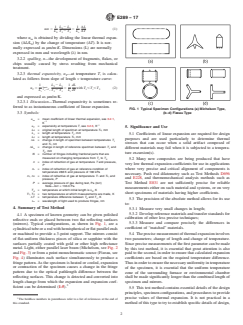
7.1.1 The principle of the single pass absolute system is shown in Fig. 2a. A parallel light beam usually generated from a laser
through a beam expander is split by a beam splitter B. The resulting beams are reflected by mirrors M and M and recombined
1 2
on B. If M' is inclined slightly over the light-beam its mirror image M' forms a small angle with M producing fringes of equal
2 2 1
thickness located on the virtual face M' .
7.1.2 One example of a single contact type is shown in Fig. 2b. A prism or a polished very flat faced cylindrical specimen is
placed on one mirror with one face also offered to the incident light. An interference pattern is generated and this is divided into
two fields corresponding to each end of the specimen. The lens, L, projects the image of the fringes onto a plane where two
detectors are placed one on the specimen and the other on the baseplate fields. As the specimen is heated or cooled, both the
specimen and support change of lengths cause the surface S and M to move relative to M at different rates. The difference in
2 1
the fringe count provides a measure of the net absolute expansion.
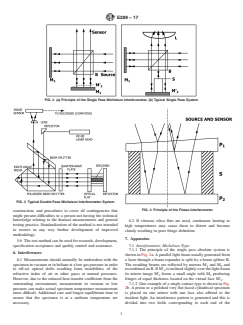
7.1.3 The principle of the double pass system is essentially similar to the single pass with three important distinctions. The
specimen can be a relatively simple cylinder with hemispherical or flat ends and requiring less precise machining, the interfering
beams are reflected twice from each face to the specimen thus giving twice the sensitivity of the single pass, and no reference arm
is required. One example of the double pass form is shown in Fig. 3.
7.1.4 It is common practice to use polarized laser light and quarter wave plates to generate circularly polarized light. In this way
detectors combined with appropriate analyzers generate signals either with information on fringe number, fraction and motion
sense for each beam or linear array data of light intensity, which indicate the profile of the instantaneous whole fringe pattern. The
array data provides complete information (position of fringe and distance between fringes) to determine the absolute length change
of the specimen depending upon the system. These signals are normally processed electronically.
7.2 Fizeau Type:
7.2.1 This type is available in both absolute and comparative versions.
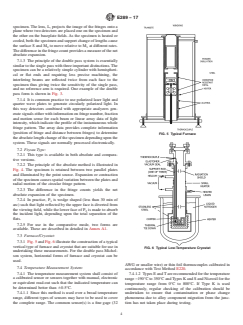
7.2.2 The principle of the absolute method is illustrated in Fig. 4. The specimen is retained between two parallel plates and
illuminated by the point source. Expansion or contraction of the specimen causes spatial variation between the plates and radial
motion of the circular fringe pattern.
7.2.3 The difference in the fringe counts yields the net absolute expansion of the specimen.
7.2.4 In practice, P is wedge shaped (less than 30 min of arc) such that light reflected by the upper face is diverted from the
is made to absorb the incident light, depending upon the total separation of the flats.
viewing field, while the lower face of P
7.2.5 For use in the comparative mode, two forms are available. These are described in detailed in Annex A1.
7.3 Furnace/Cryostat:
7.3.1 Fig. 5 and Fig. 6 illustrate the construction of a typical vertical type of furnace and cryostat that are suitable for use in
undertaking these measurements. For the double pass Michelson system, horizontal forms of furnace and cryostat can be used.
E289 − 17
FIG. 5 Typical Furnace
FIG. 6 Typical Low-Temperature Cryostat
7.4 Temperature Measurement System:
7.4.1 The temperature measurement system shall consist of a calibrated sensor or sensors together with manual, electronic or
equivalent read-out such that the indicated temperature can be determined better than 60.5°C.
7.4.1.1 Since this method is used over a broad temperature range, different types of sensors may have to be used to cover the
complete range. The common sensor(s) is a fine gage (32 AWG or smaller wire) or thin foil thermocouples calibrated in accordance
with Test Method E220.
7.4.1.2 Types E and T are recommended for the temperature range −190−190°C to 350°C and Types K and S and Nicrosil for
the temperature range from 00°C to 800°C. If Type K is used continuously, regular checking of the calibration should be
undertaken to ensure that contamination or phase change phenomena due to alloy component migration from the junction has not
taken place during testing.
E289 − 17
7.4.1.3 In all cases where thermocouples are used they shall be referenced to 0°C by means of an ice water bath or equivalent
electronic reference system, insulated from the effects of temperature variations in the immediate surrounding ambient.
7.4.1.4 For temperatures below −190°C a calibrated carbon or germanium resistance thermometer is used.
7.5 A measurement instrument such as an index micrometer or calipers capable of reading to 0.01 mm in order to determine
the initial and final lengths of the test specimen (and other relevant components where required, see Section 8.1) and adjusting the
specimen length originally to obtain fringes.
8. Test Specimen
8.1 The specimen shall be selected from a sample in accordance with the sampling requirements of the appropriate materials
standard. If possible, it may be fabricated in one of the forms shown. For the Michelson interferometer, the form with rounded ends
shown in Fig. 1(a) gives point contact. For flat panels, mirrors may be attached as described in Ref (6). Configurations 1b–1d are
those based on 3-point support that is most appropriate for the Fizeau interferometer. The legs must be ground flat such that they
are all of the same length as measured by the micrometer.
NOTE 1—Conditioning of specimens is often necessary before reproducible expansion data can be obtained. For example, heat treatments are frequently
necessary to eliminate certain effects (strain, moisture, and the like), which may introduce length changes not associated with thermal expansion.
8.1.1 Where possible, the specimen length should be at least 5 mm, but short enough to allow for temperature uniformity of
the specimen. For Michelson interferometry, the sample length is limited by the coherence length of the light source. Some light
sources have considerably larger coherence length, for example, The optimal length is between 10 mm and 20 mm. For the double
pass type where a cylindrical specimen is used the radius of curvature of the hemispherical ends should be 3 mm or less and the
diameter uniform to 61 m rad.mrad.
8.1.2 Where only shorter specimens are available such as sheet and foil materials, the double pass Michelson interferometer can
be used by including two equal thickness quartz glass pieces each with a rounded end and optically flat surface (see 7.1). The pieces
should be of an appropriate thickness such that the total thickness of a sandwich of the test flat specimen and quartz pieces is within
the optimal range.
8.2 Where only thinner or shorter specimens are available, when testing materials that exhibit different properties in different
directions, special care must be taken when preparing the pin or pyramidal type specimens to ensure that all three have the same
angle between their axes and the principal axis of anisotropy.
9. Verification
9.1 The Michelson and Fizeau interferometers determine
...