

ASTM D7900-23
(Test Method)Standard Test Method for Determination of Light Hydrocarbons in Stabilized Crude Oils by Gas Chromatography
General Information
- Abstract
SIGNIFICANCE AND USE
5.1 Knowledge of the boiling point distribution of stabilized crude oils is important for the marketing, scheduling, and processing of crude oil in the petroleum industry. Test Method D7169 and IP 545 purport to give such a distribution in crude oils, but are susceptible to significant errors in the light ends portion of the distribution as well as in the mass recovery of the whole crude oil due to the interference imposed by the diluent solvent. This test method allows for more accurate determination of the front end of the boiling point distribution curve, in addition to providing important C1 to C9 (nonane) component level information, and more accurate mass recovery at C9 (nonane).
SCOPE
1.1 This test method specifies a method to determine the boiling range distribution of hydrocarbons in stabilized crude oil up to and including n-nonane. A stabilized crude oil is defined as having a Reid Vapor Pressure equivalent to or less than 82.7 kPa. The results of this test method can be combined with those from Test Method D7169 and IP 545 to give a full boiling point distribution of a crude oil (see Appendix X3).
1.2 The values stated in SI units are to be regarded as the standard. The values given in parentheses are provided for information purposes only.
1.3 This standard does not purport to address all of the safety concerns, if any, associated with its use. It is the responsibility of the user of this standard to establish appropriate safety, health, and environmental practices and determine the applicability of regulatory limitations prior to use.
1.4 This international standard was developed in accordance with internationally recognized principles on standardization established in the Decision on Principles for the Development of International Standards, Guides and Recommendations issued by the World Trade Organization Technical Barriers to Trade (TBT) Committee.
- Status
- Published
- Publication Date
- 28-Feb-2023
- Technical Committee
- D02 - Petroleum Products, Liquid Fuels, and Lubricants
- Drafting Committee
- D02.04.0L - Gas Chromatography Methods
Buy Documents
ASTM D7900-23 - Standard Test Method for Determination of Light Hydrocarbons in Stabilized Crude Oils by Gas Chromatography
REDLINE ASTM D7900-23 - Standard Test Method for Determination of Light Hydrocarbons in Stabilized Crude Oils by Gas Chromatography
Overview
ASTM D7900-23 provides a standardized method for the determination of light hydrocarbons (up to and including n-nonane, C9) in stabilized crude oils using gas chromatography. Developed by ASTM International, this test method is essential for accurately characterizing the front-end of the boiling point distribution of stabilized crude oils, which have a Reid Vapor Pressure (RVP) equal to or less than 82.7 kPa. By delivering precise component-level analysis of C1 to C9 hydrocarbons and enhancing mass recovery at the C9 mark, ASTM D7900-23 addresses known limitations of related techniques, especially in the light end region, and complements broader boiling range distribution methods.
Key Topics
- Scope of Analysis: Targets light hydrocarbons (methane to nonane) in stabilized crude oils.
- Stabilized Crude Oils: Applies to samples with RVP ≤ 82.7 kPa, considered safe, transportable, and suitable for further processing.
- Analytical Method: Employs gas chromatography with internal standards and a specialized column configuration, minimizing errors from co-eluting solvents.
- Integration with Other Methods: Results from ASTM D7900-23 can be merged with those from ASTM D7169 or IP 545 to give a comprehensive boiling point profile of crude oils.
- Accuracy and Precision: Designed for improved accuracy in determining light end hydrocarbons, mass recovery, and distribution curve, reducing biases seen in other test methods due to solvent interference.
Applications
The method outlined in ASTM D7900-23 is widely used in the petroleum industry for:
- Crude Oil Characterization: Provides detailed boiling range distributions critical for marketing, scheduling, allocation, and refining of crude oil.
- Operational Planning: Supports refinery and process engineering decisions by delivering reliable front-end hydrocarbon profiles.
- Quality Control: Enables producers and traders to confirm product consistency and regulatory compliance regarding volatile organic content.
- Merging Data: Complementary use with ASTM D7169 or IP 545 results produces a full-range boiling point distribution, ensuring comprehensive quality and commercial evaluations.
- Research and Development: Facilitates advanced investigations and product development in fuel formulation and petrochemical sectors.
Related Standards
Several other ASTM and international standards are referenced or commonly used in conjunction with ASTM D7900-23, including:
- ASTM D7169: Boiling point distribution of crude oils and residues by high temperature gas chromatography.
- IP 545: Boiling range distribution of crude oil-an Energy Institute standard.
- ASTM D323: Measurement of vapor pressure of petroleum products.
- ASTM D4057 and D4177: Manual and automatic sampling methodologies for petroleum products.
- ASTM D5134, D6729, D6730, D6733: Test methods for detailed hydrocarbon component analysis in petroleum and engine fuels.
- ISO 4259: Guidance on determination and application of precision data in relation to test methods for petroleum products.
Practical Value
Adopting ASTM D7900-23 ensures more reliable and accurate analysis of light hydrocarbon content in stabilized crude oils. This enables precise front-end boiling point distribution determination, essential for aligning refinery feed and marketing specifications. By directly addressing known deficiencies in light end recovery from legacy methods, ASTM D7900-23 enhances capability in risk management, operational planning, and commercial negotiations involving crude oil quality.
Keywords: ASTM D7900, light hydrocarbons, stabilized crude oil, gas chromatography, boiling point distribution, C1 to C9 hydrocarbons, petroleum analysis, front-end profile, refinery feedstock, quality control.
Relations
- Refers
ASTM D4175-23a - Standard Terminology Relating to Petroleum Products, Liquid Fuels, and Lubricants - Effective Date
- 15-Dec-2023
- Refers
ASTM D4175-23e1 - Standard Terminology Relating to Petroleum Products, Liquid Fuels, and Lubricants - Effective Date
- 01-Jul-2023
- Effective Date
- 01-Apr-2015
- Refers
ASTM D4057-06(2011) - Standard Practice for Manual Sampling of Petroleum and Petroleum Products - Effective Date
- 01-Jun-2011
- Effective Date
- 01-May-2011
- Effective Date
- 15-Apr-2009
- Effective Date
- 01-May-2008
- Effective Date
- 01-Mar-2007
- Effective Date
- 01-Nov-2006
- Effective Date
- 01-Nov-2006
- Effective Date
- 01-Aug-2006
- Effective Date
- 01-Jul-2005
- Effective Date
- 01-Nov-2004
- Effective Date
- 01-Nov-2004
- Effective Date
- 10-May-2003
Buy Documents
ASTM D7900-23 - Standard Test Method for Determination of Light Hydrocarbons in Stabilized Crude Oils by Gas Chromatography
REDLINE ASTM D7900-23 - Standard Test Method for Determination of Light Hydrocarbons in Stabilized Crude Oils by Gas Chromatography
Get Certified
Connect with accredited certification bodies for this standard

Element Materials Technology
Materials testing and product certification.

ABS Group Brazil
ABS Group certification services in Brazil.

ABS Quality Evaluations Inc.
American Bureau of Shipping quality certification.
Sponsored listings
Frequently Asked Questions
ASTM D7900-23 is a standard published by ASTM International. Its full title is "Standard Test Method for Determination of Light Hydrocarbons in Stabilized Crude Oils by Gas Chromatography". This standard covers: SIGNIFICANCE AND USE 5.1 Knowledge of the boiling point distribution of stabilized crude oils is important for the marketing, scheduling, and processing of crude oil in the petroleum industry. Test Method D7169 and IP 545 purport to give such a distribution in crude oils, but are susceptible to significant errors in the light ends portion of the distribution as well as in the mass recovery of the whole crude oil due to the interference imposed by the diluent solvent. This test method allows for more accurate determination of the front end of the boiling point distribution curve, in addition to providing important C1 to C9 (nonane) component level information, and more accurate mass recovery at C9 (nonane). SCOPE 1.1 This test method specifies a method to determine the boiling range distribution of hydrocarbons in stabilized crude oil up to and including n-nonane. A stabilized crude oil is defined as having a Reid Vapor Pressure equivalent to or less than 82.7 kPa. The results of this test method can be combined with those from Test Method D7169 and IP 545 to give a full boiling point distribution of a crude oil (see Appendix X3). 1.2 The values stated in SI units are to be regarded as the standard. The values given in parentheses are provided for information purposes only. 1.3 This standard does not purport to address all of the safety concerns, if any, associated with its use. It is the responsibility of the user of this standard to establish appropriate safety, health, and environmental practices and determine the applicability of regulatory limitations prior to use. 1.4 This international standard was developed in accordance with internationally recognized principles on standardization established in the Decision on Principles for the Development of International Standards, Guides and Recommendations issued by the World Trade Organization Technical Barriers to Trade (TBT) Committee.
SIGNIFICANCE AND USE 5.1 Knowledge of the boiling point distribution of stabilized crude oils is important for the marketing, scheduling, and processing of crude oil in the petroleum industry. Test Method D7169 and IP 545 purport to give such a distribution in crude oils, but are susceptible to significant errors in the light ends portion of the distribution as well as in the mass recovery of the whole crude oil due to the interference imposed by the diluent solvent. This test method allows for more accurate determination of the front end of the boiling point distribution curve, in addition to providing important C1 to C9 (nonane) component level information, and more accurate mass recovery at C9 (nonane). SCOPE 1.1 This test method specifies a method to determine the boiling range distribution of hydrocarbons in stabilized crude oil up to and including n-nonane. A stabilized crude oil is defined as having a Reid Vapor Pressure equivalent to or less than 82.7 kPa. The results of this test method can be combined with those from Test Method D7169 and IP 545 to give a full boiling point distribution of a crude oil (see Appendix X3). 1.2 The values stated in SI units are to be regarded as the standard. The values given in parentheses are provided for information purposes only. 1.3 This standard does not purport to address all of the safety concerns, if any, associated with its use. It is the responsibility of the user of this standard to establish appropriate safety, health, and environmental practices and determine the applicability of regulatory limitations prior to use. 1.4 This international standard was developed in accordance with internationally recognized principles on standardization established in the Decision on Principles for the Development of International Standards, Guides and Recommendations issued by the World Trade Organization Technical Barriers to Trade (TBT) Committee.
ASTM D7900-23 is classified under the following ICS (International Classification for Standards) categories: 75.080 - Petroleum products in general. The ICS classification helps identify the subject area and facilitates finding related standards.
ASTM D7900-23 has the following relationships with other standards: It is inter standard links to ASTM D4175-23a, ASTM D4175-23e1, ASTM D323-15, ASTM D4057-06(2011), ASTM D6730-01(2011), ASTM D6729-04(2009), ASTM D5134-98(2008)e1, ASTM E355-96(2007), ASTM D6730-01(2006), ASTM D6733-01(2006), ASTM D323-06, ASTM D7169-05, ASTM D6729-04e1, ASTM D6729-04, ASTM D5134-98(2003). Understanding these relationships helps ensure you are using the most current and applicable version of the standard.
ASTM D7900-23 is available in PDF format for immediate download after purchase. The document can be added to your cart and obtained through the secure checkout process. Digital delivery ensures instant access to the complete standard document.
Standards Content (Sample)
This international standard was developed in accordance with internationally recognized principles on standardization established in the Decision on Principles for the
Development of International Standards, Guides and Recommendations issued by the World Trade Organization Technical Barriers to Trade (TBT) Committee.
Designation: D7900 − 23
Standard Test Method for
Determination of Light Hydrocarbons in Stabilized Crude
Oils by Gas Chromatography
This standard is issued under the fixed designation D7900; the number immediately following the designation indicates the year of
original adoption or, in the case of revision, the year of last revision. A number in parentheses indicates the year of last reapproval. A
superscript epsilon (´) indicates an editorial change since the last revision or reapproval.
1. Scope* D5134 Test Method for Detailed Analysis of Petroleum
Naphthas through n-Nonane by Capillary Gas Chroma-
1.1 This test method specifies a method to determine the
tography
boiling range distribution of hydrocarbons in stabilized crude
D6729 Test Method for Determination of Individual Com-
oil up to and including n-nonane. A stabilized crude oil is
ponents in Spark Ignition Engine Fuels by 100 Metre
defined as having a Reid Vapor Pressure equivalent to or less
Capillary High Resolution Gas Chromatography
than 82.7 kPa. The results of this test method can be combined
D6730 Test Method for Determination of Individual Com-
with those from Test Method D7169 and IP 545 to give a full
ponents in Spark Ignition Engine Fuels by 100-Metre
boiling point distribution of a crude oil (see Appendix X3).
Capillary (with Precolumn) High-Resolution Gas Chro-
1.2 The values stated in SI units are to be regarded as the
matography
standard. The values given in parentheses are provided for
D6733 Test Method for Determination of Individual Com-
information purposes only.
ponents in Spark Ignition Engine Fuels by 50-Metre
1.3 This standard does not purport to address all of the
Capillary High Resolution Gas Chromatography
safety concerns, if any, associated with its use. It is the D7169 Test Method for Boiling Point Distribution of
responsibility of the user of this standard to establish appro-
Samples with Residues Such as Crude Oils and Atmo-
priate safety, health, and environmental practices and deter- spheric and Vacuum Residues by High Temperature Gas
mine the applicability of regulatory limitations prior to use.
Chromatography
1.4 This international standard was developed in accor- E355 Practice for Gas Chromatography Terms and Relation-
dance with internationally recognized principles on standard-
ships
ization established in the Decision on Principles for the 2.2 Energy Institute Standards:
Development of International Standards, Guides and Recom-
IP 475 Manual Sampling
mendations issued by the World Trade Organization Technical
IP 476 Automatic Pipeline Sampling
Barriers to Trade (TBT) Committee.
IP 545 Crude Petroleum and Petroleum Products—
Determination of Boiling Range Distribution of Crude Oil
2. Referenced Documents
2.3 ISO Standard:
2.1 ASTM Standards:
ISO 4259 Petroleum Products—Determination and Applica-
D323 Test Method for Vapor Pressure of Petroleum Products
tion of Precision Data in Relation to Methods of Test
(Reid Method)
3. Terminology
D4057 Practice for Manual Sampling of Petroleum and
Petroleum Products
3.1 Definitions—This test method makes reference to many
D4175 Terminology Relating to Petroleum Products, Liquid
common petroleum and gas chromatographic procedures terms
Fuels, and Lubricants
and relationships. Detailed definitions can be found in Termi-
D4177 Practice for Automatic Sampling of Petroleum and
nology D4175 and Practice E355.
Petroleum Products
4. Summary of Test Method
This test method is under the jurisdiction of ASTM Committee D02 on
4.1 An amount of internal standard is quantitatively added
Petroleum Products, Liquid Fuels, and Lubricants and is the direct responsibility of
to an aliquot of the stabilized crude oil. A portion of this
Subcommittee D02.04.0L on Gas Chromatography Methods.
mixture is injected into a pre-column in series via a splitter
Current edition approved March 1, 2023. Published September 2023. Originally
ε1
approved in 2013. Last previous edition approved in 2018 as D7900 – 18 . DOI:
10.1520/D7900-23.
2 3
For referenced ASTM standards, visit the ASTM website, www.astm.org, or Information on Energy Institute Standards can be obtained from the Energy
contact ASTM Customer Service at service@astm.org. For Annual Book of ASTM Institute at www.energyinst.org.
Standards volume information, refer to the standard’s Document Summary page on Available from American National Standards Institute (ANSI), 25 W. 43rd St.,
the ASTM website. 4th Floor, New York, NY 10036, http://www.ansi.org.
*A Summary of Changes section appears at the end of this standard
Copyright © ASTM International, 100 Barr Harbor Drive, PO Box C700, West Conshohocken, PA 19428-2959. United States
D7900 − 23
TABLE 1 Typical Chromatographic Conditions
Pre-column Pre-column Analytical Accelerated
A B Analytical
Column Length—metres 1.0 m 0.075 m 50 or 100 m 40 m
Column Internal Diameter—mm 2 mm 2.5 mm 0.25 mm 0.10 mm
A
Phase Loading 5 % 10 % OV-101 on Chromosorb
80-100 mesh
Film Thickness 0.5 um
Injection Volume 0.1 μL 0.1 μL
Injector Split Ratio 100 : 1 600 : 1
Injector Temperature 300 °C 100 °C
Pre-column Temperature 200 °C 100 °C
Injector Prog. Rate °C/min 50 °C ⁄min
Final Injector Temperature 300 °C
Initial Oven Temperature 35 °C 35 °C
Hold Time 30 min 2.6 min
Oven Program Rate °C/min 2 °C ⁄min 50 °C ⁄min → 45 °C
(hold time 3 min)
5 °C ⁄min → 60 °C
(hold time 3 min)
9.5 °C ⁄min →
Final Oven Temperature 200 °C (hold time 20 min) 200 °C (hold time 1 min)
Flame Ionization Detector 300 °C 300 °C
A
Phase type not reported except as indicated, assumed non-polar.
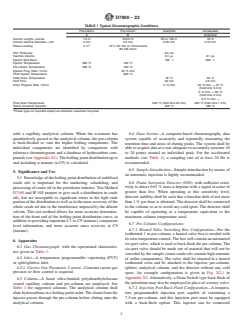
with a capillary analytical column. When the n-nonane has 6.4 Data System—A computer-based chromatography data
quantitatively passed to the analytical column, the pre-column system capable of accurately and repeatedly measuring the
is back-flushed to vent the higher boiling components. The retention time and areas of eluting peaks. The system shall be
individual components are identified by comparison with able to acquire data at a rate adequate to accurately measure 10
reference chromatograms and a database of hydrocarbon com-
to 20 points around an individual peak. For the accelerated
pounds (see Appendix X1). The boiling point distribution up to
methods (see Table 1), a sampling rate of at least 20 Hz is
and including n-nonane (n-C9) is calculated.
recommended.
6.5 Sample Introduction—Sample introduction by means of
5. Significance and Use
an automatic injection is highly recommended.
5.1 Knowledge of the boiling point distribution of stabilized
6.6 Flame Ionization Detector (FID), with sufficient sensi-
crude oils is important for the marketing, scheduling, and
tivity to detect 0.01 % mass n-heptane with a signal to noise of
processing of crude oil in the petroleum industry. Test Method
greater than five. When operating at this sensitivity level,
D7169 and IP 545 purport to give such a distribution in crude
detector stability shall be such that a baseline drift of not more
oils, but are susceptible to significant errors in the light ends
than 1 % per hour is obtained. The detector shall be connected
portion of the distribution as well as in the mass recovery of the
to the column so as to avoid any cold spots. The detector shall
whole crude oil due to the interference imposed by the diluent
be capable of operating at a temperature equivalent to the
solvent. This test method allows for more accurate determina-
tion of the front end of the boiling point distribution curve, in maximum column temperature used.
addition to providing important C1 to C9 (nonane) component
6.7 Pre-Column Configurations:
level information, and more accurate mass recovery at C9
6.7.1 Heated Valve Switching Box Configuration—For the
(nonane).
isothermal 1 m pre-column, a heated valve box is needed with
its own temperature control. The box will contain an automated
6. Apparatus
six-port valve, which is used to back-flush the pre-column. The
6.1 Gas Chromatograph, with the operational characteris-
six-port valve should be made out of material that will not be
tics given in Table 1.
corroded by the sample (some crude oils contain high amounts
6.2 Inlet—A temperature programmable vaporizing (PVT)
of sulfur components). The valve shall be situated in a heated
or split/splitless inlet.
isothermal oven and be attached to the injector, pre-column,
6.2.1 Carrier Gas Pneumatic Control—Constant carrier gas
splitter, analytical column, and the detector without any cold
pressure or flow control is required.
spots. An example configuration is given in Fig. X2.1 in
Appendix X2. Alternatively, a Dean Switch type back-flush of
6.3 Column—A fused silica-bonded polydimethylsiloxane
the petroleum may also be employed in place of a rotary valve.
coated capillary column and pre-column are employed. See
6.7.2 Injection Port Back-Flush Configuration—A tempera-
Table 1 for suggested columns. The analytical column shall
elute hydrocarbons in a boiling point order. The eluate from the ture programmable injection port capable of containing a
injector passes through the pre-column before eluting onto the 7.5 cm pre-column, and this injection port must be equipped
analytical column. with a back-flush option. This injector can be connected
D7900 − 23
directly to the capillary column (Fig. X2.2, Appendix X2) or
via a splitter (Fig. X2.3, Appendix X2).
6.8 Analytical Balance, capable of weighing with an accu-
racy of 0.1 mg.
7. Reagents and Materials
7.1 Gas Chromatograph Gases—All of the following gases
shall have a purity of 99.995 % (V ⁄V) or greater. (Warning—
Gases are compressed. Some are flammable, and all gases are
under high pressure.)
NOTE 1—These specifications can be obtained by proper use of filtering
devices and meeting the FID specifications in 6.6.
7.1.1 Carrier Gas—Helium or hydrogen is required. Any
oxygen present shall be removed, for example, by a suitable
chemical filter. If hydrogen is employed as a carrier gas, the
user is advised to follow all manufacturer’s safety guidelines
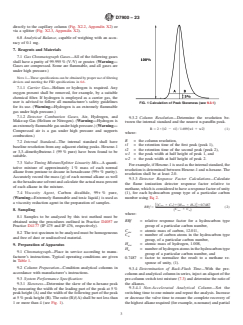
FIG. 1 Calculation of Peak Skewness (see 9.3.1)
for its use. (Warning—Hydrogen is an extremely flammable
gas under high pressure.)
7.1.2 Detector Combustion Gases, Air, Hydrogen, and
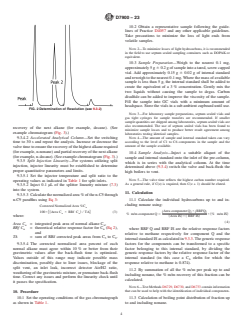
9.3.2 Column Resolution—Determine the resolution be-
Make-up Gas (Helium or Nitrogen). (Warning—Hydrogen is
tween the internal standard and the nearest n-paraffin peak.
an extremely flammable gas under high pressure.) (Warning—
R 5 2 × ~t2 2 t1! ⁄ 1.699~w1 1 w2! (1)
Compressed air is a gas under high pressure and supports
where:
combustion.)
R = the column resolution,
7.2 Internal Standard—The internal standard shall have
t1 = the retention time of the first peak (peak 1),
baseline resolution from any adjacent eluting peaks. Hexene-1
t2 = the retention time of the second peak (peak 2),
or 3,3–dimethylbutene-1 (99 % pure) have been found to be
w1 = the peak width at half height of peak 1, and
suitable.
w2 = the peak width at half height of peak 2.
7.3 Valve Timing Mixture/Splitter Linearity Mix—A quanti-
For example, if Hexene-1 is used as the internal standard, the
tative mixture of approximately 1 % mass of each normal
resolution is determined between Hexene-1 and n-hexane. The
alkane from pentane to decane in hexadecane (99+ % purity).
resolution shall be at least 2.0.
Accurately record the mass (g) of each normal alkane as well
9.3.3 Detector Response Factor Calculations—Calculate
as the hexadecane solvent and calculate the actual mass percent
the flame ionization detector response factor relative to
of each alkane in the mixture.
methane, which is considered to have a response factor of unity
7.4 Viscosity Agent, Carbon disulfide, 99+ % pure, (1), for each hydrocarbon group type of a particular carbon
(Warning—Extremely flammable and toxic liquid.) is used as
number using Eq 2.
a viscosity reduction agent in the preparation of samples.
@~C × C !1~H × H !# × 0.7487
aw n aw n
RRf 5 (2)
~C × C !
8. Sampling aw n
where:
8.1 Samples to be analyzed by this test method must be
obtained using the procedures outlined in Practice D4057 or RRf = relative response factor for a hydrocarbon type
Practice D4177 (IP 475 and IP 476, respectively). group of a particular carbon number,
C = atomic mass of carbon, 12.011,
aw
8.2 The test specimen to be analyzed must be homogeneous
C = number of carbon atoms in the hydrocarbon type
n
and free of dust or undissolved material.
group, of a particular carbon number,
H = atomic mass of hydrogen, 1.008,
9. Preparation of Apparatus aw
H = number of hydrogen atoms in the hydrocarbon type
n
9.1 Chromatograph—Place in service according to manu-
group of a particular carbon number, and
facturer’s instructions. Typical operating conditions are given
0.7487 = factor to normalize the result to a methane re-
in Table 1.
sponse of unity, (1).
9.2 Column Preparation—Condition analytical columns in
9.3.4 Determination of Back-Flush Time—With the pre-
accordance with manufacturer’s instructions.
column and analytical column in series, inject an aliquot of the
9.3 System Performance Specification: pre-column switch test mixture (7.3) and determine the ratio of
9.3.1 Skewness—Determine the skew of the n-hexane peak the alkanes.
by measuring the width of the leading part of the peak at 5 % 9.3.4.1 Non-Accelerated Analytical Column—Set the
peak height (A) and the width of the following part of the peak switching time to one minute and repeat the analysis. Increase
at 5 % peak height (B). The ratio (B)/(A) shall be not less than or decrease the valve time to ensure the complete recovery of
1 or more than 4 (see Fig. 1). the highest alkane required (for example, n-nonane) and partial
D7900 − 23
10.2 Obtain a representative sample following the guide-
lines of Practice D4057 and any other applicable guidelines.
Take precautions to minimize the loss of light ends from
volatile samples.
NOTE 2—To minimize losses of light hydrocarbons, it is recommended
in the field to use septum sealed sampling containers such as DOPAK or
equivalent.
10.3 Sample Preparation—Weigh to the nearest 0.1 mg,
approximately 5 g 6 0.2 g of sample into a tared, screw capped
vial. Add approximately 0.15 g 6 0.02 g of internal standard
and reweigh to the nearest 0.1 mg. Where the mass of available
sample is less than 5 g, the internal standard shall be added to
create the equivalent of a 3 % concentration. Gently mix the
two liquids without causing the sample to degas. Carbon
disulfide can be added to improve the viscosity of the sample.
Fill the sample into GC vials with a minimum amount of
headspace. Store the vials in a sub ambient cupboard until use.
FIG. 2 Determination of Resolution (see 9.3.2)
NOTE 3—For laboratory sample preparations, septum sealed vials and
gas tight syringes for sample transfers are recommended. If smaller
sample quantities are shipped among laboratories, septum sealed vials are
also recommended. The use of septum sealed vials has been found to
recovery of the next alkane (for example, decane). (See
minimize sample losses and to produce better result agreement among
example chromatogram (Fig. 3).)
laboratories testing identical samples.
9.3.4.2 Accelerated Analytical Column—Set the switching
NOTE 4—The amount of sample and internal standard taken can vary
time to 30 s and repeat the analysis. Increase or decrease the according to the level of C1 to C6 components in the sample and the
amount of the sample available.
valve time to ensure the recovery of the highest alkane required
(for example, n-nonane) and partial recovery of the next alkane
10.4 Sample Analysis—Inject a suitable aliquot of the
(for example, n-decane). (See example chromatogram (Fig. 3).)
sample and internal standard onto the inlet of the pre-column,
9.3.5 Split Injection Linearity—For systems utilizing split
which is in series with the analytical column. At the time
injection, injector linearity must be established to determine
determined above (9.3.4) switch the valve and back-flush the
proper quantitative parameters and limits.
high boilers to vent.
9.3.5.1 Set the injector temperature and split ratio to the
NOTE 5—The valve time reflects the highest carbon number required.
operating values as indicated in Table 1 for split inlets.
As a general rule, if C(z) is required, then C(z + 1) should be eluted.
9.3.5.2 Inject 0.1 μL of the splitter linearity mixture (7.3)
into the system.
11. Calculation
9.3.5.3 Calculate the normalized area % of the n-C5 through
n-C9 paraffins using Eq 3:
11.1 Calculate the individual hydrocarbons up to and in-
cluding nonane using:
Corrected Normalized Area %C
n
Area component Q × RRFQ
100 × @ Area C × RRf C ⁄ TA# (3) ~ ! ~ !
~ !
n n
% m/m component Q 5 × % m⁄m IS
~ !
where:
~Area IS! × ~ RRF IS!
(4)
Area C = integrated peak area of normal alkane C ,
n n
RRf C = theoretical relative response factor for C (Eq 2),
n n
where RRF Q and RRF IS are the relative response factors
and
relative to methane respectively for component Q and the
TA = sum of RRf corrected peak areas from C to C .
5 9
internal standard IS as calculated in 9.3.3. The generic response
factors for the components can be transformed to a specific
9.3.5.4 The corrected normalized area percent of each
normal alkane must agree within 10 % or better from their factor belonging to this internal standard, by dividing the
generic response factors by the relative response factor of the
gravimetric values after the back-flush time is optimized.
Values outside of this range may indicate possible mass internal standard (in this case a C olefin for which the
discrimination, possibly due to liner issues, blockage of the response relative to methane is 0.874).
split vent, an inlet leak, incorrect detector Air/H2 ratio,
11.2 By summation of all the % m/m per peak up to and
weathering of the gravimetric mixture, or premature back-flush
including nonane, the % m/m recovery of this fraction can be
time. Correct any issues and perform the linearity check until
calculated.
it passes the specification.
NOTE 6—Test Methods D6729, D6730, and D6733 contain information
that can be used to help with the identification of individual components.
10. Procedure
10.1 Set the operating conditions of the gas chromatograph 11.3 Calculation of boiling point distribution of fraction up
as shown in Table 1. to and including nonane.
D7900 − 23
FIG. 3 Example Chromatogram Showing Elution on n-Nonane and n-Decane for Determining Back-Flush Time (see 9.3.4)
11.4 Plot for all peaks (beginning with the lowest boiling procdures of ISO 4259. The recovery up to n-nonane results in
point) the cumulative % m/m versus the boiling point up to the this precision study ranged from 7.48 to 25.36 % m ⁄m.
last peak of interest, for example, n-nonane. See Test Method 13.1.1 Repeatability—The difference between successive
D7169 (IP 545) for merging of the results to give a full crude test results obtained by the same operator with the same
analysis. apparatus under constant operating conditions on identical test
material would, in the long run, in the normal and correct
12. Report operation of the test method, exceed the following values only
in one case in 20 (see Table 2).
12.1 Report the cumulative mass percent versus boiling
13.1.2 Reproducibility—The difference between two single
point results to the nearest 0.01 % m/m, and 0.5 °C (1 °F)
and independent results obtained by different operators work-
respectively, up to the last peak of interest, for example
ing in different laboratories on identical test material would, in
n-nonane.
the long run, exceed the following values only in one case in 20
(see Table 2).
13. Precision and Bias
NOTE 7—The degrees of freedom associated with the reproducibility
13.1 Precision—The precision of this test method was
determined by statistical evaluation of the interlaboratory test
results consisting of 14 labs (ten from Europe and four from the
Supporting data have been filed at the Energy Institute Headquarters and may
U.S.) analyzing eight crude oil samples in duplicate. The
be obtained by requesting EI Research Report for method IP PM DL: Determination
repeatability and reproducibility were calculated following the of Light Hydrocarbons in Stabilized Crude Oil—Gas Chromatography Method.
D7900 − 23
TABLE 2 Precision Values
13.2.1 A rigorous, theoretical definition of the boiling range
Recovery (% m/m) distribution of stabilized crude oils
...
This document is not an ASTM standard and is intended only to provide the user of an ASTM standard an indication of what changes have been made to the previous version. Because
it may not be technically possible to adequately depict all changes accurately, ASTM recommends that users consult prior editions as appropriate. In all cases only the current version
of the standard as published by ASTM is to be considered the official document.
´1
Designation: D7900 − 18 D7900 − 23
Designation: 601
Standard Test Method for
Determination of Light Hydrocarbons in Stabilized Crude
1,21
Oils by Gas Chromatography
This standard is issued under the fixed designation D7900; the number immediately following the designation indicates the year of
original adoption or, in the case of revision, the year of last revision. A number in parentheses indicates the year of last reapproval. A
superscript epsilon (´) indicates an editorial change since the last revision or reapproval.
ε NOTE—Subsection 1.1 was revised editorially in November 2018.
1. Scope*
1.1 This test method specifies a method to determine the boiling range distribution of hydrocarbons in stabilized crude oil up to
and including n-nonane. A stabilized crude oil is defined as having a Reid Vapor Pressure equivalent to or less than 82.7 kPa. The
results of this test method can be combined with those from Test Method D7169 and IP 545 to give a full boiling point distribution
of a crude oil (see Appendix X3).
1.2 The values stated in SI units are to be regarded as the standard. The values given in parentheses are provided for information
purposes only.
1.3 This standard does not purport to address all of the safety concerns, if any, associated with its use. It is the responsibility
of the user of this standard to establish appropriate safety, health, and environmental practices and determine the applicability of
regulatory limitations prior to use.
1.4 This international standard was developed in accordance with internationally recognized principles on standardization
established in the Decision on Principles for the Development of International Standards, Guides and Recommendations issued
by the World Trade Organization Technical Barriers to Trade (TBT) Committee.
2. Referenced Documents
2.1 ASTM Standards:
D323 Test Method for Vapor Pressure of Petroleum Products (Reid Method)
D4057 Practice for Manual Sampling of Petroleum and Petroleum Products
D4175 Terminology Relating to Petroleum Products, Liquid Fuels, and Lubricants
D4177 Practice for Automatic Sampling of Petroleum and Petroleum Products
D5134 Test Method for Detailed Analysis of Petroleum Naphthas through n-Nonane by Capillary Gas Chromatography
D6729 Test Method for Determination of Individual Components in Spark Ignition Engine Fuels by 100 Metre Capillary High
Resolution Gas Chromatography
D6730 Test Method for Determination of Individual Components in Spark Ignition Engine Fuels by 100-Metre Capillary (with
Precolumn) High-Resolution Gas Chromatography
This test method is under the jurisdiction of ASTM Committee D02 on Petroleum Products, Liquid Fuels, and Lubricants and is the direct responsibility of Subcommittee
D02.04.0L on Gas Chromatography Methods.
Current edition approved Oct. 1, 2018March 1, 2023. Published October 2018September 2023. Originally approved in 2013. Last previous edition approved in 20172018
ε1
as D7900 – 17.D7900 – 18 . DOI: 10.1520/D7900-18E01.10.1520/D7900-23.
For referenced ASTM standards, visit the ASTM website, www.astm.org, or contact ASTM Customer Service at service@astm.org. For Annual Book of ASTM Standards
volume information, refer to the standard’s Document Summary page on the ASTM website.
*A Summary of Changes section appears at the end of this standard
Copyright © ASTM International, 100 Barr Harbor Drive, PO Box C700, West Conshohocken, PA 19428-2959. United States
D7900 − 23
D6733 Test Method for Determination of Individual Components in Spark Ignition Engine Fuels by 50-Metre Capillary High
Resolution Gas Chromatography
D7169 Test Method for Boiling Point Distribution of Samples with Residues Such as Crude Oils and Atmospheric and Vacuum
Residues by High Temperature Gas Chromatography
E355 Practice for Gas Chromatography Terms and Relationships
2.2 Energy Institute Standards:
IP 475 Manual Sampling
IP 476 Automatic Pipeline Sampling
IP 545 Crude Petroleum and Petroleum Products—Determination of Boiling Range Distribution of Crude Oil
IP 475 Manual Sampling
IP 476 Automatic Pipeline Sampling
2.3 ISO Standard:
ISO 4259 Petroleum Products—Determination and Application of Precision Data in Relation to Methods of Test
3. Terminology
3.1 Definitions—This test method makes reference to many common petroleum and gas chromatographic procedures, terms,
procedures terms and relationships. Detailed definitions can be found in Terminology D4175 and Practice E355.
4. Summary of Test Method
4.1 An amount of internal standard is quantitatively added to an aliquot of the stabilized crude oil. A portion of this mixture is
injected into a pre-column in series via a splitter with a capillary analytical column. When the n-nonane has quantitatively passed
to the analytical column, the pre-column is back-flushed to vent the higher boiling components. The individual components are
identified by comparison with reference chromatograms and a database of hydrocarbon compounds (see Appendix X1). The
boiling point distribution up to and including n-nonane (n-C9) is calculated.
5. Significance and Use
5.1 Knowledge of the boiling point distribution of stabilized crude oils is important for the marketing, scheduling, and processing
of crude oil in the petroleum industry. Test Method D7169 and IP 545 purport to give such a distribution in crude oils, but are
susceptible to significant errors in the light ends portion of the distribution as well as in the mass recovery of the whole crude oil
due to the interference imposed by the diluent solvent. This test method allows for more accurate determination of the front end
of the boiling point distribution curve, in addition to providing important C1 to C9 (nonane) component level information, and
more accurate mass recovery at C9 (nonane).
6. Apparatus
6.1 Gas Chromatograph, with the operational characteristics given in Table 1.
6.2 Inlet—A temperature programmable vaporizing (PVT) or split/splitless inlet.
6.2.1 Carrier Gas Pneumatic Control—Constant carrier gas pressure or flow control is required.
6.3 Column—A fused silica-bonded polydimethylsiloxane coated capillary column and pre-column are employed. See Table 1 for
suggested columns. The analytical column shall elute hydrocarbons in a boiling point order. The eluate from the injector passes
through the pre-column before eluting onto the analytical column.
6.4 Data System—A computer-based chromatography data system capable of accurately and repeatedly measuring the retention
time and areas of eluting peaks. The system shall be able to acquire data at a rate adequate to accurately measure 10 to 20 points
around an individual peak. For the accelerated methods (see Table 1), a sampling rate of at least 20 Hz is recommended.
6.5 Sample Introduction—Sample introduction by means of an automatic injection is highly recommended.
Information on Energy Institute Standards can be obtained from the Energy Institute at www.energyinst.org.
Available from American National Standards Institute (ANSI), 25 W. 43rd St., 4th Floor, New York, NY 10036, http://www.ansi.org.
D7900 − 23
TABLE 1 Typical Chromatographic Conditions
Pre-column Pre-column Analytical Accelerated
A B Analytical
Column Length—metres 1.0 m 0.075 m 50 or 100 m 40 m
Column Internal Diameter—mm 2 mm 2.5 mm 0.25 mm 0.10 mm
A
Phase Loading 5 % 10 % OV-101 on Chromosorb
80-100 mesh
Film Thickness 0.5 um
Injection Volume 0.1 μL 0.1 μL
Injector Split Ratio 100 : 1 600 : 1
Injector Temperature 300 °C 100 °C
Pre-column Temperature 200 °C 100 °C
Injector Prog. Rate °C/min 50 °C ⁄min
Final Injector Temperature 300 °C
Initial Oven Temperature 35 °C 35 °C
Hold Time 30 min 2.6 min
Oven Program Rate °C/min 2 °C ⁄min 50 °C ⁄min → 45 °C
(hold time 3 min)
5 °C ⁄min → 60 °C
(hold time 3 min)
9.5 °C ⁄min →
Final Oven Temperature 200 °C (hold time 20 min) 200 °C (hold time 1 min)
Flame Ionization Detector 300 °C 300 °C
A
Phase type not reported except as indicated, assumed non-polar.
6.6 Flame Ionization Detector (FID), with sufficient sensitivity to detect 0.01 % mass n-heptane with a signal to noise of greater
than five. When operating at this sensitivity level, detector stability shall be such that a baseline drift of not more than 1 % per
hour is obtained. The detector shall be connected to the column so as to avoid any cold spots. The detector shall be capable of
operating at a temperature equivalent to the maximum column temperature used.
6.7 Pre-Column Configurations:
6.7.1 Heated Valve Switching Box Configuration—For the isothermal 1 m pre-column, a heated valve box is needed with its own
temperature control. The box will contain an automated six-port valve, which is used to back-flush the pre-column. The six-port
valve should be made out of material that will not be corroded by the sample (some crude oils contain high amounts of sulfur
components). The valve shall be situated in a heated isothermal oven and be attached to the injector, pre-column, splitter, analytical
column, and the detector without any cold spots. An example configuration is given in Fig. X2.1 in Appendix X2. Alternatively,
a Dean Switch type back-flush of the petroleum may also be employed in place of a rotary valve.
6.7.2 Injection Port Back-Flush Configuration—A temperature programmable injection port capable of containing a 7.5 cm
pre-column, and this injection port must be equipped with a back-flush option. This injector can be connected directly to the
capillary column (Fig. X2.2, Appendix X2) or via a splitter (Fig. X2.3, Appendix X2).
6.8 Analytical Balance, capable of weighing with an accuracy of 0.1 mg.
7. Reagents and Materials
7.1 Gas Chromatograph Gases—All of the following gases shall have a purity of 99.995 % (V ⁄V) or greater. (Warning—Gases
are compressed. Some are flammable, and all gases are under high pressure.)
NOTE 1—These specifications can be obtained by proper use of filtering devices and meeting the FID specifications in 6.6.
7.1.1 Carrier Gas—Helium or hydrogen is required. Any oxygen present shall be removed, for example, by a suitable chemical
filter. If hydrogen is employed as a carrier gas, the user is advised to follow all manufacturer’s safety guidelines for its use.
(Warning—Hydrogen is an extremely flammable gas under high pressure.)
7.1.2 Detector Combustion Gases, Air, Hydrogen, and Make-up Gas (Helium or Nitrogen). (Warning—Hydrogen is an extremely
flammable gas under high pressure.) (Warning—Compressed air is a gas under high pressure and supports combustion.)
D7900 − 23
FIG. 1 Calculation of Peak Skewness (see 9.3.1)
7.2 Internal Standard—The internal standard shall have baseline resolution from any adjacent eluting peaks. Hexene-1 or
3,3–dimethylbutene-1 (99 % pure) have been found to be suitable.
7.3 Valve Timing Mixture/Splitter Linearity Mix—A quantitative mixture of approximately 1 % mass of each normal alkane from
pentane to decane in hexadecane (99+ % purity). Accurately record the mass (g) of each normal alkane as well as the hexadecane
solvent and calculate the actual mass percent of each alkane in the mixture.
7.4 Viscosity Agent, Carbon disulfide, 99+ % pure, (Warning—Extremely flammable and toxic liquidliquid.) is used as a viscosity
reduction agent in the preparation of samples.
8. Sampling
8.1 Samples to be analyzed by this test method must be obtained using the procedures outlined in Practice D4057 or Practice
D4177 (IP 475 and IP 476, respectively).
8.2 The test specimen to be analyzed must be homogeneous and free of dust or undissolved material.
9. Preparation of Apparatus
9.1 Chromatograph—Place in service according to manufacturer’s instructions. Typical operating conditions are given in Table 1.
9.2 Column Preparation—Condition analytical columns in accordance with manufacturer’s instructions.
9.3 System Performance Specification:
9.3.1 Skewness—Determine the skew of the n-hexane peak by measuring the width of the leading part of the peak at 5 % peak
height (A) and the width of the following part of the peak at 5 % peak height (B). The ratio (B)/(A) shall be not less than 1 or
more than 4 (see Fig. 1).
9.3.2 Column Resolution—Determine the resolution between the internal standard and the nearest n-paraffin peak.
R5 2 × t2 2 t1 ⁄ 1.699 w1 1 w2 (1)
~ ! ~ !
where:
R = the column resolution,
t1 = the retention time of the first peak (peak 1),
t2 = the retention time of the second peak (peak 2),
D7900 − 23
FIG. 2 Determination of Resolution (see 9.3.2)
w1 = the peak width at half height of peak 1, and
w2 = the peak width at half height of peak 2.
For example, if Hexene-1 is used as the internal standard, the resolution is determined between Hexene-1 and n-hexane. The
resolution shall be at least 2.0.
9.3.3 Detector Response Factor Calculations—Calculate the flame ionization detector response factor relative to methane, which
is considered to have a response factor of unity (1), for each hydrocarbon group type of a particular carbon number using Eq 2.
@~C × C !1~H × H !# ×0.7487
aw n aw n
RRf 5 (2)
C × C
~ !
aw n
where:
RRf = relative response factor for a hydrocarbon type group of a particular carbon number,
C = atomic mass of carbon, 12.011,
aw
C = number of carbon atoms in the hydrocarbon type group, of a particular carbon number,
n
H = atomic mass of hydrogen, 1.008,
aw
H = number of hydrogen atoms in the hydrocarbon type group of a particular carbon number, and
n
0.7487 = factor to normalize the result to a methane response of unity, (1).
9.3.4 Determination of Back-Flush Time—With the pre-column and analytical column in series, inject an aliquot of the pre-column
switch test mixture (7.3) and determine the ratio of the alkanes.
9.3.4.1 Non-Accelerated Analytical Column—Set the switching time to one minute and repeat the analysis. Increase or decrease
the valve time to ensure the complete recovery of the highest alkane required (for example, n-nonane) and partial recovery of the
next alkane (for example, decane). (See example chromatogram (Fig. 3).)
9.3.4.2 Accelerated Analytical Column—Set the switching time to 30 s and repeat the analysis. Increase or decrease the valve time
to ensure the recovery of the highest alkane required (for example, n-nonane) and partial recovery of the next alkane (for example,
n-decane). (See example chromatogram (Fig. 3).)
9.3.5 Split Injection Linearity—For systems utilizing split injection, injector linearity must be established to determine proper
quantitative parameters and limits.
9.3.5.1 Set the injector temperature and split ratio to the operating values as indicated in Table 1 for split inlets.
9.3.5.2 Inject 0.1 μL of the splitter linearity mixture (7.3) into the system.
9.3.5.3 Calculate the normalized area % of the n-C5 through n-C9 paraffins using Eq 3:
D7900 − 23
FIG. 3 Example Chromatogram Showing Elution on n-Nonane and n-Decane for Determining Back-Flush Time (see 9.3.4)
Corrected Normalized Area %C
n
100 ×@~AreaC × RRf C ! ⁄ TA# (3)
n n
where:
Area C = integrated peak area of normal alkane C ,
n n
RRf C = theoretical relative response factor for C (Eq 2), and
n n
TA = sum of RRf corrected peak areas from C to C .
5 9
9.3.5.4 The corrected normalized area percent of each normal alkane must agree within 10 % or better from their gravimetric
values after the back-flush time is optimized. Values outside of this range may indicate possible mass discrimination, possibly due
to liner issues, blockage of the split vent, an inlet leak, incorrect detector Air/H2 ratio, weathering of the gravimetric mixture, or
premature back-flush time. Correct any issues and perform the linearity check until it passes the specification.
10. Procedure
10.1 Set the operating conditions of the gas chromatograph as shown in Table 1.
10.2 Obtain a representative sample following the guidelines of Practice D4057 and any other applicable guidelines. Take
precautions to minimize the loss of light ends from volatile samples.
D7900 − 23
NOTE 2—To minimize losses of light hydrocarbons, it is recommended in the field to use septum sealed sampling containers such as DOPAK or equivalent.
10.3 Sample Preparation—Weigh to the nearest 0.1 mg, approximately 5 g 6 0.2 g of sample into a tared, screw capped vial. Add
approximately 0.15 g 6 0.02 g of internal standard and reweigh to the nearest 0.1 mg. Where the mass of available sample is less
than 5 g, the internal standard shall be added to create the equivalent of a 3 % concentration. Gently mix the two liquids without
causing the sample to degas. Carbon disulfide can be added to improve the viscosity of the sample. Fill the sample into GC vials
with a minimum amount of headspace. Store the vials in a sub ambient cupboard until use.
NOTE 3—For laboratory sample preparations, septum sealed vials and gas tight syringes for sample transfers are recommended. If smaller sample
quantities are shipped among laboratories, septum sealed vials are also recommended. The use of septum sealed vials has been found to minimize sample
losses and to produce better result agreement among laboratories testing identical samples.
NOTE 4—The amount of sample and internal standard taken can vary according to the level of C1 to C6 components in the sample and the amount of
the sample available.
10.4 Sample Analysis—Inject a suitable aliquot of the sample and internal standard onto the inlet of the pre-column, which is in
series with the analytical column. At the time determined above (9.3.4) switch the valve and back-flush the high boilers to vent.
NOTE 5—The valve time reflects the highest carbon number required. As a general rule, if C(z) is required, then C(z + 1) should be eluted.
11. Calculation
11.1 Calculate the individual hydrocarbons up to and including nonane using:
Area component Q × RRFQ
~ ! ~ !
%m/m component Q 5 ×~% m⁄m IS! (4)
~Area IS! ×~ RRF IS!
where RRF Q and RRF IS are the relative response factors relative to methane respectively for component Q and the internal
standard IS as calculated in 9.3.3. The generic response factors for the components can be transformed to a specific factor
belonging to this internal standard, by dividing the generic response factors by the relative response factor of the internal standard
(in this case a C olefin for which the response relative to methane is 0.874).
11.2 By summation of all the % m/m per peak up to and including nonane, the % m/m recovery of this fraction can be calculated.
NOTE 6—Test Methods D6729, D6730, and D6733 contain information that can be used to help with the identification of individual components.
11.3 Calculation of boiling point distribution of fraction up to and including nonane.
11.4 Plot for all peaks (beginning with the lowest boiling point) the cumulative % m/m versus the boiling point up to the last peak
of interest, for example, n-nonane. See Test Method D7169 (IP 545) for merging of the results to give a full crude analysis.
12. Report
12.1 Report the cumulative mass percent versus boiling point results to the nearest 0.01 % m/m, and 0.5 °C (1 °F) respectively,
up to the last peak of interest, for example n-nonane.
13. Precision and Bias
13.1 Precision—The precision of this test method was determined by statistical evaluation of the interlaboratory test results
consisting of 14 labs (ten from Europe and four from the U.S.) analyzing eight crude oil samples in duplicate. The repeatability
and reproducibility were calculated following the procdures of ISO 4259. The recovery up to n-nonane results in this precision
study ranged from 7.48 to 25.36 % m ⁄m.
Supporting data have been filed at the Energy Institute Headquarters and may be obtained by requesting EI Research Report for method IP PM DL: Determination of
Light Hydrocarbons in Stabilized Crude Oil—Gas Chromatography Method.
D7900 − 23
TABLE 2 Precision Values
Recovery (% m/m)
A
Repeatability, r 0.01982(x + 8)
A
Reproducibility, R 0.1267(x + 8)
A
Where x = % m/m recovered.
13.1.1 Repeatability—The difference between successive test results obtained by the same operator with the same apparatus under
constant operating conditions on identical test material would, in the long run, in the normal and correct operation of the test
method, exceed the following values only in one case in 20 (see Table 2).
13.1.2 Reproducibility—The difference between two single and independent results obtained by different operators working in
different laboratories on identical test material would, in the long run, exceed the following values only in one case in 20 (see Table
2).
NOTE 7—The degrees of freedom associated with the reproducibility estimate from this round robin study was 29. Since the minimum requirement of
30 (in accordance with ASTM
...