

ASTM F1861-21
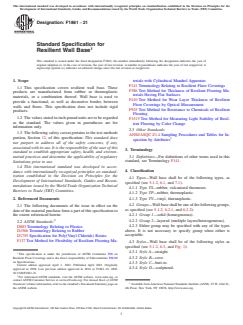
(Specification)Standard Specification for Resilient Wall Base
General Information
- Abstract
ABSTRACT
This specification covers resilient wall base. These products are manufactured from rubber or thermoplastic materials, or a combination thereof. Wall base is used to provide a functional, as well as decorative border, between walls and floors. This specification does not include rigid products. Wall base shall be of the following types, as specified: type TS - rubber, vulcanized thermoset, type TP - rubber, thermoplastic, and type TV - vinyl, thermoplastic. Wall base shall be one of the following groups, as specified: group 1 - solid, and group 2 - layered. Wall base shall be of the following styles as specified: style A - straight, style B - cove, style C - butt-to, style D - sculptured. The wear layer thickness, flexibility, adjacent surface straining induced by wall base, light resistance, chemical resistance, dimensional stability, height, thickness, and length shall be tested to meet the requirements prescribed.
SCOPE
1.1 This specification covers resilient wall base. These products are manufactured from rubber or thermoplastic materials, or a combination thereof. Wall base is used to provide a functional, as well as decorative border, between walls and floors. This specification does not include rigid products.
1.2 The values stated in inch-pound units are to be regarded as the standard. The values given in parentheses are for information only.
1.3 The following safety caveat pertains to the test methods portion, Section 12, of this specification: This standard does not purport to address all of the safety concerns, if any, associated with its use. It is the responsibility of the user of this standard to establish appropriate safety, health, and environmental practices and determine the applicability of regulatory limitations prior to use.
1.4 This international standard was developed in accordance with internationally recognized principles on standardization established in the Decision on Principles for the Development of International Standards, Guides and Recommendations issued by the World Trade Organization Technical Barriers to Trade (TBT) Committee.
- Status
- Published
- Publication Date
- 31-Mar-2021
- Technical Committee
- F06 - Resilient Floor Coverings
- Drafting Committee
- F06.80 - Specifications
Overview
ASTM F1861-21: Standard Specification for Resilient Wall Base specifies requirements for resilient wall base materials made from rubber or thermoplastic compounds, including both solid and layered constructions. This internationally recognized standard ensures consistent performance and quality for products used as borders between floors and walls, providing both functional and decorative purposes. The specification applies to wall base types that are not rigid, and includes requirements for various material compositions and design styles to meet diverse application needs in commercial, institutional, and residential settings.
Key Topics
- Material Types: Covers rubber (vulcanized thermoset and thermoplastic) and vinyl (thermoplastic) wall bases.
- Construction Groups: Addresses both solid (homogeneous) and layered (heterogeneous) wall base groups.
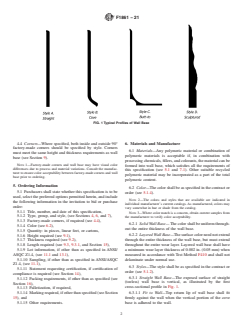
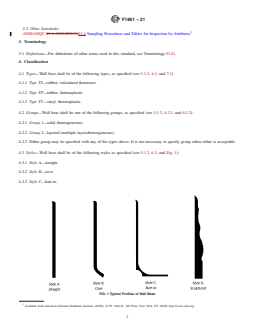
- Styles: Specifies four styles - straight, cove, butt-to, and sculptured profiles, each suited for different aesthetic and functional purposes.
- Performance Criteria: Includes requirements for flexibility, stain resistance, light and chemical resistance, dimensional stability, wear layer thickness, and physical dimensions (height, thickness, and length).
- Workmanship: Ensures wall base products are free from defects such as blemishes, lines, delamination, or blisters that adversely impact appearance or performance.
- Testing and Compliance: Outlines accepted test methods and inspection practices for quality assurance, referencing established ASTM and ANSI standards.
Applications
Resilient wall base is widely used in:
- Commercial Facilities: Offices, retail, and institutional environments where a durable and attractive floor-to-wall junction is needed.
- Healthcare and Educational Environments: Spaces requiring easy-to-clean surfaces with chemical and stain resistance.
- Residential Buildings: Providing both decorative finishes and surface protection for high-traffic areas.
- Renovation Projects: Wall base can be selected for replacement or upgrade work, ensuring compatibility with existing floor and wall materials.
Key practical benefits include:
- Protection: Shields walls from damage by floor cleaning equipment, impacts, and general wear.
- Hygiene and Maintenance: Cove bases, in particular, help prevent debris and moisture from collecting at wall-floor junctions, facilitating easier cleaning and contributing to a healthier indoor environment.
- Design Flexibility: Available in various colors, sizes, and profiles to match décor while meeting technical requirements for usage and durability.
Related Standards
ASTM F1861-21 references and aligns with several other standards to ensure comprehensive and reliable product specification and performance:
- ASTM D883 - Terminology Relating to Plastics
- ASTM D1566 - Terminology Relating to Rubber
- ASTM F137 - Test Method for Flexibility of Resilient Flooring
- ASTM F386 - Test Method for Thickness of Resilient Flooring
- ASTM F410 - Test Method for Wear Layer Thickness by Optical Measurement
- ASTM F925 - Test Method for Chemical Resistance of Resilient Flooring
- ASTM F1515 - Test Method for Measuring Light Stability by Color Change
- ANSI/ASQC Z1.4 - Sampling Procedures and Tables for Inspection by Attributes
Manufacturers and installers should refer to these related standards for terminology, testing procedures, and compliance guidance.
Keywords: resilient wall base, ASTM F1861-21, thermoplastic, rubber, vinyl, cove base, straight base, wall protection, commercial flooring standards, flexible wall base, building materials, floor-wall junction.
Relations
- Effective Date
- 01-Feb-2024
- Effective Date
- 01-Nov-2023
- Effective Date
- 01-Aug-2023
- Effective Date
- 01-Jul-2020
- Effective Date
- 15-Jan-2020
- Effective Date
- 01-Jan-2020
- Effective Date
- 01-Aug-2019
- Effective Date
- 15-Apr-2019
- Effective Date
- 01-Feb-2019
- Effective Date
- 01-Dec-2018
- Effective Date
- 01-Nov-2018
- Effective Date
- 01-Oct-2018
- Effective Date
- 15-Aug-2017
- Effective Date
- 01-Dec-2013
- Effective Date
- 01-Dec-2013
Get Certified
Connect with accredited certification bodies for this standard

DIBt (Deutsches Institut für Bautechnik)
German Institute for Building Technology.
DIN CERTCO
DIN Group product certification.

Aboma Certification B.V.
Specialized in construction, metal, and transport sectors.
Sponsored listings
Frequently Asked Questions
ASTM F1861-21 is a technical specification published by ASTM International. Its full title is "Standard Specification for Resilient Wall Base". This standard covers: ABSTRACT This specification covers resilient wall base. These products are manufactured from rubber or thermoplastic materials, or a combination thereof. Wall base is used to provide a functional, as well as decorative border, between walls and floors. This specification does not include rigid products. Wall base shall be of the following types, as specified: type TS - rubber, vulcanized thermoset, type TP - rubber, thermoplastic, and type TV - vinyl, thermoplastic. Wall base shall be one of the following groups, as specified: group 1 - solid, and group 2 - layered. Wall base shall be of the following styles as specified: style A - straight, style B - cove, style C - butt-to, style D - sculptured. The wear layer thickness, flexibility, adjacent surface straining induced by wall base, light resistance, chemical resistance, dimensional stability, height, thickness, and length shall be tested to meet the requirements prescribed. SCOPE 1.1 This specification covers resilient wall base. These products are manufactured from rubber or thermoplastic materials, or a combination thereof. Wall base is used to provide a functional, as well as decorative border, between walls and floors. This specification does not include rigid products. 1.2 The values stated in inch-pound units are to be regarded as the standard. The values given in parentheses are for information only. 1.3 The following safety caveat pertains to the test methods portion, Section 12, of this specification: This standard does not purport to address all of the safety concerns, if any, associated with its use. It is the responsibility of the user of this standard to establish appropriate safety, health, and environmental practices and determine the applicability of regulatory limitations prior to use. 1.4 This international standard was developed in accordance with internationally recognized principles on standardization established in the Decision on Principles for the Development of International Standards, Guides and Recommendations issued by the World Trade Organization Technical Barriers to Trade (TBT) Committee.
ABSTRACT This specification covers resilient wall base. These products are manufactured from rubber or thermoplastic materials, or a combination thereof. Wall base is used to provide a functional, as well as decorative border, between walls and floors. This specification does not include rigid products. Wall base shall be of the following types, as specified: type TS - rubber, vulcanized thermoset, type TP - rubber, thermoplastic, and type TV - vinyl, thermoplastic. Wall base shall be one of the following groups, as specified: group 1 - solid, and group 2 - layered. Wall base shall be of the following styles as specified: style A - straight, style B - cove, style C - butt-to, style D - sculptured. The wear layer thickness, flexibility, adjacent surface straining induced by wall base, light resistance, chemical resistance, dimensional stability, height, thickness, and length shall be tested to meet the requirements prescribed. SCOPE 1.1 This specification covers resilient wall base. These products are manufactured from rubber or thermoplastic materials, or a combination thereof. Wall base is used to provide a functional, as well as decorative border, between walls and floors. This specification does not include rigid products. 1.2 The values stated in inch-pound units are to be regarded as the standard. The values given in parentheses are for information only. 1.3 The following safety caveat pertains to the test methods portion, Section 12, of this specification: This standard does not purport to address all of the safety concerns, if any, associated with its use. It is the responsibility of the user of this standard to establish appropriate safety, health, and environmental practices and determine the applicability of regulatory limitations prior to use. 1.4 This international standard was developed in accordance with internationally recognized principles on standardization established in the Decision on Principles for the Development of International Standards, Guides and Recommendations issued by the World Trade Organization Technical Barriers to Trade (TBT) Committee.
ASTM F1861-21 is classified under the following ICS (International Classification for Standards) categories: 91.060.10 - Walls. Partitions. Facades. The ICS classification helps identify the subject area and facilitates finding related standards.
ASTM F1861-21 has the following relationships with other standards: It is inter standard links to ASTM D883-24, ASTM D883-23, ASTM F141-23, ASTM F925-13(2020), ASTM F141-12(2020), ASTM D883-20, ASTM D883-19c, ASTM D883-19a, ASTM D883-19, ASTM D883-18a, ASTM D883-18, ASTM F137-08(2018), ASTM D883-17, ASTM F410-08(2013), ASTM F137-08(2013). Understanding these relationships helps ensure you are using the most current and applicable version of the standard.
ASTM F1861-21 is available in PDF format for immediate download after purchase. The document can be added to your cart and obtained through the secure checkout process. Digital delivery ensures instant access to the complete standard document.
Standards Content (Sample)
This international standard was developed in accordance with internationally recognized principles on standardization established in the Decision on Principles for the
Development of International Standards, Guides and Recommendations issued by the World Trade Organization Technical Barriers to Trade (TBT) Committee.
Designation:F1861 −21
Standard Specification for
Resilient Wall Base
This standard is issued under the fixed designation F1861; the number immediately following the designation indicates the year of
original adoption or, in the case of revision, the year of last revision. A number in parentheses indicates the year of last reapproval. A
superscript epsilon (´) indicates an editorial change since the last revision or reapproval.
1. Scope terials with Cylindrical Mandrel Apparatus
F141 Terminology Relating to Resilient Floor Coverings
1.1 This specification covers resilient wall base. These
F386 Test Method for Thickness of Resilient Flooring Ma-
products are manufactured from rubber or thermoplastic
terials Having Flat Surfaces
materials, or a combination thereof. Wall base is used to
F410 Test Method for Wear Layer Thickness of Resilient
provide a functional, as well as decorative border, between
Floor Coverings by Optical Measurement
walls and floors. This specification does not include rigid
F925 Test Method for Resistance to Chemicals of Resilient
products.
Flooring
1.2 The values stated in inch-pound units are to be regarded
F1515 Test Method for Measuring Light Stability of Resil-
as the standard. The values given in parentheses are for
ient Flooring by Color Change
information only.
2.3 Other Standards:
1.3 The following safety caveat pertains to the test methods
ANSI/ASQC Z1.4 Sampling Procedures and Tables for In-
portion, Section 12, of this specification: This standard does 3
spection by Attributes
not purport to address all of the safety concerns, if any,
associated with its use. It is the responsibility of the user of this
3. Terminology
standard to establish appropriate safety, health, and environ-
3.1 Definitions—For definitions of other terms used in this
mental practices and determine the applicability of regulatory
standard, see Terminology F141.
limitations prior to use.
1.4 This international standard was developed in accor-
4. Classification
dance with internationally recognized principles on standard-
ization established in the Decision on Principles for the
4.1 Types—Wall base shall be of the following types, as
Development of International Standards, Guides and Recom-
specified (see 5.1.2, 6.1, and 7.1).
mendations issued by the World Trade Organization Technical
4.1.1 Type TS—rubber, vulcanized thermoset.
Barriers to Trade (TBT) Committee.
4.1.2 Type TP—rubber, thermoplastic.
4.1.3 Type TV—vinyl, thermoplastic.
2. Referenced Documents
4.2 Groups—Wallbaseshallbeoneofthefollowinggroups,
2.1 The following documents of the issue in effect on the
as specified (see 5.1.2, 6.2.1, and 6.2.2):
dateofthematerialpurchaseformapartofthisspecificationto
the extent referenced herein: 4.2.1 Group 1—solid (homogeneous).
4.2.2 Group 2—layered (multiple layers/heterogeneous).
2.2 ASTM Standards:
4.2.3 Either group may be specified with any of the types
D883 Terminology Relating to Plastics
above. It is not necessary to specify group when either is
D1566 Terminology Relating to Rubber
acceptable.
D1755 Specification for Poly(Vinyl Chloride) Resins
F137 Test Method for Flexibility of Resilient Flooring Ma-
4.3 Styles—Wall base shall be of the following styles as
specified (see 5.1.2, 6.3, and Fig. 1):
4.3.1 Style A—straight.
This specification is under the jurisdiction of ASTM Committee F06 on
4.3.2 Style B—cove.
Resilient Floor Coverings and is the direct responsibility of Subcommittee F06.80
on Specifications.
4.3.3 Style C—butt-to.
Current edition approved April 1, 2021. Published April 2021. Originally
4.3.4 Style D—sculptured.
approved in 1998. Last previous edition approved in 2016 as F1861–16. DOI:
10.1520/F1861-21.
For referenced ASTM standards, visit the ASTM website, www.astm.org, or
contact ASTM Customer Service at service@astm.org. For Annual Book of ASTM
Standards volume information, refer to the standard’s Document Summary page on Available fromAmerican National Standards Institute (ANSI), 25 W. 43rd St.,
the ASTM website. 4th Floor, New York, NY 10036, http://www.ansi.org.
Copyright © ASTM International, 100 Barr Harbor Drive, PO Box C700, West Conshohocken, PA 19428-2959. United States
F1861−21
FIG. 1Typical Profiles of Wall Base
4.4 Corners—Where specified, both inside and outside 90° 6. Materials and Manufacture
factory-made corners should be specified by style. Corners
6.1 Materials—Any polymeric material or combination of
must meet the same height and thickness requirements as wall
polymeric materials is acceptable if, in combination with
base (see Section 9).
processing chemicals, fillers, and colorants, the material can be
NOTE 1—Factory-made corners and wall base may have visual color
formed into wall base, which satisfies all the requirements of
differences due to process and material variations. Consult the manufac-
this specification (see 5.1 and 7.1). Other suitable recycled
turer to ensure color acceptability between factory-made corners and wall
polymeric material may be incorporated as a part of the total
base prior to ordering.
polymeric content.
5. Ordering Information
6.2 Color—The color shall be as specified in the contract or
5.1 Purchasers shall state whether this specification is to be order (see 5.1.4).
used, select the preferred options permitted herein, and include
NOTE 2—The colors and styles that are available are indicated in
the following information in the invitation to bid or purchase
individual manufacturer’s current catalogs. As manufactured, colors may
order:
vary somewhat in hue or shade from the catalog.
5.1.1 Title, number, and date of this specification,
NOTE 3—Where color match is a concern, obtain current samples from
5.1.2 Type, group, and style, (see Sections 4, 6, and 7),
the manufacturer to verify color acceptability.
5.1.3 Factory-made corners, if required (see 4.4),
6.2.1 Solid Wall Base—The color shall be uniform through-
5.1.4 Color (see 6.2),
out the entire thickness of the wall base.
5.1.5 Quantity: in pieces, linear feet, or cartons,
6.2.2 LayeredWallBase—Thesurfacecolorneednotextend
5.1.6 Height required (see 9.1),
through the entire thickness of the wall base, but must extend
5.1.7 Thickness required (see 9.2),
throughout the entire wear layer. Layered wall base shall have
5.1.8 Length required (see 9.3, 9.3.1, and Section 15),
a minimum wear layer thickness of 0.002 in. (0.05 mm) when
5.1.9 Lot information, if other than as specified in ANSI/
measured in accordance with Test Method F410 and shall not
ASQC Z1.4, (see 11.1 and 13.1),
5.1.10 Sampling, if other than as specified in ANSI/ASQC delaminate under normal use.
Z1.4, (see 11.1),
6.3 Styles—The style shall be as specified in the contract or
5.1.11 Statement requesting certification, if certification of
order (see 5.1.2).
compliance is required (see Section 14),
6.3.1 Straight Wall Base—The exposed surface of straight
5.1.12 Packing requirements, if other than as specified (see
(toeless) wall base is vertical, as illustrated by the first
Section 16),
cross-sectional profile in Fig. 1.
5.1.13 Palletization, if required,
5.1.14 Marking required, if other than specified (see Section 6.3.1.1 Fit to Wall—Top return lip of wall base shall fit
15), and firmly against the wall when the vertical portion of the cove
5.1.15 Other requirements. base is adhered to the wall.
F1861−21
6.3.2 Cove Wall Base— The exposed surface of cove wall 8.2 Staining of Adjacent Surfaces Induced by Wall Base—
base shall be distinguished by a “toe” at its bottom edge as Wall base shall contain no ingredient which will cause staining
illustrated by the second cross-sectional profile in Fig. 1. of the finished surfaces adjacent to it when aged by the method
6.3.2.1 Fit to Floor— The toe shall be curved, or angled, or specified in 12.1 – 12.7.
both, to allow it to fit snugly against the floor when the vertical
8.3 Resistance to Light—When tested in accordance to Test
portion of the cove base is adhered to the wall.
Method F1515, the color change of the wall base shall have an
6.3.2.2 Intersection at Toe—The intersection of the exposed
average∆E no greater than 8.0 after 200 h of exposure to light,
surfaces of the toe and the vertical portion of the cove base
simulated by a properly fitted xenon-arc radiant energy source.
shall be rounded and smooth to facilitate maintenance.
8.4 Resistance to Chemicals—When tested in accordance
6.3.2.3 Fit to Wall—Top return lip of wall base shall fit
with Test Method F925, the wall base shall have no more than
firmly against the wall when the vertical portion of the cove
a slight change in surface dulling, surface attack, or staining
base is adhered to the wall.
when exposed to the following chemicals:
6.3.3 Butt-to Wall Base—The exposed surface of butt-to
8.4.1 White vinegar (5 % acetic acid).
wall base shall be distinguished by a “toe,” which butts against
8.4.2 Rubbing alcohol (70 % isopropyl alcohol).
the flooring as illustrated by the third cross-sectional profile in
8.4.3 White mineral oil (medicinal grade).
Fig. 1.
8.4.4 Sodium hydroxide solution (5 % NaOH).
6.3.3.1 Fit to Floor— The leading edge of the toe of the
8.4.5 Hydrochloric acid solution (5 % HCl).
butt-to base shall be square to allow a tight, flush fit to the
8.4.6 Sulfuric acid solution (5 H SO ).
2 4
finished flooring when the vertical portion of the butt-to base is
8.4.7 Household ammonia solution (5 % NH OH).
adhered to the wall.
8.4.8 Household bleach solution (5.25 % NaOCl).
6.3.3.2 Intersection at Toe—The intersection of the exposed
8.4.9 Olive oil (light).
surfaces of the toe and the vertical portion of the butt-to base
8.4.10 Kerosene (K1).
shall be designed to facilitate maintenance.
8.4.11 Unleaded gasoline (regular grade).
6.3.3.3 Fit to Wall—Top return lip of wall base shall fit
firmly against the wall when the vertical portion of the cove
NOTE 5—These basic chemicals are representative of those likely to be
base is adhered to the wall. found in domestic, commercial, and institutional use. Many proprietary
compounds contain one or more of these basic chemicals. Should the wall
6.3.4 Sculptured Wall Base—The exposed surface of sculp-
base for an unusual application need to be resistant to a specific chemical,
tured wall base shall have an appearance replicating carved
this additional requirement should become part of the procurement
wood or chiseled stone, as illustrated by the fourth cross-
document.
sectional profile in Fig. 1.
8.5 Dimensional Stability—Wall base shall not change in
6.3.4.1 Fit to Wall—Top return lip of wall base shall fit
length by more than 6 0.25 % when tested by the method
firmly against the wall when the vertical portion of the cove
specified in 12.8 – 12.15.
base is adhered to the wall.
8.6 Odor—The wall base shall be free from offensive odor.
7. Material Definitions
9. Dimensions and Permissible Variations
7.1 The following definitions will be used in classifying
material according to 4.1: 9.1 Height—Theheightofthewallbaseshallbeasspecified
7.1.1 Rubber, Vulcanized Thermoset—The polymeric binder in the contract or order (see 5.1.6).Atolerance of 61%ofthe
of this compound shall satisfy the definition of rubber, and nominal height of the wall base shall be permitted when
have been vulcanized, as defined in Terminology D1566. measured with a scale, caliper, or other device graduated in
7.1.2 Rubber, Thermoplastic—The polymeric binder of this 0.001–in. (0.025 mm) divisions and capable of measuring the
compound shall satisfy the definition of rubber, but remain maximum height of the specimen. The specimen shall be
thermoplastic, as defined in Terminology D883. placed on a flat surface and the measuring device applied in
7.1.3 Vinyl, Thermoplastic—The polymeric binder of this such a manner that the height is not distorted during measure-
compoundshallsatisfythedefinitionofpoly(vinylchloride)in ment.
Terminology D883 and Specification D1755 but remain ther-
9.2 Thickness—Unless otherwise specified in the contract or
moplastic as defined in Terminology D883.
order (see 5.1.7), the wall base shall be 0.080 in. (2.03 mm) or
0.125in.(3.17mm)thick.Apermissibletolerancefor0.080in.
8. Performance Requirements
(2.03 mm) thick wall base shall be +0.015 in. to –0.005 in.
8.1 Flexibility— Unless otherwise specified in the contract
(+0.38 mm to –0.13 mm) and 0.125 in. to 0.375 in. (3.17 mm
or order (see 5.1), the wall base shall show no visible cracks,
to 9.53 mm) thick wall base shall have a permissible tolerance
breaks, or other evidence of weakness when tested in accor-
of +0.015 in. to –0.015 in. (+0.38 mm to –0.38 mm) and wall
dance with Test Method F137 using a ⁄4 in. (6.35 mm) base thicker than 0.375 in. (9.53 mm) shall have a permissible
diameter mandrel. This requirement is not applicable for
tolerance of +0.020 in. to –0.020 in. (+0.51 mm to –0.51 mm)
sculptured wall base thicker than 0.125 in. (3.17 mm) in when measured in accordance with Test Method F386.
thickness. NOTE 6—Measure sculptured wall base at its thickest point.
9.3 Length—Thelengthofthewallbaseshallbeasspecified
NOTE 4—Cove wall base shall be tested with the mandrel perpendicular
to the cove when oriented as in use. in the contract or order (see 5.1.8). The length of the wall base
F1861−21
TABLE 1 Characteristics and Tests
shall not be less than as marked on the label or package when
measured with a calibrated scale or tape graduated in 1/8 in. Characteristic Requi
...
This document is not an ASTM standard and is intended only to provide the user of an ASTM standard an indication of what changes have been made to the previous version. Because
it may not be technically possible to adequately depict all changes accurately, ASTM recommends that users consult prior editions as appropriate. In all cases only the current version
of the standard as published by ASTM is to be considered the official document.
Designation: F1861 − 16 F1861 − 21
Standard Specification for
Resilient Wall Base
This standard is issued under the fixed designation F1861; the number immediately following the designation indicates the year of
original adoption or, in the case of revision, the year of last revision. A number in parentheses indicates the year of last reapproval. A
superscript epsilon (´) indicates an editorial change since the last revision or reapproval.
1. Scope
1.1 This specification covers resilient wall base. These products are manufactured from rubber or thermoplastic materials, or a
combination thereof. Wall base is used to provide a functional, as well as decorative border, between walls and floors. This
specification does not include rigid products.
1.2 The values stated in inch-pound units are to be regarded as the standard. The values given in parentheses are for information
only.
1.3 The following safety caveat pertains to the test methods portion, Section 12, of this specification: This standard does not
purport to address all of the safety concerns, if any, associated with its use. It is the responsibility of the user of this standard to
establish appropriate safety safety, health, and healthenvironmental practices and determine the applicability of regulatory
limitations prior to use.
1.4 This international standard was developed in accordance with internationally recognized principles on standardization
established in the Decision on Principles for the Development of International Standards, Guides and Recommendations issued
by the World Trade Organization Technical Barriers to Trade (TBT) Committee.
2. Referenced Documents
2.1 The following documents of the issue in effect on the date of the material purchase form a part of this specification to the extent
referenced herein:
2.2 ASTM Standards:
D883 Terminology Relating to Plastics
D1566 Terminology Relating to Rubber
D1755 Specification for Poly(Vinyl Chloride) Resins
F137 Test Method for Flexibility of Resilient Flooring Materials with Cylindrical Mandrel Apparatus
F141 Terminology Relating to Resilient Floor Coverings
F386 Test Method for Thickness of Resilient Flooring Materials Having Flat Surfaces
F410 Test Method for Wear Layer Thickness of Resilient Floor Coverings by Optical Measurement
F925 Test Method for Resistance to Chemicals of Resilient Flooring
F1515 Test Method for Measuring Light Stability of Resilient Flooring by Color Change
This specification is under the jurisdiction of ASTM Committee F06 on Resilient Floor Coverings and is the direct responsibility of Subcommittee F06.80 on
Specifications.
Current edition approved Nov. 1, 2016April 1, 2021. Published December 2016April 2021. Originally approved in 1998. Last previous edition approved in 20082016 as
ɛ1
F1861–08 (2012)–16. . DOI: 10.1520/F1861-16.10.1520/F1861-21.
For referenced ASTM standards, visit the ASTM website, www.astm.org, or contact ASTM Customer Service at service@astm.org. For Annual Book of ASTM Standards
volume information, refer to the standard’s Document Summary page on the ASTM website.
Copyright © ASTM International, 100 Barr Harbor Drive, PO Box C700, West Conshohocken, PA 19428-2959. United States
F1861 − 21
2.3 Other Standards:
ANSI/ASQC Z1.4–2003(R2013)Z1.4 Sampling Procedures and Tables for Inspection by Attributes
3. Terminology
3.1 Definitions—For definitions of other terms used in this standard, see Terminology F141.
4. Classification
4.1 Types—Wall base shall be of the following types, as specified (see 5.1.2, 6.1, and 7.1).
4.1.1 Type TS—rubber, vulcanized thermoset.
4.1.2 Type TP—rubber, thermoplastic.
4.1.3 Type TV—vinyl, thermoplastic.
4.2 Groups—Wall base shall be one of the following groups, as specified (see 5.1.2, 6.2.1, and 6.2.2):
4.2.1 Group 1—solid (homogeneous).
4.2.2 Group 2—layered (multiple layers/heterogeneous).
4.2.3 Either group may be specified with any of the types above. It is not necessary to specify group when either is acceptable.
4.3 Styles—Wall base shall be of the following styles as specified (see 5.1.2, 6.3, and Fig. 1):
4.3.1 Style A—straight.
4.3.2 Style B—cove.
4.3.3 Style C—butt-to.
FIG. 1 Typical Profiles of Wall Base
Available from American National Standards Institute (ANSI), 25 W. 43rd St., 4th Floor, New York, NY 10036, http://www.ansi.org.
F1861 − 21
4.3.4 Style D—sculptured.
4.4 Corners—Where specified, both inside and outside 90° factory-made corners should be specified by style. Corners must meet
the same height and thickness requirements as wall base (see Section 9).
NOTE 1—Factory-made corners and wall base may have visual color differences due to process and material variations. Consult the manufacturer to ensure
color acceptability between factory-made corners and wall base prior to ordering.
5. Ordering Information
5.1 Purchasers shall state whether this specification is to be used, select the preferred options permitted herein, and include the
following information in the invitation to bid or purchase order:
5.1.1 Title, number, and date of this specification,
5.1.2 Type, group, and style, (see Sections 4, 6, and 7),
5.1.3 Factory-made corners, if required (see 4.4),
5.1.4 Color (see 6.2),
5.1.5 Quantity: in pieces, linear feet, or cartons,
5.1.6 Height required (see 9.1),
5.1.7 Thickness required (see 9.2),
5.1.8 Length required (see 9.3, 9.3.1, and Section 15),
5.1.9 Lot information, if other than as specified in ANSI/ASQC Z1.4–2003(R2013),Z1.4, (see 11.1 and 13.1),
5.1.10 Sampling, if other than as specified in ANSI/ASQC Z1.4–2003(R2013),Z1.4, (see 11.1),
5.1.11 Statement requesting certification, if certification of compliance is required (see Section 14),
5.1.12 Packing requirements, if other than as specified (see Section 16),
5.1.13 Palletization, if required,
5.1.14 Marking required, if other than specified (see Section 15), and
5.1.15 Other requirements.
6. Materials and Manufacture
6.1 Materials—Any polymeric material or combination of polymeric materials is acceptable if, in combination with processing
chemicals, fillers, and colorants, the material can be formed into wall base, which satisfies all the requirements of this specification
(see 5.1 and 7.1). Other suitable recycled polymeric material may be incorporated as a part of the total polymeric content.
6.2 Color—The color shall be as specified in the contract or order (see 5.1.4).
NOTE 2—The colors and styles that are available are indicated in individual manufacturer’s current catalogs. As manufactured, colors may vary somewhat
in hue or shade from the catalog.
NOTE 3—Where color match is a concern, obtain current samples from the manufacturer to verify color acceptability.
6.2.1 Solid Wall Base— The color shall be uniform throughout the entire thickness of the wall base.
F1861 − 21
6.2.2 Layered Wall Base—The surface color need not extend through the entire thickness of the wall base, but must extend
throughout the entire wear layer. Layered wall base shall have a minimum wear layer thickness of 0.002 in. (0.05 mm) when
measured in accordance with Test Method F410 and shall not delaminate under normal use.
6.3 Styles—The style shall be as specified in the contract or order (see 5.1.2).
6.3.1 Straight Wall Base—The exposed surface of straight (toeless) wall base is vertical, as illustrated by the first cross-sectional
profile in Fig. 1.
6.3.1.1 Fit to Wall—Top return lip of wall base shall fit firmly against the wall when the vertical portion of the cove base is adhered
to the wall.
6.3.2 Cove Wall Base— The exposed surface of cove wall base shall be distinguished by a “toe” at its bottom edge as illustrated
by the second cross-sectional profile in Fig. 1.
6.3.2.1 Fit to Floor— The toe shall be curved, or angled, or both, to allow it to fit snugly against the floor when the vertical portion
of the cove base is adhered to the wall.
6.3.2.2 Intersection at Toe—The intersection of the exposed surfaces of the toe and the vertical portion of the cove base shall be
rounded and smooth to facilitate maintenance.
6.3.2.3 Fit to Wall—Top return lip of wall base shall fit firmly against the wall when the vertical portion of the cove base is adhered
to the wall.
6.3.3 Butt-to Wall Base—The exposed surface of butt-to wall base shall be distinguished by a “toe,” which butts against the
flooring as illustrated by the third cross-sectional profile in Fig. 1.
6.3.3.1 Fit to Floor— The leading edge of the toe of the butt-to base shall be square to allow a tight, flush fit to the finished flooring
when the vertical portion of the butt-to base is adhered to the wall.
6.3.3.2 Intersection at Toe—The intersection of the exposed surfaces of the toe and the vertical portion of the butt-to base shall
be designed to facilitate maintenance.
6.3.3.3 Fit to Wall—Top return lip of wall base shall fit firmly against the wall when the vertical portion of the cove base is adhered
to the wall.
6.3.4 Sculptured Wall Base—The exposed surface of sculptured wall base shall have an appearance replicating carved wood or
chiseled stone, as illustrated by the fourth cross-sectional profile in Fig. 1.
6.3.4.1 Fit to Wall—Top return lip of wall base shall fit firmly against the wall when the vertical portion of the cove base is adhered
to the wall.
7. Material Definitions
7.1 The following definitions will be used in classifying material according to 4.1:
7.1.1 Rubber, Vulcanized Thermoset—The polymeric binder of this compound shall satisfy the definition of rubber, and have been
vulcanized, as defined in Terminology D1566.
7.1.2 Rubber, Thermoplastic—The polymeric binder of this compound shall satisfy the definition of rubber, but remain
thermoplastic, as defined in Terminology D883.
7.1.3 Vinyl, Thermoplastic—The polymeric binder of this compound shall satisfy the definition of poly (vinyl chloride) in
Terminology D883 and Specification D1755 but remain thermoplastic as defined in Terminology D883.
F1861 − 21
8. Performance Requirements
8.1 Flexibility— Unless otherwise specified in the contract or order (see 5.1), the wall base shall show no visible cracks, breaks,
or other evidence of weakness when tested in accordance with Test Method F137 using a ⁄4 in. (6.35 mm) diameter mandrel. This
requirement is not applicable for sculptured wall base thicker than 0.125 in. (3.17 mm) in thickness.
NOTE 4—Cove wall base shall be tested with the mandrel perpendicular to the cove when oriented as in use.
8.2 Staining of Adjacent Surfaces Induced by Wall Base—Wall base shall contain no ingredient which will cause staining of the
finished surfaces adjacent to it when aged by the method specified in 12.1 – 12.7.
8.3 Resistance to Light—When tested in accordance to Test Method F1515, the color change of the wall base shall have an average
ΔE no greater than 8.0 after 200 h of exposure to light, simulated by a properly fitted xenon-arc radiant energy source.
8.4 Resistance to Chemicals—When tested in accordance with Test Method F925, the wall base shall have no more than a slight
change in surface dulling, surface attack, or staining when exposed to the following chemicals:
8.4.1 White vinegar (5 % acetic acid).
8.4.2 Rubbing alcohol (70 % isopropyl alcohol).
8.4.3 White mineral oil (medicinal grade).
8.4.4 Sodium hydroxide solution (5 % NaOH).
8.4.5 Hydrochloric acid solution (5 % HCl).
8.4.6 Sulfuric acid solution (5 H SO ).
2 4
8.4.7 Household ammonia solution (5 % NH OH).
8.4.8 Household bleach solution (5.25 % NaOCl).
8.4.9 Olive oil (light).
8.4.10 Kerosene (K1).
8.4.11 Unleaded gasoline (regular grade).
NOTE 5—These basic chemicals are representative of those likely to be found in domestic, commercial, and institutional use. Many proprietary compounds
contain one or more of these basic chemicals. Should the wall base for an unusual application need to be resistant to a specific chemical, this additional
requirement should become part of the procurement document.
8.5 Dimensional Stability—Wall base shall not change in length by more than 6 0.25 % when tested by the method specified in
12.8 – 12.15.
8.6 Odor—The wall base shall be free from offensive odor.
9. Dimensions and Permissible Variations
9.1 Height—The height of the wall base shall be as specified in the contract or order (see 5.1.6). A tolerance of 61 % of the
nominal height of the wall base shall be permitted when measured with a scale, caliper, or other device graduated in 0.001–in.
(0.025 mm) divisions and capable of measuring the maximum height of the specimen. The specimen shall be placed on a flat
surface and the measuring device applied in such a manner that the height is not distorted during measurement.
9.2 Thickness—Unless otherwise specified in the contract or order (see 5.1.7), the wall base shall be 0.080 in. (2.03 mm) or 0.125
F1861 − 21
in. (3.17 mm) thick. A permissible tolerance for 0.080 in. (2.03 mm) thick wall base shall be +0.015 in. to –0.005 in. (+0.38 mm
to –0.13 mm) and 0.125 in. to 0.375 in. (3.17 mm to 9.53 mm) thick wall base shall have a permissible tolerance of +0.015 in.
to –0.015 in. (+0.38 mm to –0.38 mm) and wall base thicker than 0.375 in. (9.53 mm) shall have a permissible tolerance of +0.020
in. to –0.020 in. (+0.51 mm to –0.51 mm) when measured in accordance with Test Method F386.
NOTE 6—Measure sculptured wall base at its thickest point.
9.3 Length—The length of the wall base shall be as specified in the contract or order (see 5.1.8). The length of the wall base shall
not be less than as marked on the label or package when measured with a calibrated scale or tape graduated in 1/8 in. (3.18 mm)
divisions an
...