

ASTM D5188-23
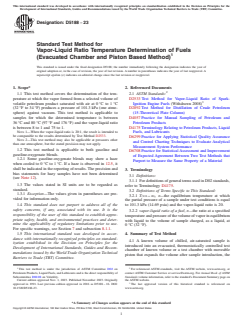
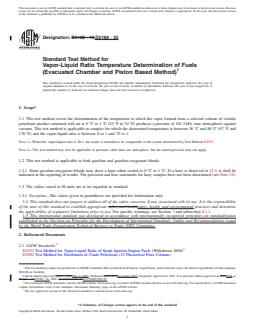
(Test Method)Standard Test Method for Vapor-Liquid Ratio Temperature Determination of Fuels (Evacuated Chamber and Piston Based Method)
General Information
- Abstract
SIGNIFICANCE AND USE
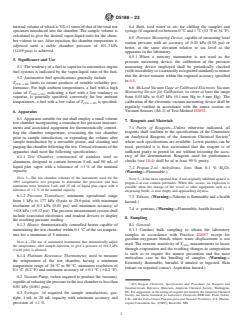
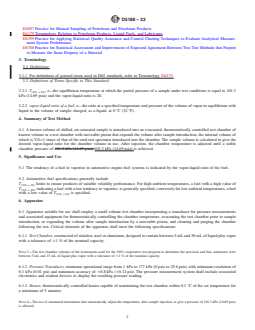
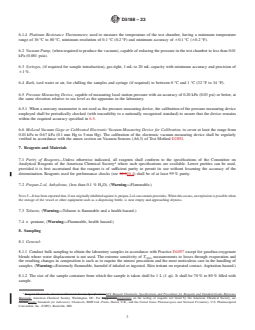
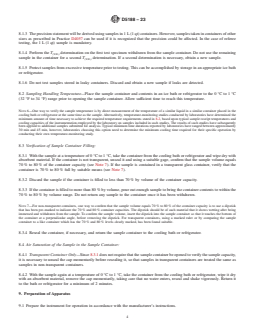
5.1 The tendency of a fuel to vaporize in automotive engine fuel systems is indicated by the vapor-liquid ratio of the fuel.
5.2 Automotive fuel specifications generally include
T(V/L = 20) limits to ensure products of suitable volatility performance. For high ambient temperatures, a fuel with a high value of T(V/L = 20), indicating a fuel with a low tendency to vaporize, is generally specified; conversely for low ambient temperatures, a fuel with a low value of T(V/L = 20) is specified.
SCOPE
1.1 This test method covers the determination of the temperature at which the vapor formed from a selected volume of volatile petroleum product saturated with air at 0 °C to 1 °C (32 °F to 34 °F) produces a pressure of 101.3 kPa (one atmosphere) against vacuum. This test method is applicable to samples for which the determined temperature is between 36 °C and 80 °C (97 °F and 176 °F) and the vapor-liquid ratio is between 8 to 1 and 75 to 1.
Note 1: When the vapor-liquid ratio is 20:1, the result is intended to be comparable to the results determined by Test Method D2533.
Note 2: This test method may also be applicable at pressures other than one atmosphere, but the stated precision may not apply.
1.2 This test method is applicable to both gasoline and gasoline-oxygenate blends.
1.2.1 Some gasoline-oxygenate blends may show a haze when cooled to 0 °C to 1 °C. If a haze is observed in 12.5, it shall be indicated in the reporting of results. The precision and bias statements for hazy samples have not been determined (see Note 12).
1.3 The values stated in SI units are to be regarded as standard.
1.3.1 Exception—The values given in parentheses are provided for information only.
1.4 This standard does not purport to address all of the safety concerns, if any, associated with its use. It is the responsibility of the user of this standard to establish appropriate safety, health, and environmental practices and determine the applicability of regulatory limitations prior to use. For specific warnings, see Section 7 and subsection 8.1.1.
1.5 This international standard was developed in accordance with internationally recognized principles on standardization established in the Decision on Principles for the Development of International Standards, Guides and Recommendations issued by the World Trade Organization Technical Barriers to Trade (TBT) Committee.
- Status
- Published
- Publication Date
- 31-Oct-2023
- Technical Committee
- D02 - Petroleum Products, Liquid Fuels, and Lubricants
- Drafting Committee
- D02.08 - Volatility
Buy Documents
ASTM D5188-23 - Standard Test Method for Vapor-Liquid Ratio Temperature Determination of Fuels (Evacuated Chamber and Piston Based Method)
REDLINE ASTM D5188-23 - Standard Test Method for Vapor-Liquid Ratio Temperature Determination of Fuels (Evacuated Chamber and Piston Based Method)
Overview
ASTM D5188-23: Standard Test Method for Vapor-Liquid Ratio Temperature Determination of Fuels (Evacuated Chamber and Piston Based Method) provides a reliable procedure for assessing the temperature at which a volatile petroleum product, saturated with air at 0 °C to 1 °C, creates a specified vapor-liquid ratio and produces a pressure of 101.3 kPa (one atmosphere). This method applies to both gasoline and gasoline-oxygenate blends, determining values critical to evaluating fuel volatility. Derived results help ensure automotive fuel systems operate efficiently under various ambient temperatures.
Fuel volatility, as measured by vapor-liquid ratio and corresponding temperature, plays a significant role in fuel performance, especially under different climatic and engine conditions. The ASTM D5188-23 method is widely adopted within the petroleum, automotive, and regulatory sectors for quality control and specification compliance.
Key Topics
- Vapor-Liquid Ratio (V/L): The ratio at specified conditions of the vapor volume in equilibrium with a given volume of liquid fuel, essential for gauging volatility.
- Temperature Determination: Identification of the equilibrium temperature, commonly referred to as T(V/L=20), where the vapor-liquid ratio is 20:1 at 101.3 kPa. This value is integral for comparing with specification limits and ensuring volatile performance.
- Fuel Compatibility: Applicable for gasoline and gasoline-oxygenate blends across a temperature range of 36 °C to 80 °C, and a vapor-liquid ratio from 8:1 to 75:1.
- Test Apparatus: Utilizes either an evacuated chamber or a piston-based system equipped with precise pressure and temperature measurement devices as outlined by the standard.
- Precision and Bias: Repeatability and reproducibility values are established for gasoline and gasoline-oxygenate blends, ensuring measurement reliability across laboratories.
Applications
The ASTM D5188-23 test method is critical in a variety of practical contexts, including:
- Quality Control in Fuel Production: Refineries and fuel blenders use this standard to ensure finished gasoline and gasoline-oxygenate blends meet required volatility specifications for market distribution.
- Automotive Industry Testing: Automakers and fuel system designers rely on vapor-liquid ratio temperature data to assess fuel suitability in engines, especially for performance in high or low temperature regions.
- Regulatory Compliance: Fuel is tested to conform with local, national, and international regulations that specify volatility ranges to optimize emission control and reduce vapor lock risks.
- Research and Development: Laboratories leverage this method in the development and performance analysis of new fuel formulations or when evaluating performance effects of biofuel or oxygenate additives.
- Dispute Resolution: Provides an authoritative reference for arbitration and verification in cases of product quality claims or specification disagreements.
Related Standards
Several ASTM standards complement and support ASTM D5188-23:
- ASTM D2533: Test Method for Vapor-Liquid Ratio of Spark-Ignition Engine Fuels (Withdrawn 2008) - older, comparable methodology using mercury.
- ASTM D2892: Test Method for Distillation of Crude Petroleum, which assists with petroleum fraction analysis.
- ASTM D4057: Practice for Manual Sampling of Petroleum and Petroleum Products, referenced for obtaining representative fuel samples.
- ASTM D4175: Terminology Relating to Petroleum Products, Liquid Fuels, and Lubricants, providing standard definitions.
- ASTM D6299: Practice for Applying Statistical Quality Assurance and Control Charting Techniques, critical for laboratory quality control.
- ASTM D6708: Practice for Statistical Assessment and Improvement of Expected Agreement Between Test Methods, used for validating equivalence among testing procedures.
The ASTM D5188-23 standard continues to be vital for the global petroleum industry, facilitating consistent measurement of fuel volatility properties and supporting reliable automotive engine operation through every stage of the fuel supply chain. For the most current official documentation and details, consult the ASTM website.
Relations
- Effective Date
- 01-Nov-2023
- Effective Date
- 01-Mar-2024
- Refers
ASTM D4175-23a - Standard Terminology Relating to Petroleum Products, Liquid Fuels, and Lubricants - Effective Date
- 15-Dec-2023
- Effective Date
- 01-Dec-2023
- Effective Date
- 01-Jul-2023
- Refers
ASTM D4175-23e1 - Standard Terminology Relating to Petroleum Products, Liquid Fuels, and Lubricants - Effective Date
- 01-Jul-2023
- Effective Date
- 01-May-2021
- Effective Date
- 01-Nov-2023
- Effective Date
- 01-Nov-2023
Buy Documents
ASTM D5188-23 - Standard Test Method for Vapor-Liquid Ratio Temperature Determination of Fuels (Evacuated Chamber and Piston Based Method)
REDLINE ASTM D5188-23 - Standard Test Method for Vapor-Liquid Ratio Temperature Determination of Fuels (Evacuated Chamber and Piston Based Method)
Get Certified
Connect with accredited certification bodies for this standard

Element Materials Technology
Materials testing and product certification.

ABS Group Brazil
ABS Group certification services in Brazil.

ABS Quality Evaluations Inc.
American Bureau of Shipping quality certification.
Sponsored listings
Frequently Asked Questions
ASTM D5188-23 is a standard published by ASTM International. Its full title is "Standard Test Method for Vapor-Liquid Ratio Temperature Determination of Fuels (Evacuated Chamber and Piston Based Method)". This standard covers: SIGNIFICANCE AND USE 5.1 The tendency of a fuel to vaporize in automotive engine fuel systems is indicated by the vapor-liquid ratio of the fuel. 5.2 Automotive fuel specifications generally include T(V/L = 20) limits to ensure products of suitable volatility performance. For high ambient temperatures, a fuel with a high value of T(V/L = 20), indicating a fuel with a low tendency to vaporize, is generally specified; conversely for low ambient temperatures, a fuel with a low value of T(V/L = 20) is specified. SCOPE 1.1 This test method covers the determination of the temperature at which the vapor formed from a selected volume of volatile petroleum product saturated with air at 0 °C to 1 °C (32 °F to 34 °F) produces a pressure of 101.3 kPa (one atmosphere) against vacuum. This test method is applicable to samples for which the determined temperature is between 36 °C and 80 °C (97 °F and 176 °F) and the vapor-liquid ratio is between 8 to 1 and 75 to 1. Note 1: When the vapor-liquid ratio is 20:1, the result is intended to be comparable to the results determined by Test Method D2533. Note 2: This test method may also be applicable at pressures other than one atmosphere, but the stated precision may not apply. 1.2 This test method is applicable to both gasoline and gasoline-oxygenate blends. 1.2.1 Some gasoline-oxygenate blends may show a haze when cooled to 0 °C to 1 °C. If a haze is observed in 12.5, it shall be indicated in the reporting of results. The precision and bias statements for hazy samples have not been determined (see Note 12). 1.3 The values stated in SI units are to be regarded as standard. 1.3.1 Exception—The values given in parentheses are provided for information only. 1.4 This standard does not purport to address all of the safety concerns, if any, associated with its use. It is the responsibility of the user of this standard to establish appropriate safety, health, and environmental practices and determine the applicability of regulatory limitations prior to use. For specific warnings, see Section 7 and subsection 8.1.1. 1.5 This international standard was developed in accordance with internationally recognized principles on standardization established in the Decision on Principles for the Development of International Standards, Guides and Recommendations issued by the World Trade Organization Technical Barriers to Trade (TBT) Committee.
SIGNIFICANCE AND USE 5.1 The tendency of a fuel to vaporize in automotive engine fuel systems is indicated by the vapor-liquid ratio of the fuel. 5.2 Automotive fuel specifications generally include T(V/L = 20) limits to ensure products of suitable volatility performance. For high ambient temperatures, a fuel with a high value of T(V/L = 20), indicating a fuel with a low tendency to vaporize, is generally specified; conversely for low ambient temperatures, a fuel with a low value of T(V/L = 20) is specified. SCOPE 1.1 This test method covers the determination of the temperature at which the vapor formed from a selected volume of volatile petroleum product saturated with air at 0 °C to 1 °C (32 °F to 34 °F) produces a pressure of 101.3 kPa (one atmosphere) against vacuum. This test method is applicable to samples for which the determined temperature is between 36 °C and 80 °C (97 °F and 176 °F) and the vapor-liquid ratio is between 8 to 1 and 75 to 1. Note 1: When the vapor-liquid ratio is 20:1, the result is intended to be comparable to the results determined by Test Method D2533. Note 2: This test method may also be applicable at pressures other than one atmosphere, but the stated precision may not apply. 1.2 This test method is applicable to both gasoline and gasoline-oxygenate blends. 1.2.1 Some gasoline-oxygenate blends may show a haze when cooled to 0 °C to 1 °C. If a haze is observed in 12.5, it shall be indicated in the reporting of results. The precision and bias statements for hazy samples have not been determined (see Note 12). 1.3 The values stated in SI units are to be regarded as standard. 1.3.1 Exception—The values given in parentheses are provided for information only. 1.4 This standard does not purport to address all of the safety concerns, if any, associated with its use. It is the responsibility of the user of this standard to establish appropriate safety, health, and environmental practices and determine the applicability of regulatory limitations prior to use. For specific warnings, see Section 7 and subsection 8.1.1. 1.5 This international standard was developed in accordance with internationally recognized principles on standardization established in the Decision on Principles for the Development of International Standards, Guides and Recommendations issued by the World Trade Organization Technical Barriers to Trade (TBT) Committee.
ASTM D5188-23 is classified under the following ICS (International Classification for Standards) categories: 75.160.20 - Liquid fuels. The ICS classification helps identify the subject area and facilitates finding related standards.
ASTM D5188-23 has the following relationships with other standards: It is inter standard links to ASTM D5188-16, ASTM D6708-24, ASTM D4175-23a, ASTM D6299-23a, ASTM D6299-23e1, ASTM D4175-23e1, ASTM D6708-21, ASTM D4814-23, ASTM D7826-23a. Understanding these relationships helps ensure you are using the most current and applicable version of the standard.
ASTM D5188-23 is available in PDF format for immediate download after purchase. The document can be added to your cart and obtained through the secure checkout process. Digital delivery ensures instant access to the complete standard document.
Standards Content (Sample)
This international standard was developed in accordance with internationally recognized principles on standardization established in the Decision on Principles for the
Development of International Standards, Guides and Recommendations issued by the World Trade Organization Technical Barriers to Trade (TBT) Committee.
Designation: D5188 − 23
Standard Test Method for
Vapor-Liquid Ratio Temperature Determination of Fuels
(Evacuated Chamber and Piston Based Method)
This standard is issued under the fixed designation D5188; the number immediately following the designation indicates the year of
original adoption or, in the case of revision, the year of last revision. A number in parentheses indicates the year of last reapproval. A
superscript epsilon (´) indicates an editorial change since the last revision or reapproval.
1. Scope* 2. Referenced Documents
1.1 This test method covers the determination of the tem- 2.1 ASTM Standards:
perature at which the vapor formed from a selected volume of D2533 Test Method for Vapor-Liquid Ratio of Spark-
volatile petroleum product saturated with air at 0 °C to 1 °C Ignition Engine Fuels (Withdrawn 2008)
(32 °F to 34 °F) produces a pressure of 101.3 kPa (one atmo- D2892 Test Method for Distillation of Crude Petroleum
sphere) against vacuum. This test method is applicable to (15-Theoretical Plate Column)
samples for which the determined temperature is between D4057 Practice for Manual Sampling of Petroleum and
36 °C and 80 °C (97 °F and 176 °F) and the vapor-liquid ratio Petroleum Products
is between 8 to 1 and 75 to 1. D4175 Terminology Relating to Petroleum Products, Liquid
NOTE 1—When the vapor-liquid ratio is 20:1, the result is intended to
Fuels, and Lubricants
be comparable to the results determined by Test Method D2533.
D6299 Practice for Applying Statistical Quality Assurance
NOTE 2—This test method may also be applicable at pressures other
and Control Charting Techniques to Evaluate Analytical
than one atmosphere, but the stated precision may not apply.
Measurement System Performance
1.2 This test method is applicable to both gasoline and
D6708 Practice for Statistical Assessment and Improvement
gasoline-oxygenate blends.
of Expected Agreement Between Two Test Methods that
1.2.1 Some gasoline-oxygenate blends may show a haze
Purport to Measure the Same Property of a Material
when cooled to 0 °C to 1 °C. If a haze is observed in 12.5, it
shall be indicated in the reporting of results. The precision and
3. Terminology
bias statements for hazy samples have not been determined
3.1 Definitions:
(see Note 12).
3.1.1 For definitions of general terms used in D02 standards,
1.3 The values stated in SI units are to be regarded as
refer to Terminology D4175.
standard.
3.2 Definitions of Terms Specific to This Standard:
1.3.1 Exception—The values given in parentheses are pro-
3.2.1 T , n—the equilibrium temperature at which
(V/L = 20)
vided for information only.
the partial pressure of a sample under test conditions is equal
1.4 This standard does not purport to address all of the to 101.3 kPa (14.69 psia) and the vapor-liquid ratio is 20.
safety concerns, if any, associated with its use. It is the
3.2.2 vapor-liquid ratio of a fuel, n—the ratio at a specified
responsibility of the user of this standard to establish appro-
temperature and pressure of the volume of vapor in equilibrium
priate safety, health, and environmental practices and deter-
with liquid to the volume of sample charged, as a liquid, at
mine the applicability of regulatory limitations prior to use.
0 °C (32 °F).
For specific warnings, see Section 7 and subsection 8.1.1.
1.5 This international standard was developed in accor-
4. Summary of Test Method
dance with internationally recognized principles on standard-
4.1 A known volume of chilled, air-saturated sample is
ization established in the Decision on Principles for the
introduced into an evacuated, thermostatically controlled test
Development of International Standards, Guides and Recom-
chamber of known volume or a test chamber with moveable
mendations issued by the World Trade Organization Technical
piston that expands the volume after sample introduction, the
Barriers to Trade (TBT) Committee.
1 2
This test method is under the jurisdiction of ASTM Committee D02 on For referenced ASTM standards, visit the ASTM website, www.astm.org, or
Petroleum Products, Liquid Fuels, and Lubricants and is the direct responsibility of contact ASTM Customer Service at service@astm.org. For Annual Book of ASTM
Subcommittee D02.08 on Volatility. Standards volume information, refer to the standard’s Document Summary page on
Current edition approved Nov. 1, 2023. Published November 2023. Originally the ASTM website.
approved in 1991. Last previous edition approved in 2016 as D5188 – 16. DOI: The last approved version of this historical standard is referenced on
10.1520/D5188-23. www.astm.org.
*A Summary of Changes section appears at the end of this standard
Copyright © ASTM International, 100 Barr Harbor Drive, PO Box C700, West Conshohocken, PA 19428-2959. United States
D5188 − 23
internal volume of which is V/L+1 times of that of the total test 6.4 Bath, iced water or air, for chilling the samples and
specimen introduced into the chamber. The sample volume is syringe (if required) to between 0 °C and 1 °C (32 °F to 34 °F).
calculated to give the desired vapor-liquid ratio for the cham-
6.5 Pressure Measuring Device, capable of measuring local
ber volume in use. After injection, the chamber temperature is
station pressure with an accuracy of 0.20 kPa (0.03 psi) or
adjusted until a stable chamber pressure of 101.3 kPa
better, at the same elevation relative to sea level as the
(14.69 psia) is achieved.
apparatus in the laboratory.
6.5.1 When a mercury manometer is not used as the
5. Significance and Use
pressure measuring device, the calibration of the pressure
5.1 The tendency of a fuel to vaporize in automotive engine measuring device employed shall be periodically checked
(with traceability to a nationally recognized standard) to ensure
fuel systems is indicated by the vapor-liquid ratio of the fuel.
that the device remains within the required accuracy specified
5.2 Automotive fuel specifications generally include
in 6.5.
T limits to ensure products of suitable volatility per-
(V/L = 20)
formance. For high ambient temperatures, a fuel with a high 6.6 McLeod Vacuum Gage or Calibrated Electronic Vacuum
Measuring Device for Calibration, to cover at least the range
value of T , indicating a fuel with a low tendency to
(V/L = 20)
vaporize, is generally specified; conversely for low ambient from 0.01 kPa to 0.67 kPa (0.1 mm Hg to 5 mm Hg). The
calibration of the electronic vacuum measuring device shall be
temperatures, a fuel with a low value of T is specified.
(V/L = 20)
regularly verified in accordance with the annex section on
Vacuum Sensors (A6.3) of Test Method D2892.
6. Apparatus
6.1 Apparatus suitable for use shall employ a small volume
7. Reagents and Materials
test chamber incorporating a transducer for pressure measure-
7.1 Purity of Reagents—Unless otherwise indicated, all
ments and associated equipment for thermostatically control-
reagents shall conform to the specifications of the Committee
ling the chamber temperature, evacuating the test chamber
on Analytical Reagents of the American Chemical Society
prior to sample introduction, or expanding the volume after
where such specifications are available. Lower purities can be
sample introduction by a moveable piston, and cleaning and
used, provided it is first ascertained that the reagent is of
purging the chamber following the test. Critical elements of the
sufficient purity to permit its use without lessening the accu-
apparatus shall meet the following specifications:
racy of the determination. Reagents used for performance
6.1.1 Test Chamber, constructed of stainless steel or
checks (see 10.4) shall be of at least 99 % purity.
aluminum, designed to contain between 5 mL and 50 mL of
liquid plus vapor with a tolerance of 61 % of the nominal
7.2 Propan-2-ol, Anhydrous, (less than 0.1 % H O).
capacity.
(Warning—Flammable.)
NOTE 3—The test chamber volumes of the instruments used for the
NOTE 5—It has been reported that, if not originally inhibited against it,
1991 cooperative test program to determine the precision and bias
propan-2-ol can contain peroxides. When this occurs, an explosion is
statements were between 5 mL and 15 mL of liquid plus vapor with a
possible when the storage of the vessel or other equipment such as a
tolerance of 61 % of the nominal capacity.
dispensing bottle, is near empty and approaching dryness.
6.1.2 Pressure Transducer, minimum operational range
7.3 Toluene, (Warning—Toluene is flammable and a health
from 1 kPa to 177 kPa (0 psia to 25.6 psia) with minimum
hazard.)
resolution of 0.1 kPa (0.01 psi) and minimum accuracy of
7.4 n -pentane, (Warning—Flammable, health hazard.)
60.8 kPa (60.12 psi). The pressure measurement system shall
include associated electronics and readout devices to display
8. Sampling
the resulting pressure reading.
8.1 General:
6.1.3 Heater, thermostatically controlled heater capable of
maintaining the test chamber within 0.1 °C of the set tempera- 8.1.1 Conduct bulk sampling to obtain the laboratory
samples in accordance with Practice D4057 except for
ture for a minimum of 5 minutes.
gasoline-oxygenate blends where water displacement is not
NOTE 4—The use of automated instruments that automatically adjust
used. The extreme sensitivity of T measurements to losses
(V/L)
the temperature, after sample injection, to give a pressure of 101.3 kPa
through evaporation and the resulting changes in composition
(14.69 psia) is allowed.
is such as to require the utmost precaution and the most
6.1.4 Platinum Resistance Thermometer, used to measure
meticulous care in the handling of samples. (Warning—
the temperature of the test chamber, having a minimum
Extremely flammable, harmful if inhaled or ingested. Skin
temperature range of 36 °C to 80 °C, minimum resolution of
irritant on repeated contact. Aspiration hazard.)
0.1 °C (0.2 °F) and minimum accuracy of 60.1 °C (60.2 °F).
6.2 Vacuum Pump, (when required to produce the vacuum),
capable of reducing the pressure in the test chamber to less than
ACS Reagent Chemicals, Specifications and Procedures for Reagents and
0.01 kPa (0.001 psia).
Standard-Grade Reference Materials, American Chemical Society, Washington,
DC. For suggestions on the testing of reagents not listed by the American Chemical
6.3 Syringes, (if required for sample introduction), gas-
Society, see Analar Standards for Laboratory Chemicals, BDH Ltd., Poole, Dorset,
tight, 1 mL to 20 mL capacity with minimum accuracy and
U.K., and the United States Pharmacopeia and National Formulary, U.S. Pharma-
precision of 61 %. copeial Convention, Inc. (USPC), Rockville, MD.
D5188 − 23
8.1.2 The size of the sample container from which the 8.3.4 Reseal the container, if necessary, and return the
sample is taken shall be 1 L (1 qt). It shall be 70 % to 80 % sample container to the cooling bath or refrigerator.
filled with sample.
8.4 Air Saturation of the Sample in the Sample Container:
8.1.3 The precision statement will be derived using samples
8.4.1 Transparent Container Only—Since 8.3.1 does not
in 1 L (1 qt) containers. However, samples taken in containers
require that the sample container be opened to verify the
of other sizes as prescribed in Practice D4057 can be used if it
sample capacity, it is necessary to unseal the cap momentarily
is recognized that the precision could be affected. In the case of
before resealing it, so that samples in transparent containers are
referee testing, the 1 L (1 qt) sample is mandatory.
treated the same as samples in non-transparent containers.
8.1.4 Perform the T determination on the first test
(V/L)
8.4.2 With the sample again at a temperature of 0 °C to
specimen withdrawn from the sample container. Do not use the
1 °C, take the container from the cooling bath or refrigerator,
remaining sample in the container for a second T determi-
(V/L)
wipe it dry with an absorbent material, remove the cap
nation. If a second determination is necessary, obtain a new
momentarily, taking care that no water enters, reseal and shake
sample.
vigorously. Return it to the bath or refrigerator for a minimum
8.1.5 Protect samples from excessive temperature prior to
of 2 minutes.
testing. This can be accomplished by storage in an appropriate
9. Preparation of Apparatus
ice bath or refrigerator.
8.1.6 Do not test samples stored in leaky containers. Discard
9.1 Prepare the instrument for operation in accordance with
and obtain a new sample if leaks are detected.
the manufacturer’s instructions.
8.2 Sampling Handling Temperature—Place the sample
9.2 Clean and dry, or rinse the test chamber to avoid
container and contents in an ice bath or refrigerator to the 0 °C
contamination of the test sample.
to 1 °C (32 °F to 34 °F) range prior to opening the sample
9.3 When a vacuum pump is used for evacuation prior to
container. Allow sufficient time to reach this temperature.
sample introduction, visually determine from the instrument
NOTE 6—One way to verify the sample temperature is by direct
display that the test chamber pressure is stable and does not
measurement of the temperature of a similar liquid in a similar container
exceed 0.1 kPa (0.01 psia). If the pressure is not stable or
placed in the cooling bath or refrigerator at the same time as the sample.
exceeds this value, check that the chamber contains no volatile
Alternatively, temperature-monitoring studies conducted by laboratories
materials from a previous sample, the seals are satisfactory, the
have determined the minimum amount of time necessary to achieve the
required temperature requirements stated in 8.2, based upon typical calibration of the transducer is correct, and the apparatus does
sample receipt temperatures and cooling capacities of the instrumentation
not leak.
employed by the laboratory on samples included in such studies. The
9.4 If a syringe is used for introduction of the sample
results of such studies have subsequently been applied to additional
samples submitted for analysis. Typical minimum time durations reported
specimen, chill the syringe to between 0 °C and 1.0 °C
...
This document is not an ASTM standard and is intended only to provide the user of an ASTM standard an indication of what changes have been made to the previous version. Because
it may not be technically possible to adequately depict all changes accurately, ASTM recommends that users consult prior editions as appropriate. In all cases only the current version
of the standard as published by ASTM is to be considered the official document.
Designation: D5188 − 16 D5188 − 23
Standard Test Method for
Vapor-Liquid Ratio Temperature Determination of Fuels
(Evacuated Chamber and Piston Based Method)
This standard is issued under the fixed designation D5188; the number immediately following the designation indicates the year of
original adoption or, in the case of revision, the year of last revision. A number in parentheses indicates the year of last reapproval. A
superscript epsilon (´) indicates an editorial change since the last revision or reapproval.
1. Scope*
1.1 This test method covers the determination of the temperature at which the vapor formed from a selected volume of volatile
petroleum product saturated with air at 0 °C to 1 °C (32 °F to 34 °F) produces a pressure of 101.3 kPa (one atmosphere) against
vacuum. This test method is applicable to samples for which the determined temperature is between 36 °C and 80 °C (97 °F and
176 °F) and the vapor-liquid ratio is between 8 to 1 and 75 to 1.
NOTE 1—When the vapor-liquid ratio is 20:1, the result is intended to be comparable to the results determined by Test Method D2533.
NOTE 2—This test method may also be applicable at pressures other than one atmosphere, but the stated precision may not apply.
1.2 This test method is applicable to both gasoline and gasoline-oxygenate blends.
1.2.1 Some gasoline-oxygenate blends may show a haze when cooled to 0 °C to 1 °C. If a haze is observed in 12.5, it shall be
indicated in the reporting of results. The precision and bias statements for hazy samples have not been determined (see Note 12).
1.3 The values stated in SI units are to be regarded as standard.
1.3.1 Exception—The values given in parentheses are provided for information only.
1.4 This standard does not purport to address all of the safety concerns, if any, associated with its use. It is the responsibility
of the user of this standard to establish appropriate safety and healthsafety, health, and environmental practices and determine
the applicability of regulatory limitations prior to use. For specific warnings, see Section 7 and subsection 8.1.1.
1.5 This international standard was developed in accordance with internationally recognized principles on standardization
established in the Decision on Principles for the Development of International Standards, Guides and Recommendations issued
by the World Trade Organization Technical Barriers to Trade (TBT) Committee.
2. Referenced Documents
2.1 ASTM Standards:
D2533 Test Method for Vapor-Liquid Ratio of Spark-Ignition Engine Fuels (Withdrawn 2008)
D2892 Test Method for Distillation of Crude Petroleum (15-Theoretical Plate Column)
This test method is under the jurisdiction of ASTM Committee D02 on Petroleum Products, Liquid Fuels, and Lubricants and is the direct responsibility of Subcommittee
D02.08 on Volatility.
Current edition approved April 1, 2016Nov. 1, 2023. Published April 2016November 2023. Originally approved in 1991. Last previous edition approved in 20142016 as
D5188 – 14.D5188 – 16. DOI: 10.1520/D5188-16.10.1520/D5188-23.
For referenced ASTM standards, visit the ASTM website, www.astm.org, or contact ASTM Customer Service at service@astm.org. For Annual Book of ASTM Standards
volume information, refer to the standard’s Document Summary page on the ASTM website.
The last approved version of this historical standard is referenced on www.astm.org.
*A Summary of Changes section appears at the end of this standard
Copyright © ASTM International, 100 Barr Harbor Drive, PO Box C700, West Conshohocken, PA 19428-2959. United States
D5188 − 23
D4057 Practice for Manual Sampling of Petroleum and Petroleum Products
D4175 Terminology Relating to Petroleum Products, Liquid Fuels, and Lubricants
D6299 Practice for Applying Statistical Quality Assurance and Control Charting Techniques to Evaluate Analytical Measure-
ment System Performance
D6708 Practice for Statistical Assessment and Improvement of Expected Agreement Between Two Test Methods that Purport
to Measure the Same Property of a Material
3. Terminology
3.1 Definitions:
3.1.1 For definitions of general terms used in D02 standards, refer to Terminology D4175.
3.2 Definitions of Terms Specific to This Standard:
3.2.1 T , n—the equilibrium temperature at which the partial pressure of a sample under test conditions is equal to 101.3
(V/L = 20)
kPa (14.69 psia) and the vapor-liquid ratio is 20.
3.2.2 vapor-liquid ratio of a fuel, n—the ratio at a specified temperature and pressure of the volume of vapor in equilibrium with
liquid to the volume of sample charged, as a liquid, at 0 °C (32 °F).
4. Summary of Test Method
4.1 A known volume of chilled, air-saturated sample is introduced into an evacuated, thermostatically controlled test chamber of
known volume or a test chamber with moveable piston that expands the volume after sample introduction, the internal volume of
which is V/L+1 times of that of the total test specimen introduced into the chamber. The sample volume is calculated to give the
desired vapor-liquid ratio for the chamber volume in use. After injection, the chamber temperature is adjusted until a stable
chamber pressure of 101.3 kPa (14.69 psia) 101.3 kPa (14.69 psia) is achieved.
5. Significance and Use
5.1 The tendency of a fuel to vaporize in automotive engine fuel systems is indicated by the vapor-liquid ratio of the fuel.
5.2 Automotive fuel specifications generally include
T limits to ensure products of suitable volatility performance. For high ambient temperatures, a fuel with a high value of
(V/L = 20)
T , indicating a fuel with a low tendency to vaporize, is generally specified; conversely for low ambient temperatures, a fuel
(V/L = 20)
with a low value of T is specified.
(V/L = 20)
6. Apparatus
6.1 Apparatus suitable for use shall employ a small volume test chamber incorporating a transducer for pressure measurements
and associated equipment for thermostatically controlling the chamber temperature, evacuating the test chamber prior to sample
introduction, or expanding the volume after sample introduction by a moveable piston, and cleaning and purging the chamber
following the test. Critical elements of the apparatus shall meet the following specifications:
6.1.1 Test Chamber, constructed of stainless steel or aluminum, designed to contain between 5 mL and 50 mL of liquid plus vapor
with a tolerance of 61 % of the nominal capacity.
NOTE 3—The test chamber volumes of the instruments used for the 1991 cooperative test program to determine the precision and bias statements were
between 5 mL and 15 mL of liquid plus vapor with a tolerance of 61 % of the nominal capacity.
6.1.2 Pressure Transducer, minimum operational range from 1 kPa to 177 kPa (0 psia to 25.6 psia) with minimum resolution of
0.1 kPa (0.01 psi) and minimum accuracy of 60.8 kPa (60.12 psi). The pressure measurement system shall include associated
electronics and readout devices to display the resulting pressure reading.
6.1.3 Heater, thermostatically controlled heater capable of maintaining the test chamber within 0.1 °C of the set temperature for
a minimum of 5 minutes.
NOTE 4—The use of automated instruments that automatically adjust the temperature, after sample injection, to give a pressure of 101.3 kPa (14.69 psia)
is allowed.
D5188 − 23
6.1.4 Platinum Resistance Thermometer, used to measure the temperature of the test chamber, having a minimum temperature
range of 36 °C to 80 °C, minimum resolution of 0.1 °C (0.2 °F) and minimum accuracy of 60.1 °C (60.2 °F).
6.2 Vacuum Pump, (when required to produce the vacuum), capable of reducing the pressure in the test chamber to less than 0.01
kPa (0.001 psia).
6.3 Syringes, (if required for sample introduction), gas-tight, 1 mL to 20 mL capacity with minimum accuracy and precision of
61 %.
6.4 Bath, iced water or air, for chilling the samples and syringe (if required) to between 0 °C and 1 °C (32 °F to 34 °F).
6.5 Pressure Measuring Device, capable of measuring local station pressure with an accuracy of 0.20 kPa (0.03 psi) or better, at
the same elevation relative to sea level as the apparatus in the laboratory.
6.5.1 When a mercury manometer is not used as the pressure measuring device, the calibration of the pressure measuring device
employed shall be periodically checked (with traceability to a nationally recognized standard) to ensure that the device remains
within the required accuracy specified in 6.5.
6.6 McLeod Vacuum Gage or Calibrated Electronic Vacuum Measuring Device for Calibration, to cover at least the range from
0.01 kPa to 0.67 kPa (0.1 mm Hg to 5 mm Hg). The calibration of the electronic vacuum measuring device shall be regularly
verified in accordance with the annex section on Vacuum Sensors (A6.3) of Test Method D2892.
7. Reagents and Materials
7.1 Purity of Reagents—Unless otherwise indicated, all reagents shall conform to the specifications of the Committee on
Analytical Reagents of the American Chemical Society where such specifications are available. Lower purities can be used,
provided it is first ascertained that the reagent is of sufficient purity to permit its use without lessening the accuracy of the
determination. Reagents used for performance checks (see 10.310.4) shall be of at least 99 % purity.
7.2 Propan-2-ol, Anhydrous, (less than 0.1 % H O). (Warning—Flammable.)
NOTE 5—It has been reported that, if not originally inhibited against it, propan-2-ol can contain peroxides. When this occurs, an explosion is possible when
the storage of the vessel or other equipment such as a dispensing bottle, is near empty and approaching dryness.
7.3 Toluene, (Warning—Toluene is flammable and a health hazard.)
7.4 n -pentane, (Warning—Flammable, health hazard.)
8. Sampling
8.1 General:
8.1.1 Conduct bulk sampling to obtain the laboratory samples in accordance with Practice D4057 except for gasoline-oxygenate
blends where water displacement is not used. The extreme sensitivity of T measurements to losses through evaporation and
(V/L)
the resulting changes in composition is such as to require the utmost precaution and the most meticulous care in the handling of
samples. (Warning—Extremely flammable, harmful if inhaled or ingested. Skin irritant on repeated contact. Aspiration hazard.)
8.1.2 The size of the sample container from which the sample is taken shall be 1 L (1 qt). It shall be 70 % to 80 % filled with
sample.
Reagent Chemicals, American Chemical Society Specifications,ACS Reagent Chemicals, Specifications and Procedures for Reagents and Standard-Grade Reference
Materials, American Chemical Society, Washington, DC. For Suggestionssuggestions on the testing of reagents not listed by the American Chemical Society, see
AnnualAnalar Standards for Laboratory Chemicals, BDH Ltd., Poole, Dorset, U.K., and the United States Pharmacopeia and National Formulary, U.S. Pharmacopeial
Convention, Inc. (USPC), Rockville, MD.
D5188 − 23
8.1.3 The precision statement will be derived using samples in 1 L (1 qt) containers. However, samples taken in containers of other
sizes as prescribed in Practice D4057 can be used if it is recognized that the precision could be affected. In the case of referee
testing, the 1 L (1 qt) sample is mandatory.
8.1.4 Perform the T determination on the first test specimen withdrawn from the sample container. Do not use the remaining
(V/L)
sample in the container for a second T determination. If a second determination is necessary, obtain a new sample.
(V/L)
8.1.5 Protect samples from excessive temperature prior to testing. This can be accomplished by storage in an appropriate ice bath
or refrigerator.
8.1.6 Do not test samples stored in leaky containers. Discard and obtain a new sample if leaks are detected.
8.2 Sampling Handling Temperature—Place the sample container and contents in an ice bath or refrigerator to the 0 °C to 1 °C
(32 °F to 34 °F) range prior to opening the sample container. Allow sufficient time to reach this temperature.
NOTE 6—One way to verify the sample temperature is by direct measurement of the temperature of a similar liquid in a similar container placed in the
cooling bath or refrigerator at the same time as the sample. Alternatively, temperature-monitoring studies conducted by laboratories have determined the
minimum amount of time necessary to achieve the required temperature requirements stated in 8.2, based upon typical sample receipt temperatures and
cooling capacities of the instrumentation employed by the laboratory on samples included in such studies. The results of such studies have subsequently
been applied to additional samples submitted for analysis. Typical minimum time durations reported by laboratories have ranged between approximately
30 min and 45 min, however, laboratories choosing this option need to determine the minimum cooling time required for their specific operation by
conducting their own temperature-monitoring study.
8.3 Verification of Sample Container Filling:
8.3.1 With the sample at a temperature of 0 °C to 1 °C, take the container from the cooling bath or refrigerator and wipe dry with
absorbent material. If the container is not transparent, unseal it and using a suitable gage, confirm that the sample volume equals
70 % to 80 % of the container capacity (see Note 7). If the sample is contained in a transparent glass container, verify that the
container is 70 % to 80 % full by suitable means (see Note 7).
8.3.2 Discard the sample if the container is filled to less than 70 % by volume of the container capacity.
8.3.3 If the container is filled to more than 80 % by volume, pour out enough sample to bring the container contents to within the
70 % to 80 % by volume range. Do not return any sample to the container once it has been withdrawn.
NOTE 7—For non-transparent containers, one way to confirm that the sample volume equals 70 % to 80 % of the container capacity is to use a dipstick
that has been pre-marked to indicate the 70 % and 80 % container capacities. The dipstick should be of such material that it shows wetting after being
immersed and withdrawn from the sample. To confirm the sample volume, insert th
...