

ASTM F856-97(2022)
(Practice)Standard Practice for Mechanical Symbols, Shipboard-Heating, Ventilation, and Air Conditioning (HVAC)
General Information
- Abstract
SIGNIFICANCE AND USE
2.1 When symbolic representation is required for an item not covered in this standard, the character of the symbol shall be adequately identified and shall be subject to one interpretation only. If necessary, a note shall be attached to the symbol for further clarity.
2.2 Symbolic representation does not require exact or scale layouts of the actual system. Therefore, the symbols may be used in all views of the system layout.
SCOPE
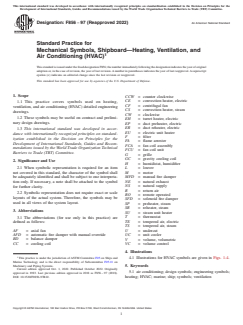
1.1 This practice covers symbols used on heating, ventilation, and air conditioning (HVAC) detailed engineering drawings.
1.2 These symbols may be useful on contract and preliminary design drawings.
1.3 This international standard was developed in accordance with internationally recognized principles on standardization established in the Decision on Principles for the Development of International Standards, Guides and Recommendations issued by the World Trade Organization Technical Barriers to Trade (TBT) Committee.
- Status
- Published
- Publication Date
- 30-Sep-2022
- Technical Committee
- F25 - Ships and Marine Technology
- Drafting Committee
- F25.11 - Machinery and Piping Systems
Overview
ASTM F856-97(2022), titled Standard Practice for Mechanical Symbols, Shipboard-Heating, Ventilation, and Air Conditioning (HVAC), offers a comprehensive framework for the use of standard mechanical symbols on engineering drawings related to shipboard HVAC systems. Developed by ASTM International in alignment with globally recognized practices from the World Trade Organization Technical Barriers to Trade (TBT) Committee, this standard enhances clarity and efficiency in the design, documentation, and communication of shipboard HVAC systems.
By providing a unified set of mechanical symbols, ASTM F856-97(2022) supports engineers, designers, and contractors in representing complex systems succinctly and consistently, minimizing potential errors and ambiguities in both preliminary and detailed design phases.
Key Topics
1. Scope of Symbol Usage
- Defines standard symbols for shipboard HVAC components used in detailed engineering drawings.
- Supports both contract documents and preliminary design schemes.
- Symbols are not required to be scaled representations of actual system layouts, allowing flexibility in various views.
2. Guidance for Unlisted Symbols
- When a symbol for a particular item is not included, users must create an adequately identified symbol subject to a single, clear interpretation.
- Supplemental notes may be attached for further clarity, ensuring all parties understand the intended meaning.
3. Abbreviations and Examples
- Outlines standard abbreviations such as:
- AF (Axial Fan), BD (Balance Damper), CC (Cooling Coil), EH (Turret Heater, Electric), FCU (Fan Coil Unit), MFD (Manual Fire Damper), SFD (Solenoid Fire Damper).
- Example components include ventilation fans, filters, heaters, dampers, and controls, covering all essential shipboard HVAC system parts.
4. Illustrations and Visual References
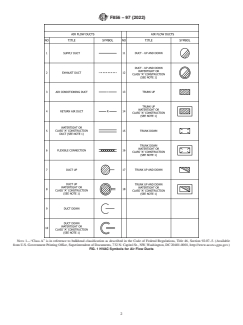
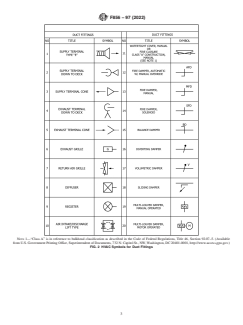
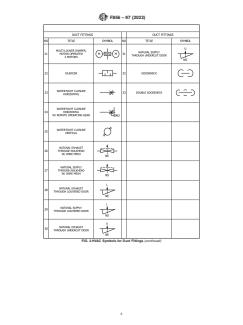
- Provides illustrative figures displaying HVAC symbols for ducts, fittings, ventilators, and appliances.
- Symbols are compatible with U.S. federal regulations and are referenced in official marine codes.
Applications
Shipboard HVAC System Design
- Ensures consistent and accurate representation of heating, ventilation, and air conditioning components in shipboard applications, aiding shipyards, naval architects, and marine engineers.
- Supports clear communication between diverse stakeholders, including designers, contractors, ship operators, and regulatory bodies.
Contract and Bid Documentation
- Standardizes symbol usage for contract drawings, improving clarity in technical specifications and work scopes.
- Facilitates easier review and approval processes with regulatory authorities by adhering to recognized international standards.
Engineering Project Management
- Enhances collaboration across multidisciplinary teams, reducing misunderstandings and technical discrepancies.
- Aids in streamlined system modification, retrofitting, and maintenance activities by providing universally understood symbols.
Related Standards
- ASTM F25: Standards related to ships and marine technology, under which this standard falls.
- ISO 14617: International standard for graphical symbols in diagrams.
- ASME Y32.2: American standard for graphic symbols for mechanical and architectural diagrams.
- IEC 60617: Standards for graphical symbols for diagrams relevant to electrical engineering, sometimes used in HVAC system diagrams.
- U.S. Code of Federal Regulations, Title 46, Section 92.07-5: Marine safety regulations that reference symbol classifications.
Keywords: shipboard HVAC symbols, marine engineering drawings, ventilation design standards, heating and air conditioning, mechanical symbol standardization, ASTM HVAC standards, ship system documentation, HVAC drawing abbreviations
By applying the ASTM F856-97(2022) standard, marine and shipbuilding professionals achieve greater consistency, safety, and compliance in the development and maintenance of shipboard HVAC systems.
Get Certified
Connect with accredited certification bodies for this standard

DIBt (Deutsches Institut für Bautechnik)
German Institute for Building Technology.
DIN CERTCO
DIN Group product certification.

Aboma Certification B.V.
Specialized in construction, metal, and transport sectors.
Sponsored listings
Frequently Asked Questions
ASTM F856-97(2022) is a standard published by ASTM International. Its full title is "Standard Practice for Mechanical Symbols, Shipboard-Heating, Ventilation, and Air Conditioning (HVAC)". This standard covers: SIGNIFICANCE AND USE 2.1 When symbolic representation is required for an item not covered in this standard, the character of the symbol shall be adequately identified and shall be subject to one interpretation only. If necessary, a note shall be attached to the symbol for further clarity. 2.2 Symbolic representation does not require exact or scale layouts of the actual system. Therefore, the symbols may be used in all views of the system layout. SCOPE 1.1 This practice covers symbols used on heating, ventilation, and air conditioning (HVAC) detailed engineering drawings. 1.2 These symbols may be useful on contract and preliminary design drawings. 1.3 This international standard was developed in accordance with internationally recognized principles on standardization established in the Decision on Principles for the Development of International Standards, Guides and Recommendations issued by the World Trade Organization Technical Barriers to Trade (TBT) Committee.
SIGNIFICANCE AND USE 2.1 When symbolic representation is required for an item not covered in this standard, the character of the symbol shall be adequately identified and shall be subject to one interpretation only. If necessary, a note shall be attached to the symbol for further clarity. 2.2 Symbolic representation does not require exact or scale layouts of the actual system. Therefore, the symbols may be used in all views of the system layout. SCOPE 1.1 This practice covers symbols used on heating, ventilation, and air conditioning (HVAC) detailed engineering drawings. 1.2 These symbols may be useful on contract and preliminary design drawings. 1.3 This international standard was developed in accordance with internationally recognized principles on standardization established in the Decision on Principles for the Development of International Standards, Guides and Recommendations issued by the World Trade Organization Technical Barriers to Trade (TBT) Committee.
ASTM F856-97(2022) is classified under the following ICS (International Classification for Standards) categories: 01.080.20 - Graphical symbols for use on specific equipment; 91.140.10 - Central heating systems; 91.140.30 - Ventilation and air-conditioning systems. The ICS classification helps identify the subject area and facilitates finding related standards.
ASTM F856-97(2022) is available in PDF format for immediate download after purchase. The document can be added to your cart and obtained through the secure checkout process. Digital delivery ensures instant access to the complete standard document.
Standards Content (Sample)
This international standard was developed in accordance with internationally recognized principles on standardization established in the Decision on Principles for the
Development of International Standards, Guides and Recommendations issued by the World Trade Organization Technical Barriers to Trade (TBT) Committee.
Designation: F856 − 97 (Reapproved 2022) An American National Standard
Standard Practice for
Mechanical Symbols, Shipboard—Heating, Ventilation, and
Air Conditioning (HVAC)
ThisstandardisissuedunderthefixeddesignationF856;thenumberimmediatelyfollowingthedesignationindicatestheyearoforiginal
adoption or, in the case of revision, the year of last revision.Anumber in parentheses indicates the year of last reapproval.Asuperscript
epsilon (´) indicates an editorial change since the last revision or reapproval.
This standard has been approved for use by agencies of the U.S. Department of Defense.
1. Scope
CCW = counter clockwise
CE = convection heater, electric
1.1 This practice covers symbols used on heating,
CF = centrifugal fan
ventilation, and air conditioning (HVAC) detailed engineering
CS = convection heater, steam
drawings.
CW = clockwise
1.2 These symbols may be useful on contract and prelimi-
EH = turret heater, electric
nary design drawings.
EP = duct preheater, electric
ER = duct reheater, electric
1.3 This international standard was developed in accor-
EU = electric unit heater
dance with internationally recognized principles on standard-
F = filter
ization established in the Decision on Principles for the
FA = flame arrester
Development of International Standards, Guides and Recom-
FCA = fan coil assembly
mendations issued by the World Trade Organization Technical
FCU = fan coil unit
Barriers to Trade (TBT) Committee.
G = grille
GC = gravity cooling coil
2. Significance and Use
H = humidistat, humidifier
2.1 When symbolic representation is required for an item
L = louver
not covered in this standard, the character of the symbol shall M = motor
MFD = manual fire damper
be adequately identified and shall be subject to one interpreta-
NE = natural exhaust
tion only. If necessary, a note shall be attached to the symbol
NS = natural supply
for further clarity.
R = return air
2.2 Symbolic representation does not require exact or scale
RO = remote operated
layouts of the actual system. Therefore, the symbols may be
SFD = solenoid fire damper
used in all views of the system layout.
SP = preheater, steam
SR = reheater, steam
3. Abbreviations
SU = steam unit heater
3.1 The abbreviations (for use only in this practice) are T = thermostat
TE = tempered air, electric
defined as follows:
TS = tempered air, steam
AF = axial fan
U = undercut
AFD = automatic fire damper with manual override UC = unit cooler
BD = balance damper V = volume, volumetric
CC = cooling coil VC = volume control
4. Illustrations
This practice is under the jurisdiction of ASTM Committee F25 on Ships and
4.1 Illustrations for HVAC symbols are given in Figs. 1-4.
Marine Technology and is the direct responsibility of Subcommittee F25.11 on
Machinery and Piping Systems. 5. Keywords
Current edition approved Oct. 1, 2022. Published October 2022. Originally
5.1 air conditioning; design symbols;
...