


ASTM A48/A48M-22
(Specification)Standard Specification for Gray Iron Castings
Standard Specification for Gray Iron Castings
ABSTRACT
This specification covers gray iron castings intended for general engineering use where tensile strength is a major consideration. Castings are classified on the basis of the tensile strength of the iron in separately cast test bars. The surface of the casting shall be free of adhering sand, scale, cracks, and hot tears, as determined by visual examination. The test bars are designated into S, A, B, and C categories, according to the thickness of its controlling wall section. The casting shall be subjected to a tension test to determine its tensile strength.
SCOPE
1.1 This specification covers gray iron castings intended for general engineering use where tensile strength is a major consideration. Castings are classified on the basis of the tensile strength of the iron in separately cast test bars.
1.1.1 This specification subordinates chemical composition to tensile strength.
1.2 Castings produced to this specification are graded on the basis of minimum tensile strength obtained in special test coupons designed to standardize cooling rate. The tensile strength developed in certain casting sections may vary from test coupon values (see X1.2).
1.3 The values stated in either SI units or inch-pound units are to be regarded separately as standard. The values stated in each system may not be exact equivalents; therefore, each system shall be used independently of the other. Combining values from the two systems may result in nonconformance with the standard.
1.4 This international standard was developed in accordance with internationally recognized principles on standardization established in the Decision on Principles for the Development of International Standards, Guides and Recommendations issued by the World Trade Organization Technical Barriers to Trade (TBT) Committee.
General Information
- Status
- Published
- Publication Date
- 30-Apr-2022
- Technical Committee
- A04 - Iron Castings
- Drafting Committee
- A04.01 - Grey and White Iron Castings
Relations
- Effective Date
- 01-Jan-2024
- Effective Date
- 01-Nov-2017
- Effective Date
- 15-Jul-2016
- Effective Date
- 01-Feb-2015
- Effective Date
- 01-Oct-2014
- Effective Date
- 01-Jun-2013
- Effective Date
- 01-May-2013
- Effective Date
- 01-Dec-2011
- Effective Date
- 01-Jul-2009
- Effective Date
- 01-Jun-2009
- Effective Date
- 01-Nov-2005
- Effective Date
- 10-Dec-1998
Overview
ASTM A48/A48M-22: Standard Specification for Gray Iron Castings establishes requirements for gray iron castings intended for general engineering applications where tensile strength plays a critical role. This internationally recognized standard, developed by ASTM International, supports the selection, classification, and testing of gray iron castings based on mechanical properties, specifically minimum tensile strength, rather than chemical composition. Both SI and inch-pound units are provided, with clear instructions on their independent use.
Key Topics
Classification by Tensile Strength
Gray iron castings under ASTM A48/A48M-22 are graded by the minimum tensile strength measured in separately cast test bars. These grades ensure consistent, reliable mechanical performance for engineering applications.Test Bar Designation
Castings are classified with a number-letter system, where the number indicates tensile strength and the letter (A, B, C, or S) corresponds to test bar dimensions and the thickness of the controlling wall section in the casting.Inspection and Testing
Surface quality requirements mandate castings be free from adhering sand, scale, cracks, and hot tears, determined by visual examination. Tension tests according to ASTM E8/E8M are used to verify compliance.Special Requirements and Options
Provisions exist for additional customer requirements such as chemical composition, microstructure, hardness, or pressure tightness. Agreement between manufacturer and purchaser may also include special heat treatments or alternative test procedures.Workmanship and Traceability
Requirements for clean surfaces, dimensional conformity, and product marking support traceability and quality assurance throughout manufacturing and delivery.
Applications
The ASTM A48/A48M-22 standard is utilized across multiple industries where reliable gray iron castings are essential due to their machinability, damping capacity, and ease of manufacture. Applications include:
- Automotive Components: Engine blocks, cylinder heads, brake drums, and housings
- Industrial Machinery: Pump housings, gear blanks, flywheels, and bases
- Infrastructure and Utilities: Pipe fittings, valve bodies, municipal castings (e.g., manhole covers)
- Construction Equipment: Counterweights, brackets, and structural frames
Its focus on tensile strength ensures parts perform safely under mechanical loads, making ASTM A48/A48M-22 an essential standard for specifying gray iron castings where dependability is required.
Related Standards
Organizations using ASTM A48/A48M-22 may also reference related ASTM and other international standards for comprehensive quality control and specification:
- ASTM A644: Terminology Relating to Iron Castings - for clear definitions
- ASTM E8/E8M: Standard Test Methods for Tension Testing of Metallic Materials
- MIL-STD-129: Marking for Shipment and Storage (for government and defense contracts)
- Federal Standard No. 123: Marking for Shipment (Civil Agencies)
Together, these standards ensure that gray iron castings meet precise mechanical and logistical criteria for engineering, procurement, and manufacturing operations.
Keywords: ASTM A48, A48/A48M-22, gray iron castings, tensile strength, iron casting specification, industrial castings, engineering standards, metal casting quality
Buy Documents
ASTM A48/A48M-22 - Standard Specification for Gray Iron Castings
REDLINE ASTM A48/A48M-22 - Standard Specification for Gray Iron Castings
Get Certified
Connect with accredited certification bodies for this standard

Element Materials Technology
Materials testing and product certification.

Inštitut za kovinske materiale in tehnologije
Institute of Metals and Technology. Materials testing, metallurgical analysis, NDT.
Sponsored listings
Frequently Asked Questions
ASTM A48/A48M-22 is a technical specification published by ASTM International. Its full title is "Standard Specification for Gray Iron Castings". This standard covers: ABSTRACT This specification covers gray iron castings intended for general engineering use where tensile strength is a major consideration. Castings are classified on the basis of the tensile strength of the iron in separately cast test bars. The surface of the casting shall be free of adhering sand, scale, cracks, and hot tears, as determined by visual examination. The test bars are designated into S, A, B, and C categories, according to the thickness of its controlling wall section. The casting shall be subjected to a tension test to determine its tensile strength. SCOPE 1.1 This specification covers gray iron castings intended for general engineering use where tensile strength is a major consideration. Castings are classified on the basis of the tensile strength of the iron in separately cast test bars. 1.1.1 This specification subordinates chemical composition to tensile strength. 1.2 Castings produced to this specification are graded on the basis of minimum tensile strength obtained in special test coupons designed to standardize cooling rate. The tensile strength developed in certain casting sections may vary from test coupon values (see X1.2). 1.3 The values stated in either SI units or inch-pound units are to be regarded separately as standard. The values stated in each system may not be exact equivalents; therefore, each system shall be used independently of the other. Combining values from the two systems may result in nonconformance with the standard. 1.4 This international standard was developed in accordance with internationally recognized principles on standardization established in the Decision on Principles for the Development of International Standards, Guides and Recommendations issued by the World Trade Organization Technical Barriers to Trade (TBT) Committee.
ABSTRACT This specification covers gray iron castings intended for general engineering use where tensile strength is a major consideration. Castings are classified on the basis of the tensile strength of the iron in separately cast test bars. The surface of the casting shall be free of adhering sand, scale, cracks, and hot tears, as determined by visual examination. The test bars are designated into S, A, B, and C categories, according to the thickness of its controlling wall section. The casting shall be subjected to a tension test to determine its tensile strength. SCOPE 1.1 This specification covers gray iron castings intended for general engineering use where tensile strength is a major consideration. Castings are classified on the basis of the tensile strength of the iron in separately cast test bars. 1.1.1 This specification subordinates chemical composition to tensile strength. 1.2 Castings produced to this specification are graded on the basis of minimum tensile strength obtained in special test coupons designed to standardize cooling rate. The tensile strength developed in certain casting sections may vary from test coupon values (see X1.2). 1.3 The values stated in either SI units or inch-pound units are to be regarded separately as standard. The values stated in each system may not be exact equivalents; therefore, each system shall be used independently of the other. Combining values from the two systems may result in nonconformance with the standard. 1.4 This international standard was developed in accordance with internationally recognized principles on standardization established in the Decision on Principles for the Development of International Standards, Guides and Recommendations issued by the World Trade Organization Technical Barriers to Trade (TBT) Committee.
ASTM A48/A48M-22 is classified under the following ICS (International Classification for Standards) categories: 77.140.80 - Iron and steel castings. The ICS classification helps identify the subject area and facilitates finding related standards.
ASTM A48/A48M-22 has the following relationships with other standards: It is inter standard links to ASTM E8/E8M-24, ASTM A644-17, ASTM E8/E8M-16, ASTM E8/E8M-15, ASTM A644-14, ASTM E8/E8M-13, ASTM A644-13, ASTM E8/E8M-11, ASTM A644-09a, ASTM A644-09, ASTM A644-05, ASTM A644-98(2003). Understanding these relationships helps ensure you are using the most current and applicable version of the standard.
ASTM A48/A48M-22 is available in PDF format for immediate download after purchase. The document can be added to your cart and obtained through the secure checkout process. Digital delivery ensures instant access to the complete standard document.
Standards Content (Sample)
This international standard was developed in accordance with internationally recognized principles on standardization established in the Decision on Principles for the
Development of International Standards, Guides and Recommendations issued by the World Trade Organization Technical Barriers to Trade (TBT) Committee.
Designation:A48/A48M −22
Standard Specification for
Gray Iron Castings
This standard is issued under the fixed designation A48/A48M; the number immediately following the designation indicates the year
of original adoption or, in the case of revision, the year of last revision. A number in parentheses indicates the year of last reapproval.
A superscript epsilon (´) indicates an editorial change since the last revision or reapproval.
This standard has been approved for use by agencies of the U.S. Department of Defense.
This specification replaces Federal Specification QQ-I-652.
1. Scope 2.2 Military Standard:
MIL-STD-129 Marking for Shipment and Storage
1.1 This specification covers gray iron castings intended for
2.3 Federal Standard:
general engineering use where tensile strength is a major
Federal Standard No. 123 Marking for Shipment (Civil
consideration. Castings are classified on the basis of the tensile
Agencies)
strength of the iron in separately cast test bars.
1.1.1 This specification subordinates chemical composition
3. Terminology
to tensile strength.
3.1 Definitions:
1.2 Castings produced to this specification are graded on the
3.1.1 Definitions for many terms common to gray iron
basis of minimum tensile strength obtained in special test
castings are found in Terminology A644.
coupons designed to standardize cooling rate. The tensile
strength developed in certain casting sections may vary from
4. Classification
test coupon values (see X1.2).
4.1 Castings ordered and produced in accordance with this
1.3 The values stated in either SI units or inch-pound units
specificationareclassifiedintoanumberofgradesbasedonthe
are to be regarded separately as standard. The values stated in
properties of separately cast test bars (Tables 1 and 2). Each
each system may not be exact equivalents; therefore, each
class is designated by a number followed by a letter. The
system shall be used independently of the other. Combining number indicates the minimum tensile strength of the sepa-
values from the two systems may result in nonconformance
rately cast test bar, and the letter indicates the size of the test
with the standard. bar. Examples of proper designations are as follows:
4.1.1 Gray Iron Castings, ASTM Specification A48, Class
1.4 This international standard was developed in accor-
30B.
dance with internationally recognized principles on standard-
4.1.2 Gray Iron Castings, ASTM Specification A48, Class
ization established in the Decision on Principles for the
40C.
Development of International Standards, Guides and Recom-
mendations issued by the World Trade Organization Technical
5. Ordering Information
Barriers to Trade (TBT) Committee.
5.1 Orders for material to this specification shall include the
following information:
2. Referenced Documents
5.1.1 ASTM designation number and year of issue,
2.1 ASTM Standards:
5.1.2 Class of iron required (see 4.1 and Tables 1 and 2),
A644 Terminology Relating to Iron Castings
5.1.3 The size of the separately cast test bar (letter
E8/E8M Test Methods for Tension Testing of Metallic Ma-
classification—A, B, C, or S) that best represents the thickness
terials
of the controlling section of the casting (see Table 3),
5.1.4 The tension test specimen (B or C) to be machined
from test bar C (see 13.3, Table 4, and Fig. 1),
This specification is under the jurisdiction of ASTM Committee A04 on Iron
5.1.5 The tension test specimen to be machined from test
CastingsandisthedirectresponsibilityofSubcommitteeA04.01onGreyandWhite
bar S (see 13.4, Table 4, and Fig. 1),
Iron Castings.
5.1.6 Lot size (see Section 10),
Current edition approved May 1, 2022. Published May 2022. Originally
5.1.7 Special requirements (see Section 6),
approved in 1905. Last previous edition approved in 2021 as A48/
A48M – 03 (2021). DOI: 10.1520/A0048_A0048M-22.
For referenced ASTM standards, visit the ASTM website, www.astm.org, or
contact ASTM Customer Service at service@astm.org. For Annual Book of ASTM Available from Standardization Documents Order Desk, DODSSP, Bldg. 4,
Standards volume information, refer to the standard’s Document Summary page on Section D, 700 Robbins Ave., Philadelphia, PA 19111-5098, http://
the ASTM website. www.dodssp.daps.mil.
Copyright © ASTM International, 100 Barr Harbor Drive, PO Box C700, West Conshohocken, PA 19428-2959. United States
A48/A48M−22
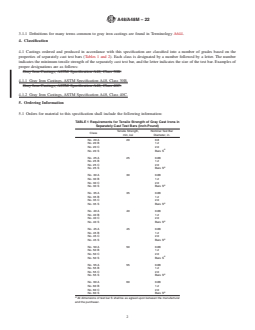
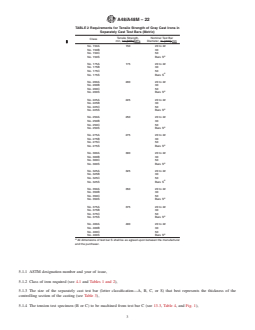
TABLE 1 Requirements for Tensile Strength of Gray Cast Irons in TABLE 2 Requirements for Tensile Strength of Gray Cast Irons in
Separately Cast Test Bars (Inch-Pound) Separately Cast Test Bars (Metric)
Tensile Strength, Nominal Test Bar Tensile Strength, Nominal Test Bar
Class Class
min, ksi Diameter, in. min, MPa Diameter, mm
No. 20 A 20 0.8 No. 150A 150 20 to 22
No. 20 B 1.2 No. 150B 30
No. 20 C 2.0 No. 150C 50
A A
No. 20 S Bars S No. 150S Bars S
No. 25 A 25 0.88 No. 175A 175 20 to 22
No. 25 B 1.2 No. 175B 30
No. 25 C 2.0 No. 175C 50
A A
No. 25 S Bars S No. 175S Bars S
No. 30 A 30 0.88 No. 200A 200 20 to 22
No. 30 B 1.2 No. 200B 30
No. 30 C 2.0 No. 200C 50
A A
No. 30 S Bars S No. 200S Bars S
No. 35 A 35 0.88 No. 225A 225 20 to 22
No. 35 B 1.2 No. 225B 30
No. 35 C 2.0 No. 225C 50
A A
No. 35 S Bars S No. 225S Bars S
No. 40 A 40 0.88 No. 250A 250 20 to 22
No. 40 B 1.2 No. 250B 30
No. 40 C 2.0 No. 250C 50
A A
No. 40 S Bars S No. 250S Bars S
No. 45 A 45 0.88 No. 275A 275 20 to 22
No. 45 B 1.2 No. 275B 30
No. 45 C 2.0 No. 275C 50
A A
No. 45 S Bars S No. 275S Bars S
No. 50 A 50 0.88 No. 300A 300 20 to 22
No. 50 B 1.2 No. 300B 30
No. 50 C 2.0 No. 300C 50
A A
No. 50 S Bars S No. 300S Bars S
No. 55 A 55 0.88 No. 325A 325 20 to 22
No. 55 B 1.2 No. 325B 30
No. 55 C 2.0 No. 325C 50
A A
No. 55 S Bars S No. 325S Bars S
No. 60 A 60 0.88 No. 350A 350 20 to 22
No. 60 B 1.2 No. 350B 30
No. 60 C 2.0 No. 350C 50
A A
No. 60 S Bars S No. 350S Bars S
A
All dimensions of test bar S shall be as agreed upon between the manufacturer
No. 375A 375 20 to 22
and the purchaser.
No. 375B 30
No. 375C 50
A
No. 375S Bars S
No. 400A 400 20 to 22
No. 400B 30
No. 400C 50
5.1.8 Saving tested specimens or unbroken test bars (see
A
No. 400S Bars S
15.1), and
A
All dimensions of test bar S shall be as agreed upon between the manufacturer
5.1.9 Special preparation for delivery (see Section 19).
and the purchaser.
6. Special Requirements
6.1 When agreed upon in writing between the manufacturer
8. Dimensional Requirements
and the purchaser, it may be necessary for the castings to meet
8.1 The castings shall conform to the dimensions or draw-
special requirements as to hardness, chemical composition,
ings furnished by the purchaser or, if there are no drawings, to
microstructure, pressure tightness, radiographic soundness,
the dimensions predicted by the pattern equipment supplied by
dimensions, surface finish, and so forth.
the purchaser.
7. Tensile Requirements
9. Workmanship and Finish
7.1 Test bars representing castings conforming to this speci- 9.1 The surface of the casting shall be free of adhering sand,
fication shall meet the requirements for tensile strength as scale, cracks, and hot tears, as determined by visual examina-
described in Tables 1 and 2. tion.
A48/A48M−22
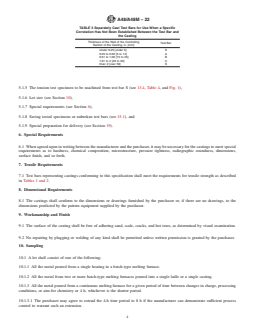
TABLE 3 Separately Cast Test Bars for Use When a Specific
11.4 Test bars that are intended to represent castings that are
Correlation Has Not Been Established Between the Test Bar and
hotter than 900 °F [480 °C], when shaken out of their molds,
the Casting
shall be cooled as described in 11.3 or (by agreement between
Thickness of the Wall of the Controlling
Test Bar the manufacturer and the purchaser) may be shaken out of their
Section of the Casting, in. [mm]
molds at approximately the same temperature as the castings
Under 0.25 [under 5] S
they represent.
0.25 to 0.50 [5 to 14] A
0.51 to 1.00 [15 to 25] B
11.5 When castings are stress-relieved, annealed, or other-
1.01 to 2 [26 to 50] C
Over 2 [over 50] S wise heat-treated, test bars shall receive the same thermal
treatment and shall be treated adjacent to the castings they
represent.
12. Number of Tests and Retests
9.2 No repairing by plugging or welding of any kind shall
be permitted unless written permission is granted by the
12.1 The tension test shall be conducted in accordance with
purchaser.
Test Methods E8/E8M.
12.2 One tension test shall be performed on each lot and
10. Sampling
shall conform to the tensile requirements specified.
10.1 A lot shall consist of one of the following:
12.3 If the results of a valid test fail to conform to the
10.1.1 All the metal poured from a single heating in a
requirements of this specification, two retests shall be made. If
batch-type melting furnace.
either retest fails to meet the specification requirements, the
10.1.2 All the metal from two or more batch-type melting
castings represented by these test specimens shall be rejected.
furnaces poured into a single ladle or a single casting.
A valid test is one wherein the specimen has been properly
10.1.3 All the metal poured from a continuous melting
prepared and appears to be sound and on which the approved
furnace for a given period of time between changes in charge,
test procedure has been followed.
processing conditions, or aim-for chemistry or 4 h, whichever
is the shorter period.
12.4 Ifsufficientseparatelycasttestpiecesarenotavailable,
10.1.3.1 The purchaser may agree to extend the 4-h time
the manufacturer shall have the option of removing a test
period to8hifthe manufacturer can demonstrate sufficient
specimen from a location of representative casting, as agreed
process control to warrant such an extension.
upon between the manufacturer and purchaser.
12.5 If the first test results indicate that a heat treatment is
11. Cast Test Bars
needed to meet the test requirements, the entire lot of castings
11.1 Test bars shall be separate castings poured from the
and the representative test specimens shall be heat treated
same lot as the castings they represent and shall have dimen-
together. Testing shall proceed in accordance with 12.1 – 12.3.
sions as shown in Table 4. Allowance may be made for
12.6 If, after testing, a test specimen shows evidence of a
reasonablepatterndraftwithinthetolerancesshowninTable4.
defect, the results of the test may be invalidated and another
Test bars A, B, and C are all standard test bars in the form of
made on a specimen from the same lot.
simple cylinders. Test bar S is special and is intended for use
where the standard bars are not satisfactory.
13. Tension Test Specimens
11.2 The test bars shall be cast in dried, baked, or chemi-
13.1 For test barA, the tension test specimenA, as sh
...
This document is not an ASTM standard and is intended only to provide the user of an ASTM standard an indication of what changes have been made to the previous version. Because
it may not be technically possible to adequately depict all changes accurately, ASTM recommends that users consult prior editions as appropriate. In all cases only the current version
of the standard as published by ASTM is to be considered the official document.
Designation: A48/A48M − 03 (Reapproved 2021) A48/A48M − 22
Standard Specification for
Gray Iron Castings
This standard is issued under the fixed designation A48/A48M; the number immediately following the designation indicates the year
of original adoption or, in the case of revision, the year of last revision. A number in parentheses indicates the year of last reapproval.
A superscript epsilon (´) indicates an editorial change since the last revision or reapproval.
This standard has been approved for use by agencies of the U.S. Department of Defense.
This specification replaces Federal Specification QQ-I-652.
1. Scope
1.1 This specification covers gray iron castings intended for general engineering use where tensile strength is a major
consideration. Castings are classified on the basis of the tensile strength of the iron in separately cast test bars.
1.1.1 This specification subordinates chemical composition to tensile strength.
1.2 Castings produced to this specification are graded on the basis of minimum tensile strength obtained in special test coupons
designed to standardize cooling rate. The tensile strength developed in certain casting sections may vary from test coupon values
(see X1.2).
1.3 The values stated in either SI units or inch-pound units are to be regarded separately as standard. The values stated in each
system may not be exact equivalents; therefore, each system shall be used independently of the other. Combining values from the
two systems may result in nonconformance with the standard.
1.4 This international standard was developed in accordance with internationally recognized principles on standardization
established in the Decision on Principles for the Development of International Standards, Guides and Recommendations issued
by the World Trade Organization Technical Barriers to Trade (TBT) Committee.
2. Referenced Documents
2.1 ASTM Standards:
A644 Terminology Relating to Iron Castings
E8/E8M Test Methods for Tension Testing of Metallic Materials
2.2 Military Standard:
MIL-STD-129 Marking for Shipment and Storage
2.3 Federal Standard:
Federal Standard No. 123 Marking for Shipment (Civil Agencies)
3. Terminology
3.1 Definitions:
This specification is under the jurisdiction of ASTM Committee A04 on Iron Castings and is the direct responsibility of Subcommittee A04.01 on Grey and White Iron
Castings.
Current edition approved Sept. 1, 2021May 1, 2022. Published September 2021May 2022. Originally approved in 1905. Last previous edition approved in 20162021 as
A48/A48M – 03 (2016).(2021). DOI: 10.1520/A0048_A0048M-03R21.10.1520/A0048_A0048M-22.
For referenced ASTM standards, visit the ASTM website, www.astm.org, or contact ASTM Customer Service at service@astm.org. For Annual Book of ASTM Standards
volume information, refer to the standard’s Document Summary page on the ASTM website.
Available from Standardization Documents Order Desk, DODSSP, Bldg. 4, Section D, 700 Robbins Ave., Philadelphia, PA 19111-5098, http://www.dodssp.daps.mil.
Copyright © ASTM International, 100 Barr Harbor Drive, PO Box C700, West Conshohocken, PA 19428-2959. United States
A48/A48M − 22
3.1.1 Definitions for many terms common to gray iron castings are found in Terminology A644.
4. Classification
4.1 Castings ordered and produced in accordance with this specification are classified into a number of grades based on the
properties of separately cast test bars (Tables 1 and 2). Each class is designated by a number followed by a letter. The number
indicates the minimum tensile strength of the separately cast test bar, and the letter indicates the size of the test bar. Examples of
proper designations are as follows:
Gray Iron Castings, ASTM Specification A48, Class 30B.
4.1.1 Gray Iron Castings, ASTM Specification A48, Class 30B.
Gray Iron Castings, ASTM Specification A48, Class 40C.
4.1.2 Gray Iron Castings, ASTM Specification A48, Class 40C.
5. Ordering Information
5.1 Orders for material to this specification shall include the following information:
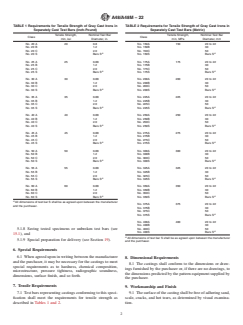
TABLE 1 Requirements for Tensile Strength of Gray Cast Irons in
Separately Cast Test Bars (Inch-Pound)
Tensile Strength, Nominal Test Bar
Class
min, ksi Diameter, in.
No. 20 A 20 0.8
No. 20 B 1.2
No. 20 C 2.0
A
No. 20 S Bars S
No. 25 A 25 0.88
No. 25 B 1.2
No. 25 C 2.0
A
No. 25 S Bars S
No. 30 A 30 0.88
No. 30 B 1.2
No. 30 C 2.0
A
No. 30 S Bars S
No. 35 A 35 0.88
No. 35 B 1.2
No. 35 C 2.0
A
No. 35 S Bars S
No. 40 A 40 0.88
No. 40 B 1.2
No. 40 C 2.0
A
No. 40 S Bars S
No. 45 A 45 0.88
No. 45 B 1.2
No. 45 C 2.0
A
No. 45 S Bars S
No. 50 A 50 0.88
No. 50 B 1.2
No. 50 C 2.0
A
No. 50 S Bars S
No. 55 A 55 0.88
No. 55 B 1.2
No. 55 C 2.0
A
No. 55 S Bars S
No. 60 A 60 0.88
No. 60 B 1.2
No. 60 C 2.0
A
No. 60 S Bars S
A
All dimensions of test bar S shall be as agreed upon between the manufacturer
and the purchaser.
A48/A48M − 22
TABLE 2 Requirements for Tensile Strength of Gray Cast Irons in
Separately Cast Test Bars (Metric)
Tensile Strength, Nominal Test Bar
Class
min, ksi [MPa]MPa Diameter, in. [mm] mm
No. 150A 150 20 to 22
No. 150B 30
No. 150C 50
A
No. 150S Bars S
No. 175A 175 20 to 22
No. 175B 30
No. 175C 50
A
No. 175S Bars S
No. 200A 200 20 to 22
No. 200B 30
No. 200C 50
A
No. 200S Bars S
No. 225A 225 20 to 22
No. 225B 30
No. 225C 50
A
No. 225S Bars S
No. 250A 250 20 to 22
No. 250B 30
No. 250C 50
A
No. 250S Bars S
No. 275A 275 20 to 22
No. 275B 30
No. 275C 50
A
No. 275S Bars S
No. 300A 300 20 to 22
No. 300B 30
No. 300C 50
A
No. 300S Bars S
No. 325A 325 20 to 22
No. 325B 30
No. 325C 50
A
No. 325S Bars S
No. 350A 350 20 to 22
No. 350B 30
No. 350C 50
A
No. 350S Bars S
No. 375A 375 20 to 22
No. 375B 30
No. 375C 50
A
No. 375S Bars S
No. 400A 400 20 to 22
No. 400B 30
No. 400C 50
A
No. 400S Bars S
A
All dimensions of test bar S shall be as agreed upon between the manufacturer
and the purchaser.
5.1.1 ASTM designation number and year of issue,
5.1.2 Class of iron required (see 4.1 and Tables 1 and 2),
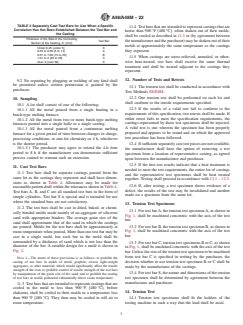
5.1.3 The size of the separately cast test bar (letter classification—A, B, C, or S) that best represents the thickness of the
controlling section of the casting (see Table 3),
5.1.4 The tension test specimen (B or C) to be machined from test bar C (see 13.3, Table 4, and Fig. 1),
A48/A48M − 22
TABLE 3 Separately Cast Test Bars for Use When a Specific
Correlation Has Not Been Established Between the Test Bar and
the Casting
Thickness of the Wall of the Controlling
Test Bar
Section of the Casting, in. [mm]
Under 0.25 [under 5] S
0.25 to 0.50 [5 to 14] A
0.51 to 1.00 [15 to 25] B
1.01 to 2 [26 to 50] C
Over 2 [over 50] S
5.1.5 The tension test specimen to be machined from test bar S (see 13.4, Table 4, and Fig. 1),
5.1.6 Lot size (see Section 10),
5.1.7 Special requirements (see Section 6),
5.1.8 Saving tested specimens or unbroken test bars (see 15.1), and
5.1.9 Special preparation for delivery (see Section 19).
6. Special Requirements
6.1 When agreed upon in writing between the manufacturer and the purchaser, it may be necessary for the castings to meet special
requirements as to hardness, chemical composition, microstructure, pressure tightness, radiographic soundness, dimensions,
surface finish, and so forth.
7. Tensile Requirements
7.1 Test bars representing castings conforming to this specification shall meet the requirements for tensile strength as described
in Tables 1 and 2.
8. Dimensional Requirements
8.1 The castings shall conform to the dimensions or drawings furnished by the purchaser or, if there are no drawings, to the
dimensions predicted by the pattern equipment supplied by the purchaser.
9. Workmanship and Finish
9.1 The surface of the casting shall be free of adhering sand, scale, cracks, and hot tears, as determined by visual examination.
9.2 No repairing by plugging or welding of any kind shall be permitted unless written permission is granted by the purchaser.
10. Sampling
10.1 A lot shall consist of one of the following:
10.1.1 All the metal poured from a single heating in a batch-type melting furnace.
10.1.2 All the metal from two or more batch-type melting furnaces poured into a single ladle or a single casting.
10.1.3 All the metal poured from a continuous melting furnace for a given period of time between changes in charge, processing
conditions, or aim-for chemistry or 4 h, whichever is the shorter period.
10.1.3.1 The purchaser may agree to extend the 4-h time period to 8 h if the manufacturer can demonstrate sufficient process
control to warrant such an extension.
A48/A48M − 22
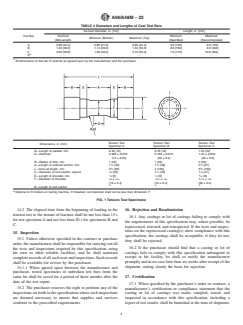
TABLE 4 Diameters and Lengths of Cast Test Bars
As-Cast Diameter, in. [mm] Length, in. [mm]
Test Bar
Nominal Minimum Maximum
Minimum (Bottom) Maximum (Top)
(Mid-Length) (Specified) (Recommended)
A 0.88 [22.4] 0.85 [21.6] 0.96 [24.4] 5.0 [125] 6.0 [150]
B 1.20 [30.5] 1.14 [29.0] 1.32 [33.5] 6.0 [150] 9.0 [230]
C 2.00 [50.8] 1.90 [48.3] 2.10 [53.3] 7.0 [175] 10.0 [255]
A
S . . . . . . . . . . . . . . .
A
All dimensions of test bar S shall be as agreed upon by the manufacturer and the purchaser.
Tension Test Tension Test Tension Test
Dimensions, in. [mm]
Specimen A Specimen B Specimen C
G—Length of parallel, min 0.50 [13] 0.75 [19] 1.25 [32]
D—Diameter 0.500 ± 0.010 0.750 ± 0.015 1.25 ± 0.025
[13 ± 0.25] [20 ± 0.4] [30 ± 0.6]
R—Radius of fillet, min 1 [25] 1 [25] 2 [50]
1 1 1
A—Length of reduced section, min 1 ⁄4 [32] 1 ⁄2 [38] 2 ⁄4 [57]
3 3
L—Over-all length, min 3 ⁄4 [95] 4 [100] 6 ⁄8 [160]
7 1 7
C—Diameter of end section, approx ⁄8 [20] 1 ⁄4 [20] 1 ⁄8 [47]
1 1 5
E—Length of shoulder, min ⁄4 [6] ⁄4 [6] ⁄16 [8]
5 1 15 1 7 1
F—Diameter of shoulder ⁄8 ± ⁄64 ⁄16 ± ⁄64 1 ⁄16 ± ⁄64
[16 ± 0.4] [24 ± 0.4] [36 ± 0.4]
A A A
B—Length of end section
A
Optional to fit holders on testing machine. If threaded, root diameter shall not be less than dimension F.
FIG. 1 Tension Test Specimens
11. Cast Test Bars
11.1 Test bars shall be separate castings poured from the same lot as the castings they represent and shall have dimensions as
shown in Table 4. Allowance may be made for reasonable pattern draft within the tolerances shown in Table 4. Test bars A, B, and
C are all standard test bars in the form of simple cylinders. Test bar S is special and is intended for use where the standard bars
are not satisfactory.
11.2 The test bars shall be cast in dried, baked, or chemically bonded molds made mainly of an aggregate of siliceous sand with
appropriate binders. The average grain size of the sand shall approximate that of the sand in which the castings are poured. Molds
for the test bars shall be approximately at room temperature when poured. More than one test bar may be cast in a single mold,
but each bar in the mold shall be surrounded by a thickness of sand which is not
...
Questions, Comments and Discussion
Ask us and Technical Secretary will try to provide an answer. You can facilitate discussion about the standard in here.
Loading comments...