

ASTM D7856-21
(Specification)Standard Specification for Color and Appearance Retention of Solid and Variegated Color Plastic Siding Products using CIELab Color Space
General Information
- Abstract
SCOPE
1.1 This specification establishes requirements and test methods for the color and appearance retention of solid and variegated colored plastic siding products.
1.2 Color retention testing provides a method for estimating the acceptability of color change in a plastic siding product over an extended period of service.
Note 1: The exposure locations and durations specified in this standard have been shown to provide a good estimation of the color change in vinyl and polypropylene siding products over an extended period of service (see 2.2). It is expected that materials designed for the exposure conditions typical of exterior siding will respond similarly, but the applicability of this standard to other types of plastic siding has not been empirically established.
1.3 This specification is a successor to Specifications D6864 and D7251, which cover solid colors and variegated colors, respectively. This specification combines coverage for both, and has the same scope as those standards.
1.4 Specifications D6864 and D7251 use Hunter Lab color space for measurement of colors and evaluation of color change. These standards require classification of colors into regions based on the L, a, and b coordinates of the color, and evaluation of color changes is done using an ellipsoid value equation having unique coefficients for each color region. This specification uses CIE 1976 L* a* b* color space for measurement and evaluation of color change. Using this method, the need for separate color regions and evaluation equations has been eliminated.
1.5 Provisions for sample selection and preparation, and weathering are the same in this specification as in Specifications D6864 and D7251.
1.6 Characterization of color and appearance for variegated colors is complicated by the presence of multiple colors in a random pattern. The procedure for measuring variegated colors in this specification is based on using a template to reference six spots for color measurement.
1.7 This standard specifies outdoor weathering in three specific climate zones for a single 24-month exposure, and the color retention performance requirements under these conditions are established to be indicative of acceptable performance over an extended period of service. However, nothing in this standard precludes the use of different or additional climate zones, or different exposure durations, so long as those conditions are clearly specified in any reports.
1.8 Units—The values stated in inch-pound units are to be regarded as standard. The values given in parentheses are mathematical conversions to SI units that are provided for information only and are not considered standard.
1.9 This standard does not purport to address all of the safety concerns, if any, associated with its use. It is the responsibility of the user of this standard to establish appropriate safety, health, and environmental practices and determine the applicability of regulatory limitations prior to use.
Note 2: There is no known ISO equivalent to this standard.
1.10 This international standard was developed in accordance with internationally recognized principles on standardization established in the Decision on Principles for the Development of International Standards, Guides and Recommendations issued by the World Trade Organization Technical Barriers to Trade (TBT) Committee.
- Status
- Published
- Publication Date
- 30-Jun-2021
- Technical Committee
- D20 - Plastics
- Drafting Committee
- D20.24 - Plastic Building Products
Buy Documents
ASTM D7856-21 - Standard Specification for Color and Appearance Retention of Solid and Variegated Color Plastic Siding Products using CIELab Color Space
REDLINE ASTM D7856-21 - Standard Specification for Color and Appearance Retention of Solid and Variegated Color Plastic Siding Products using CIELab Color Space
Overview
ASTM D7856-21: Standard Specification for Color and Appearance Retention of Solid and Variegated Color Plastic Siding Products using CIELab Color Space defines requirements and testing methods for the color and appearance retention of both solid and variegated plastic siding products. The standard specifically covers vinyl and polypropylene siding but may apply to other plastics designed for exterior siding applications. By using CIE 1976 Lab* (CIELab) color space, this specification offers a unified approach for evaluating color changes under outdoor weathering conditions, ensuring long-term color durability for building materials.
Key Topics
Color Retention and Evaluation
The standard establishes procedures to estimate color change over extended service periods. It eliminates prior complexities by using CIELab color space, which treats all colors with a single method, removing the need for separate equations and color region classifications.Sample Selection and Preparation
- Samples must represent the finished commercial product.
- Both solid and variegated color siding require specific specimen sizes and preparation methods to ensure accurate and reproducible results.
- For variegated colors, a template referencing six discrete spots is used to account for random color patterns.
Outdoor Weathering Testing
- Requires specimen exposure in three distinct North American climate zones: temperate northern, hot humid, and hot dry.
- Weathering lasts for 24 months, simulating real-world exterior conditions.
- Color measurements are taken before and after exposure using standardized equipment and procedures.
Performance Criteria
- Color change (ΔE) is calculated according to the CIEDE2000 equation.
- Acceptable performance: average color change ΔE ≤ 4.0; no specimen may exceed ΔE 6.0.
- Visual assessment ensures surfaces are free of defects such as peeling, flaking, cracking, and loss of variegation.
Applications
Building and Construction Materials
- Ensures long-term aesthetic performance of vinyl and polypropylene siding products used in residential and commercial construction.
- Provides confidence to architects, builders, and homeowners regarding color durability under varied climatic conditions.
Quality Assurance and Product Development
- Assists manufacturers in developing, testing, and certifying siding products for color retention, helping to reduce product failures and warranty claims.
- Useful for third-party testing laboratories and certification bodies that validate product compliance with industry requirements.
Specification and Purchase Decisions
- Decision-makers and material specifiers can use ASTM D7856-21 to compare products and select siding with proven long-term color stability.
- Facilitates communication between suppliers and users regarding expected color performance over time.
Related Standards
- ASTM D6864 (Withdrawn): Former specification for solid-colored plastic siding.
- ASTM D7251 (Withdrawn): Former specification for variegated color plastic siding.
- ASTM D1435: Practice for Outdoor Weathering of Plastics.
- ASTM D2244: Practice for Calculation of Color Tolerances and Differences.
- ASTM E1331: Test Method for Reflectance Factor and Color by Spectrophotometry.
- ASTM D4214, D660, D661, D662, D714, D772: Methods for evaluating surface defects and weathering-induced changes in appearance.
- ASTM D883, D1600: Terminology for plastics and related abbreviated terms.
Note: There is currently no known ISO equivalent to ASTM D7856-21.
Keywords: ASTM D7856-21, CIELab, color retention, plastic siding, vinyl siding, polypropylene siding, weatherability, color change, building materials, appearance retention, outdoor weathering, construction standards
Relations
- Effective Date
- 02-May-2018
- Effective Date
- 02-May-2018
- Effective Date
- 01-Feb-2024
- Effective Date
- 01-Nov-2023
- Effective Date
- 01-Nov-2023
- Refers
ASTM D4214-23 - Standard Test Methods for Evaluating the Degree of Chalking of Exterior Paint Films - Effective Date
- 01-Oct-2023
- Effective Date
- 01-Jan-2020
- Effective Date
- 01-Nov-2019
- Effective Date
- 01-Oct-2019
- Refers
ASTM D660-93(2019) - Standard Test Method for Evaluating Degree of Checking of Exterior Paints - Effective Date
- 01-Oct-2019
- Refers
ASTM D661-93(2019) - Standard Test Method for Evaluating Degree of Cracking of Exterior Paints - Effective Date
- 01-Oct-2019
- Effective Date
- 01-Aug-2019
- Effective Date
- 15-Apr-2019
- Effective Date
- 01-Feb-2019
- Effective Date
- 01-Dec-2018
Buy Documents
ASTM D7856-21 - Standard Specification for Color and Appearance Retention of Solid and Variegated Color Plastic Siding Products using CIELab Color Space
REDLINE ASTM D7856-21 - Standard Specification for Color and Appearance Retention of Solid and Variegated Color Plastic Siding Products using CIELab Color Space
Get Certified
Connect with accredited certification bodies for this standard

DIN CERTCO
DIN Group product certification.

Smithers Quality Assessments
US management systems and product certification.
Sponsored listings
Frequently Asked Questions
ASTM D7856-21 is a technical specification published by ASTM International. Its full title is "Standard Specification for Color and Appearance Retention of Solid and Variegated Color Plastic Siding Products using CIELab Color Space". This standard covers: SCOPE 1.1 This specification establishes requirements and test methods for the color and appearance retention of solid and variegated colored plastic siding products. 1.2 Color retention testing provides a method for estimating the acceptability of color change in a plastic siding product over an extended period of service. Note 1: The exposure locations and durations specified in this standard have been shown to provide a good estimation of the color change in vinyl and polypropylene siding products over an extended period of service (see 2.2). It is expected that materials designed for the exposure conditions typical of exterior siding will respond similarly, but the applicability of this standard to other types of plastic siding has not been empirically established. 1.3 This specification is a successor to Specifications D6864 and D7251, which cover solid colors and variegated colors, respectively. This specification combines coverage for both, and has the same scope as those standards. 1.4 Specifications D6864 and D7251 use Hunter Lab color space for measurement of colors and evaluation of color change. These standards require classification of colors into regions based on the L, a, and b coordinates of the color, and evaluation of color changes is done using an ellipsoid value equation having unique coefficients for each color region. This specification uses CIE 1976 L* a* b* color space for measurement and evaluation of color change. Using this method, the need for separate color regions and evaluation equations has been eliminated. 1.5 Provisions for sample selection and preparation, and weathering are the same in this specification as in Specifications D6864 and D7251. 1.6 Characterization of color and appearance for variegated colors is complicated by the presence of multiple colors in a random pattern. The procedure for measuring variegated colors in this specification is based on using a template to reference six spots for color measurement. 1.7 This standard specifies outdoor weathering in three specific climate zones for a single 24-month exposure, and the color retention performance requirements under these conditions are established to be indicative of acceptable performance over an extended period of service. However, nothing in this standard precludes the use of different or additional climate zones, or different exposure durations, so long as those conditions are clearly specified in any reports. 1.8 Units—The values stated in inch-pound units are to be regarded as standard. The values given in parentheses are mathematical conversions to SI units that are provided for information only and are not considered standard. 1.9 This standard does not purport to address all of the safety concerns, if any, associated with its use. It is the responsibility of the user of this standard to establish appropriate safety, health, and environmental practices and determine the applicability of regulatory limitations prior to use. Note 2: There is no known ISO equivalent to this standard. 1.10 This international standard was developed in accordance with internationally recognized principles on standardization established in the Decision on Principles for the Development of International Standards, Guides and Recommendations issued by the World Trade Organization Technical Barriers to Trade (TBT) Committee.
SCOPE 1.1 This specification establishes requirements and test methods for the color and appearance retention of solid and variegated colored plastic siding products. 1.2 Color retention testing provides a method for estimating the acceptability of color change in a plastic siding product over an extended period of service. Note 1: The exposure locations and durations specified in this standard have been shown to provide a good estimation of the color change in vinyl and polypropylene siding products over an extended period of service (see 2.2). It is expected that materials designed for the exposure conditions typical of exterior siding will respond similarly, but the applicability of this standard to other types of plastic siding has not been empirically established. 1.3 This specification is a successor to Specifications D6864 and D7251, which cover solid colors and variegated colors, respectively. This specification combines coverage for both, and has the same scope as those standards. 1.4 Specifications D6864 and D7251 use Hunter Lab color space for measurement of colors and evaluation of color change. These standards require classification of colors into regions based on the L, a, and b coordinates of the color, and evaluation of color changes is done using an ellipsoid value equation having unique coefficients for each color region. This specification uses CIE 1976 L* a* b* color space for measurement and evaluation of color change. Using this method, the need for separate color regions and evaluation equations has been eliminated. 1.5 Provisions for sample selection and preparation, and weathering are the same in this specification as in Specifications D6864 and D7251. 1.6 Characterization of color and appearance for variegated colors is complicated by the presence of multiple colors in a random pattern. The procedure for measuring variegated colors in this specification is based on using a template to reference six spots for color measurement. 1.7 This standard specifies outdoor weathering in three specific climate zones for a single 24-month exposure, and the color retention performance requirements under these conditions are established to be indicative of acceptable performance over an extended period of service. However, nothing in this standard precludes the use of different or additional climate zones, or different exposure durations, so long as those conditions are clearly specified in any reports. 1.8 Units—The values stated in inch-pound units are to be regarded as standard. The values given in parentheses are mathematical conversions to SI units that are provided for information only and are not considered standard. 1.9 This standard does not purport to address all of the safety concerns, if any, associated with its use. It is the responsibility of the user of this standard to establish appropriate safety, health, and environmental practices and determine the applicability of regulatory limitations prior to use. Note 2: There is no known ISO equivalent to this standard. 1.10 This international standard was developed in accordance with internationally recognized principles on standardization established in the Decision on Principles for the Development of International Standards, Guides and Recommendations issued by the World Trade Organization Technical Barriers to Trade (TBT) Committee.
ASTM D7856-21 is classified under the following ICS (International Classification for Standards) categories: 01.070 - Colour coding; 83.080.01 - Plastics in general. The ICS classification helps identify the subject area and facilitates finding related standards.
ASTM D7856-21 has the following relationships with other standards: It is inter standard links to ASTM D6864-11, ASTM D7251-11, ASTM D883-24, ASTM D883-23, ASTM E1331-15(2023), ASTM D4214-23, ASTM D883-20, ASTM E1331-15(2019), ASTM D662-93(2019), ASTM D660-93(2019), ASTM D661-93(2019), ASTM D883-19c, ASTM D883-19a, ASTM D883-19, ASTM D883-18a. Understanding these relationships helps ensure you are using the most current and applicable version of the standard.
ASTM D7856-21 is available in PDF format for immediate download after purchase. The document can be added to your cart and obtained through the secure checkout process. Digital delivery ensures instant access to the complete standard document.
Standards Content (Sample)
This international standard was developed in accordance with internationally recognized principles on standardization established in the Decision on Principles for the
Development of International Standards, Guides and Recommendations issued by the World Trade Organization Technical Barriers to Trade (TBT) Committee.
Designation:D7856 −21
Standard Specification for
Color and Appearance Retention of Solid and Variegated
Color Plastic Siding Products using CIELab Color Space
This standard is issued under the fixed designation D7856; the number immediately following the designation indicates the year of
original adoption or, in the case of revision, the year of last revision. A number in parentheses indicates the year of last reapproval. A
superscript epsilon (´) indicates an editorial change since the last revision or reapproval.
1. Scope* in this specification is based on using a template to reference
six spots for color measurement.
1.1 This specification establishes requirements and test
methods for the color and appearance retention of solid and 1.7 This standard specifies outdoor weathering in three
specific climate zones for a single 24-month exposure, and the
variegated colored plastic siding products.
color retention performance requirements under these condi-
1.2 Color retention testing provides a method for estimating
tionsareestablishedtobeindicativeofacceptableperformance
the acceptability of color change in a plastic siding product
over an extended period of service. However, nothing in this
over an extended period of service.
standard precludes the use of different or additional climate
NOTE 1—The exposure locations and durations specified in this
zones, or different exposure durations, so long as those
standard have been shown to provide a good estimation of the color
conditions are clearly specified in any reports.
change in vinyl and polypropylene siding products over an extended
period of service (see 2.2). It is expected that materials designed for the 1.8 Units—The values stated in inch-pound units are to be
exposure conditions typical of exterior siding will respond similarly, but
regarded as standard. The values given in parentheses are
the applicability of this standard to other types of plastic siding has not
mathematical conversions to SI units that are provided for
been empirically established.
information only and are not considered standard.
1.3 ThisspecificationisasuccessortoSpecificationsD6864
1.9 This standard does not purport to address all of the
and D7251, which cover solid colors and variegated colors,
safety concerns, if any, associated with its use. It is the
respectively. This specification combines coverage for both,
responsibility of the user of this standard to establish appro-
and has the same scope as those standards.
priate safety, health, and environmental practices and deter-
1.4 Specifications D6864 and D7251 use Hunter Lab color
mine the applicability of regulatory limitations prior to use.
space for measurement of colors and evaluation of color
NOTE 2—There is no known ISO equivalent to this standard.
change. These standards require classification of colors into
1.10 This international standard was developed in accor-
regions based on the L, a, and b coordinates of the color, and
dance with internationally recognized principles on standard-
evaluation of color changes is done using an ellipsoid value
ization established in the Decision on Principles for the
equation having unique coefficients for each color region. This
Development of International Standards, Guides and Recom-
specification uses CIE 1976 L* a* b* color space for measure-
mendations issued by the World Trade Organization Technical
ment and evaluation of color change. Using this method, the
Barriers to Trade (TBT) Committee.
need for separate color regions and evaluation equations has
been eliminated.
2. Referenced Documents
1.5 Provisions for sample selection and preparation, and
2.1 ASTM Standards:
weathering are the same in this specification as in Specifica-
D660 Test Method for Evaluating Degree of Checking of
tions D6864 and D7251.
Exterior Paints
D661 Test Method for Evaluating Degree of Cracking of
1.6 Characterization of color and appearance for variegated
Exterior Paints
colors is complicated by the presence of multiple colors in a
D662 Test Method for Evaluating Degree of Erosion of
randompattern.Theprocedureformeasuringvariegatedcolors
Exterior Paints
D714 Test Method for Evaluating Degree of Blistering of
Paints
This test method is under the jurisdiction ofASTM Committee D20 on Plastics
and is the direct responsibility of Subcommittee D20.24 on Plastic Building
Products. For referenced ASTM standards, visit the ASTM website, www.astm.org, or
Current edition approved July 1, 2021. Published July 2021. Originally approved contact ASTM Customer Service at service@astm.org. For Annual Book of ASTM
in 2014. Last previous edition approved in 2015 as D7856 – 15a. DOI:10.1520/ Standards volume information, refer to the standard’s Document Summary page on
D7856-21. the ASTM website.
*A Summary of Changes section appears at the end of this standard
Copyright © ASTM International, 100 Barr Harbor Drive, PO Box C700, West Conshohocken, PA 19428-2959. United States
D7856−21
D772 Test Method for Evaluating Degree of Flaking (Scal- 4.2 The methodology and procedures prescribed are only
ing) of Exterior Paints applicable to this specification.
D883 Terminology Relating to Plastics
4.3 The exposure locations and durations specified in this
D1435 Practice for Outdoor Weathering of Plastics
standard have been shown to provide a good estimation of the
D1600 Terminology forAbbreviatedTerms Relating to Plas-
color change in vinyl and polypropylene siding products over
tics
an extended period of service (see 2.2). It is expected that
D2244 Practice for Calculation of Color Tolerances and
materials designed for the exposure conditions typical of
Color Differences from Instrumentally Measured Color
exterior siding will respond similarly, but the applicability of
Coordinates
this standard to other types of plastic siding has not been
D4214 Test Methods for Evaluating the Degree of Chalking
empirically established.
of Exterior Paint Films
4.4 The response of siding color samples to outdoor expo-
D6864 Specification for Color andAppearance Retention of
sure is sensitive to differences in weather, and is subject to
Solid Colored Plastic Siding Products (Withdrawn 2018)
variation from year to year. Differences in exposure and
D7251 Specification for Color andAppearance Retention of
weather patterns, including temperature, moisture, total radiant
Variegated Color Plastic Siding Products (Withdrawn
energy, and type and concentration of pollutants, also affect
2018)
response in different climates. For this reason, samples are
E29 Practice for Using Significant Digits in Test Data to
weathered in three distinct NorthAmerican locations. Samples
Determine Conformance with Specifications
must show acceptable weathering performance at all three
E1331 Test Method for Reflectance Factor and Color by
locations.
Spectrophotometry Using Hemispherical Geometry
G147 Practice for Conditioning and Handling of Nonmetal-
4.5 It has been shown (see 2.2) that most color change
lic Materials for Natural and Artificial Weathering Tests
occurs during the first two years of outdoor exposure. After
2.2 Other Reference:
approximately two years, the rate of change levels off, and the
VS2W Vinyl Siding Institute (VSI) Technical Research Re-
degree of change observed after two years provides a signifi-
port for Weatherability of Vinyl Siding Products
cant indication of the overall degree of change that will be
present through subsequent long-term exposure.
NOTE 3—The report cited in 2.2 supports the conclusion that commer-
cial vinyl siding products which demonstrate weathering behavior within
4.6 Studies involving vinyl siding and polypropylene siding
conformance to these standards during a two year test program are likely
support the applicability of the methods and criteria in this
toprovideacceptablecolorretentionpropertiesoveranextendedperiodof
standard to plastic siding. As essentially all plastic siding uses
service. Unpublished long term weathering study data support a similar
conclusion for polypropylene siding (see Appendix X1).
either vinyl or polypropylene, no comparable studies of siding
using polymers other than these two have been identified.
3. Terminology
4.7 No method that is subject to the variables of outdoor
3.1 Definitions—Definitions are in accordance with Termi-
weather can be expected to absolutely predict the degree of
nologies D883 and D1600 unless otherwise noted.
color change at a specific point in the future. However, the
3.2 Definitions of Terms Specific to This Standard:
above results show that acceptability of color change measured
3.2.1 polypropylene siding—a shaped material, made prin-
after two-years of outdoor exposure correlates sufficiently to
cipally from polypropylene homopolymer, or copolymer,
the long-term acceptability to provide an indication of the
which in some cases may contain fillers and/or reinforcements,
commercialviabilityofacolorforlongtermuseoncustomers’
that is used to clad exterior walls of buildings.
buildings, which is the purpose of this specification.
3.2.2 temperate northern climate—in weathering testing, a
4.8 Criteria for acceptability were developed by correlating
North American metropolitan area testing site within 73 to
the results of visual evaluation of various colors and color
100°W longitude and 37 to 45°N latitude.
differences to the measured degrees of color difference. Thus
3.2.3 variegated plastic siding—siding having discrete theperformancerequirementsinSection7representthehuman
markings of different colors.
perception of the limits of acceptability of a measured color
change.
3.2.4 vinyl siding—a shaped material, made principally
from rigid poly(vinyl chloride) (PVC), that is used to clad
5. Sampling and Specimen Preparation
exterior walls of buildings.
5.1 Samples shall be representative of the product to be
4. Significance and Use
evaluated. Samples shall be taken either from commercial
4.1 This specification uses two-year outdoor weathering to
products or from laboratory samples. Laboratory samples shall
provide an indication of the long-term color retention proper-
be produced in the same manner as the commercial products to
ties of plastic siding samples.
be evaluated.
NOTE4—Productionoflaboratorysamplesinthesamemannerincludes
use of the same method of forming the product. For example, if the
The last approved version of this historical standard is referenced on
commercial product is extruded, the laboratory specimen shall be ex-
www.astm.org.
Available from Vinyl Siding Institute (VSI), National Housing Center, 1201 truded; if the commercial product is injection molded, the laboratory
15th Street NW, Suite 220, Washington, DC 20005, http://www.vinylsiding.org. specimen shall be injection molded, and so forth.
D7856−21
5.2 Mark each specimen permanently to ensure retention of 6.2.2 Color is measured using 8° sphere geometry, diffuse
identity during and after exposure testing. Ensure that the illumination, specular component included (di:8), Illuminant
identification marking is small and does not interfere with the D65,and10°observer,inaccordancewithTestMethodE1331.
color measuring area. For solid colors make at least three separate measurements on
the specimen and average them. For variegated colors take one
NOTE 5—Use of a vibratool leaves a permanent mark that satisfies this
reading at each of the six spots identified in 5.4.4, and average
criterion.
them.
5.3 Solid Color Specimens:
6.2.3 Calculate the CIE 1976 L*a*b* units in accordance
5.3.1 Prepare a minimum of four specimens per sample per
with the “CIE 1976 L* a* b* Uniform Color Space and
test site to allow for three test specimens and one file specimen
Color-Difference Equation” in Test Method D2244, using the
for each sample evaluated.
average of the replicate measurements, and record them in a
5.3.2 The file specimen will be measured for color at each
permanent record.
testlocationandwillserveasthereferencecolorforevaluation
6.2.4 Measured specimen color values shall be reported to
of color changes in the three replicates after weathering.
no more than two decimal places, in accordance with the
5.3.3 Specimens shall be a flat section and a minimum of 2
rounding method in Practice E29.
by 3 ⁄4 in. (51 by 95 mm). If the normally-exposed surface of
6.3 Initial Color Measurement:
the siding is heavily textured to the extent that correct or
6.3.1 Solid colors—At each weathering location, measure
consistent color measurements cannot be obtained, weathering
the color of each file specimen in accordance with 6.2 and
test exposure of the back surface or other surface is permitted,
record the L*a*b* values in a permanent record. The initial
so long as the surface is representative of the exposed surface.
L*a*b* values determined from the file specimens are used as
5.4 Variegated Color Specimens:
the reference point for all measurements of color change of the
5.4.1 Prepare a minimum of four specimens per sample per
weatheredsamplesduringthedurationoftheweatheringstudy.
test site to allow for three test specimens and one file specimen
6.3.2 Variegated Colors—At each weathering location,
for each sample evaluated.
measure the color of each of the six spots on each of the test
5.4.2 The file specimen will be used for a visual assessment
specimens in accordance with 6.2. Determine the average of
of variegation/contrast change. The test specimens will be
the six spots for each test specimen and record the average
measured for color and weathered.
L*a*b* values in a permanent record. The measured average
5.4.3 Specimens shall be a flat section and a minimum of 3
color of each test specimen is the specimen’s initial color and
by 10 in. (76 by 254 mm). The variegated pattern shall be
is used to determine color change after specified periods of
parallel to the long edge of the specimen.
exposure testing.
5.4.4 Use the Variegated Color Measurement Template to
6.4 Exposure:
identify the six spots on each test specimen for color retention
6.4.1 Expose the test specimens at the test sites in specified
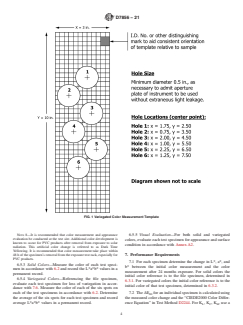
testing.ThecenterpointsofthesesixspotsarespecifiedinFig.
in 6.1.1. Record the test start date in a permanent record.
1. The diameter of the six spots is specified as 0.50 in. (12.2
mm) minimum.The actual diameter used shall be large enough NOTE 6—Exposures should start on the same date at all sites whenever
possible.
to admit the aperture plate of the instrument used without
extraneous light leakage.
6.4.2 Expose the specimens at an angle of 45° facing South
5.4.5 The exact locations of these test spots must be and backed using unpainted plywood in accordance to Prac-
determined and recorded for each test specimen to allow tices D1435 and G147. The su
...
This document is not an ASTM standard and is intended only to provide the user of an ASTM standard an indication of what changes have been made to the previous version. Because
it may not be technically possible to adequately depict all changes accurately, ASTM recommends that users consult prior editions as appropriate. In all cases only the current version
of the standard as published by ASTM is to be considered the official document.
Designation: D7856 − 15a D7856 − 21
Standard Specification for
Color and Appearance Retention of Solid and Variegated
Color Plastic Siding Products using CIELab Color Space
This standard is issued under the fixed designation D7856; the number immediately following the designation indicates the year of
original adoption or, in the case of revision, the year of last revision. A number in parentheses indicates the year of last reapproval. A
superscript epsilon (´) indicates an editorial change since the last revision or reapproval.
1. Scope*
1.1 This specification establishes requirements and test methods for the color and appearance retention of solid and variegated
colored plastic siding products.
1.2 Color retention testing provides a method for estimating the acceptability of color change in a plastic siding product over an
extended period of service.
NOTE 1—The exposure locations and durations specified in this standard have been shown to provide a good estimation of the color change in vinyl and
polypropylene siding products over an extended period of service (see 2.2). It is expected that materials designed for the exposure conditions typical of
exterior siding will respond similarly, but the applicability of this standard to other types of plastic siding has not been empirically established.
1.3 This specification is a successor to Specifications D6864 and D7251, which cover solid colors and variegated colors,
respectively. This specification combines coverage for both, and has the same scope as those standards.
1.4 Specifications D6864 and D7251 use Hunter Lab color space for measurement of colors and evaluation of color change. These
standards require classification of colors into regions based on the L, a, and b coordinates of the color, and evaluation of color
changes is done using an ellipsoid value equation having unique coefficients for each color region. This specification uses CIE 1976
L* a* b* color space for measurement and evaluation of color change. Using this method, the need for separate color regions and
evaluation equations has been eliminated.
1.5 Provisions for sample selection and preparation, and weathering are the same in this specification as in Specifications D6864
and D7251.
1.6 Characterization of color and appearance for variegated colors is complicated by the presence of multiple colors in a random
pattern. The procedure for measuring variegated colors in this specification is based on using a template to reference six spots for
color measurement.
1.7 This standard specifies outdoor weathering in three specific climate zones for a single 24-month exposure, and the color
retention performance requirements under these conditions are established to be indicative of acceptable performance over an
extended period of service. However, nothing in this standard precludes the use of different or additional climate zones, or different
exposure durations, so long as those conditions are clearly specified in any reports.
This test method is under the jurisdiction of ASTM Committee D20 on Plastics and is the direct responsibility of Subcommittee D20.24 on Plastic Building Products.
Current edition approved Dec. 1, 2015July 1, 2021. Published December 2015July 2021. Originally approved in 2014. Last previous edition approved in 2015 as
D7856 – 15.D7856 – 15a. DOI:10.1520/D7856-15A.DOI:10.1520/D7856-21.
*A Summary of Changes section appears at the end of this standard
Copyright © ASTM International, 100 Barr Harbor Drive, PO Box C700, West Conshohocken, PA 19428-2959. United States
D7856 − 21
1.8 Units—The values stated in inch-pound units are to be regarded as standard. The values given in parentheses are mathematical
conversions to SI units that are provided for information only and are not considered standard.
1.9 This standard does not purport to address all of the safety concerns, if any, associated with its use. It is the responsibility
of the user of this standard to establish appropriate safety safety, health, and healthenvironmental practices and determine the
applicability of regulatory limitations prior to use.
NOTE 2—There is no known ISO equivalent to this standard.
1.10 This international standard was developed in accordance with internationally recognized principles on standardization
established in the Decision on Principles for the Development of International Standards, Guides and Recommendations issued
by the World Trade Organization Technical Barriers to Trade (TBT) Committee.
2. Referenced Documents
2.1 ASTM Standards:
D660 Test Method for Evaluating Degree of Checking of Exterior Paints
D661 Test Method for Evaluating Degree of Cracking of Exterior Paints
D662 Test Method for Evaluating Degree of Erosion of Exterior Paints
D714 Test Method for Evaluating Degree of Blistering of Paints
D772 Test Method for Evaluating Degree of Flaking (Scaling) of Exterior Paints
D883 Terminology Relating to Plastics
D1435 Practice for Outdoor Weathering of Plastics
D1600 Terminology for Abbreviated Terms Relating to Plastics
D2244 Practice for Calculation of Color Tolerances and Color Differences from Instrumentally Measured Color Coordinates
D4214 Test Methods for Evaluating the Degree of Chalking of Exterior Paint Films
D6864 Specification for Color and Appearance Retention of Solid Colored Plastic Siding Products (Withdrawn 2018)
D7251 Specification for Color and Appearance Retention of Variegated Color Plastic Siding Products (Withdrawn 2018)
E29 Practice for Using Significant Digits in Test Data to Determine Conformance with Specifications
E1331 Test Method for Reflectance Factor and Color by Spectrophotometry Using Hemispherical Geometry
G147 Practice for Conditioning and Handling of Nonmetallic Materials for Natural and Artificial Weathering Tests
2.2 Other Reference:
VS2W Vinyl Siding Institute (VSI) Technical Research Report for Weatherability of Vinyl Siding Products
NOTE 3—The report cited in 2.2 supports the conclusion that commercial vinyl siding products which demonstrate weathering behavior within
conformance to these standards during a two year test program are likely to provide acceptable color retention properties over an extended period of
service. Unpublished long term weathering study data support a similar conclusion for polypropylene siding (see Appendix X1).
3. Terminology
3.1 Definitions—Definitions are in accordance with Terminologies D883 and D1600 unless otherwise noted.
3.2 Definitions of Terms Specific to This Standard:
3.2.1 polypropylene siding—a shaped material, made principally from polypropylene homopolymer, or copolymer, which in some
cases may contain fillers and/or reinforcements, that is used to clad exterior walls of buildings.
3.2.2 temperate northern climate—in weathering testing, a North American metropolitan area testing site within 73 to 100°W
longitude and 37 to 45°N latitude.
3.2.3 variegated plastic siding—siding having discrete markings of different colors.
3.2.4 vinyl siding—a shaped material, made principally from rigid poly(vinyl chloride) (PVC), that is used to clad exterior walls
of buildings.
For referenced ASTM standards, visit the ASTM website, www.astm.org, or contact ASTM Customer Service at service@astm.org. For Annual Book of ASTM Standards
volume information, refer to the standard’s Document Summary page on the ASTM website.
The last approved version of this historical standard is referenced on www.astm.org.
Available from Vinyl Siding Institute (VSI), National Housing Center, 1201 15th Street NW, Suite 220, Washington, DC 20005, http://www.vinylsiding.org.
D7856 − 21
4. Significance and Use
4.1 This specification uses two-year outdoor weathering to provide an indication of the long-term color retention properties of
plastic siding samples.
4.2 The methodology and procedures prescribed are only applicable to this specification.
4.3 The exposure locations and durations specified in this standard have been shown to provide a good estimation of the color
change in vinyl and polypropylene siding products over an extended period of service (see 2.2). It is expected that materials
designed for the exposure conditions typical of exterior siding will respond similarly, but the applicability of this standard to other
types of plastic siding has not been empirically established.
4.4 The response of siding color samples to outdoor exposure is sensitive to differences in weather, and is subject to variation from
year to year. Differences in exposure and weather patterns, including temperature, moisture, total radiant energy, and type and
concentration of pollutants, also affect response in different climates. For this reason, samples are weathered in three distinct North
American locations. Samples must show acceptable weathering performance at all three locations.
4.5 It has been shown (see 2.2) that most color change occurs during the first two years of outdoor exposure. After approximately
two years, the rate of change levels off, and the degree of change observed after two years provides a significant indication of the
overall degree of change that will be present through subsequent long term long-term exposure.
4.6 Studies involving vinyl siding and polypropylene siding support the applicability of the methods and criteria in this standard
to plastic siding. As essentially all plastic siding uses either vinyl or polypropylene, no comparable studies of siding using polymers
other than these two have been identified.
4.7 No method that is subject to the vagariesvariables of outdoor weather can be expected to absolutely predict the degree of color
change at a specific point in the future. However, the above results show that acceptability of color change measured after
two-years of outdoor exposure correlates sufficiently to the long term long-term acceptability to provide an indication of the
commercial viability of a color for long term use on customers’ buildings, which is the purpose of this specification.
4.8 Criteria for acceptability were developed by correlating the results of visual evaluation of various colors and color differences
to the measured degrees of color difference. Thus the performance requirements in Section 7 represent the human perception of
the limits of acceptability of a measured color change.
5. Sampling and Specimen Preparation
5.1 Samples shall be representative of the product to be evaluated. Samples shall be taken either from commercial products or
from laboratory samples. Laboratory samples shall be produced in the same manner as the commercial products to be evaluated.
NOTE 4—Production of laboratory samples in the same manner includes use of the same method of forming the product. For example, if the commercial
product is extruded, the laboratory specimen shall be extruded; if the commercial product is injection molded, the laboratory specimen shall be injection
molded, and so forth.
5.2 Mark each specimen permanently to ensure retention of identity during and after exposure testing. Ensure that the
identification marking is small and does not interfere with the color measuring area.
NOTE 5—Use of a vibratool leaves a permanent mark that satisfies this criterion.
5.3 Solid Color Specimens:
5.3.1 Prepare a minimum of four specimens per sample per test site to allow for three test specimens and one file specimen for
each sample evaluated.
5.3.2 The file specimen will be measured for color at each test location and will serve as the reference color for evaluation of color
changes in the three replicates after weathering.
D7856 − 21
5.3.3 Specimens shall be a flat section and a minimum of 2 by 3 ⁄4 in. (51 by 95 mm). If the normally-exposed surface of the siding
is heavily textured to the extent that correct or consistent color measurements cannot be obtained, weathering test exposure of the
back surface or other surface is permitted, so long as the surface is representative of the exposed surface.
5.4 Variegated Color Specimens:
5.4.1 Prepare a minimum of four specimens per sample per test site to allow for three test specimens and one file specimen for
each sample evaluated.
5.4.2 The file specimen will be used for a visual assessment of variegation/contrast change. The test specimens will be measured
for color and weathered.
5.4.3 Specimens shall be a flat section and a minimum of 3 by 10 in. (76 by 254 mm). The variegated pattern shall be parallel
to the long edge of the specimen.
5.4.4 Use the Variegated Color Measurement Template to identify the six spots on each test specimen for color retention testing.
The center points of these six spots are specified in Fig. 1. The diameter of the six spots is specified as 0.50 in. (12.2 mm) minimum.
The actual diameter used shall be large enough to admit the aperture plate of the instrument used without extraneous light leakage.
5.4.5 The exact locations of these test spots must be determined and recorded for each test specimen to allow measurement of
color change following exposure testing. The locations and spot sizes identified in 5.4.4 for each test specimen shall not change
once the exposure test is started.
6. Procedure
6.1 Outdoor Weathering:
6.1.1 Samples shall be exposed at three test sites: Temperate Northern represented by a site located in near Louisville, KY or
Cleveland, OH; hot, humid represented by a site located near Miami, FL; and hot, dry represented by a site located near Phoenix,
AZ. Actual test locations are not limited to these representative cities so long as the location is representative of the indicated
climate zone.
6.2 Color Measurement (General):
6.2.1 All color measurements are to be made in accordance with this section. Obtain test and file specimens in accordance with
5.3 or 5.4. The following procedure is used at each of the three weathering locations.
6.2.2 Color is measured using 8° sphere geometry, diffuse illumination, specular component included (di:8), Illuminant D65, and
10° observer, in accordance with Test Method E1331. For solid colors make at least three separate measurements on the specimen
and average them. For variegated colors take one reading at each of the six spots identified in 5.4.4, and average them.
6.2.3 Calculate the CIE 1976 L*a*b* units in accordance with the “CIE 1976 L* a* b* Uniform Color Space and Color-Difference
Equation” in Test Method D2244, using the average of the replicate measurements, and record them in a permanent record.
6.2.4 Measured specimen color values shall be reported to no more than two decimal places, in accordance with the rounding
method in Practice E29.
6.3 Initial Color Measurement:
6.3.1 Solid colors—At each weathering location, measure the color of each file specimen in accordance with 6.2 and record the
L*a*b* values in a permanent record. The initial L*a*b* values determined from the file specimens are used as the reference point
for all measurements of color change of the weathered samples during the duration of the weathering study.
6.3.2 Variegated Colors—At each weathering location, measure the color of each of the six spots on each of the test specimens
in accordance with 6.2. Determin
...