

ASTM F1337-22
(Practice)Standard Practice for Human Systems Integration Program Requirements for Ships and Marine Systems, Equipment, and Facilities
General Information
- Abstract
SIGNIFICANCE AND USE
6.1 Intended Use—Compliance with this practice provides the procuring organization with assurance that human users will be efficient, effective, and safe in the operation and maintenance of marine systems, equipment, and facilities. Specifically, it is intended to ensure the following:
6.1.1 System performance requirements are achieved reliably by appropriate use and accommodation of the human component of the system.
6.1.2 Usable design of equipment, software, and environment permits the human-equipment/software combination to meet system performance goals.
6.1.3 System features, processes, and procedures do not constitute hazards to humans.
6.1.4 Trade-offs between automated and manual operations results in effective human performance and appropriate cost control.
6.1.5 Manpower, personnel, and training requirements are met.
6.1.6 Selected HSI design standards are applied that are adequate and appropriate technically.
6.1.7 Systems and equipments are designed to facilitate required maintenance.
6.1.8 Procedures for operating and maintaining equipment are efficient, reliable, approved for maritime use, and safe.
6.1.9 Potential error-inducing equipment design features are eliminated, or at least, minimized, and systems are designed to be error-tolerant.
6.1.10 Layouts and arrangements of equipment afford efficient traffic patterns, communications, and use.
6.1.11 Habitability facilities and working spaces meet environmental control and physical environment requirements to provide the level of comfort and quality of life for the crew that is conducive to maintaining optimum personnel performance and endurance.
6.1.12 Hazards to human health are minimized.
6.1.13 Personnel survivability is maximized.
6.2 Scope and Nature of Work—HSI includes, but is not limited to, active participation throughout all phases in the life cycle of a marine system, including requirements definition, design, development, production, operations and...
SCOPE
1.1 Objectives—This practice establishes and defines the processes and associated requirements for incorporating Human Systems Integration (HSI) into all phases of government and commercial ship, offshore structure, and marine system and equipment (hereafter referred to as marine system) acquisition life cycle. HSI must be integrated fully with the engineering processes applied to the design, acquisition, and operations of marine systems. This application includes the following:
1.1.1 Ships and offshore structures.
1.1.2 Marine systems, machinery, and equipment developed to be deployed on a ship or offshore structure where their design, once integrated into the ship or offshore structure, will potentially impact human performance, safety and health hazards, survivability, morale, quality of life, and fitness for duty.
1.1.3 Integration of marine systems and equipment into ships and offshore structures including arrangements, facility layout, installations, communications, and data links.
1.1.4 Modernization and retrofitting ships and offshore structures.
1.2 Target Audience—The intended audience for this document consists of individuals with HSI training and experience representing the procuring activity, contractor or vendor personnel with HSI experience, and engineers and management personnel familiar with HSI methods, processes, and objectives. See 5.2.3 for guidance on qualifications of HSI specialists.
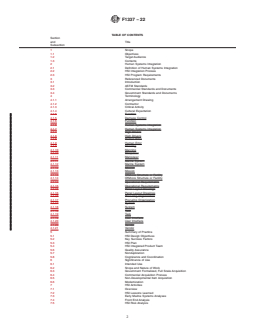
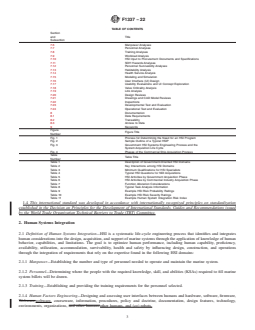
1.3 Contents—This document is divided into the following sections and subsections.
TABLE OF CONTENTS
Section
and
Subsection
Title
1
Scope
1.1
Objectives
1.2
Target Audience
1.3
Contents
2
Human Systems Integration
2.1
Definition of Human Systems Integration
2.2
HSI Integration Process
2.3
HSI Program Requirements
3
Referenced Documents
3.1
Introduction
3.2
ASTM Standards
3.3
Commercial Standards and Do...
- Status
- Published
- Publication Date
- 31-Jan-2022
- Technical Committee
- F25 - Ships and Marine Technology
- Drafting Committee
- F25.07 - General Requirements
Buy Documents
ASTM F1337-22 - Standard Practice for Human Systems Integration Program Requirements for Ships and Marine Systems, Equipment, and Facilities
REDLINE ASTM F1337-22 - Standard Practice for Human Systems Integration Program Requirements for Ships and Marine Systems, Equipment, and Facilities
Overview
ASTM F1337-22: Standard Practice for Human Systems Integration Program Requirements for Ships and Marine Systems, Equipment, and Facilities establishes processes and requirements for integrating Human Systems Integration (HSI) into every phase of the marine system acquisition lifecycle. Developed under ASTM Committee F25, this standard aims to ensure that human factors-including safety, performance, and well-being-are systematically considered in the design, acquisition, modernization, and operation of ships, marine systems, offshore structures, and related equipment. Compliance with ASTM F1337-22 helps organizations achieve optimal system performance, reduce operational risks, and manage life-cycle costs by effectively addressing the human interface.
Key Topics
Human Systems Integration (HSI) Framework
The standard defines HSI as a multidisciplinary engineering process that incorporates human considerations-such as personnel, training, human factors engineering, safety, survivability, and habitability-across a system’s complete lifecycle.- Manpower: Determining required staffing levels and skillsets
- Personnel: Identifying and sourcing individuals with the necessary qualifications
- Training: Establishing requirements and resources for workforce readiness
- Human Factors Engineering: Ensuring effective user interfaces and ergonomic design
- Safety and Occupational Health: Minimizing health hazards and system-related risks
- Personnel Survivability: Enhancing emergency preparedness and escape routes
- Habitability: Providing comfortable, safe, and high-quality living/working conditions
Integration in Engineering Processes
HSI must be fully embedded alongside traditional engineering processes. This includes participation in requirements definition, design reviews, analysis of maintenance tasks, facility layout, and modernization efforts.Program Management and Implementation
The standard outlines necessary management commitments, such as:- Assigning HSI champions within organizations
- Early and continued involvement of qualified HSI specialists
- Maintaining a Human Systems Integration Plan (HSIP)
- Documenting lessons learned and tracking human-related issues
Continuous Improvement and Lifecycle Feedback
Feedback loops, including lessons learned during design and operation, are essential for refining HSI processes and achieving system improvements.
Applications
ASTM F1337-22 is applicable to a broad range of marine industry stakeholders, including government agencies, shipbuilders, offshore facility designers, equipment vendors, and engineering consultants. Practical uses include:
- Design and Acquisition:
Ensuring that new ships, platforms, and marine equipment are user-centric, safer, and more maintainable from the outset. - Modernization and Retrofits:
Applying HSI principles during upgrades to meet evolving safety, usability, or occupational health requirements. - Operations and Maintenance:
Streamlining workflows, reducing manpower costs, and minimizing the potential for human error or workplace accidents. - Procurement and Contract Management:
Incorporating HSI requirements in technical documentation, specifications, and statements of work to ensure contractor compliance and alignment with best practices. - Regulatory and Compliance Audits:
Demonstrating a systematic approach to addressing human factors, aligning with industry expectations and international guidelines.
Related Standards
ASTM F1337-22 should be used in conjunction with related standards and guidance documents to maximize effectiveness and compliance, including:
- ASTM F1166: Practice for Human Engineering Design for Marine Systems
- ABS Guidance: Application of Ergonomics to Marine Systems and Crew Habitability Guides
- ANSI/HFES 100 & 200: Human Factors Engineering for Workstations and Software User Interfaces
- DOD & NAVSEA Standards: Such as MIL-STD-882E for System Safety, and relevant NAVSEA and OPNAV instructions on safety, personnel, training, and habitability
By integrating ASTM F1337-22 into the marine system lifecycle, organizations proactively address the human element, enhance safety and performance, and align with international best practices in human systems integration.
Relations
- Effective Date
- 01-Jan-2007
- Effective Date
- 01-Jun-2006
- Effective Date
- 01-Jan-2000
Buy Documents
ASTM F1337-22 - Standard Practice for Human Systems Integration Program Requirements for Ships and Marine Systems, Equipment, and Facilities
REDLINE ASTM F1337-22 - Standard Practice for Human Systems Integration Program Requirements for Ships and Marine Systems, Equipment, and Facilities
Get Certified
Connect with accredited certification bodies for this standard

DNV
DNV is an independent assurance and risk management provider.

Lloyd's Register
Lloyd's Register is a global professional services organisation specialising in engineering and technology.

FSC International
Forest Stewardship Council certification.
Sponsored listings
Frequently Asked Questions
ASTM F1337-22 is a standard published by ASTM International. Its full title is "Standard Practice for Human Systems Integration Program Requirements for Ships and Marine Systems, Equipment, and Facilities". This standard covers: SIGNIFICANCE AND USE 6.1 Intended Use—Compliance with this practice provides the procuring organization with assurance that human users will be efficient, effective, and safe in the operation and maintenance of marine systems, equipment, and facilities. Specifically, it is intended to ensure the following: 6.1.1 System performance requirements are achieved reliably by appropriate use and accommodation of the human component of the system. 6.1.2 Usable design of equipment, software, and environment permits the human-equipment/software combination to meet system performance goals. 6.1.3 System features, processes, and procedures do not constitute hazards to humans. 6.1.4 Trade-offs between automated and manual operations results in effective human performance and appropriate cost control. 6.1.5 Manpower, personnel, and training requirements are met. 6.1.6 Selected HSI design standards are applied that are adequate and appropriate technically. 6.1.7 Systems and equipments are designed to facilitate required maintenance. 6.1.8 Procedures for operating and maintaining equipment are efficient, reliable, approved for maritime use, and safe. 6.1.9 Potential error-inducing equipment design features are eliminated, or at least, minimized, and systems are designed to be error-tolerant. 6.1.10 Layouts and arrangements of equipment afford efficient traffic patterns, communications, and use. 6.1.11 Habitability facilities and working spaces meet environmental control and physical environment requirements to provide the level of comfort and quality of life for the crew that is conducive to maintaining optimum personnel performance and endurance. 6.1.12 Hazards to human health are minimized. 6.1.13 Personnel survivability is maximized. 6.2 Scope and Nature of Work—HSI includes, but is not limited to, active participation throughout all phases in the life cycle of a marine system, including requirements definition, design, development, production, operations and... SCOPE 1.1 Objectives—This practice establishes and defines the processes and associated requirements for incorporating Human Systems Integration (HSI) into all phases of government and commercial ship, offshore structure, and marine system and equipment (hereafter referred to as marine system) acquisition life cycle. HSI must be integrated fully with the engineering processes applied to the design, acquisition, and operations of marine systems. This application includes the following: 1.1.1 Ships and offshore structures. 1.1.2 Marine systems, machinery, and equipment developed to be deployed on a ship or offshore structure where their design, once integrated into the ship or offshore structure, will potentially impact human performance, safety and health hazards, survivability, morale, quality of life, and fitness for duty. 1.1.3 Integration of marine systems and equipment into ships and offshore structures including arrangements, facility layout, installations, communications, and data links. 1.1.4 Modernization and retrofitting ships and offshore structures. 1.2 Target Audience—The intended audience for this document consists of individuals with HSI training and experience representing the procuring activity, contractor or vendor personnel with HSI experience, and engineers and management personnel familiar with HSI methods, processes, and objectives. See 5.2.3 for guidance on qualifications of HSI specialists. 1.3 Contents—This document is divided into the following sections and subsections. TABLE OF CONTENTS Section and Subsection Title 1 Scope 1.1 Objectives 1.2 Target Audience 1.3 Contents 2 Human Systems Integration 2.1 Definition of Human Systems Integration 2.2 HSI Integration Process 2.3 HSI Program Requirements 3 Referenced Documents 3.1 Introduction 3.2 ASTM Standards 3.3 Commercial Standards and Do...
SIGNIFICANCE AND USE 6.1 Intended Use—Compliance with this practice provides the procuring organization with assurance that human users will be efficient, effective, and safe in the operation and maintenance of marine systems, equipment, and facilities. Specifically, it is intended to ensure the following: 6.1.1 System performance requirements are achieved reliably by appropriate use and accommodation of the human component of the system. 6.1.2 Usable design of equipment, software, and environment permits the human-equipment/software combination to meet system performance goals. 6.1.3 System features, processes, and procedures do not constitute hazards to humans. 6.1.4 Trade-offs between automated and manual operations results in effective human performance and appropriate cost control. 6.1.5 Manpower, personnel, and training requirements are met. 6.1.6 Selected HSI design standards are applied that are adequate and appropriate technically. 6.1.7 Systems and equipments are designed to facilitate required maintenance. 6.1.8 Procedures for operating and maintaining equipment are efficient, reliable, approved for maritime use, and safe. 6.1.9 Potential error-inducing equipment design features are eliminated, or at least, minimized, and systems are designed to be error-tolerant. 6.1.10 Layouts and arrangements of equipment afford efficient traffic patterns, communications, and use. 6.1.11 Habitability facilities and working spaces meet environmental control and physical environment requirements to provide the level of comfort and quality of life for the crew that is conducive to maintaining optimum personnel performance and endurance. 6.1.12 Hazards to human health are minimized. 6.1.13 Personnel survivability is maximized. 6.2 Scope and Nature of Work—HSI includes, but is not limited to, active participation throughout all phases in the life cycle of a marine system, including requirements definition, design, development, production, operations and... SCOPE 1.1 Objectives—This practice establishes and defines the processes and associated requirements for incorporating Human Systems Integration (HSI) into all phases of government and commercial ship, offshore structure, and marine system and equipment (hereafter referred to as marine system) acquisition life cycle. HSI must be integrated fully with the engineering processes applied to the design, acquisition, and operations of marine systems. This application includes the following: 1.1.1 Ships and offshore structures. 1.1.2 Marine systems, machinery, and equipment developed to be deployed on a ship or offshore structure where their design, once integrated into the ship or offshore structure, will potentially impact human performance, safety and health hazards, survivability, morale, quality of life, and fitness for duty. 1.1.3 Integration of marine systems and equipment into ships and offshore structures including arrangements, facility layout, installations, communications, and data links. 1.1.4 Modernization and retrofitting ships and offshore structures. 1.2 Target Audience—The intended audience for this document consists of individuals with HSI training and experience representing the procuring activity, contractor or vendor personnel with HSI experience, and engineers and management personnel familiar with HSI methods, processes, and objectives. See 5.2.3 for guidance on qualifications of HSI specialists. 1.3 Contents—This document is divided into the following sections and subsections. TABLE OF CONTENTS Section and Subsection Title 1 Scope 1.1 Objectives 1.2 Target Audience 1.3 Contents 2 Human Systems Integration 2.1 Definition of Human Systems Integration 2.2 HSI Integration Process 2.3 HSI Program Requirements 3 Referenced Documents 3.1 Introduction 3.2 ASTM Standards 3.3 Commercial Standards and Do...
ASTM F1337-22 is classified under the following ICS (International Classification for Standards) categories: 13.180 - Ergonomics; 47.020.01 - General standards related to shipbuilding and marine structures. The ICS classification helps identify the subject area and facilitates finding related standards.
ASTM F1337-22 has the following relationships with other standards: It is inter standard links to ASTM F1166-07, ASTM F1166-95a(2006), ASTM F1166-95a(2000). Understanding these relationships helps ensure you are using the most current and applicable version of the standard.
ASTM F1337-22 is available in PDF format for immediate download after purchase. The document can be added to your cart and obtained through the secure checkout process. Digital delivery ensures instant access to the complete standard document.
Standards Content (Sample)
This international standard was developed in accordance with internationally recognized principles on standardization established in the Decision on Principles for the
Development of International Standards, Guides and Recommendations issued by the World Trade Organization Technical Barriers to Trade (TBT) Committee.
Designation: F1337 − 22 An American National Standard
Standard Practice for
Human Systems Integration Program Requirements for
Ships and Marine Systems, Equipment, and Facilities
This standard is issued under the fixed designation F1337; the number immediately following the designation indicates the year of
original adoption or, in the case of revision, the year of last revision. A number in parentheses indicates the year of last reapproval. A
superscript epsilon (´) indicates an editorial change since the last revision or reapproval.
1. Scope
TABLE OF CONTENTS
Section
1.1 Objectives—This practice establishes and defines the
and Title
Subsection
processes and associated requirements for incorporating Hu-
1 Scope
man Systems Integration (HSI) into all phases of government
1.1 Objectives
and commercial ship, offshore structure, and marine system
1.2 Target Audience
and equipment (hereafter referred to as marine system) acqui-
1.3 Contents
2 Human Systems Integration
sition life cycle. HSI must be integrated fully with the
2.1 Definition of Human Systems Integration
engineering processes applied to the design, acquisition, and
2.2 HSI Integration Process
operations of marine systems. This application includes the
2.3 HSI Program Requirements
3 Referenced Documents
following:
3.1 Introduction
1.1.1 Ships and offshore structures.
3.2 ASTM Standards
3.3 Commercial Standards and Documents
1.1.2 Marine systems, machinery, and equipment developed
3.4 Government Standards and Documents
to be deployed on a ship or offshore structure where their
4 Terminology
design, once integrated into the ship or offshore structure, will 4.1.1 Arrangement Drawing
4.1.2 Contractor
potentially impact human performance, safety and health
4.1.3 Critical Activity
hazards, survivability, morale, quality of life, and fitness for
4.1.4 Cultural Expectation
4.1.5 Damage Control
duty.
4.1.6 Function
1.1.3 Integration of marine systems and equipment into
4.1.7 Human Systems Integration
ships and offshore structures including arrangements, facility
4.1.8 High Drivers
4.1.9 Human Error
layout, installations, communications, and data links.
4.1.10 Manning
1.1.4 Modernization and retrofitting ships and offshore
4.1.11 Manpower
4.1.12 Marine System
structures.
4.1.13 Mission
4.1.14 Offshore Structure or Facility
1.2 Target Audience—The intended audience for this docu-
4.1.15 Operational Requirements
ment consists of individuals with HSI training and experience
4.1.16 Panel Layout Drawings
representing the procuring activity, contractor or vendor per-
4.1.17 Procuring Organization
4.1.18 System
sonnel with HSI experience, and engineers and management
4.1.19 Task
personnel familiar with HSI methods, processes, and objec-
4.1.20 User Interface
tives. See 5.2.3 for guidance on qualifications of HSI special-
4.1.21 Vendor
5 Summary of Practice
ists.
5.1 HSI Design Objectives
5.2 Key Success Factors
1.3 Contents—This document is divided into the following
5.3 HSI Plan
sections and subsections.
5.4 HSI Integrated Product Team
5.6 Quality Assurance
5.7 Nonduplication
5.8 Cognizance and Coordination
6 Significance of Use
This practice is under the jurisdiction of ASTM Committee F25 on Ships and
6.1 Intended Use
Marine Technology and is the direct responsibility of Subcommittee F25.07 on
6.2 Scope and Nature of Work
General Requirements.
6.3 Government Formalized, Full Scale Acquisition
CurrenteditionapprovedFeb.1,2022.PublishedJuly2022.Originallyapproved
6.4 Commercial Acquisition Process
in 1991. Last previous edition approved in 2015 as F1337 – 10 (2015). DOI:
6.5 Non-Developmental Item Acquisition
10.1520/F1337-22.
Copyright © ASTM International, 100 Barr Harbor Drive, PO Box C700, West Conshohocken, PA 19428-2959. United States
F1337 − 22
design, construction, and operations through the integration of
TABLE OF CONTENTS
Section
requirements that rely on the expertise found in the following
and Title
HSI domains:
Subsection
2.1.1 Manpower—Establishing the number and type of
6.6 Modernization
7 HSI Activities personnel needed to operate and maintain the marine system.
7.1 Overview
2.1.2 Personnel—Determining where the people with the
7.2 HSI Lessons Learned
required knowledge, skill, and abilities (KSAs) required to fill
7.3 Early Marine Systems Analyses
7.4 Front End Analysis
marine system billets will be drawn.
7.5 HSI Risk Analysis
2.1.3 Training—Establishing and providing the training re-
7.6 Manpower Analyses
quirements for the personnel selected.
7.7 Personnel Analyses
7.8 Training Analyses
2.1.4 Human Factors Engineering—Designing and assess-
7.9 Workload Analysis
ing user interfaces between humans and hardware, software,
7.10 HSI Input to Procurement Documents and Specifications
7.11 SOH Hazards Analyses
firmware, webware, courseware, information, procedures,
7.12 Personnel Survivability Analyses
policy and doctrine, documentation, design features,
7.13 Habitability Analysis
technology, environments, organizations, other humans, and
7.14 Health Service Analysis
7.15 Modeling and Simulation
(co) robots.
7.16 User Interface (UI) Design
2.1.5 Safety and Occupational Health—Providing a safe
7.17 Usability Evaluations and UI Concept Exploration
and healthy working environment.
7.18 Valve Criticality Analysis
7.19 Link Analysis
2.1.6 Personnel Survivability—Providing a platform that
7.20 Design Reviews
maximizes crew survivability.
7.21 Drawings and CAD Model Reviews
7.22 Inspections
2.1.7 Habitability—Providingthecharacteristicsofsystems,
7.23 Developmental Test and Evaluation
facilities, personal services, and living and working conditions
7.24 Operational Test and Evaluation
that result in high levels of crew morale, quality of life, safety,
8 Documentation
8.1 Data Requirements health, and comfort.
8.2 Traceability
2.1.8 Government-oriented definitions of the HSI domains
8.3 Access to Data
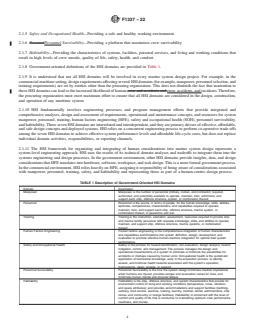
are provided in Table 1.
9 Keywords
Figure
2.1.9 It is understood that not all HSI domains will be
Figure Title
Number
involved in every marine system design project. For example,
Fig. 1 Process for Determining the Need for an HSI Program
Fig. 2 Sample Outline of a Typical HSIP
in the commercial maritime setting, design requirements af-
Fig. 3 Government HSI Systems Engineering Process and the
fecting several HSI domains (for example, manpower, person-
System Acquisition Life Cycle
nel selection, and training requirements) are set by entities
Fig. 4 Phases of the Commercial Ship Acquisition Process
Table other than the procuring organization. This does not diminish
Table Title
Number
the fact that inattention to these HSI domains can lead to the
Table 1 Description of Government-Oriented HSI Domains
increased likelihood of human error, accidents, and incidents.
Table 2 Key Interactions among HSI Domains
Table 3 Minimum Qualifications for HSI Specialists Therefore, the procuring organization must exert maximum
Table 4 Typical HSI Questions for NDI Acquisitions
effort to ensure that all HSI domains are considered in the
Table 5 HSI Activities by Government Acquisition Phase
design, construction, and operation of any maritime system.
Table 6 HSI Activities by Commercial Industry Acquisition Phase
Table 7 Function Allocation Considerations
2.1.10 HSI fundamentally involves engineering processes
Table 8 Typical Task Analysis Information
and program management efforts that provide integrated and
Table 9 Example HSI Risk Probability Ratings
comprehensive analyses, design and assessment of
Table 10 Example HSI Risk Severity Ratings
Table 11 Example Human System Integration Risk Index
requirements, operational and maintenance concepts, and re-
sources for system manpower, personnel, training, human
1.4 This international standard was developed in accor-
factors engineering (HFE), safety and occupational health
dance with internationally recognized principles on standard-
(SOH), personnel survivability, and habitability. These seven
ization established in the Decision on Principles for the
HSI domains are interrelated and interdependent, and they are
Development of International Standards, Guides and Recom-
primary drivers of effective, affordable, and safe design con-
mendations issued by the World Trade Organization Technical
cepts and deployed systems. HSI relies on a concurrent
Barriers to Trade (TBT) Committee.
engineering process to perform co-operative trade-offs among
the seven HSI domains to achieve effective system perfor-
2. Human Systems Integration
mance levels and affordable life-cycle costs, but does not
2.1 Definition of Human Systems Integration—HSI is a
replace individual domain activities, responsibilities, or report-
systematic life-cycle engineering process that identifies and
ing channels.
integrates human considerations into the design, acquisition,
2.1.11 The HSI framework for organizing and integrating of
and support of marine systems through the application of
human considerations into marine system design represents a
knowledge of human behavior, capabilities, and limitations.
system-level engineering approach. HSI uses the results of its
The goal is to optimize human performance, including human technical domain analyses and tradeoffs to integrate them into
capability, proficiency, availability, utilization,
the systems engineering and design processes. In the govern-
accommodation, survivability, health and safety by influencing ment environment, other HSI domains provide insights, data,
F1337 − 22
TABLE 1 Description of Government-Oriented HSI Domains
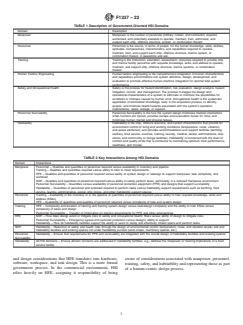
Domain Description
Manpower Manpower is the number of personnel (military, civilian, and contractor) required,
authorized, and potentially available to operate, maintain, train, administer, and
support each ship, offshore structure, system, or combination thereof.
Personnel Personnel is the source, in terms of people, for the human knowledge, skills, abilities,
aptitudes, competencies, characteristics, and capabilities required to operate,
maintain, train, and support each ship, offshore structure, marine system, or
combination thereof, in peacetime and war.
Training Training is the instruction, education, assessment, resources required to provide ship
and marine facility personnel with requisite knowledge, skills, and abilities to operate,
maintain, and support ship, offshore structure, marine systems, or combination
thereof.
Human Factors Engineering Human factors engineering is the comprehensive integration of human characteristics
and capabilities and limitations into system definition, design, development, and
evaluation to promote effective human-machine integration for optimal total system
performance.
Safety and Occupational Health Safety is the process for hazard identification, risk evaluation, design analysis, hazard
mitigation, control, and management. The process manages the design and
operational characteristics of a system to eliminate or minimize the possibilities for
accidents or mishaps caused by human error. Occupational health is the systematic
application of biomedical knowledge, early in the acquisition process, to identify,
assess, and minimize health hazards associated with the system’s operation,
maintenance, repair, storage, or support.
Personnel Survivability Personnel Survivability is the how the system design minimizes medical implications
when humans are injured, provides escape and evacuation routes for crew, and
minimizes human mental and physical fatigue.
Habitability Habitability is the ship, offshore structure, and system characteristics that provide for
environment control of living and working conditions (temperature, noise, vibration,
and space attributes); and provides accommodations and support facilities (berthing,
sanitary, food service, exercise, training, laundry, medical, dental, administrative, ship
stores, and community or lounge facilities). Habitability is concerned with the level of
comfort and quality of life that is conducive to maintaining optimum crew performance,
readiness, and morale.
TABLE 2 Key Interactions Among HSI Domains
Domain Interactions
Manpower Personnel – Qualities and quantities of personnel required versus availability in inventory and pipeline
Training – Qualities and quantities required versus ability to train to meet requirements
HFE – Qualities and quantities of personnel required versus ability of system design or redesign to support manpower, task complexity, and
workload
SOH – Qualities and quantities of personnel required versus ability to safely perform tasks, particularly in a reduced manpower environment
Personnel Survivability – Quantities versus availability of personnel protection equipment (PPE) and designs that support survivability
Habitability – Quantities of personnel and workload required to perform tasks versus habitability support requirements such as berthing, food
service, laundry, administrative, postal, ship stores, and other habitability support spaces
Personnel Training – Availability in the inventory or in the pipeline of quantities of personnel required versus ability to train required knowledge, skills and
abilities (KSAs)
HFE – Availability of quantities and qualities of personnel required versus complexity of task and system design
Training HFE – Complexity and duration of training and training system design versus task/design complexity and the ability to train KSAs versus
complexity of tasks and design
Personnel Survivability – Transfer of information on training requirements for PPE and other emergencies
HFE SOH – How does design avoid or mitigate risks to safety and occupational health; Risks versus ability of design to mitigate risks
Personnel Survivability – Emergency egress and personal protection versus design’s ability to support
Habitability – How do habitability facilities support the ability of users to safely and effectively inhabit space and perform tasks
SOH Habitability – Reduction of safety and health risks through the design of environmental control (temperature, noise, and vibration levels) and and
habitability facilities and working spaces not under habitability purview (work shops, machinery spaces, etc.)
Personnel Habitability – Ensure that requirements for PPE and survivability are integrated with the overall design of habitability facilities and working spaces
Survivability
Habitability All HSI Domains – Ensure domain concerns are addressed in habitability facilities, e.g., address the manpower or training implications of a food
service facility
and design considerations that HFE translates into hardware, aware of considerations associated with manpower, personnel,
software, workspace, and task design. This is a more formal
training, safety, and habitability and representing those as part
government process. In the commercial environment, HSI
of a human-centric design process.
relies heavily on HFE, assigning it responsibility of being
F1337 − 22
2.2 HSI Integration Process: in-service ships and offshore structures on marine systems,
machinery, and equipment.
2.2.1 A key HSI focus is integration. HSI takes a total
system level view of design, acquisition, and operations. This 2.2.3.6 Defining and empowering an integrator role that has
responsibility for facilitating and managing the information
system level view starts with the performance requirements of
flow among HSI domains and with systems engineering. This
the total system that are translated into requirements for total
individual must be someone with an understanding of HSI,
system performance and total cost of ownership. The system
preferably possess an engineering background, and be a senior
performance and cost requirements then are integrated into the
member of the organization. The HSI integrator should not be
design by the application of HSI methods and standards to the
responsible for performing the HSI activities, rather should
design of the marine system. HSI continues as an integrated
focus on ensuring communication between the various HSI
element of the operations and support activity as a mechanism
domains and with the engineering program.
to support training, maintenance, and identify system improve-
ment opportunities. 2.2.3.7 Collecting and tracking information on operator or
maintainerfeedbackandlessons-learnedfromlegacyorsimilar
2.2.2 HSI relies on the individual technical HSI domains,
operational systems concerning human performance,
but also the integration of these domains among themselves
workload, health and safety, and accommodation. This pro-
and with the other systems engineering and logistics require-
vides information on how well a design approach has worked
mentsandprocesses.ThedomainsofHSImustworkinconcert
in meeting objectives, and what problems or issues have been
among themselves and with other systems engineering pro-
identifiedregardinghumanperformance,behavior,availability,
cesses to address human design issues and trade-offs that
productivity, competence, health and safety, and accommoda-
optimize overall system performance and reduce life cycle
tion.
costs. Table 2 provides a high-level view of some of the types
2.2.3.8 Conducting user-centered design of user interfaces
of interactions and tradeoffs that occur among HSI domains.
that emphasizes requirements for human performance, includ-
2.2.3 Integration between HSI domains occurs through the
ing human capability, behavior, availability, productivity,
following activities:
competence, health and safety, and accommodation.
2.2.3.1 Developing and maintaining a Human Systems In-
2.2.3.9 Conducting Test and Evaluation (T&E) activities
tegration Plan (HSIP) that includes all HSI domains and
that assess all HSI domains and the efficacy of any tradeoffs
discusses interactions required among these domains. The key
that have occurred. The T&E activities should focus on the
here is to maintain the HSIP over the marine system life cycle
human performance aspects of total system performance,
through updates as design issues and considerations change.
behavior, availability, productivity, competence, health and
See 5.3 for more information on the HSIP.The HSIPshould be
safety, and accommodation.
integrated with the Systems Engineering Plan (SEP) and other
engineering plans.
2.3 HSI Program Requirements—HSI is required for gov-
ernment system acquisition programs. For the commercial
2.2.3.2 Close coordination and communication among HSI
marineindustry,thereisnopolicyrequirementforHSI,butthis
domains. This occurs through informal and formal meetings,
document serves as a best practice that can be required through
design reviews, and other communications such as email,
contract language by the procuring organization.
telephone conversations, list serves, bulletin boards, and video
conferences.
2.3.1 The decision as to whether to invoke this practice as a
mandatory provision for design, development, and operational
2.2.3.3 Use of an HSI Integrated Product Team. See 5.4 for
programs for government or commercial industry marine
more information.
systems is dependent on three key factors:
2.2.3.4 Performing a unified front-end analysis that ad-
2.3.1.1 The potential influence of human performance on
dresses requirements and concepts for each domain, the inter-
mission and task success.
actions among HSI domains, and the integration with systems
2.3.1.2 TheexistenceofanyoverarchingHSIdriversforthe
engineering.Aunified front-end analysis represents one analy-
sis that accepts input and provides output to all the HSI acquisition, such as reduced manpower or training burden, or
both, enhanced safety, or increased human and total system
domains and other engineering areas.
performance requirements.
2.2.3.5 Maintaining a consolidated database of HSI issues
2.3.1.3 The potential to reduce total ownership costs for
and design decisions. This database should include all HSI
systems by reducing costs associated with manpower, training,
issues identified during the design effort, suggested HSI inputs
human errors and accidents.
from all the HSI domains, a description as to whether or not
each HSI recommendation was incorporated in the marine 2.3.2 Fig. 1 provides a high-level decision process for
system design; and if not accepted, provide the reason for
determining the requirement for an HSI Program. This process
rejection along with the risk assessment. The database is is performed as a precursor to any front-end analysis to make
created and maintained by the HSI specialists from the
judgments about human involvement with the marine system.
procuring organization. This database should be maintained These judgments will be detailed, refined, and validated in the
through the marine system life cycle to support the documen- early phases of the marine system design and acquisition
tation of HSI issues that arise during training, operation, and process.ThesizeandsignificanceofanyrequiredHSIprogram
maintenance. The consolidated database of HSI issues should will depend on a number of factors, including those associated
includelessonslearnedfromthedesignprocess,feedbackfrom with the answers to the questions in 2.3.3.
F1337 − 22
FIG. 1 Process for Determining the Need for an HSI Program
2.3.3 Once the HSI program decision has been made, key 2.3.4 Where a HSI program is required, decisions to imple-
considerationsthatshouldbelookedattoscopethelevelofthe ment or comply with this practice by tailoring the HSI
HSI program effort include the following: activities to be performed should be made by HSI specialists
2.3.3.1 Will the type of personnel involvement or the and include detailed justification for the decision. The procur-
approaches related to operation or maintenance of the marine ing organization has final approval of any tailoring.
system differ substantially from what is the current practice of
3. Referenced Documents
the organization?
2.3.3.2 Will the marine system introduce new technologies
3.1 Introduction—The following documents, where
or impose new tasks and skill requirements on the operators/
appropriate, should be used in conjunction with this practice in
maintainers not previously supported to acceptable levels?
implementing a HSI program. These documents should be
2.3.3.3 Are there opportunities to increase operator/
considered for use by both the government and the commercial
maintainer levels of efficiency through improved design?
industry.
2.3.3.4 Will the marine system be operated and maintained
3.2 ASTM Standards:
by individuals not normally assigned to work on the facility?
F1166 Practice for Human Engineering Design for Marine
2.3.3.5 Is one objective of the marine system to reduce
Systems, Equipment, and Facilities
manpower?
3.3 Commercial Standards and Documents:
2.3.3.6 Will the marine system be used by personnel from a
ABS Guidance Notes for the Application of Ergonomics to
culture or geographic part of the world different from the
Marine Systems, August 2013 (Updated August 2018)
individuals doing the design and construction? If so, what HSI
ABS Guidance Notes on the Ergonomic Design of Naviga-
requirements need to be modified to meet the target user
tion Bridges, October 2003 (Updated August 2018)
population?
ABS Guide for Crew Habitability on Offshore Installations,
2.3.3.7 Willthemarinesystembeoperatedormaintainedby
February 2016
both males and females?
ABS Guide for Crew Habitability on Ships, February 2016
2.3.3.8 Will the marine system provide equipment with
ABSGuideforBuildingandClassingNavalVessels(limited
which the personnel have had little or no previous experience?
distribution) Part 0 General Provisions, Chapter 7 “Hu-
2.3.3.9 Is one goal of the marine system to reduce accidents
man Systems Integration,” Chapter 8 “System Safety,”
or incidents that have occurred on other marine systems?
Chapter 9 “GeneralArrangements,” and Chapter 10 “Mar-
2.3.3.10 Will the new marine system be more complex than,
gins;” Part 4 Control, Automation, and Navigation Sys-
or different from, any previous system?
tems; Part 6 Habitability and Outfit
2.3.3.11 Does the procuring organization lack any previous
Human Factors Design Handbook Woodson,W.,Tillman, B.
HSI experience on previous design projects that could be
and Tillman, P., 1992
transferable to the new marine system?
ANSI/HFES 100 Human Factors Engineering of Computer
2.3.3.12 Is one goal of the new project to reduce operating
Workstations
and maintenance costs?
ANSI/HFES 200 Human Factors Engineering of Software
2.3.3.13 Does the procuring organization have a specific
User Interfaces
mission to enhance safety and quality of the work environment
ANSI/ITAA GEIA-STD-0010 Standard Best Practices for
for its employees?
System Safety Program Development and Execution, 18
2.3.3.14 Has the procuring organization had previous unfa-
October 2018
vorable rulings from regulatory agencies on issues of safety,
pollution control, or system design based on HSI issues?
For referenced ASTM standards, visit the ASTM website, www.astm.org, or
2.3.3.15 Does the marine system add or reduce logistics
contact ASTM Customer Service at service@astm.org. For Annual Book of ASTM
issues?
Standards volume information, refer to the standard’s Document Summary page on
2.3.3.16 Does the marine system reduce or add to the
the ASTM website.
damage control response? Referenced ABS guides are available at the ABS website, www.eagle.org.
F1337 − 22
3.4 Government Standards and Documents: 4.1.7 human systems integration—modern systems engi-
NAVSEA Human Systems Engineering Best Practices neering that addresses optimization of manpower, personnel
Guide Beaton, R., Bost, R., and Malone, T., 2008 andtraining,andenhancementofhumanperformanceaffecting
OPNAVINST 1500.76D Naval Training Systems total system performance and life cycle costs, including human
Requirements, Acquisition, and Management, 29 July capability,availability,safety,survivabilityandfitnessforduty.
4.1.8 high drivers—high drivers for HSI include functions
DOD Directive 1100.4 Guidance for Manpower Programs,
that impose high demands on manpower, are labor intensive,
12 February 2005
are expected to impose high risks, workloads, and performance
MIL-STD-46855 RevA Requirements for Military Systems,
complexities, are error prone, require excessive training, or are
Equipment and Facilities, 21 December 2020
unsafe.
MIL-STD 882E DOD Standard Practice for System Safety,
4.1.9 human error—inappropriate or undesirable human
11 May 2012
decision or behavior. Human errors can be categorized into
NAVSEA Standard 03-01 Common Presentation Layer
errors of omission where the human forgets or does not
Guide, September 2006
perform a task or step and commission where the human
NAVSEAINST 5100.12B System Safety Engineering
unintentionally performs a task or step incorrectly. In addition,
Policy, 3 August 2011
there are intentional errors where the human consciously and
OPNAVINST 1000.16L Navy Total Force Manpower Poli-
purposefully omits or performs a task incorrectly.Another way
cies and Procedures, 2 July 2021
to classify human error is by slips, where errors are due to
OPNAVINST 5100.23H Navy Safety and Occupational
incorrect automated/unconscious behavior, and mistakes,
Health Program, 5 June 2020
where errors are due to incorrect conscious decision making.
OPNAV M-5100.23 Navy Safety and Occupational Health
Manual
4.1.10 manning—represents the personnel assigned to, or
OPNAVINST 9640.1C Shipboard Habitability Program, 17
required for, a marine system in terms of whether people are
June 2019
currently in the personnel inventory, are in the recruitment
SECNAVINST 5100.10L Department of the Navy Safety
pipeline, or need to be recruited. Manning also deals with how
Program, 9 April 2021
the personnel need to be trained to meet KSA requirements.
4.1.11 manpower—the requirements for the number and
4. Terminology
types of people needed to perform the required workload
4.1 Definitions:
associated with the tasks defined for a marine system as
4.1.1 arrangement drawing—engineering design drawings
expressed in the number and characterization of the billets
that provide plan, sectional, and elevation views of (1) the
approved for a marine system crew.
configurationandarrangementofmajoritemsofequipmentfor
4.1.12 marine system—ships, offshore facilities, equipment,
manned compartments, spaces, or individual workstations, and
and software used in a marine environment.
(2) within the workstation, such as in a modular rack.
4.1.13 mission—a specific performance requirement im-
4.1.2 contractor—the organization or company with the
posed on one or more systems (for example, unload cargo)
contractual responsibility for designing the ship, offshore
within the operational requirements.
structure, or marine system. For ships or offshore structures,
this is typically a shipyard.
4.1.14 offshore structure or facility—fixed and floating
4.1.3 critical activity—any human activity that, if not ac- installations, offshore supply vessels (OSVs), offshore
complished in accordance with system requirements (for
terminals, or any other offshore facility created for exploration,
example, time limits, specific sequence, necessary accuracy), production, distribution, and/or transportation of natural gas
would have adverse effects on system or equipment cost,
and oil.
reliability, efficiency, effectiveness, or safety.
4.1.15 operational requirements—requirements under
4.1.4 cultural expectation—the cause and effect relation-
which the platform, system, equipment, or software are ex-
ships and use conditions (for example, red means stop or
pected to operate and be maintained (for example, day/night,
danger, moving a toggle switch up to activate) that humans
all weather operation, sea state, speed, endurance) while
learn from their culture and form the bases for design conven-
completing a specific mission or missions.
tions. Also referred to as population stereotype.
4.1.16 panel layout drawings—detailed drawings include
4.1.5 damage control—the emergency control of a situation
scale layouts (for example, controls and displays on each
that may cause the loss of a vessel.
panel), items of equipment (for example, shipboard command
4.1.6 function—a higher-level activity performed by a sys- console), descriptions of all symbols used, identification of the
tem or human (for example, provide electric power) to meet color coding used for displays and controls, the labeling used
mission objectives usually decomposed into sub functions and
on each control or display, identification of control type (for
tasks. example,rotaryorpushbutton),andscreenlayoutsforsoftware
generated displays.
4.1.17 procuring organization—the organization that pur-
SECNAV and OPNAV instructions are available at https://
www.secnav.navy.mil/doni/Directives/. chases a ship, offshore structure, marine equipment, or marine
F1337 − 22
system. For commercial shipping and offshore structures, this throughout the life cycle of the marine system. This includes
is a ship or offshore structure owner. incorporating the feedback gained from lessons learned during
design, development, build, and system operation (for
4.1.18 system—a combination of components that interact
example, operator and maintainer feedback) into updates to
together to achieve a common goal. Systems can be machine-
HSI processes and requirements. The execution of only one or
to-machine, human-to-machine, and human-to-human. The
more of these key objectives without requisite system integra-
term system can be used for individual components that are
tion efforts does not constitute HSI.
integrated into a ship or offshore structure, as well as the
complete ship or offshore structure.
5.2 Key Success Factors—The following success factors
should be part of any HSI program:
4.1.19 task—a lower level activity, compared to a function,
which is the unit of human performance. A task represents a
5.2.1 Management Commitment—Management within the
composite of related activities (for example, perceptions, procuring organization, as well as contractor and vendor
decisions, and responses) performed by a human for an
organizations must be committed to the procuring organiza-
immediate purpose under specified conditions (for example, tion’s HSI program by emphasizing planning, providing
environmental, operational and/or tactical) with a definite funding, and making available appropriate resources. This
beginning and end. commitment should be demonstrated by the following:
5.2.1.1 Identification of an HSI champion within the pro-
4.1.20 user interface—all interfaces between the human and
curingorganizationorthevendororganizationwhohasrespon-
the system, including hardware, software, and workspace.
sibility for implementation of HSI within the program, as well
4.1.21 vendor—a supplier of marine systems, equipment, or
as the required authority to be successful.
machinery to the contractor.
5.2.1.2 Location of the HSI activity within the engineering
organization.
5. Summary of Practice
5.2.1.3 Providing appropriate resources, including adequate
5.1 HSI Design Objectives—Key objectives for HSI in
funding and qualified personnel, to the HSI activity to ensure
marine system design are the following:
success.
5.1.1 Enhancement of Human Performance—A critical fac-
5.2.1.4 During design and development phases, provide
tor underlying mission success is human performance; that is,
adequate margin for design and service life growth.
the demonstrated capability of the intended user to operate,
5.2.1.5 Providing HSI awareness training to other parts of
maintain, support, manage, and use the systems and equipment
the organization.
under all expected environmental and operational conditions.
5.2.1.6 Incorporation of HSI into the systems engineering
5.1.2 Manpower Optimization—Manpower optimization is
process through integration with the systems engineering plan
defined as determining the number of personnel and skillsets
or other master planning document.
required to perform the required missions, functions, or tasks
5.2.2 Early and Consistent Involvement of HSI—HSI must
successfully given the anticipated human performance,
be integrated with the engineering effort throughout the life
workload, and safety requirements, as well as affordability,
cycle of the marine system. This integration is facilitated by
risk, and reliability constraints. This supports cost-effective
HSI specialists from the procuring organization or the contrac-
operation of ships, offshore structures, and marine equipment.
tor and vendor, or both, depending on the phase of the
5.1.3 Training Requirement Reduction—Reduction of diffi-
acquisition life cycle.
cult to train skills through design, which can reduce personnel
5.2.3 Involvement of Qualified HSI Personnel—Qualified
requirements or reduce the overall training burden, or both,
support the objectives of optimizing manpower, and enhancing HSI specialists should be used to provide the required HSI
support to the program. HSI specialists should bring to the
human performance, as well as reducing life cycle costs
associated with training. program a broad, systems engineering orientation with a
behavioral science and ergonomics background. Knowledge of
5.1.4 Enhancement of Safety and Survivability—Safety con-
sists of those system design characteristics that serve to the systems being designed and their operational environments
also is important and can be fine tuned early in the program.
minimize the potential for mishaps causing death or injury to
operators and maintainers or threaten the survival or operation, HSI domain experts should provide technical supporting capa-
bilities. Recommended minimum qualifications for HSI spe-
or both, of the system.
cialists are provided in Table 3.The HSI specialist should meet
5.1.5 Improvement in Quality of Life—Qualityoflifefactors
the qualifications listed for a Practitioner or Lead/Senior level
are those living and working conditions, that is, effective
HSI professional to lead HSI programs. Individuals with
design of space, equipment, and environmental control in
qualifications listed for the Junior or Entry levels should work
habitability facilities and work spaces, which result in levels of
on a project under technical supervision of senior HSI person-
personnel morale, safety, health and comfort, and fitness for
nel.
duty adequate to sustain maximum personnel effectiveness to
support mission performance and avoid personnel retention 5.2.4 Incorporation of HSI into Program Documentation—
problems. This includes avoidance of exposure to risks of
HSI requirements and standards must be incorporated into all
adverse health and occupational health effects. program requirements documents, specifications, statements of
5.1.6 These key objectives are met through the application work, requests for proposals or quotes, test and evaluation
and integration of HSI within the systems engineering process plans, and other contract documentation, where relevant. This
F1337 − 22
TABLE 3 Minimum Qualifications for HSI Specialists
Role Minimum Education Minimum Years Experience
Lead/Senior Ph.D. or Master’s degree in relevant field such as human factors 15 years experience applying their HSI specialty in a system design
engineering, behavioral science, industrial engineering, and systems environment. Preferably, some of that experience is with marine systems.
engineering. Years of applied experience may offset the educational requirements.
Practitioner Master’s or Bachelor’s degree in relevant field such as human factors 8 years experience applying their HSI specialty in a system design
engineering, behavioral science, industrial engineering, and systems environment. Preferably, some of that experience is with marine systems.
engineering. Years of applied experience may offset the educational requirements.
Junior Level Bachelor’s degree in relevant field such as human factors 4 years experience applying their HSI specialty in a system design
engineering, behavior science, industrial engineering, and systems environment. Advanced degrees may offset years of experience.
engineering.
Entry Level Bachelor’s degree in relevant field such as human factors 1 year or less experience applying their HSI specialty in a system design
engineering, behavioral science, industrial engineering, and systems environment.
engineering.
includes all specifications provided to vendors and contractors, tionhasapprovingauthorityovertheHSIP.Anexampleoutline
as well as involvement in source selection. of a typical HSIP is provided in Fig. 2.
5.3.4 For the government, the HSIP integrates information
5.3 Human Systems Integration Plan—The HSIP is the
sources (see Table 2), as well as information from other HSI
technical strategy and programmatic management plan to
documents such as the HSI risk management plan and HSI
ensure that HSI is implemented as early as possible and
T&E plans.
throughout the system life cycle to affect the design,
5.3.5 For the commercial industry, the HSIPcan be synony-
affordability, and supportability of the system. The HSIP must
be integrated with the systems engineering plan or with other mous with the Human Engineering Program Plan (HEPP)
provided that the HEPP adopts a systems perspective. The
relevant engineering plans when a systems engineering plan is
not part of the program. For government acquisitions, HSI HEPP should emphasize how HFE will integrate manpower,
personnel, safety, and other domain considerations into the
planning may be incorporated into the systems engineering
plan where possible rather than having a stand-alone HSIP. design and acquisition of the marine system.
5.3.1 The HSIPis an essential element of the HSI effort and
5.4 HSI Integrated Product Team—Successfulintegrationof
possesses the following characteristics:
HSI requires a team approach where HSI specialists work
5.3.1.1 It is a dynamic document updated as the acquisition
closely with other personnel from engineering, SOH, program
process progresses and as new information is available.
management, logistics, and stakeholders to ensure that the HSI
5.3.1.2 It is a planning and management guide, which
goals and objectives of the program are met. The formation of
ensures that HSI issues are addressed at the required time
an Integrated Product Team (IPT) facilitates this team ap-
throughout the life cycle of the system. It provides a system
proach. The IPT should include representatives of the procur-
management approach for identifying and addressing HSI
ing organization and the contractor(s). An HSI specialist
issues and concerns, as well as tools and analyses that
should be the chair of the IPT and coordinate all meetings and
potentially provide answers for these HSI issues.
agendas. Other members should provide input in their respec-
5.3.1.3 It identifies information sources, documents the
tive areas of expertise. The IPT should address the following,
results of analyses and trade-offs conducted, provides an audit
at a minimum:
trail for decisions made in each acquisition phase, and identi-
5.4.1 Measuring progress in meeting stated HSI goals.
fies when products and events were completed.
5.4.2 How to deal with new HSI concerns or issues that
5.3.1.4 It can be a stand alone document that serves as the
arise during the acquisition process.
single source of what information is required, when the
5.4.3 Coordination and communication between the acqui-
information is required, who is responsible for the information,
sition and design team with respect to HSI issues, scheduling,
whatisthestrategyforcollectingtheinformation,andwhatare
and resources.
the required resources in terms of personnel, facilities, and
funding. 5.4.4 Integrating HSI into engineering.
5.3.1.5 It integrates requirements from all the HSI domains
5.5 The HSI IPT should have membership with other IPTs
and addresses overarching HSI considerations.
to ensure coordination of HSI issues and requirements with the
5.3.1.6 It integrates HSI requirements into the systems
overall engineering process.
engineering plan.
5.3.2 The HSIP should be prepared early in the marine 5.6 Quality Assurance—Verification of compliance with the
system acquisition process and maintained throughout. requirements of this practice and other HSI requirements
5.3.3 Preparation of the HSIP is the responsibility of the specified by the contract is the responsibility of the procuring
procuring organization, whether that is the government or a organization. HSI performed during the design and construc-
commercial activity. However, the procuring organization may tion program by a contractor or vendor must be demonstrated
delegate responsibility for the HSIPto the contractor or require to the satisfaction of the procuring organization at the sched-
that the contractor also prepare a coordinated HSIP that uleddesignandconfigurationreviewsandinspectionsthrough-
describes the contractor and vendor HSI requirements, out the design and construction period, as well as during test
activities, deliverables, and schedule. The procuring organiza- and evaluation inspections, demonstrations, and tests.
F1337 − 22
FIG. 2 Sample Outline of a Typical HSIP
5.7 Nonduplication—The efforts performed to fulfill the 6.1.1 System performance requirements are achieved reli-
HSI requirements specified herein should be coordinated with, ably by appropriate use and accommodation of the human
but not duplicated by, efforts performed in accordance with component of the system.
other requirements.An extension of the results of other efforts
6.1.2 Usable design of equipment, software, and environ-
for use in the HSI program is not considered duplication.
ment permits the human-equipment/software combination to
Instances of duplication or conflict should be brought to the
meet system performance goals.
attention of the procuring activity.
6.1.3 System features, processes, and procedures do not
constitute hazards to humans.
5.8 Cognizance and Coordination—Where appropriate, the
6.1.4 Trade-offs between automated and manual operations
HSI program should be coordinated with maintainability,
results in effective human performance and appropriate cost
reliability, and integrated logistic support. Results of HSI
control.
analyses or lessons learned information are provided to the
logisti
...
This document is not an ASTM standard and is intended only to provide the user of an ASTM standard an indication of what changes have been made to the previous version. Because
it may not be technically possible to adequately depict all changes accurately, ASTM recommends that users consult prior editions as appropriate. In all cases only the current version
of the standard as published by ASTM is to be considered the official document.
Designation: F1337 − 10 (Reapproved 2015) F1337 − 22 An American National Standard
Standard Practice for
Human Systems Integration Program Requirements for
Ships and Marine Systems, Equipment, and Facilities
This standard is issued under the fixed designation F1337; the number immediately following the designation indicates the year of
original adoption or, in the case of revision, the year of last revision. A number in parentheses indicates the year of last reapproval. A
superscript epsilon (´) indicates an editorial change since the last revision or reapproval.
1. Scope
1.1 Objectives—This practice establishes and defines the processes and associated requirements for incorporating Human Systems
Integration (HSI) into all phases of government and commercial ship, offshore structure, and marine system and equipment
(hereafter referred to as marine system) acquisition life cycle. HSI must be integrated fully with the engineering processes applied
to the design, acquisition, and operations of marine systems. This application includes the following:
1.1.1 Ships and offshore structures.
1.1.2 Marine systems, machinery, and equipment developed to be deployed on a ship or offshore structure where their design, once
integrated into the ship or offshore structure, will potentially impact human performance, safety and health hazards, survivability,
morale, quality of life, and fitness for duty.
1.1.3 Integration of marine systems and equipment into ships and offshore structures including arrangements, facility layout,
installations, communications, and data links.
1.1.4 Modernization and retrofitting ships and offshore structures.
1.2 Target Audience—The intended audience for this document consists of individuals with HSI training and experience
representing the procuring activity, contractor or vendor personnel with HSI experience, and engineers and management personnel
familiar with HSI methods, processes, and objectives. See 5.2.3 for guidance on qualifications of HSI specialists.
1.3 Contents—This document is divided into the following sections and subsections.
This practice is under the jurisdiction of ASTM Committee F25 on Ships and Marine Technology and is the direct responsibility of Subcommittee F25.07 on General
Requirements.
Current edition approved May 1, 2015Feb. 1, 2022. Published June 2015July 2022. Originally approved in 1991. Last previous edition approved in 20102015 as
F1337 – 10.F1337 – 10 (2015). DOI: 10.1520/F1337-10R15.10.1520/F1337-22.
Copyright © ASTM International, 100 Barr Harbor Drive, PO Box C700, West Conshohocken, PA 19428-2959. United States
F1337 − 22
TABLE OF CONTENTS
Section
and Title
Subsection
1 Scope
1.1 Objectives
1.2 Target Audience
1.3 Contents
2 Human Systems Integration
2.1 Definition of Human Systems Integration
2.2 HSI Integration Process
2.3 HSI Program Requirements
3 Referenced Documents
3.1 Introduction
3.2 ASTM Standards
3.3 Commercial Standards and Documents
3.4 Government Standards and Documents
4 Terminology
4.1.1 Arrangement Drawing
4.1.2 Contractor
4.1.3 Critical Activity
4.1.4 Cultural Expectation
4.1.5 Function
4.1.5 Damage Control
4.1.6 Function
4.1.6 Human Systems Integration
4.1.7 Human Systems Integration
4.1.7 High Drivers
4.1.8 High Drivers
4.1.8 Human Error
4.1.9 Human Error
4.1.9 Manning
4.1.10 Manning
4.1.10 Manpower
4.1.11 Manpower
4.1.11 Marine System
4.1.12 Marine System
4.1.12 Mission
4.1.13 Mission
4.1.13 Offshore Structure or Facility
4.1.14 Offshore Structure or Facility
4.1.14 Operational Requirements
4.1.15 Operational Requirements
4.1.15 Panel Layout Drawings
4.1.16 Panel Layout Drawings
4.1.16 Procuring Organization
4.1.17 Procuring Organization
4.1.17 System
4.1.18 System
4.1.18 Task
4.1.19 Task
4.1.19 User Interface
4.1.20 User Interface
4.1.20 Vendor
4.1.21 Vendor
5 Summary of Practice
5.1 HSI Design Objectives
5.2 Key Success Factors
5.3 HSI Plan
5.4 HSI Integrated Product Team
5.6 Quality Assurance
5.7 Nonduplication
5.8 Cognizance and Coordination
6 Significance of Use
6.1 Intended Use
6.2 Scope and Nature of Work
6.3 Government Formalized, Full Scale Acquisition
6.4 Commercial Acquisition Process
6.5 Non-Developmental Item Acquisition
6.6 Modernization
7 HSI Activities
7.1 Overview
7.2 HSI Lessons Learned
7.3 Early Marine Systems Analyses
7.4 Front End Analysis
7.5 HSI Risk Analysis
F1337 − 22
TABLE OF CONTENTS
Section
and Title
Subsection
7.6 Manpower Analyses
7.7 Personnel Analyses
7.8 Training Analyses
7.9 Workload Analysis
7.10 HSI Input to Procurement Documents and Specifications
7.11 SOH Hazards Analyses
7.12 Personnel Survivability Analyses
7.13 Habitability Analysis
7.14 Health Service Analysis
7.15 Modeling and Simulation
7.16 User Interface (UI) Design
7.17 Usability Evaluations and UI Concept Exploration
7.18 Valve Criticality Analysis
7.19 Link Analysis
7.20 Design Reviews
7.21 Drawings and CAD Model Reviews
7.22 Inspections
7.23 Developmental Test and Evaluation
7.24 Operational Test and Evaluation
8 Documentation
8.1 Data Requirements
8.2 Traceability
8.3 Access to Data
9 Keywords
Figure
Figure Title
Number
Fig. 1 Process for Determining the Need for an HSI Program
Fig. 2 Sample Outline of a Typical HSIP
Fig. 3 Government HSI Systems Engineering Process and the
System Acquisition Life Cycle
Fig. 4 Phases of the Commercial Ship Acquisition Process
Table
Table Title
Number
Table 1 Description of Government-Oriented HSI Domains
Table 2 Key Interactions among HSI Domains
Table 3 Minimum Qualifications for HSI Specialists
Table 4 Typical HSI Questions for NDI Acquisitions
Table 5 HSI Activities by Government Acquisition Phase
Table 6 HSI Activities by Commercial Industry Acquisition Phase
Table 7 Function Allocation Considerations
Table 8 Typical Task Analysis Information
Table 9 Example HSI Risk Probability Ratings
Table 10 Example HSI Risk Severity Ratings
Table 11 Example Human System Integration Risk Index
1.4 This international standard was developed in accordance with internationally recognized principles on standardization
established in the Decision on Principles for the Development of International Standards, Guides and Recommendations issued
by the World Trade Organization Technical Barriers to Trade (TBT) Committee.
2. Human Systems Integration
2.1 Definition of Human Systems Integration—HSI is a systematic life-cycle engineering process that identifies and integrates
human considerations into the design, acquisition, and support of marine systems through the application of knowledge of human
behavior, capabilities, and limitations. The goal is to optimize human performance, including human capability, proficiency,
availability, utilization, accommodation, survivability, health and safety by influencing design, construction, and operations
through the integration of requirements that rely on the expertise found in the following HSI domains:
2.1.1 Manpower—Establishing the number and type of personnel needed to operate and maintain the marine system.
2.1.2 Personnel—Determining where the people with the required knowledge, skill, and abilities (KSAs) required to fill marine
system billets will be drawn.
2.1.3 Training—Establishing and providing the training requirements for the personnel selected.
2.1.4 Human Factors Engineering—Designing and assessing user interfaces between humans and hardware, software, firmware,
Webware,webware, courseware, information, procedures, policy and doctrine, documentation, design features, technology,
environments, organizations, and other humans.other humans, and (co) robots.
F1337 − 22
2.1.5 Safety and Occupational Health—Providing a safe and healthy working environment.
2.1.6 PersonalPersonnel Survivability—Providing a platform that maximizes crew survivability.
2.1.7 Habitability—Providing the characteristics of systems, facilities, personal services, and living and working conditions that
result in high levels of crew morale, quality of life, safety, health, and comfort.
2.1.8 Government-oriented definitions of the HSI domains are provided in Table 1.
2.1.9 It is understood that not all HSI domains will be involved in every marine system design project. For example, in the
commercial maritime setting, design requirements affecting several HSI domains (for example, manpower, personnel selection, and
training requirements) are set by entities other than the procuring organization. This does not diminish the fact that inattention to
these HSI domains can lead to the increased likelihood of human error and accidents and error, accidents, and incidents. Therefore,
the procuring organization must exert maximum effort to ensure that all HSI domains are considered in the design, construction,
and operation of any maritime system.
2.1.10 HSI fundamentally involves engineering processes and program management efforts that provide integrated and
comprehensive analyses, design and assessment of requirements, operational and maintenance concepts, and resources for system
manpower, personnel, training, human factors engineering (HFE), safety and occupational health (SOH), personnel survivability,
and habitability. These seven HSI domains are interrelated and interdependent, and they are primary drivers of effective, affordable,
and safe design concepts and deployed systems. HSI relies on a concurrent engineering process to perform co-operative trade-offs
among the seven HSI domains to achieve effective system performance levels and affordable life-cycle costs, but does not replace
individual domain activities, responsibilities, or reporting channels.
2.1.11 The HSI framework for organizing and integrating of human considerations into marine system design represents a
system-level engineering approach. HSI uses the results of its technical domain analyses and tradeoffs to integrate them into the
systems engineering and design processes. In the government environment, other HSI domains provide insights, data, and design
considerations that HFE translates into hardware, software, workspace, and task design. This is a more formal government process.
In the commercial environment, HSI relies heavily on HFE, assigning it responsibility of being aware of considerations associated
with manpower, personnel, training, safety, and habitability and representing those as part of a human-centric design process.
TABLE 1 Description of Government-Oriented HSI Domains
Domain Description
Manpower Manpower is the number of personnel (military, civilian, and contractor) required,
authorized, and potentially available to operate, maintain, train, administer, and
support each ship, offshore structure, system, or combination thereof.
Personnel Personnel is the source, in terms of people, for the human knowledge, skills, abilities,
aptitudes, competencies, characteristics, and capabilities required to operate,
maintain, train, and support each ship, offshore structure, marine system, or
combination thereof, in peacetime and war.
Training Training is the instruction, education, assessment, resources required to provide ship
and marine facility personnel with requisite knowledge, skills, and abilities to operate,
maintain, and support ship, offshore structure, marine systems, or combination
thereof.
Human Factors Engineering Human factors engineering is the comprehensive integration of human characteristics
and capabilities and limitations into system definition, design, development, and
evaluation to promote effective human-machine integration for optimal total system
performance.
Safety and Occupational Health Safety is the process for hazard identification, risk evaluation, design analysis, hazard
mitigation, control, and management. The process manages the design and
operational characteristics of a system to eliminate or minimize the possibilities for
accidents or mishaps caused by human error. Occupational health is the systematic
application of biomedical knowledge, early in the acquisition process, to identify,
assess, and minimize health hazards associated with the system’s operation,
maintenance, repair, storage, or support.
Personnel Survivability Personnel Survivability is the how the system design minimizes medical implications
when humans are injured, provides escape and evacuation routes for crew, and
minimizes human mental and physical fatigue.
Habitability Habitability is the ship, offshore structure, and system characteristics that provide for
environment control of living and working conditions (temperature, noise, vibration,
and space attributes); and provides accommodations and support facilities (berthing,
sanitary, food service, exercise, training, laundry, medical, dental, administrative, ship
stores, and community or lounge facilities). Habitability is concerned with the level of
comfort and quality of life that is conducive to maintaining optimum crew performance,
readiness, and morale.
F1337 − 22
TABLE 2 Key Interactions Among HSI Domains
Domain Interactions
Manpower Personnel – Qualities and quantities of personnel required versus availability in inventory and pipeline
Training – Qualities and quantities required versus ability to train to meet requirements
HFE – Qualities and quantities of personnel required versus ability of system design or redesign to support manpower, task complexity, and
workload
SOH – Qualities and quantities of personnel required versus ability to safely perform tasks, particularly in a reduced manpower environment
Personnel Survivability – Quantities versus availability of personnel protection equipment (PPE) and designs that support survivability
Habitability – Quantities of personnel and workload required to perform tasks versus habitability support requirements such as berthing, food
service, laundry, administrative, postal, ship stores, and other habitability support spaces
Personnel Training – Availability in the inventory or in the pipeline of quantities of personnel required versus ability to train required knowledge, skills and
abilities (KSAs)
HFE – Availability of quantities and qualities of personnel required versus complexity of task and system design
Training HFE – Complexity and duration of training and training system design versus task/design complexity and the ability to train KSAs versus
complexity of tasks and design
Personnel Survivability – Transfer of information on training requirements for PPE and other emergencies
HFE SOH – How does design avoid or mitigate risks to safety and occupational health; Risks versus ability of design to mitigate risks
Personnel Survivability – Emergency egress and personal protection versus design’s ability to support
Habitability – How do habitability facilities support the ability of users to safely and effectively inhabit space and perform tasks
SOH Habitability – Reduction of safety and health risks through the design of environmental control (temperature, noise, and vibration levels) and and
habitability facilities and working spaces not under habitability purview (work shops, machinery spaces, etc.)
Personnel Habitability – Ensure that requirements for PPE and survivability are integrated with the overall design of habitability facilities and working spaces
Survivability
Habitability All HSI Domains – Ensure domain concerns are addressed in habitability facilities, e.g., address the manpower or training implications of a food
service facility
2.2 HSI Integration Process:
2.2.1 A key HSI focus is integration. HSI takes a total system level view of design, acquisition, and operations. This system level
view starts with the performance requirements of the total system that are translated into requirements for total system performance
and total cost of ownership. The system performance and cost requirements then are integrated into the design by the application
of HSI methods and standards to the design of the marine system. HSI continues as an integrated element of the operations and
support activity as a mechanism to support training, maintenance, and identify system improvement opportunities.
2.2.2 HSI relies on the individual technical HSI domains, but also the integration of these domains among themselves and with
the other systems engineering and logistics requirements and processes. The domains of HSI must work in concert among
themselves and with other systems engineering processes to address human design issues and trade-offs that optimize overall
system performance and reduce life cycle costs. Table 2 provides a high-level view of some of the types of interactions and
tradeoffs that occur among HSI domains.
2.2.3 Integration between HSI domains occurs through the following activities:
2.2.3.1 Developing and maintaining a Human Systems Integration Plan (HSIP) that includes all HSI domains and discusses
interactions required among these domains. The key here is to maintain the HSIP over the marine system life cycle through updates
as design issues and considerations change. See 5.3 for more information on the HSIP. The HSIP should be integrated with the
Systems Engineering Plan (SEP) and other engineering plans.
2.2.3.2 Close coordination and communication among HSI domains. This occurs through informal and formal meetings, design
reviews, and other communications such as email, telephone conversations, list serves, and bulletin boards.bulletin boards, and
video conferences.
2.2.3.3 Use of an HSI Integrated Product Team. See 5.4 for more information.
2.2.3.4 Performing a unified front-end analysis that addresses requirements and concepts for each domain, the interactions among
HSI domains, and the integration with systems engineering. A unified front-end analysis represents one analysis that accepts input
and provides output to all the HSI domains and other engineering areas.
2.2.3.5 Maintaining a consolidated database of HSI issues and design decisions. This database should include all HSI issues
identified during the design effort, suggested HSI inputs from all the HSI domains, a description as to whether or not each HSI
recommendation was incorporated in the marine system design; and if not accepted, provide the reason for rejection along with
the risk assessment. The database is created and maintained by the HSI specialists from the procuring organization. This database
should be maintained through the marine system life cycle to support the documentation of HSI issues that arise during training,
F1337 − 22
operation, and maintenance. The consolidated database of HSI issues should include lessons learned from the design process,
feedback from in-service ships and offshore structures on marine systems, machinery, and equipment.
2.2.3.6 Defining and empowering an integrator role that has responsibility for facilitating and managing the information flow
among HSI domains and with systems engineering. This individual must be someone with an understanding of HSI, preferably
possess an engineering background, and be a senior member of the organization. The HSI integrator should not be responsible for
performing the HSI activities, rather should focus on ensuring communication between the various HSI domains and with the
engineering program.
2.2.3.7 Collecting and tracking information on operator or maintainer feedback and lessons-learned from legacy or similar
operational systems concerning human performance, workload, health and safety, and accommodation. This provides information
on how well a design approach has worked in meeting objectives, and what problems or issues have been identified regarding
human performance, behavior, availability, productivity, competence, health and safety, and accommodation.
2.2.3.8 Conducting user-centered design of user interfaces that emphasizes requirements for human performance, including human
capability, behavior, availability, productivity, competence, health and safety, and accommodation.
2.2.3.9 Conducting Test and Evaluation (T&E) activities that assess all HSI domains and the efficacy of any tradeoffs that have
occurred. The T&E activities should focus on the human performance aspects of total system performance, behavior, availability,
productivity, competence, health and safety, and accommodation.
2.3 HSI Program Requirements—HSI is required for government system acquisition programs. For the commercial marine
industry, there is no policy requirement for HSI, but this document serves as a best practice that can be required through contract
language by the procuring organization.
2.3.1 The decision as to whether to invoke this practice as a mandatory provision for design, development, and operational
programs for government or commercial industry marine systems is dependent on three key factors:
2.3.1.1 The potential influence of human performance on mission and task success.
2.3.1.2 The existence of any overarching HSI drivers for the acquisition, such as reduced manpower or training burden, or both,
enhanced safety, or increased human and total system performance requirements.
2.3.1.3 The potential to significantly reduce total ownership costs for systems by reducing costs associated with manpower,
training, human errors and accidents.
2.3.2 Fig. 1 provides a high-level decision process for determining the requirement for an HSI Program. This process is performed
as a precursor to any front-end analysis to make judgments about human involvement with the marine system. These judgments
will be detailed, refined, and validated in the early phases of the marine system design and acquisition process. The size and
significance of any required HSI program will depend on a number of factors, including those associated with the answers to the
questions in 2.3.3.
2.3.3 Once the HSI program decision has been made, key considerations that should be looked at to scope the level of the HSI
program effort include the following:
FIG. 1 Process for Determining the Need for an HSI Program
F1337 − 22
2.3.3.1 Will the type of personnel involvement or the approaches related to operation or maintenance of the marine system differ
substantially from what is the current practice of the organization?
2.3.3.2 Will the marine system introduce new technologies or impose new tasks and skill requirements on the operators/
maintainers not previously not supported to acceptable levels?
2.3.3.3 Are there opportunities to increase operator/maintainer levels of efficiency through improved design?
2.3.3.4 Will the marine system be operated and maintained by individuals not normally assigned to work on the facility?
2.3.3.5 Is one objective of the marine system to reduce manpower?
2.3.3.6 Will the marine system be used by personnel from a culture or geographic part of the world different from the individuals
doing the design and construction? If so, what HSI requirements need to be modified to meet the target user population?
2.3.3.7 Will the marine system be operated or maintained by both males and females?
2.3.3.8 Will the marine system provide equipment with which the personnel have had little or no previous experience?
2.3.3.9 Is one goal of the marine system to reduce accidents or incidents that have occurred on other marine systems?
2.3.3.10 Will the new marine system be more complex than, or different from, any previous system?
2.3.3.11 Does the procuring organization lack any previous HSI experience on previous design projects that could be transferable
to the new marine system?
2.3.3.12 Is one goal of the new project to reduce operating and maintenance costs?
2.3.3.13 Does the procuring organization have a specific mission to enhance safety and quality of the work environment for its
employees?
2.3.3.14 Has the procuring organization had previous unfavorable rulings from regulatory agencies on issues of safety, pollution
control, or system design based on HSI issues?
2.3.3.15 Does the marine system add or reduce logistics issues?
2.3.3.16 Does the marine system reduce or add to the damage control response?
2.3.4 Where a HSI program is required, decisions to implement or comply with this practice by tailoring the HSI activities to be
performed should be made by HSI specialists and include detailed justification for the decision. The procuring organization has
final approval of any tailoring.
3. Referenced Documents
3.1 Introduction—The following documents, where appropriate, should be used in conjunction with this practice in implementing
a HSI program. These documents should be considered for use by both the government and the commercial industry.
3.2 ASTM Standards:
F1166 Practice for Human Engineering Design for Marine Systems, Equipment, and Facilities
3.3 Commercial Standards and Documents:
ABS Guidance Notes onfor the Application of Ergonomics to Marine Systems, 2003August 2013 (Updated August 2018)
ABS Guidance Notes on the Ergonomic Design of Navigation Bridges, 2003October 2003 (Updated August 2018)
ABS Guide for Crew Habitability on Offshore Installations, 2002February 2016
For referenced ASTM standards, visit the ASTM website, www.astm.org, or contact ASTM Customer Service at service@astm.org. For Annual Book of ASTM Standards
volume information, refer to the standard’s Document Summary page on the ASTM website.
Referenced ABS guides are available at the ABS website, www.eagle.org.
F1337 − 22
ABS Guide for Crew Habitability on Ships, 2001February 2016
ABS Guide for Building and Classing Naval Vessels (limited distribution) Part 0 General Provisions, Chapter 7 “Human
Systems Integration,” Chapter 8 “System Safety,” Chapter 9 “General Arrangements,” and Chapter 10 “Margins;” Part 4
Control, Automation, and Navigation Systems; Part 6 Habitability and Outfit
Human Factors Design Handbook Woodson, W., Tillman, B. and Tillman, P., 1992
ANSI/HFES 100 Human Factors Engineering of Computer Workstations
ANSI/HFES 200 Human Factors Engineering of Software User Interfaces
ANSI/ITAA GEIA-STD-0010 Standard Best Practices for System Safety Program Development and Execution, 118 October
3.4 Government Standards and Documents:
NAVSEA Human Systems Engineering Best Practices Guide Beaton, R., Bost, R., and Malone, T., 2008
CNO P-751-1-9-97 OPNAVINST 1500.76D Navy Training Requirements Documentation Manual, 21 July 1998Naval Training
Systems Requirements, Acquisition, and Management, 29 July 2021
CNO P-751-2-97 Training Planning Process Methodology Guide, 21 July 1998
CNO P-751-3-9-97 Training Planning Process Methodology Manual, 21 July 1998
DOD Directive 1100.4 Guidance for Manpower Programs, 12 February 2005
MIL-HDBK-46855A MIL-STD-46855 Rev A Human Engineering Process and Procedures, 17 May 1999Requirements for
Military Systems, Equipment and Facilities, 21 December 2020
MIL-STD 882D882E DOD Standard Practice for System Safety, 10 February 200011 May 2012
ABS Guide for Building and Classing Naval Vessels Part 0 General Provisions, Chapter 7 “Human Systems Integration,”
Chapter 8 “System Safety,” Chapter 9 “General Arrangements,” and Chapter 10 “Margins;” Part 4 Control, Automation, and
Navigation Systems; Part 6 Habitability and Outfit, January 2009
NAVSEA Standard 03-01 Common Presentation Layer Guide, September 2006
NAVSEAINST 5100.12A5100.12B Requirements for Naval Sea Systems Command System Safety Program for Ships,
Shipborne Systems and Equipment, 20 January 2005System Safety Engineering Policy, 3 August 2011
OPNAVINST 1000.16 Manual of Navy Total Force Manpower Policies and Procedures, 17 June 2002
OPNAVINST 1000.16K1000.16L Navy Total Force Manpower Policies and Procedures, 22 August 20072 July 2021
OPNAVINST 5100.23G5100.23H Navy Safety and Occupational Health Program Manual, 30 December 2005Program, 5 June
OPNAVINST 5100.24BOPNAV M-5100.23 Navy System Safety Program, 6 February 2007Safety and Occupational Health
Manual
OPNAVINST 9640.1A9640.1C Shipboard Habitability Program, 3 September 199617 June 2019
SECNAVINST 5100.10H5100.10L Navy Policy for Safety, Mishap Prevention, Occupational Health and Fire Protection
Program, 15 June 1999Department of the Navy Safety Program, 9 April 2021
4. Terminology
4.1 Definitions:
4.1.1 arrangement drawing—engineering design drawings that provide plan, sectional, and elevation views of (1) the
configuration and arrangement of major items of equipment for manned compartments, spaces, or individual workstations, and (2)
within the workstation, such as in a modular rack.
4.1.2 contractor—the organization or company with the contractual responsibility for designing the ship, offshore structure, or
marine system. For ships or offshore structures, this is typically a shipyard.
4.1.3 critical activity—any human activity that, if not accomplished in accordance with system requirements (for example, time
limits, specific sequence, necessary accuracy), would have adverse effects on system or equipment cost, reliability, efficiency,
effectiveness, or safety.
4.1.4 cultural expectation—the cause and effect relationships and use conditions (for example, red means stop or danger, moving
a toggle switch up to activate) that humans learn from their culture and form the bases for design conventions. Also referred to
as population stereotype.
4.1.5 damage control—the emergency control of a situation that may cause the loss of a vessel.
SECNAV and OPNAV instructions are available at https://www.secnav.navy.mil/doni/Directives/.
F1337 − 22
4.1.6 function—a higher-level activity performed by a system or human (for example, provide electric power) to meet mission
objectives usually decomposed into sub functions and tasks.
4.1.7 human systems integration—modern systems engineering that addresses optimization of manpower, personnel and training,
and enhancement of human performance affecting total system performance and life cycle costs, including human capability,
availability, safety, survivability and fitness for duty.
4.1.8 high drivers—high drivers for HSI include functions that impose high demands on manpower, are labor intensive, are
expected to impose high risks, workloads, and performance complexities, are error prone, require excessive training, or are unsafe.
4.1.9 human error—inappropriate or undesirable human decision or behavior. Human errors can be categorized into errors of
omission where the human forgets or does not perform a task or step and commission where the human unintentionally performs
a task or step incorrectly. In addition, there are intentional errors where the human consciously and purposefully omits or performs
a task incorrectly. Another way to classify human error is by slips, where errors are due to incorrect automated/unconscious
behavior, and mistakes, where errors are due to incorrect conscious decision making.
4.1.10 manning—represents the personnel assigned to, or required for, a marine system in terms of whether people are currently
in the personnel inventory, are in the recruitment pipeline, or need to be recruited. Manning also deals with how the personnel need
to be trained to meet KSA requirements.
4.1.11 manpower—the requirements for the number and types of people needed to perform the required workload associated with
the tasks defined for a marine system as expressed in the number and characterization of the billets approved for a marine system
crew.
4.1.12 marine system—ships, offshore facilities, equipment, and software used in a marine environment.
4.1.13 mission—a specific performance requirement imposed on one or more systems (for example, unload cargo) within the
operational requirements.
4.1.14 offshore structure or facility—fixed and floating installations, offshore supply vessels (OSVs), offshore terminals, or any
other offshore facility created for exploration, production, distribution, and/or transportation of natural gas and oil.
4.1.15 operational requirements—requirements under which the platform, system, equipment, or software are expected to operate
and be maintained (for example, day/night, all weather operation, sea state, speed, endurance) while completing a specific mission
or missions.
4.1.16 panel layout drawings—detailed drawings include scale layouts (for example, controls and displays on each panel), items
of equipment (for example, shipboard command console), descriptions of all symbols used, identification of the color coding used
for displays and controls, the labeling used on each control or display, identification of control type (for example, rotary or
pushbutton), and screen layouts for software generated displays.
4.1.17 procuring organization—the organization that purchases a ship, offshore structure, marine equipment, or marine system.
For commercial shipping and offshore structures, this is a ship or offshore structure owner.
4.1.18 system—a combination of components that interact together to achieve a common goal. Systems can be machine-to-
machine, human-to-machine, and human-to-human. The term system can be used for individual components that are integrated into
a ship or offshore structure, as well as the complete ship or offshore structure.
4.1.19 task—a lower level activity, compared to a function, which is the unit of human performance. A task represents a composite
of related activities (for example, perceptions, decisions, and responses) performed by a human for an immediate purpose under
specified conditions (for example, environmental, operational and/or tactical) with a definite beginning and end.
4.1.20 user interface—all interfaces between the human and the system, including hardware, software, and workspace.
F1337 − 22
4.1.21 vendor—a supplier of marine systems, equipment, or machinery to the contractor.
5. Summary of Practice
5.1 HSI Design Objectives—Key objectives for HSI in marine system design are the following:
5.1.1 Enhancement of Human Performance—A critical factor underlying mission success is human performance; that is, the
demonstrated capability of the intended user to operate, maintain, support, manage, and use the systems and equipment under all
expected environmental and operational conditions.
5.1.2 Manpower Optimization—Manpower optimization is defined as determining the number of personnel and skillsets required
to perform the required missions, functions, or tasks successfully given the anticipated human performance, workload, and safety
requirements, as well as affordability, risk, and reliability constraints. This supports cost-effective operation of ships, offshore
structures, and marine equipment.
5.1.3 Training Requirement Reduction—Reduction of difficult to train skills through design, which can reduce personnel
requirements or reduce the overall training burden, or both, support the objectives of optimizing manpower, and enhancing human
performance, as well as reducing life cycle costs associated with training.
5.1.4 Enhancement of Safety and Survivability—Safety consists of those system design characteristics that serve to minimize the
potential for mishaps causing death or injury to operators and maintainers or threaten the survival or operation, or both, of the
system.
5.1.5 Improvement in Quality of Life—Quality of life factors are those living and working conditions, that is, effective design of
space, equipment, and environmental control in habitability facilities and work spaces, which result in levels of personnel morale,
safety, health and comfort, and fitness for duty adequate to sustain maximum personnel effectiveness to support mission
performance and avoid personnel retention problems. This includes avoidance of exposure to risks of adverse health and
occupational health effects.
5.1.6 These key objectives are met through the application and integration of HSI within the systems engineering process
throughout the life cycle of the marine system. This includes incorporating the feedback gained from lessons learned during design,
development, build, and system operation (for example, operator and maintainer feedback) into updates to HSI processes and
requirements. The execution of only one or more of these key objectives without requisite system integration efforts does not
constitute HSI.
5.2 Key Success Factors—The following success factors should be part of any HSI program:
5.2.1 Management Commitment—Management within the procuring organization, as well as contractor and vendor organizations
must be committed to the procuring organization’s HSI program by emphasizing planning, providing funding, and making
available appropriate resources. This commitment should be demonstrated by the following:
5.2.1.1 Identification of an HSI champion within the procuring organization or the vendor organization who has responsibility for
implementation of HSI within the program, as well as the required authority to be successful.
5.2.1.2 Location of the HSI activity within the engineering organization.
5.2.1.3 Providing appropriate resources, including adequate funding and qualified personnel, to the HSI activity to ensure success.
5.2.1.4 During design and development phases, provide adequate margin for design and service life growth.
5.2.1.5 Providing HSI awareness training to other parts of the organization.
5.2.1.6 Incorporation of HSI into the systems engineering process through integration with the systems engineering plan or other
master planning document.
5.2.2 Early and Consistent Involvement of HSI—HSI must be integrated with the engineering effort throughout the life cycle of
F1337 − 22
the marine system. This integration is facilitated by HSI specialists from the procuring organization or the contractor and vendor,
or both, depending on the phase of the acquisition life cycle.
5.2.3 Involvement of Qualified HSI Personnel—Qualified HSI specialists should be used to provide the required HSI support to
the program. HSI specialists should bring to the program a broad, systems engineering orientation with a behavioral science and
ergonomics background. Knowledge of the systems being designed and their operational environments also is important and can
be fine tuned early in the program. HSI domain experts should provide technical supporting capabilities. Recommended minimum
qualifications for HSI specialists are provided in Table 3. The HSI specialist should meet the qualifications listed for a Practitioner
or Lead/Senior level HSI professional to lead HSI programs. Individuals with qualifications listed for the Junior or Entry levels
should work on a project under technical supervision of senior HSI personnel.
5.2.4 Incorporation of HSI into Program Documentation—HSI requirements and standards must be incorporated into all program
requirements documents, specifications, statements of work, requests for proposals or quotes, test and evaluation plans, and other
contract documentation, where relevant. This includes all specifications provided to vendors and contractors, as well as
involvement in source selection.
5.3 HSI Human Systems Integration Plan—The HSIP is the technical strategy and programmatic management plan to ensure that
HSI is implemented as early as possible and throughout the system life cycle to affect the design, affordability, and supportability
of the system. The HSIP must be integrated with the systems engineering plan or with other relevant engineering plans when a
systems engineering plan is not part of the program. For government acquisitions, HSI planning may be incorporated into the
systems engineering plan where possible rather than having a stand-alone HSIP.
5.3.1 The HSIP is an essential element of the HSI effort and possesses the following characteristics:
5.3.1.1 It is a dynamic document updated as the acquisition process progresses and as new information is available.
5.3.1.2 It is a planning and management guide, which ensures that HSI issues are addressed at the required time throughout the
life cycle of the system. It provides a system management approach for identifying and addressing HSI issues and concerns, as
well as tools and analyses that potentially provide answers for these HSI issues.
5.3.1.3 It identifies information sources, documents the results of analyses and trade-offs conducted, provides an audit trail for
decisions made in each acquisition phase, and identifies when products and events were completed.
5.3.1.4 It can be a stand alone document that serves as the single source of what information is required, when the information
is required, who is responsible for the information, what is the strategy for collecting the information, and what are the required
resources in terms of personnel, facilities, and funding.
5.3.1.5 It integrates requirements from all the HSI domains and addresses overarching HSI considerations.
5.3.1.6 It integrates HSI requirements into the systems engineering plan.
5.3.2 The HSIP should be prepared early in the marine system acquisition process and maintained throughout.
5.3.3 Preparation of the HSIP is the responsibility of the procuring organization, whether that is the government or a commercial
activity. However, the procuring organization may delegate responsibility for the HSIP to the contractor or require that the
TABLE 3 Minimum Qualifications for HSI Specialists
Role Minimum Education Minimum Years Experience
Lead/Senior Ph.D. or Master’s degree in relevant field such as human factors 15 years experience applying their HSI specialty in a system design
engineering, behavioral science, industrial engineering, and systems environment. Preferably, some of that experience is with marine systems.
engineering. Years of applied experience may offset the educational requirements.
Practitioner Master’s or Bachelor’s degree in relevant field such as human factors 8 years experience applying their HSI specialty in a system design
engineering, behavioral science, industrial engineering, and systems environment. Preferably, some of that experience is with marine systems.
engineering. Years of applied experience may offset the educational requirements.
Junior Level Bachelor’s degree in relevant field such as human factors 4 years experience applying their HSI specialty in a system design
engineering, behavior science, industrial engineering, and systems environment. Advanced degrees may offset years of experience.
engineering.
Entry Level Bachelor’s degree in relevant field such as human factors 1 year or less experience applying their HSI specialty in a system design
engineering, behavioral science, industrial engineering, and systems environment.
engineering.
F1337 − 22
contractor also prepare a coordinated HSIP that describes the contractor and vendor HSI requirements, activities, deliverables, and
schedule. The procuring organization has approving authority over the HSIP. An example outline of a typical HSIP is provided in
Fig. 2.
5.3.4 For the government, the HSIP integrates information sources (see Table 2), as well as information from other HSI documents
such as the HSI risk management plan and HSI T&E plans.
5.3.5 For the commercial industry, the HSIP can be synonymous with the Human Engineering Program Plan (HEPP) provided that
the HEPP adopts a systems perspective. The HEPP should emphasize how HFE will integrate manpower, personnel, safety, and
other domain considerations into the design and acquisition of the marine system.
5.4 HSI Integrated Product Team—Successful integration of HSI requires a team approach where HSI specialists work closely
with other personnel from engineering, SOH, program management, logistics, and stakeholders to ensure that the HSI goals and
objectives of the program are met. The formation of an Integrated Product Team (IPT) facilitates this team approach. The IPT
should include representatives of the procuring organization and the contractor(s). An HSI specialist should be the chair of the IPT
and coordinate all meetings and agendas. Other members should provide input in their respective areas of expertise. The IPT should
address the following, at a minimum:
5.4.1 Measuring progress in meeting stated HSI goals.
5.4.2 How to deal with new HSI concerns or issues that arise during the acquisition process.
5.4.
...