

ASTM D8543-23
(Test Method)Standard Test Method for Determination of Pesticides and Polychlorinated Biphenyls (PCBs) in Aqueous Solution by a Tandem Gas Chromatography/Mass Spectrometry/Mass Spectrometry (GC/MS/MS)
General Information
- Abstract
SIGNIFICANCE AND USE
5.1 Pesticides and PCBs are Environmental Protection Agency (EPA)-regulated contaminants in treated drinking water, wastewater, and ground water. Liquid-liquid and solid-phase extraction (SPE) are generally applicable procedures for extracting these target analytes before GC/MS/MS analysis.
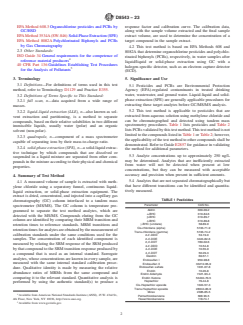
5.2 This test method is applicable to pesticides that are extracted from aqueous solution using methylene chloride and can be chromatographed and detected using tandem mass spectrometry procedures. Table 1 lists pesticides and Table 2 lists PCBs validated by this test method. This test method is not limited to the compounds listed in Table 1 or Table 2; however, the applicability of the test method to other compounds shall be demonstrated. Refer to Guide E2857 for guidance in validating the method for additional parameters.
5.3 Analyte concentrations up to approximately 250 ng/L may be determined. Analytes that are inefficiently extracted from water will not be detected when present at low concentrations, but they can be measured with acceptable accuracy and precision when present in sufficient amounts.
5.4 Analytes that are not separated chromatographically but that have different transitions can be identified and quantitatively measured.
5.5 This test method may be used to determine the concentrations of Aroclor6 mixtures or PCB congeners, or both, present in the sample. See Appendix X1 and Appendix X2 for suggested transitions and collisional energies for all 209 congeners. Separation of all 209 congeners may not be possible and may require additional GC columns and operating conditions. Analysis of all congeners is not expected to be achieved by this test method.
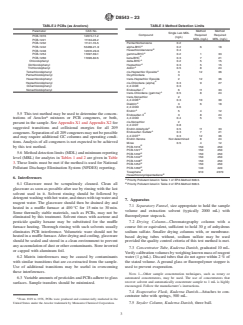
5.6 Method detection limits (MDL) and minimum reporting level (MRL) for analytes in Tables 1 and 2 are given in Table 3. These limits must be met if the method is used for National Pollutant Discharge Elimination System (NPDES) reporting. (A) Priority Pollutant listed in Table 1 of EPA Method 608.3.(...
SCOPE
1.1 This test method covers the identification and simultaneous measurement of extractable chlorinated pesticides and polychlorinated biphenyls (PCBs) by gas chromatography/mass spectrometry/mass spectrometry (GC/MS/MS).
1.2 This test method has been validated for wastewater influents, effluents, industrial discharges, surface water, and ground water.
1.3 This test method is not limited to these particular aqueous matrices; however, the applicability of this test method to other aqueous matrices shall be demonstrated.
1.4 This test method is restricted to use by or under the supervision of analysts experienced in the use of a gas chromatograph with tandem mass spectrometry. Each laboratory that uses this test method shall demonstrate the ability to generate results that meet or exceed the performance criteria of this test method.
1.5 If sensitivity permits, compound tentative identification of unknowns may be made by analyzing the extract in full-scan mode or, if the system allows simultaneous timed single-reaction monitoring (SRM)/full-scan acquisition. Identify unknown peaks according to Guide D4128.
1.6 This test method is performance-based. Minor modifications, as allowed by CFR 40 Part 136.6, may be made to improve the method performance, but changes may not be made to the extraction, the extraction solvent, sample-to-solvent ratio, or the MS/MS detection technique.
1.7 Units—The values stated in SI units are to be regarded as the standard. No other units of measurement are included in this standard.
1.8 This standard does not purport to address all of the safety concerns, if any, associated with its use. It is the responsibility of the user of this standard to establish appropriate safety, health, and environmental practices and determine the applicability of regulatory limitations prior to use.
1.9 This international standard was developed in accordance with internationally recognized princ...
- Status
- Published
- Publication Date
- 30-Nov-2023
- Technical Committee
- D19 - Water
- Drafting Committee
- D19.06 - Methods for Analysis for Organic Substances in Water
Overview
ASTM D8543-23 is the internationally recognized standard test method for the determination of pesticides and polychlorinated biphenyls (PCBs) in aqueous solutions. Developed by ASTM International, this standard outlines procedures for identifying and quantifying extractable chlorinated pesticides and PCBs using tandem gas chromatography/mass spectrometry/mass spectrometry (GC/MS/MS). The method applies to various water types, including treated drinking water, wastewater, surface water, groundwater, and industrial discharges. By employing extraction techniques such as liquid-liquid extraction and solid-phase extraction (SPE), this standard supports compliance with environmental regulations and ensures reliable monitoring of EPA-regulated contaminants.
Key Topics
- Target Analytes: The method covers a broad range of EPA-regulated chlorinated pesticides and PCBs, including those listed in the standard but also allowing for validation of additional analytes.
- Sample Types: Validated matrices include wastewater, drinking water, surface water, groundwater, and industrial effluents. Extension to other aqueous matrices is possible with appropriate validation.
- Analytical Technique: Utilizes GC/MS/MS for both identification and quantitative analysis, leveraging tandem mass spectrometry to enhance selectivity and sensitivity.
- Extraction Methods: Both liquid-liquid extraction with methylene chloride and solid-phase extraction (SPE) are employed for isolating analytes before analysis.
- Applicability and Restrictions: Use of this standard requires experienced analysts and qualified laboratories. Minor performance-based modifications are permitted, except for extraction or detection fundamentals.
- Reporting Levels: Method detection limits (MDL) and minimum reporting levels (MRL) are provided for a range of analytes; meeting these limits is essential for regulatory reporting, including NPDES permit compliance.
- Quality Control: Emphasis on calibration, validation, and proper use of internal standards, surrogates, and quality control checks.
Applications
- Regulatory Compliance: Essential for laboratories performing water quality analyses in support of EPA regulations regarding pesticides and PCBs.
- Water Treatment Monitoring: Used by utilities and authorities to monitor treated drinking water, wastewater, and ambient water sources for compliance and public safety assurance.
- Industrial Discharge: Identifies and quantifies legacy and ongoing contamination from manufacturing or chemical industry sources, particularly for discharges subject to permitting requirements.
- Environmental Assessment: Supports environmental monitoring programs assessing contaminant presence in diverse water bodies, enabling remediation decisions and pollution trend analysis.
- Method Flexibility: Performance-based nature allows adaptation for emerging contaminants, provided method validation demonstrates acceptable results per ASTM E2857.
Related Standards
- ASTM D1129: Terminology Relating to Water
- ASTM D1193: Specification for Reagent Water
- ASTM D2777: Practice for Determination of Precision and Bias of Water Test Methods
- ASTM D3370: Practices for Sampling Water from Flowing Process Streams
- ASTM D4128: Guide for Identification and Quantitation of Organic Compounds in Water by GC/MS
- ASTM D4448: Guide for Sampling Ground-Water Monitoring Wells
- ASTM D6089: Guide for Documenting Groundwater Sampling Events
- ASTM E2857: Guide for Validating Analytical Methods
- EPA Method 608.3: Organochlorine Pesticides and PCBs by GC/HSD
- EPA Method 8082A: Polychlorinated Biphenyls by Gas Chromatography
- EPA Method 3534A: Solid-Phase Extraction (SPE)
- 40 CFR Part 136: Guidelines for Pollutant Analysis in Water
Practical Value
ASTM D8543-23 provides a reliable, sensitive, and flexible framework for laboratories to measure EPA-regulated pesticides and PCBs in water, helping ensure public health protection, regulatory compliance, and effective environmental management. By following this standard, analysts can confidently obtain high-quality, defensible data critical to safeguarding water resources.
Relations
- Effective Date
- 01-May-2020
- Effective Date
- 01-May-2020
Frequently Asked Questions
ASTM D8543-23 is a standard published by ASTM International. Its full title is "Standard Test Method for Determination of Pesticides and Polychlorinated Biphenyls (PCBs) in Aqueous Solution by a Tandem Gas Chromatography/Mass Spectrometry/Mass Spectrometry (GC/MS/MS)". This standard covers: SIGNIFICANCE AND USE 5.1 Pesticides and PCBs are Environmental Protection Agency (EPA)-regulated contaminants in treated drinking water, wastewater, and ground water. Liquid-liquid and solid-phase extraction (SPE) are generally applicable procedures for extracting these target analytes before GC/MS/MS analysis. 5.2 This test method is applicable to pesticides that are extracted from aqueous solution using methylene chloride and can be chromatographed and detected using tandem mass spectrometry procedures. Table 1 lists pesticides and Table 2 lists PCBs validated by this test method. This test method is not limited to the compounds listed in Table 1 or Table 2; however, the applicability of the test method to other compounds shall be demonstrated. Refer to Guide E2857 for guidance in validating the method for additional parameters. 5.3 Analyte concentrations up to approximately 250 ng/L may be determined. Analytes that are inefficiently extracted from water will not be detected when present at low concentrations, but they can be measured with acceptable accuracy and precision when present in sufficient amounts. 5.4 Analytes that are not separated chromatographically but that have different transitions can be identified and quantitatively measured. 5.5 This test method may be used to determine the concentrations of Aroclor6 mixtures or PCB congeners, or both, present in the sample. See Appendix X1 and Appendix X2 for suggested transitions and collisional energies for all 209 congeners. Separation of all 209 congeners may not be possible and may require additional GC columns and operating conditions. Analysis of all congeners is not expected to be achieved by this test method. 5.6 Method detection limits (MDL) and minimum reporting level (MRL) for analytes in Tables 1 and 2 are given in Table 3. These limits must be met if the method is used for National Pollutant Discharge Elimination System (NPDES) reporting. (A) Priority Pollutant listed in Table 1 of EPA Method 608.3.(... SCOPE 1.1 This test method covers the identification and simultaneous measurement of extractable chlorinated pesticides and polychlorinated biphenyls (PCBs) by gas chromatography/mass spectrometry/mass spectrometry (GC/MS/MS). 1.2 This test method has been validated for wastewater influents, effluents, industrial discharges, surface water, and ground water. 1.3 This test method is not limited to these particular aqueous matrices; however, the applicability of this test method to other aqueous matrices shall be demonstrated. 1.4 This test method is restricted to use by or under the supervision of analysts experienced in the use of a gas chromatograph with tandem mass spectrometry. Each laboratory that uses this test method shall demonstrate the ability to generate results that meet or exceed the performance criteria of this test method. 1.5 If sensitivity permits, compound tentative identification of unknowns may be made by analyzing the extract in full-scan mode or, if the system allows simultaneous timed single-reaction monitoring (SRM)/full-scan acquisition. Identify unknown peaks according to Guide D4128. 1.6 This test method is performance-based. Minor modifications, as allowed by CFR 40 Part 136.6, may be made to improve the method performance, but changes may not be made to the extraction, the extraction solvent, sample-to-solvent ratio, or the MS/MS detection technique. 1.7 Units—The values stated in SI units are to be regarded as the standard. No other units of measurement are included in this standard. 1.8 This standard does not purport to address all of the safety concerns, if any, associated with its use. It is the responsibility of the user of this standard to establish appropriate safety, health, and environmental practices and determine the applicability of regulatory limitations prior to use. 1.9 This international standard was developed in accordance with internationally recognized princ...
SIGNIFICANCE AND USE 5.1 Pesticides and PCBs are Environmental Protection Agency (EPA)-regulated contaminants in treated drinking water, wastewater, and ground water. Liquid-liquid and solid-phase extraction (SPE) are generally applicable procedures for extracting these target analytes before GC/MS/MS analysis. 5.2 This test method is applicable to pesticides that are extracted from aqueous solution using methylene chloride and can be chromatographed and detected using tandem mass spectrometry procedures. Table 1 lists pesticides and Table 2 lists PCBs validated by this test method. This test method is not limited to the compounds listed in Table 1 or Table 2; however, the applicability of the test method to other compounds shall be demonstrated. Refer to Guide E2857 for guidance in validating the method for additional parameters. 5.3 Analyte concentrations up to approximately 250 ng/L may be determined. Analytes that are inefficiently extracted from water will not be detected when present at low concentrations, but they can be measured with acceptable accuracy and precision when present in sufficient amounts. 5.4 Analytes that are not separated chromatographically but that have different transitions can be identified and quantitatively measured. 5.5 This test method may be used to determine the concentrations of Aroclor6 mixtures or PCB congeners, or both, present in the sample. See Appendix X1 and Appendix X2 for suggested transitions and collisional energies for all 209 congeners. Separation of all 209 congeners may not be possible and may require additional GC columns and operating conditions. Analysis of all congeners is not expected to be achieved by this test method. 5.6 Method detection limits (MDL) and minimum reporting level (MRL) for analytes in Tables 1 and 2 are given in Table 3. These limits must be met if the method is used for National Pollutant Discharge Elimination System (NPDES) reporting. (A) Priority Pollutant listed in Table 1 of EPA Method 608.3.(... SCOPE 1.1 This test method covers the identification and simultaneous measurement of extractable chlorinated pesticides and polychlorinated biphenyls (PCBs) by gas chromatography/mass spectrometry/mass spectrometry (GC/MS/MS). 1.2 This test method has been validated for wastewater influents, effluents, industrial discharges, surface water, and ground water. 1.3 This test method is not limited to these particular aqueous matrices; however, the applicability of this test method to other aqueous matrices shall be demonstrated. 1.4 This test method is restricted to use by or under the supervision of analysts experienced in the use of a gas chromatograph with tandem mass spectrometry. Each laboratory that uses this test method shall demonstrate the ability to generate results that meet or exceed the performance criteria of this test method. 1.5 If sensitivity permits, compound tentative identification of unknowns may be made by analyzing the extract in full-scan mode or, if the system allows simultaneous timed single-reaction monitoring (SRM)/full-scan acquisition. Identify unknown peaks according to Guide D4128. 1.6 This test method is performance-based. Minor modifications, as allowed by CFR 40 Part 136.6, may be made to improve the method performance, but changes may not be made to the extraction, the extraction solvent, sample-to-solvent ratio, or the MS/MS detection technique. 1.7 Units—The values stated in SI units are to be regarded as the standard. No other units of measurement are included in this standard. 1.8 This standard does not purport to address all of the safety concerns, if any, associated with its use. It is the responsibility of the user of this standard to establish appropriate safety, health, and environmental practices and determine the applicability of regulatory limitations prior to use. 1.9 This international standard was developed in accordance with internationally recognized princ...
ASTM D8543-23 has the following relationships with other standards: It is inter standard links to ASTM D1129-13(2020)e2, ASTM D1129-13(2020)e1. Understanding these relationships helps ensure you are using the most current and applicable version of the standard.
ASTM D8543-23 is available in PDF format for immediate download after purchase. The document can be added to your cart and obtained through the secure checkout process. Digital delivery ensures instant access to the complete standard document.
Standards Content (Sample)
This international standard was developed in accordance with internationally recognized principles on standardization established in the Decision on Principles for the
Development of International Standards, Guides and Recommendations issued by the World Trade Organization Technical Barriers to Trade (TBT) Committee.
Designation: D8543 − 23
Standard Test Method for
Determination of Pesticides and Polychlorinated Biphenyls
(PCBs) in Aqueous Solution by a Tandem Gas
Chromatography/Mass Spectrometry/Mass Spectrometry
(GC/MS/MS)
This standard is issued under the fixed designation D8543; the number immediately following the designation indicates the year of
original adoption or, in the case of revision, the year of last revision. A number in parentheses indicates the year of last reapproval. A
superscript epsilon (´) indicates an editorial change since the last revision or reapproval.
1. Scope responsibility of the user of this standard to establish appro-
priate safety, health, and environmental practices and deter-
1.1 This test method covers the identification and simulta-
mine the applicability of regulatory limitations prior to use.
neous measurement of extractable chlorinated pesticides and
1.9 This international standard was developed in accor-
polychlorinated biphenyls (PCBs) by gas chromatography/
dance with internationally recognized principles on standard-
mass spectrometry/mass spectrometry (GC/MS/MS).
ization established in the Decision on Principles for the
1.2 This test method has been validated for wastewater
Development of International Standards, Guides and Recom-
influents, effluents, industrial discharges, surface water, and
mendations issued by the World Trade Organization Technical
ground water.
Barriers to Trade (TBT) Committee.
1.3 This test method is not limited to these particular
2. Referenced Documents
aqueous matrices; however, the applicability of this test
method to other aqueous matrices shall be demonstrated. 2.1 ASTM Standards:
D1129 Terminology Relating to Water
1.4 This test method is restricted to use by or under the
D1193 Specification for Reagent Water
supervision of analysts experienced in the use of a gas
D2777 Practice for Determination of Precision and Bias of
chromatograph with tandem mass spectrometry. Each labora-
Applicable Test Methods of Committee D19 on Water
tory that uses this test method shall demonstrate the ability to
D3370 Practices for Sampling Water from Flowing Process
generate results that meet or exceed the performance criteria of
Streams
this test method.
D4128 Guide for Identification and Quantitation of Organic
1.5 If sensitivity permits, compound tentative identification
Compounds in Water by Combined Gas Chromatography
of unknowns may be made by analyzing the extract in full-scan
and Electron Impact Mass Spectrometry
mode or, if the system allows simultaneous timed single-
D4448 Guide for Sampling Ground-Water Monitoring Wells
reaction monitoring (SRM)/full-scan acquisition. Identify un-
D6089 Guide for Documenting a Groundwater Sampling
known peaks according to Guide D4128.
Event
1.6 This test method is performance-based. Minor D6538 Guide for Sampling Wastewater With Automatic
Samplers
modifications, as allowed by CFR 40 Part 136.6, may be made
to improve the method performance, but changes may not be D6759 Practice for Sampling Liquids Using Grab and Dis-
crete Depth Samplers
made to the extraction, the extraction solvent, sample-to-
solvent ratio, or the MS/MS detection technique. E355 Practice for Gas Chromatography Terms and Relation-
ships
1.7 Units—The values stated in SI units are to be regarded
E2857 Guide for Validating Analytical Methods
as the standard. No other units of measurement are included in
2.2 EPA Standards:
this standard.
EPA Method 625.1 Base Neutrals and Acids by GC/MS
1.8 This standard does not purport to address all of the
safety concerns, if any, associated with its use. It is the
For referenced ASTM standards, visit the ASTM website, www.astm.org, or
contact ASTM Customer Service at service@astm.org. For Annual Book of ASTM
This test method is under the jurisdiction of ASTM Committee D19 on Water Standards volume information, refer to the standard’s Document Summary page on
and is the direct responsibility of Subcommittee D19.06 on Methods for Analysis for the ASTM website.
Organic Substances in Water. Available from United States Environmental Protection Agency (EPA), William
Current edition approved Dec. 1, 2023. Published December 2023. DOI: Jefferson Clinton Bldg., 1200 Pennsylvania Ave., NW, Washington, DC 20460,
10.1520/D8543-23. http://www.epa.gov.
Copyright © ASTM International, 100 Barr Harbor Drive, PO Box C700, West Conshohocken, PA 19428-2959. United States
D8543 − 23
EPA Method 608.3 Organochlorine pesticides and PCBs by response factor and calibration curve. The calibration data,
GC/HSD along with the sample volume extracted and the final sample
EPA Method 3534A (SW-846) Solid-Phase Extraction (SPE) extract volume, are used to determine the concentration of a
EPA Method 8082A Polychlorinated Biphenyls and PCBs target compound in the sample extract.
by Gas Chromatography
4.2 This test method is based on EPA Methods 608 and
2.3 Other Standards:
8082A that determine organochlorine pesticides and polychlo-
ISO Guide 34 General requirements for the competence of
rinated biphenyls (PCBs), respectively, in water samples after
reference material producers
liquid/liquid or solid-phase extraction using GC with a
40 CFR Part 136 Guidelines Establishing Test Procedures
halogen-specific detector, such as an electron capture detector
for the Analysis of Pollutants
(ECD).
3. Terminology
5. Significance and Use
3.1 Definitions—For definitions of terms used in this test
5.1 Pesticides and PCBs are Environmental Protection
method, refer to Terminology D1129 and Practice E355.
Agency (EPA)-regulated contaminants in treated drinking
water, wastewater, and ground water. Liquid-liquid and solid-
3.2 Definitions of Terms Specific to This Standard:
phase extraction (SPE) are generally applicable procedures for
3.2.1 full scan, n—data acquired from a wide range of
extracting these target analytes before GC/MS/MS analysis.
masses.
5.2 This test method is applicable to pesticides that are
3.2.2 liquid–liquid extraction (LLE), n—also known as sol-
extracted from aqueous solution using methylene chloride and
vent extraction and partitioning, is a method to separate
can be chromatographed and detected using tandem mass
compounds, based on their relative solubilities in two different
spectrometry procedures. Table 1 lists pesticides and Table 2
immiscible liquids, usually water (polar) and an organic
lists PCBs validated by this test method. This test method is not
solvent (non-polar).
limited to the compounds listed in Table 1 or Table 2; however,
3.2.3 quadrupole, n—component of a mass spectrometer
the applicability of the test method to other compounds shall be
capable of separating ions by their mass-to-charge ratio.
demonstrated. Refer to Guide E2857 for guidance in validating
3.2.4 solid-phase extraction (SPE), n—a solid-liquid extrac-
the method for additional parameters.
tive technique by which compounds that are dissolved or
5.3 Analyte concentrations up to approximately 250 ng/L
suspended in a liquid mixture are separated from other com-
may be determined. Analytes that are inefficiently extracted
pounds in the mixture according to their physical and chemical
from water will not be detected when present at low
properties.
concentrations, but they can be measured with acceptable
accuracy and precision when present in sufficient amounts.
4. Summary of Test Method
5.4 Analytes that are not separated chromatographically but
4.1 A measured volume of sample is extracted with meth-
that have different transitions can be identified and quantita-
ylene chloride using a separatory funnel, continuous liquid-
tively measured.
liquid extraction, or solid-phase extraction equipment. The
extract is dried, concentrated, and injected into a capillary gas
TABLE 1 Pesticides
chromatography (GC) column interfaced to a tandem mass
Parameter CAS No.
spectrometer (MS/MS). The GC column is temperature pro-
Aldrin 309-00-2
grammed to separate the test method analytes, which are
α-BHC 319-84-6
detected with the MS/MS. Compounds eluting from the GC
β-BHC 319-85-7
column are identified by comparing their MRM transition and
δ-BHC 319-86-8
γ-BHC (Lindane) 58-89-9
retention times to reference standards. MRM transitions and
Cis-chlordane (alpha) 5103-71-9
retention times for analytes are obtained by the measurement of
Trans-chlordane (gamma) 5103-74-2
calibration standards under the same conditions used for the
2-4’-DDD 53-19-0
2-4’-DDE 3424-82-6
samples. The concentration of each identified component is
2,4’-DDT 789-02-6
measured by relating the SRM response of the SRM produced
4-4’-DDD 72-54-8
by that compound to the SRM transition response produced by
4-4’-DDE 72-55-9
4,4’-DDT 50.29-3
a compound that is used as an internal standard. Surrogate
Dieldrin 60-57-1
analytes, whose concentrations are known in every sample, are
Endosulfan I 959-98-8
measured with the same internal standard calibration proce-
Endosulfan II 33212-65-9
Endosulfan sulfate 1031-07-8
dure. Qualitative identity is made by measuring the relative
Endrin 72-20-8
abundance ratios of MRMs from the same compound and
Endrin Aldehyde 7421-93-4
comparing it to the relevant standard. Quantitative analysis is
Endrin Ketone 53494-70-5
Heptachlor 76-44-8
performed by using the authentic standard(s) to produce a
Cis-Heptachlor epoxide 1024-57-3
Trans-Heptachlor epoxide 28044-83-9
Mirex 2385-85-5
Available from American National Standards Institute (ANSI), 25 W. 43rd St.,
Pentachlorobenzene 608.93-5
4th Floor, New York, NY 10036, http://www.ansi.org. Hexachlorobenzene 118-74-1
Available from www.govinfo.gov.
D8543 − 23
TABLE 2 PCBs (as Aroclors) TABLE 3 Method Detection Limits
Parameter CAS No. Method Method
Single Lab MDL
Compound Required Required
PCB-1016 12674-11-2
(ng/L)
MDL (ng/L) MRL (ng/L)
PCB-1221 11104-28-2
PCB-1232 11141-16-5 Pentachlorbenzene 0.2
A
PCB-1242 53469-21-9 alpha-BHC 0.2 6 18
B
Hexachlorobenzene 0.4
PCB-1248 12672-29-6
A
PCB-1254 11097-69-1 gamma-BHC 0.2 1 33
A
PCB-1260 11096-82-5 beta-BHC 0.3 7 21
A
Chlorobiphenyl delta-BHC 0.2 5 15
A
Dichlorobiphenyl Heptachlor 0.3 5 15
A
Trichlorobiphenyl Aldrin 0.5 8 24
A
Tetrachlorobiphenyl cis-Heptachlor Epoxide 3 12 36
Oxychlordane 3
Pentachlorobiphenyl
Hexachlorobiphenyl trans-Heptachlor Epoxide 2 12 36
A
cis-Chlordane (alpha) 0.3 9 27
Heptachlorobiphenyl
Octachlorobiphenyl 2,4’-DDE 0.3
A
Nonachlorobiphenyl Endosulfan I 6 11 33
A
trans-Chlordane (gamma) 0.5 8 24
trans-Nonachlor 2
A
4,4’-DDE 0.3 10 30
A
Dieldrin 3 6 18
2,4’-DDD 0.6
A
Endrin 5 4 12
5.5 This test method may be used to determine the concen- A
Endosulfan II 3 8 24
4,4’-DDD 0.4 5 15
trations of Aroclor mixtures or PCB congeners, or both,
cis-Nonachlor 2
present in the sample. See Appendix X1 and Appendix X2 for
2,4’-DDT 0.8
A
suggested transitions and collisional energies for all 209
Endrin Aldehyde 0.5 11 33
A
Endosulfan Sulfate 0.3 7 21
congeners. Separation of all 209 congeners may not be possible
A
4,4’-DDT 0.3 12 36
and may require additional GC columns and operating condi-
Endrin Ketone Not determined 8 24
tions. Analysis of all congeners is not expected to be achieved
Mirex 0.5 4 12
B
by this test method. PCB-1016 150 450
B
PCB-1221 150 450
B
5.6 Method detection limits (MDL) and minimum reporting
PCB-1232 150 450
B
PCB-1242 150 450
level (MRL) for analytes in Tables 1 and 2 are given in Table
B
PCB-1248 150 450
3. These limits must be met if the method is used for National
B
PCB-1254 150 450
B
Pollutant Discharge Elimination System (NPDES) reporting.
PCB-1260 140 420
B
Toxaphene 910 2370
B
Hexachlorocyclopentadiene
6. Interferences
A
Priority Pollutant listed in Table 1 of EPA Method 608.3.
B
6.1 Glassware must be scrupulously cleaned. Clean all Priority Pollutant listed in Table 2 of EPA Method 608.3.
glassware as soon as possible after use by rinsing with the last
solvent used in it. Solvent rinsing should be followed by
detergent washing with hot water, and rinses with tap water and
7. Apparatus
reagent water. The glassware should then be drained dry and
7.1 Separatory Funnel, size appropriate to hold the sample
heated in a muffle furnace at 400 °C for 15 min to 30 min.
volume and extraction solvent (typically 2000 mL) with
Some thermally stable materials, such as PCBs, may not be
fluoropolymer stopcock.
eliminated by this treatment. Solvent rinses with acetone and
pesticide quality hexane may be substituted for the muffle 7.2 Drying Column—Chromatography column with a
furnace heating. Thorough rinsing with such solvents usually course frit or equivalent, sufficient to hold 30 g of anhydrous
eliminates PCB interference. Volumetric ware should not be sodium sulfate. Smaller drying columns with, or membrane-
heated in a muffle furnace. After drying and cooling, glassware based drying tubes without, sodium sulfate may be used
should be sealed and stored in a clean environment to prevent provided the quality control criteria of this test method is met.
any accumulation of dust or other contaminants. Store inverted
7.3 Concentrator Tube, Kuderna Danish, graduated 10 mL.
or capped with aluminum foil.
Verify calibration volumes by weighing known mass of reagent
6.2 Matrix interferences may be caused by contaminants water (1 g ⁄mL). Discard tubes that do not agree within 2 % of
with similar transitions that are co-extracted from the sample. the stated volume. A ground glass or fluoropolymer stopper is
Use of additional transitions may be useful in overcoming used to prevent evaporation.
these interferences.
NOTE 1—Other sample concentration techniques, such as rotary or
automated concentrators, may be used. The use of concentrators that
6.3 Variable amounts of pesticides and PCBs adhere to glass
recover solvent and automatically concentrate sample to 1 mL is highly
surfaces. Sample transfers should be minimized.
encouraged. Follow the manufacturer’s instructions.
7.4 Evaporative Flask, Kuderna Danish—Attaches to con-
centrator tube with springs, 500 mL.
From 1929 to 1976, PCBs were produced and commercially marketed in the
United States under the Aroclor trademark by Monsanto Chemical Corporation. 7.5 Snyder Column, Kuderna Danish, three ball.
D8543 − 23
7.6 Continuous Liquid/Liquid Extractor, equipped with nizing a GC peak within any given retention time window,
fluoropolymer or glass connection joints requiring no lubrica- comparing the MRM transition from the GC peak with MRM
tion. transition in a user-created database, and generating a list of
7.6.1 Continuous liquid/liquid extraction is useful for identified compounds with their retention times. The software
shall allow integration of the ion abundance of any specific
samples containing up to 1 % solids that cause emulsions. This
technique is more efficient than separatory funnel extraction, transition between specified time limits. The software should
but the glassware is more expensive, and the overall extraction also allow calculation of response factors as defined in 11.2.3,
process is more time-consuming. linear regression; weighted least squares (WLS), also known as
weighted linear regression; % relative standard error (RSE)
7.7 Solid-Phase Extraction (SPE) Apparatus, suitable for
(see 40 CFR 136.6); construction of a second order (k=2)
extraction of up to 1000 mL of sample.
polynomial forms a quadratic expression (parabolic curve);
7.7.1 Filter, apparatus or multiple-position manifold.
calculation of response factor statistics; and calculation of
7.7.2 Vacuum System, capable of achieving 0.1 bar Hg
concentrations of analytes using either the calibration curve or
equipped with a shutoff valve and a vacuum gauge.
Eq 3.
7.7.3 Vacuum Trap, made from a 500 mL to 1000 mL
sidearm flask with a single-hole rubber stopper and glass
8. Reagents and Materials
tubing, or equivalent.
8.1 Purity of Reagents—Reagent grade chemicals shall be
7.8 Nitrogen Evaporation Device, equipped with a heated
used in all tests. Unless otherwise indicated, it is intended that
bath that can be maintained at an appropriate temperature for
all reagents shall conform to the specifications of the commit-
the solvent and analytes.
tee on Analytical Reagents of the American Chemical Society,
7.9 GC/MS/MS with Data Acquisition System:
where such specifications are available. Other grades may be
7.9.1 The GC shall be capable of temperature programming
used, provided it is pure enough to be used without lessening
and should be equipped with variable-constant differential flow
the accuracy of the determination.
controllers so that the column flow rate or linear velocity will
8.2 Purity of Water—Unless otherwise indicated, references
remain constant throughout temperature program operation.
to water shall be understood to mean reagent water conforming
7.9.1.1 Data for this test method was collected using helium
to Specification D1193, Types I or II.
as a carrier gas. If another gas is used, analytical conditions
8.3 SPE Sorbent—Non-polar C18 octadecyl, 10 g/60 mL,
may need to be adjusted. Follow the manufacturer’s instruc-
used for solid-phase extraction. Other media may be used,
tions for safety precautions regarding the use of hydrogen as a
provided the QC performance criteria of this test method are
carrier gas.
met.
7.9.2 Capillary GC Columns—Any GC column that meets
8.3.1 Each sorbent lot should be certified by the laboratory
the performance specifications of this test method may be used.
or commercial supplier to ensure recovery of the analytes of
Separations of the calibration mixture shall be equivalent or
interest and removal of 2,4,6-trichlorophenol. Add the trichlo-
better than those described in this test method. As examples,
rophenol mixture to the same standard used to prepare the
the following columns have been found to be suitable:
laboratory control sample (LCS).
7.9.2.1 Column, 30 m by 0.25 mm, 5 % phenyl methyl-
8.3.1.1 The recovery of all LCS analytes shall be within
polysiloxane-fused silica capillary with a 0.25 μm film
acceptable range except 2,4,6-trichlorophenol, which shall not
thickness, or equivalent.
be detected; otherwise, the SPE sorbent is not performing
7.9.2.2 Other columns, such as those manufactured specifi-
properly, the lot shall be rejected.
cally for the analysis of pesticides, may be used.
7.9.3 Injection Port—Split, splitless, temperature
8.4 Ethyl Alcohol, ACS Grade.
programmable, solvent purge, back flushed, or other, suitable
8.5 Ethyl Ether, Nano Grade, and free from analytes.
for injecting highly reproducible sample aliquots. An auto-
8.5.1 Ethyl ether shall be shown to be free of peroxides
sampler is highly recommended.
before use. Test strips are available for this. Procedures that
7.9.4 The mass spectrometer shall be capable of electron
recommend how to remove peroxides are available with the
ionization at a nominal electron energy of 70 eV. The spec-
strips. After removal of peroxides, add 20 mL of ethyl alcohol
trometer shall be capable of acquiring and storing data for up
to preserve each litre of ether.
to four MRMs per targeted analyte with dwell times sufficient
8.6 Methylene Chloride, ACS Grade, demonstrated to be
to measure a minimum of ten or more data points during the
free of analytes.
elution of each GC peak.
8.7 Sodium Thiosulfate, granular.
NOTE 2—Other electron ionization energies or modes of ionization may
be used, provided the quality control (QC) acceptance criteria of this test
method is met.
7.9.4.1 GC/MS/MS Interface—Any interface that meets the
Reagent Chemicals, American Chemical Society Specifications, American
Chemical Society, Washington, DC. For suggestions on the testing of reagents not
requirements in this test method may be used.
listed by the American Chemical Society, see Analar Standards for Laboratory
7.9.5 A data system is required to acquire, store, reduce, and
Chemicals, BDH Ltd., Poole, Dorset, U.K., and the United States Pharmacopeia
output mass spectral data. The computer software should have
and National Formulary, U.S. Pharmacopeial Convention, Inc. (USPC), Rockville,
the capability of processing stored GC/MS/MS data by recog- MD.
D8543 − 23
8.8 Sodium Sulfate, Granular Anhydrous—Bake in a shal- 8.11.4 Alternatively to 8.11.3, a standard containing a mix-
low tray at 450 °C for a minimum of 1 h. Cool in a desiccator ture of Aroclor 1016 and Aroclor 1260 that includes many of
and store in a precleaned glass bottle with a screw cap that the peaks represented in the other Aroclor mixtures may be
prevents moisture from entering. used. As a result, a multi-point initial calibration using a
mixture of Aroclors 1016 and 1260 at three concentrations is
NOTE 3—If membrane-based solvent drying tubes are used, sodium
enough to demonstrate the linearity of the detector response
sulfate is not needed.
without the necessity of performing multi-point initial calibra-
8.9 Standard Solutions, Stock—Standards that are to be used
tions for each of the seven Aroclors. In addition, such a mixture
for calibration shall be Independent Reference Materials
can be used as a standard to demonstrate that a sample does not
(IRMs), where available. If an IRM is not available, then the
contain peaks that represent any one of the Aroclors. This
standards shall be Reference Materials (RMs). If an IRM or
standard can also be used to determine the concentrations of
RM, or both, are not available, the standard shall be manufac-
either Aroclor 1016 or Aroclor 1260, should they be present in
tured under the requirements of ISO Guide 34. Laboratories
a sample.
may also prepare their own calibration standards from neat
8.11.5 If results are to be determined for individual PCB
materials according to 8.9.1.
congeners, then standards for the pure congeners must be
8.9.1 Prepare stock solutions by accurately weighing
prepared. Table 4 lists characteristic congeners that may be
0.0100 g of pure material. Dissolve the material in methanol or
used in the identification of the individual Aroclors. Tables
another suitable solvent and dilute to 10 mL in a volumetric
X1.1 and X2.1 include information on the additional
flask. When the assay is 96 % or greater, the weight may be
congeners, but the analyst must either document the resolution
used without a correction to calculate the concentration of the
of the congeners in question or establish procedures for
stock standard.
reporting the results of coeluting congeners that are appropriate
for the intended application.
8.9.1.1 Transfer the stock solutions to fluoropolymer-lined
lid screw cap bottles. Store at 4 °C 6 2 °C and protect from
8.12 Internal Standard Spiking Solution:
light. Check periodically for degradation or evaporation.
8.12.1 Select a minimum of two internal standard com-
8.9.1.2 Replace stock standards after six months or accord-
pounds from Table 5 that closely represent the pesticide
ing to the manufacturer’s instructions. Replace sooner if
compounds of interest. The compounds in Table 5 were chosen
comparison with check standards indicates a problem.
because they do not interfere in the analysis.
8.12.2 Prepare a mixed internal standard solution at a
8.10 Standard Solutions, Secondary Dilution—Use stock
concentration of 2 μg/L in acetone.
standard solutions to prepare secondary dilution standard
solutions that contain the analytes in methylene chloride. The 8.13 Surrogate Standard Spiking Solution:
secondary solutions should be prepared at concentrations that
8.13.1 Select a minimum of two surrogate compounds from
can be easily diluted to calibration standards that will bracket Table 5 that closely represent the pesticide compounds of
the calibration range (Table 4).
interest. The compounds in Table 5 do not interfere in the
analysis.
8.10.1 Store secondary dilution standards at 4 °C 6 2 °C,
8.13.2 Prepare a mixed surrogate solution at a concentration
protected from light. Check periodically for evaporation and
of 2 μg/L in acetone.
degradation.
8.10.2 Replace secondary dilution standards after six
9. Hazards
months or according to the manufacturer’s instructions. Re-
9.1 This standard does not purport to address all of the
place sooner if comparison with check standards indicates a
safety concerns, if any, associated with its use. It is the
problem.
responsibility of the user of this standard to establish appro-
8.11 Standard Solutions, Calibration—For Table 1 analytes,
priate safety, health, and environmental practices and deter-
prepare a minimum of five calibration solutions in methylene
mine the applicability of regulatory limitations prior to use.
chloride.
10. Sample Collection, Preservation, and Storage
8.11.1 One of the calibration standards should be at a
concentration of the analyte near the Minimum Reporting
10.1 Sample Collection, Dechlorination, and Preservation:
Limit (MRL). The lower value may be rounded to a whole
10.1.1 Collect all chlorinated samples in 1000 mL amber
number that is more convenient for preparing the standard, but
glass bottles containing 75 mg of sodium thiosulfate crystals. If
shall not exceed the MRL.
collecting less sample, use less sodium thiosulfate as appropri-
8.11.2 The other concentrations should correspond to the
ate. Un-chlorinated samples do not require sodium thiosulfate.
expected range of concentrations expected in samples or
10.1.2 Collect non-chlorinated, non-tap water samples in
should define the working range.
accordance with Practices D3370, Guide D4448, Guide
8.11.3 Use a minimum of three concentrations of each D6538, or Practice D6759. Document field activities according
Aroclor in Table 2 to demonstrate the linearity of the detector to Guide D6089.
response for individual congeners identified in Table 8. Cali- 10.1.3 The samples shall be chilled to above freezing and
brate in separate mixtures at concentrations ranging from ≤6 °C on the day of collection and shall be maintained at that
0.5 ppb to 1000 ppb. Choose three to five of the individual temperature until extraction. Field samples that will not be
characteristic congeners to represent each Aroclor. received at the laboratory on the day of collection shall be
D8543 − 23
TABLE 4 Example Calibration Range and Typical Response Factors % RSD
ID Compound Dynamic Range (ng/L) RF %RSD
1 PCB01_Monochlorobiphenyl_01 5 - 250 10.43
2 Pentachlorbenzene 0.5 - 250 6.67
3 PCB01_Monochlorobiphenyl_02 5 - 250 5.89
4 PCB01_Monochlorobiphenyl_03 50 - 250 8.83
5 PCB02_Dichlorobiphenyl_02 2 - 250 14.47
6 2,4,5,6-Tetrachloro-m-xylene ISTD -
7 PCB9-13C12 ISTD -
8 PCB02_Dichlorobiphenyl_05 20 - 250 5.7
9 PCB02_Dichlorobiphenyl_04 2 - 250 5.88
10 PCB02_Dichlorobiphenyl_01 2 - 250 15.8
11 alpha-BHC 0.5 - 250 9.71
12 Hexachlorobenzene 0.5 - 250 7.77
13 gamma-BHC 0.5 - 250 14.03
14 beta-BHC 0.5 - 250 13.99
15 PCB03_Trichlorobiphenyl_01 0.5 - 250 13.99
16 PCB02_Dichlorobiphenyl_03 0.5 - 250 15.07
17 delta-BHC 0.5 - 250 7.36
18 PCB03_Trichlorobiphenyl_05 0.5 - 250 19.24
19 PCB03_Trichlorobiphenyl_02 0.5 - 250 11.73
20 PCB03_Trichlorobiphenyl_03 1 - 250 15.79
21 PCB03_Trichlorobiphenyl_04 1 - 250 8.39
22 Heptachlor 0.5 - 250 10.34
23 PCB04_Tetrachlorobiphenyl_01 2 - 250 13.06
24 PCB04_Tetrachlorobiphenyl_03 2 - 250 14.69
25 PCB04_Tetrachlorobiphenyl_05 10 - 250 5.9
26 Aldrin 1 - 250 10
27 PCB04_Tetrachlorobiphenyl_02 5 - 250 10.47
28 4,4’-Dibromobiphenyl ISTD -
29 PCB04_Tetrachlorobiphenyl_04 5 - 250 5.29
30 cis-Heptachlor Epoxide 2 - 250 7.98
31 Oxychlordane 2 - 250 12.09
32 trans-Heptachlor Epoxide 5 - 250 18.23
33 PCB05_Pentachlorobiphenyl_02 20 - 250 11.57
34 cis-Chlordane 1 - 250 14.33
35 PCB05_Pentachlorobiphenyl_05 50 - 250 14.47
36 2,4’-DDE 0.5 - 250 15.95
37 PCB05_Pentachlorobiphenyl_01 20 - 250 7.25
38 Endosulfan I 5 - 250 17.39
39 trans-Chlordane 2 - 250 5.99
40 trans-Nonachlor 5 - 250 6.07
41 PCB111-13C12 ISTD -
42 4,4’-DDE 0.5 - 250 12.74
43 Dieldrin 5 - 250 19.19
44 PCB05_Pentachlorobiphenyl_03 50 - 100 6.96
45 2,4’-DDD 0.5 - 100 16.79
46 PCB06_Hexachlorobiphenyl_04 20 - 250 14.83
47 Endrin 5 - 250 11.3
48 PCB06_Hexachlorobiphenyl_02 10 - 250 1.53
49 Endosulfan II 5 - 250 10.35
50 PCB05_Pentachlorobiphenyl_04 50 - 250 8.8
51 4,4’-DDD 0.5 - 250 14.28
52 cis-Nonachlor 5 - 250 7.78
53 2,4’-DDT 0.5 - 250 12.84
54 Endrin Aldehyde 5 - 250 7.53
55 PCB06_Hexachlorobiphenyl_01 5 - 250 19.71
56 PCB06_Hexachlorobiphenyl_05 50 - 250 6.81
57 Endosulfan Sulfate 1 - 250 6.82
58 4,4’-DDT 0.5 - 250 10.15
59 PCB06_Hexachlorobiphenyl_03 5 - 250 2.71
60 PCB07_Heptachlorobiphenyl_02 5 - 250 11.16
61 PCB07_Heptachlorobiphenyl_05 5 - 250 18.67
62 Endrin Ketone 5 - 250 13.54
63 PCB07_Heptachlorobiphenyl_03 20 - 250 5.01
64 PCB08_Octachlorobiphenyl_05 100 - 250 15.69
65 PCB07_Heptachlorobiphenyl_01 1 - 250 3.67
66 Mirex 0.5 - 250 11.24
67 PCB07_Heptachlorobiphenyl_04 20 - 250 9.63
68 PCB08_Octachlorobiphenyl_01 50 - 250 12.41
69 PCB08_Octachlorobiphenyl_02 50 - 250 20.52
70 PCB09_Nonachlorobiphenyl_02 50 - 250 10.85
71 PCB08_Octachlorobiphenyl_04 50 - 250 23.39
72 PCB09_Nonachlorobiphenyl_03 50 - 250 24.57
73 PCB08_Octachlorobiphenyl_03 50 - 250 9.61
74 PCB09_Nonachlorobiphenyl_01 50 - 250 22.29
D8543 − 23
A
TABLE 5 Suggested Internal Standards and Surrogates
Internal Standards
2,4,5,6-Tetrachloro-m-xylene CAS: 877-09-8 For pesticides (Primary)
4,4’-Dibromobiphenyl CAS: 92-86-4 For pesticides (Secondary)
Chlorpyrifos-d10 For pesticides (Secondary)
2,5-Dichlorobiphenyl (13C labeled) CAS: 25569-80-6 For PCBs (Primary)
2,3,3’,5,5’-Pentachlorobiphenyl (13C labeled) CAS: 235416-29-2 For PCBs (Secondary)
Surrogates
Methoxychlor-d14 CAS: N/A For pesticides (Primary)
2,4,5,6-Tetrachloro-m-xylene CAS: 877-09-8 For pesticides (Secondary)
2,2’,5,5’-Tetrachlorobiphenyl (13C12) CAS: 208263-80-3 For PCBs (Primary)
2,2’,4,5,5’-Pentachlorobiphenyl (13C12) CAS: 104130-39-4 For PCBs (Secondary)
A
If either one of them is interfered or unstable by matrices, or both, another one can be used.
packaged for shipment with enough ice to ensure that they will decomposes to endrin aldehyde and endrin ketone. If degrada-
be at ≤6 °C on arrival at the laboratory. tion of DDT or endrin exceeds 15 %, take corrective action
before proceeding. Since this test measures the performance of
10.2 Sample Storage:
the injection port, it should be conducted even if DDT or endrin
10.2.1 Store samples at above freezing and ≤6 °C until
are not target analytes.
analysis.
(a) Inject 1 μL of a DDT and endrin decomposition
10.2.2 Extract all samples within seven days of collection.
solution, containing endrin at a concentration of 1 μg/mL and
10.3 Field Reagent Blanks:
4,4’-DDT at a concentration of 2 μg/mL in methylene chloride.
10.3.1 Duplicate field reagent blanks, if collected, shall be
(b) Measure the MRM area of DDT, endrin, DDD, DDE,
handled along with each sample set, which is composed of the
endrin aldehyde, and endrin ketone, and calculate the percent
samples collected from the same general sample site at
breakdown as:
approximately the same time. At the laboratory, fill field blank
% DDT breakdown = @~DDD + DDE! ⁄ ~DDT + DDD + DDE!# × 100
sample bottles with water, seal, and ship to the sampling site
(1)
along with empty sample bottles, and send back to the
laboratory with filled sample bottles. Wherever a set of
% endrin breakdown =
samples is shipped and stored, it is accompanied by appropriate
@~endrin aldehyde + endrin ketone! ⁄
(2)
blanks.
~endrin + endrin aldehyde + endrin ketone!# × 100
NOTE 4—Alternatively, calibrate for each compound and calculate
11. Calibration and Standardization
breakdown-using concentration.
11.1 Demonstration and documentation of acceptable initial
11.2.1.2 MS Sensitivity—The GC/MS/MS/DS peak identifi-
calibration for compounds of interest are required before any
cation software should be able to recognize an MRM transition
samples are analyzed, and are required intermittently through-
in the appropriate retention time window for each of the
out sample analysis as dictated by results of continuing
compounds in the calibration solution and make correct iden-
calibration checks. After initial calibration is successful, a
tifications. If fewer than 99 % of the compounds are
continuing calibration check is required at the beginning of
recognized, system maintenance is required.
each 12 h period during which analyses are performed. Addi-
11.2.2 If all performance criteria are met, inject an aliquot of
tional periodic calibration checks are good practice for labo-
each of the other calibration standards using the same GC/
ratories. The criteria in this section were used for the method
MS/MS conditions.
validation. Other criteria may be more appropriate in a given
11.2.3 Use the GC/MS/MS data system software or other
situation depending on the data quality objectives.
proven software to generate a calibration curve, which may
include either a relative response factor (RRF), a linear
11.2 Initial Calibration:
11.2.1 Performance Criteria for the Medium Calibration: calibration not through the origin, or a non-linear calibration
model. If a calibration curve is used, a measure of relative error
11.2.1.1 GC Performance—Good column performance will
produce symmetrical peaks with minimum tailing for most (either as a percent relative error (%RE) or a percent relative
standard error (%RSE)) should be used. The RE or RSE shall
compounds. If peaks are broad, or sensitivity is poor, see 11.3.5
for some possible remedial actions. be ≤20 % for Table 1 analytes and ≤30 % for Table 2 analytes.
Use a minimum of two internal standards. Appropriate internal
(1) DDT and endrin may degrade at a contaminated injec-
tion port, or if there are exposed metal fittings. Test for DDT standards are listed in Table 5. Table 6 contains suggested
quantitation ions for all compounds. Experience gained from
and endrin breakdown before the initial calibration verification
the method validation has shown that the use of these sug-
by injecting a standard containing only DDT and endrin under
gested ions and the suggested internal standards listed in Tables
the exact conditions of the analytical method, and measure
5 and 6 minimizes method interferences.
either the area of the full scan peak or the primary ion MRM
transitions. If using the MRM transition, the lab shall first 11.2.3.1 Alternatively, calculate a relative response factor
demonstrate that the MRM transitions being used yield the (RRF) for each analyte and surrogate for each calibration
same nominal breakdown percentage as the full scan. If there standard. The calculation of RRF is supported in acceptable
is breakdown, DDT decomposes to DDE and DDD, and endrin GC/MS/MS data system software. The RRF is a unitless
D8543 − 23
A
TABLE 6 Example of Primary Ion and Confirmation Ion Transitions
Primary Ion Transition Confirmation Ion Transition
Retention Time,
Component
min
Precursor Product Precursor Product
Aldrin 10.437 260.9 191.0 262.9 193.0
alpha-BHC 6.995 216.9 180.9 218.9 182.9
beta-BHC 7.668 216.9 180.9 218.9 182.9
delta-BHC 8.160 216.9 180.9 218.9 182.9
gamma-BHC (Lindane) 7.499 216.9 180.9 218.9 182.9
trans-Chlordane 12.452 372.8 262.8 374.8 264.8
cis-Chlordane 12.968 372.8 262.8 374.8 264.8
4,4’-DDD 15.265 235.0 165.0 237.0 167.0
4,4’-DDE 13.708 315.9 246.0 317.9 248.0
4,4’-DDT 16.715 235.0 165.0 237.0 167.0
Dieldrin 13.779 260.9 191.0 262.9 193.0
Endosulfan I 12.882 240.9 170.0 242.9 172.0
Endosulfan II 14.907 240.9 170.0 242.9 172.0
Endosulfan sulfate 16.515 395.9 395.9 397.9 397.9
Endrin 14.567 260.9 191.0 262.9 193.0
Endrin aldehyde 15.607 249.9 214.9 249.9 179.0
Endrin ketone 18.309 281.0 244.9 281.0 208.9
Heptachlor 9.441 269.9 234.9 271.9 236.9
Heptachlor epoxide 11.665 352.8 262.9 354.8 264.9
Methoxychlor 19.033 212.1 212.1 273.9 273.9
Hx-Sed 12.917 294.9 258.9 296.9 260.9
Hep-Sed 13.640 306.9 270.9 308.9 272.9
Parlar-26 14.531 328.9 292.9 330.9 294.9
Parlar-40 16.733 340.9 304.9 342.9 306.9
Parlar-41 16.733 340.9 304.9 342.9 306.9
Parlar-44 17.132 376.9 340.9 378.9 342.9
Parlar-50 17.965 374.9 338.9 376.9 340.9
Parlar-62 20.003 338.9 302.9 340.9 304.9
Monochlorobiphenyl 5.590 188.0 153.0 190.0 155.0
Dichlorobiphenyl 6.984 222.0 187.0 224.0 189.0
Trichlorobiphenyl 8.842 255.9 186.0 257.9 188.0
Tetrachlorobiphenyl 11.116 289.9 220.0 291.9 222.0
Pentachlorobiphenyl 13.674 323.9 253.9 325.9 255.9
Hexachlorobiphenyl 16.333 357.9 287.9 359.9 289.9
Heptachlorobiphenyl 18.726 391.8 321.8 393.8 323.8
Octachlorobiphenyl 21.181 427.8 357.8 429.8 359.9
Nonachlorobiphenyl 23.618 461.7 391.8 463.7 393.8
2,4,5,6-Tetrachloro-m-xylene 6.295 244.0 209.1 171.0 136.2
2,2’,5,5-Tetrachlorobiphenyl (13C12) 9.922 301.9 231.9 303.9 233.9
2,2’,4,5,5-Pentachlorobiphenyl (13C12) 12.710 335.9 265.9 337.9 267.9
Methoxychlor-d14 18.943 241.1 177.1 241.1 223.1
Chlorpyrifos-d10 10.421 324.1 259.9 324.1 194.9
4,4’-Dibromobiphenyl 10.841 312.0 152.1 310.0 152.1
Pyrene-d10 12.710 212.2 208.2 208.2 204.2
Decachlorobiphenyl 26.030 507.7 437.8 509.7 439.8
A
PCBs show the retention times of the center of data acquisition time windows.
number, but units used to express quantities of analyte and 11.2.4 For the initial calibration to be acceptable, the
internal standard shall be equivalent. following criteria shall be met. These criteria verify the
linearity of the calibration curve.
~Ax!~Qis!
RRF 5 (3)
11.2.4.1 The RSD of the mean RRF shall be ≤20 % for the
Ais Qx
~ !~ !
Table 1 analytes and ≤30 % for Table 2 analytes.
where:
11.2.4.2 If the acceptance criteria are not met, take action to
Ax = integrated abundance of the quantitation ion of the
improve GC/MS/MS performance and recalibrate.
analyte;
11.3 Continuing Calibration Check—Verify the initial cali-
Ais = integrated abundance of the quantitation ion of the
bration at the beginning of each 12 h work shift during which
internal standard;
Qx = quantity of analyte purged, ng or concentration units; analyses are performed, using the following procedure. Ana-
lyze a final calibration verification standard at the end of the
and
Qis = quantity of internal standard, ng, or concentration
batch.
units.
11.3.1 Inject a medium concentration calibration standard
and analyze with the same conditions used during the initial
11.2.3.2 For each analyte and surrogate, calculate the mean
calibration.
(M) RRF from the analyses of the calibration standards.
Calculate the standard deviation (SD) and the relative standard 11.3.2 Demonstrate acceptable performance for the criteria
deviation (RSD) from each mean: RSD = 100(SD ⁄M). shown in 11.2.1.
D8543 − 23
11.3.3 Determine that the absolute areas of the quantitation separatory funnel (7.1). Pipet the surrogate standard (8.10.1)
ions of the internal standard and surrogates have not decreased into the separatory funnel, immersing the tip of the pipet a few
by more than 30 % from the areas measured in the most recent millimeters into the sample. If the sample will be used for LCS,
continuing calibration check or by more than 50 % from the LCSD, MS, or MSD, pipet 1 mL of spiking solution (8.11.1)
areas measured during initial calibration. If these areas have into the separatory funnel, immersing the tip of the pipet a few
decreased by more than these amounts, adjustments shall be millimeters into the sample. Swirl the sample to mix well.
made to restore system sensitivity. These adjustments may
12.1.4 Add 60 mL of methylene chloride (8.3) to the sample
require cleaning of the MS ion source or other maintenance, as
bottle, seal, and shake for about 30 s. Transfer the methylene
indicated in 11.3.5, and recalibration. Control charts are useful
chloride to the separatory funnel and extract by shaking the
aids in documenting system sensitivity changes.
funnel for 2 min, with periodic venting to relieve pressure.
11.3.4 Calculate the percent recovery for each analyte and
12.1.5 Allow phases to separate. If an emulsion forms,
surrogate from the data measured in the continuing calibration
apply mechanical means to break the emulsion. This can
check. For the continuing calibration to be acceptable, the
include adding NaCl, stirring with a glass rod, or filtration
following criteria shall be met.
through glass wool.
11.3.4.1 The percent recovery for at least 90 % of the
12.1.6 Drain the methylene chloride layer through a drying
analytes and surrogates shall be within 25 % of the expected
column (7.2) containing 30 g of anhydrous sodium sulfate (8.7)
concentration.
into an evaporator flask (7.4) with a 10 mL concentrator tube
11.3.4.2 For any analyte or surrogate with percent recovery
(7.3) attached.
more than 25 % from the mean value of the initial calibration,
12.1.7 Repeat the extraction (12.1.4 – 12.1.6) twice, com-
the percent recovery shall be within 30 % of the expected
bining the extracts. Concentrate the extract according to 12.3.
concentration.
12.1.8 Determine the original sample volume by refilling
11.3.4.3 The percent recovery of a given analyte or surro-
the sample bottle to the mark (12.1.3) and transferring to an
gate shall not exceed 75 % to 125 % for more than three
appropriately-sized graduated cylinder. For samples sizes near
continuing calibrations in a row.
1000 mL, record to the nearest 10 mL. For sample volumes
11.3.4.4 If the acceptance criteria for an opening continuing
near 100 mL, record to the nearest milliliter.
calibration check are not met, remedial action shall be taken
that may require recalibration.
12.2 SPE:
11.3.5 Possible Remedial Actions Following a Calibration
12.2.1 The steps in this subsection address the extraction of
Verification Failure:
aqueous field samples using disk-based SPE media.
11.3.5.1 Check and adjust GC or MS operating conditions,
12.2.1.1 Mark the water meniscus on the side of the sample
or both, check the MS resolution, and calibrate the mass scale.
bottle for later determination of sample volume. Pipet the
11.3.5.2 Clean or replace the splitless injection liner.
surrogate standard (8.10.1) into the bottle, immersing the tip of
11.3.5.3 Break off a short portion of the column from the
the pipet a few millimeters into the sample. If the sample
end near the injector or replace the GC column. This action will
contains particulates, let stand to settle out the particulates
cause a change in retention times.
before extraction. Place a standard filter apparatus on a vacuum
11.3.5.4 Prepare fresh calibration solutions and repeat the
filtration flask or manifold and attach to a vacuum source. The
initial calibration step.
vacuum gauge should read at least 63.5 cm of mercury when
11.3.5.5 Clean the MS ion source or quadrupole rods, or
all valves are closed. Position an extraction disk onto the filter
both.
screen. Wet the entire disk with methanol. To aid in filtering
11.3.5.6 Replace any components that allow analytes to
samples with particulates, a 1 μm glass fiber filter or filter aid
come into contact with hot metal surfaces.
can be placed on the top of the disk and wetted with methanol.
11.3.5.7 Replace the MS electron multiplier or any other
(If a filter is used, it must also be extracted as in the following
faulty components.
steps along with the disk). Install the reservoir and clamp.
11.3.6 Verify a continuing calibration check standard after
Resume vacuum to dry the disk. Interrupt the vacuum. Wash
any maintenance.
the disk and reservoir with 20 mL of methylene chloride.
Resume the vacuum briefly to pull methylene chloride through
12. Procedure
the disk. Interrupt the vacuum and allow the disk to soak for
about a minute. Resume vacuum and completely dry the disk.
12.1 Separatory Funnel Sample Extraction:
12.1.1 This section contains procedures for separatory fun-
12.2.1.2 Condition the disk with 20 mL of methanol. Apply
nel liquid-liquid extraction. Other techniques, such as continu- vacuum until nearly all the solvent has passed through the disk,
ous liquid-liquid extraction are referenced elsewhere (EPA
interrupting it while solvent remains on the disk. Allow the
SW846 Method 3535). disk to soak for about a minute. Resume vacuum to pull most
12.1.2 This procedure assumes an extraction volume of 1 L.
of the methanol through, but interrupting it to leave a layer of
If a different sample volume is used, adjust the methylene methanol on the surface of the disk. Do not allow disk to dry.
chloride accordingly. For NPDES compliance, do not extract
For uniform flow and good recovery, it is critical the disk is not
less than a 100 mL sample. allowed to dry
...