

ASTM F3623-23
(Specification)Standard Specification for Surveillance Supplementary Data Service Providers
General Information
- Abstract
SCOPE
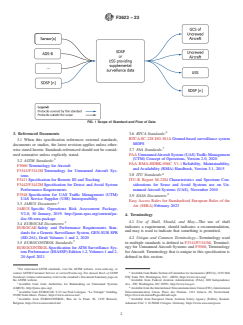
1.1 This specification defines minimum performance requirements for Surveillance supplemental data service providers (SDSPs) and associated equipment and services. This specification also defines requirements on users of the Surveillance SDSP’s services. Surveillance SDSPs may provide aircraft track information to Detect and Avoid (DAA) systems and situational awareness tools to enable beyond visual line of sight (BVLOS) UAS operations and support VLOS operations.
FIG. 1 Scope of Standard and Flow of Data
1.2 The expected operating environment is low- to medium-risk airspace (equivalent to Joint Authorities for Rulemaking of Unmanned Systems Specific Operations Risk Assessment (JARUS SORA) ARC-b and ARC-c airspace, respectively). It is generally intended to cover operations below 10 000 ft AGL, and specifically operations below 1200 ft AGL.
1.3 This standard does not purport to address all of the safety concerns, if any, associated with its use. It is the responsibility of the user of this standard to establish appropriate safety, health, and environmental practices and determine the applicability of regulatory limitations prior to use.
1.4 This international standard was developed in accordance with internationally recognized principles on standardization established in the Decision on Principles for the Development of International Standards, Guides and Recommendations issued by the World Trade Organization Technical Barriers to Trade (TBT) Committee.
- Status
- Published
- Publication Date
- 31-Oct-2023
- Technical Committee
- F38 - Unmanned Aircraft Systems
- Drafting Committee
- F38.01 - Airworthiness
Overview
ASTM F3623-23: Standard Specification for Surveillance Supplementary Data Service Providers is an international standard published by ASTM International, under the jurisdiction of Committee F38 on Unmanned Aircraft Systems. This specification establishes the minimum performance requirements for Surveillance Supplementary Data Service Providers (SDSPs) and associated equipment and services. SDSPs play a crucial role by supplying supplemental surveillance information, such as aircraft track data, which supports Detect and Avoid (DAA) systems and enhances situational awareness. This is critical for enabling Beyond Visual Line of Sight (BVLOS) operations for Unmanned Aircraft Systems (UAS), as well as supporting Visual Line of Sight (VLOS) activities.
The specification is primarily intended for use in low- to medium-risk airspace (equivalent to JARUS SORA ARC-b and ARC-c) and typically covers operations below 10,000 feet above ground level (AGL), with emphasis on operations below 1,200 feet AGL.
Key Topics
- Performance Requirements: Defines minimum standards for data quality, accuracy, latency, availability, and the frequency of surveillance data updates provided by SDSPs.
- Service-Level Agreements (SLAs): Specifies the required provisions in agreements between SDSPs and end users, including performance metrics, notification protocols, data processing specifics, and responsibilities during service degradation.
- Roles and Responsibilities:
- SDSPs must validate and communicate current system status, provide timely and accurate surveillance data, and implement procedures for notification during system failures or degraded performance.
- End users are responsible for defining their operational needs and ensuring that the SDSP's data meets these requirements.
- Data Handling & Security: SDSPs are required to comply with information security best practices, manage data retention for safety investigations (minimum 30 days), and ensure machine-readable data delivery and secure, authenticated access.
- Interoperability: Aligns terminology and data protocols with other relevant UAS standards to enhance compatibility, clarity, and data exchange.
Applications
The ASTM F3623-23 standard has practical applications across a variety of unmanned aviation and airspace management scenarios:
- UAS Operations: Ensures that UAS operators, manufacturers, and integrators can rely on consistent, high-quality surveillance data to support both BVLOS and VLOS operations.
- Detect and Avoid Systems: Provides critical track information for DAA solutions, enhancing mid-air collision avoidance and overall airspace safety.
- UAS Traffic Management (UTM): Supports interoperability among different USS (UAS Service Suppliers) and SDSPs, fostering a cohesive ecosystem for monitoring, tracking, and incident response.
- Regulatory Compliance & Safety: Facilitates compliance with civil aviation authority requirements, including data retention, incident reporting, and corrective action for degraded service events.
- Risk Assessment: Offers a framework for verifying that risk ratios for airspace operations are achieved, aiding operators and authorities in operational approvals and oversight.
Related Standards
To implement robust UAS operations and comprehensive surveillance, ASTM F3623-23 should be used in conjunction with the following related standards and documents:
- ASTM F3442/F3442M: Specification for Detect and Avoid System Performance Requirements
- ASTM F3411: Specification for Remote ID and Tracking
- ASTM F3548: Specification for UAS Traffic Management (UTM) USS Interoperability
- RTCA DO-381A: Ground-based Surveillance System MOPS
- JARUS SORA: Specific Operations Risk Assessment Package
- EUROCAE ED-261: Safety and Performance Requirements for a Generic Surveillance System
- EUROCONTROL ESASSP: Specification for ATM Surveillance System Performance
- FAA and EASA Guidance: UAS Traffic Management Concepts, Safety Management Handbooks
- ITU-R M.2204: Spectrum Considerations for Sense and Avoid Systems
Practical Value
Implementing ASTM F3623-23 enhances operational safety, regulatory compliance, and seamless data integration. UAS operators, SDSPs, and UTM service providers relying on this standard can ensure accurate surveillance, clear roles, timely response to system health changes, and proper data retention for audits and investigations. This results in safer UAS operations, particularly for complex BVLOS missions and in shared or controlled airspace.
Keywords: ASTM F3623-23, Surveillance Supplementary Data Service Provider, SDSP, UAS, DAA, situational awareness, BVLOS, VLOS, performance requirements, SLA, airspace safety, data retention, interoperability, UTM.
Frequently Asked Questions
ASTM F3623-23 is a technical specification published by ASTM International. Its full title is "Standard Specification for Surveillance Supplementary Data Service Providers". This standard covers: SCOPE 1.1 This specification defines minimum performance requirements for Surveillance supplemental data service providers (SDSPs) and associated equipment and services. This specification also defines requirements on users of the Surveillance SDSP’s services. Surveillance SDSPs may provide aircraft track information to Detect and Avoid (DAA) systems and situational awareness tools to enable beyond visual line of sight (BVLOS) UAS operations and support VLOS operations. FIG. 1 Scope of Standard and Flow of Data 1.2 The expected operating environment is low- to medium-risk airspace (equivalent to Joint Authorities for Rulemaking of Unmanned Systems Specific Operations Risk Assessment (JARUS SORA) ARC-b and ARC-c airspace, respectively). It is generally intended to cover operations below 10 000 ft AGL, and specifically operations below 1200 ft AGL. 1.3 This standard does not purport to address all of the safety concerns, if any, associated with its use. It is the responsibility of the user of this standard to establish appropriate safety, health, and environmental practices and determine the applicability of regulatory limitations prior to use. 1.4 This international standard was developed in accordance with internationally recognized principles on standardization established in the Decision on Principles for the Development of International Standards, Guides and Recommendations issued by the World Trade Organization Technical Barriers to Trade (TBT) Committee.
SCOPE 1.1 This specification defines minimum performance requirements for Surveillance supplemental data service providers (SDSPs) and associated equipment and services. This specification also defines requirements on users of the Surveillance SDSP’s services. Surveillance SDSPs may provide aircraft track information to Detect and Avoid (DAA) systems and situational awareness tools to enable beyond visual line of sight (BVLOS) UAS operations and support VLOS operations. FIG. 1 Scope of Standard and Flow of Data 1.2 The expected operating environment is low- to medium-risk airspace (equivalent to Joint Authorities for Rulemaking of Unmanned Systems Specific Operations Risk Assessment (JARUS SORA) ARC-b and ARC-c airspace, respectively). It is generally intended to cover operations below 10 000 ft AGL, and specifically operations below 1200 ft AGL. 1.3 This standard does not purport to address all of the safety concerns, if any, associated with its use. It is the responsibility of the user of this standard to establish appropriate safety, health, and environmental practices and determine the applicability of regulatory limitations prior to use. 1.4 This international standard was developed in accordance with internationally recognized principles on standardization established in the Decision on Principles for the Development of International Standards, Guides and Recommendations issued by the World Trade Organization Technical Barriers to Trade (TBT) Committee.
ASTM F3623-23 is available in PDF format for immediate download after purchase. The document can be added to your cart and obtained through the secure checkout process. Digital delivery ensures instant access to the complete standard document.
Standards Content (Sample)
This international standard was developed in accordance with internationally recognized principles on standardization established in the Decision on Principles for the
Development of International Standards, Guides and Recommendations issued by the World Trade Organization Technical Barriers to Trade (TBT) Committee.
Designation: F3623 − 23
Standard Specification for
Surveillance Supplementary Data Service Providers
This standard is issued under the fixed designation F3623; the number immediately following the designation indicates the year of
original adoption or, in the case of revision, the year of last revision. A number in parentheses indicates the year of last reapproval. A
superscript epsilon (´) indicates an editorial change since the last revision or reapproval.
1. Scope 2.2 Specification F3442/F3442M specifies high-level risk
ratios that the overall system must achieve. Many components
1.1 This specification defines minimum performance re-
and factors go into determining and verifying a given risk ratio.
quirements for Surveillance supplemental data service provid-
These include elements such as the vehicle’s speed and
ers (SDSPs) and associated equipment and services. This
maneuverability; the level of human interaction required to
specification also defines requirements on users of the Surveil-
respond to an alert; the quality, accuracy, latency and com-
lance SDSP’s services. Surveillance SDSPs may provide air-
pleteness of traffic surveillance information; and the
craft track information to Detect and Avoid (DAA) systems and
performance, availability and latency of command and control
situational awareness tools to enable beyond visual line of sight
(C2) links. The applicant seeking approval (which could be an
(BVLOS) UAS operations and support VLOS operations.
operator, integrator, service provider or manufacturer) should
1.2 The expected operating environment is low- to medium-
be able to verify that the required risk ratios can be achieved.
risk airspace (equivalent to Joint Authorities for Rulemaking of
Each element to be used in an integrated DAA solution is
Unmanned Systems Specific Operations Risk Assessment
expected to provide documentation such that risk ratios may be
(JARUS SORA) ARC-b and ARC-c airspace, respectively). It
determined.
is generally intended to cover operations below 10 000 ft AGL,
2.3 The latencies between the sensors and Surveillance
and specifically operations below 1200 ft AGL.
SDSPs are important variables to be included in any risk ratio
1.3 This standard does not purport to address all of the
calculations.
safety concerns, if any, associated with its use. It is the
2.4 A successfully implemented Surveillance SDSP may use
responsibility of the user of this standard to establish appro-
this specification to define its operational requirements to
priate safety, health, and environmental practices and deter-
verify that it is fulfilling the detect function, whether partially
mine the applicability of regulatory limitations prior to use.
or fully, in a way that meets the DAA performance require-
1.4 This international standard was developed in accor-
ments of Specification F3442/F3442M. The Surveillance
dance with internationally recognized principles on standard-
ization established in the Decision on Principles for the SDSP alone cannot demonstrate whether the risk ratios are
achieved, since this depends on many factors controlled by
Development of International Standards, Guides and Recom-
mendations issued by the World Trade Organization Technical each operator’s integration with the SDSP, and each operator’s
avoidance concept.
Barriers to Trade (TBT) Committee.
2.4.1 The Surveillance SDSP entity writes a test plan, taking
2. Relationships Between Standards
into account its system and limitations/assumptions associated
2.1 This specification is one of several developed within
with its expected users (for example, types of vehicles and
ASTM International that, when taken together, endeavor to on-board/ground-based DAA systems).
provide a robust and scalable set of DAA solutions to enable
2.4.2 The Surveillance SDSP entity conducts a series of
BVLOS operations for UAS. Therefore, the reader is also
tests (for example, live flights, simulated encounter datasets, or
encouraged to consider Specification for Detect and Avoid
a combination), documenting each test (for example, through
System Performance Requirements (F3442/F3442M), Specifi-
test cards) as well as its results (for example, through collection
cation for Remote ID and Tracking (F3411), and Specification
and analysis of data).
for UAS Traffic Management (UTM) UAS Service Supplier
2.4.3 The Surveillance SDSP entity uses the results of its
(USS) Interoperability (F3548). There are several ways that
tests as part of its documentation to users and competent
these standards may be used collectively.
authorities, demonstrating that its capabilities are as described.
2.4.4 The Surveillance SDSP entity will also conduct an
This specification is under the jurisdiction of ASTM Committee F38 on
interference test to determine the level at which interference
Unmanned Aircraft Systems and is the direct responsibility of Subcommittee F38.01
adversely affects the required accuracy of the surveillance
on Airworthiness.
systems and set an alert level in the surveillance monitoring
Current edition approved Nov. 1, 2023. Published December 2023. DOI:
10.1520/F3623-23. system to notify the pilot of degraded DAA performance.
Copyright © ASTM International, 100 Barr Harbor Drive, PO Box C700, West Conshohocken, PA 19428-2959. United States
F3623 − 23
FIG. 1 Scope of Standard and Flow of Data
3. Referenced Documents 3.6 RTCA Standards:
RTCA SC-228 DO-381A Ground-based surveillance system
3.1 When this specification references external standards,
MOPS
documents or studies, the latest revision applies unless other-
wise stated herein. Standards referenced should not be consid- 3.7 FAA Standards:
ered normative unless explicitly stated. FAA Unmanned Aircraft System (UAS) Traffic Management
(UTM) Concept of Operations, Version 2.0, 2020
3.2 ASTM Standards:
FAA RMA-HDBK-006C V1.1 Reliability, Maintainability,
F3060 Terminology for Aircraft
and Availability (RMA) Handbook, Version 3.1, 2015
F3341/F3341M Terminology for Unmanned Aircraft Sys-
tems 3.8 ITU Standards:
ITU-R Report M.2204 Characteristics and Spectrum Con-
F3411 Specification for Remote ID and Tracking
F3442/F3442M Specification for Detect and Avoid System siderations for Sense and Avoid Systems use on Un-
Performance Requirements manned Aircraft Systems (UAS), November 2010
F3548 Specification for UAS Traffic Management (UTM)
3.9 EASA Documents:
UAS Service Supplier (USS) Interoperability
Easy Access Rules for Standardised European Rules of the
3.3 JARUS Documents:
Air (SERA) February 2023
JARUS Specific Operations Risk Assessment Package,
V2.0, 30 January, 2019. http://jarus-rpas.org/content/jar-
4. Terminology
doc-06-sora-package
4.1 Use of Shall, Should, and May—The use of shall
3.4 EUROCAE Documents:
indicates a requirement, should indicates a recommendation,
EUROCAE Safety and Performance Requirements Stan-
and may is used to indicate that something is permitted.
dards for a Generic Surveillance System, GEN-SUR SPR
(ED-261), Draft Volumes 1 and 2, 2020 4.2 Unique and Common Terminology—Terminology used
in multiple standards is defined in F3341/F3341M, Terminol-
3.5 EUROCONTROL Standards:
ogy for Unmanned Aircraft Systems and F3060, Terminology
EUROCONTROL Specification for ATM Surveillance Sys-
for Aircraft. Terminology that is unique to this specification is
tem Performance (ESASSP) Edition 1.2, Volumes 1 and 2,
defined in this section.
20 April 2021
For referenced ASTM standards, visit the ASTM website, www.astm.org, or
contact ASTM Customer Service at service@astm.org. For Annual Book of ASTM Available from Radio Technical Committee for Aeronautics (RTCA), 1150 18th
Standards volume information, refer to the standard’s Document Summary page on NW, Suite 910, Washington, D.C., 20036, https://www.rtca.org/.
the ASTM website. Available from Federal Aviation Administration (FAA), 800 Independence
Available from Joint Authorities for Rulemaking on Unmanned Systems Ave., SW, Washington, DC 20591, http://www.faa.gov.
(JARUS), http://jarus-rpas.org/. Available from the International Telecommunication Union (ITU), International
Available from EUROCAE, 9-23 rue Paul Lafargue, “Le Triangle” building, Telecommunication Union, Place des Nations, 1211 Geneva 20, Switzerland,
93200 Saint-Denis, France, https://www.eurocae.net/. https://www.itu.int/en/Pages/default.aspx.
5 9
Available from EUROCONTROL, Rue de la Fusée 96, 1130 Brussels, Available from European Union Aviation Safety Agency (EASA), Konrad-
Belgium, https://www.eurocontrol.int/. Adenauer-Ufer 3, D-50668 Cologne, Germany, https://www.easa.europa.eu.
F3623 − 23
4.3 This specification uses terminology contained within 5.1.1.4 Applicable limitations or restrictions on aircraft
Specifications F3442/F3442M and F3548. These terms are not classes and data usage,
duplicated within this document.
5.1.1.5 An indication as to whether the Surveillance SDSP
4.3.1 The following terms, among others, are defined in supports Class 1 DAA systems, Class 2 DAA systems per
Specification F3442/F3442M: detect and avoid (DAA);
Specification F3442/F3442M, or situational awareness sys-
NMAC risk ratio (RR) measurement; operational volume tems.
(OV); loss of well clear risk ratio (LR) measurement; mid-air
5.1.1.6 The required notification time prior to scheduled
collision (MAC); near mid-air collision (NMAC) function; service changes (14 days unless stated otherwise),
remain well clear (RWC) function; and well-clear (WC)
5.1.1.7 Post-processing applied to the raw data feed (for
boundary.
example, extrapolation, interpolation, fusion, correlation,
4.3.2 The following terms, among others, are defined in
validation), and
Specification F3548: operational intent, UAS service supplier
5.1.1.8 Any additional services provided.
(USS), UAS traffic management (UTM) and USS service.
5.1.2 The Surveillance SDSP may also include the follow-
ing in the SLA:
4.4 The following terms, among others, are defined in
5.1.2.1 An overview and definition of its system and
RTCA DO-381A: declaration volume (DV); and surveillance
processes, and
volume (SV).
5.1.2.2 Information pertaining to the commercial agreement
4.5 Abbreviations and Acronyms:
with its End User (for example, penalties for service failures,
4.5.1 ADS-B—automatic dependent surveillance – broad-
rules on sharing/reselling of data).
cast
5.1.3 The Surveillance SDSP shall provide timely and
4.5.2 AGL—above ground level
accurate updates about its coverage and performance, espe-
4.5.3 AMSL—above mean sea level cially when its service is degraded or otherwise nonconformant
to the SLA. The Surveillance SDSP shall notify Users of
4.5.4 ATC—air traffic control
unplanned service degradation or non-conformance with the
4.5.5 BVLOS—beyond visual line of sight
SLA as soon as practicable but no later than within 24 hours of
4.5.6 DAA—detect and avoid
discovery unless stated otherwise. The Surveillance SDSP shall
routinely confirm that its current status meets or exceeds the
4.5.7 EPU—estimated position uncertainty
minimum performance agreed upon in the SLA.
4.5.8 LIDAR—light detection and ranging
5.1.4 The Surveillance SDSP shall define and calculate
4.5.9 MOR—mandatory occurrence report
surveillance and declaration volumes.
4.5.10 MTBF—mean time between failures
5.1.5 The Surveillance SDSP shall provide the altitude of
tracks with its reference (above mean sea level (AMSL), above
4.5.11 MTTR—mean time to recovery
ground level (AGL), uncorrected barometric pressure altitude,
4.5.12 RMS—root mean square
or GPS altitude) when capable of reporting altitude.
4.5.13 SLA—service level agreement
5.1.6 The Surveillance SDSP should convert between alti-
4.5.14 SDSP—supplemental data service provider
tude reference frame values.
4.5.15 UA—unmanned aircraft
5.2 The User’s Responsibilities:
4.5.16 UAS—unmanned aircraft system
5.2.1 The User shall identify the system performance
needed to support their operations and safety requirements.
4.5.17 USS—UAS service supplier
The User shall determine whether the data characteristics (for
4.5.18 UTM—UAS traffic management
example, quality, reliability, availability, coverage area) pro-
4.5.19 VLOS—visual line of sight
vided by the Surveillance SDSP and detailed in the SLA are
sufficient.
5. Service-Level Agreement (SLA)
5.2.2 The User shall define their operational volume and
5.1 Surveillance SDSP Responsibilities: verify that the associated volume(s) is (are) appropriately
encapsulated by the Surveillance SDSP surveillance and dec-
5.1.1 The Surveillance SDSP shall have a service-level
laration volumes.
agreement (SLA) or other form of agreement in place with
5.2.3 The User shall determine the appropriate contingency
each end user that explains, among other things, how this
specification is implemented. An optional outline of relevant action upon notification of degradation or failure of the
Surveillance SDSP’s service(s).
SLA provisions can be found in Appendix X1. The SLA shall,
at a minimum, include the following: 5.2.4 The User shall comply with training and system
5.1.1.1 A statement declaring the Surveillance SDSP’s ad- limitations documentation provided by the Surveillance SDSP.
herence to applicable provisions of this specification, The User should distribute this documentation to personnel or
5.1.1.2 A summary of the Surveillance SDSP’s performance participants, or both, in a manner consistent with their safety
and operational requirements.
and quality metrics as defined in Section 7, Performance
Requirements, 5.2.5 The User shall make any necessary conversions of
5.1.1.3 A description of how the Surveillance SDSP’s sur- reference frames to support their safety and operational re-
veillance volume is calculated or measured, or both, quirements.
F3623 − 23
5.2.6 The User may limit the ingested surveillance volume specified update rate. A track is considered coasted (and shall
to a predetermined area. be tagged as such) if none of the sensors detected the track in
5.2.7 The User shall verify that the information received its respective last update cycles.
from the Surveillance SDSP supports the system-level risk
NOTE 1—This value is used for ATC for 3NM separation and is
ratios for a given set of operations.
considered the minimum acceptable threshold.
5.2.8 While the User is ultimately responsible for the above
7.3 The Surveillance SDSP shall send heartbeat messages to
items, they may delegate the underlying/implied tasks de-
all users at the rate specified in the SLA. This rate shall not be
scribed above to another entity, including the Surveillance
less frequent than twice the update rate (for example, for an
SDSP.
update rate of 4 seconds, the heartbeat rate shall not be less
6. Roles and Functions of the Surveillance SDSP frequent than 8 seconds).
6.1 The Surveillance SDSP uses input data from one or 7.4 The Surveillance SDSP shall measure the probability of
more sensors or other surveillance SDSPs. Sensors can be track updates. This is to ensure that tracks are updated
provisioned by any combination of public or private entities, as statistically consistently and that misses (no update) are not
concentrated in time and on any particular track. This shall be
allowed by applicable regulation. There are many possible
types of sensors, but they generally fall into three types: done using the methodology described in 7.5.
6.1.1 Independent or primary, which detects aircraft with no
7.5 After each track update, the next update is expected
assistance from the aircraft (for example, primary radar,
within a specified measurement interval (typically 5 s for ATC
LIDAR, optical, acoustic);
4 s update rate). A gap is the time between the end of the
6.1.2 Cooperative or secondary, which detects aircraft with
measurement interval and the next track update.
assistance from the aircraft (for example, secondary radar,
7.5.1 Probability of update is calculated by:
Transponder Modes A, C, or S); or
total duration of all gaps
6.1.3 Dependent, is a passive sensor that depends on the
1 2
total duration of all tracks
aircraft to provide location and identification information (for
NOTE 2—One duration is the first time a sensor captures a track to the
example, ADS-B, FLARM, passive multilateration).
last time a sensor captures a track. The total duration of all tracks is the
summation of all track durations for each 24 hour operational period.
6.2 The Surveillance SDSP may provide validated track
data to its users, meaning that the position of a given track is
7.5.2 Probability of update shall be greater than 97 % for
known with a degree of certainty to represent an actual aircraft
each 24-hour operational period.
at that location. This can be achieved by comparing two or
7.5.3 Long gaps (larger than 3 times the measurement
more sources.
interval + 10 %) shall be less than 0.5 % for each 24-hour
operational period.
6.3 Surveillance is an important input to a number of other
functions outside of a UTM setting. For example, it can support
7.6 The accuracy of a track is a function of the underlying
DAA safety functions, which can be used in a variety of ways
sensors detecting the object and the methods, if any, used for
by the operator/UAS itself or by an intermediate service.
tracking. The Surveillance SDSP’s track accuracy shall be
6.3.1 From a system-level view, the Surveillance SDSP and
specified in the SLA, in accordance with the limits set in this
its underlying sensors contribute to the target NMAC risk ratio
specification.
(RR) and loss of well clear risk ratio (LR) for a given
7.7 The actual track trajectory can be reconstructed and the
operation. Calculating whether a given surveillance configura-
received track data can be measured against the reconstructed
tion satisfies the operation’s requirements must be done by the
trajectory. The difference between the reconstructed trajectory
operator or its USS, or another entity that has access to detailed
and the received track data should be measured at the time of
information about the operator’s and vehicle’s contribution to
update. An RMS (root mean square) average of this distance is
the risk ratios. The quantitative performance requirements for
measured for each track across all track updates. Actual track
a given intruder’s equipage can be found in Specification
trajectory can be reconstructed using a variety of methods. This
F3442/F3442M.
is typically based on adjacent air traffic and mathematical
reconstruction over the entire life of the track.
7. Performance Requirements
7.8 The horizontal accuracy class shall be stated by
7.1 Users of the Surveillance SDSP data feed will require
keeping into account the 95 % of horizontal accuracy bound
varying data quality and performance depending on their
and the following EPU (estimated position uncertainty) cat-
intended operation. This section provides the minimum re-
egories:
quired data metrics and values. This section also specifies how
EPU ≥ 926 m (0.5 NM)
those metrics and values should be measured wherever neces-
EPU < 926 m (0.5 NM)
sary. These metrics and values may be improved upon in the
EPU < 555.6 m (0.3 NM)
SLA.
7.2 The Surveillance SDSP shall update all track data sent to
users at the rate specified in the SLA. The rate shall be at least
This methodology is derived from ESASSP Ed. 1.2.
once every 4 seconds. This rate is considered one update cycle.
R2 of ESASSP Ed. 1.2.
If the sensor measurement rate is less frequent than the
R3 of ESASSP Ed. 1.2.
specified update rate, extrapolation may be used to achieve the Appendix 1 to AMC1 SERA.6005(c).
F3623 − 23
EPU < 185.2 m (0.1 NM) 7.17 If the Surveillance SDSP provides extrapolation as a
service, it shall offer all track data within a given surveillance
EPU < 92.6 m (0.05 NM)
volume at the current time or with a difference between
EPU < 30 m
timestamps of no more than 200 ms. The user shall have access
EPU < 10 m
to the non-extrapolated track feed should their use case require
EPU < 3 m
it. The age of the last measured information, compared to the
7.9 Vertical accuracy follows the same determination
timestamp of the message, shall be provided.
method as horizontal accuracy. Vertical accuracy requirements
7.18 A coasted track shall be terminated after no more than
are only applicable for systems that are capable of reporting
16 seconds. The number of track updates associated with a
altitude. The Surveillance SDSP shall provide the reference
coasted track shall be specified in the SLA and may vary
frame for the reported altitude.
depending on aircraft classification. The Surveillance SDSP
7.10 The vertical accuracy shall be stated according to the
shall identify coasted tracks in the track message.
following categories by keeping into account 95 % geometric
altitude accuracy: 7.19 The termination of a track shall be explicitly stated.
Information about the reason for termination may also be
Unknown or > 150 m
provided, if available (for example, ADS-B equipped aircraft
≤ 150 m
landed, operation finished for a UAS, track obscured by a
≤ 45 m
physical obstacle). The user of the Surveillance SDSP data may
≤ 15 m
choose to keep dropped tracks displayed if beneficial to their
7.11 Latency is the measure of time delay. Several latencies
situational awareness.
are relevant to the use of surveillance data. Latency is
7.20 False tracks are non-real tracks within a declaration
expressed in the time delay from the time of applicability to the
volume. False tracks do not correspond to an aircraft or to its
sensor; from the sensor to the Surveillance SDSP; in the
actual position. If the Surveillance SDSP is capable of identi-
internal processing time of the Surveillance SDSP itself; and
fying false tracks for a specific surveillance volume, it shall
from the Surveillance SDSP to the user (including network
report the false track at the time of discovery. The Surveillance
latencies). See Appendix X2 for Surveillance SDSP system
SDSP shall report false track statistics for a given surveillance
latency design considerations.
volume that persists for more than three update cycles (for
7.12 The Surveillance SDSP shall define its nominal and
example, as a percentage of total encounters or as the number
maximum latencies in milliseconds from the time of applica-
of alerts per hour) alongside the date on which the statistic was
bility to the Surveillance SDSP’s dissemination endpoint. The
gathered.
Surveillance SDSP shall indicate nominal latency in its heart-
beat messages, including alerts if latencies exceed those 7.21 For the purposes of setting limits on instances of
specified by SLA. dropped tracks and false tracks, the Surveillance SDSP shall
indicate geographic areas that constitute a single declaration
7.13 The Surveillance SDSP may report which functions its
volume, regardless of the number and types of sensors that lie
latency includes (DF, A1F, A2F) as per Specification F3442/
within that region. A single declaration volume should not be
F3442M.
smaller than the declaration volume of a single sensor. For a
7.14 The User shall monitor the network and latency be-
network of sensors, the declaration volume shall not be smaller
tween the Surveillance SDSP and the user and shall respond to
than the contiguous declaration volume of the network. The
diminished network and latency performance in a manner
Surveillance SDSP may change, add, remove, enlarge or shrink
consistent with their safety management system and standard
its surveillance volumes but shall provide prior notification of
operating procedures, if defined. This can be achieved by
those changes to its users. Adherence to chart revision cycles or
measuring the delay between timestamped messages and their
similar intervals is encouraged but ultimately is at the discre-
reception time at the user’s.
tion of the competent authority.
7.15 For Surveillance SDSPs where track capacity is a
7.22 Because the Surveillance SDSP is an important com-
limiting operational factor, the Surveillance SDSP shall report
ponent in helping the UAS operator or USS ensure that the UA
the maximum number of tracks the system is capable of
does not collide with manned air traffic, it is expected to meet
handling to its users.
high availability metrics, as defined in this section. The
differentiator between Class 1 and Class 2 Surveillance SDSPs
7.16 When information about the type of object being
is in the achievement of these metrics, which necessarily
tracked is provided by the sensor, that information shall be
influences overall robustness. The Surveillance SDSP shall
provided by the Surveillance SDSP to its users. The Surveil-
meet the requirements in Table 1 for MTTR (mean time to
lance SDSP may report false tracks delineated by classification
recovery), automatic recovery time, and MTBF (mean time
in addition to the requirements outlined in 7.20.
between failures). The Surveillance SDSP is expected to
NOTE 3—This information can be presented in various ways. It may be
employ automatic recovery, but there may be instances of
an indication of type of aircraft, or that an object is a UA or birds. It may
unsatisfactory operation of the automatic recovery mechanism
also be one or more expressions of the certainty that a given object fits one
where human intervention may be required. To allow for that,
or more classification categories. This behavior is set by the sensor
provider. two MTBF intervals are specified.
F3623 − 23
TABLE 1 Surveillance SDSP Availability and Reliability Metrics
8.4 Many data fields may be expressed in multiple units. In
Class 1 Class 2 those cases, the data dictionary indicates suggested or default
MTTR 30 min 30 min units, as well as other units that may be used, as long as the
Automatic Recovery Time 10 min 5 min
units are carried in the message.
MTBF with Automatic Recovery 30 h 300 h
MTBF without Automatic Recovery 500 h 5000 h
8.5 In order to promote interop
...