

ASTM D6780/D6780M-19
(Test Method)Standard Test Methods for Water Content and Density of Soil In situ by Time Domain Reflectometry (TDR)
General Information
- Abstract
SIGNIFICANCE AND USE
5.1 This test method can be used to determine the density and water content of naturally occurring soils and of soils placed during the construction of earth embankments, road fills, and structural backfills.
5.2 Time domain reflectometry (TDR) measures the apparent dielectric constant (Procedure A) and the apparent dielectric constant, first voltage drop and long term voltage (V1 and Vf) (Procedure B) of soil. The apparent dielectric constant is affected significantly by the water content and density of soil, and to a lesser extent by the chemical composition of soil and pore water, and by temperature. The first voltage drop and long term voltage (V1 and Vf) are affected significantly by the water content, density, and the chemical composition of the in situ pore water, and to a lesser extent the chemical composition of the soil solids. This test method measures the gravimetric water content.
5.3 Soil and pore water characteristics are accounted for in Procedure A with two calibration constants and for Procedure B with five calibration constants. The two soil constants for Procedure A are determined for a given soil by performing compaction tests in a special mold as described in Annex A2. The five soil constants for Procedure B are determined in conjunction with compaction testing in accordance with specified compaction procedures, for example, Test Method D698 as described in Annex A3. Both Procedures A and B use Test Method D2216 to determine the water contents.
5.4 When following Procedure A, the water content is the average value over the length of the cylindrical mold and the density is the average value over the length of the multiple-rod probe embedded in the soil. When following Procedure B, the water content and density is the average values over the length of the multiple-rod embedded in the soil.
Note 1: The quality of the result produced by this standard is dependent on the competence of the personnel performing it, and the suitability of th...
SCOPE
1.1 This test method may be used to determine the water content of soils and the density of soils in place using Time Domain Reflectometry.
1.2 This test method applies to soils that have 30 % or less by weight of their particles retained on the 19.0-mm [3/4-in.] sieve.
1.3 This test method is suitable for use as a means of acceptance for compacted fill or embankments.
1.4 This test method is not appropriate for frozen soils or soils at temperatures over 40°C [100°F] and may not be suitable for organic soils, highly plastic soils, or extremely dense soils.
1.5 All observed and calculated values shall conform to the guidelines for significant digits and rounding established in Practice D6026.
1.5.1 The method used to specify how data are collected, calculated, or recorded in this standard is not directly related to the accuracy to which the data can be applied in design or other uses, or both. How one applies the results obtained using this standard is beyond its scope.2
1.6 Two alternative procedures are provided to determine the water content and the density of soil in situ:
1.6.1 Procedure A
involves two tests in the field, an in situ test and a test in a mold containing material excavated from the in situ test location. The apparent dielectric constant is determined in both tests.
1.6.2 Procedure B
involves only an in situ test by incorporating the first voltage drop and long term voltage (V1 and Vf ) in addition to the apparent dielectric constant. While the bulk electrical conductivity can be determined from these measurements, it is not needed for the determination of water content and density.
1.7 Units—The values stated in either SI units or inch-pound units are to be regarded separately as standard. The values stated in each system may not be exact equivalents; therefore, each system shall be used independently of the other. Combining values from the two systems may result in non...
- Status
- Published
- Publication Date
- 31-Jul-2019
- Technical Committee
- D18 - Soil and Rock
- Drafting Committee
- D18.08 - Special and Construction Control Tests
Buy Documents
ASTM D6780/D6780M-19 - Standard Test Methods for Water Content and Density of Soil In situ by Time Domain Reflectometry (TDR)
REDLINE ASTM D6780/D6780M-19 - Standard Test Methods for Water Content and Density of Soil In situ by Time Domain Reflectometry (TDR)
Overview
ASTM D6780/D6780M-19 is a standard developed by ASTM International for determining the water content and density of soil in situ by Time Domain Reflectometry (TDR). This test method provides procedures for accurately and efficiently measuring these critical soil properties at construction sites, earth embankments, road fills, and structural backfills. It enhances quality control and ensures proper soil compaction, which is essential for the stability and longevity of civil engineering projects.
This standard applies to soils with 30% or less, by weight, particles retained on a 19.0-mm [3/4-in.] sieve. It is not suitable for frozen soils, soils at temperatures above 40°C [100°F], highly organic soils, or those with extremely high plasticity or density.
Key Topics
- Time Domain Reflectometry (TDR): An advanced non-destructive testing method that measures the apparent dielectric constant of soil, which correlates strongly to both water content and soil density.
- Procedures A and B: Two alternative procedures are outlined:
- Procedure A combines an in situ TDR measurement with additional laboratory testing of excavated material compacted in a mold.
- Procedure B relies exclusively on in situ measurements, incorporating additional electric properties such as the first voltage drop and long term voltage (V1 and Vf).
- Calibration and Soil Types: Both methods require calibration constants determined from laboratory compaction tests to account for different soil and pore water characteristics. The standard provides guidelines for suitable calibration.
- Significance: By measuring in situ water content and density, this method provides rapid and accurate assessments essential for construction quality assurance and soil classification.
Applications
The ASTM D6780/D6780M-19 standard is primarily used in the following contexts:
- Earth Embankments and Dams: Verification of compaction levels and moisture conditions to ensure safety and performance.
- Road Construction: In situ soil moisture and density measurement for base and sub-base layers, crucial for road durability.
- Structural Backfills: Assessment for fill materials around foundations to prevent settling and instability.
- Quality Control Testing: Used as an acceptance test for compacted fill to meet construction specifications.
- Geotechnical Investigations: Provides essential data for soil characterization and engineering analysis in situ, saving time compared to traditional laboratory-only approaches.
It is especially valued for its non-destructive nature, efficiency, and adaptability to a range of soil types (excluding highly organic or extremely plastic soils).
Related Standards
Professionals using ASTM D6780/D6780M-19 should be aware of the following related standards:
- ASTM D653: Terminology Relating to Soil, Rock, and Contained Fluids
- ASTM D698: Laboratory Compaction Characteristics of Soil Using Standard Effort
- ASTM D1557: Laboratory Compaction Characteristics of Soil Using Modified Effort
- ASTM D2216: Laboratory Determination of Water (Moisture) Content of Soil and Rock by Mass
- ASTM D2487: Classification of Soils for Engineering Purposes (Unified Soil Classification System)
- ASTM D3740: Requirements for Agencies Engaged in Testing and/or Inspection of Soil and Rock
- ASTM D4753: Evaluating and Specifying Balances for Use in Soil and Construction Materials Testing
- ASTM D6026: Use of Significant Digits in Geotechnical Data
Practical Value
ASTM D6780/D6780M-19 enables project engineers, contractors, and inspectors to verify soil density and water content on-site in real time. This reduces delays and helps ensure that constructed earthworks and fills meet design specifications. Its use leads to improved construction quality, reduced risk of structural failures, and optimized project outcomes.
For anyone involved in geotechnical engineering, earthwork construction, or soil testing, adherence to ASTM D6780/D6780M-19 ensures reliable, standardized results and aligns with internationally recognized best practices in soil moisture and density determination.
Relations
- Effective Date
- 01-Aug-2019
- Effective Date
- 01-Feb-2024
- Effective Date
- 01-Nov-2023
- Effective Date
- 01-Oct-2019
- Effective Date
- 01-May-2019
- Effective Date
- 01-Mar-2019
- Effective Date
- 15-Dec-2017
- Effective Date
- 15-Dec-2017
- Effective Date
- 01-May-2015
- Effective Date
- 01-Aug-2014
- Effective Date
- 01-Nov-2012
- Effective Date
- 01-Nov-2012
- Effective Date
- 01-May-2012
- Effective Date
- 01-May-2012
- Effective Date
- 01-May-2012
Buy Documents
ASTM D6780/D6780M-19 - Standard Test Methods for Water Content and Density of Soil In situ by Time Domain Reflectometry (TDR)
REDLINE ASTM D6780/D6780M-19 - Standard Test Methods for Water Content and Density of Soil In situ by Time Domain Reflectometry (TDR)
Get Certified
Connect with accredited certification bodies for this standard

CIS Institut d.o.o.
Personal Protective Equipment (PPE) certification body. Notified Body NB-2890 for EU Regulation 2016/425 PPE.

Kiwa BDA Testing
Building and construction product certification.
Kmetijski inštitut Slovenije
Agricultural Institute of Slovenia. Soil testing, plant health, agricultural product analysis.
Sponsored listings
Frequently Asked Questions
ASTM D6780/D6780M-19 is a standard published by ASTM International. Its full title is "Standard Test Methods for Water Content and Density of Soil In situ by Time Domain Reflectometry (TDR)". This standard covers: SIGNIFICANCE AND USE 5.1 This test method can be used to determine the density and water content of naturally occurring soils and of soils placed during the construction of earth embankments, road fills, and structural backfills. 5.2 Time domain reflectometry (TDR) measures the apparent dielectric constant (Procedure A) and the apparent dielectric constant, first voltage drop and long term voltage (V1 and Vf) (Procedure B) of soil. The apparent dielectric constant is affected significantly by the water content and density of soil, and to a lesser extent by the chemical composition of soil and pore water, and by temperature. The first voltage drop and long term voltage (V1 and Vf) are affected significantly by the water content, density, and the chemical composition of the in situ pore water, and to a lesser extent the chemical composition of the soil solids. This test method measures the gravimetric water content. 5.3 Soil and pore water characteristics are accounted for in Procedure A with two calibration constants and for Procedure B with five calibration constants. The two soil constants for Procedure A are determined for a given soil by performing compaction tests in a special mold as described in Annex A2. The five soil constants for Procedure B are determined in conjunction with compaction testing in accordance with specified compaction procedures, for example, Test Method D698 as described in Annex A3. Both Procedures A and B use Test Method D2216 to determine the water contents. 5.4 When following Procedure A, the water content is the average value over the length of the cylindrical mold and the density is the average value over the length of the multiple-rod probe embedded in the soil. When following Procedure B, the water content and density is the average values over the length of the multiple-rod embedded in the soil. Note 1: The quality of the result produced by this standard is dependent on the competence of the personnel performing it, and the suitability of th... SCOPE 1.1 This test method may be used to determine the water content of soils and the density of soils in place using Time Domain Reflectometry. 1.2 This test method applies to soils that have 30 % or less by weight of their particles retained on the 19.0-mm [3/4-in.] sieve. 1.3 This test method is suitable for use as a means of acceptance for compacted fill or embankments. 1.4 This test method is not appropriate for frozen soils or soils at temperatures over 40°C [100°F] and may not be suitable for organic soils, highly plastic soils, or extremely dense soils. 1.5 All observed and calculated values shall conform to the guidelines for significant digits and rounding established in Practice D6026. 1.5.1 The method used to specify how data are collected, calculated, or recorded in this standard is not directly related to the accuracy to which the data can be applied in design or other uses, or both. How one applies the results obtained using this standard is beyond its scope.2 1.6 Two alternative procedures are provided to determine the water content and the density of soil in situ: 1.6.1 Procedure A involves two tests in the field, an in situ test and a test in a mold containing material excavated from the in situ test location. The apparent dielectric constant is determined in both tests. 1.6.2 Procedure B involves only an in situ test by incorporating the first voltage drop and long term voltage (V1 and Vf ) in addition to the apparent dielectric constant. While the bulk electrical conductivity can be determined from these measurements, it is not needed for the determination of water content and density. 1.7 Units—The values stated in either SI units or inch-pound units are to be regarded separately as standard. The values stated in each system may not be exact equivalents; therefore, each system shall be used independently of the other. Combining values from the two systems may result in non...
SIGNIFICANCE AND USE 5.1 This test method can be used to determine the density and water content of naturally occurring soils and of soils placed during the construction of earth embankments, road fills, and structural backfills. 5.2 Time domain reflectometry (TDR) measures the apparent dielectric constant (Procedure A) and the apparent dielectric constant, first voltage drop and long term voltage (V1 and Vf) (Procedure B) of soil. The apparent dielectric constant is affected significantly by the water content and density of soil, and to a lesser extent by the chemical composition of soil and pore water, and by temperature. The first voltage drop and long term voltage (V1 and Vf) are affected significantly by the water content, density, and the chemical composition of the in situ pore water, and to a lesser extent the chemical composition of the soil solids. This test method measures the gravimetric water content. 5.3 Soil and pore water characteristics are accounted for in Procedure A with two calibration constants and for Procedure B with five calibration constants. The two soil constants for Procedure A are determined for a given soil by performing compaction tests in a special mold as described in Annex A2. The five soil constants for Procedure B are determined in conjunction with compaction testing in accordance with specified compaction procedures, for example, Test Method D698 as described in Annex A3. Both Procedures A and B use Test Method D2216 to determine the water contents. 5.4 When following Procedure A, the water content is the average value over the length of the cylindrical mold and the density is the average value over the length of the multiple-rod probe embedded in the soil. When following Procedure B, the water content and density is the average values over the length of the multiple-rod embedded in the soil. Note 1: The quality of the result produced by this standard is dependent on the competence of the personnel performing it, and the suitability of th... SCOPE 1.1 This test method may be used to determine the water content of soils and the density of soils in place using Time Domain Reflectometry. 1.2 This test method applies to soils that have 30 % or less by weight of their particles retained on the 19.0-mm [3/4-in.] sieve. 1.3 This test method is suitable for use as a means of acceptance for compacted fill or embankments. 1.4 This test method is not appropriate for frozen soils or soils at temperatures over 40°C [100°F] and may not be suitable for organic soils, highly plastic soils, or extremely dense soils. 1.5 All observed and calculated values shall conform to the guidelines for significant digits and rounding established in Practice D6026. 1.5.1 The method used to specify how data are collected, calculated, or recorded in this standard is not directly related to the accuracy to which the data can be applied in design or other uses, or both. How one applies the results obtained using this standard is beyond its scope.2 1.6 Two alternative procedures are provided to determine the water content and the density of soil in situ: 1.6.1 Procedure A involves two tests in the field, an in situ test and a test in a mold containing material excavated from the in situ test location. The apparent dielectric constant is determined in both tests. 1.6.2 Procedure B involves only an in situ test by incorporating the first voltage drop and long term voltage (V1 and Vf ) in addition to the apparent dielectric constant. While the bulk electrical conductivity can be determined from these measurements, it is not needed for the determination of water content and density. 1.7 Units—The values stated in either SI units or inch-pound units are to be regarded separately as standard. The values stated in each system may not be exact equivalents; therefore, each system shall be used independently of the other. Combining values from the two systems may result in non...
ASTM D6780/D6780M-19 is classified under the following ICS (International Classification for Standards) categories: 13.080.20 - Physical properties of soils. The ICS classification helps identify the subject area and facilitates finding related standards.
ASTM D6780/D6780M-19 has the following relationships with other standards: It is inter standard links to ASTM D6780/D6780M-12, ASTM D4753-24, ASTM D3740-23, ASTM D3740-19, ASTM E2877-12(2019), ASTM D2216-19, ASTM D2487-17e1, ASTM D2487-17, ASTM D4753-15, ASTM D653-14, ASTM E2877-12e1, ASTM E2877-12, ASTM D698-12, ASTM D698-12e1, ASTM D3740-12a. Understanding these relationships helps ensure you are using the most current and applicable version of the standard.
ASTM D6780/D6780M-19 is available in PDF format for immediate download after purchase. The document can be added to your cart and obtained through the secure checkout process. Digital delivery ensures instant access to the complete standard document.
Standards Content (Sample)
This international standard was developed in accordance with internationally recognized principles on standardization established in the Decision on Principles for the
Development of International Standards, Guides and Recommendations issued by the World Trade Organization Technical Barriers to Trade (TBT) Committee.
Designation:D6780/D6780M −19
Standard Test Methods for
Water Content and Density of Soil In situ by Time Domain
Reflectometry (TDR)
This standard is issued under the fixed designation D6780/D6780M; the number immediately following the designation indicates the
year of original adoption or, in the case of revision, the year of last revision. A number in parentheses indicates the year of last
reapproval. A superscript epsilon (´) indicates an editorial change since the last revision or reapproval.
1. Scope* electrical conductivity can be determined from these
measurements, it is not needed for the determination of water
1.1 This test method may be used to determine the water
content and density.
content of soils and the density of soils in place using Time
1.7 Units—The values stated in either SI units or inch-
Domain Reflectometry.
pound units are to be regarded separately as standard. The
1.2 This test method applies to soils that have 30% or less
values stated in each system may not be exact equivalents;
by weight of their particles retained on the 19.0-mm [ ⁄4-in.]
therefore,eachsystemshallbeusedindependentlyoftheother.
sieve.
Combining values from the two systems may result in non-
1.3 This test method is suitable for use as a means of
conformance with the standard. For additional information
acceptance for compacted fill or embankments.
consult SI10.
1.4 This test method is not appropriate for frozen soils or
1.8 This standard does not purport to address all of the
soils at temperatures over 40°C [100°F] and may not be safety concerns, if any, associated with its use. It is the
suitable for organic soils, highly plastic soils, or extremely
responsibility of the user of this standard to establish appro-
dense soils. priate safety, health, and environmental practices and deter-
mine the applicability of regulatory limitations prior to use.
1.5 All observed and calculated values shall conform to the
1.9 This international standard was developed in accor-
guidelines for significant digits and rounding established in
dance with internationally recognized principles on standard-
Practice D6026.
ization established in the Decision on Principles for the
1.5.1 The method used to specify how data are collected,
Development of International Standards, Guides and Recom-
calculated,orrecordedinthisstandardisnotdirectlyrelatedto
mendations issued by the World Trade Organization Technical
theaccuracytowhichthedatacanbeappliedindesignorother
Barriers to Trade (TBT) Committee.
uses, or both. How one applies the results obtained using this
standard is beyond its scope.
2. Referenced Documents
1.6 Two alternative procedures are provided to determine 3
2.1 ASTM Standards:
the water content and the density of soil in situ:
D653Terminology Relating to Soil, Rock, and Contained
1.6.1 Procedure A involves two tests in the field, an in situ
Fluids
testandatestinamoldcontainingmaterialexcavatedfromthe
D698Test Methods for Laboratory Compaction Character-
in situ test location. The apparent dielectric constant is deter- 3
istics of Soil Using Standard Effort (12,400 ft-lbf/ft (600
mined in both tests. 3
kN-m/m ))
1.6.2 Procedure B involves only an in situ test by incorpo-
D1557Test Methods for Laboratory Compaction Character-
rating the first voltage drop and long term voltage (V and V )
1 f
istics of Soil Using Modified Effort (56,000 ft-lbf/ft
in addition to the apparent dielectric constant. While the bulk 3
(2,700 kN-m/m ))
D2216TestMethodsforLaboratoryDeterminationofWater
(Moisture) Content of Soil and Rock by Mass
D2487Practice for Classification of Soils for Engineering
ThistestmethodisunderthejurisdictionofASTMCommitteeD18onSoiland
Rock and is the direct responsibility of Subcommittee D18.08 on Special and
Purposes (Unified Soil Classification System)
Construction Control Tests.
D3740Practice for Minimum Requirements for Agencies
Current edition approved Aug. 1, 2019. Published September 2019. Originally
approved in 2002. Last previous edition approved in 2012 as D6780/D6780M–12.
DOI: 10.1520/D6780_D6780M-19.
2 3
“TheWaterContentandDensityofSoilInsitubyTimeDomainReflectometry For referenced ASTM standards, visit the ASTM website, www.astm.org, or
apparatus and procedures are covered by a patent. If you are aware of an contact ASTM Customer Service at service@astm.org. For Annual Book of ASTM
alternative(s) to the patented item, please attach to your ballot return a description Standards volume information, refer to the standard’s Document Summary page on
of the alternatives. All suggestions will be considered by the committee.” the ASTM website.
*A Summary of Changes section appears at the end of this standard
Copyright © ASTM International, 100 Barr Harbor Drive, PO Box C700, West Conshohocken, PA 19428-2959. United States
D6780/D6780M−19
Engaged in Testing and/or Inspection of Soil and Rock as 3.2.4 coaxial head, CH —a device that forms a transition
Used in Engineering Design and Construction from the coaxial cable connected to the TDR apparatus to the
D4753Guide for Evaluating, Selecting, and Specifying Bal- Multiple Rod Probe or to a Cylindrical Mold Probe.
ances and Standard Masses for Use in Soil, Rock, and
3.2.5 cylindrical mold probe, CMP , n—a probe formed by
Construction Materials Testing
a cylindrical metal mold as the outer conductor having a
D6026Practice for Using Significant Digits in Geotechnical
non-metallic end plate, filled with compacted soil, and with an
Data
inner conductor consisting of a rod driven into the soil along
E2877Guide for Digital Contact Thermometers
the axis of the mold.
SI10American National Standard for Metric Practice
3.2.6 first voltage drop, V [V], n—the vertical distance
(voltage) between the point on the waveform due to the
3. Terminology
reflection from the surface of the soil where the probe is
3.1 Definitions—For definitions of common technical terms
inserted into the soil to the point on the waveform due to the
used in this standard, refer to Terminology D653.
reflection from the end of the probe, as illustrated in Fig. 1.
3.2 Definitions of Terms Specific to This Standard:
3.2.7 long term voltage, V [V], n—thevoltageasymptoteas
f
3.2.1 apparent dielectric constant, K ,K , [unitless],
in situ mold scaled distance becomes large as illustrated in Fig. 1.
n—the ability of a substance to store electrical energy in an
3.2.8 multiple rod probe, MRP , n—a probe formed by
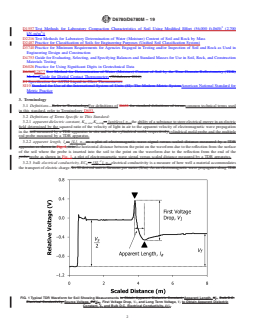
electric field determined by the squared ratio of the velocity of
drivingfourrodsofequallengthintothesoilinapatternwhere
light in air to the apparent velocity of electromagnetic wave
threeoftherodsdefinetheouterconductorofa“coaxialcable”
propagation in the cylindrical mold probe and the multiple rod
and one of the rods is the inner conductor.
probe measured by a TDR apparatus.
3.2.9 probe length, for multiple rod probe, L [L], n—the
in situ
3.2.2 apparent length, l [L], n—the horizontal distance
a
length of the multiple rodTDR probe that is below the surface
between the point on the waveform due to the reflection from
of the soil determined by total length of the rods minus the
the surface of the soil where the probe is inserted into the soil
length exposed above the soil surface.
tothepointonthewaveformduetothereflectionfromtheend
oftheprobeasshowninFig.1,aplotofelectromagneticwave
signal versus scaled distance measured by a TDR apparatus.
–1 The apparatus is covered by patents. Interested parties are invited to submit
3.2.3 bulk electrical conductivity, EC [SL ], n—electrical
b
information regarding the identification of alternative(s) to this patented item to the
conductivity is a measure of how well a material accommo-
ASTMHeadquarters.Yourcommentswillreceivecarefulconsiderationatameeting
dates the transport of electric charge. of the responsible technical committee, which you may attend.
FIG. 1Typical TDR Waveform for Soil Showing Measurements Apparent Length, l , Source Voltage, V , First Voltage Drop, V , and Long
a s 1
Term Voltage, V to Obtain Apparent Dielectric Constant, K and Bulk D.C. Electrical Conductivity, EC .
f a b
D6780/D6780M−19
3.2.10 probe length for cylindrical mold probe L , [L], placed during the construction of earth embankments, road
mold
n—length of the rod inserted into soil in the cylindrical mold fills, and structural backfills.
probe that is below the surface of the soil in the mold
5.2 Time domain reflectometry (TDR) measures the appar-
determinedbytotallengthoftherodminusthelengthexposed
ent dielectric constant (Procedure A) and the apparent dielec-
above the soil surface.
tric constant, first voltage drop and long term voltage (V and
3.2.11 scaled distance, l [L], n—the travel time of the
V) (Procedure B) of soil. The apparent dielectric constant is
f
electromagnetic wave in the probe converted to a distance by
affected significantly by the water content and density of soil,
use of the velocity of light in air. (This is a common output
and to a lesser extent by the chemical composition of soil and
used by most commercially available TDR apparatus.)
porewater,andbytemperature.Thefirstvoltagedropandlong
term voltage (V and V) are affected significantly by the water
3.2.12 source voltage, V , [V], n—the source voltage ap- 1 f
s
content, density, and the chemical composition of the in situ
plied to the probe is equal to twice the step voltage generated
pore water, and to a lesser extent the chemical composition of
read out by the TDR apparatus.
thesoilsolids.Thistestmethodmeasuresthegravimetricwater
3.2.13 TDR internal resistance, R,[Ω], n—the internal
s
content.
resistance of theTDR apparatus’pulse generator (generally 50
5.3 Soil and pore water characteristics are accounted for in
ohms).
Procedure A with two calibration constants and for Procedure
4. Summary of Test Method B with five calibration constants. The two soil constants for
Procedure A are determined for a given soil by performing
4.1 Procedure A —Thedielectricconstantofthesoilinsitu
compaction tests in a special mold as described in Annex A2.
isdeterminedusingamultiplerodprobe(MRP),acoaxialhead
The five soil constants for Procedure B are determined in
(CH),andTDRapparatus.Thesoilatthelocationoftheinsitu
conjunction with compaction testing in accordance with speci-
measurement is then excavated and compacted in a mold. By
fiedcompactionprocedures,forexample,TestMethodD698as
measurement of the mass of the mold and soil and with the
described in Annex A3. Both Procedures A and B use Test
mass and volume of the mold known, the wet density of the
Method D2216 to determine the water contents.
soil in the mold is determined.Arod driven into the soil along
the axis of the mold creates a cylindrical mold probe (CMP). 5.4 When following Procedure A, the water content is the
Using the same coaxial head (CH), an adapter ring, and the
average value over the length of the cylindrical mold and the
TDRapparatusthedielectricconstantofthesoilinthemoldis densityistheaveragevalueoverthelengthofthemultiple-rod
measured. The water content of the soil in the mold is
probe embedded in the soil. When following Procedure B, the
determined using a correlation between the dielectric constant, water content and density is the average values over the length
moisture content and soil density.The correlation requires two of the multiple-rod embedded in the soil.
NOTE 1—The quality of the result produced by this standard is
constantsthataresomewhatsoilspecific.Itisassumedthatthe
dependent on the competence of the personnel performing it, and the
watercontentofthesoilinsituisthesameasthewatercontent
suitability of the equipment and facilities used. Agencies that meet the
in the mold. The dry density of the soil in situ is determined
criteria of Practice D3740 are generally considered capable of competent
from the density of the soil in the mold and the dielectric
and objective testing/sampling/inspection/etc. Users of this standard are
constants measured in the mold and in situ.
cautioned that compliance with Practice D3740 does not in itself assure
reliable results. Reliable results depend on many factors; Practice D3740
4.2 Procedure B —The apparent dielectric constant of the
provides a means of evaluating some of those factors.
soilinsitu,firstvoltagedropandlongtermvoltage(V and V)
1 f
are determined using a multiple rod probe (MRP), a coaxial
6. Interferences
head (CH), andTDR apparatus.The water content and density
6.1 Quality and accuracy of the test results significantly
of the soil in situ are determined from the measured apparent
depend on soil having contact with the inner conductor of the
dielectric constant, V , V and five constants. The five soil
1 f
probes.To assist this, when installing the rods of the MRP, the
constantsaresoilandinsituporefluiddependent.Thefivesoil
rod that forms the inner conductor must be the last rod
constants are determined in conjunction with laboratory com-
installed.Ifintheinstallationprocess,therodhitsuponalarge
paction procedures using specified compaction procedures, for
particle that causes it to drift from vertical alignment, all rods
example, Test Method D698, and by taking measurements of
should be removed and the test conducted in a new location at
theapparentdielectricconstant, V and V foreachcompaction
1 f
least 0.2-m [8-in.] from the previous test location.
point.
6.2 The quality of the signal read by the TDR apparatus
5. Significance and Use
depends on having clean contacts between the CH and the
MRP and the CMP. The contacting surfaces should be wiped
5.1 This test method can be used to determine the density
with a clean cloth prior to placing the CH on the MRP and the
and water content of naturally occurring soils and of soils
CMP. Once placed, observe the signal on the TDR apparatus.
If the characteristic signal is not present, the CH may have to
5 be slightly rotated about its axis to make better contact.
The apparatus and procedures are covered by patents and pending patents.
Interested parties are invited to submit information regarding the identification of
6.3 This test method is not appropriate for frozen soils or
alternative(s) to these patented items to the ASTM Headquarters. Your comments
soils at temperatures over approximately 40°C [100°F]. The
will receive careful consideration at a meeting of the responsible technical
committee, which you may attend. apparent dielectric constant is slightly temperature dependent
D6780/D6780M−19
for soils and depends on soil type. For soil temperatures portable computer with a communication port to the TDR is
between 15°C and 25°C [59°F and 77°F], no temperature suggested for controlling the apparatus, acquiring and saving
corrections are needed for most soils. A simple temperature the data, and for making the calculations as the test proceeds.
adjustment for water content determination is part of the test
4 4
7.2 Multiple Rod Probe (MRP) with Coaxial Head (CH)
method.
7.2.1 The MRP consists of four common steel spikes,
6.4 This test method may not be applicable in some very
typically 250-mm [10-in.] in length and uniform diameters of
dense soils (dry density > 95% of D1557 (modified effort 3
9.5-mm [ ⁄8-in.]. (Other length spikes, but with the same
compaction)) due to disturbance in driving the spikes into the
diameter, may be used but in no case should they have lengths
soil unless holes for spikes are predrilled with a carbide-tipped
less than 150-mm [6-in.]. For lengths longer than 250-mm
masonry bit with diameter approximately 80% of the spike.
[10-in.], drift in the alignment of the spikes and loss of
reflected signal from the end of the MRP may occur.)
6.5 This test method may not be applicable in some organic
7.2.2 A MRP guide template (see Fig. 2 as an example ) is
soils or highly plastic clays, for example, Liquid Limit >50%
due to attenuation of the electrical signal from the high bulk used to guide the spikes as they are driven into the soil. The
electrical conductivity frequently associated with such soils. template must allow for its removal after the spikes are driven
and before a TDR measurement is made. (The radius from the
7. Apparatus
central spike to the outer spikes must be within the range of 5
to 7.5 times the diameter of the central spike.)
7.1 TDR Apparatus,aMetallicTimeDomainReflectometer
with a scaled length resolution of at least 2.4-mm [0.10-in.] 7.2.3 The Coaxial Head (CH) (see Fig. 3 as an example)
(this corresponds approximately to a time between data points formsatransitionfromthecoaxialcablecomingfromtheTDR
-12
less than or equal to sixteen picoseconds (16×10 s). A apparatus to the MRP.
NOTE 1—All dimensions are in inches. See Table 1 for tolerances and metric equivalents.
FIG. 2Example of a MRP Guide Template
D6780/D6780M−19
TABLE 1 SI Equivalents for Dimensions in Fig. 2
measuring the length that each spike protrudes from the
[in.] Tol. [in.] mm Tol. mm template when fully inserted. All measured lengths should be
0.391 ± 0.002 10.00 ± 0.05 equal within 0.5-mm [0.020-in.].
1.000 ± 0.005 25.00 ± 0.15
9.2 Determine the volume of the cylindrical mold, V ,
1.350 ± 0.015 34.30 ± 0.40
mold
1.500 ± 0.015 38.00 ± 0.40
m [in. ], in accordance with Annex A1.
2.588 ± 0.005 65.70 ± 0.13
3.200 ± 0.020 80.00 ± 0.50 9.3 Determine the mass of the empty and clean cylindrical
mold including the base, but without the ring collar, M,kg
[lbf], by placing on a calibrated balance.
7.3 Cylindrical Mold Probe (CMP) , the CMP consists of a
9.4 Determinethelengthofthecentralrodforinsertioninto
cylindrical mold, a guide template, a central rod, and a ring
the compaction mold, L , m [in.].
central rod
collar. Details for these items are shown in Fig. 4.
3 3
9.5 Calibration Constants:
7.3.1 Volume of 943.0 614 cm [0.0333 60.0005 ft ].
9.5.1 Procedure A—Determine the values of a and b for the
7.3.2 The central rod in this example probe is a stainless
soils to be tested in the field by procedures in Annex A2.
steel rod with a diameter of 8.0-mm [ ⁄16-in.] and a length of
9.5.2 Procedure B—Determinethevalues a, b, c, d,and ffor
264-mm [10.4-in.] in length.
the soils to be tested in the field by procedures in Annex A3.
7.4 Balances or Scales, meeting Specification GP10 of
Specification D4753 to determine the mass of the soil and the
10. Procedure for In situ Testing
cylindrical mold.Abattery-operated balance or scale having a
10.1 The following is applicable for Procedures A and B:
minimum capacity of 10 kg [25 lbm] is suitable when an
10.1.1 Prepare the surface at the test location so that it is
apparatus with the dimension given in Fig. 3 is used.
plane and level.
7.5 Driving Tools, a brass-headed hammer for driving
10.1.2 Seat the MRP guide template on the plane surface.
spikes for the MRP and the central rod into the cylindrical
10.1.3 Drivetheouterspikesthroughtheguideholessothat
mold.Aresin-headedhammeralsomaybeusedfordrivingthe
the bottom surfaces of the spike heads touch the template.
central rod into the cylindrical mold. (Use of these hammers
Drive the central spike last. (See Fig. 5.)
prevents peening of the driving end of the steel rods from
10.1.4 Remove the template as shown in Fig. 6. Check that
repeated use.)
all spikes are driven properly without any air gap around the
spikes where they penetrate the soil.
7.6 Tamping Rod, an aluminum rod with flat ends, a
10.1.5 Connect the coaxial cable to the CH and the TDR
diameter of 37-mm [1.5-in.], and a length of approximately
device. Turn on the device.
380-mm [15-in.]. Other tamping devices which provide a
10.1.6 Wipe the top surfaces of the spike heads and ends of
relatively uniformly compacted specimen also may be used.
the studs on the CH and place the CH on the spikes, centering
7.7 Thermometric Device, 0 to 50 °C range, 0.5 °C
the CH on the heads of all the spikes as shown in Fig. 7.
graduations, conforming to requirements of Specification
10.1.7 ActivateaTDRmeasurementand,observethesignal
E2877 or a temperature measuring device with equal or better
ontheTDRapparatus.Ifthecharacteristicsignalisnotpresent
accuracy.
(see Fig. 1), the CH may have to be slightly rotated about its
7.8 Vernier or Dial Caliper, having a measuring range of at
axis to make better contact.
least 0 to 250-mm [0 to 10-in.] and readable to at least 10.1.8 Determine and record the apparent length, l ,m
in situ
6,7
0.02-mm [0.001-in.].
[in.] with the TDR equipment.
10.1.9 When following Procedure B, determine and record
7.9 Miscellaneous Tools, a battery-powered hand drill with
the source voltage, V , the first voltage drop, V , and the long
s 1
a spare battery and charger and with a 25-mm [1-in.] diameter
termvoltage, V,fromtheTDRwaveform asillustratedinFig.
auger bit (alternatively, a small pick will work), straight edge f
1.
for smoothing the surface of the soil for the in situ test and for
10.1.10 Remove the spikes.
smoothingthesurfaceofthesoilinthecylindricalmold,pliers
for removing the spikes and central rod, small scoop or spoon
10.2 For Procedure A, do the following:
for removal of the loosened soil and for placement in the
10.2.1 Measure the apparent length in the cylindrical mold.
cylindrical mold, cloth for cleaning the contact area of the and
10.2.2 Assembleandsecurethecylindricalmoldtothebase
a brush for removing excess soil from around the base of the
plate and attach the ring collar.
cylindrical mold prior to determining its mass.
10.2.3 With the use of the power drill or other suitable
digging implement, excavate the soil from the between the
8. Preparation of Apparatus
8.1 Charge or replace, as appropriate batteries in the TDR
Automated procedures for doing this are usually contained in a program on the
apparatus, the hand drill, and the balance.
portable computer. Algorithms for various procedures are discussed by Baker and
Allmaras(1990) (1 ),Fengetal.(1998) (2),HeimovaaraandBouten(1990) (3),and
9. Calibration and Standardization
Wraith and Or (1999) (4).
The boldface numbers in parentheses refer to a list of references at the end of
9.1 Determine the average length of the spikes that will
this standard.
penetrateintothesoilsurfaceintheinsitutest, L ,m[in.],
in situ Background for making these measurements is provided by Yu and Drnevich
by inserting each spike into the MRP guide template and (2004) (5) and Jung, et al. (2013) (6).
D6780/D6780M−19
FIG. 3Example of a Coaxial Head (CH)
holes left by the outer rods of the MRP and to a depth 10.2.9 Clean the shoulder at the top of the mold and place
corresponding to the rod penetration and place the soil into the theringcollaronthecylindricalmold.Rotatetheringbackand
cylindrical mold in 6 uniform lifts applying 10 blows per lift forth on the mold to facilitate good electrical contact.
usingthetampingrod.Soilshouldbetakenuniformlyoverthe
10.2.10 Wipe the top surface of the ring collar, the central
entire depth of in situ measurement and placed directly and
rod and the ends of studs of the CH and then place the CH on
quickly into the cylindrical mold to minimize moisture loss.
the ring collar, centering the central stud on the central rod as
Remove the ring collar and strike the surface level with the
shown in Fig. 8.
straight edge after compaction. Remove any spilled soil from
10.2.11 Activate a TDR measurement and, observe the
around the exterior of the base plate with the brush.
signal on the TDR apparatus. If the characteristic signal is not
10.2.4 Makesurethebalanceisleveled,measureandrecord
present (See Fig. 1), the CH may have to be slightly rotated
the mass of the soil-filled cylindrical mold including the base
about its axis to make better contact.
plate, M , kg [lb].
10.2.12 Determine and record the apparent length, l ,m,
mold
10.2.5 Clean the shoulder at the top of the mold and mount
with the TDR device.
the cylindrical mold guide template on to the cylindrical mold.
10.2.13 Remove the central rod from the mold.
10.2.6 Using the brass-headed or resin-headed hammer,
10.2.14 If the soil is a cohesive soil and if the temperature
drive the central rod through the guide hole into the soil until
ofthesoilisestimatedtobeoutsidetherangeof15to25°C[59
the top of rod is flush with the template.
to 77°F], insert a metal thermometer into the hole created by
10.2.7 Remove the guide template from the cylindrical
thecentralrod,waituntilthetemperaturestabilizes,andrecord
mold.
the temperature, °C [°F].
10.2.8 Determine and record the length of the central rod
above the soil surface, L , m [in.]. 10.2.15 Remove the soil from the cylindrical mold.
rod exposed
D6780/D6780M−19
NOTE 1—All dimensions are in inches. See Table 2 for tolerances and metric equivalents.
FIG. 4Example of a Cylindrical Mold, Ring Collar, and Guide Template
TABLE 2 SI Equivalents for Dimensions in Fig. 4
[in.] Tol. [in.] mm Tol. mm
0.138 ± 0.005 3.50 ± 0.13
0.250 ± 0.005 6.30 ± 0.13
0.313 + 0.002, − 0.000 7.88 + 0.05, − 0.00
0.750 ± 0.010 18.90 ± 0.25
1.000 ± 0.010 25.00 ± 0.25
1.200 ± 0.002 30.24 ± 0.05
1.450 ± 0.005 36.54 ± 0.13
2.000 ± 0.020 50.00 ± 0.50
4.000 ± 0.016 100.00 ± 0.40
4.248 + 0.000, − 0.003 107.90 + 0.00, − 0.08
4.250 + 0.003, − 0.000 107.95 + 0.08, −0.00
4.500 ± 0.020 115.00 ± 0.50
5.500 ± 0.020 140.00 ± 0.50
6.000 ± 0.020 150.00 ± 0.50
9.168 ± 0.020 231.00 ± 0.50 FIG. 5Driving Spikes through Template
11. Calculation or Interpretation of Results
11.1 Calculate the apparent dielectric constant of the soil in l
~ !
a
in situ
K 5 (1)
F G
in situ
situ as follows: L
in situ
D6780/D6780M−19
where:
K = apparent dielectric constant of soil in the mold,
mold
(l ) = measuredapparentlengthinthemold,m[in.],and
a mold
L = length of the rod inserted into the soil in the mold
mold
below the surface of the soil, m [in.]
= L − L
central rod rod exposed
11.2.2 Calculate the wet density of the soil in mold as
follows:
M 2 M
1 2
ρ 5 (3)
t,mold
V
mold
where:
3 3
ρ = wet density of the soil in the mold, kg/m [lbf⁄ft ],
t,mold
M = massofthesoil-filledmold,andbaseplate,kg[lbf],
FIG. 6Removal of Template after Driving Spikes
M = mass of the empty mold and base plate, kg [lbf],
3 3
V = volume of the mold, m [ft ].
mold
11.2.3 Calculate the apparent dielectric constant of the soil
in the mold at 20 °C from:
K 5 K 3 TCF (4)
mold,20 °C mold,T °C K
where:
TCF = Temperature Correction Factor,
K
= 0.97 + 0.0015T °C for cohesionless soils, 4 °C ≤T
°C ≤ 40 °C, and
= 1.04 – 0.0019 T °C for cohesive soils, 4 °C ≤T°C
≤ 40 °C.
11.2.4 Calculate the water content of the soil in the mold
and in place as follows:
FIG. 7Placement of Coaxial Head on Spikes
aρ
t,mold
=K 2
mold,20 °C
ρ
w
w 5 w 5 3100 (5)
in situ mold
bρ
t,mold
2 =K
mold,20 °C
ρ
w
where:
w = water content of the soil in the mold, %,
mold
w = water content of the soil in situ, %,
in situ
3 3
ρ = density of water ≈ 1000 kg/m [62.4 lbf/ft ] suffi-
w
ciently accurate for these tests,
A = calibration constant, (see Annex A2), and
B = calibration constant, (see Annex A2).
11.2.5 Correct the apparent dielectric constant calculated in
11.1 to K from:
in situ, 20°C
K 5 K 3TCF (6)
in situ,20 °C in situ, T° K
FIG. 8Coaxial Head on Ring Collar
11.2.6 Calculatetheinsitudrydensityofthesoilasfollows:
=K ρ
in situ,20°C
t,mold
ρ 5 3 (7)
d,in situ
w
mold
=K
mold, 20 °C
where:
K = apparent dielectric constant of the soil in situ,
in situ
where:
(l ) = measured apparent length in situ, m [in.], and
a in situ
3 3
ρ = dry density of the soil in situ, kg/m [lbf⁄ft ].
L = length below the surface of the soil of the spikes
d, in situ
in situ
inserted into the soil, m [in.].
11.3 Procedure B:
11.2 Procedure A: 11.3.1 Obtain the first voltage drop and long term voltages
(V and V) from the in situTDR waveform obtained in 10.1.9.
11.2.1 Calculate the dielectric constant of the soil in the
1 f
mold as follows:
l
~ !
a mold
K 5 (2)
F G
mold 9
L See Dallinger (2006) (7) for discussion of these values.
mold
D6780/D6780M−19
V V
12.2.8 Other comments as appropriate.
1, in situ 1, in situ
11.3.2 Correct the ratio of to by use
S D
V V
f, in situ f, in situ
20°C
12.3 ThereportshallincludethefollowingforProcedureB:
of:
12.3.1 Temperature of the soil in situ, T .
in situ,T°C
V V
1, in situ 1, in situ
12.3.2 Valueoftheapparentdielectricconstantofthesoilin
5 3TCF (8)
S D
VR
V V
f, in situ 20 °C f, in situ
situ, K .
in situ
12.3.3 Value of the source voltage, V .
where:
s
12.3.4 Value of the first voltage drop of the soil in situ,
TCF = Temperature Correction Factor.
VR
V .
1,in situ
V
f, in situ
801 T °C 2 20
~ ! 12.3.5 Value of the long term voltage, V .
f,in situ
0.5 V
s
TCF 5
12.3.6 Dry density of the soil in situ, ρ from Eq 10.
VR
d,in situ
□□~1.08 2 0.004 T °C!~40 1 2.0 T °C!□□
12.3.7 Water content of the soil in situ, w , from Eq 11
for cohesionless soils, 4 °C ≤T°C ≤ 40 °C in situ
12.3.8 Calibration constants a, b, c, d, and f.
V
f, in situ
801 T °C 2 20
~ !
12.3.9 Other comments as appropriate.
0.5 V
s
TCF 5
VR
□ 0.94 1 0.003 T °C 40 1 2.0 T °C □
~ !
...
This document is not an ASTM standard and is intended only to provide the user of an ASTM standard an indication of what changes have been made to the previous version. Because
it may not be technically possible to adequately depict all changes accurately, ASTM recommends that users consult prior editions as appropriate. In all cases only the current version
of the standard as published by ASTM is to be considered the official document.
Designation: D6780/D6780M − 12 D6780/D6780M − 19
Standard Test MethodMethods for
Water Content and Density of Soil In situ by Time Domain
Reflectometry (TDR)
This standard is issued under the fixed designation D6780/D6780M; the number immediately following the designation indicates the
year of original adoption or, in the case of revision, the year of last revision. A number in parentheses indicates the year of last
reapproval. A superscript epsilon (´) indicates an editorial change since the last revision or reapproval.
1. Scope*
1.1 This test method may be used to determine the water content of soils and the in situ density of soils using a TDR apparatus.in
place using Time Domain Reflectometry.
1.2 This test method applies to soils that have 30 % or less by weight of their particles retained on the 19.0-mm [ ⁄4-in.] sieve.
1.3 This test method is suitable for use as a means of acceptance for compacted fill or embankments.
1.4 This test method is not appropriate for frozen soils or soils at temperatures over 40°C [100°F] and may not be suitable for
organic andsoils, highly plastic soils, or extremely dense soils.
1.5 All observed and calculated values shall conform to the guidelines for significant digits and rounding established in Practice
D6026.
1.5.1 The method used to specify how data are collected, calculated, or recorded in this standard is not directly related to the
accuracy to which the data can be applied in design or other uses, or both. How one applies the results obtained using this standard
is beyond its scope.
1.6 Two alternative procedures are provided.provided to determine the water content and the density of soil in situ:
1.6.1 Procedure A involves two tests in the field, an in situ test and a test in a mold containing material excavated from the in
situ test location. The apparent dielectric constant is determined in both tests.
1.6.2 Procedure B involves only an in situ test by incorporating the first voltage drop and long term voltage (V and V ) in
1 f
addition to the apparent dielectric constant. While the bulk electrical conductivity can be determined from these measurements,
it is not needed for the determination of water content and density.
1.7 Units—The values stated in either SI units or inch-pound units are to be regarded separately as standard. The values stated
in each system may not be exact equivalents; therefore, each system shall be used independently of the other. Combining values
from the two systems may result in non-conformance with the standard. For additional information consult SI10.
1.8 This standard does not purport to address all of the safety concerns, if any, associated with its use. It is the responsibility
of the user of this standard to establish appropriate safety safety, health, and healthenvironmental practices and determine the
applicability of regulatory limitations prior to use.
1.9 This international standard was developed in accordance with internationally recognized principles on standardization
established in the Decision on Principles for the Development of International Standards, Guides and Recommendations issued
by the World Trade Organization Technical Barriers to Trade (TBT) Committee.
2. Referenced Documents
2.1 ASTM Standards:
D653 Terminology Relating to Soil, Rock, and Contained Fluids
3 3
D698 Test Methods for Laboratory Compaction Characteristics of Soil Using Standard Effort (12,400 ft-lbf/ft (600 kN-m/m ))
This test method is under the jurisdiction of ASTM Committee D18 on Soil and Rock and is the direct responsibility of Subcommittee D18.08 on Special and Construction
Control Tests.
Current edition approved May 15, 2012Aug. 1, 2019. Published August 2012September 2019. Originally approved in 2002. Last previous edition approved in 20052012
as D6780 – 05.D6780/D6780M – 12. DOI: 10.1520/D6780_D6780M-12.10.1520/D6780_D6780M-19.
“The Water Content and Density of Soil In situ by Time Domain Reflectometry apparatus and procedures are covered by a patent. If you are aware of an alternative(s)
to the patented item, please attach to your ballot return a description of the alternatives. All suggestions will be considered by the committee.”
For referenced ASTM standards, visit the ASTM website, www.astm.org, or contact ASTM Customer Service at service@astm.org. For Annual Book of ASTM Standards
volume information, refer to the standard’s Document Summary page on the ASTM website.
*A Summary of Changes section appears at the end of this standard
Copyright © ASTM International, 100 Barr Harbor Drive, PO Box C700, West Conshohocken, PA 19428-2959. United States
D6780/D6780M − 19
D1557 Test Methods for Laboratory Compaction Characteristics of Soil Using Modified Effort (56,000 ft-lbf/ft (2,700
kN-m/m ))
D2216 Test Methods for Laboratory Determination of Water (Moisture) Content of Soil and Rock by Mass
D2487 Practice for Classification of Soils for Engineering Purposes (Unified Soil Classification System)
D3740 Practice for Minimum Requirements for Agencies Engaged in Testing and/or Inspection of Soil and Rock as Used in
Engineering Design and Construction
D4753 Guide for Evaluating, Selecting, and Specifying Balances and Standard Masses for Use in Soil, Rock, and Construction
Materials Testing
D6026 Practice for Using Significant Digits in Geotechnical Data
D6565E2877 Test Method for Determination of Water (Moisture) Content of Soil by the Time-Domain Reflectometry (TDR)
MethodGuide for Digital Contact Thermometers (Withdrawn 2014)
E1 Specification for ASTM Liquid-in-Glass Thermometers
SI10 Standard for Use of the International System of Units (SI): The Modern Metric SystemAmerican National Standard for
Metric Practice
3. Terminology
3.1 Definitions—Refer to TerminologyFor definitions of D653 for standard definitions of terms.common technical terms used
in this standard, refer to Terminology D653.
3.2 Definitions of Terms Specific to This Standard:
3.2.1 apparent dielectric constant, K ,K ,— [unitless], n—the ability of a substance to store electrical energy in an electric
in situ mold
field determined by the squared ratio of the velocity of light in air to the apparent velocity of electromagnetic wave propagation
in the soil measured by a TDR apparatus in situ and in the cylindrical mold, respectively.cylindrical mold probe and the multiple
rod probe measured by a TDR apparatus.
3.2.2 apparent length, l — [L], n—on a plot of electromagnetic wave signal versus scaled distance measured by a TDR
a
apparatus as shown in Fig. 1, it is the horizontal distance between the point on the waveform due to the reflection from the surface
of the soil where the probe is inserted into the soil to the point on the waveform due to the reflection from the end of the
probe.probe as shown in Fig. 1, a plot of electromagnetic wave signal versus scaled distance measured by a TDR apparatus.
–1
3.2.3 bulk electrical conductivity, EC — [SL ], n—electrical conductivity is a measure of how well a material accommodates
b
the transport of electric charge. Its SI derived unit is Siemens per meter (S/m). As an electromagnetic wave propagates along TDR
FIG. 1 Typical TDR Waveform for Soil Showing Measurements to Obtain Apparent Dielectric Constant, Apparent Length, Kl , Bulk D.C.
a
Electrical Conductivity, Source Voltage, ECV , First Voltage Drop, V , and Long Term Voltage, V to Obtain Apparent Dielectric
bs 1 f
Constant, K and Bulk D.C. Electrical Conductivity, EC .
a b
D6780/D6780M − 19
probed buried in soil, the signal energy is attenuated in proportion to the electrical conductivity along the travel path. Determination
of bulk electrical conductivity is illustrated in Fig. 1.
3.2.4 coaxial head, CH —a device that forms a transition from the coaxial cable connected to the TDR apparatus to the Multiple
Rod Probe or to a Cylindrical Mold Probe.
3.2.5 cylindrical mold probe, CMP —, n—a probe formed by a cylindrical metal mold as the outer conductor having a
non-metallic end plate, filled with compacted soil, and with an inner conductor consisting of a rod driven into the soil along the
axis of the mold.
3.2.6 first voltage drop, V — [V], n—it is the vertical distance (voltage) between the point on the waveform due to the reflection
from the surface of the soil where the probe is inserted into the soil to the point on the waveform due to the reflection from the
end of the probe, as illustrated in Fig. 1.
3.2.7 long term voltage, V — [V], n—the long term voltage asymptote as scaled distance becomes large as illustrated in Fig.
f
1.
3.2.8 multiple rod probe, MRP —, n—a probe formed by driving four rods of equal length into the soil in a pattern where three
of the rods define the outer conductor of a “coaxial cable” and one of the rods is the inner conductor.
3.2.9 probe length, L—for multiple rod probe, L [L], n—the length of the multiple rod TDR probe that is below the surface
in situ
of the soil.soil determined by total length of the rods minus the length exposed above the soil surface.
3.2.10 probe length for cylindrical mold probe L , [L], n—length of the rod inserted into soil in the cylindrical mold probe
mold
that is below the surface of the soil in the mold determined by total length of the rod minus the length exposed above the soil
surface.
3.2.11 scaled distance, l—l [L], n—the product of the travel time of the electromagnetic wave in the probe converted to a
distance by use of the velocity of light in air and electromagnetic wave travel time in the soil divided by two.air. (This is a common
output used by most commercially available TDR apparatus.)
3.2.12 source voltage, V —, [V], n—the source voltage and applied to the probe is equal to twice the step voltage generated read
s
out by the TDR.TDR apparatus.
3.2.13 TDR internal resistance, R —, [Ω], n—the internal resistance of the TDR’s TDR apparatus’ pulse generator (generally
s
50 ohms).
4. Summary of Test Method
4.1 Procedure A —The dielectric constant of the soil in situ is determined using a multiple rod probe (MRP), a coaxial head
(CH), and TDR apparatus. The soil at the location of the in situ measurement is then excavated and compacted in a mold. By
measurement of the mass of the mold and soil and with the mass and volume of the mold known, the wet density of the soil in
the mold is determined. A rod driven into the soil along the axis of the mold creates a cylindrical mold probe (CMP). Using the
same coaxial head (CH), an adapter ring, and the TDR apparatus the dielectric constant of the soil in the mold is measured. The
water content of the soil in the mold is determined using a correlation between the dielectric constant, moisture content and soil
density. The correlation requires two constants that are somewhat soil specific. It is assumed that the water content of the soil in
situ is the same as the water content in the mold. The dry density of the soil in situ is determined from the density of the soil in
the mold and the dielectric constants measured in the mold and in situ.
4.2 Procedure B —The apparent dielectric constant of the soil in situ, first voltage drop and long term voltage (V and V ) are
1 f
determined using a multiple rod probe (MRP), a coaxial head (CH), and TDR apparatus. The water content and density of the soil
in situ are determined from the measured apparent dielectric constant, V ,V and five constants. The five soil constants are soil and
1 f
in situ pore fluid dependent. The five soil constants are determined in conjunction with laboratory compaction procedures using
specified compaction procedures, for example, Test Method D698, and by taking measurements of the apparent dielectric constant,
V and V for each compaction point.
1 f
5. Significance and Use
5.1 This test method can be used to determine the density and water content of naturally occurring soils and of soils placed
during the construction of earth embankments, road fills, and structural backfills.
5.2 Time domain reflectometry (TDR) measures the apparent dielectric constant (Procedure A) and the apparent dielectric
constant, first voltage drop and long term voltage (V and V ) (Procedure B) of soil. The apparent dielectric constant is affected
1 f
The apparatus is covered by patents. Interested parties are invited to submit information regarding the identification of alternative(s) to this patented item to the ASTM
Headquarters. Your comments will receive careful consideration at a meeting of the responsible technical committee, which you may attend.
The apparatus and procedures are covered by patents and pending patents. Interested parties are invited to submit information regarding the identification of alternative(s)
to these patented items to the ASTM Headquarters. Your comments will receive careful consideration at a meeting of the responsible technical committee, which you may
attend.
D6780/D6780M − 19
significantly by the water content and density of soil, and to a lesser extent by the chemical composition of soil and pore water,
and by temperature. The first voltage drop and long term voltage (V and V ) are affected significantly by the water content, density,
1 f
and the chemical composition of the in situ pore water, and to a lesser extent the chemical composition of the soil solids. This test
method measures the gravimetric water content and makes use of a different relationship between the electrical properties and
water content from Test Method D6565 which measures the volumetric water content.
5.3 Soil and pore water characteristics are accounted for in Procedure A with two calibration constants and for Procedure B with
five calibration constants. The two soil constants for Procedure A are determined for a given soil by performing compaction tests
in a special mold as described in Annex A2. The five soil constants for Procedure B are determined in conjunction with compaction
testing in accordance with specified compaction procedures, for example, Test Method D698 as described in Annex A3. Both
Procedures A and B use Test Method D2216 to determine the water contents.
5.4 When following Procedure A, the water content is the average value over the length of the cylindrical mold and the density
is the average value over the length of the multiple-rod probe embedded in the soil. When following Procedure B, the water content
and density is the average values over the length of the multiple-rod embedded in the soil.
NOTE 1—The quality of the result produced by this standard is dependent on the competence of the personnel performing it, and the suitability of the
equipment and facilities used. Agencies that meet the criteria of Practice D3740 are generally considered capable of competent and objective
testing/sampling/inspection/etc. Users of this standard are cautioned that compliance with Practice D3740 does not in itself assure reliable results. Reliable
results depend on many factors; Practice D3740 provides a means of evaluating some of those factors.
6. Interferences
6.1 Quality and accuracy of the test results significantly depend on soil having contact with the inner conductor of the probes.
To assist this, when installing the rods of the MRP, the rod that forms the inner conductor must be the last rod installed. If in the
installation process, the rod hits upon a large particle that causes it to drift from vertical alignment, all rods should be removed
and the test conducted in a new location at least 0.2-m [8-in.] from the previous test location.
6.2 The quality of the signal read by the TDR apparatus depends on having clean contacts between the CH and the MRP and
the CMP. The contacting surfaces should be wiped with a clean cloth prior to placing the CH on the MRP and the CMP. Once
placed, observe the signal on the TDR apparatus. If the characteristic signal is not present, the CH may have to be slightly rotated
about its axis to make better contact.
6.3 This test method only applies to non-frozen soil. is not appropriate for frozen soils or soils at temperatures over
approximately 40 °C [100 °F]. The apparent dielectric constant is slightly temperature dependent for soils and depends on soil type.
For soil temperatures between 15°C15 °C and 25°C [59°F25 °C [59 °F and 77°F],77 °F], no temperature corrections are needed
for most soils. A simple temperature adjustment for water content determination is part of the test method.
6.4 This test method may not be applicable in some very dense soils (dry density > 95 % of D1557 (modified effort
compaction)) due to disturbance in driving the spikes into the soil unless holes for spikes are predrilled with a carbide-tipped
masonry bit with diameter approximately 80 % of the spike.
6.5 This test method may not be applicable in some organic soils or highly plastic clays, for example, Liquid Limit >50 % due
to attenuation of the electrical signal from the high bulk electrical conductivity frequently associated with such soils.
7. Apparatus
7.1 TDR Apparatus, a Metallic Time Domain Reflectometer with a scaled length resolution of at least 2.4-mm [0.10-in.] (this
-12
corresponds approximately to a time between data points less than or equal to sixteen picoseconds (16 × 10 s). A portable
computer with a communication port to the TDR is suggested for controlling the apparatus, acquiring and saving the data, and for
making the calculations as the test proceeds.
4 34
7.2 Multiple Rod Probe (MRP) with Coaxial Head (CH)
7.2.1 The MRP consists of four common steel spikes, typically 250-mm [10-in.] in length and uniform diameters of 9.5-mm
[ ⁄8-in.]. (Other length spikes, but with the same diameter, may be used but in no case should they have lengths less than 150-mm
[6-in.]. For lengths longer than 250-mm [10-in.], drift in the alignment of the spikes and loss of reflected signal from the end of
the MRP may occur.)
7.2.2 A MRP guide template (see Fig. 2 as an example ) is used to guide the spikes as they are driven into the soil. The template
must allow for its removal after the spikes are driven and before a TDR measurement is made. (The radius from the central spike
to the outer spikes must be within the range of 5 to 7.5 times the diameter of the central spike.)
7.2.3 The Coaxial Head (CH) (see Fig. 3) as an example) forms a transition from the coaxial cable coming from the TDR
apparatus to the MRP.
7.3 Cylindrical Mold Probe (CMP) , the CMP consists of a cylindrical mold, a guide template, a central rod, and a ring collar.
Details for these items are shown in Fig. 4.
3 3
7.3.1 Volume of 943.0 6 14 cm [0.0333 6 0.0005 ft ].
7.3.2 The central rod in this example probe is a stainless steel rod with a diameter of 8.0-mm [ ⁄16-in.] and a length of 264-mm
[10.4-in.] in length.
D6780/D6780M − 19
NOTE 1—All dimensions are in inches. See Table 1 for tolerances and metric equivalents.
FIG. 2 Example of a MRP Guide Template
TABLE 1 MetricSI Equivalents for Dimensions in Fig. 2
[in.] Tol. [in.] mm Tol. mm
0.391 ± 0.002 10.00 ± 0.05
1.000 ± 0.005 25.00 ± 0.15
1.350 ± 0.015 34.30 ± 0.40
1.500 ± 0.015 38.00 ± 0.40
2.588 ± 0.005 65.70 ± 0.13
3.200 ± 0.020 80.00 ± 0.50
7.4 Balances or Scales, meeting Specification GP10 of Specification D4753 to determine the mass of the soil and the cylindrical
mold. A battery-operated balance or scale having a minimum capacity of 10 kg [25 lbm] is suitable when an apparatus with the
dimension given in Fig. 3 is used.
7.5 Driving Tools, a brass-headed hammer for driving spikes for the MRP and the central rod into the cylindrical mold. A
resin-headed hammer also may be used for driving the central rod into the cylindrical mold. (Use of these hammers prevents
peening of the driving end of the steel rods from repeated use.)
7.6 Tamping Rod, an aluminum rod with flat ends, a diameter of 37-mm [1.5-in.], and a length of approximately 380-mm
[15-in.]. Other tamping devices which provide a relatively uniformly compacted specimen also may be used.
7.7 Thermometric Device, 0 to 50 °C range, 0.5 °C graduations, conforming to requirements of Specification E1E2877 or a
temperature measuring device with equal or better accuracy.
7.8 Vernier or Dial Caliper, having a measuring range of at least 0 to 250-mm [0 to 10-in.] and readable to at least 0.02-mm
[0.001-in.].
D6780/D6780M − 19
FIG. 3 Example of a Coaxial Head (CH)
7.9 Miscellaneous Tools, a battery-powered hand drill with a spare battery and charger and with a 25-mm [1-in.] diameter auger
bit (alternatively, a small pick will work), straight edge for smoothing the surface of the soil for the in situ test and for smoothing
the surface of the soil in the cylindrical mold, pliers for removing the spikes and central rod, small scoop or spoon for removal
of the loosened soil and for placement in the cylindrical mold, cloth for cleaning the contact area of the and a brush for removing
excess soil from around the base of the cylindrical mold prior to determining its mass.
8. Preparation of Apparatus
8.1 Charge or replace, as appropriate batteries in the TDR apparatus, the hand drill, and the balance.
9. Calibration and Standardization
9.1 Determine the average length of the spikes that will penetrate into the soil surface in the in situ test, L , m [in.], by
in situ
inserting each spike into the MRP guide template and measuring the length that each spike protrudes from the template when fully
inserted. All measured lengths should be equal within 0.5-mm [0.020-in.].
3 3
9.2 Determine the volume of the cylindrical mold, V , m [in. ], in accordance with Annex A1.
mold
9.3 Determine the mass of the empty and clean cylindrical mold including the base, but without the ring collar, M , kg [lbf],
by placing on a calibrated balance.
9.4 Determine the length of the central rod for insertion into the compaction mold, L , m [in.].
central rod
9.5 Calibration Constants:
9.5.1 Procedure A—Determine the values of a and b for the soils to be tested in the field by procedures in Annex A2.
9.5.2 Procedure B—Determine the values a,b,c,d, and f for the soils to be tested in the field by procedures in Annex A3.
D6780/D6780M − 19
NOTE 1—All dimensions are in inches. See Table 2 for tolerances and metric equivalents.
FIG. 4 Example of a Cylindrical Mold, Ring Collar, and Guide Template
TABLE 2 MetricSI Equivalents for Dimensions in Fig. 4
[in.] Tol. [in.] mm Tol. mm
0.138 ± 0.005 3.50 ± 0.13
0.250 ± 0.005 6.30 ± 0.13
0.313 + 0.002, − 0.000 7.88 + 0.05, − 0.00
0.750 ± 0.010 18.90 ± 0.25
1.000 ± 0.010 25.00 ± 0.25
1.200 ± 0.002 30.24 ± 0.05
1.450 ± 0.005 36.54 ± 0.13
2.000 ± 0.020 50.00 ± 0.50
4.000 ± 0.016 100.00 ± 0.40
4.248 + 0.000, − 0.003 107.90 + 0.00, − 0.08
4.250 + 0.003, − 0.000 107.95 + 0.08, −0.00
4.500 ± 0.020 115.00 ± 0.50
5.500 ± 0.020 140.00 ± 0.50
6.000 ± 0.020 150.00 ± 0.50
9.168 ± 0.020 231.00 ± 0.50
10. Procedure for In situ Testing
10.1 The following is applicable for Procedures A and B:
10.1.1 Prepare the surface at the test location so that it is plane and level.
10.1.2 Seat the MRP guide template on the plane surface.
D6780/D6780M − 19
10.1.3 Drive the outer spikes through the guide holes so that the bottom surfaces of the spike heads touch the template. Drive
the central spike last. (See Fig. 5.)
10.1.4 Remove the template as shown in Fig. 6. Check that all spikes are driven properly without any air gap around the spikes
where they penetrate the soil.
10.1.5 Connect the coaxial cable to the CH and the TDR device. Turn on the device.
10.1.6 Wipe the top surfaces of the spike heads and ends of the studs on the CH and place the CH on the spikes, centering the
CH on the heads of all the spikes as shown in Fig. 7.
10.1.7 Activate a TDR measurement and, observe the signal on the TDR apparatus. If the characteristic signal is not present
(see Fig. 1), the CH may have to be slightly rotated about its axis to make better contact.
6,7
10.1.8 Determine and record the apparent length, l , m [in.] with the TDR equipment.
in situ
10.1.9 When following Procedure B, determine and record the source voltage, V , the first voltage drop, V , and the long term
s 1
voltage, V , from the TDR waveform as illustrated in Fig. 1.
f
10.1.10 Remove the spikes.
10.2 For Procedure A, do the following:
10.2.1 Measure the apparent length in the cylindrical mold.
10.2.2 Assemble and secure the cylindrical mold to the base plate and attach the ring collar.
10.2.3 With the use of the power drill or other suitable digging implement, excavate the soil from the between the holes left
by the outer rods of the MRP and to a depth corresponding to the rod penetration and place the soil into the cylindrical mold in
6 uniform lifts applying 10 blows per lift using the aluminum-tamping rod or other suitable tamping device.tamping rod. Soil
should be taken uniformly over the entire depth of in situ measurement and placed directly and quickly into the cylindrical mold
to minimize moisture loss. Remove the ring collar and strike the surface level with the straight edge after compaction. Remove
any spilled soil from around the exterior of the base plate with the brush.
10.2.4 Make sure the balance is leveled, measure and record the mass of the soil-filled cylindrical mold including the base plate,
M , kg [lb].
10.2.5 Clean the shoulder at the top of the mold and mount the cylindrical mold guide template on to the cylindrical mold.
10.2.6 Using the brass-headed or resin-headed hammer, drive the central rod through the guide hole into the soil until the top
of rod is flush with the template.
10.2.7 Remove the guide template from the cylindrical mold.
10.2.8 Determine and record the length of the central rod above the soil surface, L , m [in.].
rod exposed
10.2.9 Clean the shoulder at the top of the mold and place the ring collar on the cylindrical mold. Rotate the ring back and forth
on the mold to facilitate good electrical contact.
10.2.10 Wipe the top surface of the ring collar, the central rod and the ends of studs of the CH and then place the CH on the
ring collar, centering the central stud on the central rod as shown in Fig. 8.
10.2.11 Activate a TDR measurement and, observe the signal on the TDR apparatus. If the characteristic signal is not present
(See Fig. 1), the CH may have to be slightly rotated about its axis to make better contact.
10.2.12 Determine and record the apparent length, l , m, with the TDR device.
mold
10.2.13 Remove the central rod from the mold.
FIG. 5 Driving Spikes through Template
Automated procedures for doing this are usually contained in a program on the portable computer. Algorithms for various procedures are discussed by Baker and Allmaras
(1990) (1 ), Feng et al. (1998) (2), Heimovaara and Bouten (1990) (3), and Wraith and Or (1999) (4).
The boldface numbers in parentheses refer to a list of references at the end of this standard.
Background for making these measurements is provided by Yu and Drnevich (2004) (5) and Jung (2011) Jung, et al. (2013) (6).
D6780/D6780M − 19
FIG. 6 Removal of Template after Driving Spikes
FIG. 7 Placement of Coaxial Head on Spikes
FIG. 8 Coaxial Head on Ring Collar
10.2.14 If the soil is a cohesive soil and if the temperature of the soil is estimated to be outside the range of 15 to 25°C [59
to 77°F], insert a metal thermometer into the hole created by the central rod, wait until the temperature stabilizes, and record the
temperature, °C.°C [°F].
10.2.15 Remove the soil from the cylindrical mold.
11. Calculation or Interpretation of Results
11.1 Calculate the apparent dielectric constant of the soil in placesitu as follows:
l
~ !
a
in situ
K 5 (1)
F G
in situ
L
in situ
where:
K = apparent dielectric constant of the soil in situ,
in situ
D6780/D6780M − 19
(l ) = measured apparent length in situ, m [in.], and
a in situ
L = length below the surface of the soil of the spikes inserted into the soil, m [in.].
in situ
11.2 Procedure A:
11.2.1 Calculate the dielectric constant of the soil in the mold as follows:
~l !
a mold
K 5 (2)
F G
mold
L
mold
where:
K = apparent dielectric constant of soil in the mold,
mold
(l ) = measured apparent length in the mold, m [in.], and
a mold
L = length of the rod inserted into the soil in the mold, m [in.]
mold
L = length of the rod inserted into the soil in the mold below the surface of the soil, m [in.]
mold
= L − L
central rod rod exposed
11.2.2 Calculate the wet density of the soil in mold as follows:
M 2 M
1 2
ρ 5 (3)
t,mold
V
mold
where:
3 3
ρ = wet density of the soil in the mold, kg/m [lbf ⁄ft ],
t,mold
M = mass of the soil-filled mold, and base plate, kg [lbf],
M = mass of the empty mold and base plate, kg [lbf],
3 3
V = volume of the mold, m [ft ].
mold
11.2.3 Calculate the apparent dielectric constant of the soil in the mold at 20 °C from:
K 5 K 3TCF (4)
mold,20 °C mold,T °C K
where:
TCF = Temperature Correction Factor,
K
= 0.97 + 0.0015T °C for cohesionless soils, 4 °C ≤T °C ≤ 40 °C, and
= 1.04 – 0.0019 T °C for cohesive soils, 4 °C ≤ T °C ≤ 40 °C.
11.2.4 Calculate the water content of the soil in the mold and in place as follows:
aρ
t,mold
=K 2
mold,20 °C
ρ
w
w 5 w 5 3100 (5)
in situ mold
bρ
t,mold
2=K
mold,20 °C
ρ
w
where:
w = water content of the soil in the mold, %,
mold
w = water content of the soil in situ, %,
in situ
3 3
ρ = density of water = 1000 kg/m [62.4 lbf/ft ],
w
3 3
ρ = density of water ≈ 1000 kg/m [62.4 lbf/ft ] sufficiently accurate for these tests,
w
a = calibration constant, (see Annex A2), and
A = calibration constant, (see Annex A2), and
b = calibration constant, (see Annex A2).
B = calibration constant, (see Annex A2).
11.2.5 Correct the apparent dielectric constant calculated in 11.1 to K from:
in situ, 20°C
K 5 K 3TCF (6)
in situ, 20 °C in situ, T° K
11.2.6 Calculate the in situ dry density of the soil as follows:
=K ρ
in situ, 20°C t,mold
ρ 5 3 (7)
d,in situ
w
mold
=K
mold, 20 °C
where:
3 3
ρ = dry density of the soil in situ, kg/m [lbf ⁄ft ].
d, in situ
11.3 Procedure B:
See Dallinger (2006) (7) for discussion of these values.
D6780/D6780M − 19
11.3.1 Obtain the first voltage drop and long term voltages (V and V ) from the in situ TDR waveform obtained in 10.1.810.1.9.
1 f
V V
1, in situ 1, in situ
11.3.2 Correct the ratio of to by use of:
S D
V V
f, in situ f, in situ
20°C
V V
1, in situ 1, in situ
5 3TCF (8)
S D
VR
V V
f, in situ 20 °C f, in situ
where:
TCF = Temperature Correction Factor.
VR
V
f, in situ
801 T ° C 2 20
~ !
0.5 V
s
TCF 5
VR
~1.08 2 0.004 T ° C!~40 1 2.0 T ° C!
V
f, in situ
801 T °C 2 20
~ !
0.5 V
s
TCF 5
VR
□□~1.08 2 0.004 T °C!~40 1 2.0 T °C!□□
forfor cohesionless soils, 4 °C ≤ T °C ≤ 40 °C
V
f, in situ
801 ~T ° C 2 20!
0.5 V
s
TCF 5
VR
0.94 1 0.003 T ° C 40 1 2.0 T ° C
~ !~ !
V
f, in situ
801 T °C 2 20
~ !
0.5 V
s
TCF 5
VR
□ 0.94 1 0.003 T °C 40 1 2.0 T °C □
~ !~ !
forfor cohesive soils, 4 °C ≤ T °C 4 °C ≤ T °C ≤ 40 °C
Calculate the dry density and water content of the soil in situ as follows:
V
1, in situ
ρ
S D
w
V
f, in situ 20 °C
ρ 5 (9)
d, in situ
c1d~K 2 1!2 c·exp@2 f · ~K 2 1!#
in situ, 20 °C in situ, 20 °C
1 ρ
w
w 5 =K 2 a (10)
S D
in situ in situ, 20 °C
b ρ
d, in situ
where:
3 3
ρ = dry density of the soil in situ, kg/m [lb/ft ]
d, in situ
V = first voltage drop of the soil in situ, V
1, in situ
V = long term voltage of the soil in situ, V, and
f, in situ
w = water content of the soil in situ, %.
in situ
a, b, c, d, and f = calibration constants, (see Annex A3)
12. Report
12.1 The report shall include the following:
12.1.1 Procedure used (A or B).
12.1.2 Test site identification.
12.1.3 Date and time of test.
12.1.4 Name of the operator(s).
12.1.5 Visual description of the material tested.
12.1.6 Make, model and serial number of the TDR apparatus.
12.1.7 Average length of the spikes that penetrated into the soil surface in the in situ test, L , m [in.],
in situ
12.2 The report shall include the following for Procedure A:
3 3
12.2.1 Volume of the cylindrical mold, V , m [ft ].
mold
12.2.2 Length of the central rod, L , m [in.], the length of the central rod exposed, L , m [in.], and inserted length
central rod rod exposed
of the central rod in the mold, L , m [in.].
mold
12.2.3 Temperature of the soil in the mold, T .
m
...