

ASTM D3427-19
(Test Method)Standard Test Method for Air Release Properties of Hydrocarbon Based Oils
General Information
- Abstract
SIGNIFICANCE AND USE
5.1 Agitation of lubricating oil with air in equipment, such as bearings, couplings, gears, pumps, and oil return lines, may produce a dispersion of finely divided air bubbles in the oil. If the residence time in the reservoir is too short to allow the air bubbles to rise to the oil surface, a mixture of air and oil will circulate through the lubricating oil system. This may result in an inability to maintain oil pressure (particularly with centrifugal pumps), incomplete oil films in bearings and gears, and poor hydraulic system performance or failure.
5.2 This test method measures the time for the entrained air content to fall to the relatively low value of 0.2 % volume under a standardized set of test conditions and hence permits the comparison of the ability of oils to separate entrained air under conditions where a separation time is available. The significance of this test method has not been fully established. However, entrained air can cause sponginess and lack of sensitivity of the control of turbine and hydraulic systems. This test may not be suitable for ranking oils in applications where residence times are short and gas contents are high.
SCOPE
1.1 This test method covers the ability of turbine, hydraulic, and gear oils to separate entrained air.
Note 1: This test method was developed for hydrocarbon based oils. It may be used for some synthetic fluids; however, the precision statement applies only to hydrocarbon based oils.
1.2 The values stated in SI units are to be regarded as standard. No other units of measurement are included in this standard.
1.3 This standard does not purport to address all of the safety concerns, if any, associated with its use. It is the responsibility of the user of this standard to establish appropriate safety, health, and environmental practices and determine the applicability of regulatory limitations prior to use.
1.4 This international standard was developed in accordance with internationally recognized principles on standardization established in the Decision on Principles for the Development of International Standards, Guides and Recommendations issued by the World Trade Organization Technical Barriers to Trade (TBT) Committee.
- Status
- Published
- Publication Date
- 30-Nov-2019
- Technical Committee
- D02 - Petroleum Products, Liquid Fuels, and Lubricants
- Drafting Committee
- D02.C0.02 - Corrosion and Water/Air Separability
Overview
ASTM D3427-19 is the internationally recognized standard test method for evaluating the air release properties of hydrocarbon-based oils, such as turbine, hydraulic, and gear oils. Published by ASTM International, this test method provides procedures to determine the ability of these oils to separate entrained air under controlled laboratory conditions. The presence of air bubbles in lubricating systems can lead to numerous operational issues, including difficulty in maintaining oil pressure, incomplete oil films, and potential failure in hydraulic systems. The standard outlines a systematic approach to quantify how quickly an oil can release entrained air, providing valuable data for oil development, equipment design, and quality control.
Key Topics
- Entrained Air in Lubricating Oils: The standard addresses the tendency for air to become dispersed as fine bubbles during the agitation of lubricating oil in machinery components like bearings, gears, pumps, and oil return lines.
- Measurement Objective: ASTM D3427-19 measures the time required for the entrained air content in oil to decrease to 0.2% by volume under specific temperature conditions, allowing for comparative evaluation of air release performance among different oils.
- Test Scope: While the method is specifically developed for hydrocarbon-based oils, it can also be used for select synthetic fluids, though its stated precision applies only to hydrocarbon oils.
- Significance: Entrained air can compromise lubrication, reduce pump performance, and impair hydraulic and turbine system control. Accurate and reliable measurement of air release time is essential for avoiding sponginess and maintaining sensitive system operations.
- Standardized Conditions: The method specifies use of SI units for all measurements and emphasizes safety, health, and environmental practices during testing.
Applications
The practical application of ASTM D3427-19 spans multiple industries where fluid reliability and system performance are critical:
- Power Generation: Ensures turbine oils quickly release air, contributing to stable control and efficient turbine operation.
- Industrial Hydraulic Systems: Verifies that hydraulic oils can maintain appropriate pressure and lubrication, directly impacting machinery performance and lifespans.
- Automotive and Heavy Equipment: Gear oils in transmissions, differentials, and other mechanical assemblies benefit from lower entrained air, supporting mechanical reliability.
- Lubricant Development: Oil formulators and manufacturers use the test to benchmark and enhance product performance for air release properties.
- Quality Control: Oil suppliers and end users deploy this method to confirm product compliance and fitness for critical equipment applications.
- Maintenance Optimization: Monitoring air release performance enables predictive maintenance, reducing the risk of failures due to oil aeration.
Related Standards
To provide a comprehensive understanding of oil performance and testing, the following ASTM and international standards are relevant:
- ASTM D1193: Specification for Reagent Water used in testing protocols.
- ASTM D1401: Test Method for Water Separability of Petroleum Oils and Synthetic Fluids.
- ASTM D4057: Practice for Manual Sampling of Petroleum and Petroleum Products.
- ASTM E1: Specification for ASTM Liquid-in-Glass Thermometers.
- DIN 51 381: German standard for air release properties, technically equivalent to ASTM D3427 for comparative purposes.
These related standards ensure completeness in testing methodology and support best practices in oil analysis and equipment maintenance routines.
Keywords: ASTM D3427, air release properties, hydrocarbon based oils, lubricating oil, turbine oil, hydraulic oil, gear oil, oil aeration, oil system performance, oil testing standards
Relations
- Refers
ASTM D1401-18 - Standard Test Method for Water Separability of Petroleum Oils and Synthetic Fluids - Effective Date
- 01-Mar-2018
- Effective Date
- 01-May-2013
- Refers
ASTM D1401-12e1 - Standard Test Method for Water Separability of Petroleum Oils and Synthetic Fluids - Effective Date
- 15-May-2012
- Refers
ASTM D4057-06(2011) - Standard Practice for Manual Sampling of Petroleum and Petroleum Products - Effective Date
- 01-Jun-2011
- Refers
ASTM D1401-09 - Standard Test Method for Water Separability of Petroleum Oils and Synthetic Fluids - Effective Date
- 01-Jul-2009
- Effective Date
- 01-Nov-2007
- Effective Date
- 01-Mar-2006
- Effective Date
- 01-Nov-2005
- Effective Date
- 01-Nov-2003
- Effective Date
- 10-May-2003
- Refers
ASTM D1401-02 - Standard Test Method for Water Separability of Petroleum Oils and Synthetic Fluids - Effective Date
- 10-Nov-2002
- Effective Date
- 10-Oct-2001
- Effective Date
- 10-Oct-2001
- Effective Date
- 10-Oct-2001
- Refers
ASTM D4057-95(2000) - Standard Practice for Manual Sampling of Petroleum and Petroleum Products - Effective Date
- 10-Apr-2000
Get Certified
Connect with accredited certification bodies for this standard

Element Materials Technology
Materials testing and product certification.

ABS Group Brazil
ABS Group certification services in Brazil.

ABS Quality Evaluations Inc.
American Bureau of Shipping quality certification.
Sponsored listings
Frequently Asked Questions
ASTM D3427-19 is a standard published by ASTM International. Its full title is "Standard Test Method for Air Release Properties of Hydrocarbon Based Oils". This standard covers: SIGNIFICANCE AND USE 5.1 Agitation of lubricating oil with air in equipment, such as bearings, couplings, gears, pumps, and oil return lines, may produce a dispersion of finely divided air bubbles in the oil. If the residence time in the reservoir is too short to allow the air bubbles to rise to the oil surface, a mixture of air and oil will circulate through the lubricating oil system. This may result in an inability to maintain oil pressure (particularly with centrifugal pumps), incomplete oil films in bearings and gears, and poor hydraulic system performance or failure. 5.2 This test method measures the time for the entrained air content to fall to the relatively low value of 0.2 % volume under a standardized set of test conditions and hence permits the comparison of the ability of oils to separate entrained air under conditions where a separation time is available. The significance of this test method has not been fully established. However, entrained air can cause sponginess and lack of sensitivity of the control of turbine and hydraulic systems. This test may not be suitable for ranking oils in applications where residence times are short and gas contents are high. SCOPE 1.1 This test method covers the ability of turbine, hydraulic, and gear oils to separate entrained air. Note 1: This test method was developed for hydrocarbon based oils. It may be used for some synthetic fluids; however, the precision statement applies only to hydrocarbon based oils. 1.2 The values stated in SI units are to be regarded as standard. No other units of measurement are included in this standard. 1.3 This standard does not purport to address all of the safety concerns, if any, associated with its use. It is the responsibility of the user of this standard to establish appropriate safety, health, and environmental practices and determine the applicability of regulatory limitations prior to use. 1.4 This international standard was developed in accordance with internationally recognized principles on standardization established in the Decision on Principles for the Development of International Standards, Guides and Recommendations issued by the World Trade Organization Technical Barriers to Trade (TBT) Committee.
SIGNIFICANCE AND USE 5.1 Agitation of lubricating oil with air in equipment, such as bearings, couplings, gears, pumps, and oil return lines, may produce a dispersion of finely divided air bubbles in the oil. If the residence time in the reservoir is too short to allow the air bubbles to rise to the oil surface, a mixture of air and oil will circulate through the lubricating oil system. This may result in an inability to maintain oil pressure (particularly with centrifugal pumps), incomplete oil films in bearings and gears, and poor hydraulic system performance or failure. 5.2 This test method measures the time for the entrained air content to fall to the relatively low value of 0.2 % volume under a standardized set of test conditions and hence permits the comparison of the ability of oils to separate entrained air under conditions where a separation time is available. The significance of this test method has not been fully established. However, entrained air can cause sponginess and lack of sensitivity of the control of turbine and hydraulic systems. This test may not be suitable for ranking oils in applications where residence times are short and gas contents are high. SCOPE 1.1 This test method covers the ability of turbine, hydraulic, and gear oils to separate entrained air. Note 1: This test method was developed for hydrocarbon based oils. It may be used for some synthetic fluids; however, the precision statement applies only to hydrocarbon based oils. 1.2 The values stated in SI units are to be regarded as standard. No other units of measurement are included in this standard. 1.3 This standard does not purport to address all of the safety concerns, if any, associated with its use. It is the responsibility of the user of this standard to establish appropriate safety, health, and environmental practices and determine the applicability of regulatory limitations prior to use. 1.4 This international standard was developed in accordance with internationally recognized principles on standardization established in the Decision on Principles for the Development of International Standards, Guides and Recommendations issued by the World Trade Organization Technical Barriers to Trade (TBT) Committee.
ASTM D3427-19 is classified under the following ICS (International Classification for Standards) categories: 75.080 - Petroleum products in general. The ICS classification helps identify the subject area and facilitates finding related standards.
ASTM D3427-19 has the following relationships with other standards: It is inter standard links to ASTM D1401-18, ASTM E1-13, ASTM D1401-12e1, ASTM D4057-06(2011), ASTM D1401-09, ASTM E1-07, ASTM D1193-06, ASTM E1-05, ASTM E1-03a, ASTM E1-03, ASTM D1401-02, ASTM E1-98, ASTM E1-98e1, ASTM E1-01, ASTM D4057-95(2000). Understanding these relationships helps ensure you are using the most current and applicable version of the standard.
ASTM D3427-19 is available in PDF format for immediate download after purchase. The document can be added to your cart and obtained through the secure checkout process. Digital delivery ensures instant access to the complete standard document.
Standards Content (Sample)
This international standard was developed in accordance with internationally recognized principles on standardization established in the Decision on Principles for the
Development of International Standards, Guides and Recommendations issued by the World Trade Organization Technical Barriers to Trade (TBT) Committee.
Designation: D3427 − 19
Designation 313–01
Standard Test Method for
Air Release Properties of Hydrocarbon Based Oils
This standard is issued under the fixed designation D3427; the number immediately following the designation indicates the year of
original adoption or, in the case of revision, the year of last revision.Anumber in parentheses indicates the year of last reapproval.A
superscript epsilon (´) indicates an editorial change since the last revision or reapproval.
1. Scope* E1Specification for ASTM Liquid-in-Glass Thermometers
2.2 DIN Standard:
1.1 Thistestmethodcoverstheabilityofturbine,hydraulic,
DIN 51381
and gear oils to separate entrained air.
NOTE 1—This test method was developed for hydrocarbon based oils.
3. Terminology
Itmaybeusedforsomesyntheticfluids;however,theprecisionstatement
3.1 Definitions of Terms Specific to This Standard:
applies only to hydrocarbon based oils.
3.1.1 air release time, n—the number of minutes needed for
1.2 The values stated in SI units are to be regarded as
air entrained in the oil to reduce in volume to 0.2% under the
standard. No other units of measurement are included in this
conditions of this test and at the specified temperature.
standard.
1.3 This standard does not purport to address all of the
4. Summary of Test Method
safety concerns, if any, associated with its use. It is the
4.1 Compressed air is blown through the test oil, which has
responsibility of the user of this standard to establish appro-
been heated to a temperature of 25°C, 50°C, or 75°C. After
priate safety, health, and environmental practices and deter-
the air flow is stopped, the time required for the air entrained
mine the applicability of regulatory limitations prior to use.
in the oil to reduce in volume to 0.2% is recorded as the air
1.4 This international standard was developed in accor-
release time.
dance with internationally recognized principles on standard-
NOTE2—Byagreementbetweenthecustomerandthelaboratory,theoil
ization established in the Decision on Principles for the
may be heated at other temperatures. However, the precision at these
Development of International Standards, Guides and Recom-
different temperatures is not known at present.
mendations issued by the World Trade Organization Technical
Barriers to Trade (TBT) Committee.
5. Significance and Use
2. Referenced Documents 5.1 Agitation of lubricating oil with air in equipment, such
2 as bearings, couplings, gears, pumps, and oil return lines, may
2.1 ASTM Standards:
produce a dispersion of finely divided air bubbles in the oil. If
D1193Specification for Reagent Water
the residence time in the reservoir is too short to allow the air
D1401TestMethodforWaterSeparabilityofPetroleumOils
bubbles to rise to the oil surface, a mixture of air and oil will
and Synthetic Fluids
circulate through the lubricating oil system. This may result in
D4057Practice for Manual Sampling of Petroleum and
aninabilitytomaintainoilpressure(particularlywithcentrifu-
Petroleum Products
gal pumps), incomplete oil films in bearings and gears, and
poor hydraulic system performance or failure.
This test method is under the jurisdiction of ASTM Committee D02 on
5.2 This test method measures the time for the entrained air
Petroleum Products, Liquid Fuels, and Lubricants and is the direct responsibility of
content to fall to the relatively low value of 0.2% volume
Subcommittee D02.C0.02 on Corrosion and Water/Air Separability.
Current edition approved Dec. 1, 2019. Published January 2020. Originally
under a standardized set of test conditions and hence permits
approved in 1975. Last previous edition approved in 2015 as D3427–15. DOI:
the comparison of the ability of oils to separate entrained air
10.1520/D3427-19.
under conditions where a separation time is available. The
This standard has been developed through the cooperative effort betweenASTM
significance of this test method has not been fully established.
International and the Energy Institute, London. The EI and ASTM International
logos imply that the ASTM International and EI standards are technically
However, entrained air can cause sponginess and lack of
equivalent, but does not imply that both standards are editorially identical.Adopted
sensitivityofthecontrolofturbineandhydraulicsystems.This
as a joint ASTM/IP standard in 2006.
For referenced ASTM standards, visit the ASTM website, www.astm.org, or
contact ASTM Customer Service at service@astm.org. For Annual Book of ASTM
Standards volume information, refer to the standard’s Document Summary page on Available from Beuth Verlag GmbH, Burggrafenstrasse 6, 1000 Berlin 30,
the ASTM website. Germany.
*A Summary of Changes section appears at the end of this standard
Copyright © ASTM International, 100 Barr Harbor Drive, PO Box C700, West Conshohocken, PA 19428-2959. United States
D3427 − 19
test may not be suitable for ranking oils in applications where 6.1.4 Heater,tobringthecompressedairuptomeasurement
residence times are short and gas contents are high. temperature.Acoil of copper tubing immersed in the circulat-
ing bath (see 6.1.5) is suitable at 25°C, but additional heating
6. Apparatus
is necessary at 50°C and 75°C. This can be obtained by an
6.1 AschematicdiagramoftheapparatusisshowninFig.1.
additional bath, or by using a separate steam or electric heat
The component parts are described as follows:
exchanger. The temperature of the air shall be measured by a
6.1.1 TestVessel,madeofborosilicateglassasshowninFig.
thermometer located as close as possible to the testing vessel
2, consisting of a jacketed sample tube fitted with an air inlet
and meeting the specifications shown in 6.1.3.
capillary,baffleplate,andairoutlettube.Thetwopartsofeach
NOTE4—Theapplicationofthermalinsulationtothepipeworkcarrying
test vessel should be marked and preferably used as a pair.
the heated compressed air is recommended.
Interchanged parts may be used so long as the resultant test
6.1.5 Circulating Bath, approximately 10L capacity with a
vessel conforms to the stated dimensions.
rateofflowof10L/minandcapableofmaintainingthetestcell
NOTE 3—Users are advised to verify the distance between the air inlet
at a temperature of 25°C, 50°C, or 75°C within 60.1°C.
capillary and the bottom of the test cell as described in the method, by
NOTE 5—Use of water in the bath has been found to minimize
using an appropriate measuring device. It has been noted by some
electrostatic effects.
laboratories that variation from the required measurements has significant
NOTE6—Theapplicationofthermalinsulationtothepipeworkcarrying
effect on results.
the heated bath fluid is recommended.
6.1.2 Pressure Gage, covering the range from 0kPa to
(Warning—The use of glass vessels with glass hose fittings
35kPa, with divisions at least every 2kPa, and an accuracy of
for circulating 75°C bath medium is potentially dangerous.
1.5kPa.
Back pressure in excess of a gage pressure of 70kPa can be
6.1.3 Thermometers:
generated when the bath medium is pumped at the required
6.1.3.1 Air Thermometer, for measuring compressed air
rate; this can cause fracture of the glass or slippage of the hose
temperature. ASTM Precision Thermometer having a range
connections. Use of a pressure relief valve set at 70kPa is
from−20°C to 102°C, graduated in 0.2°C and conforming to
recommended. In addition, use of a safety shield is recom-
the requirements forThermometer 12C as prescribed in Speci-
mended.)
fication E1 is suitable. A temperature sensor of at least
equivalent performance is also suitable. Care shall be taken to 6.2 Balance, capable of measuring density, accurate to
avoid restricting the air path with the thermometer bulb or any
0.5kg⁄m .
adapter used.
6.3 Sinker, having a round or tapered bottom of 5mL or
6.1.3.2 Sample Thermometer,formeasuringthetemperature
10mL displacement, 80.0mm 6 1.5mm length. If the sinker
of the sample during preparation and trial runs. ASTM Preci-
contains a thermometer, it shall be usable between 25°C and
sion Thermometer having a range from –20°C to 102°C,
75°C.
graduated in 0.2°C and conforming to the requirements for
6.4 Oven,capableofheatingsamplesto10°Cabovethetest
Thermometer12CasprescribedinSpecificationE1issuitable.
temperature.
Atemperaturesensorofatleastequivalentperformanceisalso
suitable.
6.5 Timer, readable to 1s, with an accuracy of better than
0.1%.
6.6 Pump, with a nonpulsating output and capable of
maintaining an air flow of 40 L/min at a pressure of 20 kPa
(optional, see 7.4).
7. Materials
7.1 Purity of Reagents—Reagent grade chemicals shall be
used in all tests. Unless otherwise indicated, it is intended that
all reagents conform to the specifications of the Committee on
Analytical Reagents of theAmerican Chemical Society where
such specifications are available. Other grades may be used,
provided it is first ascertained that the reagent is of sufficiently
high purity to permit its use without lessening the accuracy of
the determination.
7.2 Purity of Water—ReagentwaterasdefinedbyTypeIIof
Specification D1193.
ACS Reagent Chemicals, Specifications and Procedures for Reagents and
Standard-Grade Reference Materials, American Chemical Society, Washington,
DC. For suggestions on the testing of reagents not listed by theAmerican Chemical
Society, see Analar Standards for Laboratory Chemicals, BDH Ltd., Poole, Dorset,
U.K., and the United States Pharmacopeia and National Formulary, U.S. Pharma-
FIG. 1 Apparatus for the Determination of Air Release Time copeial Convention, Inc. (USPC), Rockville, MD.
D3427 − 19
FIG. 2 Test Vessel
7.3 Acetone, minimum reagent grade. (Warning—
Flammable. Health hazard.)
D3427 − 19
7.4 Air, Compressed, dry and free from moisture, 50°C. Oils having a viscosity at 40°C greater than 90 mm /s
particulates, and oil. Air from a cylinder or a nonpulsating shall be tested at 75°C.
pump may be used. (Warning—Compressed gas under high
10.2 Warm approximately 200 mL of the oil to be tested in
pressure.)
an oven set at a temperature of 10°C higher than the test
7.5 Cleaning Reagent, Cleaning either in hot Nochromix
temperature. Allow the sample to reach the test temperature.
(Warning—Corrosive health hazard oxidi
...
This document is not an ASTM standard and is intended only to provide the user of an ASTM standard an indication of what changes have been made to the previous version. Because
it may not be technically possible to adequately depict all changes accurately, ASTM recommends that users consult prior editions as appropriate. In all cases only the current version
of the standard as published by ASTM is to be considered the official document.
Designation: D3427 − 15 D3427 − 19
Designation 313–01
Standard Test Method for
Air Release Properties of Hydrocarbon Based Oils
This standard is issued under the fixed designation D3427; the number immediately following the designation indicates the year of
original adoption or, in the case of revision, the year of last revision. A number in parentheses indicates the year of last reapproval. A
superscript epsilon (´) indicates an editorial change since the last revision or reapproval.
1. Scope*
1.1 This test method covers the ability of turbine, hydraulic, and gear oils to separate entrained air.
NOTE 1—This test method was developed for hydrocarbon based oils. It may be used for some synthetic fluids; however, the precision statement applies
only to hydrocarbon based oils.
1.2 The values stated in SI units are to be regarded as standard. No other units of measurement are included in this standard.
1.3 This standard does not purport to address all of the safety concerns, if any, associated with its use. It is the responsibility
of the user of this standard to establish appropriate safety safety, health, and healthenvironmental practices and determine the
applicability of regulatory limitations prior to use.
1.4 This international standard was developed in accordance with internationally recognized principles on standardization
established in the Decision on Principles for the Development of International Standards, Guides and Recommendations issued
by the World Trade Organization Technical Barriers to Trade (TBT) Committee.
2. Referenced Documents
2.1 ASTM Standards:
D1193 Specification for Reagent Water
D1401 Test Method for Water Separability of Petroleum Oils and Synthetic Fluids
D4057 Practice for Manual Sampling of Petroleum and Petroleum Products
E1 Specification for ASTM Liquid-in-Glass Thermometers
2.2 DIN Standard:
DIN 51 381
3. Terminology
3.1 Definitions of Terms Specific to This Standard:
3.1.1 air release time, n—the number of minutes needed for air entrained in the oil to reduce in volume to 0.2 % under the
conditions of this test and at the specified temperature.
4. Summary of Test Method
4.1 Compressed air is blown through the test oil, which has been heated to a temperature of 25 °C, 50 °C, or 75 °C. After the
air flow is stopped, the time required for the air entrained in the oil to reduce in volume to 0.2 % is recorded as the air release time.
NOTE 2—By agreement between the customer and the laboratory, the oil may be heated at other temperatures. However, the precision at these different
temperatures is not known at present.
This test method is under the jurisdiction of ASTM Committee D02 on Petroleum Products, Liquid Fuels, and Lubricants and is the direct responsibility of Subcommittee
D02.C0.02 on Corrosion and Water/Air Separability.
Current edition approved Oct. 1, 2015Dec. 1, 2019. Published November 2015January 2020. Originally approved in 1975. Last previous edition approved in 20142015
ɛ1
as D3427 – 14aD3427 – 15. . DOI: 10.1520/D3427-15.10.1520/D3427-19.
This standard has been developed through the cooperative effort between ASTM International and the Energy Institute, London. The EI and ASTM International logos
imply that the ASTM International and EI standards are technically equivalent, but does not imply that both standards are editorially identical. Adopted as a joint ASTM/IP
standard in 2006.
For referenced ASTM standards, visit the ASTM website, www.astm.org, or contact ASTM Customer Service at service@astm.org. For Annual Book of ASTM Standards
volume information, refer to the standard’s Document Summary page on the ASTM website.
Available from Beuth Verlag GmbH, Burggrafenstrasse 6, 1000 Berlin 30, Germany.
*A Summary of Changes section appears at the end of this standard
Copyright © ASTM International, 100 Barr Harbor Drive, PO Box C700, West Conshohocken, PA 19428-2959. United States
D3427 − 19
5. Significance and Use
5.1 Agitation of lubricating oil with air in equipment, such as bearings, couplings, gears, pumps, and oil return lines, may
produce a dispersion of finely divided air bubbles in the oil. If the residence time in the reservoir is too short to allow the air bubbles
to rise to the oil surface, a mixture of air and oil will circulate through the lubricating oil system. This may result in an inability
to maintain oil pressure (particularly with centrifugal pumps), incomplete oil films in bearings and gears, and poor hydraulic
system performance or failure.
5.2 This test method measures the time for the entrained air content to fall to the relatively low value of 0.2 % volume under
a standardized set of test conditions and hence permits the comparison of the ability of oils to separate entrained air under
conditions where a separation time is available. The significance of this test method has not been fully established. However,
entrained air can cause sponginess and lack of sensitivity of the control of turbine and hydraulic systems. This test may not be
suitable for ranking oils in applications where residence times are short and gas contents are high.
6. Apparatus
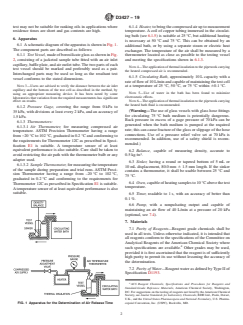
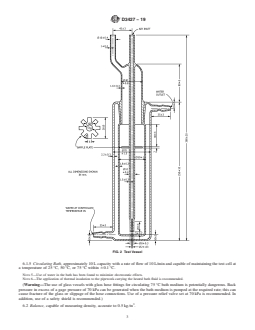
6.1 A schematic diagram of the apparatus is shown in Fig. 1. The component parts are described as follows:
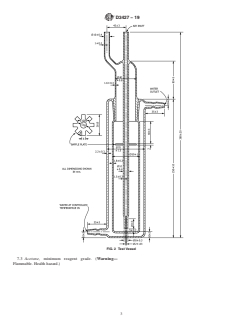
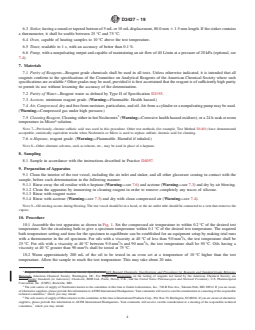
6.1.1 Test Vessel, made of borosilicate glass as shown in Fig. 2, consisting of a jacketed sample tube fitted with an air inlet
capillary, baffle plate, and air outlet tube. The two parts of each test vessel should be marked and preferably used as a pair.
Interchanged parts may be used so long as the resultant test vessel conforms to the stated dimensions.
NOTE 3—Users are advised to verify the distance between the air inlet capillary and the bottom of the test cell as described in the method, by using
an appropriate measuring device. It has been noted by some laboratories that variation from the required measurements has significant effect on results.
6.1.2 Pressure Gage, covering the range from 0 kPa to 35 kPa, with divisions at least every 2 kPa, and an accuracy of 1.5 kPa.
6.1.3 Thermometers:
6.1.3.1 Air Thermometer, for measuring compressed air temperature. ASTM Precision Thermometer having a range
from −20 °C to 102 °C, graduated in 0.2 °C and conforming to the requirements for Thermometer 12C as prescribed in
Specification E1 is suitable. A temperature sensor of at least equivalent performance is also suitable. Care shall be taken to avoid
restricting the air path with the thermometer bulb or any adapter used.
6.1.3.2 Sample Thermometer, for measuring the temperature of the sample during preparation and trial runs. ASTM Precision
Thermometer having a range from –20 °C to 102 °C, graduated in 0.2 °C and conforming to the requirements for Thermometer
12C as prescribed in Specification E1 is suitable. A temperature sensor of at least equivalent performance is also suitable.
6.1.4 Heater, to bring the compressed air up to measurement temperature. A coil of copper tubing immersed in the circulating
bath (see 6.1.5) is suitable at 25 °C, but additional heating is necessary at 50 °C and 75 °C. This can be obtained by an additional
bath, or by using a separate steam or electric heat exchanger. The temperature of the air shall be measured by a thermometer located
as close as possible to the testing vessel and meeting the specifications shown in 6.1.3.
NOTE 4—The application of thermal insulation to the pipework carrying the heated compressed air is recommended.
FIG. 1 Apparatus for the Determination of Air Release Time
D3427 − 19
FIG. 2 Test Vessel
6.1.5 Circulating Bath, approximately 10 L capacity with a rate of flow of 10 L/min and capable of maintaining the test cell at
a temperature of 25 °C, 50 °C, or 75 °C within 60.1 °C.
NOTE 5—Use of water in the bath has been found to minimize electrostatic effects.
NOTE 6—The application of thermal insulation to the pipework carrying the heated bath fluid is recommended.
(Warning—The use of glass vessels with glass hose fittings for circulating 75 °C bath medium is potentially dangerous. Back
pressure in excess of a gage pressure of 70 kPa can be generated when the bath medium is pumped at the required rate; this can
cause fracture of the glass or slippage of the hose connections. Use of a pressure relief valve set at 70 kPa is recommended. In
addition, use of a safety shield is recommended.)
6.2 Balance, capable of measuring density, accurate to 0.5 kg ⁄m .
D3427 − 19
6.3 Sinker, having a round or tapered bottom of 5 mL or 10 mL displacement, 80.0 mm 6 1.5 mm length. If the sinker contains
a thermometer, it shall be usable between 25 °C and 75 °C.
6.4 Oven, capable of heating samples to 10 °C above the test temperature.
6.5 Timer, readable to 1 s, with an accuracy of better than 0.1 %.
6.6 Pump, with a nonpulsating output and capable of maintaining an air flow of 40 L/min at a pressure of 20 kPa (optional, see
7.4).
7. Materials
7.1 Purity of Reagents—Reagent grade chemicals shall be used in all tests. Unless otherwise indicated, it is intended that all
reagents conform to the specifications of the Committee on Analytical Reagents of the American Chemical Society where such
specifications are available. Other grades may be used, provided it is first ascertained that the reagent is of sufficiently high purity
to permit its use without lessening the accuracy of the determination.
7.2 Purity of Water—Reagent water as defined by Type II of Specification D1193.
7.3 Acetone, minimum reagent grade. (Warning—Flammable. Health hazard.)
7.4 Air, Compressed, dry and free from moisture, particulates, and oil. Air from a cylinder or a nonpulsating pump may be used.
(Warning—Compressed gas under high pressure.)
7.5 Cleaning Reagent, Cleaning either in hot Nochromix (Warning—Corrosive health hazard oxidizer), or a 24 h soak at room
temperature in Micro solution.
NOTE 7—Previously, chrome sulfuric acid was used in this procedure. Other test methods (for example, Test Method D1401) have demonstrated
acceptable, statistically equivalent results when Nochromix or Micro is used to replace sulfuric chromic acid for cleaning.
7.6 n-Heptane, reagent grade. (Warning—Flammable. Harmful if inhaled.)
NOTE 8—Other alternate solvents, such as toluene, etc., may be used in place of n-heptane.
8. Sampling
8.1 Sample in accordance with the instructions described in Practice D4057.
9. Preparation of Apparatus
9.1 Clean the interior of the test vessel, including the air inlet and sinker, and all other glassware coming in contact with the
sample, before each determination in the following manner:
9.1.1 Rinse away the oil residue with n-heptane (Warning—see 7.6) and acetone (Warning—see 7.3) and dry by air blowing.
9.1.2 Clean the apparatus by immersing in cleaning reagent in order to remove completely any traces of silicone.
9.1.3 Rinse with reagent water.
9.1.4 Rinse with acetone (Warning—see 7.3) and dry with clean compressed air (Warning—see 7.4).
NOTE 9—Oil misting occurs during blowing. The test vessel should be in a hood, or the air outlet tube should be connected to a vent that removes the
vapors.
...