

ASTM D4155-22
(Specification)Standard Performance Specification for Women's and Girls' Woven Sportswear, Shorts, Slacks, and Suiting Fabrics
General Information
- Abstract
SIGNIFICANCE AND USE
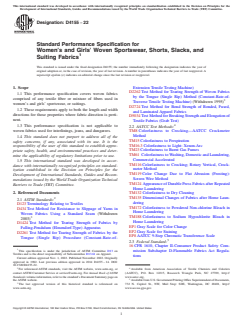
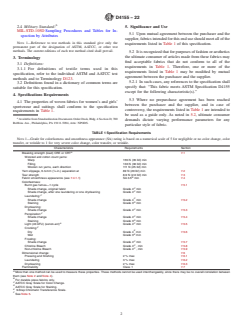
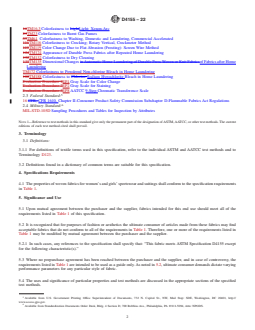
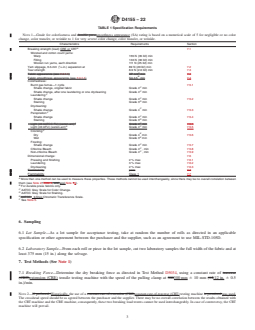
5.1 Upon mutual agreement between the purchaser and the supplier, fabrics intended for this end use should meet all of the requirements listed in Table 1 of this specification.
5.2 It is recognized that for purposes of fashion or aesthetics the ultimate consumer of articles made from these fabrics may find acceptable fabrics that do not conform to all of the requirements in Table 1. Therefore, one or more of the requirements listed in Table 1 may be modified by mutual agreement between the purchaser and the supplier.
5.2.1 In such cases, any references to the specification shall specify that: “This fabric meets ASTM Specification D4155 except for the following characteristic(s).”
5.3 Where no prepurchase agreement has been reached between the purchaser and the supplier, and in case of controversy, the requirements listed in Table 1 are intended to be used as a guide only. As noted in 5.2, ultimate consumer demands dictate varying performance parameters for any particular style of fabric.
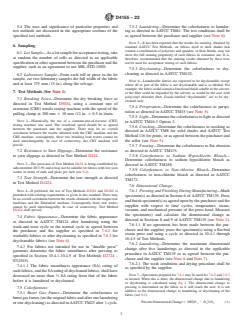
5.4 The uses and significance of particular properties and test methods are discussed in the appropriate sections of the specified test methods.
SCOPE
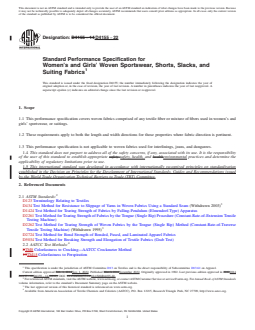
1.1 This performance specification covers woven fabrics comprised of any textile fiber or mixture of fibers used in women's and girls' sportswear, or suitings.
1.2 These requirements apply to both the length and width directions for those properties where fabric direction is pertinent.
1.3 This performance specification is not applicable to woven fabrics used for interlinings, jeans, and dungarees.
1.4 This standard does not purport to address all of the safety concerns, if any, associated with its use. It is the responsibility of the user of this standard to establish appropriate safety, health, and environmental practices and determine the applicability of regulatory limitations prior to use.
1.5 This international standard was developed in accordance with internationally recognized principles on standardization established in the Decision on Principles for the Development of International Standards, Guides and Recommendations issued by the World Trade Organization Technical Barriers to Trade (TBT) Committee.
- Status
- Published
- Publication Date
- 31-Oct-2022
- Technical Committee
- D13 - Textiles
- Drafting Committee
- D13.61 - Apparel
Buy Documents

ASTM D4155-22 - Standard Performance Specification for Women's and Girls' Woven Sportswear, Shorts, Slacks, and Suiting Fabrics
REDLINE ASTM D4155-22 - Standard Performance Specification for Women's and Girls' Woven Sportswear, Shorts, Slacks, and Suiting Fabrics
Overview
ASTM D4155-22 defines the standard performance specification for women’s and girls’ woven sportswear, shorts, slacks, and suiting fabrics. Developed by ASTM International, this standard establishes uniform requirements to ensure the quality, durability, appearance, and safety of woven fabrics used in apparel for women and girls. Covering fabrics made from any textile fiber or blend, this specification applies to materials intended for sportswear and suiting, but specifically excludes denim, dungarees, and interlining fabrics.
The document provides a comprehensive framework for both manufacturers and consumers, offering guidelines on properties such as breaking strength, colorfastness, dimensional stability, fabric appearance, and flammability resistance. Compliance with this standard allows textile producers to meet purchasing and regulatory requirements while supporting product consistency and consumer satisfaction.
Key Topics
- Fabric Scope: Applies to woven fabrics crafted from any fiber or blend, used in women’s and girls’ sportswear and suiting.
- Performance Criteria: Requirements include:
- Breaking strength and tear resistance
- Yarn slippage resistance
- Colorfastness to laundering, dry cleaning, light, crocking, bleaching, perspiration, and gas fumes
- Fabric appearance and smoothness after laundering and pressing
- Dimensional stability after repeated laundering, drycleaning, and pressing
- Flammability meeting regulatory standards
- Test Methods: References multiple established ASTM and AATCC test methods, including but not limited to D5034 (breaking strength), D1424 (tearing strength), AATCC 61 (laundering colorfastness), and AATCC 124 (appearance after home laundering).
- Consumer Flexibility: Allows for agreed-upon exceptions between buyer and supplier to address fashion trends and consumer preferences, provided any deviations are documented.
- Safety & Compliance: Advises users to establish appropriate safety, health, and environmental practices and adhere to applicable regulations.
Applications
ASTM D4155-22 delivers significant value for the textile manufacturing and apparel industries:
- Product Development: Provides designers and manufacturers with a benchmark for material selection and fabric engineering.
- Quality Assurance: Enables suppliers and brands to ensure consistent product performance throughout the supply chain.
- Purchasing Agreements: Acts as a reference in buyer-supplier contracts to define material performance expectations and testing protocols.
- Regulatory Compliance: Assists garment manufacturers in fulfilling consumer product safety regulations, especially regarding flammability.
- Market Confidence: Helps retailers and end-users identify products that meet established quality and reliability standards, supporting customer satisfaction.
This standard is particularly relevant for textile mills, garment manufacturers, quality control laboratories, and purchasing agents responsible for women’s and girls’ woven fashion and sportswear collections.
Related Standards
When using ASTM D4155-22, the following closely associated standards and test methods may also apply:
- ASTM D123: Terminology Relating to Textiles
- ASTM D5034: Breaking Strength and Elongation of Textile Fabrics (Grab Test)
- ASTM D1424: Tearing Strength by Falling-Pendulum (Elmendorf) Apparatus
- AATCC 8 & 116: Colorfastness to Crocking
- AATCC 15: Colorfastness to Perspiration
- AATCC 61: Colorfastness to Laundering
- AATCC 124: Appearance After Repeated Home Laundering
- 16 CFR 1610: Flammability of Clothing Textiles (U.S. Consumer Product Safety Commission Regulation)
- MIL-STD-105D: Sampling Procedures for Inspection by Attributes
Referring to these standards ensures comprehensive testing, product performance evaluation, and adherence to global textile industry best practices for women’s and girls’ woven apparel fabrics.
Relations
- Effective Date
- 01-Jan-2024
- Effective Date
- 15-Jul-2017
- Effective Date
- 15-Jul-2017
- Effective Date
- 01-Mar-2017
- Effective Date
- 15-Sep-2015
- Effective Date
- 01-Sep-2015
- Effective Date
- 01-Jul-2015
- Effective Date
- 01-Apr-2015
- Effective Date
- 01-Jul-2013
- Effective Date
- 01-Jul-2013
- Effective Date
- 15-Jun-2013
- Effective Date
- 15-Jun-2013
- Effective Date
- 15-May-2013
- Effective Date
- 01-Jan-2013
- Effective Date
- 01-Feb-2012
Buy Documents
ASTM D4155-22 - Standard Performance Specification for Women's and Girls' Woven Sportswear, Shorts, Slacks, and Suiting Fabrics
REDLINE ASTM D4155-22 - Standard Performance Specification for Women's and Girls' Woven Sportswear, Shorts, Slacks, and Suiting Fabrics
Frequently Asked Questions
ASTM D4155-22 is a technical specification published by ASTM International. Its full title is "Standard Performance Specification for Women's and Girls' Woven Sportswear, Shorts, Slacks, and Suiting Fabrics". This standard covers: SIGNIFICANCE AND USE 5.1 Upon mutual agreement between the purchaser and the supplier, fabrics intended for this end use should meet all of the requirements listed in Table 1 of this specification. 5.2 It is recognized that for purposes of fashion or aesthetics the ultimate consumer of articles made from these fabrics may find acceptable fabrics that do not conform to all of the requirements in Table 1. Therefore, one or more of the requirements listed in Table 1 may be modified by mutual agreement between the purchaser and the supplier. 5.2.1 In such cases, any references to the specification shall specify that: “This fabric meets ASTM Specification D4155 except for the following characteristic(s).” 5.3 Where no prepurchase agreement has been reached between the purchaser and the supplier, and in case of controversy, the requirements listed in Table 1 are intended to be used as a guide only. As noted in 5.2, ultimate consumer demands dictate varying performance parameters for any particular style of fabric. 5.4 The uses and significance of particular properties and test methods are discussed in the appropriate sections of the specified test methods. SCOPE 1.1 This performance specification covers woven fabrics comprised of any textile fiber or mixture of fibers used in women's and girls' sportswear, or suitings. 1.2 These requirements apply to both the length and width directions for those properties where fabric direction is pertinent. 1.3 This performance specification is not applicable to woven fabrics used for interlinings, jeans, and dungarees. 1.4 This standard does not purport to address all of the safety concerns, if any, associated with its use. It is the responsibility of the user of this standard to establish appropriate safety, health, and environmental practices and determine the applicability of regulatory limitations prior to use. 1.5 This international standard was developed in accordance with internationally recognized principles on standardization established in the Decision on Principles for the Development of International Standards, Guides and Recommendations issued by the World Trade Organization Technical Barriers to Trade (TBT) Committee.
SIGNIFICANCE AND USE 5.1 Upon mutual agreement between the purchaser and the supplier, fabrics intended for this end use should meet all of the requirements listed in Table 1 of this specification. 5.2 It is recognized that for purposes of fashion or aesthetics the ultimate consumer of articles made from these fabrics may find acceptable fabrics that do not conform to all of the requirements in Table 1. Therefore, one or more of the requirements listed in Table 1 may be modified by mutual agreement between the purchaser and the supplier. 5.2.1 In such cases, any references to the specification shall specify that: “This fabric meets ASTM Specification D4155 except for the following characteristic(s).” 5.3 Where no prepurchase agreement has been reached between the purchaser and the supplier, and in case of controversy, the requirements listed in Table 1 are intended to be used as a guide only. As noted in 5.2, ultimate consumer demands dictate varying performance parameters for any particular style of fabric. 5.4 The uses and significance of particular properties and test methods are discussed in the appropriate sections of the specified test methods. SCOPE 1.1 This performance specification covers woven fabrics comprised of any textile fiber or mixture of fibers used in women's and girls' sportswear, or suitings. 1.2 These requirements apply to both the length and width directions for those properties where fabric direction is pertinent. 1.3 This performance specification is not applicable to woven fabrics used for interlinings, jeans, and dungarees. 1.4 This standard does not purport to address all of the safety concerns, if any, associated with its use. It is the responsibility of the user of this standard to establish appropriate safety, health, and environmental practices and determine the applicability of regulatory limitations prior to use. 1.5 This international standard was developed in accordance with internationally recognized principles on standardization established in the Decision on Principles for the Development of International Standards, Guides and Recommendations issued by the World Trade Organization Technical Barriers to Trade (TBT) Committee.
ASTM D4155-22 is classified under the following ICS (International Classification for Standards) categories: 61.020 - Clothes. The ICS classification helps identify the subject area and facilitates finding related standards.
ASTM D4155-22 has the following relationships with other standards: It is inter standard links to ASTM D2261-13(2024), ASTM D2261-13(2017), ASTM D2261-13(2017)e1, ASTM D123-17, ASTM D123-15b, ASTM D123-15a, ASTM D2724-07(2015), ASTM D123-15, ASTM D1424-09(2013)e1, ASTM D1424-09(2013), ASTM D123-13ae1, ASTM D123-13a, ASTM D123-13, ASTM D2261-13, ASTM D123-12e1. Understanding these relationships helps ensure you are using the most current and applicable version of the standard.
ASTM D4155-22 is available in PDF format for immediate download after purchase. The document can be added to your cart and obtained through the secure checkout process. Digital delivery ensures instant access to the complete standard document.
Standards Content (Sample)
This international standard was developed in accordance with internationally recognized principles on standardization established in the Decision on Principles for the
Development of International Standards, Guides and Recommendations issued by the World Trade Organization Technical Barriers to Trade (TBT) Committee.
Designation:D4155 −22
Standard Performance Specification for
Women’s and Girls’ Woven Sportswear, Shorts, Slacks, and
Suiting Fabrics
This standard is issued under the fixed designation D4155; the number immediately following the designation indicates the year of
original adoption or, in the case of revision, the year of last revision. A number in parentheses indicates the year of last reapproval. A
superscript epsilon (´) indicates an editorial change since the last revision or reapproval.
1. Scope Extension Tensile Testing Machine)
D2262 Test Method for Tearing Strength of Woven Fabrics
1.1 This performance specification covers woven fabrics
by the Tongue (Single Rip) Method (Constant-Rate-of-
comprised of any textile fiber or mixture of fibers used in
Traverse Tensile Testing Machine) (Withdrawn 1995)
women’s and girls’ sportswear, or suitings.
D2724 Test Method for Bond Strength of Bonded, Fused,
1.2 These requirements apply to both the length and width
and Laminated Apparel Fabrics
directions for those properties where fabric direction is perti-
D5034 TestMethodforBreakingStrengthandElongationof
nent.
Textile Fabrics (Grab Test)
1.3 This performance specification is not applicable to
2.2 AATCC Test Methods:
woven fabrics used for interlinings, jeans, and dungarees.
TM8 Colorfastness to Crocking—AATCC Crockmeter
Method
1.4 This standard does not purport to address all of the
TM15 Colorfastness to Perspiration
safety concerns, if any, associated with its use. It is the
TM16.3 Colorfastness to Light: Xenon-Arc
responsibility of the user of this standard to establish appro-
TM23 Colorfastness to Burnt Gas Fumes
priate safety, health, and environmental practices and deter-
TM61 Colorfastness toWashing, Domestic and Laundering,
mine the applicability of regulatory limitations prior to use.
Commercial Accelerated
1.5 This international standard was developed in accor-
TM116 Colorfastness to Crocking; Rotary Vertical, Crock-
dance with internationally recognized principles on standard-
meter Method
ization established in the Decision on Principles for the
TM119 Color Change Due to Flat Abrasion (Frosting):
Development of International Standards, Guides and Recom-
Screen Wire Method
mendations issued by the World Trade Organization Technical
TM124 Appearance of Durable Press Fabrics after Repeated
Barriers to Trade (TBT) Committee.
Home Laundering
2. Referenced Documents TM132 Colorfastness to Dry Cleaning
2 TM135 Dimensional Changes of Fabrics after Home Laun-
2.1 ASTM Standards:
dering
D123 Terminology Relating to Textiles
TM172 Colorfastness to Powdered Non-chlorine Bleach in
D434 Test Method for Resistance to Slippage of Yarns in
Home Laundering
Woven Fabrics Using a Standard Seam (Withdrawn
3 TM188 Colorfastness to Sodium Hypochlorite Bleach in
2003)
Home Laundering
D1424 Test Method for Tearing Strength of Fabrics by
EP1 Gray Scale for Color Change
Falling-Pendulum (Elmendorf-Type) Apparatus
EP2 Gray Scale for Staining
D2261 Test Method for Tearing Strength of Fabrics by the
EP8 AATCC 9-Step Chromatic Transference Scale
Tongue (Single Rip) Procedure (Constant-Rate-of-
2.3 Federal Standard:
16 CFR 1610, Chapter II-Consumer Product Safety Com-
This specification is under the jurisdiction of ASTM Committee D13 on
mission Subchapter D-Flammable Fabrics Act Regula-
Textiles and is the direct responsibility of Subcommittee D13.61 on Apparel.
tions
Current edition approved Nov. 1, 2022. Published November 2022. Originally
approved in 1982. Last previous edition approved in 2014 D4155 – 14. DOI:
10.1520/D4155-22.
2 4
For referenced ASTM standards, visit the ASTM website, www.astm.org, or Available from American Association of Textile Chemists and Colorists
contact ASTM Customer Service at service@astm.org. For Annual Book of ASTM (AATCC), P.O. Box 12215, Research Triangle Park, NC 27709, http://
Standards volume information, refer to the standard’s Document Summary page on www.aatcc.org.
the ASTM website. AvailablefromU.S.GovernmentPrintingOfficeSuperintendentofDocuments,
The last approved version of this historical standard is referenced on 732 N. Capitol St., NW, Mail Stop: SDE, Washington, DC 20401, http://
www.astm.org. www.access.gpo.gov.
Copyright © ASTM International, 100 Barr Harbor Drive, PO Box C700, West Conshohocken, PA 19428-2959. United States
D4155−22
2.4 Military Standard: 5. Significance and Use
MIL-STD-105D Sampling Procedures and Tables for In-
5.1 Upon mutual agreement between the purchaser and the
spection by Attributes
supplier,fabricsintendedforthisenduseshouldmeetallofthe
NOTE 1—Reference to test methods in this standard give only the
requirements listed in Table 1 of this specification.
permanent part of the designation of ASTM, AATCC, or other test
methods. The current editions of each test method cited shall prevail.
5.2 Itisrecognizedthatforpurposesoffashionoraesthetics
the ultimate consumer of articles made from these fabrics may
3. Terminology
find acceptable fabrics that do not conform to all of the
3.1 Definitions:
requirements in Table 1. Therefore, one or more of the
3.1.1 For definitions of textile terms used in this
requirements listed in Table 1 may be modified by mutual
specification, refer to the individual ASTM and AATCC test
agreement between the purchaser and the supplier.
methods and to Terminology D123.
5.2.1 In such cases, any references to the specification shall
3.2 Definitions found in a dictionary of common terms are
specify that: “This fabric meets ASTM Specification D4155
suitable for this specification.
except for the following characteristic(s).”
4. Specifications Requirements
5.3 Where no prepurchase agreement has been reached
4.1 The properties of woven fabrics for women’s and girls’
between the purchaser and the supplier, and in case of
sportswear and suitings shall conform to the specification
controversy, the requirements listed in Table 1 are intended to
requirements in Table 1.
be used as a guide only. As noted in 5.2, ultimate consumer
AvailablefromStandardizationDocumentsOrderDesk,Bldg.4SectionD,700
demands dictate varying performance parameters for any
Robbins Ave., Philadelphia, PA 19111-5094, Attn: NPODS.
particular style of fabric.
TABLE 1 Specification Requirements
NOTE 1—Grade for colorfastness and smoothness appearance (SA) rating is based on a numerical scale of 5 for negligible or no color change, color
transfer, or wrinkle to 1 for very severe color change, color transfer, or wrinkle.
Characteristics Requirements Section
A
Breaking strength (load) CRE or CRT 7.1
Worsted and cotton count yarns:
Warp 155 N (35 lbf) min
Filling 133 N (30 lbf) min
Woolen run yarns, each direction 111 N (25 lbf) min
Yarn slippage, 6.3-mm ( ⁄4-in.) separation at 89 N (20 lbf) min 7.2
Tear strength 8.9 N (2.0 lbf) min 7.3
B
Fabric smoothness appearance (see 7.4.1.1)SA3.5 min 7.4
Colorfastness:
Burnt gas fumes—1 cycle 7.5.1
C
Shade change, original fabric Grade 4 min
C
Shade change, after one laundering or one drycleaning Grade 4 min
F
Laundering:
C
Shade change Grade 4 min 7.5.2
D
Staining Grade 3 min
Drycleaning:
C
Shade change Grade 4 min 7.5.3
F
Perspiration:
C
Shade change Grade 4 min 7.5.4
D
Staining Grade 3 min
A C
Light (40 AFU) (xenon-arc) Grade 4 min 7.5.5
F
Crocking:
E
Dry Grade 4 min 7.5.6
E
Wet Grade 3 min
Frosting:
C
Shade change Grade 4 min 7.5.7
C
Chlorine Bleach Grade 4 ,min 7.5.8
C
Non-chlorine Bleach Grade 4 ,min 7.5.9
Dimensional change: 7.6
Pressing and finishing 2 % max 7.6.1
Laundering 3 % max 7.6.2
Drycleaning 2 % max 7.6.3
Flammability Class 1 7.7
A
More than one method can be used to measure these properties. These methods cannot be used interchangeably, since there may be no overall correlation between
them (see Note 2 and Note 4).
B
For durable press fabrics only.
C
AATCC Gray Scale for Color Change.
D
AATCC Gray Scale for Staining.
E
9-Step Chromatic Tra
...
This document is not an ASTM standard and is intended only to provide the user of an ASTM standard an indication of what changes have been made to the previous version. Because
it may not be technically possible to adequately depict all changes accurately, ASTM recommends that users consult prior editions as appropriate. In all cases only the current version
of the standard as published by ASTM is to be considered the official document.
Designation: D4155 − 14 D4155 − 22
Standard Performance Specification for
Women’s and Girls’ Woven Sportswear, Shorts, Slacks, and
Suiting Fabrics
This standard is issued under the fixed designation D4155; the number immediately following the designation indicates the year of
original adoption or, in the case of revision, the year of last revision. A number in parentheses indicates the year of last reapproval. A
superscript epsilon (´) indicates an editorial change since the last revision or reapproval.
1. Scope
1.1 This performance specification covers woven fabrics comprised of any textile fiber or mixture of fibers used in women’s and
girls’ sportswear, or suitings.
1.2 These requirements apply to both the length and width directions for those properties where fabric direction is pertinent.
1.3 This performance specification is not applicable to woven fabrics used for interlinings, jeans, and dungarees.
1.4 This standard does not purport to address all of the safety concerns, if any, associated with its use. It is the responsibility
of the user of this standard to establish appropriate safety safety, health, and healthenvironmental practices and determine the
applicability of regulatory limitations prior to use.
1.5 This international standard was developed in accordance with internationally recognized principles on standardization
established in the Decision on Principles for the Development of International Standards, Guides and Recommendations issued
by the World Trade Organization Technical Barriers to Trade (TBT) Committee.
2. Referenced Documents
2.1 ASTM Standards:
D123 Terminology Relating to Textiles
D434 Test Method for Resistance to Slippage of Yarns in Woven Fabrics Using a Standard Seam (Withdrawn 2003)
D1424 Test Method for Tearing Strength of Fabrics by Falling-Pendulum (Elmendorf-Type) Apparatus
D2261 Test Method for Tearing Strength of Fabrics by the Tongue (Single Rip) Procedure (Constant-Rate-of-Extension Tensile
Testing Machine)
D2262 Test Method for Tearing Strength of Woven Fabrics by the Tongue (Single Rip) Method (Constant-Rate-of-Traverse
Tensile Testing Machine) (Withdrawn 1995)
D2724 Test Method for Bond Strength of Bonded, Fused, and Laminated Apparel Fabrics
D5034 Test Method for Breaking Strength and Elongation of Textile Fabrics (Grab Test)
2.2 AATCC Test Methods:
8TM8 Colorfastness to Crocking—AATCC Crockmeter Method
15TM15 Colorfastness to Perspiration
This specification is under the jurisdiction of ASTM Committee D13 on Textiles and is the direct responsibility of Subcommittee D13.61 on Apparel.
Current edition approved Feb. 1, 2014Nov. 1, 2022. Published March 2014November 2022. Originally approved in 1982. Last previous edition approved in 20122014
D4155 – 01D4155 – 14.(2012). DOI: 10.1520/D4155-14.10.1520/D4155-22.
For referenced ASTM standards, visit the ASTM website, www.astm.org, or contact ASTM Customer Service at service@astm.org. For Annual Book of ASTM Standards
volume information, refer to the standard’s Document Summary page on the ASTM website.
The last approved version of this historical standard is referenced on www.astm.org.
Available from American Association of Textile Chemists and Colorists (AATCC), P.O. Box 12215, Research Triangle Park, NC 27709, http://www.aatcc.org.
Copyright © ASTM International, 100 Barr Harbor Drive, PO Box C700, West Conshohocken, PA 19428-2959. United States
D4155 − 22
16TM16.3 Colorfastness to LightLight: Xenon-Arc
23TM23 Colorfastness to Burnt Gas Fumes
61TM61 Colorfastness to Washing, Domestic and Laundering, Commercial Accelerated
116TM116 Colorfastness to Crocking; Rotary Vertical, Crockmeter Method
119TM119 Color Change Due to Flat Abrasion (Frosting): Screen Wire Method
124TM124 Appearance of Durable Press Fabrics after Repeated Home Laundering
132TM132 Colorfastness to Dry Cleaning
135TM135 Dimensional Changes in Automatic Home Laundering of Durable Press Woven or Knit Fabricsof Fabrics after Home
Laundering
TM172 Colorfastness to Powdered Non-chlorine Bleach in Home Laundering
188TM188 Colorfastness to Chlorine Sodium Hypochlorite Bleach in Home Laundering
Evaluation Procedure 1EP1 Gray Scale for Color Change
Evaluation Procedure 2EP2 Gray Scale for Staining
Evaluation Procedure 3EP8 AATCC 9-Step Chromatic Transference Scale
2.3 Federal Standard:
16 CFR, CFR 1610, Chapter II-Consumer Product Safety Commission Subchapter D-Flammable Fabrics Act Regulations
2.4 Military Standard:
MIL-STD-105D Sampling Procedures and Tables for Inspection by Attributes
NOTE 1—Reference to test methods in this standard give only the permanent part of the designation of ASTM, AATCC, or other test methods. The current
editions of each test method cited shall prevail.
3. Terminology
3.1 Definitions:
3.1.1 For definitions of textile terms used in this specification, refer to the individual ASTM and AATCC test methods and to
Terminology D123.
3.2 Definitions found in a dictionary of common terms are suitable for this specification.
4. Specifications Requirements
4.1 The properties of woven fabrics for women’s and girls’ sportswear and suitings shall conform to the specification requirements
in Table 1.
5. Significance and Use
5.1 Upon mutual agreement between the purchaser and the supplier, fabrics intended for this end use should meet all of the
requirements listed in Table 1 of this specification.
5.2 It is recognized that for purposes of fashion or aesthetics the ultimate consumer of articles made from these fabrics may find
acceptable fabrics that do not conform to all of the requirements in Table 1. Therefore, one or more of the requirements listed in
Table 1 may be modified by mutual agreement between the purchaser and the supplier.
5.2.1 In such cases, any references to the specification shall specify that: “This fabric meets ASTM Specification D4155 except
for the following characteristic(s).”
5.3 Where no prepurchase agreement has been reached between the purchaser and the supplier, and in case of controversy, the
requirements listed in Table 1 are intended to be used as a guide only. As noted in 5.2, ultimate consumer demands dictate varying
performance parameters for any particular style of fabric.
5.4 The uses and significance of particular properties and test methods are discussed in the appropriate sections of the specified
test methods.
Available from U.S. Government Printing Office Superintendent of Documents, 732 N. Capitol St., NW, Mail Stop: SDE, Washington, DC 20401, http://
www.access.gpo.gov.
Available from Standardization Documents Order Desk, Bldg. 4 Section D, 700 Robbins Ave., Philadelphia, PA 19111-5094, Attn: NPODS.
D4155 − 22
TABLE 1 Specification Requirements
NOTE 1—Grade for colorfastness and durable presssmoothness appearance (SA) rating is based on a numerical scale of 5 for negligible or no color
change, color transfer, or wrinkle to 1 for very severe color change, color transfer, or wrinkle.
Characteristics Requirements Section
A
Breaking strength (load) CRE or CRT 7.1
Worsted and cotton count yarns:
Warp 155 N (35 lbf) min
Filling 133 N (30 lbf) min
Woolen run yarns, each direction 111 N (25 lbf) min
Yarn slippage, 6.3-mm ( ⁄4-in.) separation at 89 N (20 lbf) min 7.2
Tear strength 8.9 N (2.0 lbf) min 7.3
B
Fabric appearance (see 7.4.1.1) DP 3.5 min 7.4
B
Fabric smoothness appearance (see 7.4.1.1) SA 3.5 min 7.4
Colorfastness:
Burnt gas fumes—1 cycle 7.5.1
C
Shade change, original fabric Grade 4 min
C
Shade change, after one laundering or one drycleaning Grade 4 min
F
Laundering:
C
Shade change Grade 4 min 7.5.2
D
Staining Grade 3 min
Drycleaning:
C
Shade change Grade 4 min 7.5.3
F
Perspiration:
C
Shade change Grade 4 min 7.5.4
D
Staining Grade 3 min
A C
Light (40 AATCC FU) (xenon-arc) Grade 4 min 7.5.5
A C
Light (40 AFU) (xenon-arc) Grade 4 min 7.5.5
F
Crocking:
E
Dry Grade 4 min 7.5.6
E
Wet Grade 3 min
Frosting:
C
Shade change Grade 4 min 7.5.7
C
Chlorine Bleach Grade 4 , min 7.5.8
C
Non-chlorine Bleach Grade 4 , min 7.5.9
Dimensional change: 7.6
Pressing and finishing 2 % max 7.6.1
Laundering 3 % max 7.6.2
Drycleaning 2 % max 7.6.3
Flammability pass 7.7
Flammability Class 1 7.7
A
More than one method can be used to measure these properties. These methods cannot be used interchangeably, since there may be no overall correlation between
them (see Note 2, Note 4, and and Note 74).
B
For durable press fabrics only.
C
AATCC Gray Scale for Color Change.
D
AATCC Gray S
...