

ASTM D2294-96(2016)
(Test Method)Standard Test Method for Creep Properties of Adhesives in Shear by Tension Loading (Metal-to-Metal)
General Information
- Abstract
SIGNIFICANCE AND USE
4.1 This test method is useful in research and development for comparison of creep properties of adhesives, particularly as those properties are affected by changes in adhesive formulation or expected service conditions, including temperature, moisture level, and duration of loading.
4.2 The relative size and simplicity of design of the spring-loaded apparatus permits easy portability and transfer from one environment to the next without disturbing static loads.
4.3 The relative simplicity of design with inexpensive materials permits replication of creep tests at relatively low costs.
SCOPE
1.1 This test method covers the determination of the creep properties of adhesives for bonding metals when tested on a standard specimen and subjected to certain conditions of temperature and tensile stress in a spring-loaded testing apparatus.
1.2 This test method is applicable to the temperature range from −55 to +260°C (−67 to +500°F).
1.3 The values stated in SI units are to be regarded as standard. The values given in parentheses are for information only.
1.4 This standard does not purport to address all of the safety concerns, if any, associated with its use. It is the responsibility of the user of this standard to establish appropriate safety and health practices and determine the applicability of regulatory limitations prior to use.
- Status
- Published
- Publication Date
- 30-Apr-2016
- Technical Committee
- D14 - Adhesives
- Drafting Committee
- D14.80 - Metal Bonding Adhesives


Overview
ASTM D2294-96(2016), titled Standard Test Method for Creep Properties of Adhesives in Shear by Tension Loading (Metal-to-Metal), is a widely recognized test method for assessing the creep behavior of adhesives used in bonding metal substrates. Published by ASTM, this standard outlines procedures for determining how adhesives perform under prolonged shear stress and elevated or reduced temperatures, simulating long-term service conditions. The method is crucial for research and development, aiding manufacturers and engineers in comparing different adhesive formulations and evaluating their suitability for various applications involving metal-to-metal bonding.
Key Topics
- Creep Properties of Adhesives: The standard focuses on evaluating the time-dependent deformation (creep) of adhesives subjected to continuous shear stress in metal-to-metal joints.
- Test Environment: The method is applicable across a broad temperature range, from −55 to +260°C (−67 to +500°F), making it suitable for both low and high-temperature service conditions.
- Test Apparatus: Utilizes a spring-loaded, easily portable testing device, enabling testing in diverse environments without disrupting the applied static load.
- Specimen Preparation and Measurement:
- Test specimens are shaped per standard dimensions and tested in a tension shear configuration.
- Displacement (creep deflection) is measured periodically using a calibrated microscope at 100× magnification for precise analysis.
- Reporting Requirements: Comprehensive results documentation, including specimen identification, load and temperature conditions, observed creep, and any failure characteristics.
- Cost-Efficiency: The testing procedure’s simplicity and the use of affordable materials facilitate low-cost replication for comparative research.
Applications
- Adhesive Development and Comparison: Essential for researchers and product developers who need to assess and compare the creep resistance of different adhesive formulations when bonding metals.
- Quality Assurance for Adhesives: Manufacturers use this method to ensure that metal-to-metal adhesive bonds will maintain structural integrity over prolonged service periods, especially in critical temperature and humidity conditions.
- Component Testing in Harsh Environments: Industries such as aerospace, automotive, and construction rely on this standard to validate the long-term durability of bonded joints exposed to fluctuating thermal and mechanical loads.
- Product Certification and Compliance: Satisfying ASTM D2294-96(2016) requirements helps meet customer and regulatory expectations in markets demanding reliable adhesives for metal assemblies.
Related Standards
- ASTM D638: Test Method for Tensile Properties of Plastics. Often referenced for equipment compatibility and testing techniques relevant to adhesives.
- ASTM D907: Standard Terminology of Adhesives. Provides definitions which support consistent interpretation of terms found in ASTM D2294.
- ASTM D1002: Test Method for Apparent Shear Strength of Single-Lap-Joint Adhesively Bonded Metal Specimens by Tension Loading. Complementary to D2294, especially regarding specimen preparation and test setup.
By adhering to ASTM D2294-96(2016), organizations ensure rigorous evaluation of adhesive performance under realistic service conditions, leading to enhanced reliability and product confidence in metal-to-metal bonded assemblies. This test method remains a cornerstone in material testing for adhesive selection and quality control across multiple industries.
Relations
- Effective Date
- 01-Apr-2019
- Effective Date
- 01-Jul-2012
- Effective Date
- 01-May-2012
- Effective Date
- 01-Dec-2011
- Effective Date
- 01-Jan-2011
- Effective Date
- 15-May-2010
- Effective Date
- 01-Oct-2008
- Effective Date
- 15-Aug-2008
- Effective Date
- 01-Mar-2008
- Effective Date
- 01-Dec-2006
- Effective Date
- 01-Oct-2005
- Effective Date
- 01-Apr-2005
- Effective Date
- 01-Apr-2005
- Effective Date
- 01-Dec-2004
- Effective Date
- 01-Apr-2004
Get Certified
Connect with accredited certification bodies for this standard

DIN CERTCO
DIN Group product certification.

Smithers Quality Assessments
US management systems and product certification.
Sponsored listings
Frequently Asked Questions
ASTM D2294-96(2016) is a standard published by ASTM International. Its full title is "Standard Test Method for Creep Properties of Adhesives in Shear by Tension Loading (Metal-to-Metal)". This standard covers: SIGNIFICANCE AND USE 4.1 This test method is useful in research and development for comparison of creep properties of adhesives, particularly as those properties are affected by changes in adhesive formulation or expected service conditions, including temperature, moisture level, and duration of loading. 4.2 The relative size and simplicity of design of the spring-loaded apparatus permits easy portability and transfer from one environment to the next without disturbing static loads. 4.3 The relative simplicity of design with inexpensive materials permits replication of creep tests at relatively low costs. SCOPE 1.1 This test method covers the determination of the creep properties of adhesives for bonding metals when tested on a standard specimen and subjected to certain conditions of temperature and tensile stress in a spring-loaded testing apparatus. 1.2 This test method is applicable to the temperature range from −55 to +260°C (−67 to +500°F). 1.3 The values stated in SI units are to be regarded as standard. The values given in parentheses are for information only. 1.4 This standard does not purport to address all of the safety concerns, if any, associated with its use. It is the responsibility of the user of this standard to establish appropriate safety and health practices and determine the applicability of regulatory limitations prior to use.
SIGNIFICANCE AND USE 4.1 This test method is useful in research and development for comparison of creep properties of adhesives, particularly as those properties are affected by changes in adhesive formulation or expected service conditions, including temperature, moisture level, and duration of loading. 4.2 The relative size and simplicity of design of the spring-loaded apparatus permits easy portability and transfer from one environment to the next without disturbing static loads. 4.3 The relative simplicity of design with inexpensive materials permits replication of creep tests at relatively low costs. SCOPE 1.1 This test method covers the determination of the creep properties of adhesives for bonding metals when tested on a standard specimen and subjected to certain conditions of temperature and tensile stress in a spring-loaded testing apparatus. 1.2 This test method is applicable to the temperature range from −55 to +260°C (−67 to +500°F). 1.3 The values stated in SI units are to be regarded as standard. The values given in parentheses are for information only. 1.4 This standard does not purport to address all of the safety concerns, if any, associated with its use. It is the responsibility of the user of this standard to establish appropriate safety and health practices and determine the applicability of regulatory limitations prior to use.
ASTM D2294-96(2016) is classified under the following ICS (International Classification for Standards) categories: 83.180 - Adhesives. The ICS classification helps identify the subject area and facilitates finding related standards.
ASTM D2294-96(2016) has the following relationships with other standards: It is inter standard links to ASTM D1002-10(2019), ASTM D907-12a, ASTM D907-12, ASTM D907-11a, ASTM D907-11, ASTM D638-10, ASTM D907-08b, ASTM D907-08a, ASTM D907-08, ASTM D907-06, ASTM D1002-05, ASTM D907-05e1, ASTM D907-05, ASTM D907-04a, ASTM D907-04. Understanding these relationships helps ensure you are using the most current and applicable version of the standard.
ASTM D2294-96(2016) is available in PDF format for immediate download after purchase. The document can be added to your cart and obtained through the secure checkout process. Digital delivery ensures instant access to the complete standard document.
Standards Content (Sample)
This international standard was developed in accordance with internationally recognized principles on standardization established in the Decision on Principles for the
Development of International Standards, Guides and Recommendations issued by the World Trade Organization Technical Barriers to Trade (TBT) Committee.
Designation: D2294 − 96 (Reapproved 2016)
Standard Test Method for
Creep Properties of Adhesives in Shear by Tension Loading
(Metal-to-Metal)
This standard is issued under the fixed designation D2294; the number immediately following the designation indicates the year of
original adoption or, in the case of revision, the year of last revision. A number in parentheses indicates the year of last reapproval. A
superscript epsilon (´) indicates an editorial change since the last revision or reapproval.
1. Scope 4. Significance and Use
1.1 This test method covers the determination of the creep
4.1 This test method is useful in research and development
properties of adhesives for bonding metals when tested on a for comparison of creep properties of adhesives, particularly as
standard specimen and subjected to certain conditions of
those properties are affected by changes in adhesive formula-
temperature and tensile stress in a spring-loaded testing appa- tion or expected service conditions, including temperature,
ratus.
moisture level, and duration of loading.
1.2 This test method is applicable to the temperature range 4.2 The relative size and simplicity of design of the spring-
from −55 to +260°C (−67 to +500°F).
loaded apparatus permits easy portability and transfer from one
environment to the next without disturbing static loads.
1.3 The values stated in SI units are to be regarded as
standard. The values given in parentheses are for information
4.3 The relative simplicity of design with inexpensive
only.
materials permits replication of creep tests at relatively low
costs.
1.4 This standard does not purport to address all of the
safety concerns, if any, associated with its use. It is the
5. Apparatus
responsibility of the user of this standard to establish appro-
priate safety and health practices and determine the applica-
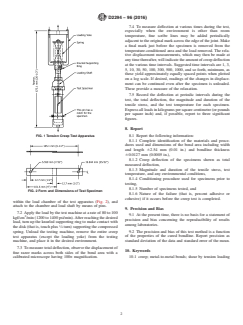
5.1 Tension Creep Test Apparatus, as shown in Fig. 1. It
bility of regulatory limitations prior to use.
shall consist of a hollow loading chamber, a solid extension rod
with provisions for attachment of test specimens, and a
2. Referenced Documents
high-temperature-resistant spring. A testing machine conform-
2.1 ASTM Standards:
ing to the requirements of Test Method D638 is required to
D638 Test Method for Tensile Properties of Plastics
apply the static load.
D907 Terminology of Adhesives
5.2 Microscope, calibrated, having 100× magnification.
D1002 Test Method for Apparent Shear Strength of Single-
Lap-Joint Adhesively Bonded Metal Specimens by Ten-
6. Test Specimens
sion Loading (Metal-to-Metal)
2.2 ASTM Adjuncts:
6.1 Test specimens shall conform to the shape and dimen-
Tension Creep Test Apparatus sions shown in Fig. 2. These specimens are similar to the
tension lap shear specimens described in Test Method D1002,
3. Terminology
except for the holes as shown in Fig. 2.
3.1 Definitions—Many terms in this test method are defined
6.2 Test at least three specimens for each set of standard
in Terminology D907.
conditions of load, time, and temperature.
6.3 A complete description of these specimens and the
This test method is under the jurisdiction of ASTM Committee D14 on
method of preparation is given in Sections 6, 7, and 8 of Test
Adhesives and is the direct responsibility of Subcommittee D14.80 on Metal
Bonding Adhesives.
Method D1002.
Current edition approved May 1, 2016. Published May 2016. Originally
6.4 For creep measurements, polish the 12.7-mm ( ⁄2-in.)
approved in 1964. Last previous approved in 2008 as D2294 – 96 (2008). DOI:
10.1520/D2294-96R16.
edges of the bonded area of each test specimen, and scribe with
For referenced ASTM standards, visit the ASTM website, www.astm.org, or
three fine lines across the bondline (Fig. 1).
contact ASTM Customer Service at service@astm.org. For Annual Book of ASTM
Standards volume information, refer to the standard’s Document Summary page on
the ASTM website. 7. Procedure
Detailed working drawings for the construction of the tensile creep test
7.1 Attach the test apparatus to a testing machine and
apparatus are available from ASTM International Headquarters. Order Adjunct No.
ADJD2294. condition to a prescribed test temperature. Place a specimen
Copyright © ASTM International, 100 Barr Harbor Drive, PO Box C700, West Conshohocken, PA 19428-2959. United States
...