

ASTM D8327-24
(Test Method)Standard Test Method for Measuring the Permeability of Powders as a Function of Consolidation Using the Freeman Technology FT4 Powder Rheometer
General Information
- Abstract
SIGNIFICANCE AND USE
5.1 The test method can be used to evaluate the following:
5.1.1 Classification or Comparison of Powders—Both the measured PDq and calculated gas permeability can be used to classify powders relative to each other.
5.1.2 Sensitivity Analysis—The test can be used to evaluate the relative effects of a range of powder properties or environmental parameters, or both, such as (but not limited to) humidity, particle size and size distribution, particle shape and shape distribution, moisture content and temperature.
5.1.3 Quality Control—The test can be used to assess the PDq and gas permeability of a feedstock, intermediate or product against pre-determined acceptance criteria.
5.1.4 Process Design and Operation—The determined parameters can be used to quantify powder behavior in numerous processing environments. The ability of a powder to discharge consistently from a storage vessel, through pipes or down chutes is primarily dependent on its flow properties, interaction with the material of construction and the geometry of the equipment (1 and 2)3. However, design methodologies assume that there is a gas interchange between the top and bottom of the stored powder that allows consistent flow through the outlet. Gas permeability is a controlling factor in discharge rates (1 and 2). Powders with low gas permeability may exhibit reduced or intermittent/pulsatile flow, or both, that cannot be predicted from only considering shear and dynamic flow properties. This could lead to poor filling or discharge of cavities/bags/vessels and thus result in poor weight uniformity or slow discharge. Furthermore, a powder with low gas permeability may be more likely to have compromised compression properties in tableting operations due to increased entrained gas after the filling stage and a reduced ability to release this gas during compression.
Note 1: The quality of the result produced by this test method is dependent on the competence of the personnel performing it, and t...
SCOPE
1.1 This method covers the apparatus and procedures for quantifying the pressure drop and deriving the gas permeability of a powder bed with respect to consolidation stress or superficial gas velocity, or both, using the FT4 Powder Rheometer.
1.2 The parameters generated during this test are most commonly used to assist with the design and operation of powder processing and transport operations. They can also provide relative classification or comparison of the flow behavior of different powders, or different batches of the same powder, that are subjected to similar stress and flow regimes within their processing equipment.
1.3 The 50 mm apparatus described in this standard can be used to measure the properties of powders and other bulk solids with a maximum particle size of 6 mm. It is practicable to test powders that have a small proportion of particles of 6-10 mm, but it is recommended they represent no more than 5 % of the total mass in samples with a normal (Gaussian) size distribution.
1.4 All observed and calculated values shall conform to the guidelines for significant digits and rounding established in Practice D6026.
1.4.1 The procedures used to specify how data are collected/recorded or calculated in this standard are regarded as the industry standard. In addition, they are representative of the significant digits that generally should be retained. The procedures used do not consider material variation, purpose for obtaining the data, special purpose studies, or any considerations for the user's objectives; and it is common practice to increase or decrease significant digits of reported data to be commensurate with these considerations. It is beyond the scope of this standard to consider significant digits used in analysis methods for engineering design.
1.5 Units—The values stated in SI units are to be regarded as standard. No other units of measure are included in this standard. Reporting of t...
- Status
- Published
- Publication Date
- 31-Dec-2023
- Technical Committee
- D18 - Soil and Rock
- Drafting Committee
- D18.24 - Characterization and Handling of Powders and Bulk Solids
Overview
ASTM D8327-24: Standard Test Method for Measuring the Permeability of Powders as a Function of Consolidation Using the Freeman Technology FT4 Powder Rheometer provides a standardized approach for quantifying the gas permeability and pressure drop of powder beds under consolidation stress. Developed by ASTM International, this test method is essential for industries reliant on powder processing, where understanding powder flow properties is critical to product quality, process design, and operational efficiency.
This standard specifies the apparatus, procedures, and recommended practices for assessing powder behavior utilizing the FT4 Powder Rheometer. The results are instrumental in classifying powders, quality control, and optimizing processes within various industries, particularly pharmaceuticals, chemicals, and food production.
Keywords: powder permeability, pressure drop, consolidation, FT4 Powder Rheometer, powder flowability, gas permeability, powder processing, ASTM D8327.
Key Topics
Powder Classification and Comparison
The standard outlines the measurement of pressure drop (PDq) and calculated gas permeability to provide a basis for comparing the flow behavior of different powders, or different batches of the same powder, under similar conditions.Sensitivity Analysis
This method enables evaluation of the impact of powder properties and environmental factors (e.g., humidity, particle size and distribution, particle shape, moisture content, temperature) on permeability and flow behavior.Quality Control
The test offers reliable metrics for verifying that powder feedstocks, intermediates, or finished products meet pre-established acceptance criteria, supporting robust process control and consistency.Process Design and Operational Insights
The permeability parameters derived from this method inform the design and operation of systems for powder storage, transport, and handling. Permeability is a crucial factor in ensuring consistent powder discharge from vessels, pipes, or chutes, and avoiding common issues such as intermittent flow, blockages, or poor filling.Test Apparatus and Conditions
The standard uses a 50 mm test vessel for samples with particle sizes up to 6 mm, and provides guidance for using smaller vessels as needed. All measurements adhere to SI units, and data collection practices align with established ASTM rounding and significant digit protocols.
Applications
Industrial Powder Processing
Fundamental for optimizing the flow properties of powders in pharmaceutical, chemical, ceramic, metallurgical, and food industries.Product Development and Specification
Enables comparative assessment of powder blends, aiding formulation and processing decisions for tablets, capsules, granules, and bulk powders.Troubleshooting and Process Improvement
Assists in diagnosing issues related to powder flow, such as discharge rate variability, caking, or poor packing, by elucidating the role of gas permeability under operational stresses.Regulatory and Compliance
Provides standardized test results supporting internal and external audits, as well as customer and regulatory documentation for powder-based products.Research and Development
Valuable for studying the relationship between powder properties and process outcomes, driving innovation in powder handling and material design.
Related Standards
- ASTM D653: Terminology Relating to Soil, Rock, and Contained Fluids
- ASTM D2216: Test Methods for Laboratory Determination of Water (Moisture) Content of Soil and Rock by Mass
- ASTM D3740: Practice for Minimum Requirements for Agencies Engaged in Testing and/or Inspection of Soil and Rock
- ASTM D6026: Practice for Using Significant Digits and Data Records in Geotechnical Data
These related ASTM standards provide foundational terminology, data reporting practices, and quality systems relevant to powder characterization and the broader field of particulate material testing.
ASTM D8327-24 ensures consistent, accurate measurement of powder permeability, underpinning quality manufacturing, safe processing, and equipment optimization across industries dependent on bulk solids and powder materials.
Frequently Asked Questions
ASTM D8327-24 is a standard published by ASTM International. Its full title is "Standard Test Method for Measuring the Permeability of Powders as a Function of Consolidation Using the Freeman Technology FT4 Powder Rheometer". This standard covers: SIGNIFICANCE AND USE 5.1 The test method can be used to evaluate the following: 5.1.1 Classification or Comparison of Powders—Both the measured PDq and calculated gas permeability can be used to classify powders relative to each other. 5.1.2 Sensitivity Analysis—The test can be used to evaluate the relative effects of a range of powder properties or environmental parameters, or both, such as (but not limited to) humidity, particle size and size distribution, particle shape and shape distribution, moisture content and temperature. 5.1.3 Quality Control—The test can be used to assess the PDq and gas permeability of a feedstock, intermediate or product against pre-determined acceptance criteria. 5.1.4 Process Design and Operation—The determined parameters can be used to quantify powder behavior in numerous processing environments. The ability of a powder to discharge consistently from a storage vessel, through pipes or down chutes is primarily dependent on its flow properties, interaction with the material of construction and the geometry of the equipment (1 and 2)3. However, design methodologies assume that there is a gas interchange between the top and bottom of the stored powder that allows consistent flow through the outlet. Gas permeability is a controlling factor in discharge rates (1 and 2). Powders with low gas permeability may exhibit reduced or intermittent/pulsatile flow, or both, that cannot be predicted from only considering shear and dynamic flow properties. This could lead to poor filling or discharge of cavities/bags/vessels and thus result in poor weight uniformity or slow discharge. Furthermore, a powder with low gas permeability may be more likely to have compromised compression properties in tableting operations due to increased entrained gas after the filling stage and a reduced ability to release this gas during compression. Note 1: The quality of the result produced by this test method is dependent on the competence of the personnel performing it, and t... SCOPE 1.1 This method covers the apparatus and procedures for quantifying the pressure drop and deriving the gas permeability of a powder bed with respect to consolidation stress or superficial gas velocity, or both, using the FT4 Powder Rheometer. 1.2 The parameters generated during this test are most commonly used to assist with the design and operation of powder processing and transport operations. They can also provide relative classification or comparison of the flow behavior of different powders, or different batches of the same powder, that are subjected to similar stress and flow regimes within their processing equipment. 1.3 The 50 mm apparatus described in this standard can be used to measure the properties of powders and other bulk solids with a maximum particle size of 6 mm. It is practicable to test powders that have a small proportion of particles of 6-10 mm, but it is recommended they represent no more than 5 % of the total mass in samples with a normal (Gaussian) size distribution. 1.4 All observed and calculated values shall conform to the guidelines for significant digits and rounding established in Practice D6026. 1.4.1 The procedures used to specify how data are collected/recorded or calculated in this standard are regarded as the industry standard. In addition, they are representative of the significant digits that generally should be retained. The procedures used do not consider material variation, purpose for obtaining the data, special purpose studies, or any considerations for the user's objectives; and it is common practice to increase or decrease significant digits of reported data to be commensurate with these considerations. It is beyond the scope of this standard to consider significant digits used in analysis methods for engineering design. 1.5 Units—The values stated in SI units are to be regarded as standard. No other units of measure are included in this standard. Reporting of t...
SIGNIFICANCE AND USE 5.1 The test method can be used to evaluate the following: 5.1.1 Classification or Comparison of Powders—Both the measured PDq and calculated gas permeability can be used to classify powders relative to each other. 5.1.2 Sensitivity Analysis—The test can be used to evaluate the relative effects of a range of powder properties or environmental parameters, or both, such as (but not limited to) humidity, particle size and size distribution, particle shape and shape distribution, moisture content and temperature. 5.1.3 Quality Control—The test can be used to assess the PDq and gas permeability of a feedstock, intermediate or product against pre-determined acceptance criteria. 5.1.4 Process Design and Operation—The determined parameters can be used to quantify powder behavior in numerous processing environments. The ability of a powder to discharge consistently from a storage vessel, through pipes or down chutes is primarily dependent on its flow properties, interaction with the material of construction and the geometry of the equipment (1 and 2)3. However, design methodologies assume that there is a gas interchange between the top and bottom of the stored powder that allows consistent flow through the outlet. Gas permeability is a controlling factor in discharge rates (1 and 2). Powders with low gas permeability may exhibit reduced or intermittent/pulsatile flow, or both, that cannot be predicted from only considering shear and dynamic flow properties. This could lead to poor filling or discharge of cavities/bags/vessels and thus result in poor weight uniformity or slow discharge. Furthermore, a powder with low gas permeability may be more likely to have compromised compression properties in tableting operations due to increased entrained gas after the filling stage and a reduced ability to release this gas during compression. Note 1: The quality of the result produced by this test method is dependent on the competence of the personnel performing it, and t... SCOPE 1.1 This method covers the apparatus and procedures for quantifying the pressure drop and deriving the gas permeability of a powder bed with respect to consolidation stress or superficial gas velocity, or both, using the FT4 Powder Rheometer. 1.2 The parameters generated during this test are most commonly used to assist with the design and operation of powder processing and transport operations. They can also provide relative classification or comparison of the flow behavior of different powders, or different batches of the same powder, that are subjected to similar stress and flow regimes within their processing equipment. 1.3 The 50 mm apparatus described in this standard can be used to measure the properties of powders and other bulk solids with a maximum particle size of 6 mm. It is practicable to test powders that have a small proportion of particles of 6-10 mm, but it is recommended they represent no more than 5 % of the total mass in samples with a normal (Gaussian) size distribution. 1.4 All observed and calculated values shall conform to the guidelines for significant digits and rounding established in Practice D6026. 1.4.1 The procedures used to specify how data are collected/recorded or calculated in this standard are regarded as the industry standard. In addition, they are representative of the significant digits that generally should be retained. The procedures used do not consider material variation, purpose for obtaining the data, special purpose studies, or any considerations for the user's objectives; and it is common practice to increase or decrease significant digits of reported data to be commensurate with these considerations. It is beyond the scope of this standard to consider significant digits used in analysis methods for engineering design. 1.5 Units—The values stated in SI units are to be regarded as standard. No other units of measure are included in this standard. Reporting of t...
ASTM D8327-24 is available in PDF format for immediate download after purchase. The document can be added to your cart and obtained through the secure checkout process. Digital delivery ensures instant access to the complete standard document.
Standards Content (Sample)
This international standard was developed in accordance with internationally recognized principles on standardization established in the Decision on Principles for the
Development of International Standards, Guides and Recommendations issued by the World Trade Organization Technical Barriers to Trade (TBT) Committee.
Designation: D8327 − 24
Standard Test Method for
Measuring the Permeability of Powders as a Function of
Consolidation Using the Freeman Technology FT4 Powder
Rheometer
This standard is issued under the fixed designation D8327; the number immediately following the designation indicates the year of
original adoption or, in the case of revision, the year of last revision. A number in parentheses indicates the year of last reapproval. A
superscript epsilon (´) indicates an editorial change since the last revision or reapproval.
1. Scope 1.5 Units—The values stated in SI units are to be regarded
as standard. No other units of measure are included in this
1.1 This method covers the apparatus and procedures for
standard. Reporting of test results in units other than SI shall
quantifying the pressure drop and deriving the gas permeability
not be regarded as nonconformance with this standard.
of a powder bed with respect to consolidation stress or
1.6 This standard does not purport to address all of the
superficial gas velocity, or both, using the FT4 Powder
safety concerns, if any, associated with its use. It is the
Rheometer.
responsibility of the user of this standard to establish appro-
1.2 The parameters generated during this test are most
priate safety, health, and environmental practices and deter-
commonly used to assist with the design and operation of
mine the applicability of regulatory limitations prior to use.
powder processing and transport operations. They can also
1.7 This international standard was developed in accor-
provide relative classification or comparison of the flow
dance with internationally recognized principles on standard-
behavior of different powders, or different batches of the same
ization established in the Decision on Principles for the
powder, that are subjected to similar stress and flow regimes
Development of International Standards, Guides and Recom-
within their processing equipment.
mendations issued by the World Trade Organization Technical
1.3 The 50 mm apparatus described in this standard can be
Barriers to Trade (TBT) Committee.
used to measure the properties of powders and other bulk solids
2. Referenced Documents
with a maximum particle size of 6 mm. It is practicable to test
powders that have a small proportion of particles of 6-10 mm,
2.1 ASTM Standards:
but it is recommended they represent no more than 5 % of the
D653 Terminology Relating to Soil, Rock, and Contained
total mass in samples with a normal (Gaussian) size distribu-
Fluids
tion.
D2216 Test Methods for Laboratory Determination of Water
1.4 All observed and calculated values shall conform to the (Moisture) Content of Soil and Rock by Mass
D3740 Practice for Minimum Requirements for Agencies
guidelines for significant digits and rounding established in
Practice D6026. Engaged in Testing and/or Inspection of Soil and Rock as
Used in Engineering Design and Construction
1.4.1 The procedures used to specify how data are collected/
recorded or calculated in this standard are regarded as the D6026 Practice for Using Significant Digits and Data Re-
cords in Geotechnical Data
industry standard. In addition, they are representative of the
significant digits that generally should be retained. The proce-
3. Terminology
dures used do not consider material variation, purpose for
obtaining the data, special purpose studies, or any consider- 3.1 Definitions—For definitions of common technical terms
ations for the user’s objectives; and it is common practice to used in this standard, refer to Terminology D653.
increase or decrease significant digits of reported data to be
3.2 Definitions of Terms Specific to This Standard:
commensurate with these considerations. It is beyond the scope
3.2.1 conditioning, v—in storing, handling and processing
of this standard to consider significant digits used in analysis
bulk solids using industrial equipment, the process of homog-
methods for engineering design.
enizing the state of consolidation of a powder test specimen by
use of a specialized blade attachment.
This test method is under the jurisdiction of ASTM Committee D18 on Soil and
Rock and is the direct responsibility of Subcommittee D18.24 on Characterization For referenced ASTM standards, visit the ASTM website, www.astm.org, or
and Handling of Powders and Bulk Solids. contact ASTM Customer Service at service@astm.org. For Annual Book of ASTM
Current edition approved Jan. 1, 2024. Published March 2024. DOI: 10.1520/ Standards volume information, refer to the standard’s Document Summary page on
D8327-24. the ASTM website.
Copyright © ASTM International, 100 Barr Harbor Drive, PO Box C700, West Conshohocken, PA 19428-2959. United States
D8327 − 24
3.2.2 gas permeability, n—in storing, handling and process- exhibit reduced or intermittent/pulsatile flow, or both, that
ing bulk solids using industrial equipment, the relationship cannot be predicted from only considering shear and dynamic
between superficial gas velocity and pressure drop in a packed flow properties. This could lead to poor filling or discharge of
powder bed under laminar flow conditions. cavities/bags/vessels and thus result in poor weight uniformity
or slow discharge. Furthermore, a powder with low gas
3.2.3 Pressure Drop, PD , n—in storing, handling and
q
permeability may be more likely to have compromised com-
processing bulk solids using industrial equipment, the gas
pression properties in tableting operations due to increased
pressure difference across the powder bed resulting from the
entrained gas after the filling stage and a reduced ability to
passage of a controlled, superficial gas flow traversing the test
release this gas during compression.
specimen at q mm/s.
3.2.3.1 Discussion—Calculation for PD described in Sec-
q NOTE 1—The quality of the result produced by this test method is
tion 11. dependent on the competence of the personnel performing it, and the
suitability of the equipment and facilities used. Agencies that meet the
criteria of Practice D3740 are generally considered capable of competent
4. Summary of Test Method
and objective testing/sampling/inspection/etc. Users of this test method
4.1 Selection of the Appropriate Testing Regime—The par-
are cautioned that compliance with Practice D3740 does not in itself
ticular consolidating stress level or levels used to evaluate the
assure reliable results. Reliable results depend on many factors; Practice
D3740 provides a means of evaluating some of those factors. Additional
PD and gas permeability of the powder may depend on the
q
guidance on sampling of powders is given in Reference (3).
reason for generating the data, as outlined in Section 5, and
Practice D3740 was developed for agencies engaged in the testing
should broadly reflect the stresses that the powder is subjected
and/or inspection of soil and rock. As such it is not totally applicable to
to in its processing environment.
agencies performing this test method. However, users of this test method
should recognize that the framework of Practice D3740 is appropriate for
4.2 Measurement of PD and Calculation of Gas
q
evaluating the quality of an agency performing this practice. Currently
Permeability—In order to measure PD and calculate the gas
q
there is no known qualifying national authority that inspects agencies that
permeability of the test specimen, a regulated superficial flow
perform this test method.
of gas is maintained at the base of the test vessel by means of
6. Apparatus
a computer-controlled Aeration Control Unit (ACU), which is
supplied with a compressed gas feed of between 300 and 900
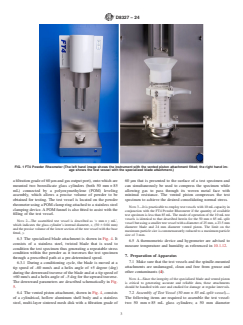
6.1 The FT4 Powder Rheometer is shown in Fig. 1. It is a
kPa. The gas traverses the powder bed and passes through a
computer-controlled instrument that simultaneously measures
vented piston. The powder’s gas permeability is determined by
the torque and force required to mobilize a powder contained
measuring the gas pressure differential across the powder bed
in a range of vessel types. This allows for the quantification of
at different consolidating stress levels or superficial gas
powder characteristics such as dynamic flow properties, in-
velocities, or both.
cluding aeration behavior, shear, wall friction, permeability and
compressibility properties of test specimens, using a series of
5. Significance and Use
spindle-mounted attachments driven by an electric motor
5.1 The test method can be used to evaluate the following:
located on a carriage, driven by another electric motor, which
5.1.1 Classification or Comparison of Powders—Both the
moves the attachments in the vertical direction.
measured PD and calculated gas permeability can be used to
q 6.1.1 The force is measured by a force transducer located
classify powders relative to each other.
beneath and fixed to the table that supports the test vessel
5.1.2 Sensitivity Analysis—The test can be used to evaluate
during the measurement process.
the relative effects of a range of powder properties or environ-
6.1.2 The torque (shear resistance) is evaluated by measur-
mental parameters, or both, such as (but not limited to)
ing the moment on the attachment using a torque transducer.
humidity, particle size and size distribution, particle shape and
Both torque and force are measured with respect to the axial
shape distribution, moisture content and temperature.
position of the blade within the test vessel.
5.1.3 Quality Control—The test can be used to assess the
6.1.3 The vertical position of the carriage is measured by a
PD and gas permeability of a feedstock, intermediate or
q linear potentiometer.
product against pre-determined acceptance criteria.
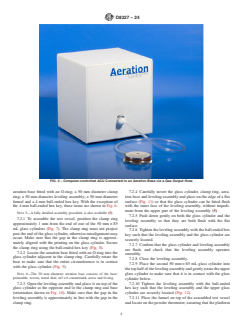
6.1.4 A dry, compressed gas supply is moderated using a
5.1.4 Process Design and Operation—The determined pa-
computer-controlled ACU (Fig. 2), which also monitors the
rameters can be used to quantify powder behavior in numerous
delivery pressure of the supply. The gas flow rate is controlled
processing environments. The ability of a powder to discharge
using mass flow controllers and the pressure is measured using
consistently from a storage vessel, through pipes or down
a pressure transducer.
chutes is primarily dependent on its flow properties, interaction
6.2 The test vessel (50 mm × 85 mL split vessel) is shown in
with the material of construction and the geometry of the
Fig. 3. It consists of a stainless steel aeration base (with a
equipment (1 and 2) . However, design methodologies assume
stainless steel, permeable, multi-layer sintered mesh disk with
that there is a gas interchange between the top and bottom of
the stored powder that allows consistent flow through the
outlet. Gas permeability is a controlling factor in discharge 4
The sole source of supply of the apparatus known to the committee at this time
rates (1 and 2). Powders with low gas permeability may is Freeman Technology Ltd, 1 Miller Court, Severn Drive, Tewkesbury,
Gloucestershire, GL20 8DN, United Kingdom. If you are aware of alternative
suppliers, please provide this information to ASTM International Headquarters.
The boldface numbers in parentheses refer to a list of references at the end of Your comments will receive careful consideration at a meeting of the responsible
this standard. technical committee, which you may attend.
D8327 − 24
FIG. 1 FT4 Powder Rheometer (The left hand image shows the instrument with the vented piston attachment fitted; the right hand im-
age shows the test vessel with the specialized blade attachment.)
a filtration grade of 60 μm and gas output port), onto which are 60 μm that is presented to the surface of a test specimen and
mounted two borosilicate glass cylinders (both 50 mm × 85 can simultaneously be used to compress the specimen while
mL) connected by a polyoxymethylene (POM) leveling allowing gas to pass through its woven metal face with
assembly, which allows a precise volume of powder to be minimal resistance. The vented piston compresses the test
obtained for testing. The test vessel is located on the powder specimen to achieve the desired consolidating normal stress.
rheometer using a POM clamp ring attached to a stainless steel
NOTE 3—It is practicable to employ test vessels with 10 mL capacity in
clamping device. A POM funnel is also fitted to assist with the
conjunction with the FT4 Powder Rheometer if the quantity of available
filling of the test vessel.
test specimen is less than 85 mL. The mode of operation of the 10 mL test
vessels is identical to that described herein for the 50 mm × 85 mL split
NOTE 2—The assembled test vessel is described as ‘x mm × y mL’,
vessel but using a smaller test vessel with a diameter of 25 mm, a 23.5 mm
which indicates the glass cylinder’s internal diameter, x, (50 6 0.04 mm)
diameter blade and 24 mm diameter vented piston. The limit on the
and the precise volume of the lower section of the test vessel with the base
maximum particle size is commensurately reduced to a maximum particle
fitted, y.
size of 3 mm.
6.3 The specialized blade attachment is shown in Fig. 4. It
6.5 A thermometric device and hygrometer are advised to
consists of a stainless steel, twisted blade that is used to
measure temperature and humidity as referenced in 10.1.12.
condition the test specimen thus generating a repeatable stress
condition within the powder as it traverses the test specimen
7. Preparation of Apparatus
through a prescribed path at a pre-determined speed.
7.1 Make sure that the test vessels and the spindle-mounted
6.3.1 During a conditioning cycle, the blade is moved at a
attachments are undamaged, clean and free from grease and
tip speed of –60 mm/s and a helix angle of +5 degree (deg)
other contaminants (4).
during the downward traverse of the blade and at a tip speed of
+60 mm/s and a helix angle of –5 deg for the upward traverse.
NOTE 4—Since the integrity of the specialized blade and vented piston
The downward parameters are described schematically in Fig.
is critical to generating accurate and reliable data, these attachments
5. should be handled with care and studied for damage at regular intervals.
6.4 The vented piston attachment, shown in Fig. 4, consists 7.2 Assembly of Test Vessel (50 mm × 85 mL split vessel)—
of a cylindrical, hollow aluminum shell body and a stainless The following items are required to assemble the test vessel:
steel, multi-layer sintered mesh disk with a filtration grade of two 50 mm × 85 mL glass cylinders; a 50 mm diameter
D8327 − 24
FIG. 2 – Computer-controlled ACU Connected to an Aeration Base via a Gas Output Hose
aeration base fitted with an O-ring; a 50 mm diameter clamp 7.2.4 Carefully invert the glass cylinder, clamp ring, aera-
ring; a 50 mm diameter leveling assembly; a 50 mm diameter tion base and leveling assembly and place on the edge of a flat
funnel and a 4 mm ball-ended hex key. With the exception of surface (Fig. 11) so that the glass cylinder can be fitted flush
the 4 mm ball-ended hex key, these items are shown in Fig. 6. with the inner face of the leveling assembly, without impedi-
ment from the upper part of the leveling assembly (5).
NOTE 5—A fully detailed assembly procedure is also available (5).
7.2.5 Push down gently on both the glass cylinder and the
7.2.1 To assemble the test vessel, position the clamp ring
leveling assembly so that they are both flush with the flat
approximately 1 mm from the end of one of the 50 mm × 85
surface.
mL glass cylinders (Fig. 7). The clamp ring must not pr
...