

ASTM D8567-24
(Test Method)Standard Test Method for Analysis of Engine Coolant for Organic Additives by High Performance Liquid Chromatograph
General Information
- Abstract
SIGNIFICANCE AND USE
4.1 This test method provides for the qualitative and quantitative determination of common organic additives in engine coolant in milligrams per liter and only requires a few milliliters of sample per test, with results typically available in 12 min.
SCOPE
1.1 This test method covers the chemical analysis of engine coolant for azoles and organic acids by high performance liquid chromatography (HPLC).
1.2 This test method is applicable to both new and used engine coolant.
1.3 Analysis can be performed directly by this test method without pretreatment other than dilution and filtration, as required by the calibration ranges of the equipment.
1.4 The values stated in SI units are to be regarded as standard. No other units of measurement are included in this standard.
1.5 This standard does not purport to address all of the safety concerns, if any, associated with its use. It is the responsibility of the user of this standard to establish appropriate safety, health, and environmental practices and determine the applicability of regulatory limitations prior to use.
1.6 This international standard was developed in accordance with internationally recognized principles on standardization established in the Decision on Principles for the Development of International Standards, Guides and Recommendations issued by the World Trade Organization Technical Barriers to Trade (TBT) Committee.
- Status
- Published
- Publication Date
- 31-Mar-2024
- Technical Committee
- D15 - Engine Coolants and Related Fluids
- Drafting Committee
- D15.21 - Extended Life Coolants
Overview
ASTM D8567-24 is the international standard test method for the analysis of organic additives in engine coolant using High Performance Liquid Chromatography (HPLC). Developed by ASTM International, this method enables both qualitative and quantitative determination of key organic compounds-such as azoles and organic acids-in engine coolants. It is applicable to both new and used fluids, offering efficient performance by providing results in approximately 12 minutes with only a few milliliters of sample required. The standard supports laboratory quality control and maintenance of coolant formulation, helping address industry requirements for precise coolant additive measurement.
Key Topics
- Scope and Applicability: ASTM D8567-24 details the chemical analysis of engine coolants for carboxylate, triazole, and thiazole-based additives. Suitable for both fresh and in-service coolants, the method requires minimal sample preparation-typically just dilution and filtration.
- Test Method: The process involves preparing the engine coolant sample, running it through HPLC, and determining additive concentrations in milligrams per liter. The standard prescribes using gradient HPLC methods for optimal additive separation and identification.
- Sample and Reagent Handling: Proper procedures for collecting, handling, and preparing samples are included to minimize contamination and analytical interference. The standard emphasizes the use of high-purity reagents and careful sample handling, including the recommendation to use latex or nitrile gloves.
- Calibration and Validation: Laboratories must verify calibration curves and analytical blanks daily. The standard specifies a minimum requirement for calibration curve correlation (R² > 0.995) and instructs users to use multi-level standards for reliable quantitation.
- Precision and Safety: Guidance on the correct calibration ranges, sampling protocols, and safety practices (including the use of personal protective equipment and fume hoods) are outlined, though precision and bias statements await completion of interlaboratory studies.
Applications
The ASTM D8567-24 standard is widely used in several automotive and industrial sectors:
- Engine Coolant Manufacturing: Quality control of product formulations by measuring the concentration of vital organic additives, ensuring the correct balance for optimal corrosion inhibition and thermal performance.
- Maintenance and In-Service Testing: Analysis of used engine coolant to monitor additive depletion and inform decisions about fluid replacement or system maintenance.
- Research and Development: Evaluation of new coolant chemistries and additive packages for performance benchmarking and regulatory compliance.
- Fleet and Equipment Management: Supports proactive maintenance strategies by enabling regular assessment of coolant health in heavy-duty vehicles, off-road machinery, and stationary engines.
By using robust HPLC methods, laboratories can accurately measure additives such as benzoic acid, benzotriazole, tolyltriazole, and a range of organic acids, supporting regulatory, safety, and performance targets in engine coolant management.
Related Standards
- ASTM D1176 - Practice for Sampling and Preparing Aqueous Solutions of Engine Coolants or Antirusts for Testing Purposes
- ASTM D1193 - Specification for Reagent Water
These referenced ASTM standards provide essential guidance for sample collection and quality of reagents, which directly impact the effectiveness and reliability of the HPLC analysis as outlined in ASTM D8567-24.
Keywords: ASTM D8567-24, engine coolant, high performance liquid chromatography, HPLC analysis, organic additives, azoles, organic acids, coolant testing, automotive standards, quality control, corrosion inhibitors, additive quantification.
Frequently Asked Questions
ASTM D8567-24 is a standard published by ASTM International. Its full title is "Standard Test Method for Analysis of Engine Coolant for Organic Additives by High Performance Liquid Chromatograph". This standard covers: SIGNIFICANCE AND USE 4.1 This test method provides for the qualitative and quantitative determination of common organic additives in engine coolant in milligrams per liter and only requires a few milliliters of sample per test, with results typically available in 12 min. SCOPE 1.1 This test method covers the chemical analysis of engine coolant for azoles and organic acids by high performance liquid chromatography (HPLC). 1.2 This test method is applicable to both new and used engine coolant. 1.3 Analysis can be performed directly by this test method without pretreatment other than dilution and filtration, as required by the calibration ranges of the equipment. 1.4 The values stated in SI units are to be regarded as standard. No other units of measurement are included in this standard. 1.5 This standard does not purport to address all of the safety concerns, if any, associated with its use. It is the responsibility of the user of this standard to establish appropriate safety, health, and environmental practices and determine the applicability of regulatory limitations prior to use. 1.6 This international standard was developed in accordance with internationally recognized principles on standardization established in the Decision on Principles for the Development of International Standards, Guides and Recommendations issued by the World Trade Organization Technical Barriers to Trade (TBT) Committee.
SIGNIFICANCE AND USE 4.1 This test method provides for the qualitative and quantitative determination of common organic additives in engine coolant in milligrams per liter and only requires a few milliliters of sample per test, with results typically available in 12 min. SCOPE 1.1 This test method covers the chemical analysis of engine coolant for azoles and organic acids by high performance liquid chromatography (HPLC). 1.2 This test method is applicable to both new and used engine coolant. 1.3 Analysis can be performed directly by this test method without pretreatment other than dilution and filtration, as required by the calibration ranges of the equipment. 1.4 The values stated in SI units are to be regarded as standard. No other units of measurement are included in this standard. 1.5 This standard does not purport to address all of the safety concerns, if any, associated with its use. It is the responsibility of the user of this standard to establish appropriate safety, health, and environmental practices and determine the applicability of regulatory limitations prior to use. 1.6 This international standard was developed in accordance with internationally recognized principles on standardization established in the Decision on Principles for the Development of International Standards, Guides and Recommendations issued by the World Trade Organization Technical Barriers to Trade (TBT) Committee.
ASTM D8567-24 is available in PDF format for immediate download after purchase. The document can be added to your cart and obtained through the secure checkout process. Digital delivery ensures instant access to the complete standard document.
Standards Content (Sample)
This international standard was developed in accordance with internationally recognized principles on standardization established in the Decision on Principles for the
Development of International Standards, Guides and Recommendations issued by the World Trade Organization Technical Barriers to Trade (TBT) Committee.
Designation: D8567 − 24
Standard Test Method for
Analysis of Engine Coolant for Organic Additives by High
Performance Liquid Chromatograph
This standard is issued under the fixed designation D8567; the number immediately following the designation indicates the year of
original adoption or, in the case of revision, the year of last revision. A number in parentheses indicates the year of last reapproval. A
superscript epsilon (´) indicates an editorial change since the last revision or reapproval.
1. Scope then run through the instrument. The outcome will yield the
concentration of organic-based coolant additives, specifically
1.1 This test method covers the chemical analysis of engine
carboxylate-, triazole-, and thiazole-based additives.
coolant for azoles and organic acids by high performance
liquid chromatography (HPLC).
4. Significance and Use
1.2 This test method is applicable to both new and used
4.1 This test method provides for the qualitative and quan-
engine coolant.
titative determination of common organic additives in engine
1.3 Analysis can be performed directly by this test method
coolant in milligrams per liter and only requires a few
without pretreatment other than dilution and filtration, as
milliliters of sample per test, with results typically available in
required by the calibration ranges of the equipment.
12 min.
1.4 The values stated in SI units are to be regarded as
5. Interferences
standard. No other units of measurement are included in this
standard.
5.1 The example methods have been vetted to provide the
least number of interferences.
1.5 This standard does not purport to address all of the
safety concerns, if any, associated with its use. It is the
5.2 Method interferences can be caused by contamination of
responsibility of the user of this standard to establish appro-
glassware, eluent, reagents, etc. Care must be taken to ensure
priate safety, health, and environmental practices and deter-
that contamination is kept at the lowest possible level.
mine the applicability of regulatory limitations prior to use.
5.3 Interferences will have to be determined by each system.
1.6 This international standard was developed in accor-
NOTE 1—The use of latex or nitrile gloves is highly recommended to
dance with internationally recognized principles on standard-
prevent contamination during sample and eluent preparation.
ization established in the Decision on Principles for the
Development of International Standards, Guides and Recom-
6. Apparatus
mendations issued by the World Trade Organization Technical
6.1 Analytical Balance, capable of weighing accurately to
Barriers to Trade (TBT) Committee.
0.0001 g.
2. Referenced Documents
6.2 Ultrasonic Bath.
2.1 ASTM Standards:
6.3 High Performance Liquid Chromatograph.
D1176 Practice for Sampling and Preparing Aqueous Solu-
tions of Engine Coolants or Antirusts for Testing Purposes 6.4 Gradient Pump.
D1193 Specification for Reagent Water
6.5 Appropriate Analytical HPLC Column.
3. Summary of Test Method
6.6 Column Heater (Optional).
3.1 A sample of engine coolant is prepared by dilution with
6.7 Ultraviolet Detector.
water. This diluted sample is placed into a sample vial which is
6.8 Optional Light Scattering Detector.
6.9 Integrator or Chromatography Data System Software.
This test method is under the jurisdiction of ASTM Committee D15 on Engine
Coolants and Related Fluids and is the direct responsibility of Subcommittee
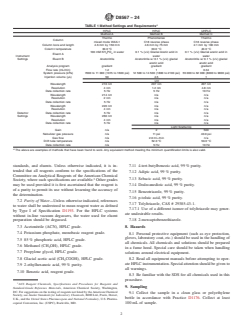
6.10 Table 1 shows some of the specification needs for the
D15.21 on Extended Life Coolants.
example methods.
Current edition approved April 1, 2024. Published May 2024. DOI: 10.1520/
D8567-24.
For referenced ASTM standards, visit the ASTM website, www.astm.org, or 7. Reagents
contact ASTM Customer Service at service@astm.org. For Annual Book of ASTM
7.1 Purity of Reagents—Reagent grade or higher purity
Standards volume information, refer to the standard’s Document Summary page on
the ASTM website. chemicals should be used for the preparation of all samples,
Copyright © ASTM International, 100 Barr Harbor Drive, PO Box C700, West Conshohocken, PA 19428-2959. United States
D8567 − 24
A
TABLE 1 Method Settings and Requirements
HPLC HPLC UHPLC
Method A Method B Method C
Thermo Phenomenex Thermo
Column
mixed mode WAX-1 C18 reverse phase C18 reverse phase
Column bore and length 4.6 mm by 150 mm 4.6 mm by 75 mm 2.1 mm by 100 mm
Column temperature 30.0 °C 30.0 °C 40.0 °C
100 mM KH PO in water 0.1 % (v/v) Glacial Acetic acid in 0.1 % (v/v) Glacial acetic acid in
2 4
Eluent A
Instrument water water
Settings Eluent B Acetonitrile Acetonitrile w/ 0.1 % (v/v) glacial Acetonitrile w/ 0.1 % (v/v) glacial
acetic acid acetic acid
Analysis program gradient gradient gradient
Flow rate (mL/min) 1.2 1 0.34
System pressure (kPa) 7000 to 11 000 (1015 to 1600 psi) 12 500 to 14 500 (1800 to 2100 psi) 55 000 to 62 000 (8000 to 9000 psi)
Injection volume (μL) 50 4.5 1
UV
Wavelength 210 nm 207 nm 207 nm
Resolution 4 nm 1.2 nm 4.8 nm
Data collection rate 5 Hz 5 Hz 10 Hz
Wavelength 214 nm n/a n/a
Resolution 2 nm n/a n/a
Data collection rate 5 Hz n/a n/a
Wavelength 220 nm n/a n/a
Resolution 4 nm n/a n/a
Detector Data collection rate 5 Hz n/a n/a
Settings
Wavelength 260 nm n/a n/a
Resolution 4 nm n/a n/a
Data collection rate 5 Hz n/a n/a
Light Scattering
Gain n/a 2 500
Nebulizer gas pressure n/a 11 psi 40.0 psi
Gas flow n/a 2.0 mL ⁄min n/a
Drift tube temperature n/a 52.0 °C 50.0 °C
Data collection rate n/a 5 Hz 10 Hz
A
The above are examples of methods that have been found to work. Any equivalent method meeting the minimum quantification limits is also valid.
standards, and eluents. Unless otherwise indicated, it is in- 7.11 4-tert-butylbenzoic acid, 99 % purity.
tended that all reagents conform to the specifications of the
7.12 Adipic acid, 99 % purity.
Committee on Analytical Reagents of the American Chemical
3 7.13 Sebacic acid, 99 % purity.
Society, where such specifications are available. Other grades
may be used provided it is first ascertained that the reagent is 7.14 Dodecanedioic acid, 99 % purity.
of a purity to permit its use without lessening the accuracy of
7.15 Benzotriazole, 99 % purity.
the determination.
7.16 p-toluic acid, 99 % purity.
7.2 Purity of Water—Unless otherwise indicated, references
7.17 Tolyltriazole, CAS # 29385-43-1.
to water shall be understood to mean reagent water as defined
7.17.1 Use of a different isomer of tolyltriazole may gener-
by Type I of Specification D1193. For the HPLC systems
ate undesirable results.
without in-line vacuum degassers, the water used for eluent
7.18 2-mercaptobenzothiazole.
preparation should be degassed.
7.3 Acetonitrile (ACN), HPLC grade.
8. Hazards
7.4 Potassium phosphate, monobasic reagent grade.
8.1 Personal protective equipment (such as eye protection,
gloves, laboratory coat, etc.) should be used in the handling of
7.5 85 % phosphoric acid, HPLC grade.
all chemicals. All chemicals and solutions should be prepared
7.6 Methanol (CH OH), HPLC grade.
in a fume hood. Special care should be taken when handling
7.7 Propylene glycol, HPLC grade.
solutions around electrical equipment.
7.8 Glacial acetic acid (CH COOH), HPLC grade.
8.2 Read all equipment manuals before attempting to oper-
ate HPLC instrumentation. Special attention should be given to
7.9 2-ethylhexanoic acid, 99 % purity.
all warnings.
7.10 Benzoic acid, reagent grade.
8.3 Be familiar with the SDS for all chemicals used in this
procedure.
ACS Reagent Chemicals, Specifications and Procedures for Reagents and
9. Sampling
Standard-Grade Reference Materials, American Chemical Society, Washington,
DC. For suggestions on the testing of reagents not listed by the American Chemical
9.1 Collect the sample in a clean glass or polyethylene
Society, see Analar Standards for Laboratory Chemicals, BDH Ltd., Poole, Dorset,
bottle in accordance with Practice D1176. Collect at least
U.K., and the United States Pharmacopeia and National Formulary, U.S. Pharma-
copeial Convention, Inc. (USPC), Rockville, MD. 100 mL of sample.
D8567 − 24
TABLE 2 Minimun Values of Quantification
A
Analyte (listed in relative retention Minimum Limit of Quantitation (mg/L)
time)
Adipic acid 125
...