

ASTM F1085-19
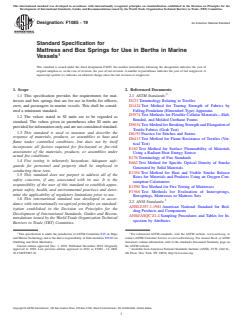
(Specification)Standard Specification for Mattress and Box Springs for Use in Berths in Marine Vessels
General Information
- Abstract
ABSTRACT
This specification provides the requirements for mattresses and box springs that are for use in berths for officers, crew, and passengers in marine vessels. This shall be considered a minimum standard. Tearing strength, breaking strength, elongation, and flame resistance of the material shall be tested to meet the requirements prescribed.
SCOPE
1.1 This specification provides the requirements for mattresses and box springs that are for use in berths for officers, crew, and passengers in marine vessels. This shall be considered a minimum standard.
1.2 The values stated in SI units are to be regarded as standard. The values given in parentheses after SI units are provided for information only and are not considered standard.
1.3 This standard is used to measure and describe the response of materials, products, or assemblies to heat and flame under controlled conditions, but does not by itself incorporate all factors required for fire-hazard or fire-risk assessment of the materials, products, or assemblies under actual fire conditions.
1.4 Fire testing is inherently hazardous. Adequate safeguards for personnel and property shall be employed in conducting these tests.
1.5 This standard does not purport to address all of the safety concerns, if any, associated with its use. It is the responsibility of the user of this standard to establish appropriate safety, health, and environmental practices and determine the applicability of regulatory limitations prior to use.
1.6 This international standard was developed in accordance with internationally recognized principles on standardization established in the Decision on Principles for the Development of International Standards, Guides and Recommendations issued by the World Trade Organization Technical Barriers to Trade (TBT) Committee.
- Status
- Published
- Publication Date
- 30-Nov-2019
- Technical Committee
- F25 - Ships and Marine Technology
- Drafting Committee
- F25.03 - Outfitting and Deck Machinery
Buy Documents
ASTM F1085-19 - Standard Specification for Mattress and Box Springs for Use in Berths in Marine Vessels
REDLINE ASTM F1085-19 - Standard Specification for Mattress and Box Springs for Use in Berths in Marine Vessels
Overview
ASTM F1085-19: Standard Specification for Mattress and Box Springs for Use in Berths in Marine Vessels is developed by ASTM International to define the minimum requirements for mattresses and box springs installed in berths for officers, crew, and passengers aboard marine vessels. This specification is crucial for marine safety, focusing on mechanical strength, durability, and flame resistance to ensure protection, comfort, and long service life in harsh marine environments. The standard applies to both innerspring and solid core mattresses, as well as box springs, and details performance, fire resistance, and construction criteria.
Key Topics
Material Requirements:
- Ensures use of durable ticking, cushioning, insulator pads, and resilient mattress cores.
- Clearly specifies that all materials must meet minimum mechanical (tear and breaking strength) and fire performance criteria.
- Materials must comply with commercial bedding industry best practices.
Fire Resistance:
- Sets mandatory flame resistance requirements for all components following test methods (such as ASTM D6413, ASTM E162, ASTM E662, and ASTM E1590).
- Requirements include maximum char length, after-flame duration, absence of flaming droplets, and limits on heat and smoke release.
Physical Properties:
- Enforces minimum tear strength and breaking strength for ticking and border materials.
- Specifies performance under cycles of use, permanent deformation, and support firmness.
Construction & Workmanship:
- Mandates continuous and secure stitching for all seams.
- Requires materials and finishes to meet commercial marine bedding standards.
- Ensures that construction is suitable for both comfort and safety in a marine setting.
Inspection and Labeling:
- Each product must be inspected for defects in materials and workmanship.
- Items must be labeled confirming conformity with ASTM F1085-19 or recognized equivalents.
Applications
ASTM F1085-19 is widely referenced and used in various marine environments, serving as a benchmark for:
- Naval Vessels: Ensures berthing mattresses and box springs meet U.S. Navy requirements for fire performance and durability, particularly for safety-critical spaces.
- Merchant Ships and Passenger Vessels: Protects passengers and crew by mandating fire-resistant, robust sleeping surfaces in berths.
- Commercial Marine Outfitting: Offers guidance for suppliers and manufacturers designing, procuring, or certifying marine bedding.
- Regulatory Compliance: Supports compliance with national and international fire safety codes and marine outfitting standards.
- Custom Marine Interiors: Provides design flexibility within a framework of robust safety and performance requirements for shipbuilders, outfitting contractors, and vessel owners.
Related Standards
ASTM F1085-19 references and aligns with several related standards to support comprehensive compliance:
- ASTM D6413: Standard Test Method for Flame Resistance of Textiles (Vertical Test)
- ASTM E1590: Standard Test Method for Fire Testing of Mattresses
- ASTM F1566: Test Methods for Evaluation of Innersprings, Boxsprings, Mattresses or Mattress Sets
- CA Technical Bulletin 129 (CA TB 129): Flammability Test Procedure for Mattresses for Use in Public Buildings
- NFPA 301: Code for Safety to Life from Fire on Merchant Vessels
- ANSI Z357.1-1981: American National Standard for Bedding Products and Components
- 16 CFR 1632: Standard for the Flammability of Mattresses and Mattress Pads
Practical Value
By adhering to ASTM F1085-19, manufacturers, shipbuilders, and regulatory bodies ensure that all mattresses and box springs installed on marine vessels:
- Meet minimum safety and flammability requirements, reducing risks in fire emergencies.
- Provide durable and reliable sleep surfaces for personnel and passengers.
- Align with international trade and marine outfitting practices, supporting both safety and commercial needs.
- Facilitate standardized procurement, inspection, and maintenance processes.
Keywords: marine berth mattress, marine vessel bedding, flame resistance, marine safety, ASTM mattress standard, shipboard box springs, naval vessel bedding, marine interior outfitting.
Relations
- Effective Date
- 01-Dec-2019
- Effective Date
- 01-Jan-2024
- Effective Date
- 01-Jul-2020
- Effective Date
- 15-Dec-2018
- Effective Date
- 01-Dec-2018
- Effective Date
- 01-Mar-2018
- Effective Date
- 01-Jul-2017
- Effective Date
- 01-Mar-2017
- Effective Date
- 01-Mar-2017
- Effective Date
- 01-Feb-2017
- Effective Date
- 15-Nov-2016
- Effective Date
- 01-Nov-2016
- Effective Date
- 01-May-2016
- Effective Date
- 01-Feb-2016
- Effective Date
- 01-Jan-2016
Buy Documents
ASTM F1085-19 - Standard Specification for Mattress and Box Springs for Use in Berths in Marine Vessels
REDLINE ASTM F1085-19 - Standard Specification for Mattress and Box Springs for Use in Berths in Marine Vessels
Get Certified
Connect with accredited certification bodies for this standard

DNV
DNV is an independent assurance and risk management provider.

Lloyd's Register
Lloyd's Register is a global professional services organisation specialising in engineering and technology.

FSC International
Forest Stewardship Council certification.
Sponsored listings
Frequently Asked Questions
ASTM F1085-19 is a technical specification published by ASTM International. Its full title is "Standard Specification for Mattress and Box Springs for Use in Berths in Marine Vessels". This standard covers: ABSTRACT This specification provides the requirements for mattresses and box springs that are for use in berths for officers, crew, and passengers in marine vessels. This shall be considered a minimum standard. Tearing strength, breaking strength, elongation, and flame resistance of the material shall be tested to meet the requirements prescribed. SCOPE 1.1 This specification provides the requirements for mattresses and box springs that are for use in berths for officers, crew, and passengers in marine vessels. This shall be considered a minimum standard. 1.2 The values stated in SI units are to be regarded as standard. The values given in parentheses after SI units are provided for information only and are not considered standard. 1.3 This standard is used to measure and describe the response of materials, products, or assemblies to heat and flame under controlled conditions, but does not by itself incorporate all factors required for fire-hazard or fire-risk assessment of the materials, products, or assemblies under actual fire conditions. 1.4 Fire testing is inherently hazardous. Adequate safeguards for personnel and property shall be employed in conducting these tests. 1.5 This standard does not purport to address all of the safety concerns, if any, associated with its use. It is the responsibility of the user of this standard to establish appropriate safety, health, and environmental practices and determine the applicability of regulatory limitations prior to use. 1.6 This international standard was developed in accordance with internationally recognized principles on standardization established in the Decision on Principles for the Development of International Standards, Guides and Recommendations issued by the World Trade Organization Technical Barriers to Trade (TBT) Committee.
ABSTRACT This specification provides the requirements for mattresses and box springs that are for use in berths for officers, crew, and passengers in marine vessels. This shall be considered a minimum standard. Tearing strength, breaking strength, elongation, and flame resistance of the material shall be tested to meet the requirements prescribed. SCOPE 1.1 This specification provides the requirements for mattresses and box springs that are for use in berths for officers, crew, and passengers in marine vessels. This shall be considered a minimum standard. 1.2 The values stated in SI units are to be regarded as standard. The values given in parentheses after SI units are provided for information only and are not considered standard. 1.3 This standard is used to measure and describe the response of materials, products, or assemblies to heat and flame under controlled conditions, but does not by itself incorporate all factors required for fire-hazard or fire-risk assessment of the materials, products, or assemblies under actual fire conditions. 1.4 Fire testing is inherently hazardous. Adequate safeguards for personnel and property shall be employed in conducting these tests. 1.5 This standard does not purport to address all of the safety concerns, if any, associated with its use. It is the responsibility of the user of this standard to establish appropriate safety, health, and environmental practices and determine the applicability of regulatory limitations prior to use. 1.6 This international standard was developed in accordance with internationally recognized principles on standardization established in the Decision on Principles for the Development of International Standards, Guides and Recommendations issued by the World Trade Organization Technical Barriers to Trade (TBT) Committee.
ASTM F1085-19 is classified under the following ICS (International Classification for Standards) categories: 47.020.80 - Accommodation spaces. The ICS classification helps identify the subject area and facilitates finding related standards.
ASTM F1085-19 has the following relationships with other standards: It is inter standard links to ASTM F1085-14, ASTM E176-24, ASTM D6193-16(2020), ASTM E176-18a, ASTM E662-18, ASTM E176-18, ASTM E662-17a, ASTM D123-17, ASTM D3574-17, ASTM E662-17, ASTM E1590-16, ASTM D3574-16, ASTM E1354-16a, ASTM E1354-16, ASTM D6193-16. Understanding these relationships helps ensure you are using the most current and applicable version of the standard.
ASTM F1085-19 is available in PDF format for immediate download after purchase. The document can be added to your cart and obtained through the secure checkout process. Digital delivery ensures instant access to the complete standard document.
Standards Content (Sample)
This international standard was developed in accordance with internationally recognized principles on standardization established in the Decision on Principles for the
Development of International Standards, Guides and Recommendations issued by the World Trade Organization Technical Barriers to Trade (TBT) Committee.
Designation:F1085 −19 An American National Standard
Standard Specification for
Mattress and Box Springs for Use in Berths in Marine
Vessels
This standard is issued under the fixed designation F1085; the number immediately following the designation indicates the year of
original adoption or, in the case of revision, the year of last revision. A number in parentheses indicates the year of last reapproval. A
superscript epsilon (´) indicates an editorial change since the last revision or reapproval.
1. Scope 2. Referenced Documents
1.1 This specification provides the requirements for mat- 2.1 ASTM Standards:
tresses and box springs that are for use in berths for officers, D123 Terminology Relating to Textiles
crew, and passengers in marine vessels. This shall be consid- D1424 Test Method for Tearing Strength of Fabrics by
ered a minimum standard. Falling-Pendulum (Elmendorf-Type) Apparatus
D3574 Test Methods for Flexible Cellular Materials—Slab,
1.2 The values stated in SI units are to be regarded as
Bonded, and Molded Urethane Foams
standard. The values given in parentheses after SI units are
D5034 TestMethodforBreakingStrengthandElongationof
provided for information only and are not considered standard.
Textile Fabrics (Grab Test)
1.3 This standard is used to measure and describe the
D6193 Practice for Stitches and Seams
response of materials, products, or assemblies to heat and
D6413 Test Method for Flame Resistance of Textiles (Ver-
flame under controlled conditions, but does not by itself
tical Test)
incorporate all factors required for fire-hazard or fire-risk
E162 Test Method for Surface Flammability of Materials
assessment of the materials, products, or assemblies under
Using a Radiant Heat Energy Source
actual fire conditions.
E176 Terminology of Fire Standards
1.4 Fire testing is inherently hazardous. Adequate safe-
E662 Test Method for Specific Optical Density of Smoke
guards for personnel and property shall be employed in
Generated by Solid Materials
conducting these tests.
E1354 Test Method for Heat and Visible Smoke Release
1.5 This standard does not purport to address all of the
Rates for Materials and Products Using an Oxygen Con-
safety concerns, if any, associated with its use. It is the
sumption Calorimeter
responsibility of the user of this standard to establish appro-
E1590 Test Method for Fire Testing of Mattresses
priate safety, health, and environmental practices and deter-
F1566 Test Methods for Evaluation of Innersprings,
mine the applicability of regulatory limitations prior to use.
Boxsprings, Mattresses or Mattress Sets
1.6 This international standard was developed in accor-
2.2 ANSI Standards:
dance with internationally recognized principles on standard-
ANSI Z357.1-1981 American National Standard for Bed-
ization established in the Decision on Principles for the
ding Products and Components
Development of International Standards, Guides and Recom-
ANSI/ASQC Z1.4 Sampling Procedures and Tables for In-
mendations issued by the World Trade Organization Technical
spection by Attributes
Barriers to Trade (TBT) Committee.
1 2
This specification is under the jurisdiction of ASTM Committee F25 on Ships For referenced ASTM standards, visit the ASTM website, www.astm.org, or
and Marine Technology and is the direct responsibility of Subcommittee F25.03 on contact ASTM Customer Service at service@astm.org. For Annual Book of ASTM
Outfitting and Deck Machinery. Standards volume information, refer to the standard’s Document Summary page on
Current edition approved Dec. 1, 2019. Published December 2019. Originally the ASTM website.
approved in 1988. Last previous edition approved in 2014 as F1085 – 14. DOI: Available fromAmerican National Standards Institute (ANSI), 25 W. 43rd St.,
10.1520/F1085-19. 4th Floor, New York, NY 10036, http://www.ansi.org.
Copyright © ASTM International, 100 Barr Harbor Drive, PO Box C700, West Conshohocken, PA 19428-2959. United States
F1085−19
2.3 California Bureau of Home Furnishings and Thermal 3.2.9 mattress core, n—themainsupportsystemthatmaybe
Insulation Standard: present in a mattress, such as springs, foam, or resilient filling.
CATechnical Bulletin 129 (CATB 129), Flammability Test
3.2.10 mattress, innerspring, n—any mattress containing an
Procedure for Mattresses for Use in Public Buildings—
innerspring unit.
October 1992
3.2.11 mattress, solid core, n—any mattress containing
2.4 Federal Standards:
padding, but not an innerspring unit.
Code of Federal Regulations, Title 16, Vol 2, Part 1632
3.2.12 quilted, adj—stitched with any thread or by fusion
Purchase Description—Mattress—Innerspring, Flame-
through the ticking and one or more layers of upholstery
Resistant, Shipboard—NAVSEA 05L PD 4-02 (May
material.
2002)
2.5 NFPA Standard:
3.2.13 tape edge, n—seam or border edge of a mattress.
NFPA 301 Code for Safety to Life from Fire on Merchant
3.2.14 ticking, n—the outermost layer of fabric or related
Vessels
material that encloses the core and upholstery materials of a
mattress or mattress pad.
3. Terminology
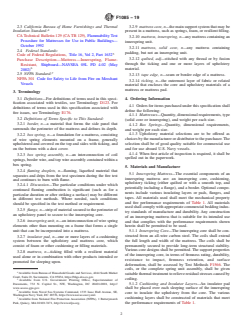
3.1 Definitions—For definitions of terms used in this speci-
4. Ordering Information
fication associated with textiles, see Terminology D123. For
4.1 Orders for items purchased under this specification shall
definitions of terms used in this specification associated with
define the following:
fire issues, see Terminology E176.
4.1.1 Mattresses—Quantity, dimensional requirements, type
3.2 Definitions of Terms Specific to This Standard:
(solid core or innerspring), and weight per each size.
3.2.1 border, n—a material that forms the side panel that
4.1.2 Box Springs—Quantity, dimensional requirements,
surrounds the perimeter of the mattress and defines its depth.
and weight per each size.
4.1.3 Upholstery material selections are to be offered as
3.2.2 box spring, n—a foundation for a mattress, consisting
choicesbythemanufacturerordistributortothepurchaser.The
of wire spring elements mounted on a frame, generally
selection shall be of good quality suitable for commercial use
upholstered and covered on the top and sides with ticking, and
and for use aboard U.S. Navy vessels.
on the bottom with a dust cover.
4.1.4 When first article of inspection is required, it shall be
3.2.3 box spring assembly, n—an interconnection of coil
spelled out in the paperwork.
springs, border wire, and top wire assembly contained within a
box spring.
5. Materials and Manufacture
3.2.4 flaming droplets, n—flaming, liquefied material that
5.1 Innerspring Mattress—The essential components of an
separates and drips from the test specimen during the fire test
innerspring mattress are: an innerspring core, cushioning,
and continues to burn with flame.
upholstery ticking (either quilted or with a smooth top, and
3.2.4.1 Discussion—The particular conditions under which
potentially including a flange), and a border. Optional compo-
continued flaming combustion is significant (such as for a
nents include various insulating layers or pads, flanges, and
particular duration or after striking a surface) may be different
tapes. All materials used shall meet the mechanical property
in different test methods. Where needed, such conditions
and fire performance requirements of Table 1. All materials
should be specified in the test method or requirement.
used shall comply with appropriate commercial bedding indus-
3.2.5 flange, n—strip of material secured to the perimeter of
try standards of manufacture and durability. Any construction
an upholstery panel to secure to the innerspring core.
of an innerspring mattress that is suitable for its intended use
3.2.6 innerspring unit, n—an interconnection of wire spring
and that complies with the performance requirements shown
elements other than mounting on a frame that forms a single
herein shall be permitted to be used.
unit that can be incorporated into a mattress.
5.1.1 Innerspring Core—The innerspring core shall be con-
structed from an all-wire carbon steel. The coils shall extend
3.2.7 insulator pad, n—one or more layers of a cushioning
the full length and width of the mattress. The coils shall be
system between the upholstery and mattress core, which
permanently secured to provide long-term structural stability.
consist of foam or other cushioning or filling materials.
Various core designs shall be permitted.The support properties
3.2.8 mattress, n—ticking filled with a resilient material
of the innerspring core, in terms of firmness rating, durability,
used alone or in combination with other products intended or
resistance to impact, firmness retention, and surface
promoted for sleeping upon.
deformation, shall be assessed by Test Methods F1566. The
coils, or the complete spring unit assembly, shall be given
Available from Bureau of Household Goods and Services, 4244 South Market
suitablethermaltreatmenttorelieveresidualstressescausedby
Court, Suite D, Sacramento, CA 95834, https://bhgs.dca.ca.gov.
5 coiling.
Available from U.S. Government Printing Office, Superintendent of
5.1.2 Cushioning and Insulator Layers—An insulator pad
Documents, 732 N. Capitol St., NW, Washington, DC 20401-0001, http://
www.access.gpo.gov.
shall be placed over each sleeping surface of the innerspring
Available from Naval Sea Systems Command, 1333 Isaac Hull Avenue, SE,
core to insulate the upholstery from the core. The various
Washington Navy Yard, DC 20376, https://www.navsea.navy.mil.
cushioning layers shall be constructed of materials that meet
Available from National Fire Protection Association (NFPA), 1 Batterymarch
Park, Quincy, MA 02169-7471, http://www.nfpa.org. the performance requirements of Table 1.
F1085−19
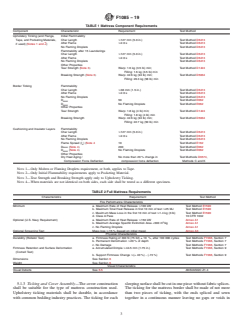
TABLE 1 Mattress Component Requirements
Component Characteristic Requirement Test Method
Upholstery Ticking (and Flange, Initial Flammability
Tape, and Pocketing Materials, Char Length #127 mm (5.0 in.) Test Method D6413
After Flame #2.0 s Test Method D6413
if used) (Notes 1 and2)
No Flaming Droplets Test Method D6413
Flammability after 15 Launderings
Char Length #127 mm (5.0 in.) Test Method D6413
After Flame #2.0 s Test Method D6413
No Flaming Droplets Test Method D6413
Other Properties
Tear Strength (Note 3) Warp: 1.6 kg (3.5 lb) min; Test Method D1424
Filling: 1.6 kg (3.5 lb) min
Breaking Strength (Note 3) Warp: 42.6 kg (94 lb) min; Test Method D5034
Filling: 26.3 kg (58 lb) min
Border Ticking Flammability
Char Length #38 mm (1.5 in.) Test Method D6413
After Flame #2.0 s Test Method D6413
No Flaming Droplets Test Method D6413
D 50 Test Method E662
MAX
D No Flaming Droplets Test Method E662
MAX
Other Properties
Tear Strength Warp: 1.8 kg (4 lb) min; Test Method D1424
Filling: 1.8 kg (4 lb) min
Breaking Strength Warp: 42.6 kg (94 lb) min; Test Method D5034
Filling: 22.7 kg (50 lb) min
Cushioning and Insulator Layers Flammability
Char Length #127 mm (5.0 in.) Test Method D6413
After Flame #2.0 s Test Method D6413
No Flaming Droplets Test Method D6413
Flame Spread (I)(Note 4 10 Test Method E162
s
D (Note 4) 200 Test Method E662
MAX
D (Note 4) No Flaming Droplets Test Method E662
MAX
Other Properties
Dry Heat Aging / No more than 20 % change in Test Methods D3574,
Compression Force Deflection compression force deflection Methods C and K
NOTE 1—Only Molten or Flaming Droplets requirement, or both, applies to Tape.
NOTE 2—Only Initial Flammability requirements apply to Pocketing Material.
NOTE 3—Tear Strength and Breaking Strength apply only to Upholstery Ticking.
NOTE 4—When materials are not identical on both sides, each side shall be tested as a different specimen.
TABLE 2 Full Mattress Requirements
Characteristics Requirement Test Method
Fire Performance Characteristics
Minimum a. Maximum Rate of Heat Release#100 kW Test Method E1590
b. Maximum Total Heat Release in first 10 min of test#25 MJ Test Method E1590
c. Maximum Mass Loss in the first 10 min of test#1.4 kg (3 lb) Test Method E1590
d. Class A Pass 16 CFR 1632
Optional (U.S. Navy Requirement) a. Maximum Rate of Heat Release#150 kW Annex A1
b. Maximum Average Specific Extinction Area <300 m /kg Annex A1
c. No Flaming Droplets Annex A1
Optional Screening Test Mass loss#15 % (based on initial mass) Annex A3
Physical Characteristics
Durability (Rollator Test) a. Firmness Rating of 330 N (75 lbf) ± 10 %, after 100 000 cycles Test Methods F1566, Section 7
b. Permanent Deformation#20 % of depth Test Methods F1566, Section 7
c. No Damage Test Methods F1566, Section 7
Firmness Retention and Surface Deformation a. Accumulated Dimple#44.5 mm (1.75 in.) Test Methods F1566, Section 9
(Cornell Test)
b. Support Firmness Change#(+ 40 %) - (-15 %) Test Methods F1566, Section 9
Dimensions See Section 6
Weight See Section 6
Visual Characteristics
Visual Defects See 6.5 ANSI/ASQC Z1.4
5.1.3 Ticking and Cover Assembly—The cover construction sleepingsurfaceshallbecutinonepiecewithoutfabricsplices.
shall be suitable for the type of mattress construction used. The ticking for the mattress border shall be made of not more
Upholstery ticking materials shall be durable, in accordance than two pieces of ticking, with the ends spliced and sewn
with common bedding industry practices. The ticking for each together in a continuous manner leaving no gaps or voids in
F1085−19
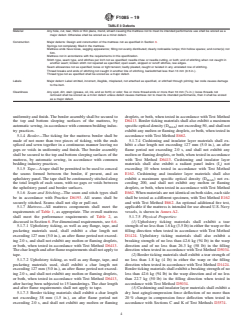
TABLE 3 Defects
Material Any hole, cut, tear, thick or thin place, mend, smash causing the mattress not to meet its intended performance use shall be scored as a
major defect. Otherwise shall be scored as a minor defect.
Construction Major defects: Design and construction of the mattress not as specified in Section 3.
Springs not completely filled in the mattress.
Mattress ends have loose, sagging appearance; filling not evenly distributed; clearly noticeable lumps; thin hollow spaces; and corner(s) not
firm.
Mattress not in accordance with the requirements in this specification.
Stitch type, seam type, and stitches per inch not as specified; needle chew or needle cutting, or both; end of stitching when not caught in
another seam; broken stitch not repaired as specified; open seam, skipped or runoff stitches, raw edges.
Seam allowances not as specified; loose or tight tension; badly pleated, caught or twisted in any unrelated row of stitching.
Thread breaks and ends of stitching not caught in another line of stitching, backstitched less than 13 mm (0.5 in.).
Thread type not as specified shall be scored as a major defect.
Labels Major defect: Label omitted, incorrect, illegible, misplaced, not attached as specified, or stitched through printing; bar code causes damage
to the item.
Cleanliness Any spot, dirt, stain (grease, oil, ink, and so forth) or odor; five or more thread ends or more than 10 mm ( ⁄8 in.); loose threads not
removed shall be scored as a minor defect unless defect causes mattress not to meet its intended performance, then it shall be scored
as a major defect.
uniformity and finish. The border assembly shall be secured to droplets, or both, when tested in accordance with Test Method
the top and bottom sleeping surfaces of the mattress, by D6413. Border ticking materials shall also exhibit a maximum
automatic sewing, in accordance with common bedding indus- specific optical density (D ) not exceeding 50, and shall not
MAX
try practices. exhibit any molten or flaming droplets, or both, when tested in
5.1.4 Border—The ticking for the mattress border shall be accordance with Test Method E662.
made of not more than two pieces of ticking, with the ends 5.1.7.4 Cushioning and insulator layer materials shall ex-
spliced and sewn together in a continuous manner leaving no hibit a char length not exceeding 127 mm (5.0 in.), an after
gaps or voids in uniformity and finish. The border assembly flame period not exceeding 2.0 s, and shall not exhibit any
shall be secured to the top and bottom sleeping surfaces of the molten or flaming droplets, or both, when tested in accordance
mattress, by automatic sewing, in accordance with common with Test Method D6413. Cushioning and insulator layer
bedding industry practices. materials shall also exhibit a radiant panel index (I ) not
s
5.1.5 Tape—Atape shall be permitted to be used to conceal exceeding 10 when tested in accordance with Test Method
the seams formed between the border, if present, and an E162. Cushioning and insulator layer materials shall also
upholstery panel.The tape shall be continuously stitched along exhibit a maximum specific optical density (D ) not ex-
MAX
the total length of each seam, with no gaps or voids between ceeding 200, and shall not exhibit any molten or flaming
the upholstery panel and border surfaces. droplets, or both, when tested in accordance with Test Method
5.1.6 Seam and Stitching—The seam and stitch types shall E662.Whenmaterialsarenotidenticalonbothsides,eachside
be in accordance with Practice D6193. All seams shall be shall be tested as a different specimen, with Test Method E162
securely stitched. Seams shall not slip or pull out. and with Test Method E662. An optional additional fire test,
5.1.7 Mattress—All mattress components shall meet the applicable if the mattress is intended for use aboard U.S. Navy
requirements of Table 1, as appropriate. The overall mattress vessels, is shown in Annex A2.
shall meet the performance requirements of Table 2,as 5.1.7.5 Physical Properties:
discussed in Section 6. For dimensional requirements, see 6.6. (1) Upholstery ticking materials shall exhibit a tear
5.1.7.1 Upholstery ticking, as well as any flange, tape, and strength of no less than 1.6 kg (3.5 lb) in either the warp or the
pocketing materials used, shall exhibit a char length not filling direction when tested in accordance with Test Method
exceeding 127 mm (5.0 in.), an after flame period not exceed- D1424. Upholstery ticking materials shall also exhibit a
ing 2.0 s, and shall not exhibit any molten or flaming droplets, breaking strength of no less than 42.6 kg (94 lb) in the warp
or both, when tested in accordance with Test Method D6413. direction and of no less than 26.3 kg (58 lb) in the filling
The char length and after flame requirements shall not apply to direction when tested in accordance with Test Method D5034.
tape. (2) Border ticking materials shall exhibit a tear strength of
5.1.7.2 Upholstery ticking, as well as any flange, tape, and no less than 1.8 kg (4 lb) in either the warp or the filling
pocketing materials used, shall exhibit a char length not direction when tested in accordance with Test Method D1424.
exceeding 127 mm (5.0 in.), an after flame period not exceed- Border ticking materials shall exhibit a breaking strength of no
ing 2.0 s, and shall not exhibit any molten or flaming droplets, less than 42.6 kg (94 lb) in the warp direction and of no less
or both, when tested in accordance with Test Method D6413, than 22.7 kg (50 lb) in the filling direction when tested in
after having been subjected to 15 launderings. The char length accordance with Test Method D5034.
and after flame requirements shall not apply to tape. (3) Cushioning and insulator layer materials shall exhibit a
5.1.7.3 Border ticking materials shall exhibit a char length dry heat aging/compression force deflection of no more than
not exceeding 38 mm (1.5 in.), an after flame period not 20 % change in compression force deflection when tested in
exceeding 2.0 s, and shall not exhibit any molten or flaming accordance with Sections C and K of Test Methods D3574.
F1085−19
5.1.8 Label—The label shall state that the mattress meets four corners shall be suitably fastened at each point of
one of the following sets of fire test requirements: (1) this attachment, in accordance with standard commercial bedding
specification (in accordance with Table 1 and Table 2), (2) practices. All bottom edges shall be eased (sharp corners
California Technical Bulletin 129, or (3), Purchase blunted by sanding).The wood base frame shall be constructed
Description—Mattress—Innerspring, Flame-Resistant, ofindustrystandardboxspringframelumber,typicallyEastern
Shipboard—NAVSEA 05L PD 4-02 (May 2002). CanadianspruceorSouthernyellowpine.Thespringassembly
shall be attached to the wood base frame.
5.2 Solid Core Mattress—The required components of a
5.3.2 Cushioning, Insulation Layers, Ticking and
solid core mattress are cushioning and upholstery ticking.
Construction—The requirements for materials and manufac-
5.2.1 All materials used shall meet the mechanical property
ture of all other components shall be as those for innerspring
and fire performance requirements of Table 1, as indicated in
mattresses, in 5.1, as applicable. The insulation layer shall be
5.1, for innerspring mattresses, as applicable. All materials
attached to the top surface to prevent slippage. Each corner
used shall comply with appropriate commercial bedding indus-
shall be filled with cushioning material, to provide proper
try standards of manufacture and durability.
tailoring. The box spring border ticking shall be of the same
5.2.2 Mattress—All mattress components shall meet the
material as that of the mattress. The top panel shall be of a
requirements of Table 1, as appropriate. The overall mattress
material that retards slipping. The cover assembly shall be
shall meet the performance requirements of Table 2.
placed over the top of the steel and wood assembly and
5.2.3 Label—The label shall state that the mattress meets
properly attached, in accordance with standard commercial
one of the following sets of fire test requirements: (1) this
bedding practices.
specification (in accordance with Table 1 and Table 2), (2)
5.3.3 The box spring shall display trade labels regarding
California Technical Bulletin 129, or (3), Purchase
material content and manufacturer as required by law.
Description—Mattress—Innerspring, Flame-Resistant,
5.3.4 Label—The label shall state that the box spring meets
Shipboard—NAVSEA 05L PD 4-02 (May 2002).
one of the following sets of fire test requirements: (1) this
5.3 Box Spring—The tolerances of the overall length, width
specification (in accordance with Table 1 and Table 2), (2)
and thickness dimensions of the box spring shall be consistent
California Technical Bulletin 129, or (3), Purchase
with the mattress dimensions. Fig. 1 shows an example of a
Description—Mattress—Innerspring, Flame-Resistant,
typical design of box spring. The top wire assembly shall be
Shipboard—NAVSEA 05L PD 4-02 (May 2002).
attached securely to the border wire.
5.4 Mattress/Box Spring:
5.3.1 The individual coils shall be securely attached to the
5.4.1 Packaging shall protect the products from physical
top
...
This document is not an ASTM standard and is intended only to provide the user of an ASTM standard an indication of what changes have been made to the previous version. Because
it may not be technically possible to adequately depict all changes accurately, ASTM recommends that users consult prior editions as appropriate. In all cases only the current version
of the standard as published by ASTM is to be considered the official document.
Designation: F1085 − 14 F1085 − 19 An American National Standard
Standard Specification for
Mattress and Box Springs for Use in Berths in Marine
Vessels
This standard is issued under the fixed designation F1085; the number immediately following the designation indicates the year of
original adoption or, in the case of revision, the year of last revision. A number in parentheses indicates the year of last reapproval. A
superscript epsilon (´) indicates an editorial change since the last revision or reapproval.
1. Scope
1.1 This specification provides the requirements for mattresses and box springs that are for use in berths for officers, crew, and
passengers in marine vessels. This shall be considered a minimum standard.
1.2 The values stated in SI units are to be regarded as the standard. The values given in parentheses, in inch-pound units, are
for information only.parentheses after SI units are provided for information only and are not considered standard.
1.3 This standard is used to measure and describe the response of materials, products, or assemblies to heat and flame under
controlled conditions, but does not by itself incorporate all factors required for fire-hazard or fire-risk assessment of the materials,
products, or assemblies under actual fire conditions.
1.4 Fire testing is inherently hazardous. Adequate safeguards for personnel and property shall be employed in conducting these
tests.
1.5 This standard does not purport to address all of the safety concerns, if any, associated with its use. It is the responsibility
of the user of this standard to establish appropriate safety safety, health, and healthenvironmental practices and determine the
applicability of regulatory limitations prior to use.
1.6 This international standard was developed in accordance with internationally recognized principles on standardization
established in the Decision on Principles for the Development of International Standards, Guides and Recommendations issued
by the World Trade Organization Technical Barriers to Trade (TBT) Committee.
2. Referenced Documents
2.1 ASTM Standards:
D123 Terminology Relating to Textiles
D1424 Test Method for Tearing Strength of Fabrics by Falling-Pendulum (Elmendorf-Type) Apparatus
D3574 Test Methods for Flexible Cellular Materials—Slab, Bonded, and Molded Urethane Foams
D3951 Practice for Commercial Packaging
D5034 Test Method for Breaking Strength and Elongation of Textile Fabrics (Grab Test)
D6193 Practice for Stitches and Seams
D6413 Test Method for Flame Resistance of Textiles (Vertical Test)
E162 Test Method for Surface Flammability of Materials Using a Radiant Heat Energy Source
E176 Terminology of Fire Standards
E662 Test Method for Specific Optical Density of Smoke Generated by Solid Materials
E1354 Test Method for Heat and Visible Smoke Release Rates for Materials and Products Using an Oxygen Consumption
Calorimeter
E1590 Test Method for Fire Testing of Mattresses
F1566 Test Methods for Evaluation of Innersprings, Boxsprings, Mattresses or Mattress Sets
2.2 ANSI Standards:
ANSI Z357.1-1981 American National Standard for Bedding Products and Components
ANSI/ASQC Z1.4 Sampling Procedures and Tables for Inspection by Attributes
This specification is under the jurisdiction of ASTM Committee F25 on Ships and Marine Technology and is the direct responsibility of Subcommittee F25.03 on
Outfitting and Deck Machinery.
Current edition approved Nov. 1, 2014Dec. 1, 2019. Published November 2014December 2019. Originally approved in 1988. Last previous edition approved in 20102014
as F1085 – 10.F1085 – 14. DOI: 10.1520/F1085-14.10.1520/F1085-19.
For referenced ASTM standards, visit the ASTM website, www.astm.org, or contact ASTM Customer Service at service@astm.org. For Annual Book of ASTM Standards
volume information, refer to the standard’s Document Summary page on the ASTM website.
Available from American National Standards Institute (ANSI), 25 W. 43rd St., 4th Floor, New York, NY 10036, http://www.ansi.org.
Copyright © ASTM International, 100 Barr Harbor Drive, PO Box C700, West Conshohocken, PA 19428-2959. United States
F1085 − 19
2.3 California Bureau of Home Furnishings and Thermal Insulation Standard:
CA Technical Bulletin 129,129 (CA TB 129)129), Flammability Test Procedure for Mattresses for Use in Public Buildings—
October 1992
2.4 Federal Standards:
Code of Federal Regulations, Title 16, Vol 2, Part 1632
Purchase Description—Mattress—Innerspring, Flame-Resistant, Shipboard—NAVSEA 05L PD 4-02 (May 2002)
2.5 NFPA Standard:
NFPA 301 Code for Safety to Life from Fire on Merchant Vessels
3. Terminology
3.1 Definitions—For definitions of terms used in this specification associated with textiles, see Terminology D123. For
definitions of terms used in this specification associated with fire issues, see Terminology E176.
3.2 Definitions of Terms Specific to This Standard:
3.2.1 border, n—a material that forms the side panel that surrounds the perimeter of the mattress and defines its depth.
3.2.2 box spring, n—a foundation for a mattress, consisting of wire spring elements mounted on a frame, generally upholstered
and covered on the top and sides with ticking, and on the bottom with a dust cover.
3.2.3 box spring assembly, n—an interconnection of coil springs, border wire, and top wire assembly contained within a box
spring.
3.2.4 flaming droplets, n—flaming molten or flaming liquefied droplets which fall flaming, liquefied material that separates and
drips from the test specimen during the fire test and continue to burn.continues to burn with flame.
3.2.4.1 Discussion—
The particular conditions under which continued flaming combustion is significant (such as for a particular duration or after
striking a surface) may be different in different test methods. Where needed, such conditions should be specified in the test method
or requirement.
3.2.5 flange, n—strip of material secured to the perimeter of an upholstery panel to secure to the innerspring core.
3.2.6 innerspring unit, n—an interconnection of wire spring elements other than mounting on a frame that forms a single unit
that can be incorporated into a mattress.
3.2.7 insulator pad, n—one or more layers of a cushioning system between the upholstery and mattress core, which consist of
foam or other cushioning or filling materials.
3.2.8 mattress, n—ticking filled with a resilient material used alone or in combination with other products intended or promoted
for sleeping upon.
3.2.9 mattress core, n—the main support system that may be present in a mattress, such as springs, foam, or resilient filling.
3.2.10 mattress, innerspring, n—any mattress containing an innerspring unit.
3.2.11 mattress, solid core, n—any mattress containing padding, but not an innerspring unit.
3.2.12 quilted, adj—stitched with any thread or by fusion through the ticking and one or more layers of upholstery material.
3.2.13 tape edge, n—seam or border edge of a mattress.
3.2.14 ticking, n—the outermost layer of fabric or related material that encloses the core and upholstery materials of a mattress
or mattress pad.
4. Ordering Information
4.1 Orders for items purchased under this specification shall define the following:
4.1.1 Mattresses—Quantity, dimensional requirements, type (solid core or innerspring), and weight per each size.
4.1.2 Box Springs—Quantity, dimensional requirements, and weight per each size.
4.1.3 Upholstery material selections are to be offered as choices by the manufacturer or distributor to the purchaser. The
selection shall be of good quality suitable for commercial use and for use aboard U.S. Navy vessels.
Available from California Bureau of Home Furnishings and Thermal Insulation, 3483 Orange Grove Ave., North Highlands, CA 95660.Household Goods and Services,
4244 South Market Court, Suite D, Sacramento, CA 95834, https://bhgs.dca.ca.gov.
Available from U.S. Government Printing Office, Superintendent of Documents, 732 N. Capitol St., NW, Mail Stop: SDE, Washington, DC 20401,20401-0001,
http://www.access.gpo.gov.
Available from Naval Sea Systems Command (NAVSEA), Command, 1333 Isaac Hull Ave., SE, Washington, Avenue, SE, Washington Navy Yard, DC 20376,
http://www.navsea.navy.mil.https://www.navsea.navy.mil.
Available from National Fire Protection Association (NFPA), 1 Batterymarch Park, Quincy, MA 02169-7471, http://www.nfpa.org.
F1085 − 19
4.1.4 When first article of inspection is required, it shall be spelled out in the paperwork.
5. Materials and Manufacture
5.1 Innerspring Mattress—The essential components of an innerspring mattress are: an innerspring core, cushioning, upholstery
ticking (either quilted or with a smooth top, and potentially including a flange), and a border. Optional components include various
insulating layers or pads, flanges, and tapes. All materials used shall meet the mechanical property and fire performance
requirements of Table 1. All materials used shall comply with appropriate commercial bedding industry standards of manufacture
and durability. Any construction of an innerspring mattress that is suitable for its intended use and that complies with the
performance requirements shown herein shall be permitted to be used.
5.1.1 Innerspring Core—The innerspring core shall be constructed from an all-wire carbon steel. The coils shall extend the full
length and width of the mattress. The coils shall be permanently secured to provide long-term structural stability. Various core
designs shall be permitted. The support properties of the innerspring core, in terms of firmness rating, durability, resistance to
impact, firmness retention, and surface deformation, shall be assessed by Test Methods F1566. The coils, or the complete spring
unit assembly, shall be given suitable thermal treatment to relieve residual stresses caused by coiling.
5.1.2 Cushioning and Insulator Layers—An insulator pad shall be placed over each sleeping surface of the innerspring core to
insulate the upholstery from the core. The various cushioning layers shall be constructed of materials that meet the performance
requirements of Table 1.
5.1.3 Ticking and Cover Assembly—The cover construction shall be suitable for the type of mattress construction used.
Upholstery ticking materials shall be durable, in accordance with common bedding industry practices. The ticking for each
sleeping surface shall be cut in one piece without fabric splices. The ticking for the mattress border shall be made of not more than
two pieces of ticking, with the ends spliced and sewn together in a continuous manner leaving no gaps or voids in uniformity and
finish. The border assembly shall be secured to the top and bottom sleeping surfaces of the mattress, by automatic sewing, in
accordance with common bedding industry practices.
TABLE 1 Mattress Component Requirements
Component Characteristic Requirement Test Method
Upholstery Ticking Initial Flammability
(and Flange, Tape, and Char Length #127 mm (5.0 in.) Test Method D6413
Pocketing Materials, if used) After Flame #2.0 s Test Method D6413
No Flaming Droplets Test Method
(Notes 1 and 2)
Flammability after 15 Launderings
Char Length #127 mm (5.0 in.) Test Method
After Flame #2.0 s Test Method
No Flaming Droplets Test Method
Other Properties
Tear Strength (Note 3) Warp: 1.6 kg (3.5 lb) min; Test Method
Filling: 1.6 kg (3.5 lb) min
Breaking Strength (Note 3) Warp: 42.6 kg (94 lb) min; Test Method
Filling: 26.3 kg (58 lb) min
Border Ticking Flammability
Char Length #38 mm (1.5 in.) Test Method D6413
After Flame #2.0 s Test Method D6413
No Flaming Droplets Test Method D6413
D 50 Test Method E662
MAX
D No Flaming Droplets Test Method E662
MAX
Other Properties
Tear Strength Warp: 1.8 kg (4 lb) min; Test Method D1424
Filling: 1.8 kg (4 lb) min
Breaking Strength Warp: 42.6 kg (94 lb) min; Test Method D5034
Filling: 22.7 kg (50 lb) min
Cushioning and Insulator Layers Flammability
Char Length #127 mm (5.0 in.) Test Method D6413
After Flame #2.0 s Test Method D6413
No Flaming Droplets Test Method D6413
Flame Spread (I ) (Note 4 10 Test Method E162
s
D (Note 4) 200 Test Method E662
MAX
D (Note 4) No Flaming Droplets Test Method E662
MAX
Other Properties
Dry Heat Aging / No more than 20 % change in Test Method D3574,
Compression Force Deflection compression force deflection Methods C and K
Dry Heat Aging / No more than 20 % change in Test Methods D3574,
Compression Force Deflection compression force deflection Methods C and K
F1085 − 19
NOTE 1—Only Molten or Flaming Droplets requirement, or both, applies to Tape.
5.1.4 Border—The ticking for the mattress border shall be made of not more than two pieces of ticking, with the ends spliced
and sewn together in a continuous manner leaving no gaps or voids in uniformity and finish. The border assembly shall be secured
to the top and bottom sleeping surfaces of the mattress, by automatic sewing, in accordance with common bedding industry
practices.
5.1.5 Tape—A tape shall be permitted to be used to conceal the seams formed between the border, if present, and an upholstery
panel. The tape shall be continuously stitched along the total length of each seam, with no gaps or voids between the upholstery
panel and border surfaces.
5.1.6 Seam and Stitching—The seam and stitch types shall be in accordance with Practice D6193. All seams shall be securely
stitched. Seams shall not slip or pull out.
5.1.7 Mattress—All mattress components shall meet the requirements of Table 1, as appropriate. The overall mattress shall meet
the performance requirements of Table 2, as discussed in Section 6. For dimensional requirements, see 6.6.
5.1.7.1 Upholstery ticking, as well as any flange, tape, and pocketing materials used, shall exhibit a char length not exceeding
127 mm (5.0 in.), an after flame period not exceeding 2.0 s, and shall not exhibit any molten or flaming droplets, or both, when
tested in accordance with Test Method D6413. The char length and after flame requirements shall not apply to tape.
5.1.7.2 Upholstery ticking, as well as any flange, tape, and pocketing materials used, shall exhibit a char length not exceeding
127 mm (5.0 in.), an after flame period not exceeding 2.0 s, and shall not exhibit any molten or flaming droplets, or both, when
tested in accordance with Test Method D6413, after having been subjected to 15 launderings. The char length and after flame
requirements shall not apply to tape.
5.1.7.3 Border ticking materials shall exhibit a char length not exceeding 38 mm (1.5 in.), an after flame period not exceeding
2.0 s, and shall not exhibit any molten or flaming droplets, or both, when tested in accordance with Test Method D6413. Border
ticking materials shall also exhibit a maximum specific optical density (D ) not exceeding 50, and shall not exhibit any molten
MAX
or flaming droplets, or both, when tested in accordance with Test Method E662.
5.1.7.4 Cushioning and insulator layer materials shall exhibit a char length not exceeding 127 mm (5.0 in.), an after flame period
not exceeding 2.0 s, and shall not exhibit any molten or flaming droplets, or both, when tested in accordance with Test Method
D6413. Cushioning and insulator layer materials shall also exhibit a radiant panel index (I ) not exceeding 10 when tested in
s
accordance with Test Method E162. Cushioning and insulator layer materials shall also exhibit a maximum specific optical density
(D ) not exceeding 200, and shall not exhibit any molten or flaming droplets, or both, when tested in accordance with Test
MAX
Method E662. When materials are not identical on both sides, each side shall be tested as a different specimen, with Test Method
E162 and with Test Method E662. An optional additional fire test, applicable if the mattress is intended for use aboard U.S. Navy
vessels, is shown in Annex A2.
5.1.7.5 Physical Properties:
(1) Upholstery ticking materials shall exhibit a tear strength of no less than 1.6 kg (3.5 lb) in either the warp or the filling
direction when tested in accordance with Test Method D1424. Upholstery ticking materials shall also exhibit a breaking strength
of no less than 42.6 kg (94 lb) in the warp direction and of no less than 26.3 kg (58 lb) in the filling direction when tested in
accordance with Test Method D5034.
(2) Border ticking materials shall exhibit a tear strength of no less than 1.8 kg (4 lb) in either the warp or the filling direction
when tested in accordance with Test Method D1424. Border ticking materials shall exhibit a breaking strength of no less than 42.6
kg (94 lb) in the warp direction and of no less than 22.7 kg (50 lb) in the filling direction when tested in accordance with Test
Method D5034.
(3) Cushioning and insulator layer materials shall exhibit a dry heat aging/compression force deflection of no more than 20 %
change in compression force deflection when tested in accordance with Sections C and K of Test MethodMethods D3574.
5.1.8 Label—The label shall state that the mattress meets one of the following sets of fire test requirements: (1) this specification
(in accordance with Table 1 and Table 2), (2) California Technical Bulletin 129, or (3), Purchase Description—Mattress—
Innerspring, Flame-Resistant, Shipboard—NAVSEA 05L PD 4-02 (May 2002).
5.2 Solid Core Mattress—The required components of a solid core mattress are cushioning and upholstery ticking.
5.2.1 All materials used shall meet the mechanical property and fire performance requirements of Table 1, as indicated in 5.1,
for innerspring mattresses, as applicable. All materials used shall comply with appropriate commercial bedding industry standards
of manufacture and durability.
5.2.2 Mattress—All mattress components shall meet the requirements of Table 1, as appropriate. The overall mattress shall meet
the performance requirements of Table 2.
5.2.3 Label—The label shall state that the mattress meets one of the following sets of fire test requirements: (1) this specification
(in accordance with Table 1 and Table 2), (2) California Technical Bulletin 129, or (3), Purchase Description—Mattress—
Innerspring, Flame-Resistant, Shipboard—NAVSEA 05L PD 4-02 (May 2002).
5.3 Box Spring—The tolerances of the overall length, width and thickness dimensions of the box spring shall be consistent with
the mattress dimensions. Fig. 1 shows an example of a typical design of box spring. The top wire assembly shall be attached
securely to the border wire.
F1085 − 19
NOTE 2—Only Initial Flammability requirements apply to Pocketing Material.
5.3.1 The individual coils shall be securely attached to the top wire assembly. The coils, or the complete spring assembly, shall
be given thermal treatment to relieve residual stresses caused by coiling. The wood frame assembly shall be suitable for
commercial use or for use aboard U.S. Navy vessels. All four corners shall be suitably fastened at each point of attachment, in
accordance with standard commercial bedding practices. All bottom edges shall be eased (sharp corners blunted by sanding). The
wood base frame shall be constructed of industry standard box spring frame lumber, typically Eastern Canadian spruce or Southern
yellow pine. The spring assembly shall be attached to the wood base frame.
5.3.2 Cushioning, Insulation Layers, Ticking and Construction—The requirements for materials and manufacture of all other
components shall be as those for innerspring mattresses, in 5.1, as applicable. The insulation layer shall be attached to the top
surface to prevent slippage. Each corner shall be filled with cushioning material, to provide proper tailoring. The box spring border
ticking shall be of the same material as that of the mattress. The top panel shall be of a material that retards slipping. The cover
assembly shall be placed over the top of the steel and wood assembly and properly attached, in accordance with standard
commercial bedding practices.
5.3.3 The box spring shall display trade labels regarding material content and manufacturer as required by law.
5.3.4 Label—The label shall state that the box spring meets one of the following sets of fire test requirements: (1) this
specification (in accordance with Table 1 and Table 2), (2) California Technical Bulletin 129, or (3), Purchase Description—
Mattress—Innerspring, Flame-Resistant, Shipboard—NAVSEA 05L PD 4-02 (May 2002).
5.4 Mattress/Box Spring:
5.4.1 Packaging shall protect the products from physical damage and be acceptable to a common carrier.
5.4.2 Each item shall be clearly marked in accordance with the purchase order requirements.
6. Performance Requirements for the Complete Mattress
6.1 The complete mattress shall meet the performance requirements shown in Table 2.
6.2 Fire Performance Requirements—At a minimum, the mattress shall comply with the requirements of 6.2.1 – 6.2.4
(consistent with those contained in NFPA 301).
6.2.1 The mattress ticking shall pass the requirements for Class A performance in accordance with 16 CFR 1632.
6.2.2 The mattress shall exhibit a maximum rate of heat release not exceeding 100 kW when tested in accordance with Test
Method E1590.
6.2.3 The mattress shall exhibit a total heat released in the first 10 min of test not exceeding 25 MJ when tested in accordance
with Test Method E1590.
6.2.4 The mattress shall exhibit a mass loss in the first 10 min of test not exceeding 1.4 kg (3 lb) when tested in accordance
with Test Method E1590.
6.3 Optional Fire Performance Requirements—As an option, the mattress shall be permitted to exhibit fire performance in
accordance with the fire test method described in Annex A1. This will involve, at a minimum, that the mattress comply with the
requirements of 6.3.1 – 6.3.3. If a mattress is intended for use aboard U.S. Navy vessels, it shall be required to comply with the
criteria shown in 6.3.1 – 6.3.3, when tested in accordance with the fire test method described in Annex A1.
6.3.1 The mattress shall exhibit a maximum rate of heat release, during the test, not exceeding 150 kW.
6.3.2 The mattress shall exhibit a maximum average specific extinction area, during the test, not exceeding 300 m /kg.
6.3.3 The mattress shall not exhibit flaming droplets during the test.
6.4 Physical Characteristics:
6.4.1 The mattress shall exhibit a firmness rating of 330 N (75 lbf) 6 10 %, and shall not exhibit any signs of wear, tear, damage,
or degradation, when tested for 100 000 cycles in accordance with Section 7 of Test MethodMethods F1566. The test report shall
include the initial firmness rating, the firmness rating after 25 000,
50 000, and 75 000 cycles, as well as the final firmness rating after 100 000 cycles. The test report shall also include any signs
of wear, tear, damage, or degradation on any part of the mattress when inspected after each set of 25 000 cycles.
6.4.2 The mattress shall exhibit a permanent deformation not exceeding 20 % of depth, when tested in accordance with the
Rollator Test section of Test MethodMethods F1566.
6.4.3 The mattress shall exhibit an accumulated dimple not to exceed 44.5 mm (1.75 in.), when tested in accordance with the
Cornell Test section of Test MethodMethods F1566.
6.4.4 The mattress shall exhibit a support firmness change not exceeding (+40 %) or (–15 %), when tested in accordance with
the Cornell Test section of Test MethodMethods F1566.
6.5 Visual Inspection—Visual inspection shall be conducted to check for any defects in the finished mattress, as shown in Table
3. The finished mattresses shall be clean and free from defects and other conditions affecting form, fit, function, and appearance.
The lot size shall be expressed in units of mattresses. The sample unit shall be one mattress. The inspection shall be performed
in accordance with ANSI/ASQC Z1.4.
F1085 − 19
NOTE 3—Tear Strength and Breaking Strength apply only to Upholstery Ticking.
6.6 Dime
...