

ASTM D6193-16(2020)
(Practice)Standard Practice for Stitches and Seams
General Information
- Abstract
SIGNIFICANCE AND USE
4.1 Seam engineering, the determination of the best stitch type, seam configuration, and thread type which should be used for a particular assembly, requires a thorough knowledge of many variables. The improper selection of any one component can result in failure of the sewn junction, and ultimately failure of the product manufactured.
4.2 General Characteristics—The characteristics of a properly constructed sewn seam are strength, elasticity, durability, security, and appearance. These characteristics must be balanced with the properties of the material to be joined to form the optimum sewn seam. The end use of the item will govern the relative importance of these characteristics. The selection of the seam type and stitch type should be based upon these considerations.
4.2.1 Strength—The seam efficiency of the sewn seam should be as high as possible. This will produce sewn seam strength with a balanced construction that will withstand the forces encountered in the use of the sewn item. The elements affecting the strength of a sewn seam are:
4.2.1.1 Fabric type and strength,
4.2.1.2 Seam type,
4.2.1.3 Stitch type,
4.2.1.4 Stitch density (spi),
4.2.1.5 Thread tension, and
4.2.1.6 Thread strength.
4.2.2 Elasticity—The elasticity of a sewn seam should be slightly greater than that of the material which it joins. This will enable the material to support its share of the forces encountered for the intended end use of the sewn item. The elasticity of a sewn seam depends upon:
4.2.2.1 Fabric type and strength,
4.2.2.2 Seam type,
4.2.2.3 Stitch type,
4.2.2.4 Stitch density (spi),
4.2.2.5 Thread tension, and
4.2.2.6 Thread elasticity.
4.2.3 Durability—The durability of a sewn seam depends largely upon its strength relative to the elasticity of the seam and the elasticity of the material. However, in less elastic, tightly woven or dense materials, there is a tendency for the plies to “work” or slide on each other. To form a durable sewn sea...
SCOPE
1.1 This practice covers the requirements and characteristics of stitches and seams used in the fabrication of sewn items.
1.2 This practice identifies the category, formation, and general purpose for stitch types and seam types used in the fabrication of sewn items.
1.3 Subsequent to a general discussion of stitches and seams that include schematic indices, this practice is comprised of the following sections that are listed in the order in which they appear:
1.3.1 Section 5—Classification of Stitch Types for which drawings are shown in Stitch Figs. 1-69,
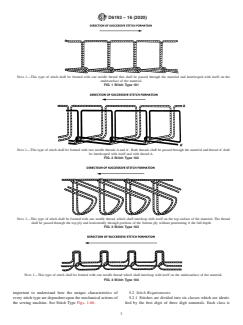
FIG. 1 Stitch Type 101
Note 1: This type of stitch shall be formed with one needle thread that shall be passed through the material and interlooped with itself on the undersurface of the material.
FIG. 2 Stitch Type 102
Note 1: This type of stitch shall be formed with two needle threads A and A′. Both threads shall be passed through the material and thread A′ shall be interlooped with itself and with thread A.
FIG. 3 Stitch Type 103
Note 1: This type of stitch shall be formed with one needle thread, which shall interloop with itself on the top surface of the material. The thread shall be passed through the top ply and horizontally through portions of the bottom ply without penetrating it the full depth.
FIG. 4 Stitch Type 104
Note 1: This type of stitch shall be formed with one needle thread which shall interloop with itself on the undersurface of the material.
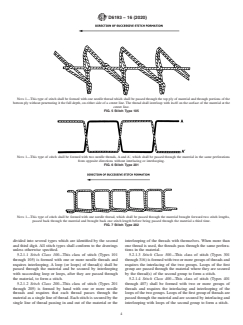
FIG. 5 Stitch Type 105
Note 1: This type of stitch shall be formed with one needle thread which shall be passed through the top ply of material and through portions of the bottom ply without penetrating it the full depth, on either side of a center line. The thread shall interloop with itself on the surface of the material at the center line.
FIG. 6 Stitch Type 201
Note 1: This type of stitch shall be formed with two needle threads, A and A′, which shall be passed through th...
- Status
- Published
- Publication Date
- 30-Jun-2020
- Technical Committee
- D13 - Textiles
- Drafting Committee
- D13.54 - Subassemblies
Overview
ASTM D6193-16(2020), Standard Practice for Stitches and Seams, establishes the requirements and characteristics of stitches and seams used in the fabrication of sewn items. Developed under ASTM Committee D13 on Textiles, this international standard guides the selection, classification, and implementation of stitch and seam types critical to product quality in textile and sewn product manufacturing.
Seam engineering, as highlighted in the standard, involves determining the optimal stitch type, seam configuration, and thread type for specific assemblies. Proper selection is crucial to ensure strength, durability, elasticity, security, and aesthetic quality of the sewn seam. The standard also addresses common seam and stitch defects, and provides detailed classifications complete with schematic figures for reference.
Key Topics
- Classification of Stitch Types: Stitches are systematically organized into six major classes, each identified by a three-digit code and illustrated through detailed figures. Proper stitch selection impacts the seam's strength, elasticity, and overall quality.
- Stitch classes include: 100 (simple chainstitch), 200 (hand stitches), 300 (lockstitch), 400 (multithread chainstitch), 500 (overedge), and 600 (coverstitch).
- Classification of Seam Types: Seam classes are identified using upper case abbreviations and are also depicted through schematic indices. The standard describes positioning and assembly of fabric sections to create various seam types.
- Key Seam Characteristics:
- Strength: The seam’s ability to withstand applied forces, depending on factors such as fabric type, seam and stitch type, thread characteristics, and stitch density.
- Elasticity: The capacity of the seam to stretch slightly more than the joined material, enhancing item durability and performance.
- Durability: Longevity of the seam, influenced by the balance between strength and elasticity, careful selection of thread size, and appropriate stitch density.
- Security: Prevention of stitch unraveling, dependent on stitch type and density.
- Appearance: Final look of the seam, governed by thread type, stitch density, and fabric characteristics.
- Seam and Stitch Defects: The document discusses common defects such as loose stitches, puckering, skipped stitches, raw edges, and seam run-off, and emphasizes the importance of proper seam assembly to avoid these issues.
Applications
ASTM D6193-16(2020) provides essential guidance across various industries where sewn textiles are integral parts of the final product. Practical applications include:
- Apparel Manufacturing: Ensuring consistency and durability of garments through standardized stitch and seam practices.
- Industrial Textiles: Supporting the fabrication of workwear, tarpaulins, and safety equipment that require robust seam engineering.
- Automotive Interiors: Specifying suitable stitch and seam types for seats, headliners, and trim to enhance safety and appearance.
- Home Textiles: Standardizing seam quality in bedding, curtains, and upholstery for improved consumer satisfaction.
- Military and Defense: Providing recognized seam quality benchmarks for uniforms, gear, and other critical sewn articles.
Adherence to ASTM D6193 supports quality assurance programs, helps reduce product failures, and simplifies communication between designers, manufacturers, and clients regarding stitched assemblies.
Related Standards
- ASTM D123: Terminology Relating to Textiles
- ASTM D1683: Standard Test Method for Failure in Sewn Seams of Woven Apparel Fabrics
- ISO 4916: Textiles - Seam types - Classification and terminology
- ASTM D5587: Standard Test Method for Tearing Strength of Fabrics by Trapezoid Procedure
For organizations involved in textile manufacturing and sewn product assembly, ASTM D6193-16(2020) is a foundational reference for achieving consistent seam performance and product reliability. Incorporating this standard optimizes seam selection, enhances product quality, and aligns with international best practices for stitched textile assemblies.
Relations
- Effective Date
- 01-Jul-2020
- Effective Date
- 01-Mar-2017
- Effective Date
- 15-Sep-2015
- Effective Date
- 01-Sep-2015
- Effective Date
- 01-Apr-2015
- Effective Date
- 15-Jun-2013
- Effective Date
- 15-Jun-2013
- Effective Date
- 15-May-2013
- Effective Date
- 01-Feb-2012
- Effective Date
- 01-Feb-2012
- Effective Date
- 15-Jan-2009
- Effective Date
- 15-Jan-2009
- Effective Date
- 15-Jan-2009
- Effective Date
- 01-Jul-2007
- Effective Date
- 10-Feb-2003
Frequently Asked Questions
ASTM D6193-16(2020) is a standard published by ASTM International. Its full title is "Standard Practice for Stitches and Seams". This standard covers: SIGNIFICANCE AND USE 4.1 Seam engineering, the determination of the best stitch type, seam configuration, and thread type which should be used for a particular assembly, requires a thorough knowledge of many variables. The improper selection of any one component can result in failure of the sewn junction, and ultimately failure of the product manufactured. 4.2 General Characteristics—The characteristics of a properly constructed sewn seam are strength, elasticity, durability, security, and appearance. These characteristics must be balanced with the properties of the material to be joined to form the optimum sewn seam. The end use of the item will govern the relative importance of these characteristics. The selection of the seam type and stitch type should be based upon these considerations. 4.2.1 Strength—The seam efficiency of the sewn seam should be as high as possible. This will produce sewn seam strength with a balanced construction that will withstand the forces encountered in the use of the sewn item. The elements affecting the strength of a sewn seam are: 4.2.1.1 Fabric type and strength, 4.2.1.2 Seam type, 4.2.1.3 Stitch type, 4.2.1.4 Stitch density (spi), 4.2.1.5 Thread tension, and 4.2.1.6 Thread strength. 4.2.2 Elasticity—The elasticity of a sewn seam should be slightly greater than that of the material which it joins. This will enable the material to support its share of the forces encountered for the intended end use of the sewn item. The elasticity of a sewn seam depends upon: 4.2.2.1 Fabric type and strength, 4.2.2.2 Seam type, 4.2.2.3 Stitch type, 4.2.2.4 Stitch density (spi), 4.2.2.5 Thread tension, and 4.2.2.6 Thread elasticity. 4.2.3 Durability—The durability of a sewn seam depends largely upon its strength relative to the elasticity of the seam and the elasticity of the material. However, in less elastic, tightly woven or dense materials, there is a tendency for the plies to “work” or slide on each other. To form a durable sewn sea... SCOPE 1.1 This practice covers the requirements and characteristics of stitches and seams used in the fabrication of sewn items. 1.2 This practice identifies the category, formation, and general purpose for stitch types and seam types used in the fabrication of sewn items. 1.3 Subsequent to a general discussion of stitches and seams that include schematic indices, this practice is comprised of the following sections that are listed in the order in which they appear: 1.3.1 Section 5—Classification of Stitch Types for which drawings are shown in Stitch Figs. 1-69, FIG. 1 Stitch Type 101 Note 1: This type of stitch shall be formed with one needle thread that shall be passed through the material and interlooped with itself on the undersurface of the material. FIG. 2 Stitch Type 102 Note 1: This type of stitch shall be formed with two needle threads A and A′. Both threads shall be passed through the material and thread A′ shall be interlooped with itself and with thread A. FIG. 3 Stitch Type 103 Note 1: This type of stitch shall be formed with one needle thread, which shall interloop with itself on the top surface of the material. The thread shall be passed through the top ply and horizontally through portions of the bottom ply without penetrating it the full depth. FIG. 4 Stitch Type 104 Note 1: This type of stitch shall be formed with one needle thread which shall interloop with itself on the undersurface of the material. FIG. 5 Stitch Type 105 Note 1: This type of stitch shall be formed with one needle thread which shall be passed through the top ply of material and through portions of the bottom ply without penetrating it the full depth, on either side of a center line. The thread shall interloop with itself on the surface of the material at the center line. FIG. 6 Stitch Type 201 Note 1: This type of stitch shall be formed with two needle threads, A and A′, which shall be passed through th...
SIGNIFICANCE AND USE 4.1 Seam engineering, the determination of the best stitch type, seam configuration, and thread type which should be used for a particular assembly, requires a thorough knowledge of many variables. The improper selection of any one component can result in failure of the sewn junction, and ultimately failure of the product manufactured. 4.2 General Characteristics—The characteristics of a properly constructed sewn seam are strength, elasticity, durability, security, and appearance. These characteristics must be balanced with the properties of the material to be joined to form the optimum sewn seam. The end use of the item will govern the relative importance of these characteristics. The selection of the seam type and stitch type should be based upon these considerations. 4.2.1 Strength—The seam efficiency of the sewn seam should be as high as possible. This will produce sewn seam strength with a balanced construction that will withstand the forces encountered in the use of the sewn item. The elements affecting the strength of a sewn seam are: 4.2.1.1 Fabric type and strength, 4.2.1.2 Seam type, 4.2.1.3 Stitch type, 4.2.1.4 Stitch density (spi), 4.2.1.5 Thread tension, and 4.2.1.6 Thread strength. 4.2.2 Elasticity—The elasticity of a sewn seam should be slightly greater than that of the material which it joins. This will enable the material to support its share of the forces encountered for the intended end use of the sewn item. The elasticity of a sewn seam depends upon: 4.2.2.1 Fabric type and strength, 4.2.2.2 Seam type, 4.2.2.3 Stitch type, 4.2.2.4 Stitch density (spi), 4.2.2.5 Thread tension, and 4.2.2.6 Thread elasticity. 4.2.3 Durability—The durability of a sewn seam depends largely upon its strength relative to the elasticity of the seam and the elasticity of the material. However, in less elastic, tightly woven or dense materials, there is a tendency for the plies to “work” or slide on each other. To form a durable sewn sea... SCOPE 1.1 This practice covers the requirements and characteristics of stitches and seams used in the fabrication of sewn items. 1.2 This practice identifies the category, formation, and general purpose for stitch types and seam types used in the fabrication of sewn items. 1.3 Subsequent to a general discussion of stitches and seams that include schematic indices, this practice is comprised of the following sections that are listed in the order in which they appear: 1.3.1 Section 5—Classification of Stitch Types for which drawings are shown in Stitch Figs. 1-69, FIG. 1 Stitch Type 101 Note 1: This type of stitch shall be formed with one needle thread that shall be passed through the material and interlooped with itself on the undersurface of the material. FIG. 2 Stitch Type 102 Note 1: This type of stitch shall be formed with two needle threads A and A′. Both threads shall be passed through the material and thread A′ shall be interlooped with itself and with thread A. FIG. 3 Stitch Type 103 Note 1: This type of stitch shall be formed with one needle thread, which shall interloop with itself on the top surface of the material. The thread shall be passed through the top ply and horizontally through portions of the bottom ply without penetrating it the full depth. FIG. 4 Stitch Type 104 Note 1: This type of stitch shall be formed with one needle thread which shall interloop with itself on the undersurface of the material. FIG. 5 Stitch Type 105 Note 1: This type of stitch shall be formed with one needle thread which shall be passed through the top ply of material and through portions of the bottom ply without penetrating it the full depth, on either side of a center line. The thread shall interloop with itself on the surface of the material at the center line. FIG. 6 Stitch Type 201 Note 1: This type of stitch shall be formed with two needle threads, A and A′, which shall be passed through th...
ASTM D6193-16(2020) is classified under the following ICS (International Classification for Standards) categories: 61.020 - Clothes. The ICS classification helps identify the subject area and facilitates finding related standards.
ASTM D6193-16(2020) has the following relationships with other standards: It is inter standard links to ASTM D6193-16, ASTM D123-17, ASTM D123-15b, ASTM D123-15a, ASTM D123-15, ASTM D123-13ae1, ASTM D123-13a, ASTM D123-13, ASTM D123-12e1, ASTM D123-12, ASTM D123-09e1, ASTM D123-09, ASTM D123-09e2, ASTM D123-07, ASTM D123-03. Understanding these relationships helps ensure you are using the most current and applicable version of the standard.
ASTM D6193-16(2020) is available in PDF format for immediate download after purchase. The document can be added to your cart and obtained through the secure checkout process. Digital delivery ensures instant access to the complete standard document.
Standards Content (Sample)
This international standard was developed in accordance with internationally recognized principles on standardization established in the Decision on Principles for the
Development of International Standards, Guides and Recommendations issued by the World Trade Organization Technical Barriers to Trade (TBT) Committee.
Designation: D6193 − 16 (Reapproved 2020)
Standard Practice for
Stitches and Seams
This standard is issued under the fixed designation D6193; the number immediately following the designation indicates the year of
original adoption or, in the case of revision, the year of last revision. A number in parentheses indicates the year of last reapproval. A
superscript epsilon (´) indicates an editorial change since the last revision or reapproval.
This standard has been approved for use by agencies of the U.S. Department of Defense.
1. Scope 3.1.1 bartack, n—a reinforcement stitch that effectively
minimizes tearing at the ends of critical stress stitchlines.
1.1 Thispracticecoverstherequirementsandcharacteristics
3.1.1.1 Discussion—Examples of critical stress stitchlines
of stitches and seams used in the fabrication of sewn items.
include: ends of seams, zippers, pocket flaps, crotch/seat
1.2 This practice identifies the category, formation, and
seams, collars, webbing and other components. If the bartack-
general purpose for stitch types and seam types used in the
ing process exhibits an insufficient number of stitches, im-
fabrication of sewn items.
proper thread size relationship or shortened bartack stitched
1.3 Subsequenttoageneraldiscussionofstitchesandseams length then it will fail under stress. Bartacking, because of the
that include schematic indices, this practice is comprised of the stitch density, can exhibit severe needle-cutting, thus creating a
following sections that are listed in the order in which they self-destructive characteristic if number of stitches is
appear: excessive, or sewing needle or thread size is too large for
1.3.1 Section 5—Classification of Stitch Types for which fabric. Bartacking is specified strictly as a relationship between
drawings are shown in Stitch Figs. 1-69, length,widthorthrowandtotalstitches.Itdoesnotincorporate
1.3.2 Section 6—Classification of Seam Types for which stitches per inch as a typical seam may specify.
drawings are shown in Seam Figs. 70-288, and
3.1.1.2 Discussion—Counting finished bartack stitches is
1.3.3 Annex A1—Seam Assembly Recommendations. virtually impossible since the overall process consists of three
components. The process begins in a horizontal position to
1.4 This standard does not purport to address all of the
achieve the required length and then forms the familiar zig-zag
safety concerns, if any, associated with its use. It is the
stitch-line along the horizontal plane including backstitching at
responsibility of the user of this standard to establish appro-
both ends to lock in the zig-zag stitches to prevent raveling.
priate safety, health, and environmental practices and deter-
The zig-zag stitches criss-cross the initial horizontal stitch line
mine the applicability of regulatory limitations prior to use.
thus virtually hiding the initial stitch line.
1.5 This international standard was developed in accor-
dance with internationally recognized principles on standard-
3.1.2 needle damage, n—in sewn fabrics, the partial or
ization established in the Decision on Principles for the
complete yarn severance or fiber fusing caused by a needle
Development of International Standards, Guides and Recom-
passing through a fabric during sewing.
mendations issued by the World Trade Organization Technical
3.1.2.1 Discussion—This can also be referred to as needle
Barriers to Trade (TBT) Committee.
cuts.
3.1.3 seam, n—a line where two or more fabrics are joined,
2. Referenced Documents
usually near the edge. See also sewn seam, glued seam, stapled
2.1 ASTM Standards:
seam, thermally bonded seam.)
D123 Terminology Relating to Textiles
3.1.4 seam allowance, n—in sewn fabrics, the distance from
3. Terminology the edge of a fabric to the parallel stitch line furthest from that
edge.
3.1 Definitions:
3.1.5 seam assembly, n—the composite structure obtained
when fabric(s) are joined by means of a seam.
ThispracticeisunderthejurisdictionofASTMCommitteeD13onTextilesand
is the direct responsibility of Subcommittee D13.54 on Subassemblies.
3.1.6 seam damage, n— in sewn fabrics, an adverse change
Current edition approved July 1, 2020. Published August 2020. Originally
in the physical condition of one or more of the components in
approved in 1997. Last previous edition approved in 2016 as D6193 – 16. DOI:
aseamwhichwouldreducetheseamacceptabilitysuchasyarn
10.1520/D6193-16R20.
For referenced ASTM standards, visit the ASTM website, www.astm.org, or
slippage, needle damage, or fabric rupture.
contact ASTM Customer Service at service@astm.org. For Annual Book of ASTM
3.1.7 seam effıciency, n—in sewn fabrics, the ratio of seam
Standards volume information, refer to the standard’s Document Summary page on
the ASTM website. strength to fabric strength.
Copyright © ASTM International, 100 Barr Harbor Drive, PO Box C700, West Conshohocken, PA 19428-2959. United States
D6193 − 16 (2020)
TABLE 1 Stitch and Seam Defects
4.2 General Characteristics—The characteristics of a prop-
Stitch Defects Seam Assembly Defects erly constructed sewn seam are strength, elasticity, durability,
Loose stitches Puckers security, and appearance. These characteristics must be bal-
Poorly formed stitches Twists
anced with the properties of the material to be joined to form
Crowded stitches Plaits
the optimum sewn seam. The end use of the item will govern
Tight stitches Undulations
Crooked stitches Run-off (raised seams) the relative importance of these characteristics. The selection
Skipped stitches Raw edges exposed
of the seam type and stitch type should be based upon these
(felled seams)
considerations.
4.2.1 Strength—The seam efficiency of the sewn seam
should be as high as possible. This will produce sewn seam
strength with a balanced construction that will withstand the
3.1.7.1 Discussion—For some constructions, yarn strength
forces encountered in the use of the sewn item. The elements
andstitchtypecancontributetoahigherseamefficiencyvalue.
affecting the strength of a sewn seam are:
3.1.8 seam slippage, n—in sewn fabrics, the displacement
4.2.1.1 Fabric type and strength,
of the fabric yarn parallel and adjacent to the stitch line.
4.2.1.2 Seam type,
3.1.9 seam type, n—in sewn fabrics, an alphanumeric des- 4.2.1.3 Stitch type,
ignation relating to the essential characteristics of fabric
4.2.1.4 Stitch density (spi),
positioning and rows of stitching in a specified sewn fabric 4.2.1.5 Thread tension, and
seam.
4.2.1.6 Thread strength.
4.2.2 Elasticity—The elasticity of a sewn seam should be
3.1.10 sew, v—to unite or fasten with stitches.
slightly greater than that of the material which it joins. This
3.1.11 sewing thread, n—a flexible, small-diameter yarn or
will enable the material to support its share of the forces
strand, usually treated with a surface coating, lubricant, or
encountered for the intended end use of the sewn item. The
both, intended to be used to stitch one or more pieces of
elasticity of a sewn seam depends upon:
material or an object to a material.
4.2.2.1 Fabric type and strength,
3.1.12 sewn seam, n—in sewn fabrics, a juncture at which
4.2.2.2 Seam type,
two or more planar structures such as textile fabrics, are joined
4.2.2.3 Stitch type,
by sewing, usually near the edge.
4.2.2.4 Stitch density (spi),
3.1.13 stitch, n—in sewing, the configuration of the inter-
4.2.2.5 Thread tension, and
lacing of sewing thread in a specific repeated unit. (See also 4.2.2.6 Thread elasticity.
stitching, and stitch type.)
4.2.3 Durability—The durability of a sewn seam depends
largely upon its strength relative to the elasticity of the seam
3.1.14 stitch density, n—in sewn seams, the number of
and the elasticity of the material. However, in less elastic,
stitches per unit length in one row of stitching in the seam.
tightly woven or dense materials, there is a tendency for the
3.1.14.1 Discussion—This is usually expressed as stitches
plies to “work” or slide on each other. To form a durable sewn
per inch (spi).
seam in these types of fabrics, the thread size must be carefully
3.1.15 stitch gage, n— in sewn seams, the perpendicular
chosen. The stitch density also needs to be carefully deter-
distance between adjacent parallel rows of stitching.
mined for the material so as not to cause excess tension which
3.1.16 stitch type, n— in sewn seams, a numerical designa-
will unbalance the elasticity and cause puckering. It is also
tion relating to the essential characteristics of the interlacing of
important to minimize abrasion and wear by contact with
sewing thread(s) in a specified stitch.
outside agencies to promote durability.
3.1.17 stitching, n—a series of stitches embodied in a 4.2.4 Security—The security of a sewn seam depends
chiefly upon the stitch type, spi, and its susceptibility to
material or materials of planar structure such as woven textile
fabrics usually for ornamental purposes or finishing an edge, or become unraveled. The stitch must be well set to the material
to prevent snagging that can cause rupture of the thread and
both.
unraveling of certain stitch types.
3.1.18 yarn slippage, n—in sewn seams in sewn fabrics, the
4.2.5 Appearance—The appearance of a sewn seam gener-
displacement of one or more yarns from the original position,
allyisgovernedbytheproperrelationshipbetweenthesizeand
causing differences in alignment, spacing, or both.
type of thread, the stitch density, and the texture and weight of
3.2 For definitions of other textile terms used in this
the fabric.
practice, refer to Terminology D123.
4.2.5.1 In addition to these general characteristics, the
technique and skill of the sewing machine operators also
4. Significance and Use
govern the appearance of the sewn seams. Some of the factors
4.1 Seam engineering, the determination of the best stitch
which will adversely affect the appearance are shown in Table
type,seamconfiguration,andthreadtypewhichshouldbeused
1.
for a particular assembly, requires a thorough knowledge of
5. Classification of Stitch Types
many variables. The improper selection of any one component
can result in failure of the sewn junction, and ultimately failure 5.1 Function—Because all stitch types require that a needle
of the product manufactured. penetrate a fabric while transporting a sewing thread, it is
D6193 − 16 (2020)
NOTE 1—This type of stitch shall be formed with one needle thread that shall be passed through the material and interlooped with itself on the
undersurface of the material.
FIG. 1 Stitch Type 101
NOTE 1—This type of stitch shall be formed with two needle threads A and A'. Both threads shall be passed through the material and thread A' shall
be interlooped with itself and with thread A.
FIG. 2 Stitch Type 102
NOTE 1—This type of stitch shall be formed with one needle thread, which shall interloop with itself on the top surface of the material. The thread
shall be passed through the top ply and horizontally through portions of the bottom ply without penetrating it the full depth.
FIG. 3 Stitch Type 103
NOTE 1—This type of stitch shall be formed with one needle thread which shall interloop with itself on the undersurface of the material.
FIG. 4 Stitch Type 104
important to understand how the unique characteristics of 5.2 Stitch Requirements:
every stitch type are dependent upon the mechanical actions of 5.2.1 Stitches are divided into six classes which are identi-
the sewing machine. See Stitch Type Figs. 1-66. fied by the first digit of three digit numerals. Each class is
D6193 − 16 (2020)
NOTE 1—This type of stitch shall be formed with one needle thread which shall be passed through the top ply of material and through portions of the
bottom ply without penetrating it the full depth, on either side of a center line. The thread shall interloop with itself on the surface of the material at the
center line.
FIG. 5 Stitch Type 105
NOTE 1—This type of stitch shall be formed with two needle threads, A and A', which shall be passed through the material in the same perforations
from opposite directions without interlacing or interlooping.
FIG. 6 Stitch Type 201
NOTE 1—This type of stitch shall be formed with one needle thread, which shall be passed through the material brought forward two stitch lengths,
passed back through the material and brought back one stitch length before being passed through the material a third time.
FIG. 7 Stitch Type 202
divided into several types which are identified by the second interlooping of the threads with themselves. When more than
and third digit. All stitch types shall conform to the drawings one thread is used, the threads pass through the same perfora-
unless otherwise specified. tions in the material.
5.2.1.1 Stitch Class 100—This class of stitch (Types 101 5.2.1.3 Stitch Class 300—This class of stitch (Types 301
through 105) is formed with one or more needle threads and through 316) is formed with two or more groups of threads and
requires interlooping. A loop (or loops) of thread(s) shall be requires the interlacing of the two groups. Loops of the first
passed through the material and be secured by interlooping group are passed through the material where they are secured
with succeeding loop or loops, after they are passed through by the thread(s) of the second group to form a stitch.
the material, to form a stitch. 5.2.1.4 Stitch Class 400—This class of stitch (Types 401
5.2.1.2 Stitch Class 200—This class of stitch (Types 201 through 407) shall be formed with two or more groups of
through 205) is formed by hand with one or more needle threads and requires the interlacing and interlooping of the
threads and requires that each thread passes through the loops of the two groups. Loops of the first group of threads are
material as a single line of thread. Each stitch is secured by the passed through the material and are secured by interlacing and
single line of thread passing in and out of the material or the interlooping with loops of the second group to form a stitch.
D6193 − 16 (2020)
NOTE 1—This type of stitch shall be formed with one needle thread, which shall be passed through the material from the underside and immediately
passed back through the same perforation to form a loop on the surface of the material. The needle shall be advanced one stitch length, passed through
the material and the loop and immediately passed back through the loop and the same needle perforation, and a new loop shall be formed to receive the
succeeding stitch.
FIG. 8 Stitch Type 203
NOTE 1—This type of stitch shall be formed with one needle thread, which shall be passed through the material and brought back one stitch length
and then passed back up through the material. The needle shall be moved diagonally across the material and forward one stitch length, passed through
the material, brought back one stitch length and again passed to the surface of the material. This process shall be repeated to form a crisscross pattern
of stitches on the surface and parallel rows of separated and off-set stitches on the underside of the material.
FIG. 9 Stitch Type 204
NOTE 1—This type of stitch shall be formed with one or more needle threads and has for a general characteristic that the thread does not interloop with
itself or any other thread or threads. The thread is passed completely through the material by means of a double pointed center eye needle and returned
by another path. This class of stitch simulates hand stitching.
FIG. 10 Stitch Type 205
5.2.1.5 Stitch Class 500—This class of stitch (Types 501 surface of the material and then through the material where
through 522) is formed with one or more groups of thread, and they are interlooped with loops of the second group of thread
requires that loops from at least one group of thread shall pass on the underside of the material. The one exception to this
around the edge of the material. Loops of one group of thread
procedure is stitch type 601 where only two groups of thread
arepassedthroughthematerialandaresecuredbyinterlooping are used and the function of the third group is performed by
with themselves before succeeding loops are passed through
one of the threads in the first group.
the material, or secured by interlooping with loops of one or
more interlooped groups of threads before succeeding loops of
6. Classification of Seam Types
the first group are again passed through the material.
6.1 Function:
5.2.1.6 Stitch Class 600—This class of stitch (Types 601
6.1.1 Seam classification relates directly to the positioning
through 607) is formed with two or more groups of threads,
of fabric sections at the junction where these sections are sewn.
and requires that two of the groups cover the raw edges of both
surfaces of the material. Loops of the first group of thread are 6.1.2 All seam types are classified by an alphabetical
passed through loops of the third group already cast on the designation. See Figs 282–291.
D6193 − 16 (2020)
NOTE 1—This type of stitch shall be formed with two threads: one needle thread, A, and one bobbin thread, B. A loop of thread A shall be passed
through the material and interlaced with thread B. ThreadAshall be pulled back so that the interlacing shall be midway between surfaces of the material
or materials being sewn.
FIG. 11 Stitch Type 301
NOTE 1—This type of stitch shall be formed with three threads: two needle threads, A and A', and one bobbin thread, B. Loops of threads A and A'
shall be passed through the material and interlaced with thread B. The interlacings shall be on the underside of the material.
FIG. 12 Stitch Type 302
NOTE 1—This type of stitch shall be formed with four threads: three needle threads, A and A' and A", and one bobbin thread, B. Loops of threads A,
A' and A" shall be passed through the material and interlaced with thread B. The interlacings shall be on the underside of the material.
FIG. 13 Stitch Type 303
NOTE 1—This type of stitch shall be formed with two threads: one needle thread, A, and one bobbin thread, B. This stitch type is exactly the same
as stitch type 301 except that successive single stitches form a symmetrical zigzag pattern.
FIG. 14 Stitch Type 304
D6193 − 16 (2020)
NOTE 1—This type of stitch shall be formed with three threads: two needle threads, A and A', and one bobbin thread, B. Loops of threads A and A'
shall be passed through the material and interlaced with thread B and the interlacing shall be left on the underside of the material. Successive single
stitches form a symmetrical zigzag pattern.
FIG. 15 Stitch Type 305
NOTE1—Thistypeofstitchshallbeformedwithtwothreads:oneneedlethread,A,andonebobbinthread,B.LoopsofthreadAshallbepassedthrough
the top ply of material and horizontally through portions of the bottom ply without penetrating it the full depth and shall be interlaced with thread B on
the top surface of the bottom ply of material.
FIG. 16 Stitch Type 306
NOTE 1—This type of stitch shall be formed with five threads: four needle threads, A, A', A", A'", and one bobbin thread, B. Loops of threads A, A',
A", A'", shall be passed through the material and interlaced with thread B. The interlacings shall be on the underside of the material.
FIG. 17 Stitch Type 307
6.1.3 Seams are divided into six classes. Each class is 6.1.3.4 Generally, most seam types can be produced using
subdivided into types and are designated by symbols as multiple rows of stitching. The symbol for the seam type will
follows:
change with the number of rows of stitches: SSa-2, SSa-3,
6.1.3.1 Class of Seam—Two or more upper case letters.
SSa-4, etc.
6.1.3.2 Types of the Class—One or more lower case letters.
6.2 Seam Requirements:
6.1.3.3 Number of Rows of Stitches—One or more Arabic
6.2.1 All seam types shall conform to the applicable draw-
numerals. Example—The symbol for a simple super-imposed
seam type with one row of stitches is: SSa-1. ings unless otherwise specified. See Seam Figs. 70-288.
D6193 − 16 (2020)
NOTE 1—This type of stitch shall be formed with two threads: one needle thread, A, and one bobbin thread, B. This stitch type is the same as stitch
type 304 except that successive pairs of stitches form a symmetrical zigzag pattern.
FIG. 18 Stitch Type 308
NOTE 1—This type of stitch shall be formed with three threads: two needle threads, A and A', and one bobbin thread, B. Loops of threads A and A'
shall be passed through the material and interlaced with thread B. The interlacings shall be left on the underside of the material.
FIG. 19 Stitch Type 309
NOTE 1—This type of stitch shall be formed with three threads: two needle threads, A and A', and one bobbin thread, B. Loops of threads A and A'
shall be passed through the material and interlaced with thread B, and the interlacings shall be left on the underside of the material. Successive single
stitches form a symmetrical zigzag pattern.
FIG. 20 Stitch Type 310
6.2.1.1 Seam Class SS—This class of seam requires that the that the stitches extend across and cover or tend to cover the
plies of material are superimposed and seamed with one or
edges of the plies joined.
more rows of stitches (Figs. 289-298).
6.2.1.5 Seam Class OS—This class of seam requires that a
6.2.1.2 Seam Class LS—This class of seam requires that the
series of stitches are embodied in a material either in a straight
plies of material are lapped and seamed with one or more rows
line, a curve, or following a design, for ornamental purposes.
of stitches.
6.2.1.6 Seam Class EF—This class of seam requires that
6.2.1.3 Seam Class BS—This class of seam is formed by
edge finishing is accomplished by either: sewing a series of
folding a binding strip over the edge of one or more plies of
stitches at or over the edge of a material while the edge may or
material and seaming the binding strip to the material with one
may not be folded as specified, or the edge of the material is
or more rows of stitches.
folded and stitched to the body of the material with a series of
6.2.1.4 Seam Class FS—This class of seam is formed by
stitches.
sewing the abutted edges of material together in such a manner
D6193 − 16 (2020)
NOTE 1—This type of stitch shall be formed with three threads: two needle threads, A and A', and one bobbin thread, B. Loops of threads A and A'
shall be passed through the material and interlaced with thread B. ThreadsAandA' shall be pulled back so that the interlacings shall be midway between
surfaces of the material or materials being sewn.
FIG. 21 Stitch Type 311
NOTE 1—This type of stitch shall be formed with three threads: two needle threads,AandA', and one bobbin thread, B. This stitch type is exactly the
same as stitch type 311 except that successive single stitches form a symmetrical zigzag pattern.
FIG. 22 Stitch Type 312
NOTE 1—This type of stitch shall be formed with two threads: one needle thread, A, and one bobbin thread, B. Loops of thread A shall be passed
horizontally through portions of both plies of material without penetrating the full depth, and shall be interlaced with thread B on the top of the material.
FIG. 23 Stitch Type 313
D6193 − 16 (2020)
NOTE1—Thistypeofstitchshallbeformedwithtwothreads:oneneedlethread,A,andonebobbinthread,B.LoopsofthreadAshallbepassedthrough
the top ply of material and horizontally through portions of the bottom ply without penetrating the full depth and shall be interlaced with thread B on
the top of the material.
FIG. 24 Stitch Type 314
NOTE 1—This type of stitch shall be formed with two threads: one needle thread, A, and one bobbin thread, B. This stitch type is the same as stitch
type 304 except that successive groups of three stitches form a symmetrical zig-zag pattern.
FIG. 25 Stitch Type 315
NOTE 1—This type of stitch shall be formed with one continuous needle thread, which after the first needle penetration is divided into two parts: part
one, needle thread A, and one reel thread, A'. In subsequent penetrations thread A is passed through the material and interlaced with thread A. Thread
Ashall be pulled up so that the interlacing is midway between the surfaces of the material or materials being sewn. This stitch type is identical to stitch
type 301 except for the initial stitch.
FIG. 26 Stitch Type 316
D6193 − 16 (2020)
NOTE1—Thistypeofstitchshallbeformedwithtwothreads:oneneedlethread,A,andonelooperthread,B.LoopsofthreadAshallbepassedthrough
the material and interlaced and interlooped with loops of thread B. The interloopings shall be drawn against the underside of the bottom ply of material.
FIG. 27 Stitch Type 401
NOTE 1—This type of stitch shall be formed with three threads: two needle threadsAandA' and one looper thread, B. Loops of threadsAandA' shall
be passed through the material and interlaced and interlooped with loops of thread B. The interloopings shall be drawn against the underside of the
material.
FIG. 28 Stitch Type 402
NOTE 1—This type of stitch shall be formed with four threads: three needle threads, A, A' and A" and one looper thread, B. Loops of threads A, A'
andA" shall be passed through the material and interlaced and interlooped with loops of thread B. The interloopings shall be drawn against the underside
of the material.
FIG. 29 Stitch Type 403
D6193 − 16 (2020)
NOTE 1—This type of stitch shall be formed with two threads: one needle thread, A, and one looper thread, B. This stitch is the same as stitch type
401 except that successive single stitches form a symmetrical zigzag pattern.
FIG. 30 Stitch Type 404
NOTE 1—This type of stitch shall be formed with three threads: two needle threads,AandA', and one looper thread, B. This stitch is the same as stitch
type 402 except that successive stitches form a symmetrical zigzag pattern.
FIG. 31 Stitch Type 405
NOTE 1—This type of stitch shall be formed with three threads: two needle threads,AandA' and one looper thread, B. Loops of threadsAandA' shall
be passed through the material and interlaced and interlooped with loops of thread B. The interloopings shall be drawn against the underside of the
material.
FIG. 32 Stitch Type 406
D6193 − 16 (2020)
NOTE 1—This type of stitch shall be formed with four threads: three needle threads A, A', and A" and one looper thread, B. Loops of threads A, A',
and A" shall be passed through the material and shall be drawn against the underside of the material.
FIG. 33 Stitch Type 407
NOTE 1—This type of stitch shall be formed with five threads: four needle threads A, A', A", and A' "; and one looper thread, B. Loops of threads A,
A', A" , and A' " shall pass through the material where they shall be interlooped with the loops of thread B on the underside.
FIG. 34 Stitch Type 408
D6193 − 16 (2020)
NOTE 1—This type of stitch shall be formed with two threads: one needle threads A, and one looper thread, B. This stitch is the same as stitch type
404, except that successive groups of three stitches form a symmetrical chainstitch zig zag pattern.
FIG. 35 Stitch Type 409
D6193 − 16 (2020)
NOTE 1—This type of stitch shall be formed with four threads: two needle threadsA, andA', and two looper threads, B and B'. This stitch is the same
as stitch type 409 , except two successive groups of three stitches form a symmetrical chainstitch zig zag pattern.
FIG. 36 Stitch Type 410
NOTE 1—This type of stitch shall be formed with six threads: five needle threads A, A', A", A' "; and A" "; one looper thread, B. Loops of threads A,
A', A", A' "; and A" " shall pass through the material where they shall be interlooped with the loops of thread B on the underside.
FIG. 37 Stitch Type 411
D6193 − 16 (2020)
NOTE 1—This type of stitch shall be formed with one needle thread which shall be passed through and around the edge of the material as a loop and
interlooped with itself at the point of needle penetration of the stitch on the surface of the material.
FIG. 38 Stitch Type 501
NOTE1—Thistypeofstitchshallbeformedwithtwothreads:oneneedlethread,A,andonelooperthread,B.LoopsofthreadAshallbepassedthrough
the material and interlooped with thread B at the point of penetration on the underside of the material. Loops of thread B shall be brought around the
edge of the material and interlooped with thread A at the next stitch on the surface of the material.
FIG. 39 Stitch Type 502
NOTE1—Thistypeofstitchshallbeformedwithtwothreads:oneneedlethread,A,andonelooperthread,B.LoopsofthreadAshallbepassedthrough
the material and brought to the edge where they shall be interlooped with thread B. The loops of thread B shall be extended from this interlooping to
the point of needle penetration of the next stitch and there interlooped with thread A.
FIG. 40 Stitch Type 503
D6193 − 16 (2020)
NOTE 1—This type of stitch shall be formed with three threads: one needle thread, A; one looper thread, B; and one cover thread, C. Loops of thread
A shall be passed through the material and interlooped with loops of thread B at the point of penetration on the underside of the material. The loops of
thread B shall be extended to the edge of the material and there interlooped with loops of thread C. Loops of thread C shall be extended from this
interlooping to the point of needle penetration of the next stitch and there interlooped with thread A.
FIG. 41 Stitch Type 504
NOTE 1—This type of stitch shall be formed with three threads: one needle thread, A; one looper thread, B; and one cover thread, C. Loops of thread
A shall be passed through the material and extended to the edge where they shall be interlooped with loops of thread B. The loops of thread B shall be
brought up to the top edge of the material and there interlooped with loops of thread C. The loops of thread C shall be extended to the point of needle
penetration of the next stitch and there interlooped with thread A.
FIG. 42 Stitch Type 505
D6193 − 16 (2020)
NOTE 1—This type of stitch shall be formed with four threads: two needle threads, A and A'; one looper thread, B; and one cover thread, C. Loops
of threads A and A' shall be passed through the material and the loops of thread A shall be extended to the point of needle penetration of the loops of
thread A'. Loops of threads A and A' shall be interlooped with loops of thread B at this point. The loops of thread B shall be brought around the edge
of the material and interlooped with loops of thread C. The loops of thread C shall be extended to the point of needle penetration of threads A and A',
where they shall be entered by the next stitch of those threads.
FIG. 43 Stitch Type 506
NOTE 1—This type of stitch shall be formed with four threads: two needle threads, A and A'; one looper thread, B; and one cover thread, C. Loops
of threads A and A' shall be passed through the material and the loops of thread A shall be extended to the point of needle penetration of the loops of
thread A'. Loops of threads A and A' shall be interlooped with loops of thread B at this point. The loops of thread B shall be brought around the edge
and interlooped with loops of thread C. The loops of thread C shall be extended to the point of needle penetration of thread A' at the next stitch where
they shall be entered by loops of that thread.
FIG. 44 Stitch Type 507
D6193 − 16 (2020)
NOTE 1—This type of stitch shall be formed with three threads: two needle threads, A and A', and one looper thread, B. Loops of threads A and A'
shall be passed through the material where they shall be interlooped at the lower point of penetration with thread B. Loops of thread B shall be brought
around the edge of the material and interlooped with thread A' at the next stitch on the surface of the material.
FIG. 45 Stitch Type 508
NOTE 1—This type of stitch shall be formed with three threads: two needle threads, A and A', and one looper thread, B. Loops of threads A and A'
shall be passed through the material where they shall be interlooped at the lower point of penetration with loops of thread B. Loops of thread B shall
be brought around and cast on the surface of the material where they shall be entered by loops of threads A and A'.
FIG. 46 Stitch Type 509
D6193 − 16 (2020)
NOTE 1—This type of stitch shall be formed with two needle threads, A and A', which shall be passed through and around the edge to the surface of
the material as loops and interlooped with thread A' at the point of needle penetration.
FIG. 47 Stitch Type 510
NOTE 1—This type of stitch shall be formed with two needle threads,AandA'. Loops of threadsAandA' shall be passed through the material, brought
around the edge and cast on the upper surface where they shall be entered by loops of themselves at the point of needle penetration of the next stitch.
FIG. 48 Stitch Type 511
D6193 − 16 (2020)
NOTE 1—This type of stitch shall be formed with four threads: two needle threads, A and A'; one looper thread, B; and one cover thread, C. Loops
of threads A and A' shall be passed through the material where they shall be interlooped at the lower point of penetration with thread B. The loops of
thread B shall be brought around the edge and interlooped with loops of thread C. The loops of thread C shall be extended to the point of needle
penetration of thread A' at the next stitch where they shall be entered by loops of that thread.
FIG. 49 Stitch Type 512
NOTE 1—This type of stitch shall be formed with one needle thread which shall be passed through the material as a loop and brought to the edge, where
it shall be passed through a loop formed by the previous stitch and a loop which has been drawn across the upper surface of the material.
FIG. 50 Stitch Type 513
D6193 − 16 (2020)
NOTE 1—This type of stitch shall be formed with four threads: two needle threads, A and A'; one looper thread, B; and one cover thread, C. Loops
of threadsAandA' shall be passed through the material where they shall be interlooped at the lower point of penetration with lops of thread B. The loops
of thread B shall be brought around the edge of the material and interlooped with loops of thread C. The loops of thread C shall be extended to the point
of needle penetration of threads A and A' at the next stitch where they shall be entered by loops of these threads.
FIG. 51 Stitch Type 514
NOTE 1—This type of stitch shall be formed by simultaneously sewing one row of stitch 401 a specified distance from the edge of the material, and
one row of stitch type 503 on the edge of the material.
FIG. 52 Stitch Type 515
D6193 − 16 (2020)
NOTE 1—This type of stitch shall be formed by simultaneously sewing one row of stitch type 401 a specified distance from the edge of the material,
and one row of stitch type 504 on the edge of the material.
FIG. 53 Stitch Type 516
NOTE 1—This type of stitch shall be formed by simultaneously sewing one row of stitch type 301 a specified distance from the edge of the material,
and one row of stitch type 504 on the edge of the material.
FIG. 54 Stitch Type 517
D6193 − 16 (2020)
NOTE 1—This type of stitch shall be formed by simultaneously sewing one row of stitch type 301 a specified distance from the edge, and one row of
stitch type 503 on the edge of the material.
FIG. 55 Stitch Type 518
NOTE 1—This type of stitch shall be formed by simultaneously sewing one row of stitch type 401 a specified distance from the edge of the material,
and one row of stitch type 602 on the edge of the material.
FIG. 56 Stitch Type 519
D6193 − 16 (2020)
NOTE 1—This type of stitch shall be formed by simultaneously sewing two rows of stitch type 401 a specified distance apart and a specified distance
from the edge of the material, and one row of stitch type 602 on the edge of the material.
FIG. 57 Stitch Type 520
D6193 − 16 (2020)
NOTE 1—This type of stitch shall be formed with three threads: two needle threads, A and A', and one looper thread, B. Loops of threads A and A'
shall be passed through the material, brought around the edge of the material and interlaced there with thread B. The loops of thread B shall be extended
from this interlacing to the points of needle penetration of threads A and A' where they shall be entered by the next stitch of those threads.
FIG. 58 Stitch Type 521
NOTE 1—This type of stitch shall be formed with four threads: two needle threads, A and A ; one looper thread, B and one looper thread C. Loops
1 1
of thread A and A shall be interlooped at the lower point of penetration with thread B. The loops of thread A and B shall be brought around the edge
and interlooped with loops of thread C. The loops of thread C shall be extended to the next stitch where they shall be entered by loops of that thread.
FIG. 59 Stitch Type 522
D6193 − 16 (2020)
NOTE 1—This type of stitch shall be formed with three threads; two needle threads, A and A', and one looper thread, B. Loops of threads A and A'
shall be passed through the material where they shall be interlooped with thread B on the underside. Loops of thread A' shall be extended across the
material to the point of needle penetration of the next stitch of threadAwhere they shall be entered by a loop of that thread as it enters the fabric to make
the next stitch.
FIG. 60 Stitch Type 601
NOTE 1—This type of stitch shall be formed with four threads: two needle threads, A and A'; one looper thread, B; and one cover thread, C. Loops
of threads A and A' shall be passed through loops of thread C already cast across the top surface of the material, and then through the material where
they shall be interlooped with loops of thread B on the underside.
FIG. 61 Stitch Type 602
NOTE 1—This type of stitch shall be formed with five threads: two needle threads, A and A'; one looper thread, B; and two cover threads, C and C'.
Loops of threadsAandA' shall be passed through loops of threads C and C' already cast across the surface of the material and then through the material
and interlooped with loops of thread B on the underside of the material.
FIG. 62 Stitch Type 603
D6193 − 16 (2020)
NOTE 1—This type of stitch shall be formed with six threads: three needle threads, A, A' and A"; one looper thread, B; and two cover threads, C and
C'. Loops of threadsA,A' andA" shall be passed through loops of threads C and C' already cast across the surface of the material, and then through the
material where they shall be interlooped with thread B on the underside.
FIG. 63 Stitch Type 604
NOTE 1—This type of stitch shall be formed with five threads: three needle threads,A,A', andA"; one looper thread, B; and one cover thread, C. Loops
of threads A, A', and A" shall be passed through loops of thread C already cast on the top surface of the material and then through the material where
they shall be interlooped with loops of thread B on the underside.
FIG. 64 Stitch Type 605
D6193 − 16 (2020)
NOTE 1—This type of stitch shall be formed with nine threads: four needle threads,A,A', andA", andA'"; four looper threads, B, B', B", and B'"; and
one cover thread, C. Loops of threads A, A', A", and A'" shall be passed through loops of thread C already cast on the top surface of the material, and
then through the material where they shall be interlooped with loops of the B threads on the underside as follows: A and A' with B; A' and A" with B'
and B"; A" and A'" with B'".
FIG. 65 Stitch Type 606
NOTE 1—This type of stitch shall be formed with six threads: four needle threads, A, A', A", and A'"; one looper thread, B; and one cover thread, C.
Loops of threads A, A', A", and A'" shall be passed through loops of thread C already cast on the surface of the material, and then through the material
where they shall be interlooped with loops of thread B on the underside.
FIG. 66 Stitch Type 607
D6193 − 16 (2020)
NOTE 1—This type of stitch shall be formed with five threads: two needle threads, A and A'; two looper threads, B and B '; and one cover thread, C.
Loops of threadsAandA' shall be passed through loops of thread C cast across the top surface of the material, and then through the material where they
shall be interlooped with loops of thread B and B 'on the underside.
FIG. 67 Stitch Type 608
NOTE 1—This type of stitch shall be formed with seven threads: three needle threads,A,A', andA"; three looper threads, B, B', and B"; and one cover
thread, C. Loops of threadsA,A', andA" shall pass through loops of thread C cast on the top surface of the material and then through the material where
they shall be interlooped with loops of threads B, B', and B" on the underside.
FIG. 68 Stitch Type 609
D6193 − 16 (2020)
NOTE 1—This type of stitch shall be formed with seven threads: five needle threads,A,A',A' ", andA" "; one looper thread, B; and one cover thread,
C. Loops of threadsA,A',A' ", andA" " shall be passed through loops of thread C cast on the surface of the material, and then through the material where
they shall be interlooped with loops of thread B on the underside.
FIG. 69 Stitch Type 610
NOTE 1—This type of seam shall be formed by superimposing two or more plies of material and seaming them with one or more rows of stitches a
specified distance from their edges.
FIG. 70 Seam Type SSa
D6193 − 16 (2020)
NOTE 1—This type of seam shall be formed by superimposing two plies of material, turning in the edge of one ply a specified distance to the inside
and seaming the plies with one or more rows of stitches.
FIG. 71 Seam Type SSb
NOTE 1—This type of seam shall be formed by superimposing two plies of material, turning the edges of both plies a specified distance to the inside
and seaming through the turned edges with one or more rows of stitches a specified distance from the edges.
FIG. 72 Seam Type SSc
NOTE 1—This type of seam shall be formed by superimposing two plies of material, turning the edge of both plies a specified distance outwardly and
seaming with one or more rows of stitches.
FIG. 73 Seam Type SSd-1
D6193 − 16 (2020)
NOTE 1—This type of seam shall be formed by:
(a) superimposing two plies of material and seaming with one row of stitches a specified distance from the edge, (seam type SSa-1), and
(b) turning both plies of material at the first seaming to cover the raw edges and seaming with one or more rows of stitches through the folded edges.
FIG. 74 Seam Type SSe
NOTE 1—This type of seam shall be formed by:
(a) superimposing two plies of material and seaming with one row of stitches, a specified distance from the edge (Seam Type SSa-1), and
(b) opening both plies of the material and seaming a reinforcing tape over the raw edges of the material with two rows of stitches a specified distance
apart.
FIG. 75 Seam Type SSf-3
D6193 − 16 (2020)
NOTE 1—This type of seam shall be formed by:
(a) superimposing two plies of material and seaming with one row of stitches, a specified distance from the edge (Seam Type SSa-1), and
(b) opening the plies of material and sewing with a row of covering stitches over the trimmed edges.
FIG. 76 Seam Type SSh-2
NOTE 1—This
...