

ASTM D7344-17a
(Test Method)Standard Test Method for Distillation of Petroleum Products and Liquid Fuels at Atmospheric Pressure (Mini Method)
General Information
- Abstract
SIGNIFICANCE AND USE
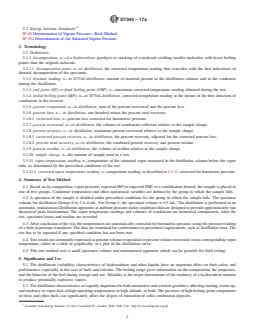
5.1 The distillation (volatility) characteristics of hydrocarbons and other liquids have an important effect on their safety and performance, especially in the case of fuels and solvents. The boiling range gives information on the composition, the properties, and the behavior of the fuel during storage and use. Volatility is the major determinant of the tendency of a hydrocarbon mixture to produce potentially explosive vapors.
5.2 The distillation characteristics are equally important for both automotive and aviation gasolines, affecting starting, warm-up, and tendency to vapor lock at high operating temperatures or high altitude, or both. The presence of high boiling point components in these and other fuels can significantly affect the degree of formation of solid combustion deposits.
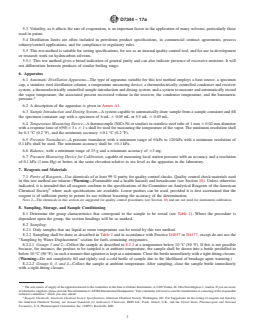
5.3 Volatility, as it affects the rate of evaporation, is an important factor in the application of many solvents, particularly those used in paints.
5.4 Distillation limits are often included in petroleum product specifications, in commercial contract agreements, process refinery/control applications, and for compliance to regulatory rules.
5.5 This test method is suitable for setting specifications, for use as an internal quality control tool, and for use in development or research work on hydrocarbon solvents.
5.5.1 This test method gives a broad indication of general purity and can also indicate presence of excessive moisture. It will not differentiate between products of similar boiling range.
SCOPE
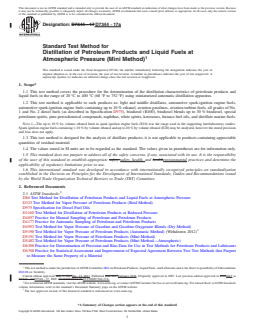
1.1 This test method covers the procedure for the determination of the distillation characteristics of petroleum products and liquid fuels in the range of 20 °C to 400 °C (68 °F to 752 °F) using miniaturized automatic distillation apparatus.
1.2 This test method is applicable to such products as: light and middle distillates, automotive spark-ignition engine fuels, automotive spark-ignition engine fuels containing up to 10 % ethanol, aviation gasolines, aviation turbine fuels, all grades of No. 1 and No. 2 diesel fuels (as described in Specification D975), biodiesel (B100), biodiesel blends up to 30 % biodiesel, special petroleum spirits, pure petrochemical compounds, naphthas, white spirits, kerosenes, furnace fuel oils, and distillate marine fuels.
Note 1: The up to 10 % by volume ethanol limit in spark ignition engine fuels (E10) was the range used in the supporting interlaboratory studies. Spark ignition engine fuels containing > 10 % by volume ethanol and up to 20 % by volume ethanol (E20) may be analyzed, however the stated precision and bias does not apply.
1.3 This test method is designed for the analysis of distillate products; it is not applicable to products containing appreciable quantities of residual material.
1.4 The values stated in SI units are to be regarded as the standard. The values given in parentheses are for information only.
1.5 This standard does not purport to address all of the safety concerns, if any, associated with its use. It is the responsibility of the user of this standard to establish appropriate safety, health, and environmental practices and determine the applicability of regulatory limitations prior to use.
1.6 This international standard was developed in accordance with internationally recognized principles on standardization established in the Decision on Principles for the Development of International Standards, Guides and Recommendations issued by the World Trade Organization Technical Barriers to Trade (TBT) Committee.
- Status
- Published
- Publication Date
- 14-Dec-2017
- Technical Committee
- D02 - Petroleum Products, Liquid Fuels, and Lubricants
- Drafting Committee
- D02.08 - Volatility
Buy Documents
ASTM D7344-17a - Standard Test Method for Distillation of Petroleum Products and Liquid Fuels at Atmospheric Pressure (Mini Method)
REDLINE ASTM D7344-17a - Standard Test Method for Distillation of Petroleum Products and Liquid Fuels at Atmospheric Pressure (Mini Method)
Overview
ASTM D7344-17a: Standard Test Method for Distillation of Petroleum Products and Liquid Fuels at Atmospheric Pressure (Mini Method) is a key international standard developed by ASTM International. This test method specifies procedures for determining the distillation characteristics of a wide range of petroleum products and liquid fuels using a miniaturized, automated distillation apparatus. Distillation, which measures the boiling range of a hydrocarbon mixture, provides crucial information regarding product composition, quality, volatility, and overall behavior under storage and use conditions. The mini method allows for efficient, accurate analysis using small sample volumes, making it ideal for both laboratory and field testing.
Key Topics
- Volatility Measurement: Volatility is a critical property affecting the safety and performance of fuels and solvents. The test method establishes how quickly a hydrocarbon mixture forms vapors, which is important for assessing the risk of explosion or fire.
- Boiling Range Determination: The method provides data on initial boiling point (IBP), final boiling point (FBP), and the distillation curve, indicating the percentage of the sample evaporated at various temperatures.
- Sample Applicability: ASTM D7344-17a applies to automotive gasolines (including ethanol blends up to E10), aviation fuels, diesel fuels (all grades), biodiesel and blends (up to 30% biodiesel), naphthas, kerosenes, furnace fuel oils, marine fuels, pure petrochemical compounds, and petroleum solvents.
- Quality Control and Research: The method is suitable for setting product specifications, serving as an internal quality assurance tool, and supporting development and research on hydrocarbon solvents.
- Safety Considerations: Users are reminded to assess health, safety, and environmental practices and to consider any regulatory limitations before using the method.
Applications
ASTM D7344-17a is widely used throughout the petroleum, fuel, and chemical industries for:
- Product Specification and Compliance: Ensuring consistency with national and international fuel standards and regulatory requirements.
- Commercial Transactions: Documenting product volatility parameters in contracting, shipment, and delivery of petroleum products.
- Process and Quality Control: Conducting rapid, accurate analysis in refineries, blending facilities, and quality control laboratories for routine monitoring and troubleshooting.
- Field Testing: The use of miniaturized automatic apparatus enables portable distillation testing at remote sites or in mobile laboratories.
- Solvent and Paint Industries: Evaluating evaporation rates of solvents used in paint and coatings formulation for both safety and application performance.
- Research and Development: Supporting fuel and solvent innovation and the analysis of new blends, including alternative and bio-based fuels.
Related Standards
ASTM D7344-17a often operates alongside other key standards and test methods, including:
- ASTM D86: Standard Test Method for Distillation of Petroleum Products and Liquid Fuels at Atmospheric Pressure (traditional method).
- ASTM D975: Specification for Diesel Fuel Oils.
- ASTM D323, D4953, D5191, D5482: Test Methods for Vapor Pressure of Petroleum Products.
- ASTM D4057, D4177: Practices for Manual and Automatic Sampling of Petroleum and Petroleum Products.
- ASTM D1160: Test Method for Distillation at Reduced Pressure.
- Energy Institute IP 69, IP 394: International vapor pressure test methods.
For optimal results and regulatory compliance, laboratories and quality assurance groups typically use ASTM D7344-17a with these related standards. This approach ensures comprehensive analysis of distillation and volatility properties essential for safe, reliable fuel and solvent performance.
Keywords: ASTM D7344-17a, mini method distillation, petroleum product volatility, fuel distillation test, boiling range, quality control, automatic distillation apparatus, distillation of liquid fuels, ASTM fuel standards, international fuel testing.
Relations
- Effective Date
- 15-Dec-2017
- Effective Date
- 01-Mar-2024
- Effective Date
- 01-Mar-2024
- Effective Date
- 15-Dec-2023
- Effective Date
- 01-Dec-2023
- Effective Date
- 01-Dec-2023
- Effective Date
- 01-Dec-2023
- Effective Date
- 01-May-2020
- Effective Date
- 01-May-2020
- Effective Date
- 01-Dec-2019
- Effective Date
- 01-May-2019
- Effective Date
- 01-Feb-2019
- Effective Date
- 01-Dec-2018
- Effective Date
- 01-Dec-2018
- Effective Date
- 01-Apr-2018
Buy Documents
ASTM D7344-17a - Standard Test Method for Distillation of Petroleum Products and Liquid Fuels at Atmospheric Pressure (Mini Method)
REDLINE ASTM D7344-17a - Standard Test Method for Distillation of Petroleum Products and Liquid Fuels at Atmospheric Pressure (Mini Method)
Get Certified
Connect with accredited certification bodies for this standard

Element Materials Technology
Materials testing and product certification.

ABS Group Brazil
ABS Group certification services in Brazil.

ABS Quality Evaluations Inc.
American Bureau of Shipping quality certification.
Sponsored listings
Frequently Asked Questions
ASTM D7344-17a is a standard published by ASTM International. Its full title is "Standard Test Method for Distillation of Petroleum Products and Liquid Fuels at Atmospheric Pressure (Mini Method)". This standard covers: SIGNIFICANCE AND USE 5.1 The distillation (volatility) characteristics of hydrocarbons and other liquids have an important effect on their safety and performance, especially in the case of fuels and solvents. The boiling range gives information on the composition, the properties, and the behavior of the fuel during storage and use. Volatility is the major determinant of the tendency of a hydrocarbon mixture to produce potentially explosive vapors. 5.2 The distillation characteristics are equally important for both automotive and aviation gasolines, affecting starting, warm-up, and tendency to vapor lock at high operating temperatures or high altitude, or both. The presence of high boiling point components in these and other fuels can significantly affect the degree of formation of solid combustion deposits. 5.3 Volatility, as it affects the rate of evaporation, is an important factor in the application of many solvents, particularly those used in paints. 5.4 Distillation limits are often included in petroleum product specifications, in commercial contract agreements, process refinery/control applications, and for compliance to regulatory rules. 5.5 This test method is suitable for setting specifications, for use as an internal quality control tool, and for use in development or research work on hydrocarbon solvents. 5.5.1 This test method gives a broad indication of general purity and can also indicate presence of excessive moisture. It will not differentiate between products of similar boiling range. SCOPE 1.1 This test method covers the procedure for the determination of the distillation characteristics of petroleum products and liquid fuels in the range of 20 °C to 400 °C (68 °F to 752 °F) using miniaturized automatic distillation apparatus. 1.2 This test method is applicable to such products as: light and middle distillates, automotive spark-ignition engine fuels, automotive spark-ignition engine fuels containing up to 10 % ethanol, aviation gasolines, aviation turbine fuels, all grades of No. 1 and No. 2 diesel fuels (as described in Specification D975), biodiesel (B100), biodiesel blends up to 30 % biodiesel, special petroleum spirits, pure petrochemical compounds, naphthas, white spirits, kerosenes, furnace fuel oils, and distillate marine fuels. Note 1: The up to 10 % by volume ethanol limit in spark ignition engine fuels (E10) was the range used in the supporting interlaboratory studies. Spark ignition engine fuels containing > 10 % by volume ethanol and up to 20 % by volume ethanol (E20) may be analyzed, however the stated precision and bias does not apply. 1.3 This test method is designed for the analysis of distillate products; it is not applicable to products containing appreciable quantities of residual material. 1.4 The values stated in SI units are to be regarded as the standard. The values given in parentheses are for information only. 1.5 This standard does not purport to address all of the safety concerns, if any, associated with its use. It is the responsibility of the user of this standard to establish appropriate safety, health, and environmental practices and determine the applicability of regulatory limitations prior to use. 1.6 This international standard was developed in accordance with internationally recognized principles on standardization established in the Decision on Principles for the Development of International Standards, Guides and Recommendations issued by the World Trade Organization Technical Barriers to Trade (TBT) Committee.
SIGNIFICANCE AND USE 5.1 The distillation (volatility) characteristics of hydrocarbons and other liquids have an important effect on their safety and performance, especially in the case of fuels and solvents. The boiling range gives information on the composition, the properties, and the behavior of the fuel during storage and use. Volatility is the major determinant of the tendency of a hydrocarbon mixture to produce potentially explosive vapors. 5.2 The distillation characteristics are equally important for both automotive and aviation gasolines, affecting starting, warm-up, and tendency to vapor lock at high operating temperatures or high altitude, or both. The presence of high boiling point components in these and other fuels can significantly affect the degree of formation of solid combustion deposits. 5.3 Volatility, as it affects the rate of evaporation, is an important factor in the application of many solvents, particularly those used in paints. 5.4 Distillation limits are often included in petroleum product specifications, in commercial contract agreements, process refinery/control applications, and for compliance to regulatory rules. 5.5 This test method is suitable for setting specifications, for use as an internal quality control tool, and for use in development or research work on hydrocarbon solvents. 5.5.1 This test method gives a broad indication of general purity and can also indicate presence of excessive moisture. It will not differentiate between products of similar boiling range. SCOPE 1.1 This test method covers the procedure for the determination of the distillation characteristics of petroleum products and liquid fuels in the range of 20 °C to 400 °C (68 °F to 752 °F) using miniaturized automatic distillation apparatus. 1.2 This test method is applicable to such products as: light and middle distillates, automotive spark-ignition engine fuels, automotive spark-ignition engine fuels containing up to 10 % ethanol, aviation gasolines, aviation turbine fuels, all grades of No. 1 and No. 2 diesel fuels (as described in Specification D975), biodiesel (B100), biodiesel blends up to 30 % biodiesel, special petroleum spirits, pure petrochemical compounds, naphthas, white spirits, kerosenes, furnace fuel oils, and distillate marine fuels. Note 1: The up to 10 % by volume ethanol limit in spark ignition engine fuels (E10) was the range used in the supporting interlaboratory studies. Spark ignition engine fuels containing > 10 % by volume ethanol and up to 20 % by volume ethanol (E20) may be analyzed, however the stated precision and bias does not apply. 1.3 This test method is designed for the analysis of distillate products; it is not applicable to products containing appreciable quantities of residual material. 1.4 The values stated in SI units are to be regarded as the standard. The values given in parentheses are for information only. 1.5 This standard does not purport to address all of the safety concerns, if any, associated with its use. It is the responsibility of the user of this standard to establish appropriate safety, health, and environmental practices and determine the applicability of regulatory limitations prior to use. 1.6 This international standard was developed in accordance with internationally recognized principles on standardization established in the Decision on Principles for the Development of International Standards, Guides and Recommendations issued by the World Trade Organization Technical Barriers to Trade (TBT) Committee.
ASTM D7344-17a is classified under the following ICS (International Classification for Standards) categories: 75.180.20 - Processing equipment. The ICS classification helps identify the subject area and facilitates finding related standards.
ASTM D7344-17a has the following relationships with other standards: It is inter standard links to ASTM D7344-17, ASTM D6708-24, ASTM D6300-24, ASTM D975-23a, ASTM D86-23a, ASTM D86-23ae1, ASTM D6300-23a, ASTM D4953-20, ASTM D5482-20, ASTM D6300-19a, ASTM D6708-19, ASTM D975-19, ASTM D975-18a, ASTM D5191-18a, ASTM D6708-18. Understanding these relationships helps ensure you are using the most current and applicable version of the standard.
ASTM D7344-17a is available in PDF format for immediate download after purchase. The document can be added to your cart and obtained through the secure checkout process. Digital delivery ensures instant access to the complete standard document.
Standards Content (Sample)
This international standard was developed in accordance with internationally recognized principles on standardization established in the Decision on Principles for the
Development of International Standards, Guides and Recommendations issued by the World Trade Organization Technical Barriers to Trade (TBT) Committee.
Designation: D7344 − 17a
Standard Test Method for
Distillation of Petroleum Products and Liquid Fuels at
Atmospheric Pressure (Mini Method)
This standard is issued under the fixed designation D7344; the number immediately following the designation indicates the year of
original adoption or, in the case of revision, the year of last revision. A number in parentheses indicates the year of last reapproval. A
superscript epsilon (´) indicates an editorial change since the last revision or reapproval.
1. Scope* mendations issued by the World Trade Organization Technical
Barriers to Trade (TBT) Committee.
1.1 This test method covers the procedure for the determi-
nation of the distillation characteristics of petroleum products
2. Referenced Documents
and liquid fuels in the range of 20 °C to 400 °C (68 °F to
752 °F) using miniaturized automatic distillation apparatus.
2.1 ASTM Standards:
D86 Test Method for Distillation of Petroleum Products and
1.2 This test method is applicable to such products as: light
Liquid Fuels at Atmospheric Pressure
and middle distillates, automotive spark-ignition engine fuels,
D323 TestMethodforVaporPressureofPetroleumProducts
automotive spark-ignition engine fuels containing up to 10 %
(Reid Method)
ethanol, aviation gasolines, aviation turbine fuels, all grades of
D975 Specification for Diesel Fuel Oils
No. 1 and No. 2 diesel fuels (as described in Specification
D1160 Test Method for Distillation of Petroleum Products at
D975),biodiesel(B100),biodieselblendsupto30 %biodiesel,
Reduced Pressure
special petroleum spirits, pure petrochemical compounds,
D4057 Practice for Manual Sampling of Petroleum and
naphthas, white spirits, kerosenes, furnace fuel oils, and
Petroleum Products
distillate marine fuels.
D4177 Practice for Automatic Sampling of Petroleum and
NOTE 1—The up to 10 % by volume ethanol limit in spark ignition
Petroleum Products
engine fuels (E10) was the range used in the supporting interlaboratory
D4953 Test Method for Vapor Pressure of Gasoline and
studies. Spark ignition engine fuels containing > 10 % by volume ethanol
Gasoline-Oxygenate Blends (Dry Method)
and up to 20 % by volume ethanol (E20) may be analyzed, however the
stated precision and bias does not apply.
D5190 Test Method for Vapor Pressure of Petroleum Prod-
ucts (Automatic Method) (Withdrawn 2012)
1.3 This test method is designed for the analysis of distillate
D5191 Test Method for Vapor Pressure of Petroleum Prod-
products;itisnotapplicabletoproductscontainingappreciable
ucts (Mini Method)
quantities of residual material.
D5482 Test Method for Vapor Pressure of Petroleum Prod-
1.4 The values stated in SI units are to be regarded as the
ucts (Mini Method—Atmospheric)
standard. The values given in parentheses are for information
D6300 Practice for Determination of Precision and Bias
only.
Data for Use in Test Methods for Petroleum Products and
1.5 This standard does not purport to address all of the
Lubricants
safety concerns, if any, associated with its use. It is the
D6708 Practice for StatisticalAssessment and Improvement
responsibility of the user of this standard to establish appro-
of Expected Agreement Between Two Test Methods that
priate safety, health, and environmental practices and deter-
Purport to Measure the Same Property of a Material
mine the applicability of regulatory limitations prior to use.
2.2 Energy Institute Standards:
1.6 This international standard was developed in accor-
IP 69 Determination of Vapour Pressure—Reid Method
dance with internationally recognized principles on standard-
IP 394 Determination of Air Saturated Vapour Pressure
ization established in the Decision on Principles for the
Development of International Standards, Guides and Recom-
For referenced ASTM standards, visit the ASTM website, www.astm.org, or
contact ASTM Customer Service at service@astm.org. For Annual Book of ASTM
This test method is under the jurisdiction of ASTM Committee D02 on Standards volume information, refer to the standard’s Document Summary page on
Petroleum Products, Liquid Fuels, and Lubricants and is the direct responsibility of theASTM website.
Subcommittee D02.08 on Volatility. The last approved version of this historical standard is referenced on
Current edition approved Dec. 15, 2017. Published February 2018. Originally www.astm.org.
approved in 2007. Last previous edition approved in 2017 as D7344 – 17. DOI: Available from Energy Institute, 61 New Cavendish St., London, WIG 7AR,
10.1520/D7344-17A. U.K., http://www.energyinst.org.uk.
*A Summary of Changes section appears at the end of this standard
Copyright © ASTM International, 100 Barr Harbor Drive, PO Box C700, West Conshohocken, PA 19428-2959. United States
D7344 − 17a
3. Terminology at ambient pressure under conditions that are designed to
provide approximately one theoretical plate fractionation. The
3.1 Definitions:
vapor temperature readings and volumes of condensate are
3.1.1 decomposition, n—of a hydrocarbon, pyrolysis or
monitored continuously. After the test, specimen losses and
cracking of a molecule yielding smaller molecules with lower
residue are recorded.
boiling points than the original molecule.
4.3 After conclusion of the test, the temperatures are auto-
3.1.1.1 decomposition point, n—in distillation,thecorrected
matically corrected for barometric pressure, using the pressure
temperature reading that coincides with the first indications of
readingofabuilt-inpressuretransducer.Thedataareexamined
thermal decomposition of the specimen.
for conformance to procedural requirements, such as distilla-
3.1.2 dynamic holdup, n—in D7344 distillation, amount of
tion rates.The test has to be repeated if any specified condition
materialpresentinthedistillationcolumn,andinthecondenser
has not been met.
during the distillation.
4.4 Test results are commonly expressed as percent volume
3.1.3 end point (EP) or final boiling point (FBP),
evaporated or percent volume recovered versus corresponding
n—maximum corrected temperature reading obtained during
vapor temperature, either in a table or graphically, as a plot of
the test.
the distillation curve.
3.1.4 initial boiling point (IBP), n—in D7344 distillation,
4.5 This test method uses a small specimen volume and
corrected temperature reading at the instant of the first detec-
miniaturized apparatus which can be portable for field testing.
tion of condensate in the receiver.
3.1.5 percent evaporated, n—in distillation, sum of the
5. Significance and Use
percent recovered and the percent loss.
5.1 The distillation (volatility) characteristics of hydrocar-
3.1.6 percent loss, n— in distillation,onehundredminusthe
bons and other liquids have an important effect on their safety
percent total recovery.
and performance, especially in the case of fuels and solvents.
3.1.6.1 corrected loss, n—percent loss corrected for baro-
The boiling range gives information on the composition, the
metric pressure.
properties, and the behavior of the fuel during storage and use.
3.1.7 percent recovered, n—in distillation, the volume of
Volatility is the major determinant of the tendency of a
condensate collected relative to the sample charge.
hydrocarbon mixture to produce potentially explosive vapors.
3.1.8 percent recovery, n—in distillation, maximum percent
5.2 The distillation characteristics are equally important for
recovered relative to the sample charge.
both automotive and aviation gasolines, affecting starting,
3.1.8.1 corrected percent recovery, n—in distillation, the
warm-up, and tendency to vapor lock at high operating
percent recovery, adjusted for the corrected percent loss.
temperatures or high altitude, or both. The presence of high
boiling point components in these and other fuels can signifi-
3.1.8.2 percent total recovery, n—in distillation, the com-
cantly affect the degree of formation of solid combustion
bined percent recovery and percent residue.
deposits.
3.1.9 percent residue, n—in distillation, the volume of
residue relative to the sample charge.
5.3 Volatility, as it affects the rate of evaporation, is an
important factor in the application of many solvents, particu-
3.1.10 sample charge, n—the amount of sample used in a
larly those used in paints.
test.
5.4 Distillation limits are often included in petroleum prod-
3.1.11 vapor temperature reading, n—temperature of the
uct specifications, in commercial contract agreements, process
saturated vapor measured in the distillation column below the
refinery/control applications, and for compliance to regulatory
vapor tube, as determined by the prescribed conditions of the
rules.
test.
3.1.11.1 corrected vapor temperature reading, 5.5 Thistestmethodissuitableforsettingspecifications,for
n—temperature reading, as described in 3.1.11, corrected for
use as an internal quality control tool, and for use in develop-
barometric pressure. ment or research work on hydrocarbon solvents.
5.5.1 This test method gives a broad indication of general
4. Summary of Test Method
purity and can also indicate presence of excessive moisture. It
willnotdifferentiatebetweenproductsofsimilarboilingrange.
4.1 Based on its composition, vapor pressure, expected IBP
orexpectedFBP,oracombinationthereof,thesampleisplaced
6. Apparatus
in one of five groups. Condenser temperature and other
operational variables are defined by the group in which the
6.1 Automatic Distillation Apparatus—The type of appara-
sample falls.
tus suitable for this test method employs a heat source, a
4.2 A specimen of the sample is distilled under prescribed specimen cup, a stainless steel distillation column, a tempera-
conditions for the group in which the sample falls. The ture measuring device, a thermoelectrically controlled con-
specimen volume for distillation Groups 0 to 3 is 6 mL. For denser and receiver system, a thermoelectrically controlled
Group 4, the specimen volume is 5.5 mL. The distillation is sample introduction and dosing system, and a system to
performed in an automatic, miniaturized distillation apparatus measure and automatically record the vapor temperature, the
D7344 − 17a
TABLE 1 Group Characteristics
associated percent recovered volume in the receiver, the
condenser temperature, and the barometric pressure. Group 0 Group 1 Group 2 Group 3 Group 4
Sample Pure Gasoline Gasoline Jet Fuel Diesel
6.2 A description of the apparatus is given in Annex A1.
characteristics
Distillate type
6.3 Sample Introduction and Dosing System—A system
capable to automatically draw sample from a sample container
Vapor pressure at:
and fill the specimen container cup with a specimen of 6 mL 6 37.8 °C, kPa <65.5 <65.5 <65.5
100 °F, psi <9.5 <9.5 <9.5
0.05 mL or 5.5 mL 6 0.05 mL.
(Test Methods D323,
D4953, D5190, D5191,
6.4 Temperature Measuring Device—A thermocouple
D5482, IP 69, or IP 394)
(NiCr-Niorsimilar)instainlesssteeltubeof1 mm 60.02 mm
Distillation:
diameterwitharesponsetimeoft(90)=3 s 61 sshallbeused
IBP °C >20 #100 >100 >100 >100
°F >68 #212 >212 >212 >212
for measuring the temperature of the vapor. The minimum
EP °C <400 #250 #250 >250 >250
resolution shall be 0.1 °C (0.2 °F), and the minimum accuracy
°F <752 #482 #482 >482 >482
60.1 °C (0.2 °F).
6.5 Pressure Transducer—A pressure transducer with a
8.2.1 Only samples that are liquid at room temperature can
minimum range of 0 kPa to 120 kPa with a minimum resolu-
be tested by this test method.
tion of 0.1 kPa shall be used. The minimum accuracy shall be
8.2.2 Sampling shall be done as described in Table 2 and in
60.1 kPa.
accordance with Practice D4057 or D4177, except do not use
6.6 Balance, with a minimum range of 25 g and a minimum
the “Sampling by Water Displacement” section for fuels
accuracy of 63 mg.
containing oxygenates.
8.2.2.1 Groups 1 and 2—Collect the sample as described in
6.7 Pressure Measuring Device for Calibration, capable of
8.2.2 at a temperature below 10 °C (50 °F). If this is not
measuring local station pressure with an accuracy and a
possible because, for instance, the product to be sampled is at
resolution of 0.1 kPa (1 mm Hg) or better, at the same
ambient temperature, the sample shall be drawn into a bottle
elevationrelativetosealevelastheapparatusinthelaboratory.
prechilled to below 10 °C (50 °F), in such a manner that
agitation is kept at a minimum. Close the bottle immediately
7. Reagents and Materials
with a tight-fitting closure. (Warning—Do not completely fill
7.1 Purity of Reagents—Use chemicals of at least 99 %
and tightly seal a cold bottle of sample due to the likelihood of
purity for quality control checks. Quality control check mate-
breakage upon warming.)
rials used in this test method are toluene (Warning—
8.2.2.2 Groups 0, 3, and 4—Collect the sample at ambient
Flammable and a health hazard) and hexadecane (see Section
temperature. After sampling, close the sample bottle immedi-
10). Unless otherwise indicated, it is intended that all reagents
ately with a tight-fitting closure.
conform to the specifications of the Committee on Analytical
8.2.2.3 If the sample received by the testing laboratory has
Reagents of the American Chemical Society where such
been sampled by others and it is not known whether sampling
specifications are available. Lower purities can be used,
has been performed as described in 8.2, the sample shall be
provided it is first ascertained that the reagent is of sufficient
assumed to have been so sampled.
purity to permit its use without lessening the accuracy of the
8.2.2.4 Follow the manufacturer’s instructions for introduc-
determination.
ing the test specimen into the measuring chamber.
NOTE 2—The chemicals in this section are suggested for quality control
procedures (see Section 10) and are not used for instrument calibration.
8.3 Sample Storage:
8.3.1 If testing is not to start immediately after collection,
8. Sampling, Storage, and Sample Conditioning
store the samples as indicated in 8.3.2 and 8.3.3 and Table 2.
All samples shall be stored away from direct sunlight or
8.1 Determine the group characteristics that correspond to
the sample to be tested (see Table 1). Where the procedure is sources of direct heat.
8.3.2 Groups 1 and 2—Store the sample at a temperature
dependent upon the group, the section headings will be so
below 10 °C (50 °F).
marked.
8.2 Sampling: NOTE 3—If there are no, or inadequate, facilities for storage below or
equal10 °C(50 °F),thesamplemayalsobestoredatatemperaturebelow
20 °C (68 °F), provided the operator ensures that the sample container is
tightly closed and leak-free.
The sole source of supply of the apparatus known to the committee at this time
8.3.3 Groups 0, 3, and 4—Store the sample at ambient or
is Grabner Instruments,A-1220Vienna, Dr. Otto Neurathgasse 1,Austria. If you are
lower temperature.
aware of alternative suppliers, please provide this information to ASTM Interna-
tional Headquarters.Your comments will receive careful consideration at a meeting
1 8.4 Sample Conditioning Prior to Analysis:
of the responsible technical committee, which you may attend.
8.4.1 Samples shall be conditioned to the temperature
Reagent Chemicals, American Chemical Society Specifications, American
Chemical Society, Washington, DC. For Suggestions on the testing of reagents not
shown in Table 2 before opening the sample container.
listed by the American Chemical Society, see Annual Standards for Laboratory
8.4.1.1 Groups 1 and 2—Samples shall be conditioned to a
Chemicals, BDH Ltd., Poole, Dorset, U.K., and the United States Pharmacopeia
temperature of less than 10 °C (50 °F) before opening the
and National Formulary, U.S. Pharmacopeial Convention, Inc. (USPC), Rockville,
MD. sample container.
D7344 − 17a
TABLE 2 Sampling, Storage, and Sample Conditioning
10. Verification of Calibration and Standardization
Group 0 Group 1 Group 2 Group 3 Group 4
10.1 Temperature Measuring Device—Verifythecalibration
Temperature of sample °C <10
of the thermocouple used to monitor the vapor temperature at
bottle
°F <50
least every six months, and after the system has been replaced
A A
Temperature of stored °C ambient <10 <10 ambient ambient
or repaired, against a thermometer which is traceable to
bottle
A A
National Institute of Standards and Technology (NIST) or
°F ambient <50 <50 ambient ambient
Temperature of sample °C ambient <10 <10 ambient ambient
national authorities in the country the equipment is used.
after
10.1.1 The temperature measuring device calibration can be
conditioning prior to °F ambient <50 <50 ambient ambient
analysis
checked by distilling pure toluene (Warning—Flammable and
B C C C
If sample is wet dry resample resample dry dry
a health hazard) in accordance with this test method. The
B D D
If sample is still wet dry dry
temperature measurement system shall indicate, at 50 %
A
Under certain circumstances, samples may also be stored at temperatures
distilled, a temperature of 110.6 °C 6 0.8 °C (231 °F 6
below 20 °C (68 °F). See also 8.3.3.
B
If sample is known to be wet, resampling may be omitted. Dry sample in
1.5 °F).
accordance with 8.5.2 and 8.5.3.
C
10.1.2 To check the temperature measuring device at el-
Dry in accordance with 8.5.3.
D
Dry in accordance with 8.5.2.
evated temperatures, perform a distillation with hexadecane
(cetane). The temperature measurement system shall indicate
at 50 % distilled a temperature of 281.3 °C 6 1.5 °C (538.5 °F
6 3 °F) under Group 3 and 4 distillation conditions.
8.4.1.2 Groups 0, 3, and 4—Samplesshallbeconditionedto
a temperature not above ambient before opening the sample
NOTE 5—The melting point of n-hexadecane is 18 °C (64.5 °F). If the
container.
sample is solid, heat it to about 25 °C (77 °F) and wait until all the
material is liquid before starting the test.
8.5 Wet Samples:
8.5.1 Samples of materials that visibly contain water are not 10.2 Pressure Transducer—Check the calibration of the
suitable for testing. If the sample is not dry, obtain another
transducer at intervals of not more than six months, and after
sample that is free from suspended water.
the instrument has been repaired. The calibration of the
8.5.2 Groups1,and2—Ifsuchasamplecannotbeobtained,
transducer is checked against ambient barometric pressure as
the suspended water can be removed by maintaining the
measured by the pressure measuring device described in 6.7.If
sampleat0 °Cto10 °C(32 °Fto50 °F),addingapproximately
the displayed atmospheric pressure is not equal to the ambient
10 g of anhydrous sodium sulfate per 100 mL of sample,
barometric pressure, adjust the transducer control until the
shaking the mixture for approximately 2 min, and then allow-
appropriate reading is observed. The ambient barometric pres-
ing the mixture to settle for approximately 15 min. Once the
sure is the actual station pressure at the location of the tester at
sample shows no visible signs of water, use a decanted portion
the time of measurement. (Warning—Many aneroid
of the sample, maintained between 1 °C and 10 °C (34 °F and
barometers, such as those used at weather stations and airports,
50 °F), for the analysis. Note in the report that the sample has
are pre-corrected to give sea level readings. These shall not be
been dried by the addition of a desiccant.
used for calibration of the apparatus.)
NOTE 4—Suspended water in hazy samples in Groups 1 and 2 can be
10.3 Receiver System—The percent volume detection sys-
removed by the addition of anhydrous sodium sulfate and separating the
tem of the apparatus shall have a resolution of 6 µL or better
liquid sample from the drying agent by decanting. For Test Method D86,
with a maximum error of 18 µL between the 0.3 mL and 6 mL
it has been shown that this procedure does not statistically affect the
results of the test. points. The calibration of the assembly shall be verified in
accordance with manufacturer’s instructions at intervals of not
8.5.3 Groups 0, 3, and 4—In cases in which a water-free
morethansixmonthsandafterthesystemhasbeenreplacedor
sampleisnotpractical,thesuspendedwatercanberemovedby
repaired.
shaking the sample with anhydrous sodium sulfate or other
suitabledryingagentandseparatingitfromthedryingagentby
11. Procedure
decanting. Note in the report that the sample has been dried by
the addition of a desiccant.
11.1 Connect the specimen container filling system inlet
tubing to the inlet of the apparatus and immerse it in the
9. Preparation of Apparatus
sample. For samples of Group 1, make provisions to avoid loss
9.1 Refer to Table 1 and prepare the instrument by choosing
of high volatiles in the sample. The overall volume of the
the appropriate group in accordance with the manufacturer’s
sample shall be at least 50 mL for all distillation groups (see
instructions.
Table 1). Follow the manufacturer’s instructions for introduc-
ing the test specimen into the measuring chamber.
9.2 Place a specimen cup whose mass has been determined
according to the manufacturer’s instructions to be known to be
11.2 Regulate the temperatures of the specimen container
at least 63 mg on the specimen cup support in the apparatus.
filling system, the condenser, and the receiver system for the
appropriate group of the sample as specified in Table 3. For
biodiesel (B100), the condenser and receiver system is regu-
Supporting data have been filed at ASTM International Headquarters and may
be obtained by requesting Research Report RR:D02-1455. lated to 60 °C 6 0.2 °C.
D7344 − 17a
A
TABLE 3 Default Conditions During Test Procedure
Group 0 Group 1 Group 2 Group 3 Group 4
A
Temperature of filling system °C 10±0.2 10±0.2 10±0.2 10±0.2 40±0.2
°F 50±0.4 50±0.4 50±0.4 50±0.4 104±0.4
A
Temperature of condenser °C 10±0.2 10±0.2 10±0.2 10±0.2 40±0.2
°F 50±0.4 50±0.4 50±0.4 50±0.4 104±0.4
A
Temperature of receiver system °C 10±0.2 10±0.2 10±0.2 10±0.2 40±0.2
°F 50±0.4 50±0.4 50±0.4 50±0.4 104±0.4
Time from first application of heat to <12 <7 <8 <12 <12
initial boiling point, min
Uniform rate of condensation at 5 % $0.15 $0.15 $0.15 $0.15 $0.15
recovered and 95 % recovered,
mL/min
Uniform rate of condensation from 0.3–0.9 0.3–0.9 0.3–0.9 0.3–0.9 0.3–0.9
10 % recovered to 90 % recovered,
mL/min
Time from 95 % recovered to end <4 <4 <4 <4 <4
point, min
Specimen volume of sample (mL) 6 ± 0.05 6 ± 0.05 6 ± 0.05 6 ± 0.05 5.5 ± 0.05
Mean density of liquid residual, g/ccm 0.72 0.76 0.76 0.86 0.87
A
The proper temperature will depend upon the wax content of the sample and of its distillation fractions. The test is generally performed using one single temperature.
Wax formation in the condenser can be deduced from (a) the presence of wax particles in the distillate, (b) a higher distillation loss than what would be expected based
on the initial boiling point of the specimen, (c) an erratic recovery rate and (d) the presence of wax particles during cleaning of the condenser with a lint-free swab. The
minimum temperature that permits satisfactory operation shall be used. In some cases involving grade No. 2 fuel oil, Grade No. 2-D diesel fuel oil, gas oils, pure
petrochemical compounds, and similar distillates, it may be necessary to hold the condenser, receiver and filling system temperature in the 40 °C to 60 °C (86 °F to 140 °F)
range. Also, for very high volatile Group 1 samples, it may be necessary to decrease the filling and receiving temperature to 5 °C (41 °F).
11.3 Filling—Following the manufacturer’s instructions, 11.8 In the interval between the IBP and the end of the
draw in sample, and place a specimen of 6 mL 6 0.05 mL distillation, record all volumes in the receiving cylinder to the
(Groups 0 to 3) or 5.5 mL 6 0.05 mL (Group 4) into the nearest 5 µL, and all temperature readings to the nearest 0.1 °C
specimen cup. (0.2 °F).
11.8.1 Record temperature readings at least at every 0.25 %
11.4 Initial Boiling Point—Apply heat to the specimen cup
recovered.
and note the start time.
11.9 When the percent recovered is approximately 95 %,
11.5 Regulate the specimen container heating so that the
make a final adjustment of the heat. The time from the 95 %,
time interval between the first application of heat and the IBP
recovered to the EP(FBP) shall be within the limits prescribed
is as specified in Table 3. Record the IBP to the nearest 0.1 °C
in Table 3. If this condition is not satisfied, repeat the test with
(0.2 °F).
appropriate modification of the final heat adjustment.
11.6 Continue to regulate the specimen container heating so
11.10 Observe and record the EP (FBP) as required, and
that the uniform average rate of condensation from 5 % or
discontinue the heating.
10 % recovered to 95 % recovered is 0.6 mL 6 0.3 mL per
11.11 Allow the distillate to drain into the receiver, after
min, as specified in Table 3.(Warning—Due to the configu-
specimen heating has been discontinued. The apparatus shall
ration of the distillation column and the conditions of the test,
continually monitor the percent recovered volume until this
the vapor and liquid around the temperature sensor are not in
volume changes by no more than 10 µL in 1 min.
thermodynamic equilibrium. The distillation rate will conse-
quently have an effect on the measured vapor temperature.The
11.12 Record the volume in the receiver, in mL, as the
distillation rate shall, therefore, be kept as constant as possible
percent recovered volume.
throughout the test.)
11.13 After the specimen cup has cooled place the cup on a
NOTE 6—When testing gasoline samples, it is not uncommon to see the
balance and determine the mass of the cup plus residual
condensate suddenly form non-miscible liquid phases and bead up on the
temperature sensor and in the neck of the distillation column at a vapor
specimen to the nearest 63 mg. (Warning—Take adequate
temperature of around 160 °C (320 °F). This may be accompanied by a
precautions when removing the sample cup to prevent acci-
sharp (about 3 °C (6 °F)) dip in the vapor temperature and a drop in the
dental burns. Remove the cup in accordance with the manu-
recovery rate. The phenomenon, which may be due to the presence of
facturer’s instructions.)
trace water in the sample, may last for 10 s to 30 s before the temperature
recovers and the condensate starts flowing smoothly again. This point is 11.13.1 If a residue larger than 300 mg is obtained and the
sometimes colloquially referred to as the Hesitation Point.
distillation was not purposely terminated before the EP, check
whether adequate heat was applied towards the end of the
11.7 If a decomposition point is observed, discontinue the
distillation and whether conditions during the test conform to
heating and proceed as directed in 11.13.
those specified in Table 3.
NOTE 7—Characteristic indications of thermal decomposition are evo-
11.14 Repeat any distillation that did not meet the require-
lutionoffumesanderratic,typicallydecreasing,temperaturereadingsthat
occur during the final stages of the distillation. ments described in 11.5 and 11.6.
D7344 − 17a
NOTE 8—The test method is not designed for the analysis of distillate
L 5 0.51 L 2 0.5 / 11 101.3 2 P /8.00 (6)
~ ! $ ~ ! %
c k
fuels containing appreciable quantities of residual material (see 1.2).
L 5 0.51~L 2 0.5!/$11~760 2 P!/60.0% (7)
c
12. Calculations
where:
12.1 Calculate the percent recovery in accordance with the
L = observed loss,
following equation: L = corrected loss,
c
P = pressure, kPa, and
k
R 5 100 V /V (1)
R S
P = pressure, mm Hg.
where:
NOTE 10—Eq 6 and 7 have been derived from the data in Table 7 and
Eqs5and6inTestMethodD86-95andearlierversions.Itisprobablethat
R = percent recovery,
Eq 6 and 7 shown were the original empirical equations from which the
V = recovered volume, in mL (see 11.14), and
R
table and equations in the Test Method D86-95 and earlier versions were
V = sample charge, in mL (see 11.3).
S
derived.
12.2 Calculate the percent residue in accordance with the
12.5.1 Calculate the corresponding corrected percent recov-
following equation:
ery in accordance with the following equation:
R 5 100 M 2 M / ρ V (2)
~ ! ~ !
p t c R S R 5 R1 L 2 L (8)
~ !
c c
where:
where:
R = percent residue,
p
L = percent loss or observed loss,
M = total mass of specimen cup and residual specimen in
t L = corrected loss,
c
the cup, as determined in 11.13,ing,
R = percent recovery, and
M = mass of the empty specimen cup, in g,
c R = corrected percent recovery.
c
ρ = mean density of residual specimen (see Table 3), in
R
12.6 To obtain the percent evaporated at a prescribed
g/ccm, and
temperature reading, add the percent loss to each of the
V = sample charge, in mL (see 11.3).
S
observed percent recovered at the prescribed temperature
12.3 The percent total recovery is the sum of the percent
readings, and report these results as the respective percent
recovery (see 12.1) and the percent residue (see 12.2). Deduct
evaporated, that is:
the percent total recovery from 100 to obtain the percent loss.
P 5 P 1L (9)
e r
12.4 Correct temperature readings to 101.3 kPa (760 mm
where:
Hg) pressure. Obtain the correction to be applied to each
temperature reading by means of the Sydney Young equation L = observed loss,
P = percent evaporated, and
as given in Eq 3, Eq 4,or Eq 5, as appropriate.
e
P = percent recovered.
For Celsius temperatures: r
12.7 To report a temperature reading at a prescribed percent
C 5 0.0009 ~101.3 2 P !~2731t ! (3)
c k c
evaporated, obtain the desired temperature directly from the
C 5 0.00012 ~760 2 P!~2731t ! (4)
c c
databaseasthetemperatureclosesttoandwithin0.1volume %
For Fahrenheit temperatures:
of the prescribed percent evaporated.
NOTE 11—The available instruments perform most procedures de-
C 5 0.00012 ~760 2 P!~4601t ! (5)
f f
scribed in Sections 11 and 12 automatically.
where:
12.8 If ‘predicted D86’ distillation results are required,
t = the observed temperature reading in °C,
c
apply the bias corrections found in 14.3 to calculate the
t = the observed temperature reading in °F,
f
‘predicted D86’ results.
C and C = corrections to be added algebraically to the
c f
observed temperature readings,
13. Report
P = barometric pressure, prevailing at the time and
k
13.1 Report the following information:
location of the test, in kPa, and
P = barometric pressure, prevailing at the time and
13.2 Report the barometric pressure to the nearest 0.1 kPa
location of the test, in mm Hg.
(1 mm Hg).
12.4.1 After applying the corrections and rounding each
13.3 Report all volumetric readings in percentages to the
result to the nearest 0.1 °C (0.2 °F), use the corrected tempera-
nearest 0.1 %, and all temperature readings to the nearest
ture readings in all further calculations and reporting.
0.1 °C (0.2 °F).
NOTE9—Temperaturereadingsarenotcorrectedto101.3 kPa(760 mm
13.4 After barometric corrections of the temperature read-
Hg) when product definitions, specifications, or agreements between the
ings have been made, the following data require no further
parties involved indicate, specifically, that such correction is not required
calculation prior to reporting: IBP, EP (FBP), decomposition
or that correction shall be made to some other base pressure.
point, and all pairs of corresponding values involving percent
12.5 Correct the actual loss to 101.3 kPa (760 mm Hg)
recovered and temperature readings.
pressure when temperature readings are corrected to 101.3 kPa
pressure. The corrected loss, L , is calculated from Eq 6 or Eq 13.5 It is advisable to base the report on relationships
c
7, as appropriate. betweentemperaturereadingsandpercentevaporatedwhenthe
D7344 − 17a
sample is a gasoline, or any other product classified under 14.1.2 Reproducibility—The difference between two single
Group 1, or in which the percent loss is greater than 2.0. and independent results obtained by different operators work-
Otherwise, the report can be based on relationships between ing in different laboratories on identical material would, in the
temperature readings and percent evaporated or percent recov- long run, in the normal and correct operation of the test
ered. Every report must indicate clearly which basis has been method, exceed the following values in only one case in
used. twenty:
Group 0: Refer to Annex A2 for tables of calculated reproducibility.
13.6 Report if a drying agent, as described in 8.5.2 or 8.5.3,
IBP: R = T × 0.0000007052 valid range: 65 °C – 215 °C
was used.
1.6477
E10: R = T × 0.0002509 valid range: 65 °C – 240 °C
0.81
E50: R = T × 0.008968 valid range: 65 °C – 255 °C
13.7 If ‘predicted D86’ distillation results are required,
–0.2137
E90: R = T × 1.6210 valid range: 65 °C – 255 °C
0.9815
report the results from 12.8 as ‘predicted D86’ distillation
FBP: R = T × 0.06388 valid range: 65 °C – 265 °C
results as determined by Test Method D7344.
Group 1 and 2 (NOT4): Refer to Annex A2 for tables of calculated
reproducibility.
14. Precision and Bias
IBP: R = 5.27 valid range: 20 °C – 60 °C
E10: R = 4.68 valid range: 40 °C – 65 °C
14.1 Precision—The precision of this test method has been
E50: R = 0.04536 × (E – 50) valid range: 75 °C – 105 °C
determinedbythestatisticalexaminationofinterlaboratorytest
E90: R = 3.53 valid range: 145 °C – 165 °C
FBP: R = 4.82 valid range: 170 °C – 200 °C
results.
Group 3 and 4 (GRP4): Refer to Annex A2 for tables of calculated
NOTE 12—The precision has been derived according to the group
reproducibility.
number in the following fashion. Group 1 and 2 samples are labeled as
IBP: R = 5.32 valid range: 150 °C – 190 °C
NOT4, and Group 3 and 4 samples are labeled GRP4.
T10: R = 0.06407 × (T – 135) valid range: 160 °C – 220 °C
NOTE 13—Distillation limits are typically not specified for fuel oils of
T50: R = 0.02475 × (T – 137) valid range: 165 °C – 285 °C
grades Nos. 4, 5, and 6.
T90: R = 0.01567 × (T – 20) valid range: 180 °C – 345 °C
NOTE 14—Information on the precision of % evaporated or % recov-
T95: R = 0.01062 × (T + 210) valid range: 185 °C – 355 °C
ered at a prescribed temperature can be found in Annex A4.
FBP: R = 0.01667 × (T – 37) valid range: 200 °C – 370 °C
where:
14.1.1 Repeatability—The difference between successive
E = evaporated temperature within valid range prescribed
test results obtained by the same apparatus under constant
T = recovered temperature within valid range prescribed
operating conditions on identical test material would, in the
NOTE 16—See Note 15.
long run, in the normal and correct operation of the test
NOTE 17—Precision was not determined above E50 for one sample of
method,exceedthefollowingvalueonlyinonecaseintwenty: aviation gasoline, because its unique boiling profile would give it undue
leverage on the precision estimates. Users are cautioned that the actual
Group 0: Refer to Annex A2 for tables of calculated repeatability.
3 precisions for aviation gasoline may differ from these estimates.
IBP: r = T × 0.0000006265 valid range: 65 °C – 215 °C
1.6477
NOTE 18—The degrees of freedom associated with the reproducibility
T10: r = T × 0.0002254 valid range: 65 °C – 240 °C
0.81
estimate from this interlaboratory study for NOT4 samples are 27 for IBP
T50: r = T × 0.004725 valid range: 65 °C – 255 °C
–0.2137
T90: r = T × 0.6504 valid range: 65 °C – 255 °C and 25 for E10. These do not meet the minimum requirements of Practice
0.9815
FBP: r = T × 0.03547 valid range: 65 °C – 265 °C
D6300. Users should be aware that the two corresponding reproducibility
estimates are not as precise as the others.
Groups 1 and 2 (NOT4): Refer to Annex A2 for tables of calculated
14.2 Bias—Since there is no accepted reference material
repeatability.
IBP: r = 2.46 valid range: 20 °C – 60 °C
suitable for determining bias for the procedure in this test
E10: r = 1.97 valid range: 40 °C – 65 °C
method, bias has not been determined.
E50: r = 0.02939 × (E – 50) valid range: 75 °C – 105 °C
E90: r = 2.45 valid range: 145 °C – 165 °C
14.3 Relative Bias—The Degree of Agreement between
FBP: r = 3.22 valid range: 170 °C – 200 °C
results by Test Method D7344 and Test Method D86
Group 3 and 4 (GRP4): Refer to Annex A2 for tables of calculated
(automated)—The 2015 interlaboratory study (ILS-1058) was
repeatability.
not used to determine the relative bias statements. The relative
IBP: r = 3.57 valid range: 150 °C – 190 °C
bias statements are from the 2005 interlaboratory study.
T10: r = 0.04782 × (T – 135) valid range: 160 °C – 220 °C
T50: r = 0.01926 × (T – 137) valid range: 165 °C – 285 °C
ResultsonthesamematerialsproducedbyTestMethodD7344
T90: r = 0.009911 × (T – 20) valid range: 180 °C – 345 °C
and Test Method D86 were assessed in accordance with
T95: r = 0.006461 × (T + 210) valid range: 185 °C – 355 °C
procedures outlined in Practice D6708. The findings were:
FBP: r = 0.01033 × (T – 37) valid range: 200 °C – 370 °C
where:
E = evaporated temperature within valid range prescribed IBP:
T = recovered temperature within valid range prescribed
NOT4
No bias-correction considered in Practice D6708 can further improve
NOTE 15—For naphthas, solvents, and other similar materials where
agreement between results from Test Method D7344 and Test Method
percent recovered are reported and the percent loss is typically less than
D86 (automated), for sample types and property ranges studied. Sample-
one percent, the percent recovered temperatures can be considered
specific bias, as defined in Practice D6708, was observed for some
identical to the percent evaporated temperatures, and precision can be
samples.
calculated as shown for Group NOT4.
Supporting data have been filed atASTM International Headquarters and may
beobtainedbyrequestingResearchReportRR:D02-1793.ContactASTMCustomer
Supporting data (the results of the 2015 Interlaboratory Cooperative Test Service at service@astm.org.
Program) have been filed atASTM International Headquarters and may be obtained Supporting data (the results of the 2005 Interlaboratory Cooperative Test
by requesting Research Report RR:D02-1855. Contact ASTM Customer Service at Program) have been filed atASTM International Headquarters and may be obtained
service@astm.org. by requesting Research Report RR:D02-1621.
D7344 − 17a
No bias-correction considered in Practice D6708 can further improve
Differences between results from Test Method D7344 and Test Method agreement between results from Test Method D7344 and Test Method
D86 (automated), for the sample types and property ranges studied, are D86 (automated), for sample types and property ranges studied. Sample-
expected to exceed the following cross method reproducibility (R ), as specific bias, as defined in Practice D6708, was observed for some
XY
defined in Practice D6708, about 5 % of the time. samples.
Group NOT4: Refer to Annex A3. Differences between results from Test Method D7344 and Test Method
D86 (automated), for the sample types and property ranges studied, are
expected to exceed the following cross method reproducibility (R ), as
GRP4
XY
The degree of agreement between results from Test Method D7344 and defined in Practice D6708, about 5 % of the time.
Test Method D86 (automated) can be further improved by applying the
bias-correction outlined in Eq 10. Sample-specific bias, as defined in Group NOT4: Refer to Annex A3.
Practice D6708, was observed for some samples after applying the bias-
correction. GRP4
The degree of agreement between results from Test Method D7344 and
Test Method D86 (automated) can be further improved by applying the
Bias2 corrected X 5 predicted Y 5 X 2 12.4 °C (10)
bias-correction outlined in Eq 13. Sample-specific bias, as defined in
Practice D6708, was observed for some samples after applying the bias-
where:
correction.
X = result obtained by Test Method D7344 (this test method), and
bias-corrected X = predicted Y = result that would have been obtained by
Bias2 corrected X 5 predicted Y 5 0.98 X13.21 °C (13)
Test Method D86 (automated) on the same sample.
where:
Differences between bias-corrected results from Eq 10 and Test Method
D86, for the sample types and property ranges studied, are expected to X = result obtained by Test Method D7344 (this test method), and
bias-corrected X = predicted Y = result that would have been obtained by
exceed the following cross method reproducibility (R ), as defined in
XY
Practice D6708, about 5 % of the time. Test Method D86 (automated) on the same sample.
Group GRP4: Refer to Annex A3. Differences between bias-corrected results from Eq 13 and Test Method
D86 (automated), for the sample types and property ranges studied, are
expected to exceed the following cross method reproducibility (R ), as
T10:
XY
defined in Practice D6708, about 5 % of the time.
NOT4
The degree of agreement between results from Test Method D7344 and
Group GRP4: Refer to Annex A3.
Test Method D86 (automated) can be further improved by applying the
bias-correction outlined in Eq 11. Sample-specific bias, as defined in
T90:
Practice D6708, was observed for some samples after applying the bias-
correction. NOT4
No bias-correction considered in Practice D6708 can further improve
agreement between results from Test Method D7344 and Test Method
Bias2 corrected X 5 predicted Y 5 X13.65 °C (11)
D86 (automated), for sample types and property ranges studied. Sample-
specific bias, as defined in Practice D6708, was observed for some
where:
samples.
X = result obtained by Test Method D7344 (this test method), and
bias-corrected X = predicted Y = result that would have been obtained by
Differences between results from Test Method D7344 and Test Method
Test Method D86 (automated) on the same sample.
D86 (automated), for the sample types and property ranges studied, are
expected to exceed the following cross method reproducibility (R ), as
XY
Differences between bias-corrected results from Eq 11 and Test Method
defined in Practice D6708, about 5 % of the time.
D86, for the sample types and property ranges studied, are expected to
Group NOT4: Refer to Annex A3.
exceed the following cross method reproducibility (R ), as defined in
XY
Practice D6708, about 5 % of the time.
GRP4
No bias-correction considered in Practice D6708 can further improve
Group NOT4: Refer to Annex A3.
agreement between results from Test Method D7344 and Test Method
D86 (automated), for sample types and property ranges studied. Sample-
GRP4
specific bias, as defined in Practice D6708, was observed for some
The degree of agreement between results from Test Method D7344 and
samples.
Test Method D86 (automated) can be further improved by applying the
bias-correction outlined in Eq 12. Sample-specific bias, as defined in
Differences between results from Test Method D7344 and Test Method
Practice D6708, was observed for some samples after applying the bias-
D86 (automated), for the sample types and property ranges studied, are
correction.
expected to exceed the following cross method reproducibility (R ), as
XY
defined in Practice D6708, about 5 % of the time.
Bias2 corrected X 5 predicted Y 5 0.97 X13.97 °C (12)
Group GRP4: Refer to Annex A3.
where:
FBP:
X = result obtained by Test Method D7344 (this test method), and
bias-corrected X = predicted Y = result that would have been obtained by
NOT4
Test Method D86 (automated) on the same sample.
No bias-correction considered in Practice D6708 can further improve
agreement between results from Test Method D7344 and Test Method
Differences between bias-corrected results from Eq 12 and Test Method
D86 (automated), for sample types and property ranges studied. Sample-
D86, for the sample types and property ranges studied, are expected to
specific bias, as defined in Practice D6708, was observed for some
exceed the following cross method reproducibility (R ), as defined in
XY samples.
Practice D6708, about 5 % of the time.
Differences between results from Test Method D7344 and Test Method
Group GRP4: Refer to Annex A3.
D86 (automated), for the sample types and property ranges studied, are
expected to exceed the following cross method reproducibility (R ), as
XY
T50:
defined in Practice D6708, about 5 % of the time.
NOT4
D7344 − 17a
14.5.2 Reproducibility—The difference between two single
Group NOT4: Refer to Annex A3.
and independent test results, obtained by different operators
GRP4
working in different laboratories on identical test material,
The degree of agreement between results from Test Method D7344 and
would in the long run, in normal and correct operation of this
Test Method D86 (automated)
...
This document is not an ASTM standard and is intended only to provide the user of an ASTM standard an indication of what changes have been made to the previous version. Because
it may not be technically possible to adequately depict all changes accurately, ASTM recommends that users consult prior editions as appropriate. In all cases only the current version
of the standard as published by ASTM is to be considered the official document.
Designation: D7344 − 17 D7344 − 17a
Standard Test Method for
Distillation of Petroleum Products and Liquid Fuels at
Atmospheric Pressure (Mini Method)
This standard is issued under the fixed designation D7344; the number immediately following the designation indicates the year of
original adoption or, in the case of revision, the year of last revision. A number in parentheses indicates the year of last reapproval. A
superscript epsilon (´) indicates an editorial change since the last revision or reapproval.
1. Scope*
1.1 This test method covers the procedure for the determination of the distillation characteristics of petroleum products and
liquid fuels in the range of 20 °C to 400 °C (68 °F to 752 °F) using miniaturized automatic distillation apparatus.
1.2 This test method is applicable to such products as: light and middle distillates, automotive spark-ignition engine fuels,
automotive spark-ignition engine fuels containing up to 10 % ethanol, aviation gasolines, aviation turbine fuels, all grades of No.
1 and No. 2 diesel fuels (as described in Specification D975), biodiesel (B100), biodiesel blends up to 30 % biodiesel, special
petroleum spirits, pure petrochemical compounds, naphthas, white spirits, kerosenes, furnace fuel oils, and distillate marine fuels.
NOTE 1—The up to 10 % by volume ethanol limit in spark ignition engine fuels (E10) was the range used in the supporting interlaboratory studies.
Spark ignition engine fuels containing > 10 % by volume ethanol and up to 20 % by volume ethanol (E20) may be analyzed, however the stated precision
and bias does not apply.
1.3 This test method is designed for the analysis of distillate products; it is not applicable to products containing appreciable
quantities of residual material.
1.4 The values stated in SI units are to be regarded as the standard. The values given in parentheses are for information only.
1.5 This standard does not purport to address all of the safety concerns, if any, associated with its use. It is the responsibility
of the user of this standard to establish appropriate safety safety, health, and healthenvironmental practices and determine the
applicability of regulatory limitations prior to use.
1.6 This international standard was developed in accordance with internationally recognized principles on standardization
established in the Decision on Principles for the Development of International Standards, Guides and Recommendations issued
by the World Trade Organization Technical Barriers to Trade (TBT) Committee.
2. Referenced Documents
2.1 ASTM Standards:
D86 Test Method for Distillation of Petroleum Products and Liquid Fuels at Atmospheric Pressure
D323 Test Method for Vapor Pressure of Petroleum Products (Reid Method)
D975 Specification for Diesel Fuel Oils
D1160 Test Method for Distillation of Petroleum Products at Reduced Pressure
D4057 Practice for Manual Sampling of Petroleum and Petroleum Products
D4177 Practice for Automatic Sampling of Petroleum and Petroleum Products
D4953 Test Method for Vapor Pressure of Gasoline and Gasoline-Oxygenate Blends (Dry Method)
D5190 Test Method for Vapor Pressure of Petroleum Products (Automatic Method) (Withdrawn 2012)
D5191 Test Method for Vapor Pressure of Petroleum Products (Mini Method)
D5482 Test Method for Vapor Pressure of Petroleum Products (Mini Method—Atmospheric)
D6300 Practice for Determination of Precision and Bias Data for Use in Test Methods for Petroleum Products and Lubricants
D6708 Practice for Statistical Assessment and Improvement of Expected Agreement Between Two Test Methods that Purport
to Measure the Same Property of a Material
This test method is under the jurisdiction of ASTM Committee D02 on Petroleum Products, Liquid Fuels, and Lubricants and is the direct responsibility of Subcommittee
D02.08 on Volatility.
Current edition approved May 1, 2017Dec. 15, 2017. Published June 2017February 2018. Originally approved in 2007. Last previous edition approved in 20142017 as
D7344 – 14.D7344 – 17. DOI: 10.1520/D7344-17.10.1520/D7344-17A.
For referenced ASTM standards, visit the ASTM website, www.astm.org, or contact ASTM Customer Service at service@astm.org. For Annual Book of ASTM Standards
volume information, refer to the standard’s Document Summary page on the ASTM website.
The last approved version of this historical standard is referenced on www.astm.org.
*A Summary of Changes section appears at the end of this standard
Copyright © ASTM International, 100 Barr Harbor Drive, PO Box C700, West Conshohocken, PA 19428-2959. United States
D7344 − 17a
2.2 Energy Institute Standards:
IP 69 Determination of Vapour Pressure—Reid Method
IP 394 Determination of Air Saturated Vapour Pressure
3. Terminology
3.1 Definitions:
3.1.1 decomposition, n—of a hydrocarbon, pyrolysis or cracking of a molecule yielding smaller molecules with lower boiling
points than the original molecule.
3.1.1.1 decomposition point, n—in distillation, the corrected temperature reading that coincides with the first indications of
thermal decomposition of the specimen.
3.1.2 dynamic holdup, n—in D7344 distillation, amount of material present in the distillation column, and in the condenser
during the distillation.
3.1.3 end point (EP) or final boiling point (FBP), n—maximum corrected temperature reading obtained during the test.
3.1.4 initial boiling point (IBP), n—in D7344 distillation, corrected temperature reading at the instant of the first detection of
condensate in the receiver.
3.1.5 percent evaporated, n—in distillation, sum of the percent recovered and the percent loss.
3.1.6 percent loss, n— in distillation, one hundred minus the percent total recovery.
3.1.6.1 corrected loss, n—percent loss corrected for barometric pressure.
3.1.7 percent recovered, n—in distillation, the volume of condensate collected relative to the sample charge.
3.1.8 percent recovery, n—in distillation, maximum percent recovered relative to the sample charge.
3.1.8.1 corrected percent recovery, n—in distillation, the percent recovery, adjusted for the corrected percent loss.
3.1.8.2 percent total recovery, n—in distillation, the combined percent recovery and percent residue.
3.1.9 percent residue, n—in distillation, the volume of residue relative to the sample charge.
3.1.10 sample charge, n—the amount of sample used in a test.
3.1.11 vapor temperature reading, n—temperature of the saturated vapor measured in the distillation column below the vapor
tube, as determined by the prescribed conditions of the test.
3.1.11.1 corrected vapor temperature reading, n—temperature reading, as described in 3.1.11, corrected for barometric pressure.
4. Summary of Test Method
4.1 Based on its composition, vapor pressure, expected IBP or expected FBP, or a combination thereof, the sample is placed in
one of five groups. Condenser temperature and other operational variables are defined by the group in which the sample falls.
4.2 A specimen of the sample is distilled under prescribed conditions for the group in which the sample falls. The specimen
volume for distillation Groups 0 to 3 is 6 mL. For Group 4, the specimen volume is 5.5 mL. The distillation is performed in an
automatic, miniaturized distillation apparatus at ambient pressure under conditions that are designed to provide approximately one
theoretical plate fractionation. The vapor temperature readings and volumes of condensate are monitored continuously. After the
test, specimen losses and residue are recorded.
4.3 After conclusion of the test, the temperatures are automatically corrected for barometric pressure, using the pressure reading
of a built-in pressure transducer. The data are examined for conformance to procedural requirements, such as distillation rates. The
test has to be repeated if any specified condition has not been met.
4.4 Test results are commonly expressed as percent volume evaporated or percent volume recovered versus corresponding vapor
temperature, either in a table or graphically, as a plot of the distillation curve.
4.5 This test method uses a small specimen volume and miniaturized apparatus which can be portable for field testing.
5. Significance and Use
5.1 The distillation (volatility) characteristics of hydrocarbons and other liquids have an important effect on their safety and
performance, especially in the case of fuels and solvents. The boiling range gives information on the composition, the properties,
and the behavior of the fuel during storage and use. Volatility is the major determinant of the tendency of a hydrocarbon mixture
to produce potentially explosive vapors.
5.2 The distillation characteristics are equally important for both automotive and aviation gasolines, affecting starting, warm-up,
and tendency to vapor lock at high operating temperatures or high altitude, or both. The presence of high boiling point components
in these and other fuels can significantly affect the degree of formation of solid combustion deposits.
Available from Energy Institute, 61 New Cavendish St., London, WIG 7AR, U.K., http://www.energyinst.org.uk.
D7344 − 17a
5.3 Volatility, as it affects the rate of evaporation, is an important factor in the application of many solvents, particularly those
used in paints.
5.4 Distillation limits are often included in petroleum product specifications, in commercial contract agreements, process
refinery/control applications, and for compliance to regulatory rules.
5.5 This test method is suitable for setting specifications, for use as an internal quality control tool, and for use in development
or research work on hydrocarbon solvents.
5.5.1 This test method gives a broad indication of general purity and can also indicate presence of excessive moisture. It will
not differentiate between products of similar boiling range.
6. Apparatus
6.1 Automatic Distillation Apparatus—The type of apparatus suitable for this test method employs a heat source, a specimen
cup, a stainless steel distillation column, a temperature measuring device, a thermoelectrically controlled condenser and receiver
system, a thermoelectrically controlled sample introduction and dosing system, and a system to measure and automatically record
the vapor temperature, the associated percent recovered volume in the receiver, the condenser temperature, and the barometric
pressure.
6.2 A description of the apparatus is given in Annex A1.
6.3 Sample Introduction and Dosing System—A system capable to automatically draw sample from a sample container and fill
the specimen container cup with a specimen of 6 mL 6 0.05 mL or 5.5 mL 6 0.05 mL.
6.4 Temperature Measuring Device—A thermocouple (NiCr-Ni or similar) in stainless steel tube of 1 mm 6 0.02 mm diameter
with a response time of t(90) = 3 s 6 1 s shall be used for measuring the temperature of the vapor. The minimum resolution shall
be 0.1 °C (0.2 °F), and the minimum accuracy 60.1 °C (0.2 °F).
6.5 Pressure Transducer—A pressure transducer with a minimum range of 0 kPa to 120 kPa with a minimum resolution of
0.1 kPa shall be used. The minimum accuracy shall be 60.1 kPa.
6.6 Balance, with a minimum range of 25 g and a minimum accuracy of 63 mg.
6.7 Pressure Measuring Device for Calibration, capable of measuring local station pressure with an accuracy and a resolution
of 0.1 kPa (1 mm Hg) or better, at the same elevation relative to sea level as the apparatus in the laboratory.
7. Reagents and Materials
7.1 Purity of Reagents—Use chemicals of at least 99 % purity for quality control checks. Quality control check materials used
in this test method are toluene (Warning—Flammable and a health hazard) and hexadecane (see Section 10). Unless otherwise
indicated, it is intended that all reagents conform to the specifications of the Committee on Analytical Reagents of the American
Chemical Society where such specifications are available. Lower purities can be used, provided it is first ascertained that the
reagent is of sufficient purity to permit its use without lessening the accuracy of the determination.
NOTE 2—The chemicals in this section are suggested for quality control procedures (see Section 10) and are not used for instrument calibration.
8. Sampling, Storage, and Sample Conditioning
8.1 Determine the group characteristics that correspond to the sample to be tested (see Table 1). Where the procedure is
dependent upon the group, the section headings will be so marked.
8.2 Sampling:
8.2.1 Only samples that are liquid at room temperature can be tested by this test method.
8.2.2 Sampling shall be done as described in Table 2 and in accordance with Practice D4057 or D4177, except do not use the
“Sampling by Water Displacement” section for fuels containing oxygenates.
8.2.2.1 Groups 1 and 2—Collect the sample as described in 8.2.2 at a temperature below 10 °C (50 °F). If this is not possible
because, for instance, the product to be sampled is at ambient temperature, the sample shall be drawn into a bottle prechilled to
below 10 °C (50 °F), in such a manner that agitation is kept at a minimum. Close the bottle immediately with a tight-fitting closure.
(Warning—Do not completely fill and tightly seal a cold bottle of sample due to the likelihood of breakage upon warming.)
8.2.2.2 Groups 0, 3, and 4—Collect the sample at ambient temperature. After sampling, close the sample bottle immediately
with a tight-fitting closure.
The sole source of supply of the apparatus known to the committee at this time is Grabner Instruments, A-1220 Vienna, Dr. Otto Neurathgasse 1, Austria. If you are aware
of alternative suppliers, please provide this information to ASTM International Headquarters. Your comments will receive careful consideration at a meeting of the responsible
technical committee, which you may attend.
Reagent Chemicals, American Chemical Society Specifications, American Chemical Society, Washington, DC. For Suggestions on the testing of reagents not listed by
the American Chemical Society, see Annual Standards for Laboratory Chemicals, BDH Ltd., Poole, Dorset, U.K., and the United States Pharmacopeia and National
Formulary, U.S. Pharmacopeial Convention, Inc. (USPC), Rockville, MD.
D7344 − 17a
TABLE 1 Group Characteristics
Group 0 Group 1 Group 2 Group 3 Group 4
Sample Pure Gasoline Gasoline Jet Fuel Diesel
characteristics
Distillate type
Vapor pressure at:
37.8 °C, kPa <65.5 <65.5 <65.5
100 °F, psi <9.5 <9.5 <9.5
(Test Methods D323,
D4953, D5190, D5191,
D5482, IP 69, or IP 394)
Distillation:
IBP °C >20 #100 >100 >100 >100
°F >68 #212 >212 >212 >212
EP °C <400 #250 #250 >250 >250
°F <752 #482 #482 >482 >482
TABLE 2 Sampling, Storage, and Sample Conditioning
Group 0 Group 1 Group 2 Group 3 Group 4
Temperature of sample °C <10
bottle
°F <50
A A
Temperature of stored °C ambient <10 <10 ambient ambient
bottle
A A
°F ambient <50 <50 ambient ambient
Temperature of sample °C ambient <10 <10 ambient ambient
after
conditioning prior to °F ambient <50 <50 ambient ambient
analysis
B C C C
If sample is wet dry resample resample dry dry
B D D
If sample is still wet dry dry
A
Under certain circumstances, samples may also be stored at temperatures
below 20 °C (68 °F). See also 8.3.3.
B
If sample is known to be wet, resampling may be omitted. Dry sample in
accordance with 8.5.2 and 8.5.3.
C
Dry in accordance with 8.5.3.
D
Dry in accordance with 8.5.2.
8.2.2.3 If the sample received by the testing laboratory has been sampled by others and it is not known whether sampling has
been performed as described in 8.2, the sample shall be assumed to have been so sampled.
8.2.2.4 Follow the manufacturer’s instructions for introducing the test specimen into the measuring chamber.
8.3 Sample Storage:
8.3.1 If testing is not to start immediately after collection, store the samples as indicated in 8.3.2 and 8.3.3 and Table 2. All
samples shall be stored away from direct sunlight or sources of direct heat.
8.3.2 Groups 1 and 2—Store the sample at a temperature below 10 °C (50 °F).
NOTE 3—If there are no, or inadequate, facilities for storage below or equal 10 °C (50 °F), the sample may also be stored at a temperature below 20 °C
(68 °F), provided the operator ensures that the sample container is tightly closed and leak-free.
8.3.3 Groups 0, 3, and 4—Store the sample at ambient or lower temperature.
8.4 Sample Conditioning Prior to Analysis:
Table 2 before opening the sample container.
8.4.1 Samples shall be conditioned to the temperature shown in
8.4.1.1 Groups 1 and 2—Samples shall be conditioned to a temperature of less than 10 °C (50 °F) before opening the sample
container.
8.4.1.2 Groups 0, 3, and 4—Samples shall be conditioned to a temperature not above ambient before opening the sample
container.
8.5 Wet Samples:
8.5.1 Samples of materials that visibly contain water are not suitable for testing. If the sample is not dry, obtain another sample
that is free from suspended water.
8.5.2 Groups 1, and 2—If such a sample cannot be obtained, the suspended water can be removed by maintaining the sample
at 0 °C to 10 °C (32 °F to 50 °F), adding approximately 10 g of anhydrous sodium sulfate per 100 mL of sample, shaking the
mixture for approximately 2 min, and then allowing the mixture to settle for approximately 15 min. Once the sample shows no
visible signs of water, use a decanted portion of the sample, maintained between 1 °C and 10 °C (34 °F and 50 °F), for the analysis.
Note in the report that the sample has been dried by the addition of a desiccant.
D7344 − 17a
NOTE 4—Suspended water in hazy samples in Groups 1 and 2 can be removed by the addition of anhydrous sodium sulfate and separating the liquid
sample from the drying agent by decanting. For Test Method D86, it has been shown that this procedure does not statistically affect the results of the
test.
8.5.3 Groups 0, 3, and 4—In cases in which a water-free sample is not practical, the suspended water can be removed by shaking
the sample with anhydrous sodium sulfate or other suitable drying agent and separating it from the drying agent by decanting. Note
in the report that the sample has been dried by the addition of a desiccant.
9. Preparation of Apparatus
9.1 Refer to Table 1 and prepare the instrument by choosing the appropriate group in accordance with the manufacturer’s
instructions.
9.2 Place a specimen cup whose mass has been determined according to the manufacturer’s instructions to be known to be at
least 63 mg on the specimen cup support in the apparatus.
10. Verification of Calibration and Standardization
10.1 Temperature Measuring Device—Verify the calibration of the thermocouple used to monitor the vapor temperature at least
every six months, and after the system has been replaced or repaired, against a thermometer which is traceable to National Institute
of Standards and Technology (NIST) or national authorities in the country the equipment is used.
10.1.1 The temperature measuring device calibration can be checked by distilling pure toluene (Warning—Flammable and a
health hazard) in accordance with this test method. The temperature measurement system shall indicate, at 50 % distilled, a
temperature of 110.6 °C 6 0.8 °C (231 °F 6 1.5 °F).
10.1.2 To check the temperature measuring device at elevated temperatures, perform a distillation with hexadecane (cetane).
The temperature measurement system shall indicate at 50 % distilled a temperature of 281.3 °C 6 1.5 °C (538.5 °F 6 3 °F) under
Group 3 and 4 distillation conditions.
NOTE 5—The melting point of n-hexadecane is 18 °C (64.5 °F). If the sample is solid, heat it to about 25 °C (77 °F) and wait until all the material is
liquid before starting the test.
10.2 Pressure Transducer—Check the calibration of the transducer at intervals of not more than six months, and after the
instrument has been repaired. The calibration of the transducer is checked against ambient barometric pressure as measured by the
pressure measuring device described in 6.7. If the displayed atmospheric pressure is not equal to the ambient barometric pressure,
adjust the transducer control until the appropriate reading is observed. The ambient barometric pressure is the actual station
pressure at the location of the tester at the time of measurement. (Warning—Many aneroid barometers, such as those used at
weather stations and airports, are pre-corrected to give sea level readings. These shall not be used for calibration of the apparatus.)
10.3 Receiver System—The percent volume detection system of the apparatus shall have a resolution of 6 μL or better with a
maximum error of 18 μL between the 0.3 mL and 6 mL points. The calibration of the assembly shall be verified in accordance with
manufacturer’s instructions at intervals of not more than six months and after the system has been replaced or repaired.
11. Procedure
11.1 Connect the specimen container filling system inlet tubing to the inlet of the apparatus and immerse it in the sample. For
samples of Group 1, make provisions to avoid loss of high volatiles in the sample. The overall volume of the sample shall be at
least 50 mL for all distillation groups (see Table 1). Follow the manufacturer’s instructions for introducing the test specimen into
the measuring chamber.
11.2 Regulate the temperatures of the specimen container filling system, the condenser, and the receiver system for the
appropriate group of the sample as specified in Table 3. For biodiesel (B100), the condenser and receiver system is regulated to
60 °C 6 0.2 °C.
11.3 Filling—Following the manufacturer’s instructions, draw in sample, and place a specimen of 6 mL 6 0.05 mL (Groups 0
to 3) or 5.5 mL 6 0.05 mL (Group 4) into the specimen cup.
11.4 Initial Boiling Point—Apply heat to the specimen cup and note the start time.
11.5 Regulate the specimen container heating so that the time interval between the first application of heat and the IBP is as
specified in Table 3. Record the IBP to the nearest 0.1 °C (0.2 °F).
11.6 Continue to regulate the specimen container heating so that the uniform average rate of condensation from 5 % or 10 %
recovered to 95 % recovered is 0.6 mL 6 0.3 mL per min, as specified in Table 3. (Warning—Due to the configuration of the
distillation column and the conditions of the test, the vapor and liquid around the temperature sensor are not in thermodynamic
equilibrium. The distillation rate will consequently have an effect on the measured vapor temperature. The distillation rate shall,
therefore, be kept as constant as possible throughout the test.)
Supporting data have been filed at ASTM International Headquarters and may be obtained by requesting Research Report RR:D02-1455.
D7344 − 17a
A
TABLE 3 Default Conditions During Test Procedure
Group 0 Group 1 Group 2 Group 3 Group 4
A
Temperature of filling system °C 10 ± 0.2 10 ± 0.2 10 ± 0.2 10 ± 0.2 40 ± 0.2
°F 50 ± 0.4 50 ± 0.4 50 ± 0.4 50 ± 0.4 104 ± 0.4
A
Temperature of condenser °C 10 ± 0.2 10 ± 0.2 10 ± 0.2 10 ± 0.2 40 ± 0.2
°F 50 ± 0.4 50 ± 0.4 50 ± 0.4 50 ± 0.4 104 ± 0.4
A
Temperature of receiver system °C 10 ± 0.2 10 ± 0.2 10 ± 0.2 10 ± 0.2 40 ± 0.2
°F 50 ± 0.4 50 ± 0.4 50 ± 0.4 50 ± 0.4 104 ± 0.4
Time from first application of heat to <12 <7 <8 <12 <12
initial boiling point, min
Uniform rate of condensation at 5 % $0.15 $0.15 $0.15 $0.15 $0.15
recovered and 95 % recovered,
mL/min
Uniform rate of condensation from 0.3–0.9 0.3–0.9 0.3–0.9 0.3–0.9 0.3–0.9
10 % recovered to 90 % recovered,
mL/min
Time from 95 % recovered to end <4 <4 <4 <4 <4
point, min
Specimen volume of sample (mL) 6 ± 0.05 6 ± 0.05 6 ± 0.05 6 ± 0.05 5.5 ± 0.05
Mean density of liquid residual, g/ccm 0.72 0.76 0.76 0.86 0.87
A
The proper temperature will depend upon the wax content of the sample and of its distillation fractions. The test is generally performed using one single temperature.
Wax formation in the condenser can be deduced from (a) the presence of wax particles in the distillate, (b) a higher distillation loss than what would be expected based
on the initial boiling point of the specimen, (c) an erratic recovery rate and (d) the presence of wax particles during cleaning of the condenser with a lint-free swab. The
minimum temperature that permits satisfactory operation shall be used. In some cases involving grade No. 2 fuel oil, Grade No. 2-D diesel fuel oil, gas oils, pure
petrochemical compounds, and similar distillates, it may be necessary to hold the condenser, receiver and filling system temperature in the 40 °C to 60 °C (86 °F to 140 °F)
range. Also, for very high volatile Group 1 samples, it may be necessary to decrease the filling and receiving temperature to 5 °C (41 °F).
NOTE 6—When testing gasoline samples, it is not uncommon to see the condensate suddenly form non-miscible liquid phases and bead up on the
temperature sensor and in the neck of the distillation column at a vapor temperature of around 160 °C (320 °F). This may be accompanied by a sharp
(about 3 °C (6 °F)) dip in the vapor temperature and a drop in the recovery rate. The phenomenon, which may be due to the presence of trace water in
the sample, may last for 10 s to 30 s before the temperature recovers and the condensate starts flowing smoothly again. This point is sometimes
colloquially referred to as the Hesitation Point.
11.7 If a decomposition point is observed, discontinue the heating and proceed as directed in 11.13.
NOTE 7—Characteristic indications of thermal decomposition are evolution of fumes and erratic, typically decreasing, temperature readings that occur
during the final stages of the distillation.
11.8 In the interval between the IBP and the end of the distillation, record all volumes in the receiving cylinder to the nearest
5 μL, and all temperature readings to the nearest 0.1 °C (0.2 °F).
11.8.1 Record temperature readings at least at every 0.25 % recovered.
11.9 When the percent recovered is approximately 95 %, make a final adjustment of the heat. The time from the 95 %, recovered
to the EP (FBP) shall be within the limits prescribed in Table 3. If this condition is not satisfied, repeat the test with appropriate
modification of the final heat adjustment.
11.10 Observe and record the EP (FBP) as required, and discontinue the heating.
11.11 Allow the distillate to drain into the receiver, after specimen heating has been discontinued. The apparatus shall
continually monitor the percent recovered volume until this volume changes by no more than 10 μL in 1 min.
11.12 Record the volume in the receiver, in mL, as the percent recovered volume.
11.13 After the specimen cup has cooled place the cup on a balance and determine the mass of the cup plus residual specimen
to the nearest 63 mg. (Warning—Take adequate precautions when removing the sample cup to prevent accidental burns. Remove
the cup in accordance with the manufacturer’s instructions.)
11.13.1 If a residue larger than 300 mg is obtained and the distillation was not purposely terminated before the EP, check
whether adequate heat was applied towards the end of the distillation and whether conditions during the test conform to those
specified in Table 3.
11.14 Repeat any distillation that did not meet the requirements described in 11.5 and 11.6.
NOTE 8—The test method is not designed for the analysis of distillate fuels containing appreciable quantities of residual material (see 1.2).
12. Calculations
12.1 Calculate the percent recovery in accordance with the following equation:
R 5 100 V /V (1)
R S
where:
R = percent recovery,
V = recovered volume, in mL (see 11.14), and
R
D7344 − 17a
V = sample charge, in mL (see 11.3).
S
12.2 Calculate the percent residue in accordance with the following equation:
R 5 100 ~M 2 M !/~ρ V ! (2)
p t c R S
where:
R = percent residue,
p
M = total mass of specimen cup and residual specimen in the cup, as determined in 11.13, in g,
t
M = mass of the empty specimen cup, in g,
c
ρ = mean density of residual specimen (see Table 3), in g/ccm, and
R
V = sample charge, in mL (see 11.3).
S
12.3 The percent total recovery is the sum of the percent recovery (see 12.1) and the percent residue (see 12.2). Deduct the
percent total recovery from 100 to obtain the percent loss.
12.4 Correct temperature readings to 101.3 kPa (760 mm Hg) pressure. Obtain the correction to be applied to each temperature
reading by means of the Sydney Young equation as given in Eq 3, Eq 4, or Eq 5, as appropriate.
For Celsius temperatures:
C 5 0.0009 101.3 2 P 2731t (3)
~ ! ~ !
c k c
C 5 0.00012 ~760 2 P! ~2731t ! (4)
c c
For Fahrenheit temperatures:
C 5 0.00012 760 2 P 4601t (5)
~ ! ~ !
f f
where:
t = the observed temperature reading in °C,
c
t = the observed temperature reading in °F,
f
C and C = corrections to be added algebraically to the observed temperature readings,
c f
P = barometric pressure, prevailing at the time and location of the test, in kPa, and
k
P = barometric pressure, prevailing at the time and location of the test, in mm Hg.
12.4.1 After applying the corrections and rounding each result to the nearest 0.1 °C (0.2 °F), use the corrected temperature
readings in all further calculations and reporting.
NOTE 9—Temperature readings are not corrected to 101.3 kPa (760 mm Hg) when product definitions, specifications, or agreements between the parties
involved indicate, specifically, that such correction is not required or that correction shall be made to some other base pressure.
12.5 Correct the actual loss to 101.3 kPa (760 mm Hg) pressure when temperature readings are corrected to 101.3 kPa pressure.
The corrected loss, L , is calculated from Eq 6 or Eq 7, as appropriate.
c
L 5 0.51~L 2 0.5!/$11~101.3 2 P !/8.00% (6)
c k
L 5 0.51 L 2 0.5 / 11 760 2 P /60.0 (7)
~ ! $ ~ ! %
c
where:
L = observed loss,
L = corrected loss,
c
P = pressure, kPa, and
k
P = pressure, mm Hg.
NOTE 10—Eq 6 and 7 have been derived from the data in Table 7 and Eqs 5 and 6 in Test Method D86-95 and earlier versions. It is probable that Eq
6 and 7 shown were the original empirical equations from which the table and equations in the Test Method D86-95 and earlier versions were derived.
12.5.1 Calculate the corresponding corrected percent recovery in accordance with the following equation:
R 5 R1 L 2 L (8)
~ !
c c
where:
L = percent loss or observed loss,
L = corrected loss,
c
R = percent recovery, and
R = corrected percent recovery.
c
12.6 To obtain the percent evaporated at a prescribed temperature reading, add the percent loss to each of the observed percent
recovered at the prescribed temperature readings, and report these results as the respective percent evaporated, that is:
P 5 P 1L (9)
e r
where:
L = observed loss,
D7344 − 17a
P = percent evaporated, and
e
P = percent recovered.
r
12.7 To report a temperature reading at a prescribed percent evaporated, obtain the desired temperature directly from the
database as the temperature closest to and within 0.1 volume % of the prescribed percent evaporated.
NOTE 11—The available instruments perform most procedures described in Sections 11 and 12 automatically.
12.8 If ‘predicted D86’ distillation results are required, apply the bias corrections found in 14.3 to calculate the ‘predicted D86’
results.
13. Report
13.1 Report the following information:
13.2 Report the barometric pressure to the nearest 0.1 kPa (1 mm Hg).
13.3 Report all volumetric readings in percentages to the nearest 0.1 %, and all temperature readings to the nearest 0.1 °C
(0.2 °F).
13.4 After barometric corrections of the temperature readings have been made, the following data require no further calculation
prior to reporting: IBP, EP (FBP), decomposition point, and all pairs of corresponding values involving percent recovered and
temperature readings.
13.5 It is advisable to base the report on relationships between temperature readings and percent evaporated when the sample
is a gasoline, or any other product classified under Group 1, or in which the percent loss is greater than 2.0. Otherwise, the report
can be based on relationships between temperature readings and percent evaporated or percent recovered. Every report must
indicate clearly which basis has been used.
13.6 Report if a drying agent, as described in 8.5.2 or 8.5.3, was used.
13.7 If ‘predicted D86’ distillation results are required, report the results from 12.8 as ‘predicted D86’ distillation results as
determined by Test Method D7344.
14. Precision and Bias
14.1 Precision—The precision of this test method has been determined by the statistical examination of interlaboratory test
results.
NOTE 12—The precision has been derived according to the group number in the following fashion. Group 1 and 2 samples are labeled as NOT4, and
Group 3 and 4 samples are labeled GRP4.
NOTE 13—Distillation limits are typically not specified for fuel oils of grades Nos. 4, 5, and 6.
NOTE 14—Information on the precision of % evaporated or % recovered at a prescribed temperature can be found in Annex A4.
14.1.1 Repeatability—The difference between successive test results obtained by the same apparatus under constant operating
conditions on identical test material would, in the long run, in the normal and correct operation of the test method, exceed the
following value only in one case in twenty:
Group 0: Refer to Annex A2 for tables of calculated repeatability.
IBP: r = T × 0.0000006265 valid range: 65 °C – 215 °C
1.6477
T10: r = T × 0.0002254 valid range: 65 °C – 240 °C
0.81
T50: r = T × 0.004725 valid range: 65 °C – 255 °C
–0.2137
T90: r = T × 0.6504 valid range: 65 °C – 255 °C
0.9815
FBP: r = T × 0.03547 valid range: 65 °C – 265 °C
Groups 1 and 2 (NOT4): Refer to Annex A2 for tables of calculated repeatability.
IBP: r = 2.46 valid range: 20 °C – 60 °C
E10: r = 1.97 valid range: 40 °C – 65 °C
E50: r = 0.02939 × (E – 50) valid range: 75 °C – 105 °C
E90: r = 2.45 valid range: 145 °C – 165 °C
FBP: r = 3.22 valid range: 170 °C – 200 °C
Group 3 and 4 (GRP4): Refer to Annex A2 for tables of calculated repeatability.
IBP: r = 3.57 valid range: 150 °C – 190 °C
T10: r = 0.04782 × (T – 135) valid range: 160 °C – 220 °C
T50: r = 0.01926 × (T – 137) valid range: 165 °C – 285 °C
T90: r = 0.009911 × (T – 20) valid range: 180 °C – 345 °C
T95: r = 0.006461 × (T + 210) valid range: 185 °C – 355 °C
FBP: r = 0.01033 × (T – 37) valid range: 200 °C – 370 °C
where:
E = evaporated temperature within valid range prescribed
T = recovered temperature within valid range prescribed
Supporting data (the results of the 2015 Interlaboratory Cooperative Test Program) have been filed at ASTM International Headquarters and may be obtained by
requesting Research Report RR:D02-1855. Contact ASTM Customer Service at service@astm.org.
D7344 − 17a
NOTE 15—For naphthas, solvents, and other similar materials where percent recovered are reported and the percent loss is typically less than one
percent, the percent recovered temperatures can be considered identical to the percent evaporated temperatures, and precision can be calculated as shown
for Group NOT4.
14.1.2 Reproducibility—The difference between two single and independent results obtained by different operators working in
different laboratories on identical material would, in the long run, in the normal and correct operation of the test method, exceed
the following values in only one case in twenty:
Group 0: Refer to Annex A2 for tables of calculated reproducibility.
IBP: R = T × 0.0000007052 valid range: 65 °C – 215 °C
1.6477
E10: R = T × 0.0002509 valid range: 65 °C – 240 °C
0.81
E50: R = T × 0.008968 valid range: 65 °C – 255 °C
–0.2137
E90: R = T × 1.6210 valid range: 65 °C – 255 °C
0.9815
FBP: R = T × 0.06388 valid range: 65 °C – 265 °C
Group 1 and 2 (NOT4): Refer to Annex A2 for tables of calculated reproducibility.
IBP: R = 5.27 valid range: 20 °C – 60 °C
E10: R = 4.68 valid range: 40 °C – 65 °C
E50: R = 0.04536 × (E – 50) valid range: 75 °C – 105 °C
E90: R = 3.53 valid range: 145 °C – 165 °C
FBP: R = 4.82 valid range: 170 °C – 200 °C
Group 3 and 4 (GRP4): Refer to Annex A2 for tables of calculated reproducibility.
IBP: R = 5.32 valid range: 150 °C – 190 °C
T10: R = 0.06407 × (T – 135) valid range: 160 °C – 220 °C
T50: R = 0.02475 × (T – 137) valid range: 165 °C – 285 °C
T90: R = 0.01567 × (T – 20) valid range: 180 °C – 345 °C
T95: R = 0.01062 × (T + 210) valid range: 185 °C – 355 °C
FBP: R = 0.01667 × (T – 37) valid range: 200 °C – 370 °C
where:
E = evaporated temperature within valid range prescribed
T = recovered temperature within valid range prescribed
NOTE 16—See Note 15.
NOTE 17—Precision was not determined above E50 for one sample of aviation gasoline, because its unique boiling profile would give it undue leverage
on the precision estimates. Users are cautioned that the actual precisions for aviation gasoline may differ from these estimates.
NOTE 18—The degrees of freedom associated with the reproducibility estimate from this interlaboratory study for NOT4 samples are 27 for IBP and
25 for E10. These do not meet the minimum requirements of Practice D6300. Users should be aware that the two corresponding reproducibility estimates
are not as precise as the others.
14.2 Bias—Since there is no accepted reference material suitable for determining bias for the procedure in this test method, bias
has not been determined.
14.3 Relative Bias—The Degree of Agreement between results by Test Method D7344 and Test Method D86 (automated)—The
2015 interlaboratory study (ILS-1058) was not used to determine the relative bias statements. The relative bias statements are
from the 2005 interlaboratory study. Results on the same materials produced by Test Method D7344 and Test Method D86 were
assessed in accordance with procedures outlined in Practice D6708. The findings were:
IBP:
NOT4
No bias-correction considered in Practice D6708 can further improve
agreement between results from Test Method D7344 and Test Method
D86 (automated), for sample types and property ranges studied. Sample-
specific bias, as defined in Practice D6708, was observed for some
samples.
Differences between results from Test Method D7344 and Test Method
D86 (automated), for the sample types and property ranges studied, are
expected to exceed the following cross method reproducibility (R ), as
XY
defined in Practice D6708, about 5 % of the time.
Group NOT4: Refer to Annex A3.
GRP4
The degree of agreement between results from Test Method D7344 and
Test Method D86 (automated) can be further improved by applying the
bias-correction outlined in Eq 10. Sample-specific bias, as defined in
Practice D6708, was observed for some samples after applying the bias-
correction.
Supporting data have been filed at ASTM International Headquarters and may be obtained by requesting Research Report RR:D02-1793. Contact ASTM Customer
Service at service@astm.org.
Supporting data (the results of the 2005 Interlaboratory Cooperative Test Program) have been filed at ASTM International Headquarters and may be obtained by
requesting Research Report RR:D02-1621.
D7344 − 17a
Bias 2corrected X5predicted Y5X212.4 °C (10)
where:
X = result obtained by Test Method D7344 (this test method), and
bias-corrected X = predicted Y = result that would have been obtained by
Test Method D86 (automated) on the same sample.
Differences between bias-corrected results from Eq 10 and Test Method
D86, for the sample types and property ranges studied, are expected to
exceed the following cross method reproducibility (R ), as defined in
XY
Practice D6708, about 5 % of the time.
Group GRP4: Refer to Annex A3.
T10:
NOT4
The degree of agreement between results from Test Method D7344 and
Test Method D86 (automated) can be further improved by applying the
bias-correction outlined in Eq 11. Sample-specific bias, as defined in
Practice D6708, was observed for some samples after applying the bias-
correction.
Bias 2corrected X5predicted Y5X13.65 °C (11)
where:
X = result obtained by Test Method D7344 (this test method), and
bias-corrected X = predicted Y = result that would have been obtained by
Test Method D86 (automated) on the same sample.
Differences between bias-corrected results from Eq 11 and Test Method
D86, for the sample types and property ranges studied, are expected to
exceed the following cross method reproducibility (R ), as defined in
XY
Practice D6708, about 5 % of the time.
Group NOT4: Refer to Annex A3.
GRP4
The degree of agreement between results from Test Method D7344 and
Test Method D86 (automated) can be further improved by applying the
bias-correction outlined in Eq 12. Sample-specific bias, as defined in
Practice D6708, was observed for some samples after applying the bias-
correction.
Bias 2corrected X5predicted Y50.97 X13.97 °C (12)
where:
X = result obtained by Test Method D7344 (this test method), and
bias-corrected X = predicted Y = result that would have been obtained by
Test Method D86 (automated) on the same sample.
Differences between bias-corrected results from Eq 12 and Test Method
D86, for the sample types and property ranges studied, are expected to
exceed the following cross method reproducibility (R ), as defined in
XY
Practice D6708, about 5 % of the time.
Group GRP4: Refer to Annex A3.
T50:
NOT4
No bias-correction considered in Practice D6708 can further improve
agreement between results from Test Method D7344 and Test Method
D86 (automated), for sample types and property ranges studied. Sample-
specific bias, as defined in Practice D6708, was observed for some
samples.
Differences between results from Test Method D7344 and Test Method
D86 (automated), for the sample types and property ranges studied, are
expected to exceed the following cross method reproducibility (R ), as
XY
defined in Practice D6708, about 5 % of the time.
Group NOT4: Refer to Annex A3.
GRP4
D7344 − 17a
The degree of agreement between results from Test Method D7344 and
Test Method D86 (automated) can be further improved by applying the
bias-correction outlined in Eq 13. Sample-specific bias, as defined in
Practice D6708, was observed for some samples after applying the bias-
correction.
Bias 2corrected X5predicted Y50.98 X13.21 °C (13)
where:
X = result obtained by Test Method D7344 (this test method), and
bias-corrected X = predicted Y = result that would have been obtained by
Test Method D86 (automated) on the same sample.
Differences between bias-corrected results from Eq 13 and Test Method
D86 (automated), for the sample types and property ranges studied, are
expected to exceed the following cross method reproducibility (R ), as
XY
defined in Practice D6708, about 5 % of the time.
Group GRP4: Refer to Annex A3.
T90:
NOT4
No bias-correction considered in Practice D6708 can further improve
agreement between results from Test Method D7344 and Test Method
D86 (automated), for sample types and property ranges studied. Sample-
specific bias, as defined in Practice D6708, was observed for some
samples.
Differences between results from Test Method D7344 and Test Method
D86 (automated), for the sample types and property ranges studied, are
expected to exceed the following cross method reproducibility (R ), as
XY
defined in Practice D6708, about 5 % of the time.
Group NOT4: Refer to Annex A3.
GRP4
No bias-correction considered in Practice D6708 can further improve
agreement between results from Test Method D7344 and Test Method
D86 (automated), for sample types and property ranges studied. Sample-
specific bias, as defined in Practice D6708, was observed for some
samples.
Differences between results from Test Method D7344 and Test Method
D86 (automated), for the sample types and property ranges studied, are
expected to exceed the following cross method reproducibility (R ), as
XY
defined in Practice D6708, about 5 % of the time.
Group GRP4: Refer to Annex A3.
FBP:
NOT4
No bias-correction considered in Practice D6708 can further improve
agreement between results from Test Method D7344 and Test Method
D86 (automated), for sample types and property ranges studied. Sample-
specific bias, as defined in Practice D6708, was observed for some
samples.
Differences between results from Test Method D7344 and Test Method
...