


ASTM D5762-18a
(Test Method)Standard Test Method for Nitrogen in Liquid Hydrocarbons, Petroleum and Petroleum Products by Boat-Inlet Chemiluminescence
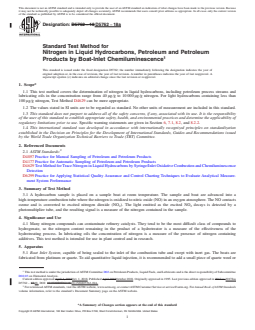
Standard Test Method for Nitrogen in Liquid Hydrocarbons, Petroleum and Petroleum Products by Boat-Inlet Chemiluminescence
SIGNIFICANCE AND USE
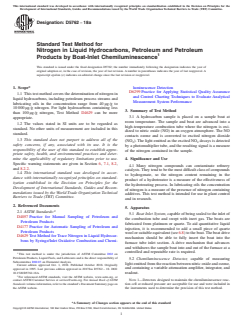
4.1 Many nitrogen compounds can contaminate refinery catalysts. They tend to be the most difficult class of compounds to hydrogenate, so the nitrogen content remaining in the product of a hydrotreator is a measure of the effectiveness of the hydrotreating process. In lubricating oils the concentration of nitrogen is a measure of the presence of nitrogen containing additives. This test method is intended for use in plant control and in research.
SCOPE
1.1 This test method covers the determination of nitrogen in liquid hydrocarbons, including petroleum process streams and lubricating oils in the concentration range from 40 μg/g to 10 000 μg/g nitrogen. For light hydrocarbons containing less than 100 μg/g nitrogen, Test Method D4629 can be more appropriate.
1.2 The values stated in SI units are to be regarded as standard. No other units of measurement are included in this standard.
1.3 This standard does not purport to address all of the safety concerns, if any, associated with its use. It is the responsibility of the user of this standard to establish appropriate safety, health, and environmental practices and determine the applicability of regulatory limitations prior to use. Specific warning statements are given in Section 6, 7.1, 8.2, and 8.2.2.
1.4 This international standard was developed in accordance with internationally recognized principles on standardization established in the Decision on Principles for the Development of International Standards, Guides and Recommendations issued by the World Trade Organization Technical Barriers to Trade (TBT) Committee.
General Information
- Status
- Published
- Publication Date
- 30-Sep-2018
- Technical Committee
- D02 - Petroleum Products, Liquid Fuels, and Lubricants
- Drafting Committee
- D02.03 - Elemental Analysis
Relations
- Effective Date
- 01-Dec-2023
- Effective Date
- 15-Dec-2017
- Effective Date
- 15-Nov-2017
- Effective Date
- 01-Jan-2017
- Effective Date
- 01-Oct-2013
- Refers
ASTM D4057-06(2011) - Standard Practice for Manual Sampling of Petroleum and Petroleum Products - Effective Date
- 01-Jun-2011
- Effective Date
- 01-Jul-2010
- Effective Date
- 01-Mar-2010
- Effective Date
- 01-Mar-2010
- Effective Date
- 01-Nov-2009
- Effective Date
- 15-Apr-2009
- Effective Date
- 15-Oct-2008
- Effective Date
- 01-Jul-2008
- Effective Date
- 01-Nov-2007
- Effective Date
- 01-Nov-2007
Overview
ASTM D5762-18a is the internationally recognized standard test method for determining the nitrogen content in liquid hydrocarbons, including petroleum process streams and lubricating oils. Using boat-inlet chemiluminescence detection, this method accurately quantifies nitrogen concentrations ranging from 40 μg/g to 10,000 μg/g. Developed by ASTM International, this standard is essential for monitoring nitrogen compounds that can impact refinery catalyst performance and for ensuring the quality and performance of petroleum products and lubricating oils.
Key Topics
- Principle: The method involves introducing a hydrocarbon sample into a high-temperature combustion tube, where nitrogen compounds are oxidized to nitric oxide (NO). A chemiluminescence detector measures the light emitted from the reaction between NO and ozone, providing a quantitative measure of nitrogen content.
- Scope and Range: Applicable to a broad spectrum of liquid hydrocarbons, especially relevant to petroleum process streams and lubricant base stocks within the specified concentration range.
- Sampling and Preparation: Precise sampling (manual or automatic) and specimen preparation are critical to maintaining representative analysis and accurate results.
- Calibration and Quality Control: Utilizes calibration standards and quality control samples to ensure reliable results and compliance with laboratory quality assurance systems.
- Precision: The method offers robust repeatability and reproducibility, critical for regulatory compliance and process control.
- Safety and Compliance: Emphasizes the necessity to follow appropriate safety, health, and environmental practices during sample handling, preparation, and analysis.
Applications
- Refinery Catalyst Management: Monitoring nitrogen levels in hydrotreated products helps assess catalyst effectiveness, as nitrogen compounds are among the most challenging impurities to hydrogenate and can poison catalysts.
- Lubricant Quality Assurance: Determines the presence and concentration of nitrogen-containing additives in lubricating oils, ensuring product formulation and performance consistency.
- Process Control and Research: Provides reliable data for plant operations and research laboratories to optimize refining and blending processes, and to ensure that nitrogen specifications are met.
- Compliance Verification: Supports compliance with industry, environmental, and customer nitrogen content requirements in petroleum products.
Related Standards
- ASTM D4629: Test Method for Trace Nitrogen in Liquid Hydrocarbons by Syringe/Inlet Oxidative Combustion and Chemiluminescence Detection, recommended for light hydrocarbons with nitrogen content below 100 μg/g.
- ASTM D4057: Practice for Manual Sampling of Petroleum and Petroleum Products, referenced for proper sample collection.
- ASTM D4177: Practice for Automatic Sampling of Petroleum and Petroleum Products.
- ASTM D6299: Practice for Applying Statistical Quality Assurance and Control Charting Techniques to Evaluate Analytical Measurement System Performance.
Practical Value
Adopting ASTM D5762-18a enhances laboratory confidence in nitrogen analysis, supports high-throughput quality control, and facilitates compliance with both internal standards and external regulations. The chemiluminescence detection method provides sensitive, accurate, and repeatable results indispensable to the petroleum refining and lubrication industries. By adhering to this standard, organizations can better manage catalyst life, product quality, and process efficiency, strengthening overall operational reliability and customer satisfaction.
Keywords: ASTM D5762, nitrogen determination, chemiluminescence, petroleum products, lubricating oils, quality control, refinery process streams, standard test method.
Buy Documents
ASTM D5762-18a - Standard Test Method for Nitrogen in Liquid Hydrocarbons, Petroleum and Petroleum Products by Boat-Inlet Chemiluminescence
REDLINE ASTM D5762-18a - Standard Test Method for Nitrogen in Liquid Hydrocarbons, Petroleum and Petroleum Products by Boat-Inlet Chemiluminescence
Get Certified
Connect with accredited certification bodies for this standard

ABS Quality Evaluations Inc.
American Bureau of Shipping quality certification.

Element Materials Technology
Materials testing and product certification.

ABS Group Brazil
ABS Group certification services in Brazil.
Sponsored listings
Frequently Asked Questions
ASTM D5762-18a is a standard published by ASTM International. Its full title is "Standard Test Method for Nitrogen in Liquid Hydrocarbons, Petroleum and Petroleum Products by Boat-Inlet Chemiluminescence". This standard covers: SIGNIFICANCE AND USE 4.1 Many nitrogen compounds can contaminate refinery catalysts. They tend to be the most difficult class of compounds to hydrogenate, so the nitrogen content remaining in the product of a hydrotreator is a measure of the effectiveness of the hydrotreating process. In lubricating oils the concentration of nitrogen is a measure of the presence of nitrogen containing additives. This test method is intended for use in plant control and in research. SCOPE 1.1 This test method covers the determination of nitrogen in liquid hydrocarbons, including petroleum process streams and lubricating oils in the concentration range from 40 μg/g to 10 000 μg/g nitrogen. For light hydrocarbons containing less than 100 μg/g nitrogen, Test Method D4629 can be more appropriate. 1.2 The values stated in SI units are to be regarded as standard. No other units of measurement are included in this standard. 1.3 This standard does not purport to address all of the safety concerns, if any, associated with its use. It is the responsibility of the user of this standard to establish appropriate safety, health, and environmental practices and determine the applicability of regulatory limitations prior to use. Specific warning statements are given in Section 6, 7.1, 8.2, and 8.2.2. 1.4 This international standard was developed in accordance with internationally recognized principles on standardization established in the Decision on Principles for the Development of International Standards, Guides and Recommendations issued by the World Trade Organization Technical Barriers to Trade (TBT) Committee.
SIGNIFICANCE AND USE 4.1 Many nitrogen compounds can contaminate refinery catalysts. They tend to be the most difficult class of compounds to hydrogenate, so the nitrogen content remaining in the product of a hydrotreator is a measure of the effectiveness of the hydrotreating process. In lubricating oils the concentration of nitrogen is a measure of the presence of nitrogen containing additives. This test method is intended for use in plant control and in research. SCOPE 1.1 This test method covers the determination of nitrogen in liquid hydrocarbons, including petroleum process streams and lubricating oils in the concentration range from 40 μg/g to 10 000 μg/g nitrogen. For light hydrocarbons containing less than 100 μg/g nitrogen, Test Method D4629 can be more appropriate. 1.2 The values stated in SI units are to be regarded as standard. No other units of measurement are included in this standard. 1.3 This standard does not purport to address all of the safety concerns, if any, associated with its use. It is the responsibility of the user of this standard to establish appropriate safety, health, and environmental practices and determine the applicability of regulatory limitations prior to use. Specific warning statements are given in Section 6, 7.1, 8.2, and 8.2.2. 1.4 This international standard was developed in accordance with internationally recognized principles on standardization established in the Decision on Principles for the Development of International Standards, Guides and Recommendations issued by the World Trade Organization Technical Barriers to Trade (TBT) Committee.
ASTM D5762-18a is classified under the following ICS (International Classification for Standards) categories: 75.080 - Petroleum products in general. The ICS classification helps identify the subject area and facilitates finding related standards.
ASTM D5762-18a has the following relationships with other standards: It is inter standard links to ASTM D6299-23a, ASTM D6299-17b, ASTM D6299-17a, ASTM D6299-17, ASTM D6299-13e1, ASTM D4057-06(2011), ASTM D4629-10, ASTM D6299-10e2, ASTM D6299-10, ASTM D6299-09, ASTM D4629-09, ASTM D6299-08, ASTM D4629-08, ASTM D6299-07, ASTM D6299-07e1. Understanding these relationships helps ensure you are using the most current and applicable version of the standard.
ASTM D5762-18a is available in PDF format for immediate download after purchase. The document can be added to your cart and obtained through the secure checkout process. Digital delivery ensures instant access to the complete standard document.
Standards Content (Sample)
This international standard was developed in accordance with internationally recognized principles on standardization established in the Decision on Principles for the
Development of International Standards, Guides and Recommendations issued by the World Trade Organization Technical Barriers to Trade (TBT) Committee.
Designation: D5762 − 18a
Standard Test Method for
Nitrogen in Liquid Hydrocarbons, Petroleum and Petroleum
Products by Boat-Inlet Chemiluminescence
This standard is issued under the fixed designation D5762; the number immediately following the designation indicates the year of
original adoption or, in the case of revision, the year of last revision.Anumber in parentheses indicates the year of last reapproval.A
superscript epsilon (´) indicates an editorial change since the last revision or reapproval.
1. Scope* luminescence Detection
D6299Practice for Applying Statistical Quality Assurance
1.1 Thistestmethodcoversthedeterminationofnitrogenin
and Control Charting Techniques to Evaluate Analytical
liquid hydrocarbons, including petroleum process streams and
Measurement System Performance
lubricating oils in the concentration range from 40µg⁄g to
10000µg⁄g nitrogen. For light hydrocarbons containing less
3. Summary of Test Method
than 100µg⁄g nitrogen, Test Method D4629 can be more
3.1 A hydrocarbon sample is placed on a sample boat at
appropriate.
room temperature. The sample and boat are advanced into a
1.2 The values stated in SI units are to be regarded as
high-temperature combustion tube where the nitrogen is oxi-
standard. No other units of measurement are included in this
dized to nitric oxide (NO) in an oxygen atmosphere. The NO
standard.
contacts ozone and is converted to excited nitrogen dioxide
1.3 This standard does not purport to address all of the
(NO ).ThelightemittedastheexcitedNO decaysisdetected
2 2
safety concerns, if any, associated with its use. It is the
byaphotomultipliertube,andtheresultingsignalisameasure
responsibility of the user of this standard to establish appro-
of the nitrogen contained in the sample.
priate safety, health, and environmental practices and deter-
mine the applicability of regulatory limitations prior to use. 4. Significance and Use
Specific warning statements are given in Section 6, 7.1, 8.2,
4.1 Many nitrogen compounds can contaminate refinery
and 8.2.2.
catalysts.Theytendtobethemostdifficultclassofcompounds
1.4 This international standard was developed in accor-
to hydrogenate, so the nitrogen content remaining in the
dance with internationally recognized principles on standard-
product of a hydrotreator is a measure of the effectiveness of
ization established in the Decision on Principles for the
the hydrotreating process. In lubricating oils the concentration
Development of International Standards, Guides and Recom-
of nitrogen is a measure of the presence of nitrogen containing
mendations issued by the World Trade Organization Technical
additives. This test method is intended for use in plant control
Barriers to Trade (TBT) Committee.
and in research.
2. Referenced Documents
5. Apparatus
2.1 ASTM Standards:
5.1 Boat Inlet System,capableofbeingsealedtotheinletof
D4057Practice for Manual Sampling of Petroleum and
the combustion tube and swept with inert gas. The boats are
Petroleum Products
fabricated from platinum or quartz. To aid quantitative liquid
D4177Practice for Automatic Sampling of Petroleum and
injection, it is recommended to add a small piece of quartz
Petroleum Products
woolorsuitableequivalent(see6.8)totheboat.Theboatdrive
D4629Test Method for Trace Nitrogen in Liquid Hydrocar-
mechanism should be able to fully insert the boat into the
bons by Syringe/Inlet Oxidative Combustion and Chemi-
furnace tube inlet section. A drive mechanism that advances
and withdraws the sample boat into and out of the furnace at a
controlled and repeatable rate is required.
This test method is under the jurisdiction of ASTM Committee D02 on
Petroleum Products, Liquid Fuels, and Lubricants and is the direct responsibility of
5.2 Chemiluminescence Detector, capable of measuring
Subcommittee D02.03 on Elemental Analysis.
lightemittedfromthereactionbetweennitricoxideandozone,
Current edition approved Oct. 1, 2018. Published October 2018. Originally
and containing a variable attenuation amplifier, integrator, and
approved in 1995. Last previous edition approved in 20178as D5762– 18. DOI:
10.1520/D5762-18A.
readout.
For referenced ASTM standards, visit the ASTM website, www.astm.org, or
NOTE 1—Detectors designed to maintain the chemiluminescence reac-
contact ASTM Customer Service at service@astm.org. For Annual Book of ASTM
Standards volume information, refer to the standard’s Document Summary page on tion cell at reduced pressure are acceptable for use and were included in
the ASTM website. the instruments used to determine the precision of this test method.
*A Summary of Changes section appears at the end of this standard
Copyright © ASTM International, 100 Barr Harbor Drive, PO Box C700, West Conshohocken, PA 19428-2959. United States
D5762 − 18a
5.3 Combustion Tube, fabricated from quartz. The inlet end 6.3 Oxidation Catalyst: Cupric Oxide Wire, CuO, or Plati-
ofthetubeshallbelargeenoughtoacceptthesampleboatand num Catalyst, PtAl O , as recommended by the instrument
2 3
tohavesidearmsforintroductionofoxygenandinertgas.The manufacturer.
construction is such that the carrier gases sweep the inlet zone
6.4 Inert Gas—Argon or Helium only, high-purity grade
transporting all of the volatilized sample into a high-
(that is, chromatographic or zero grade), 99.998% minimum
temperature oxidation zone. The oxidation section should be
purity, 5ppm maximum moisture.
large enough to ensure complete oxidation of the sample.
6.5 Anhydrous Magnesium Perchlorate, Mg(ClO ) , for
4 2
5.4 Drier Tube,fortheremovalofwatervapor.Thereaction
drying products of combustion (if permeation drier or chilled
products include water vapor that shall be eliminated prior to
drier is not used). (Warning—Strong oxidizer, irritant.)
measurement by the detector.This can be accomplished with a
6.6 Nitrogen Stock Solution, 500ng nitrogen/µL. See 6.6.1.
magnesium perchlorate, Mg(ClO ) , scrubber, a membrane
4 2
6.6.1 Calibration standards from commercial sources may
drying tube permeation drier, or a chilled dehumidifier assem-
beusediftheyconformtotherequirementsofthetestmethod.
bly.
6.6.2 Volumetric Preparation—Accurately weigh (to the
5.5 Furnace, Electric, held at a temperature sufficient to
nearest 0.1mg) approximately 0.64g of acridine into a tared
pyrolyzeallofthesampleandoxidizethenitrogentoNO.The
100mLvolumetricflask.Addxylenetodissolve,thendiluteto
followingfurnacedesignsmaybeused.Allfurnaceassemblies
volumewithxylene.Calculatethenitrogencontentofthestock
include a method for gas flow control, such as needle valves,
solution to the nearest milligram of nitrogen per litre. This
flow restrictors or mass flow controllers. Furnaces that are
stock can be further diluted to desired nitrogen concentrations.
operated at temperatures below 1050°C shall be capable of
(Warning—Remake standard solutions on a regular basis
switching to 100% oxygen carrier gas flow after the boat has
dependinguponfrequencyofuseandage.Typically,standards
been fully extended into the furnace.
have a useful life of approximately three months.)
5.5.1 Single-zone tube furnace with temperature controller
6.6.3 Gravimetric Preparation—Accurately weigh (to the
capableofmaintainingastablefurnacetemperatureof1100°C
nearest 0.1mg) approximately 0.74g of acridine into a tared
6 25°C.
container. Add xylene to dissolve, then add xylene to an
5.5.2 Two-zone tube furnace with temperature controllers
approximate weight of 100g with xylene. Calculate the nitro-
capable of maintaining the temperature of each furnace zone
gen content of the stock solution to the nearest milligram of
independently from 950°C to 1050°C (see 5.5). Or two-zone
nitrogenperkilogram.Converttheconcentrationtomilligrams
tube furnace equipped with the ability to change to a pure
of nitrogen per litre by multiplying by the density of xylene.
oxygencarriergasflowaftertheboatisfullyextendedintothe
This stock can be further diluted to desired nitrogen concen-
furnaceandtemperaturecontrollerscapableofmaintainingthe
trations. (Warning—Remake standard solutions on a regular
temperature of each furnace zone independently to 950°C.
basis depending upon frequency of use and age. Typically,
5.6 Microlitre Syringe,of5µLor10µLcapacity,capableof
standards have a useful life of approximately three months.)
accurately delivering microlitre quantities.
6.7 Oxygen, high-purity grade (that is, chromatographic or
5.7 Ozone Generator, to supply ozone to the detector
zero grade), 99.75% minimum purity, 5ppm maximum
reaction cell.
moisture, dried over molecular sieves. (Warning—Vigorously
accelerates combustion.)
5.8 Recorder (Optional), for display of chemiluminescence
detector signal.
6.8 Quartz Wool (optional), or other suitable absorbent
materialthatisstableandcapableofwithstandingtemperatures
6. Reagents and Materials
inside the furnace (see Note 2).
6.1 Purity of Reagents—Reagent grade chemicals shall be
NOTE 2—Materials meeting the requirements in 6.8 are recommended
used in all tests. Unless otherwise indicated, it is intended that to be used in sample boats to provide a more uniform injection of the
sample into the boat by wicking any remaining drops of the sample from
all reagents shall conform to the specifications of the Commit-
the tip of the syringe needle prior to introduction of the sample into the
tee onAnalytical Reagents of theAmerican Chemical Society
furnace. Consult instrument manufacturer recommendations for further
where such specifications are available. Other grades may be
guidance.
used, provided it is first ascertained that the reagent is of
6.9 Silver Wool, as recommended by the instrument manu-
sufficiently high purity to permit its use without lessening the
facturer.
accuracy of the determination.
6.10 Xylene. (Warning—Flammable, health hazard.)
6.2 Acridine, C H N, molecular weight 179.21, 7.82% by
13 9
6.11 Calibration Check Sample(s)—portionsofoneormore
mass nitrogen. (Warning—Irritant.)
liquid petroleum or product standards of known nitrogen
content and not used in the generation of the calibration curve.
A calibration check sample or samples shall be used to verify
Reagent Chemicals, American Chemical Society Specifications, American
the validity of the calibration curve as described in Section 10.
Chemical Society, Washington, DC. For Suggestions on the testing of reagents not
listed by the American Chemical Society, see Annual Standards for Laboratory
6.12 Quality Control (QC) Sample(s)—preferably portions
Chemicals, BDH Ltd., Poole, Dorset, U.K., and the United States Pharmacopeia
of one or more liquid petroleum materials that are stable and
and National Formulary, U.S. Pharmacopeial Convention, Inc. (USPC), Rockville,
MD. representative of the samples of interest. These QC samples
D5762 − 18a
can be used to verify that the testing process is in statistical 8.2.3 For the two-zone furnace with the ability to change to
control as described in Section 10. a pure oxygen carrier gas flow after the boat has been fully
extended in to the furnace, adjust the combustion tube gas
7. Sampling flows to the following values: main oxygen, 400mL⁄min 6
40mL⁄min; inlet argon carrier, 0.4L⁄min 6 0.04L⁄min, and
7.1 Obtain a test sample in accordance with Practice D4057
inlet oxygen carrier, 0.4L⁄min 6 0.04L⁄min. Other gas flows
or D4177.(Warning—Samples that are collected at tempera-
may be used if it can be shown that precision and bias are not
tures below room temperature can undergo expansion at
degraded.Settheinletfurnacetemperatureto600°C 625°C,
laboratory temperatures and rupture the container. For such
andtheoutlet(catalyst)temperatureto950°C 625°C.Setthe
samples,donotfillthecontainertothetop.Leavesufficientair
automatic boat control per manufacturer’s instructions.
space above the sample to allow room for expansion.)
8.3 Insert boat into furnace for a minimum of 2min to
(Warning—To minimize loss of volatile components, which
remove any residual nitrogen species.
canbepresentinsometestsamples,donotuncoveranylonger
than necessary. Test samples should be analyzed as soon as
9. Calibration and Standardization
possible after taking from bulk supplies to prevent loss of
9.1 Prepare calibration standards containing 1ng, 5ng,
nitrogen or contamination due to exposure or contact with
10ng, 50ng, and 100ng nitrogen⁄µL in xylene by volumetric
sample container.)
or gravimetric dilution of the 500ng nitrogen/µL nitrogen
7.2 If the test sample is not used immediately, then thor-
stock solution (see 6.6.1).
oughly mix it in its container prior to taking a test specimen.
9.2 Fivemicrolitresofthematerialtobeanalyzed(seeNote
Some test samples require heating in order to thoroughly
3) shall be quantitatively placed in the sample boat for
homogenize.
measurement of chemiluminescence response. There are two
alternative injection procedures available, the volumetric and
8. Preparation of Apparatus
the gravimetric procedures.
8.1 Assemble apparatus in accordance with the manufactur-
NOTE 3—The formation of NO and NO from oxidative combustion of
er’s instructions.
nitrogen containing hydrocarbons is dependent on combustion conditions
such as temperature and oxygen concentration. Injection of a constant
8.2 Adjust the oxygen flow for the ozone generator in
solution volume, and dilution of all test specimens and standards with a
accordance with the manufacturer’s instructions. Adjust the
common solvent, maintain consistent combustion conditions for test
combustiontubegasflowsandthepyrolysistemperaturetothe
specimens and standards.
recommended operating conditions using the following guide-
9.2.1 For volumetric measurement of the material by mi-
lines for each furnace type. (Warning—Ozone is extremely
crolitre syringe, flush the microlitre syringe several times with
toxic. Make sure that appropriate steps are taken to prevent
the material, discarding the flushed liquid each time. Fill the
discharge of ozone within the laboratory work area.)
10µLsyringe to the 5µLlevel. Retract the plunger so that the
8.2.1 For the single-zone furnace without the ability to
lower liquid meniscus falls on the 10% scale mark. When
changetoapureoxygencarriergasflowaftertheboathasbeen
bubbles are present within the liquid column, flush the syringe
fullyextendedintothefurnace,adjustthecombustiontubegas
andwithdrawanewaliquotoftheliquid.Recordthevolumeof
flows to the following values: pyrolysis oxygen, 360mL⁄min
liquid in the syringe. Immed
...
This document is not an ASTM standard and is intended only to provide the user of an ASTM standard an indication of what changes have been made to the previous version. Because
it may not be technically possible to adequately depict all changes accurately, ASTM recommends that users consult prior editions as appropriate. In all cases only the current version
of the standard as published by ASTM is to be considered the official document.
Designation: D5762 − 18 D5762 − 18a
Standard Test Method for
Nitrogen in Liquid Hydrocarbons, Petroleum and Petroleum
Products by Boat-Inlet Chemiluminescence
This standard is issued under the fixed designation D5762; the number immediately following the designation indicates the year of
original adoption or, in the case of revision, the year of last revision. A number in parentheses indicates the year of last reapproval. A
superscript epsilon (´) indicates an editorial change since the last revision or reapproval.
1. Scope*
1.1 This test method covers the determination of nitrogen in liquid hydrocarbons, including petroleum process streams and
lubricating oils in the concentration range from 40 μg ⁄g to 10 000 μg ⁄g nitrogen. For light hydrocarbons containing less than
100 μg ⁄g nitrogen, Test Method D4629 can be more appropriate.
1.2 The values stated in SI units are to be regarded as standard. No other units of measurement are included in this standard.
1.3 This standard does not purport to address all of the safety concerns, if any, associated with its use. It is the responsibility
of the user of this standard to establish appropriate safety, health, and environmental practices and determine the applicability of
regulatory limitations prior to use. Specific warning statements are given in Section 6, 7.1, 8.2, and 8.2.2.
1.4 This international standard was developed in accordance with internationally recognized principles on standardization
established in the Decision on Principles for the Development of International Standards, Guides and Recommendations issued
by the World Trade Organization Technical Barriers to Trade (TBT) Committee.
2. Referenced Documents
2.1 ASTM Standards:
D4057 Practice for Manual Sampling of Petroleum and Petroleum Products
D4177 Practice for Automatic Sampling of Petroleum and Petroleum Products
D4629 Test Method for Trace Nitrogen in Liquid Hydrocarbons by Syringe/Inlet Oxidative Combustion and Chemiluminescence
Detection
D6299 Practice for Applying Statistical Quality Assurance and Control Charting Techniques to Evaluate Analytical Measure-
ment System Performance
3. Summary of Test Method
3.1 A hydrocarbon sample is placed on a sample boat at room temperature. The sample and boat are advanced into a
high-temperature combustion tube where the nitrogen is oxidized to nitric oxide (NO) in an oxygen atmosphere. The NO contacts
ozone and is converted to excited nitrogen dioxide (NO ). The light emitted as the excited NO decays is detected by a
2 2
photomultiplier tube, and the resulting signal is a measure of the nitrogen contained in the sample.
4. Significance and Use
4.1 Many nitrogen compounds can contaminate refinery catalysts. They tend to be the most difficult class of compounds to
hydrogenate, so the nitrogen content remaining in the product of a hydrotreator is a measure of the effectiveness of the
hydrotreating process. In lubricating oils the concentration of nitrogen is a measure of the presence of nitrogen containing
additives. This test method is intended for use in plant control and in research.
5. Apparatus
5.1 Boat Inlet System, capable of being sealed to the inlet of the combustion tube and swept with inert gas. The boats are
fabricated from platinum or quartz. To aid quantitative liquid injection, it is recommended to add a small piece of quartz wool or
This test method is under the jurisdiction of ASTM Committee D02 on Petroleum Products, Liquid Fuels, and Lubricants and is the direct responsibility of Subcommittee
D02.03 on Elemental Analysis.
Current edition approved April 1, 2018Oct. 1, 2018. Published April 2018October 2018. Originally approved in 1995. Last previous edition approved in 2017 as 20178as
D5762 – 17.18. DOI: 10.1520/D5762-18.10.1520/D5762-18A.
For referenced ASTM standards, visit the ASTM website, www.astm.org, or contact ASTM Customer Service at service@astm.org. For Annual Book of ASTM Standards
volume information, refer to the standard’s Document Summary page on the ASTM website.
*A Summary of Changes section appears at the end of this standard
Copyright © ASTM International, 100 Barr Harbor Drive, PO Box C700, West Conshohocken, PA 19428-2959. United States
D5762 − 18a
suitable equivalent (see 6.8) to the boat. The boat drive mechanism should be able to fully insert the boat into the furnace tube
inlet section. A drive mechanism that advances and withdraws the sample boat into and out of the furnace at a controlled and
repeatable rate is required.
5.2 Chemiluminescence Detector, capable of measuring light emitted from the reaction between nitric oxide and ozone, and
containing a variable attenuation amplifier, integrator, and readout.
NOTE 1—Detectors designed to maintain the chemiluminescence reaction cell at reduced pressure are acceptable for use and were included in the
instruments used to determine the precision of this test method.
5.3 Combustion Tube, fabricated from quartz. The inlet end of the tube shall be large enough to accept the sample boat and to
have side arms for introduction of oxygen and inert gas. The construction is such that the carrier gases sweep the inlet zone
transporting all of the volatilized sample into a high-temperature oxidation zone. The oxidation section should be large enough to
ensure complete oxidation of the sample.
5.4 Drier Tube, for the removal of water vapor. The reaction products include water vapor that shall be eliminated prior to
measurement by the detector. This can be accomplished with a magnesium perchlorate, Mg(ClO ) , scrubber, a membrane drying
4 2
tube permeation drier, or a chilled dehumidifier assembly.
5.5 Furnace, Electric, held at a temperature sufficient to pyrolyze all of the sample and oxidize the nitrogen to NO. The
following furnace designs may be used. All furnace assemblies include a method for gas flow control, such as needle valves, flow
restrictors or mass flow controllers. Furnaces that are operated at temperatures below 1050 °C shall be capable of switching to
100 % oxygen carrier gas flow after the boat has been fully extended into the furnace.
5.5.1 Single-zone tube furnace with temperature controller capable of maintaining a stable furnace temperature of 1100 °C 6
25 °C.
5.5.2 Two-zone tube furnace with temperature controllers capable of maintaining the temperature of each furnace zone
independently from 950 °C to 1050 °C (see 5.5). Or two-zone tube furnace equipped with the ability to change to a pure oxygen
carrier gas flow after the boat is fully extended in to the furnace and temperature controllers capable of maintaining the temperature
of each furnace zone independently to 950 °C.
5.6 Microlitre Syringe, of 5 μL or 10 μL capacity, capable of accurately delivering microlitre quantities.
5.7 Ozone Generator, to supply ozone to the detector reaction cell.
5.8 Recorder (Optional), for display of chemiluminescence detector signal.
6. Reagents and Materials
6.1 Purity of Reagents—Reagent grade chemicals shall be used in all tests. Unless otherwise indicated, it is intended that all
reagents shall conform to the specifications of the Committee on Analytical Reagents of the American Chemical Society where
such specifications are available. Other grades may be used, provided it is first ascertained that the reagent is of sufficiently high
purity to permit its use without lessening the accuracy of the determination.
6.2 Acridine, C H N, molecular weight 179.21, 7.82 % by mass nitrogen. (Warning—Irritant.)
13 9
6.3 Oxidation Catalyst: Cupric Oxide Wire, CuO, or Platinum Catalyst, PtAl O , as recommended by the instrument
2 3
manufacturer.
6.4 Inert Gas—Argon or Helium only, high-purity grade (that is, chromatographic or zero grade), 99.998 % minimum purity,
5 ppm maximum moisture.
6.5 Anhydrous Magnesium Perchlorate, Mg(ClO ) , for drying products of combustion (if permeation drier or chilled drier is
4 2
not used). (Warning—Strong oxidizer, irritant.)
6.6 Nitrogen Stock Solution, 500 ng nitrogen/μL. See 6.6.1.
6.6.1 Calibration standards from commercial sources may be used if they conform to the requirements of the test method.
6.6.2 Volumetric Preparation—Accurately weigh (to the nearest 0.1 mg) approximately 0.64 g of acridine into a tared 100 mL
volumetric flask. Add xylene to dissolve, then dilute to volume with xylene. Calculate the nitrogen content of the stock solution
to the nearest milligram of nitrogen per litre. This stock can be further diluted to desired nitrogen concentrations. (Warning—
Remake standard solutions on a regular basis depending upon frequency of use and age. Typically, standards have a useful life of
approximately three months.)
6.6.3 Gravimetric Preparation—Accurately weigh (to the nearest 0.1 mg) approximately 0.74 g of acridine into a tared
container. Add xylene to dissolve, then add xylene to an approximate weight of 100 g with xylene. Calculate the nitrogen content
of the stock solution to the nearest milligram of nitrogen per kilogram. Convert the concentration to milligrams of nitrogen per
Reagent Chemicals, American Chemical Society Specifications, American Chemical Society, Washington, DC. For Suggestions on the testing of reagents not listed by
the American Chemical Society, see Annual Standards for Laboratory Chemicals, BDH Ltd., Poole, Dorset, U.K., and the United States Pharmacopeia and National
Formulary, U.S. Pharmacopeial Convention, Inc. (USPC), Rockville, MD.
D5762 − 18a
litre by multiplying by the density of xylene. This stock can be further diluted to desired nitrogen concentrations.
(Warning—Remake standard solutions on a regular basis depending upon frequency of use and age. Typically, standards have a
useful life of approximately three months.)
6.7 Oxygen, high-purity grade (that is, chromatographic or zero grade), 99.75 % minimum purity, 5 ppm maximum moisture,
dried over molecular sieves. (Warning—Vigorously accelerates combustion.)
6.8 Quartz Wool (optional), or other suitable absorbent material that is stable and capable of withstanding temperatures inside
the furnace (see Note 2).
NOTE 2—Materials meeting the requirements in 6.8 are recommended to be used in sample boats to provide a more uniform injection of the sample
into the boat by wicking any remaining drops of the sample from the tip of the syringe needle prior to introduction of the sample into the furnace. Consult
instrument manufacturer recommendations for further guidance.
6.9 Silver Wool, as recommended by the instrument manufacturer.
6.10 Xylene. (Warning—Flammable, health hazard.)
6.11 Calibration Check Sample(s)—portions of one or more liquid petroleum or product standards of known nitrogen content
and not used in the generation of the calibration curve. A calibration check sample or samples shall be used to verify the validity
of the calibration curve as described in Section 10.
6.12 Quality Control (QC) Sample(s)—preferably portions of one or more liquid petroleum materials that are stable and
representative of the samples of interest. These QC samples can be used to verify that the testing process is in statistical control
as described in Section 10.
7. Sampling
7.1 Obtain a test sample in accordance with Practice D4057 or D4177. (Warning—Samples that are collected at temperatures
below room temperature can undergo expansion at laboratory temperatures and rupture the container. For such samples, do not fill
the container to the top. Leave sufficient air space above the sample to allow room for expansion.) (Warning—To minimize loss
of volatile components, which can be present in some test samples, do not uncover any longer than necessary. Test samples should
be analyzed as soon as possible after taking from bulk supplies to prevent loss of nitrogen or contamination due to exposure or
contact with sample container.)
7.2 If the test sample is not used immediately, then thoroughly mix it in its container prior to taking a test specimen. Some test
samples require heating in order to thoroughly homogenize.
8. Preparation of Apparatus
8.1 Assemble apparatus in accordance with the manufacturer’s instructions.
8.2 Adjust the oxygen flow for the ozone generator in accordance with the manufacturer’s instructions. Adjust the combustion
tube gas flows and the pyrolysis temperature to the recommended operating conditions using the following guidelines for each
furnace type. (Warning—Ozone is extremely toxic. Make sure that appropriate steps are taken to prevent discharge of ozone
within the laboratory work area.)
8.2.1 For the single-zone furnace without the ability to change to a pure oxygen carrier gas flow after the boat has been fully
extended into the furnace, adjust the combustion tube gas flows to the following values: pyrolysis oxygen, 360 mL ⁄min 6
36 mL ⁄min; inlet oxygen, 60 mL ⁄min 6 6 mL ⁄min; and inert carrier inlet, 155 mL ⁄min 6 15 mL ⁄min. Other gas flows may be
used if it can be shown that precision and bias are not degraded. Set the furnace temperature to 1100 °C 6 25 °C. Adjust the boat
drive mechanism to obtain a drive rate of 150 mm ⁄min 6 10 mm ⁄min. Refer to the manufacturer’s instructions for descriptions
of these settings.
8.2.2 For the two-zone furnace without the ability to change to a pure oxygen carrier gas flow after the boat has been fully
extended into the furnace, adjust the combustion tube gas flows to the following values: combustion oxygen, 165 mL ⁄min
616 mL ⁄min; inlet inert carrier, 85 mL ⁄min 6 9 mL ⁄min; and boat inert carrier, 50 mL ⁄min 6 5 mL ⁄min. Other gas flows may
be used if it can be shown that precision and bias are not degraded. Set the inlet furnace temperature to 1050 °C 6 25 °C, and the
outlet furnace temperature to 925 °C 6 25 °C. Adjust the boat drive mechanism to obtain a drive rate of 150 mm ⁄min 6
10 mm ⁄min (boat speed number 4). Refer to the manufacturer’s instructions for the description of these settings. (Warning—High
temperature is employed in this test method. Use flammable materials with care near the pyrolysis furnace.)
8.2.3 For the two-zone furnace with the ability to change to a pure oxygen carrier gas flow after the boat has been fully extended
in to the furnace, adjust the combustion tube gas flows to the following values: main oxygen, 400 mL ⁄min 6 40 mL ⁄min; inlet
argon carrier, 0.4 L ⁄min 6 0.04 L ⁄min, and inlet oxygen carrier, 0.4 L ⁄min 6 0.04 L ⁄min. Other gas flows may be used if it can
be shown that precision and bias are not degraded. Set the inlet furnace temperature to 600 °C 6 25 °C, and the outlet (catalyst)
temperature to 950 °C 6 25 °C. Set the automatic boat control as follows: 1 Fuc FWD 125 speed 10 time 30, 2 Fuc 285 speed
05 time 30, 5 Fuc time 30, 6 Fuc time 90, A Fuc time 60. Refer to manufacturer’s instructions for a description of these settings.per
manufacturer’s instructions.
...
Questions, Comments and Discussion
Ask us and Technical Secretary will try to provide an answer. You can facilitate discussion about the standard in here.
Loading comments...