

ASTM D8528-24
(Test Method)Standard Test Method for Determination of Fluoride and Glycol Degradation Products in Engine Coolants by Ion Chromatography
General Information
- Abstract
SIGNIFICANCE AND USE
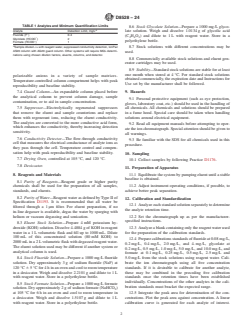
5.1 This test method is for the quantitative determination of fluoride and glycol degradation products in engine coolants. By this method, analysis can be performed directly without pretreatment, other than dilution, as required by the linear ranges of the equipment. Table 1 indicates applicable analytes and approximate detection limits. (A) Sample diluted 1/10 with reagent water, suppressed conductivity detection, IonPac AS20 column with AG20 guard column. Other systems will require MQL determinations using chosen dilution factors, eluents, columns, and detector.
SCOPE
1.1 This test method covers the determination of fluoride in engine coolants by ion chromatography. Several glycol degradation products (different carboxylates including, but not limited to, formate and glycolate) can be determined by this test method.
1.2 This test method applies to both new and used engine coolants.
1.3 The values stated in SI units are to be regarded as standard. No other units of measurement are included in this standard.
1.4 This standard does not purport to address all of the safety concerns, if any, associated with its use. It is the responsibility of the user of this standard to establish appropriate safety, health, and environmental practices and determine the applicability of regulatory limitations prior to use.
1.5 This international standard was developed in accordance with internationally recognized principles on standardization established in the Decision on Principles for the Development of International Standards, Guides and Recommendations issued by the World Trade Organization Technical Barriers to Trade (TBT) Committee.
- Status
- Published
- Publication Date
- 31-Dec-2023
- Technical Committee
- D15 - Engine Coolants and Related Fluids
- Drafting Committee
- D15.04 - Chemical Properties

Overview
ASTM D8528-24 - Standard Test Method for Determination of Fluoride and Glycol Degradation Products in Engine Coolants by Ion Chromatography - is a critical international standard developed by ASTM for the quantitative analysis of fluoride and glycol degradation products, including formate and glycolate, in both new and used engine coolants. This method uses ion chromatography with conductivity detection to provide accurate, direct results with minimal sample pretreatment aside from dilution.
Complying with this method ensures reliable determination of potentially harmful byproducts in coolant fluids, supporting quality control, maintenance, and regulatory compliance in automotive and industrial applications.
Key Topics
- Scope and Purpose:
- Covers the analysis of fluoride and multiple glycol degradation products in engine coolants.
- Applicable to both new and used (service-aged) coolants.
- Uses ion chromatography, a widely recognized analytical technique.
- Sample Preparation:
- Minimal sample pretreatment is required; only dilution based on expected analyte concentration.
- Dilution factors are selected according to the equipment’s linear range and target analyte levels.
- Analyte Detection Limits:
- Fluoride: as low as 0.4 mg/L
- Formate: 1 mg/L
- Glycolate: 2 mg/L
- Instrumentation and Materials:
- High-capacity hydroxide-selective anion exchange column and guard column.
- Conductivity detector with suppressor for enhanced sensitivity.
- Calibration through standard solutions to ensure result integrity.
- Quality Control:
- Use of procedural blanks, calibration standards, instrument checks, and optional matrix spikes to confirm data validity.
- Reporting Results:
- Results typically expressed in mg/L or μg/g, with conversion based on sample density if required.
Applications
- Automotive Industry:
- Supports the maintenance and manufacturing quality control of vehicle cooling systems.
- Helps detect breakdown products that may impact coolant performance and engine lifespan.
- Industrial Engine Maintenance:
- Enables on-site or laboratory monitoring of coolant health in heavy-duty and stationary engines.
- Provides critical information for preventive maintenance and troubleshooting.
- Laboratory Analysis Services:
- Used by analytical laboratories performing routine testing or research on coolant formulations.
- Regulatory and Environmental Compliance:
- Facilitates documentation and compliance with international quality and environmental guidelines for chemical mixtures in coolants.
Related Standards
- ASTM D1176: Practice for Sampling and Preparing Aqueous Solutions of Engine Coolants or Antirusts for Testing Purposes
- ASTM D1193: Specification for Reagent Water, defining water purity required for test accuracy
- ASTM E177: Practice for Use of the Terms Precision and Bias in ASTM Test Methods
- ASTM E691: Practice for Conducting an Interlaboratory Study to Determine the Precision of a Test Method
By adhering to ASTM D8528-24, organizations ensure the reliable detection of fluoride and glycol degradation products in engine coolants, thereby enhancing product quality, performance, and compliance. This standard is essential for professionals in engine manufacturing, maintenance, and laboratory analysis, assuring confidence in coolant monitoring and safeguarding engine systems against degradation from chemical byproducts. For further information, consult the full text of ASTM D8528-24 or related ASTM standards.
Frequently Asked Questions
ASTM D8528-24 is a standard published by ASTM International. Its full title is "Standard Test Method for Determination of Fluoride and Glycol Degradation Products in Engine Coolants by Ion Chromatography". This standard covers: SIGNIFICANCE AND USE 5.1 This test method is for the quantitative determination of fluoride and glycol degradation products in engine coolants. By this method, analysis can be performed directly without pretreatment, other than dilution, as required by the linear ranges of the equipment. Table 1 indicates applicable analytes and approximate detection limits. (A) Sample diluted 1/10 with reagent water, suppressed conductivity detection, IonPac AS20 column with AG20 guard column. Other systems will require MQL determinations using chosen dilution factors, eluents, columns, and detector. SCOPE 1.1 This test method covers the determination of fluoride in engine coolants by ion chromatography. Several glycol degradation products (different carboxylates including, but not limited to, formate and glycolate) can be determined by this test method. 1.2 This test method applies to both new and used engine coolants. 1.3 The values stated in SI units are to be regarded as standard. No other units of measurement are included in this standard. 1.4 This standard does not purport to address all of the safety concerns, if any, associated with its use. It is the responsibility of the user of this standard to establish appropriate safety, health, and environmental practices and determine the applicability of regulatory limitations prior to use. 1.5 This international standard was developed in accordance with internationally recognized principles on standardization established in the Decision on Principles for the Development of International Standards, Guides and Recommendations issued by the World Trade Organization Technical Barriers to Trade (TBT) Committee.
SIGNIFICANCE AND USE 5.1 This test method is for the quantitative determination of fluoride and glycol degradation products in engine coolants. By this method, analysis can be performed directly without pretreatment, other than dilution, as required by the linear ranges of the equipment. Table 1 indicates applicable analytes and approximate detection limits. (A) Sample diluted 1/10 with reagent water, suppressed conductivity detection, IonPac AS20 column with AG20 guard column. Other systems will require MQL determinations using chosen dilution factors, eluents, columns, and detector. SCOPE 1.1 This test method covers the determination of fluoride in engine coolants by ion chromatography. Several glycol degradation products (different carboxylates including, but not limited to, formate and glycolate) can be determined by this test method. 1.2 This test method applies to both new and used engine coolants. 1.3 The values stated in SI units are to be regarded as standard. No other units of measurement are included in this standard. 1.4 This standard does not purport to address all of the safety concerns, if any, associated with its use. It is the responsibility of the user of this standard to establish appropriate safety, health, and environmental practices and determine the applicability of regulatory limitations prior to use. 1.5 This international standard was developed in accordance with internationally recognized principles on standardization established in the Decision on Principles for the Development of International Standards, Guides and Recommendations issued by the World Trade Organization Technical Barriers to Trade (TBT) Committee.
ASTM D8528-24 is available in PDF format for immediate download after purchase. The document can be added to your cart and obtained through the secure checkout process. Digital delivery ensures instant access to the complete standard document.
Standards Content (Sample)
This international standard was developed in accordance with internationally recognized principles on standardization established in the Decision on Principles for the
Development of International Standards, Guides and Recommendations issued by the World Trade Organization Technical Barriers to Trade (TBT) Committee.
Designation: D8528 − 24
Standard Test Method for
Determination of Fluoride and Glycol Degradation Products
in Engine Coolants by Ion Chromatography
This standard is issued under the fixed designation D8528; the number immediately following the designation indicates the year of
original adoption or, in the case of revision, the year of last revision. A number in parentheses indicates the year of last reapproval. A
superscript epsilon (´) indicates an editorial change since the last revision or reapproval.
1. Scope 3. Terminology
1.1 This test method covers the determination of fluoride in 3.1 Definitions:
engine coolants by ion chromatography. Several glycol degra- 3.1.1 eluent, n—solution used to carry sample material
dation products (different carboxylates including, but not through an ion chromatography system.
limited to, formate and glycolate) can be determined by this
4. Summary of Test Method
test method.
4.1 A prepared sample is pumped through analytical col-
1.2 This test method applies to both new and used engine
umns and a suppressor into a conductivity detector. Analytes
coolants.
are separated based on their interaction with the stationary
1.3 The values stated in SI units are to be regarded as
phase (column resin) and mobile phase (eluent). The suppres-
standard. No other units of measurement are included in this
sor increases the sensitivity of the method by both increasing
standard.
the conductivity of the analytes and decreasing the conductiv-
1.4 This standard does not purport to address all of the
ity of the eluent. Analytes are quantitated by the integration of
safety concerns, if any, associated with its use. It is the
their conductivity compared with a calibration curve.
responsibility of the user of this standard to establish appro-
5. Significance and Use
priate safety, health, and environmental practices and deter-
mine the applicability of regulatory limitations prior to use.
5.1 This test method is for the quantitative determination of
1.5 This international standard was developed in accor-
fluoride and glycol degradation products in engine coolants. By
dance with internationally recognized principles on standard-
this method, analysis can be performed directly without
ization established in the Decision on Principles for the
pretreatment, other than dilution, as required by the linear
Development of International Standards, Guides and Recom-
ranges of the equipment. Table 1 indicates applicable analytes
mendations issued by the World Trade Organization Technical
and approximate detection limits.
Barriers to Trade (TBT) Committee.
6. Interferences
2. Referenced Documents
6.1 Method interferences can be caused by chemicals with
2.1 ASTM Standards:
similar retention times, especially if they are in high concen-
D1176 Practice for Sampling and Preparing Aqueous Solu-
tration compared to the analyte of interest. Sample dilution will
tions of Engine Coolants or Antirusts for Testing Purposes
be used to minimize or solve most interference problems.
D1193 Specification for Reagent Water
6.2 Cross-contamination interferences can be caused by the
E177 Practice for Use of the Terms Precision and Bias in
contamination of glassware, eluent, reagents, etc. Great care
ASTM Test Methods
must be taken to ensure that these interferences are kept at the
E691 Practice for Conducting an Interlaboratory Study to
lowest possible levels.
Determine the Precision of a Test Method
7. Apparatus
7.1 Analytical Balance, capable of measuring to the nearest
This test method is under the jurisdiction of ASTM Committee D15 on Engine
0.0001 g.
Coolants and Related Fluids and is the direct responsibility of Subcommittee
D15.04 on Chemical Properties.
7.2 Ion Chromatograph—Analytical system with all re-
Current edition approved Jan. 1, 2024. Published January 2024. DOI: 10.1520/
quired accessories. Column life and performance are improved
D8528-23.
For referenced ASTM standards, visit the ASTM website, www.astm.org, or by the use of a gradient pump, if available.
contact ASTM Customer Service at service@astm.org. For Annual Book of ASTM
7.3 Analytical Column—A high-capacity, hydroxide selec-
Standards volume information, refer to the standard’s Document Summary page on
the ASTM website. tive anion exchange column designed for the separation of
Copyright © ASTM International, 100 Barr Harbor Drive, PO Box C700, West Conshohocken, PA 19428-2959. United States
D8528 − 24
TABLE 1 Analytes and Minimum Quantification Limits
8.6 Stock Glycolate Solution—Prepare a 1000 mg ⁄L glyco-
A
Analyte Detection Limit, mg/L late solution. Weigh and dissolve 1.0134 g of glycolic acid
–
Fluoride (F ) 0.4
(C H O ) and dilute to 1 L with reagent water. Store in a
– 2 4 3
Glycolate (HCOO ) 2
– polyethylene bottle.
Formate (HCOO ) 1
A
Sample diluted ⁄10 with reagent water, suppressed conductivity detection, IonPac 8.7 Stock solutions with different concentrations may be
AS20 column with AG20 guard column. Other systems will require MQL determi-
used.
nations using chosen dilution factors, eluents, columns, and detector.
8.8 Commercially available stock solutions and eluent gen-
erator cartridges may be used.
8.9 Stability—Standard stock solutions are stable for at least
one month when stored at 4 °C. For standard stock solutions
polarizable anions in a variety of sample matrices.
obtained commercially, the expiration date and Instructions for
Temperature-controlled column compartment helps with peak
Use set by the manufacturer shall be followed.
reproducibility and baseline stability.
7.4 Guard Column—An expandable column placed before 9. Hazards
the analytical column to prevent column damage, sample
9.1 Personal protective equipment (such as eye protection,
contamination, or to aid in sample concentration.
gloves, laboratory coat, etc.) should be used in the handling of
7.5 Suppressor—Electrolytically regenerated suppressors
all chemicals. All chemicals and solutions should be prepared
that remove the eluent and sample counterions and replace in a fume hood. Special care should be taken when handling
them with regenerant ions, reducing the eluent conductivity.
solutions around electrical equipment.
The analytes are converted to the more conductive acid form,
9.2 Read all equipment manuals before attempting to oper-
which enhances the conductivity, thereby increasing detection
ate the ion chromatograph. Special attention should be given to
sensitivity.
all warnings.
7.6 Conductivity Detector—The flow-through conductivity
9.3 Be familiar with the SDS for all chemicals used in this
cell that measures the electrical conductance of analyte ions as
procedure.
they pass through the cell. Temperature control and compen-
sation help with peak reproducibility and baseline stability.
10. Sampling
7.7 Drying Oven, controlled at 105 °C, and 120 °C.
10.1 Collect samples by following Practice D1176.
7.8 Desiccator.
11. Preparation of Apparatus
11.1 Equilibrate the system by pumping eluent until a stable
8. Reagents and Materials
baseline is obtained.
8.1 Purity of Reagents—Reagent grade or higher purity
11.2 Adjust instrument operating conditions, if possible, to
chemicals
...